Adhyaya 4
Satī at Dakṣa’s Sacrifice: Condemnation of Blasphemy and Voluntary Departure by Yoga-Fire
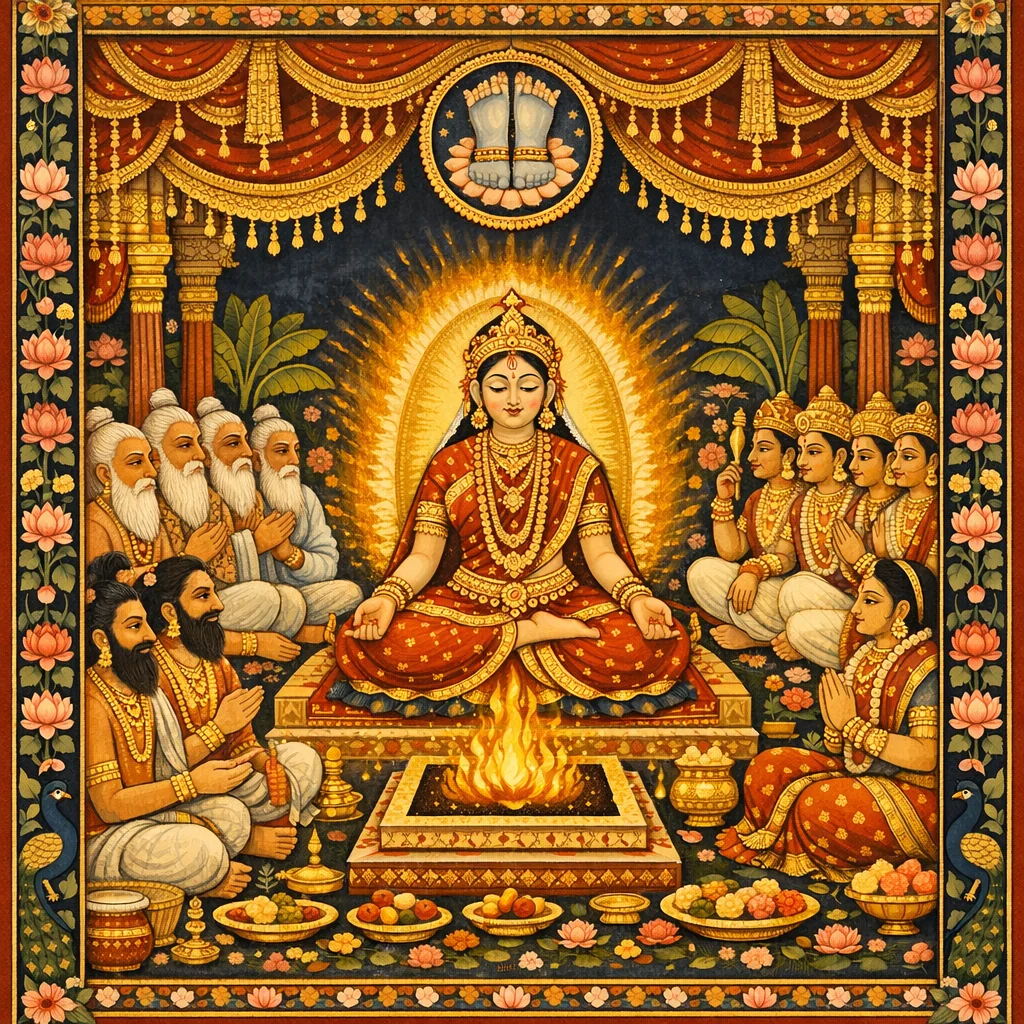
After Lord Śiva warns Satī of Dakṣa’s hostile mind, she wavers between filial love and obedience to her husband. Overcome by longing and grief, she goes to her father’s yajña despite Śiva’s counsel, escorted by Śiva’s gaṇas with royal-like paraphernalia. In the sacrificial arena she finds the assembly cowed by Dakṣa; only her mother and sisters welcome her, while Dakṣa pointedly neglects her and grants no offering-share to Śiva. Satī’s sorrow turns to righteous fury: she condemns proud, fruit-seeking ritualism, defends Śiva’s spotless purity, and declares the dharmic response to blasphemy against the Lord and the master of religion. Ashamed to bear a body received from an offender, she sits facing north, enters yogic concentration, meditates on Śiva’s lotus feet, and burns her body by inner fire. The universe resounds; onlookers lament Dakṣa’s hard-heartedness. Śiva’s attendants attempt retaliation, but Bhṛgu invokes Yajur-mantras; the Ṛbhus appear and rout the gaṇas, setting the stage for the next chapter’s escalation toward the destruction of Dakṣa’s sacrifice and the cosmic repercussions of Satī’s death.
Shlokas
Verse 1
मैत्रेय उवाच एतावदुक्त्वा विरराम शङ्कर: पत्न्यङ्गनाशं ह्युभयत्र चिन्तयन् । सुहृद्दिदृक्षु: परिशङ्किता भवान् निष्क्रामती निर्विशती द्विधास सा ॥ १ ॥
Maitreya said: Having spoken thus, Śaṅkara fell silent, pondering Satī’s fate on both sides. Satī longed to see her kinsmen at her father’s house, yet feared Bhavān’s warning; her mind wavering, she moved in and out like a swing swaying to and fro.
Verse 2
सुहृद्दिदृक्षाप्रतिघातदुर्मना: स्नेहाद्रुदत्यश्रुकलातिविह्वला । भवं भवान्यप्रतिपूरुषं रुषा प्रधक्ष्यतीवैक्षत जातवेपथु: ॥ २ ॥
Satī grew despondent when her wish to see her kinsmen was thwarted; out of affection she wept, overwhelmed by tears. Trembling, she looked upon her incomparable husband, Bhava (Śiva), in anger, as if she would scorch him with her gaze.
Verse 3
ततो विनि:श्वस्य सती विहाय तं शोकेन रोषेण च दूयता हृदा । पित्रोरगात्स्त्रैणविमूढधीर्गृहान् प्रेम्णात्मनो योऽर्धमदात्सतां प्रिय: ॥ ३ ॥
Thereafter Satī, heaving deep sighs, her heart scorched by grief and anger, left Śaṅkara—the beloved of the saintly, who out of love had given her half his own body—and went to her father’s home; her judgment, clouded by feminine weakness, led her to this unwise act.
Verse 4
तामन्वगच्छन् द्रुतविक्रमां सतीम् एकां त्रिनेत्रानुचरा: सहस्रश: । सपार्षदयक्षा मणिमन्मदादय: पुरोवृषेन्द्रास्तरसा गतव्यथा: ॥ ४ ॥
Seeing Satī depart alone with swift strides, thousands of attendants of Tri-netra Śiva—led by Maṇimān, Mada, and others—together with Yakṣas and companions, hurried after her, with the bull Nandī going in front.
Verse 5
तां सारिकाकन्दुकदर्पणाम्बुज श्वेतातपत्रव्यजनस्रगादिभि: । गीतायनैर्दुन्दुभिशङ्खवेणुभि- र्वृषेन्द्रमारोप्य विटङ्किता ययु: ॥ ५ ॥
They seated Satī upon the back of a bull and provided her with her pet bird, a ball, a mirror, a lotus, a great white canopy, fans, garlands, and other articles for her pleasure. With a party of singers and the resounding of drums, conchshells, and horns, the procession moved forth as grandly as a royal parade.
Verse 6
आब्रह्मघोषोर्जितयज्ञवैशसं विप्रर्षिजुष्टं विबुधैश्च सर्वश: । मृद्दार्वय:काञ्चनदर्भचर्मभि- र्निसृष्टभाण्डं यजनं समाविशत् ॥ ६ ॥
She then reached her father’s home, where the yajña was being performed, and entered the sacrificial arena resounding with brahma-ghoṣa—the chanting of Vedic hymns. Brāhmaṇas, great ṛṣis, and the devas were assembled on all sides; there were sacrificial animals and vessels made of clay, wood, stone/metal, gold, darbha grass, and skin—everything required for the rite.
Verse 7
तामागतां तत्र न कश्चनाद्रियद् विमानितां यज्ञकृतो भयाज्जन: । ऋते स्वसृर्वै जननीं च सादरा: प्रेमाश्रुकण्ठ्य: परिषस्वजुर्मुदा ॥ ७ ॥
When Satī arrived at the sacrificial arena with her followers, out of fear of Dakṣa none of those assembled received her with due honor. Only her mother and sisters came forward respectfully; their throats choked with tears of love, they embraced her in joy and spoke to her with gentle, pleasing words.
Verse 8
सौदर्यसम्प्रश्नसमर्थवार्तया मात्रा च मातृष्वसृभिश्च सादरम् । दत्तां सपर्यां वरमासनं च सा नादत्त पित्राप्रतिनन्दिता सती ॥ ८ ॥
Though her mother, sisters, and maternal aunts received her with respect—asking after her welfare and offering a fine seat and gifts—Satī gave no reply and accepted nothing, for her father neither greeted her nor welcomed her with words of care.
Verse 9
अरुद्रभागं तमवेक्ष्य चाध्वरं पित्रा च देवे कृतहेलनं विभौ । अनादृता यज्ञसदस्यधीश्वरी चुकोप लोकानिव धक्ष्यती रुषा ॥ ९ ॥
In the sacrificial arena Satī saw that no oblation was set aside for Rudra, and she understood that her father had slighted the all-powerful Lord Śiva; moreover, Dakṣa did not even honor her. Thus Satī, presiding over the yajña assembly, blazed with anger and looked upon her father as if to burn him with her eyes.
Verse 10
जगर्ह सामर्षविपन्नया गिरा शिवद्विषं धूमपथश्रमस्मयम् । स्वतेजसा भूतगणान्समुत्थितान् निगृह्य देवी जगतोऽभिशृण्वत: ॥ १० ॥
Overcome with anger and grief, Satī rebuked Dakṣa with fierce words—he who hated Śiva and took pride in troublesome, smoke-laden sacrifices. Śiva’s bhūtas rose to strike Dakṣa, but the Goddess restrained them by her own power and, before all who listened, openly condemned her father.
Verse 11
देव्युवाच न यस्य लोकेऽस्त्यतिशायन: प्रिय- स्तथाप्रियो देहभृतां प्रियात्मन: । तस्मिन्समस्तात्मनि मुक्तवैरके ऋते भवन्तं कतम: प्रतीपयेत् ॥ ११ ॥
The blessed Goddess said: Among all embodied beings, none is more beloved than Lord Śiva, and he has no rival. He favors none as an exclusive dear one, nor does he hold any enemy; he is the Self of all and free from enmity. Who but you could oppose such a universal being with envy?
Verse 12
दोषान् परेषां हि गुणेषु साधवो गृह्णन्ति केचिन्न भवादृशो द्विज । गुणांश्च फल्गून् बहुलीकरिष्णवो महत्तमास्तेष्वविदद्भवानघम् ॥ १२ ॥
O Dakṣa, twice-born! The saintly do not seize upon faults within another’s virtues; even a small good quality they greatly magnify. But a man like you searches for defects even in the good qualities of others. Alas, you have found fault even with so great a soul as Śiva.
Verse 13
नाश्चर्यमेतद्यदसत्सु सर्वदा महद्विनिन्दा कुणपात्मवादिषु । सेर्ष्यं महापूरुषपादपांसुभि- र्निरस्ततेज:सु तदेव शोभनम् ॥ १३ ॥
It is no wonder that those who take the perishable body to be the self continually deride great souls. The envy of such materialists is itself the cause of their downfall, for by the dust of the feet of the mahāpuruṣas their splendor is cast down—thus it is fitting.
Verse 14
यद्वयक्षरं नाम गिरेरितं नृणां सकृत्प्रसङ्गादघमाशु हन्ति तत् । पवित्रकीर्तिं तमलङ्घ्यशासनं भवानहो द्वेष्टि शिवं शिवेतर: ॥ १४ ॥
My father, by envying Lord Śiva you commit the gravest offense. His name, of two syllables—śi and va—when uttered even once in holy association, swiftly destroys sin. His fame is purifying and his command is never transgressed; yet you alone hate Śiva, the ever-pure.
Verse 15
यत्पादपद्मं महतां मनोऽलिभि- र्निषेवितं ब्रह्मरसासवार्थिभि: । लोकस्य यद्वर्षति चाशिषोऽर्थिन- स्तस्मै भवान्द्रुह्यति विश्वबन्धवे ॥ १५ ॥
You envy Lord Śiva, the friend of all living beings within the three worlds. His lotus feet are served by the bees of the minds of the great, who seek the nectar of brahmānanda. For ordinary people he showers desired boons as blessings—yet against that Friend of the universe you act with malice.
Verse 16
किं वा शिवाख्यमशिवं न विदुस्त्वदन्ये ब्रह्मादयस्तमवकीर्य जटा: श्मशाने । तन्माल्यभस्मनृकपाल्यवसत्पिशाचै- र्ये मूर्धभिर्दधति तच्चरणावसृष्टम् ॥ १६ ॥
Do you think that greater and more venerable beings than you—Brahmā and others—do not know the one whom the world calls Śiva, though you deem him inauspicious? He dwells in the cremation ground, his matted locks are disheveled, he wears garlands of human skulls and is smeared with ash, keeping company with piśācas; yet Brahmā and the great honor him, taking the flowers offered at his lotus feet and placing them reverently upon their heads.
Verse 17
कर्णौ पिधाय निरयाद्यदकल्प ईशे धर्मावितर्यसृणिभिर्नृभिरस्यमाने । छिन्द्यात्प्रसह्य रुशतीमसतीं प्रभुश्चे- ज्जिह्वामसूनपि ततो विसृजेत्स धर्म: ॥ १७ ॥
Satī said: If one hears a reckless man blaspheme the Lord, the master and governor of dharma, and cannot punish him, one should cover the ears and depart. But if one has the power, one should forcibly cut out the blasphemer’s tongue and slay the offender; and thereafter, for the protection of dharma, relinquish one’s own life—such is dharma.
Verse 18
अतस्तवोत्पन्नमिदं कलेवरं न धारयिष्ये शितिकण्ठगर्हिण: । जग्धस्य मोहाद्धि विशुद्धिमन्धसो जुगुप्सितस्योद्धरणं प्रचक्षते ॥ १८ ॥
Therefore I shall no longer bear this unworthy body, received from you who have blasphemed Śitikantha, Lord Śiva. As one who has eaten poisoned food is best cured by vomiting it out, so I shall cast off this body.
Verse 19
न वेदवादाननुवर्तते मति: स्व एव लोके रमतो महामुने: । यथा गतिर्देवमनुष्ययो: पृथक् स्व एव धर्मे न परं क्षिपेत्स्थित: ॥ १९ ॥
O great sage, the mind of one who delights in his own spiritual realm does not always follow the ritual injunctions of the Vedas. Just as the course of the demigods differs from that of men, so one established in his own duty should not censure another’s duty.
Verse 20
कर्म प्रवृत्तं च निवृत्तमप्यृतं वेदे विविच्योभयलिङ्गमाश्रितम् । विरोधि तद्यौगपदैककर्तरि द्वयं तथा ब्रह्मणि कर्म नर्च्छति ॥ २० ॥
In the Vedas there are teachings for two kinds of action: pravṛtti, for those attached to material enjoyment, and nivṛtti, for those who are detached. Their symptoms differ, and to place both at once in a single doer is contradictory. Yet one who is situated in Brahman may transcend and set aside both.
Verse 21
मा व: पदव्य: पितरस्मदास्थिता या यज्ञशालासु न धूमवर्त्मभि: । तदन्नतृप्तैरसुभृद्भिरीडिता अव्यक्तलिङ्गा अवधूतसेविता: ॥ २१ ॥
My dear father, the rank and opulence in which we are situated cannot be imagined by you or by your flatterers. Those who perform great sacrifices in the yajña halls, treading the smoky path of fruitive rites, are intent on satisfying bodily needs by eating the sacrificial offerings. But we can display our opulences by mere desire—attainable only by great renounced, self-realized souls who serve the avadhūtas.
Verse 22
नैतेन देहेन हरे कृतागसो देहोद्भवेनालमलं कुजन्मना । व्रीडा ममाभूत्कुजनप्रसङ्गत- स्तज्जन्म धिग्यो महतामवद्यकृत् ॥ २२ ॥
O Hari, you are an offender at the lotus feet of Śitikantha, Lord Śiva, and alas, my body has been born from yours. I am deeply ashamed of this bodily relation; being connected with one who offends the feet of the greatest personality, I condemn even my own birth.
Verse 23
गोत्रं त्वदीयं भगवान्वृषध्वजो दाक्षायणीत्याह यदा सुदुर्मना: । व्यपेतनर्मस्मितमाशु तदाऽहं व्युत्स्रक्ष्य एतत्कुणपं त्वदङ्गजम् ॥ २३ ॥
Because of our family tie, whenever Bhagavān Vṛṣadhvaja, Lord Śiva, addresses me as “Dākṣāyaṇī,” I at once become sorrowful, and my mirth and smile vanish. I grieve that this baglike body was born of you; therefore I shall abandon it.
Verse 24
मैत्रेय उवाच इत्यध्वरे दक्षमनूद्य शत्रुहन् क्षितावुदीचीं निषसाद शान्तवाक् । स्पृष्ट्वा जलं पीतदुकूलसंवृता निमील्य दृग्योगपथं समाविशत् ॥ २४ ॥
Maitreya said: O slayer of enemies, after speaking thus to her father Dakṣa in the sacrificial arena, Satī sat upon the ground facing north, her words now calm. Clad in saffron cloth, she purified herself by touching water, closed her eyes, and entered the path of mystic yoga.
Verse 25
कृत्वा समानावनिलौ जितासना सोदानमुत्थाप्य च नाभिचक्रत: । शनैर्हृदि स्थाप्य धियोरसि स्थितं कण्ठाद्भ्रुवोर्मध्यमनिन्दितानयत् ॥ २५ ॥
First she steadied her posture and brought the vital airs into balance. Then she lifted the udāna from the navel center and placed it in equilibrium. Next, the prāṇa joined with intelligence was set within the heart, and from there, gradually carried through the throat passage up to the point between the eyebrows.
Verse 26
एवं स्वदेहं महतां महीयसा मुहु: समारोपितमङ्कमादरात् । जिहासती दक्षरुषा मनस्विनी दधार गात्रेष्वनिलाग्निधारणाम् ॥ २६ ॥
Thus, to give up her own body—so lovingly and respectfully seated again and again upon the lap of Bhagavān Śaṅkara, revered by the great sages—Satī, her mind resolute in anger toward her father, began meditation on sustaining the fiery air within her limbs.
Verse 27
तत: स्वभर्तुश्चरणाम्बुजासवं जगद्गुरोश्चिन्तयती न चापरम् । ददर्श देहो हतकल्मष: सती सद्य: प्रजज्वाल समाधिजाग्निना ॥ २७ ॥
Then Satī thought of nothing else, but only the nectar of the lotus feet of her husband—Śiva, the Jagad-guru, the supreme spiritual master of the world. Thus all impurity was destroyed, and she saw her body at once blaze forth in the fire born of samādhi.
Verse 28
तत्पश्यतां खे भुवि चाद्भुतं महद् हाहेति वाद: सुमहानजायत । हन्त प्रिया दैवतमस्य देवी जहावसून् केन सती प्रकोपिता ॥ २८ ॥
When Satī, in wrath, gave up her body, a wondrous and mighty cry of “Alas! Alas!” arose throughout sky and earth. Why did Satī, the beloved consort of the most venerable Lord Śiva, abandon her body in such a way?
Verse 29
अहो अनात्म्यं महदस्य पश्यत प्रजापतेर्यस्य चराचरं प्रजा: । जहावसून् यद्विमतात्मजा सती मनस्विनी मानमभीक्ष्णमर्हति ॥ २९ ॥
Alas, behold this great heartlessness: Dakṣa, though Prajāpati and maintainer of all moving and unmoving beings, showed contempt for his own daughter Satī—chaste and great-souled—so that, by his neglect, she gave up her body.
Verse 30
सोऽयं दुर्मर्षहृदयो ब्रह्मध्रुक् च लोकेऽपकीर्तिं महतीमवाप्स्यति । यदङ्गजां स्वां पुरुषद्विडुद्यतां न प्रत्यषेधन्मृतयेऽपराधत: ॥ ३० ॥
Dakṣa, hardhearted and unfit for the dignity of a brāhmaṇa, a blasphemer of Brahman, will attain great ill fame in the world; for by his offense he did not restrain his own daughter as she went toward death, and he bore envy toward the Supreme Personality of Godhead.
Verse 31
वदत्येवं जने सत्या दृष्ट्वासुत्यागमद्भुतम् । दक्षं तत्पार्षदा हन्तुमुदतिष्ठन्नुदायुधा: ॥ ३१ ॥
As people spoke among themselves of Satī’s wondrous voluntary death, the attendants who had come with her rose up with weapons drawn, intent on killing Dakṣa.
Verse 32
तेषामापततां वेगं निशाम्य भगवान् भृगु: । यज्ञघ्नघ्नेन यजुषा दक्षिणाग्नौ जुहाव ह ॥ ३२ ॥
Seeing the force with which they rushed in, the venerable Bhṛgu perceived the danger; offering oblations into the southern side of the sacrificial fire, he at once uttered Yajur Vedic mantras by which the destroyers of the yajña could be slain immediately.
Verse 33
अध्वर्युणा हूयमाने देवा उत्पेतुरोजसा । ऋभवो नाम तपसा सोमं प्राप्ता: सहस्रश: ॥ ३३ ॥
As the adhvaryu poured oblations into the sacrificial fire, the devas at once manifested by their mighty ojas. The demigods known as the Ṛbhus, having gained strength from Soma through austerity, appeared in many thousands.
Verse 34
तैरलातायुधै: सर्वे प्रमथा: सहगुह्यका: । हन्यमाना दिशो भेजुरुशद्भिर्ब्रह्मतेजसा ॥ ३४ ॥
Wielding half-burned fuel from the yajña fire as weapons, the Ṛbhu demigods struck the pramathas and the guhyakas. Scorched by brahma-tejas—brahminical potency—those attendants fled in all directions and vanished.
Frequently Asked Questions
Satī is portrayed as torn between two dharmic pulls: loyalty to her husband’s counsel and intense affection for her natal family. Her agitation and repeated wavering indicate inner conflict; ultimately, attachment and grief override discernment, and she goes—only to witness Dakṣa’s public disrespect of Śiva and herself, which becomes the immediate cause of her decisive renunciation.
In the Bhāgavata’s theology, excluding a महान् (great lord/devotee) from yajña reveals that the ritual has become ego-driven rather than God-centered. The omission symbolizes sectarian contempt and the spiritual invalidation of the sacrifice’s purpose—prompting Satī’s condemnation of fruitive ritualism divorced from reverence and devotion.
Satī states a graded dharmic response: if one cannot punish the blasphemer, one should block the ears and leave; if capable, one should forcibly stop the blasphemy. Her intent is to stress the seriousness of insulting the controller of religion and the Lord’s devotee, not to license indiscriminate violence; the narrative then shows consequences unfolding through cosmic, not personal, retribution.
The chapter frames it as yogic departure (yoga-mṛtyu): Satī sits in posture, raises prāṇa through the inner channels, concentrates on the fiery element, and meditates on Śiva’s lotus feet, becoming purified and leaving the body in a blaze generated by meditation. The emphasis is on tapas and yogic mastery, though it is triggered by moral outrage and grief.
The Ṛbhus are a class of empowered demigods manifested through Bhṛgu’s oblations and Yajur-mantras. They embody mantra-śakti and brahma-tejas protecting the sacrificial establishment; they attack Śiva’s attendants and drive them away, intensifying the conflict that will culminate in the larger destruction of Dakṣa’s yajña.