Adhyaya 19
Vāmanadeva Praises Bali; the Measure of Three Steps; Śukrācārya Warns Against the Gift
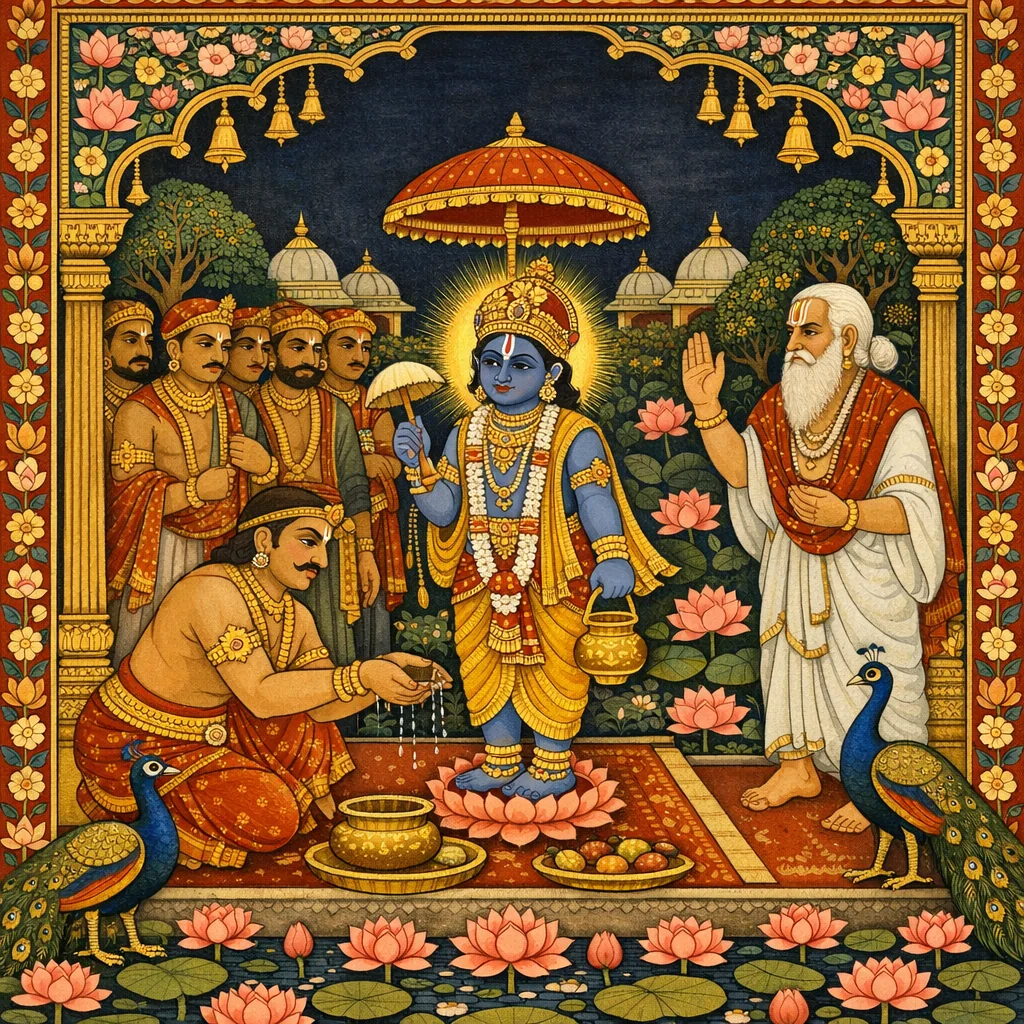
Continuing the Vāmana–Bali encounter, Vāmanadeva answers Bali’s dharma-rooted courtesy by praising the Daitya line’s famed generosity and its crown jewel, Prahlāda. Recalling Hiraṇyākṣa and Hiraṇyakaśipu, the Lord contrasts their unchecked anger and ambition with Bali’s refined religious etiquette. He then asks for only three paces of land, teaching that restraint and santoṣa (contentment) protect the brāhmaṇa from karmic bondage, while sense-driven acquisition never satisfies. Bali deems the request childish, urges Him to ask for more, and prepares to seal the gift with water. At this pivotal moment—between Bali’s vow and Trivikrama’s imminent cosmic expansion—Śukrācārya intervenes, identifies the dwarf as Viṣṇu, and warns that the donation will cost Bali his kingdom, honor, and livelihood. He argues for a strategic refusal, even allowing untruth in rare social emergencies, setting up the next chapter’s ethical clash: satya-vrata (truthful vow) versus pragmatic self-preservation under a guru’s command.
Shlokas
Verse 1
श्रीशुक उवाच इति वैरोचनेर्वाक्यं धर्मयुक्तं स सूनृतम् । निशम्य भगवान्प्रीत: प्रतिनन्द्येदमब्रवीत् ॥ १ ॥
Śukadeva Gosvāmī continued: When the Supreme Personality of Godhead, Vāmanadeva, heard Bali Mahārāja speaking in this pleasing way, He was very satisfied, for Bali Mahārāja had spoken in terms of religious principles. Thus the Lord began to praise him.
Verse 2
श्रीभगवानुवाच वचस्तवैतज्जनदेव सूनृतं कुलोचितं धर्मयुतं यशस्करम् । यस्य प्रमाणं भृगव: साम्पराये पितामह: कुलवृद्ध: प्रशान्त: ॥ २ ॥
The Supreme Lord said: O King, your words are truthful and gracious, befitting your dynasty, in harmony with dharma, and they increase your fame. Their witness is the brāhmaṇas descended from Bhṛgu, and your guide for the life to come is your grandfather, the serene elder of the line—Prahlāda Mahārāja.
Verse 3
न ह्येतस्मिन्कुले कश्चिन्नि:सत्त्व: कृपण: पुमान् । प्रत्याख्याता प्रतिश्रुत्य यो वादाता द्विजातये ॥ ३ ॥
In your family, even to this day, no one has been base-minded or miserly. No one has refused charity to brāhmaṇas, and no one, after promising a gift, has failed to keep that promise.
Verse 4
न सन्ति तीर्थे युधि चार्थिनार्थिता: पराङ्मुखा ये त्वमनस्विनो नृप । युष्मत्कुले यद्यशसामलेन प्रह्लाद उद्भाति यथोडुप: खे ॥ ४ ॥
O King, in your dynasty no low-minded ruler has ever been born who, when requested, turned away from giving charity to brāhmaṇas at holy places, or who, on the battlefield, shrank from fighting kṣatriyas. And your line shines all the more because Prahlāda Mahārāja is present within it, like the beautiful moon in the sky.
Verse 5
यतो जातो हिरण्याक्षश्चरन्नेक इमां महीम् । प्रतिवीरं दिग्विजये नाविन्दत गदायुध: ॥ ५ ॥
In your dynasty Hiraṇyākṣa was born. Alone, bearing only his own club as his weapon and without any assistance, he roamed the earth to conquer all directions, and no hero he met could rival him.
Verse 6
यं विनिर्जित्य कृच्छ्रेण विष्णु: क्ष्मोद्धार आगतम् । आत्मानं जयिनं मेने तद्वीर्यं भूर्यनुस्मरन् ॥ ६ ॥
When lifting the earth from the Garbhodaka Ocean, Lord Viṣṇu, appearing as the boar avatāra, killed Hiraṇyākṣa after a fierce battle won only with great difficulty. Later, repeatedly recalling Hiraṇyākṣa’s uncommon prowess, the Lord felt Himself truly victorious.
Verse 7
निशम्य तद्वधं भ्राता हिरण्यकशिपु: पुरा । हन्तुं भ्रातृहणं क्रुद्धो जगाम निलयं हरे: ॥ ७ ॥
Hearing that his brother had been slain, Hiraṇyakaśipu burned with rage and went to Lord Viṣṇu’s abode, intent on killing Viṣṇu, the slayer of his brother.
Verse 8
तमायान्तं समालोक्य शूलपाणिं कृतान्तवत् । चिन्तयामास कालज्ञो विष्णुर्मायाविनां वर: ॥ ८ ॥
Seeing him advance with a trident in hand like death personified, Lord Viṣṇu—knower of time’s course and foremost among mystics—reflected as follows.
Verse 9
यतो यतोऽहं तत्रासौ मृत्यु: प्राणभृतामिव । अतोऽहमस्य हृदयं प्रवेक्ष्यामि पराग्दृश: ॥ ९ ॥
Wherever I go, Hiraṇyakaśipu will pursue Me, as death pursues all living beings. Therefore I shall enter the very core of his heart; seeing only outwardly, he will not perceive Me.
Verse 10
एवं स निश्चित्य रिपो: शरीर- माधावतो निर्विविशेऽसुरेन्द्र । श्वासानिलान्तर्हितसूक्ष्मदेह- स्तत्प्राणरन्ध्रेण विविग्नचेता: ॥ १० ॥
Having thus decided, Mādhava entered the body of His enemy, the asura king who was rushing after Him with great force. In a subtle form inconceivable to Hiraṇyakaśipu, Viṣṇu slipped in through his nostril along with his breath.
Verse 11
स तन्निकेतं परिमृश्य शून्य- मपश्यमान: कुपितो ननाद । क्ष्मां द्यां दिश: खं विवरान्समुद्रान् विष्णुं विचिन्वन् न ददर्श वीर: ॥ ११ ॥
Finding Lord Viṣṇu’s residence empty, he roared in anger at not seeing Him. He searched the whole universe—earth, heavens, all directions, the sky, caves, and oceans—yet that mighty hero saw Viṣṇu nowhere.
Verse 12
अपश्यन्निति होवाच मयान्विष्टमिदं जगत् । भ्रातृहा मे गतो नूनं यतो नावर्तते पुमान् ॥ १२ ॥
Unable to see Him, Hiraṇyakaśipu said, “I have searched this whole universe, yet I cannot find Viṣṇu, the slayer of my brother. Therefore He must have gone to that place from which no one returns.”
Verse 13
वैरानुबन्ध एतावानामृत्योरिह देहिनाम् । अज्ञानप्रभवो मन्युरहंमानोपबृंहित: ॥ १३ ॥
In this world, the bondage of enmity for embodied beings lasts only until death. Anger arises from ignorance and is nourished by false ego.
Verse 14
पिता प्रह्लादपुत्रस्ते तद्विद्वान्द्विजवत्सल: । स्वमायुर्द्विजलिङ्गेभ्यो देवेभ्योऽदात् स याचित: ॥ १४ ॥
Your father Virocana, the son of Mahārāja Prahlāda, was very affectionate to the brāhmaṇas. Though he knew the demigods had come in brāhmaṇa dress, at their request he gave them the span of his own life.
Verse 15
भवानाचरितान्धर्मानास्थितो गृहमेधिभि: । ब्राह्मणै: पूर्वजै: शूरैरन्यैश्चोद्दामकीर्तिभि: ॥ १५ ॥
You too have observed the dharmic principles practiced by great persons—householder brāhmaṇas, your forefathers, and heroic men renowned for their exalted deeds.
Verse 16
तस्मात् त्वत्तो महीमीषद् वृणेऽहं वरदर्षभात् । पदानि त्रीणि दैत्येन्द्र सम्मितानि पदा मम ॥ १६ ॥
Therefore, O king of the Daityas, O best of benefactors, I ask from you only a little land—three paces, measured by My own steps.
Verse 17
नान्यत् ते कामये राजन्वदान्याज्जगदीश्वरात् । नैन: प्राप्नोति वै विद्वान्यावदर्थप्रतिग्रह: ॥ १७ ॥
O King, Lord of the universe, though you are most munificent and could grant Me as much land as I desire, I seek nothing unnecessary from you. A learned brāhmaṇa who accepts charity only according to need does not become entangled in sin.
Verse 18
श्रीबलिरुवाच अहो ब्राह्मणदायाद वाचस्ते वृद्धसम्मता: । त्वं बालो बालिशमति: स्वार्थं प्रत्यबुधो यथा ॥ १८ ॥
Bali Mahārāja said: O son of a brāhmaṇa, Your words are approved like those of learned elders. Yet You are a boy, and Your intelligence is still immature; thus You are not very prudent regarding Your own self-interest.
Verse 19
मां वचोभि: समाराध्य लोकानामेकमीश्वरम् । पदत्रयं वृणीते योऽबुद्धिमान् द्वीपदाशुषम् ॥ १९ ॥
You have pleased me with sweet words—me, the sole lord among the peoples—yet you ask only three paces of land; thus you seem not very intelligent. I am the proprietor of the three divisions of the universe and can grant you even an entire island.
Verse 20
न पुमान् मामुपव्रज्य भूयो याचितुमर्हति । तस्माद् वृत्तिकरीं भूमिं वटो कामं प्रतीच्छ मे ॥ २० ॥
O small boy, one who comes to me to beg should not have to ask again elsewhere. Therefore, if You wish, ask from me as much land as will suffice to maintain You according to Your needs.
Verse 21
श्रीभगवानुवाच यावन्तो विषया: प्रेष्ठास्त्रिलोक्यामजितेन्द्रियम् । न शक्नुवन्ति ते सर्वे प्रतिपूरयितुं नृप ॥ २१ ॥
The Supreme Lord said: O dear King, even all the most cherished objects of sense enjoyment within the three worlds cannot satisfy a person whose senses are uncontrolled.
Verse 22
त्रिभि: क्रमैरसन्तुष्टो द्वीपेनापि न पूर्यते । नववर्षसमेतेन सप्तद्वीपवरेच्छया ॥ २२ ॥
One who is not satisfied with three paces of land will not be fulfilled even by gaining one island among the seven dvīpas with their nine varṣas; having obtained one, he will still hanker for the others.
Verse 23
सप्तद्वीपाधिपतयो नृपा वैन्यगयादय: । अर्थै: कामैर्गता नान्तं तृष्णाया इति न: श्रुतम् ॥ २३ ॥
We have heard that even mighty kings such as Mahārāja Pṛthu (Vainya) and Mahārāja Gaya, though lords of the seven dvīpas, could not reach the end of their thirst for wealth and enjoyment.
Verse 24
यदृच्छयोपपन्नेन सन्तुष्टो वर्तते सुखम् । नासन्तुष्टस्त्रिभिर्लोकैरजितात्मोपसादितै: ॥ २४ ॥
One should be satisfied with whatever comes by one’s prior destiny, for discontent never yields happiness. A person without self-control will not be happy even if he possesses the three worlds.
Verse 25
पुंसोऽयं संसृतेर्हेतुरसन्तोषोऽर्थकामयो: । यदृच्छयोपपन्नेन सन्तोषो मुक्तये स्मृत: ॥ २५ ॥
Discontent regarding wealth and sense enjoyment is the cause of one’s continued material existence in saṁsāra. But satisfaction with what is obtained by destiny is remembered as the qualification for liberation.
Verse 26
यदृच्छालाभतुष्टस्य तेजो विप्रस्य वर्धते । तत् प्रशाम्यत्यसन्तोषादम्भसेवाशुशुक्षणि: ॥ २६ ॥
A brāhmaṇa satisfied with whatever is providentially obtained grows in tejas, spiritual radiance and power; but through discontent that potency wanes, as fire loses strength when sprinkled with water.
Verse 27
तस्मात् त्रीणि पदान्येव वृणे त्वद् वरदर्षभात् । एतावतैव सिद्धोऽहं वित्तं यावत्प्रयोजनम् ॥ २७ ॥
Therefore, O King, best of benefactors, I ask from you only three paces of land. By that gift alone I shall be satisfied, for happiness lies in being content with what is truly needed.
Verse 28
श्रीशुक उवाच इत्युक्त: स हसन्नाह वाञ्छात: प्रतिगृह्यताम् । वामनाय महीं दातुं जग्राह जलभाजनम् ॥ २८ ॥
Śukadeva Gosvāmī said: When the Supreme Lord spoke thus, Bali smiled and replied, “Accept whatever You desire.” To seal his promise of granting Vāmanadeva the requested land, he took up the waterpot for the ritual gift.
Verse 29
विष्णवे क्ष्मां प्रदास्यन्तमुशना असुरेश्वरम् । जानंश्चिकीर्षितं विष्णो: शिष्यं प्राह विदां वर: ॥ २९ ॥
Knowing Lord Viṣṇu’s intention, Śukrācārya, foremost among the learned, at once spoke to his disciple—the lord of the asuras—who was about to offer the earth to Vāmanadeva.
Verse 30
श्रीशुक्र उवाच एष वैरोचने साक्षाद् भगवान्विष्णुरव्यय: । कश्यपाददितेर्जातो देवानां कार्यसाधक: ॥ ३० ॥
Śukrācārya said: O son of Virocana, this brahmacārī in the form of a dwarf is directly Bhagavān Viṣṇu, the imperishable Lord. Taking Kaśyapa as His father and Aditi as His mother, He has appeared to accomplish the purpose of the devas.
Verse 31
प्रतिश्रुतं त्वयैतस्मै यदनर्थमजानता । न साधु मन्ये दैत्यानां महानुपगतोऽनय: ॥ ३१ ॥
The promise you have made to Him in ignorance will bring calamity. I do not deem it auspicious, for it will cause great harm to the daityas (demons).
Verse 32
एष ते स्थानमैश्वर्यं श्रियं तेजो यश: श्रुतम् । दास्यत्याच्छिद्य शक्राय मायामाणवको हरि: ॥ ३२ ॥
This one who falsely appears as a brahmacārī is in truth Bhagavān Hari, the Supreme Lord. He will seize your land, wealth, beauty, power, fame, and learning, and after taking all, He will hand everything to Indra, your enemy.
Verse 33
त्रिभि: क्रमैरिमाल्लोकान्विश्वकाय: क्रमिष्यति । सर्वस्वं विष्णवे दत्त्वा मूढ वर्तिष्यसे कथम् ॥ ३३ ॥
You have vowed to give Him land measured by three steps, yet He, in His universal form, will stride across the three worlds. Fool! After giving everything to Lord Viṣṇu, how will you maintain your life?
Verse 34
क्रमतो गां पदैकेन द्वितीयेन दिवं विभो: । खं च कायेन महता तार्तीयस्य कुतो गति: ॥ ३४ ॥
Vāmanadeva will cover the earth with His first step and the heavens with His second; then, expanding His vast universal body, He will fill all outer space. Where, then, will you place His third step?
Verse 35
निष्ठां ते नरके मन्ये ह्यप्रदातु: प्रतिश्रुतम् । प्रतिश्रुतस्य योऽनीश: प्रतिपादयितुं भवान् ॥ ३५ ॥
Surely you will be unable to fulfill your promise; and I think that, being unable to give what you pledged, your lasting destination will be hell.
Verse 36
न तद्दानं प्रशंसन्ति येन वृत्तिर्विपद्यते । दानं यज्ञस्तप: कर्म लोके वृत्तिमतो यत: ॥ ३६ ॥
The learned do not praise charity that endangers one’s own livelihood. Charity, sacrifice (yajña), austerity, and fruitive works are possible only for one who can properly maintain himself.
Verse 37
धर्माय यशसेऽर्थाय कामाय स्वजनाय च । पञ्चधा विभजन्वित्तमिहामुत्र च मोदते ॥ ३७ ॥
Therefore, one endowed with full understanding should apportion his gathered wealth into five parts—for dharma, for good repute, for prosperity, for the pleasures of the senses, and for the support of his own family. Thus he rejoices in this world and in the next.
Verse 38
अत्रापि बह्वृचैर्गीतं शृणु मेऽसुरसत्तम । सत्यमोमिति यत् प्रोक्तं यन्नेत्याहानृतं हि तत् ॥ ३८ ॥
O best of the asuras, hear the testimony sung in the Bahvṛca-śruti: a statement uttered with “Om” as its preface is deemed truthful, but what is spoken without “Om” is indeed untrue.
Verse 39
सत्यं पुष्पफलं विद्यादात्मवृक्षस्य गीयते । वृक्षेऽजीवति तन्न स्यादनृतं मूलमात्मन: ॥ ३९ ॥
The Vedas declare that the true outcome of the tree of the body is its good flowers and fruits. Yet if the tree itself does not exist, there can be no real flowers or fruits. Even if the body’s root is said to rest on untruth, without the bodily tree there can be no factual fruit.
Verse 40
तद् यथा वृक्ष उन्मूल: शुष्यत्युद्वर्ततेऽचिरात् । एवं नष्टानृत: सद्य आत्मा शुष्येन्न संशय: ॥ ४० ॥
As a tree, uprooted from its roots, at once falls and soon dries up, so too, when the “untruth” that sustains the body is destroyed, the body surely withers immediately—without doubt.
Verse 41
पराग् रिक्तमपूर्णं वा अक्षरं यत् तदोमिति । यत् किञ्चिदोमिति ब्रूयात् तेन रिच्येत वै पुमान् । भिक्षवे सर्वम्ॐ कुर्वन्नालं कामेन चात्मने ॥ ४१ ॥
That syllable which signifies separation—emptiness or incompleteness—is called “Om.” Whatever one gives while uttering “Om,” by that he truly becomes bereft, for his wealth is taken away. Especially when giving alms to a beggar and making everything “Om,” one finds neither the fulfillment of desires nor inner satisfaction.
Verse 42
अथैतत् पूर्णमभ्यात्मं यच्च नेत्यनृतं वच: । सर्वं नेत्यनृतं ब्रूयात् स दुष्कीर्ति: श्वसन्मृत: ॥ ४२ ॥
Therefore the safest course is to say, “No.” Though it is untrue, it affords complete protection, draws others’ compassion toward oneself, and grants full facility for gathering money from them. Yet one who always pleads, “I have nothing,” is condemned—dead while living, and even while breathing as if fit to be slain.
Verse 43
स्त्रीषु नर्मविवाहे च वृत्त्यर्थे प्राणसङ्कटे । गोब्राह्मणार्थे हिंसायां नानृतं स्याज्जुगुप्सितम् ॥ ४३ ॥
In coaxing a woman with pleasing words to bring her under control, in jest, in the marriage rite, for one’s livelihood, in peril of life, in protecting cows and brāhmaṇical culture, or in saving someone from an enemy’s hand—falsity is not deemed reprehensible.
Frequently Asked Questions
On the surface it models brāhmaṇical restraint—taking only what is needed to avoid sinful entanglement. Theologically it is deliberate līlā: the Lord’s “small” request exposes the limits of material proprietorship and prepares the revelation of Trivikrama, where the Supreme measures and reclaims the cosmos while honoring the devotee’s vow.
Satisfaction is linked to self-control, not to the quantity of possessions. The text argues that uncontrolled senses remain dissatisfied even with the three worlds, while a person content with what destiny provides becomes fit for liberation and gains spiritual strength (brahma-tejas).
Śukrācārya is the Daityas’ preceptor and a master of policy and ritual learning. He recognizes Vāmana as Viṣṇu acting for the devas’ interest and warns that the promised gift will result in total dispossession, endangering Bali’s livelihood and the Daitya cause; thus he urges refusal as protective strategy.
The passage lists narrow social exceptions where falsity is traditionally not condemned (e.g., protecting life, cows, and brāhmaṇical culture). Yet the narrative context problematizes Śukrācārya’s counsel by placing it against Bali’s pledged satya and the presence of Viṣṇu; the next narrative movement tests whether expediency can override a vow made in a sacred charitable act.