Adhyaya 111
प्रयागमाहात्म्यम् (The Greatness of Prayāga)
Agni opens the Prayāga-māhātmya by proclaiming Prayāga the supreme tīrtha, granting both bhukti and mukti, and a meeting-place of the gods (Brahmā, Viṣṇu, and others) and the ṛṣis. Its sanctity is taught through concrete ritual means: clay from the Gaṅgā’s bank, when carried or applied, destroys sin as the Sun dispels darkness, joining bodily practice to inner purification. Prayāga is then mapped through sacred anatomy and cosmography: the Gaṅgā–Yamunā interval is the Earth’s “jaghana,” with Prayāga as its inner upastha, making geography a theological body. Subsidiary tīrthas (Pratiṣṭhāna, Kambalā, Aśvatara, Bhogavatī) are identified as Prajāpati’s altar, and the Vedas and yajñas are said to be “embodied” there, so even name-chanting yields merit. At the saṅgama, dāna, śrāddha, and japa become imperishable, and the text notes the unwavering resolve of those who seek death at Prayāga. It concludes by listing eminent sites (Haṃsa-prapatana, Koṭitīrtha, Aśvamedha-tīrtha, Mānasatīrtha, Vāsaraka), praising the potency of Māgha month and the Gaṅgā’s rare triad of supreme places: Gaṅgādvāra, Prayāga, and Gaṅgā-sāgara.
Shlokas
Verse 1
इत्य् आग्नेये महापुराणे गङ्गामाहात्म्यं नाम दशाधिकशततमो ऽध्यायः अथ एकादशाधिकशततमो ऽध्यायः प्रयागमाहात्म्यं अग्निर् उवाच वक्ष्ये प्रयागमाहात्म्यं भुक्तिमुक्तिप्रदं परं प्रयागे ब्रह्मविष्ण्वाद्या देव मुनिवराः स्थिताः
Thus, in the Agni Mahāpurāṇa, the chapter entitled “The Greatness of the Gaṅgā” is the one-hundred-and-tenth. Now begins the one-hundred-and-eleventh chapter, “The Greatness of Prayāga.” Agni said: “I shall declare the supreme greatness of Prayāga, which bestows both worldly enjoyment and liberation. At Prayāga, Brahmā, Viṣṇu, and the other gods, together with the foremost sages, abide.”
Verse 2
च गङ्गातीरसमुद्भूतमृद्धारो सो ऽघहार्कवदिति ख , ग , झ च गङ्गातीरसमुद्भूतमृदं मूर्धा विभर्ति यः विभर्ति रूपं सोर्कस्य तमोनाशाय केवलमिति ङ भक्तिमुक्तिफलप्रदमिति ग भुक्तिमुक्तिप्रदायकमिति झ सरितः सागराः सिद्धा गन्धर्वसराप्सस् तथा तत्र त्रीण्यग्निकुण्डानि तेषां मध्ये तु जाह्नवी
Whoever bears upon himself clay arisen from the bank of the Gaṅgā becomes a remover of sin, like the Sun. Whoever carries upon his head the earth born from the Gaṅgā’s bank bears the Sun’s very radiance, solely for the destruction of darkness (ignorance and impurity). It grants the fruit of devotion and liberation; it bestows both worldly enjoyment and liberation. There, rivers and oceans are declared sanctified; and so too are the Siddhas, Gandharvas, and celestial nymphs (Apsarases). In that place are three fire-pits (agni-kuṇḍas); and among them is the Jāhnavī (Gaṅgā).
Verse 3
वेगेन समतिक्रान्ता सर्वतीर्थतिरस्कृता तपनस्य सुता तत्र त्रिषु लोकेषु विश्रुता
Swiftly surpassing all and eclipsing every sacred ford, the famed daughter of Tapana is there—renowned throughout the three worlds.
Verse 4
गङ्गायमुनयोर्मध्यं पृथिव्या जघनं स्मृतं प्रयागं जघनस्यान्तरुपस्थमृषयो विदुः
The region between the Gaṅgā and the Yamunā is remembered as the ‘hips’ (jaghana) of the Earth; and the sages know Prayāga to be the inner pelvic region—the intermediate ‘upastha’—of that very jaghana.
Verse 5
प्रयागं सप्रतिष्ठानम् कम्बलाश्वतरावुभौ तीर्थं भोगवती चैव वेदी प्रोक्ता प्रजापतेः
Prayāga together with Pratiṣṭhāna, both the tīrthas Kambalā and Aśvatara, and also the tīrtha Bhogavatī—these are declared to be the altar (vedī) of Prajāpati.
Verse 6
तत्र वेदाश् च यज्ञाश् च मूर्तिमन्तः प्रयागके स्तवनादस्य तीर्थस्य नामसङ्किर्तनादपि
There, at Prayāga, the Vedas and the sacrificial rites (yajñas) are, as it were, embodied. Even by praising this sacred tīrtha, and even by the mere chanting of its name, great merit is gained.
Verse 7
मृत्तिकालम्भनाद्वापि सर्वपापैः प्रमुच्यते प्रयागे सङ्गते दानं श्राद्धं जप्यादि चाक्षयं
Even by applying (or taking refuge in) the sacred clay (mṛttikā), one is freed from all sins. At Prayāga, at the confluence, gifts (dāna), śrāddha-offerings, japa, and the like become imperishable in their merit.
Verse 8
न देववचनाद्विप्र न लोकवचनादपि मतिरुत्क्रमणीयान्ते प्रयागे मरणं प्रति
O brāhmaṇa, neither by the word of the gods nor even by the word of people can one’s resolve be turned back, when—at life’s end—one is intent on dying at Prayāga.
Verse 9
दशतीर्थसहस्राणि षष्टिकोट्यस् तथापराः तेषां सान्निध्यमत्रैव प्रयागं परमन्ततः
There are ten thousand sacred fords (tīrthas), and likewise sixty crores of others; yet the very presence—the confluence of the merit of them all—is found here alone. Therefore Prayāga is supreme in the highest sense.
Verse 10
वासुकेर्भोगवत्यत्र हंसप्रपतनं परं गवां कोटिप्रदानाद्यत् त्र्यहं स्नानस्य तत्फलं
Here, at Bhogavatī of Vāsuki, the supreme tīrtha called Haṃsa-prapatana (“Swan’s Descent”) is extolled. The fruit of bathing there for three days equals that arising from gifts, beginning with the donation of ten million cows.
Verse 11
प्रयागे माघमासे तु एवमाहुर्मनीषिणः गङायमुनयोर्मध्ये इति ख सरितः सागरा इत्य् आदिः, उपस्थमृषयो विदुरित्यन्तः पाठो ग पुस्तके नास्ति श्रवणादस्येति ख , ग , घ , ङ , ज च श्राद्धद्रव्यादि चाक्षयमिति घ त्र्यहं स्नातस्येति घ सर्वत्र सुलभा गङ्गा त्रिषु स्थानेषु दुर्लभा
The wise declare thus: in the month of Māgha, at Prayāga—at the confluence of the Gaṅgā and the Yamunā—the Gaṅgā is easy to reach everywhere, yet her full sanctifying power is rare, uniquely obtained in three places.
Verse 12
गङाद्वारे प्रयागे च गङ्गासागरसङ्गमे अत्र दानाद्दिवं याति राजेन्द्रो जायते ऽत्र च
At Gaṅgādvāra (Haridvāra), at Prayāga, and at the meeting of the Gaṅgā with the ocean (Gaṅgā-sāgara), by giving gifts here one goes to heaven; and here, too, one is born as a king among kings.
Verse 13
वटमूले सङ्गमादौ मृतो विष्णुपुरीं व्रजेत् उर्वशीपुलिनं रम्यं तीर्थं सन्ध्यावतस् तथा
One who dies at the root of the banyan tree at the sacred confluence goes to Viṣṇu’s city. Likewise, Urvaśī’s lovely riverbank is a tīrtha for those devoted to the twilight worship (sandhyā).
Verse 14
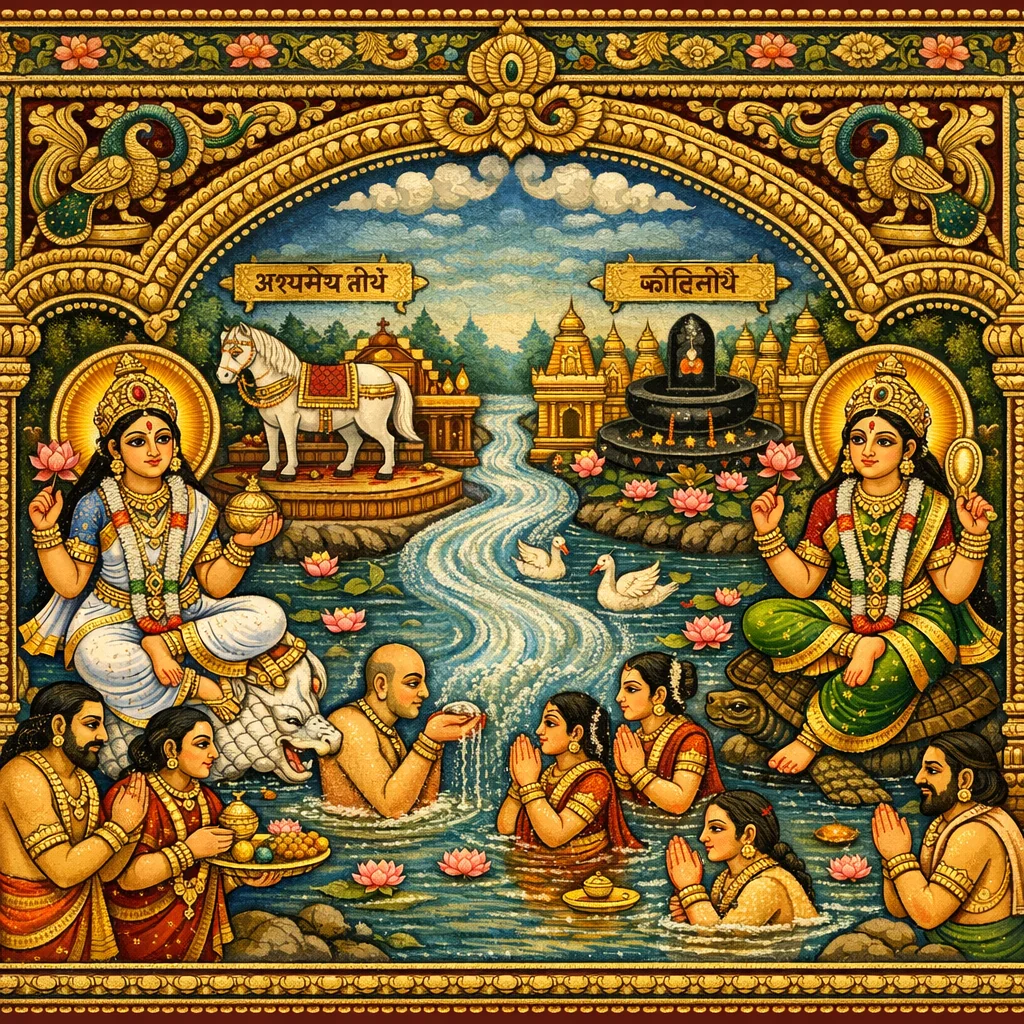
कोटीतीर्थञ्चाश्वमेधं गङ्गायमुनमुत्तमं मानसं रजसा हीनं तीर्थं वासरकं परं
Koṭitīrtha, Aśvamedha(-tīrtha), the supremely sacred confluence of the Gaṅgā and Yamunā, Mānasatīrtha free from rajas (impurity), and the transcendent Vāsaraka-tīrtha—these are proclaimed as eminent holy fords.
Frequently Asked Questions
Both: Agni explicitly frames Prayāga as 'bhukti-mukti-prada'—a tīrtha whose rites support worldly welfare while culminating in liberation.
The chapter treats mṛttikā as a portable ritual substance: bearing or applying it is said to remove sin like the Sun destroys darkness, making purification accessible beyond the river itself.
It sacralizes the place as a concentrated locus of revelation and ritual efficacy, where even praise and name-chanting are credited with extraordinary merit.
Gaṅgādvāra (Haridvāra), Prayāga, and Gaṅgā-sāgara (the Gaṅgā’s confluence with the ocean).
By mapping Prayāga onto the Earth’s body (jaghana/upastha metaphor) and listing subsidiary tīrthas as Prajāpati’s altar, it turns terrain into a structured soteriological system.