Adhyaya 108
Chapter 108 — भुवनकोषः (Bhuvana-kośa: The Structure of the Worlds)
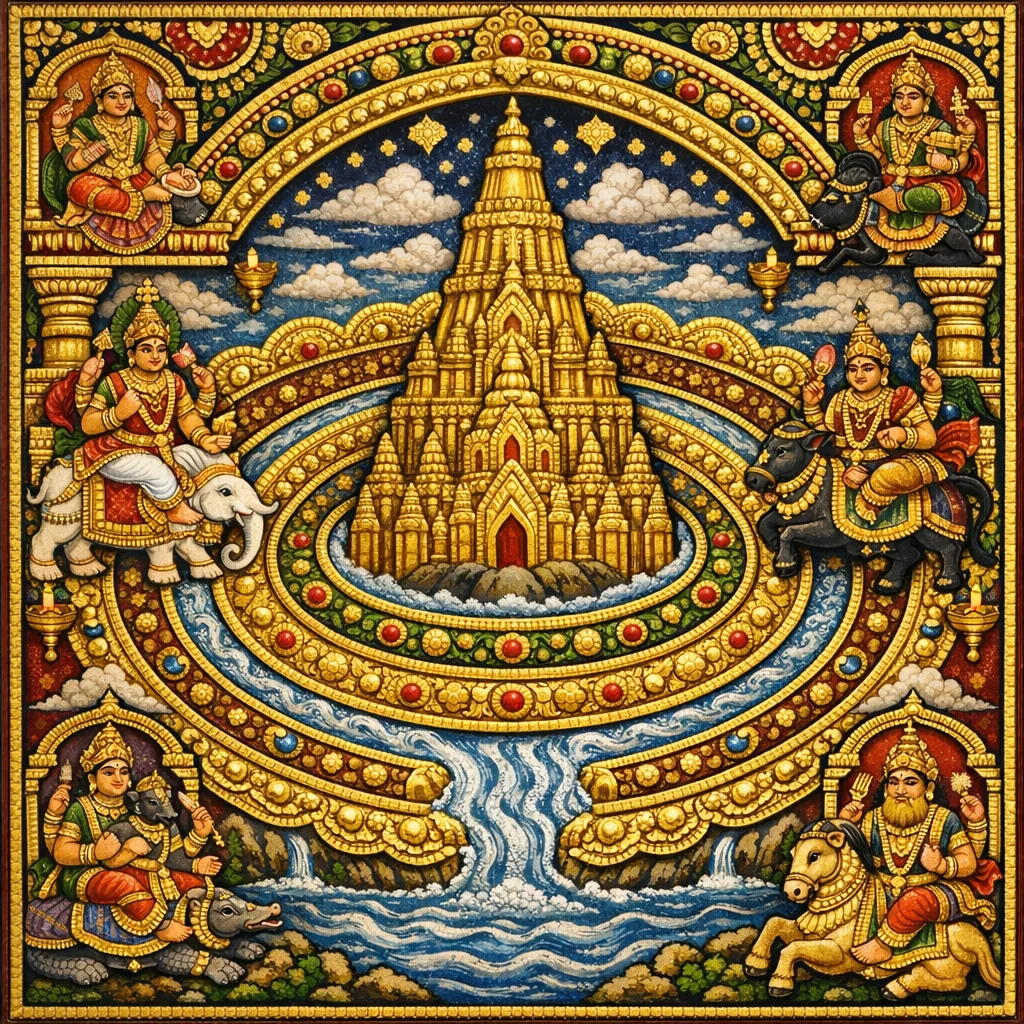
Lord Agni begins a systematic cosmographic survey for Vasiṣṭha by enumerating the seven dvīpas and their seven encircling oceans, establishing the world’s macro-structure as a sacred, ordered field of dharma. He then centers the account on Jambūdvīpa and Mount Meru, giving explicit measurements and lotus symbolism (Meru as the pericarp of the world-lotus), and outlines the boundary mountains and varṣa-regions arranged around Meru: Bhārata, Kiṁpuruṣa, Harivarṣa to the south; Ramyaka, Hiraṇmaya, Uttarakuru to the north; Ilāvṛta at the center. Geography is layered with divine presence—directional mountains, celestial groves, Brahmā’s city on Meru, and the domains of the lokapālas. Rivers descending from Viṣṇu’s Foot (notably Śītā and Ālakanandā) link heaven to earth, turning hydrology into a theological corridor. The chapter culminates by turning toward tīrtha-discourse: rivers become tīrthas, and Bhārata is highlighted as a land where sacredness is also conferred through dharmic recognition, preparing for a tirtha-mahātmya catalog.
Shlokas
Verse 1
इत्य् आग्नेये महापुराणे स्वायम्भुवः सर्गो नाम सप्ताधिकशततमो ऽध्यायः अथाष्टाधिकशततमो ऽध्यायः भुवनकोषः अग्निर् उवाच जम्बूप्लक्षाह्वयौ द्वीपौ शाल्मलिश्चापरो महान् कुशः क्रौञ्चस् तथा शाकः पुष्करश्चेति सप्तमः
Thus, in the Agni Mahāpurāṇa, the chapter entitled “The Svāyambhuva Creation” is the one hundred and seventh. Now begins the one hundred and eighth chapter, “Bhuvana-kośa (the structure of the worlds).” Agni said: “Jambū and Plakṣa are continents; Śālmali is another great one; then Kuśa, Krauñca, and also Śāka; and Puṣkara is the seventh.”
Verse 2
योगप्रस्तारे इति ग , ज , झ च इन्द्रद्युम्नोभ्यजायतेति ख , छ च प्रतीहारादित्यादिः, प्रस्तारतः सुत इत्य् अन्तः पाठो झ पुस्तके नास्ति दुष्टादुष्टश् च विरजा इति ख एते द्वीपाः समुद्रैस्तु सप्त सप्तभिरावृताः लवणेक्षुसुरासर्पिर्दधिदुग्धजलैः समं
These continents are indeed encircled, in succession, by seven oceans consisting respectively of salt water, sugarcane juice, surā (liquor), clarified butter (ghee), curd, milk, and sweet water.
Verse 3
जम्बूद्वीपो द्वीपमध्ये तन्मध्ये मेरुरुच्छ्रितः चतुरशीतिसाहस्रो भूयिष्ठः षोडशाद्विराट्
In the midst of the continents lies Jambūdvīpa; and at its very center rises Mount Meru—eighty‑four thousand yojanas in height, with a further sixteen thousand yojanas forming its prominent upper portion.
Verse 4
द्वात्रिंशन्मूर्ध्नि विस्तरात् षोडशाधः सहस्रवान् भूयस्तस्यास्य शैलो ऽसौ कर्णिकाकारसंस्थितः
At its summit it spreads to a breadth of thirty-two thousand yojanas; below, it is sixteen thousand. This mountain further rises to a height of one thousand yojanas and is set in the form of a lotus-pericarp.
Verse 5
हिमवान् हेमकूटश् च निषधश्चास्य दक्षिणे नीलः श्वेतश् च शृङ्गो च उत्तरे वर्षपर्वताः
To its south lie Himavān, Hemakūṭa, and Niṣadha; and to the north are the Varṣa-boundary mountains—Nīla, Śveta, and Śṛṅga.
Verse 6
लक्षप्रमाणौ द्वौ मध्ये दशहीनास् तथापरे सहस्रद्वितयोछ्रायास्तावद्विस्तारिणश् च ते
In the middle are two (structures) of lakṣa-measure; the others likewise are reduced by ten (units/grades). Their height is two thousand, and their breadth is of the same extent.
Verse 7
भारतं प्रथमं वर्षन्ततः किम्पुरुषं स्मृतं हरिवर्सन्तथैवान्यन्मेरोर्दक्षिणतो द्विज
O twice-born one, Bhārata is said to be the first varṣa; next is remembered Kiṁpuruṣa; likewise come Harivarṣa and another region—each to the south of Mount Meru.
Verse 8
रम्यकं चोत्तरे वर्षं तथैवान्यद्धिरण्मयं उत्तराः कुरवश् चैव यथा वै भारतं तथा
To the north lies the varṣa called Ramyaka; likewise there is another called Hiraṇmaya; and also the Northern Kurus (Uttarāḥ Kuru)—all arranged in the same manner as Bhārata (varṣa).
Verse 9
नवसाहस्रमेकैकमेतेषां मुनिसत्तम इलावृतञ्च तन्मध्ये सौवर्णा मेरुरुछ्रितः
O best of sages, each of these regions measures nine thousand yojanas; and Ilāvṛta lies among them, with the golden Mount Meru rising loftily at its center.
Verse 10
मेरोश् चतुर्दिशन्तत्र नवसाहस्रविस्तृतं ति घ , ज च भुविस्थ इति ङ षोडशांश इति झ भूपाद्मस्यास्य इति ख , ग , छ च तथैवात्र हिरण्मयमिति ग तथैवाथ हिरण्मयमिति ज इलावृतश्चेत्यादिः, नवसाहस्रविस्तृतमित्यन्तः पाठो छ पुस्तके नास्ति इलावृतं महाभाग चत्वारश्चात्र पर्वताः
On all four sides of Mount Meru, the region there extends for nine thousand yojanas. (Some manuscripts add variant readings such as “situated on the earth,” “a sixteenth part,” and “of this earth-lotus.”) Here also occurs the reading “golden,” and likewise another recension reads “then (it is) golden.” Beginning with “Ilāvṛta…,” the text continues; in the Cha-manuscript the reading ending with “navasāhasravistṛtam (extends nine thousand)” is not found. (The verse proceeds:) “O great one, Ilāvṛta—here there are four mountains.”
Verse 11
विष्कम्भा रचिता मेरोर्योजनायुतविस्तृताः पूर्वेण मन्दरो नाम दक्षिणे गन्धमादनः
Around Mount Meru are constructed the transverse supporting ranges (viṣkambha), each extending ten thousand yojanas in breadth. To the east is the mountain named Mandara, and to the south is Gandhamādana.
Verse 12
विपुलः पश्चिमे पार्श्वे सुपार्श्वश्चोत्तरे स्मृतः कदम्बस्तेषु जम्बुश् च पिप्पलो बट एव च
Vipula is prescribed on the western side, and Supārśva is remembered for the northern side. Among those placements are also the kadamba, the jambu, the pippala, and the banyan (vaṭa) trees.
Verse 13
एकादशशतायामाः पादपा गिरिकेतवः जम्बूद्वीपेति सञ्ज्ञा स्यात् फलं जम्बा गजोपमं
There are trees measuring eleven hundred yāmas in extent, and mountains that stand like banners. It is called ‘Jambūdvīpa’; and the fruit of the Jambū tree is elephant-like in size.
Verse 14
जम्बूनदीरसेनास्यास्त्विदं जाम्बूनदं परं सुपार्श्वः पूर्वतो मेरोः केतुमालस्तु पश्चिमे
From the essence (rasa) of the Jambū River arises the supreme substance called Jāmbūnada, namely gold. To the east of Mount Meru lies Supārśva, and to the west lies Ketumāla.
Verse 15
वनं चैत्ररथं पूर्वे दक्षिणे गन्धमादनः वैभ्राजं पश्चिमे सौम्ये नन्दनञ्च सरांस्यथ
To the east lies the Caitraratha grove; to the south, Gandhamādana; to the west, Vaibhrāja; and on the auspicious northern side are Nandana and the sacred lakes.
Verse 16
अरुणोदं महाभद्रं संशितोदं समानसं शिताभश् चक्रमुञ्जाद्याः पूर्वतः केशराचलाः
To the east are the mountains named Aruṇoda, Mahābhadra, Saṃśitoda, Samānasa, Śitābha, and those beginning with Cakramuñja; there too is the Keśara mountain-range.
Verse 17
दक्षिणेन्द्रेस्त्रिकूटाद्याः शिशिवासमुखा जले शङ्खकूटादयः सौम्ये मेरौ च ब्रह्मणः पुरी
In the southern quarter are mountains beginning with Trikūṭa; in the waters are those beginning with Śiśivāsa; in the gentle, auspicious northern (saumya) quarter are mountains beginning with Śaṅkhakūṭa; and on Mount Meru is the city of Brahmā.
Verse 18
चतुर्दशसहस्राणि योजनानाञ्च दिक्षु च इन्द्रादिलोकपालानां समन्तात् ब्रह्मणः पुरः
In all directions, the domain of the world-guardians (Lokapālas) beginning with Indra extends for fourteen thousand yojanas, surrounding the region before the city of Brahmā.
Verse 19
विष्णुपादात् प्लावयित्वा चन्द्रं स्वर्गात् पतन्त्यपि पूर्वेण शीता भद्राश्वाच्छैलाच्छैलाद्गतार्णवं
Surging forth from Viṣṇu’s Foot and inundating the lunar sphere, that celestial river then falls down from heaven; flowing eastward, the river Śītā passes from mountain to mountain in Bhadrāśva (varṣa) and finally reaches the ocean.
Verse 20
तथैवालकनन्दापि दक्षिणेनैव भारतं दमिति ख , ग , घ , ङ , छ च असितोदमिति ज पूर्वतः शिशिराचला इति ख , ग , घ , ज च शशिवाममुखा जले इति ख , घ , ङ , छ च दक्षिणेन च भारतमिति ख दक्षिणेनैति भारतमिति ग प्रयाति सागरं कृत्वा सप्तभेदाथ पश्चिमं
Likewise, the river Ālakanandā proceeds along the southern side of Bhārata; in some recensions it is read as “Dami,” and in another as “Asitoda.” To the east are the Śiśira mountains. The reading “Śaśivāma-mukhā in the waters” also occurs in some manuscripts. Flowing south of Bhārata, it reaches the ocean after making seven divisions, and then turns toward the west.
Verse 21
अब्धिञ्च चक्षुःसौम्याब्धिं भद्रोत्तरकुरूनपि आनीलनिषधायामौ माल्यवद्गन्धमादनौ
And (there are) the oceans Cakṣuḥ and Saumya; likewise (the regions) Bhadra and Uttarakuru; and (the mountains) Ānīla and Niṣadha; (also) Ayāma; and (the mountains) Mālyavat and Gandhamādana.
Verse 22
तयोर्मध्यगतो मेरुः कर्णिकाकारसंस्थितः भारताः केतुमालाश् च भद्राश्वाः कुरवस् तथा
Between those (regions) stands Mount Meru, situated like the pericarp of a lotus; and (around it lie) Bhārata, Ketumāla, Bhadrāśva, and also Kuru (the lands/varṣas).
Verse 23
पत्राणि लोकपद्मस्य मर्यादाशैलवाह्यतः जठरो देवकूटश् च मर्यादापर्वतावुभौ
Outside the boundary-mountain Maryādāśaila lie the “petals” of the world-lotus (lokapadma). The two boundary-mountains are called Jaṭhara and Devakūṭa.
Verse 24
तौ दक्षिणोत्तरायामावानीलनिषधायतौ गन्धमादनकैलासौ पूर्ववचायतावुभौ
Those two mountain ranges, extending in the south–north direction, are Nīla and Niṣadha; and likewise, in the eastern direction, the two are Gandhamādana and Kailāsa.
Verse 25
अशीतियोजनायामावर्णवान्तर्व्यवस्थितौ निषधः पारिपात्रश् च मर्यादापर्वतावुभौ
Within the intervening tract of eighty yojanas, Niṣadha and Pāripātra—both boundary mountains—are situated.
Verse 26
मेरोः पश्चिमदिग्भागे यथा पूर्वे तथा स्थितौ त्रिशृङ्गो रुधिरश् चैव उत्तरौ वर्षपर्वतौ
On the western side of Mount Meru, just as on the eastern side, there are situated the two northern Varṣa-mountains—Triśṛṅga and Rudhira.
Verse 27
पूर्वपञ्चायतावेतावर्णवान्तर्व्यवस्थितौ जाठराद्याश् च मर्यादाशैला मेरोश् चतुर्दिशं
These two eastern ranges, Pañcāyata and Avetā, are situated within the intervening oceans; and the boundary-mountains—beginning with Jāṭhara—stand in the four directions around Meru.
Verse 28
केशरादिषु या द्रोण्यस्तासु सन्ति पुराणि हि लक्ष्मीविष्ण्वग्निसूर्यादिदेवानां मुनिसत्तम
O best of sages, in the receptacles (droṇīs) such as those made of keśara and the like, there are indeed Purāṇas belonging to deities—Lakṣmī, Viṣṇu, Agni, Sūrya, and others.
Verse 29
भौमानां स्वर्गधर्माणां न पापास्तत्र यान्ति च ति पूर्वपश्चायतावुभौ इति घ , ङ , ज च भुमाः स्वर्गा धर्मिणान्ते न पापास्तत्र यान्ति च इति छ , ङ च मौमानां स्वर्गधर्माणां तनया ह्य् अत्र यान्ति चेति ग , घ च भोगिनां स्वर्गधर्माणां तनयास्तत्र यान्ति चेति ज भद्राश्वे ऽस्ति हयग्रीवो वराहः केतुमालके
Among earthly beings who follow the dharma of heaven, sinners do not go there (so read certain recensions), meaning both the eastern and the western regions. Other readings say: “In lands that are like heaven for the righteous, sinners do not go there.” Yet other recensions read: “Here indeed the sons of those who follow the dharma of heaven go there,” or “the sons of the enjoyers who follow the dharma of heaven go there.” Further, in Bhadrāśva-varṣa there is the form Hayagrīva, and in Ketumāla-varṣa the form Varāha.
Verse 30
भारते कूर्मरूपी च मत्स्यरूपः कुरुष्वपि विश्वरूपेण सर्वत्र पूज्यते भगवान् हरिः
In Bhārata (India) He is worshipped in the form of the Tortoise, Kūrma, and among the Kurus also in the form of the Fish, Matsya; indeed, as the Universal Form, Viśvarūpa, the Blessed Lord Hari is worshipped everywhere.
Verse 31
किम्पुरुषाद्यष्टसु क्षुद्भीतिशोकादिकं न च चत्तुर्विंशतिसाहस्रं प्रजा जीवन्त्यनामयाः
In the eight regions beginning with Kimpuruṣa, there is no affliction such as hunger, fear, or sorrow; and the people live for twenty-four thousand years, free from disease.
Verse 32
कृतादिकल्पना नास्ति भौमान्यम्भांसि नाम्बुदाः सर्वेष्वेतेषु वर्षेषु सप्त सप्त कुलाचलाः
In these terrestrial regions there is no reckoning in terms of the Kṛta and other ages; the waters are earthly (not celestial), and there are no rain-bearing clouds. In each of these varṣas there are seven and seven principal boundary-mountains (kulācalas).
Verse 33
नद्यश् च शतशस्तेभ्यस्तीर्थभूताः प्रजज्ञिरे भारते यानि नीर्थानि तानि तीर्थानि वच्मि ते
And from them hundreds of rivers arose, becoming tīrthas—sacred fords—in Bhārata. I shall tell you of those places in Bhārata which, though not naturally river-fords, are nevertheless regarded as tīrthas.
Frequently Asked Questions
It presents a Meru-centered world-lotus model: seven dvīpas encircled by seven oceans, with Jambūdvīpa at the center, Meru as the axis, and surrounding varṣas and boundary mountains organized by direction.
The chapter foregrounds measurements in yojanas for Mount Meru (height and breadth) and for regional extents (e.g., varṣa measures), using quantified cosmography as a shāstric mapping of sacred space.
By portraying rivers as descending from Viṣṇu’s Foot and by defining rivers and even non-river sites in Bhārata as tīrthas, it turns geography into a dharmic discipline—contemplation and pilgrimage become means to align life with cosmic order.