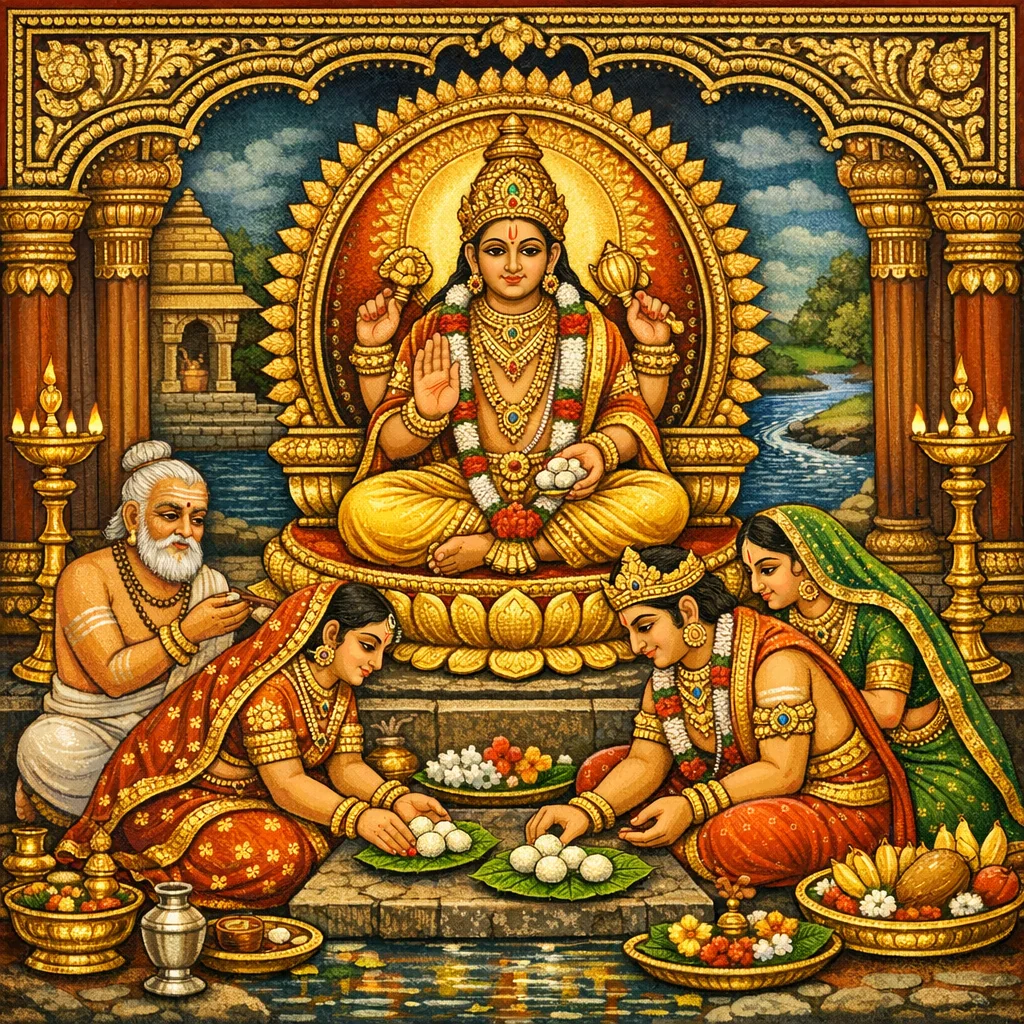
Adhyaya 116
Chapter 116 — गयायात्राविधिः (Gayā-yātrā-vidhiḥ) | The Procedure for the Gayā Pilgrimage
Lord Agni lays down a step-by-step ritual itinerary (vidhi) for the Gayā pilgrimage, centered on bathing while reciting the Gāyatrī, observing the tri-sandhyā, and performing morning and midday śrāddha with piṇḍa-dāna. Gayā is presented as a dense tīrtha-network in which particular stations—footprints (pada), kuṇḍas, śilās, gates, and deity-presences—are ritually “activated” through offerings, prostration, and mantra. The route carries soteriological assurances: passing the yoni-dvāra signifies non-return to saṃsāra; dedicating the Vaitaraṇī cow uplifts twenty-one generations; darśana of Puṇḍarīkākṣa (Viṣṇu) removes the threefold debt (ṛṇa-traya). The chapter then broadens into integrated worship of Viṣṇu’s forms (Gadādhara, Hṛṣīkeśa, Mādhava, Nārāyaṇa, Varāha, Narasiṃha, Vāmana), Śiva-liṅgas (including “secret” aṣṭa-liṅgas), Devīs, and Gaṇeśa, framing pilgrimage as a complete liturgical synthesis. It culminates in a Gadādhara stotra-prayer for dharma-artha-kāma-mokṣa, affirming debt-release and the doctrine of akṣaya-śrāddha: Gayā rites yield imperishable merit and guide ancestors toward Brahmaloka.
Shlokas
Verse 1
इत्य् आग्नेये महापुराणे गयामाहात्म्ये गययात्रा नाम पञ्चदशाधिकशततमो ऽध्यायः अथ षोडशाधिकशततमो ऽध्यायः गयायात्राविधिः अग्निर् उवाच गायत्र्यैव महानद्यां स्नातः सन्ध्यां समाचरेत् गायत्र्या अग्रतः प्रातः श्राद्धं पिण्डमथाक्षयं
Thus, in the Agni Mahāpurāṇa, in the Gayā-māhātmya section, ends the one-hundred-and-fifteenth chapter entitled “The Gayā Pilgrimage.” Now begins the one-hundred-and-sixteenth chapter, “The Procedure for the Gayā Pilgrimage.” Agni said: “Having bathed in the great river while reciting the Gāyatrī alone, one should perform the Sandhyā worship. Then, in the morning, placing the Gāyatrī foremost as the leading mantra, one should perform the Śrāddha and offer the piṇḍa, thereby gaining imperishable (akṣaya) merit.”
Verse 2
मध्याह्ने चोद्यति स्नात्वा गीतवाद्यैर् ह्युपास्य च सावित्रीपुरतः सन्ध्यां पिण्डदानञ्च तत्पदे
At midday, when the sun is at its meridian course, having bathed, one should worship with hymns and instrumental music; and in the presence of Sāvitrī one should perform the midday Sandhyā and also offer the piṇḍa at that sacred place.
Verse 3
अगस्त्यस्य पदे कुर्याद्योनिद्वारं प्रविश्य च निर्गतो न पुनर्योनिं प्रविशेन्मुच्यते भवात्
At the sacred “footprint/seat” of Agastya one should perform the rite; having entered the “yoni-gate” and then emerged, one should not enter the womb again—thus one is released from worldly becoming (saṃsāra).
Verse 4
प्रात इति क मध्याह्ने सरसीति ग मुच्यते भयादिति छ , झ च बलिं काकशिलायाञ्च कुमारञ्च नमेत्ततः स्वर्गद्वार्यां सोमकुण्डे वायुतीर्थे ऽथ पिण्डदः
“In the morning” is marked by ‘ka’; “at midday” is marked by ‘ga’; and by reciting the formula “one is released from fear” are the marks ‘cha’ and ‘jha’. Then one should offer a bali (food offering), bow to the sacred spot called Kākaśilā and to Kumāra; thereafter, at Svargadvārā, at Somakuṇḍa, and at Vāyutīrtha, one should offer piṇḍas (śrāddha funerary rice-balls).
Verse 5
भवेदाकशगङ्गायां कपिलायाञ्च पिण्डदः कपिलेशं शिवं नत्वा रुक्मिकुण्डे च पिण्डदः
At Ākāśagaṅgā and also at Kapilā one becomes a giver of piṇḍas (piṇḍa-dāna). Having bowed to Kapileśa Śiva, one likewise becomes a giver of piṇḍas at Rukmikuṇḍa as well.
Verse 6
कोटीतीर्थे च कोटीशं नत्वामोघपदे नरः गदालोले वानरके गोप्रचारे च पिण्डदः
At Koṭitīrtha, a man, having bowed to Koṭīśa; at Amoghapada; and at Gadālola, Vānaraka, and Gopracāra—should offer piṇḍas (funerary rice-balls).
Verse 7
नत्वा गावं वैतरण्यामेकविंशकुलोद्धृतिः श्राद्धपिण्डप्रदाता स्यात् क्रौञ्चपदे च पिण्डदः
Having bowed to (that is, duly dedicated) the Vaitaraṇī cow, one becomes the uplifter of twenty-one generations. One should offer the śrāddha piṇḍas, and at the Krauñca station as well one becomes a giver of piṇḍa-offerings.
Verse 8
तृतीयायां विशालायां निश्चिरायाञ्च पिण्डदः ऋणमोक्षे पापमोक्षे भस्मकुण्डे ऽथ भस्मना
In the third tīrtha called Viśālā, and also at Niścirā, the one who offers the piṇḍa (funeral oblation) attains release. At Ṛṇamokṣa and Pāpamokṣa one gains freedom from debts and from sins; and at Bhasmakuṇḍa, merit is obtained through the use of sacred ash (bhasma).
Verse 9
स्नानकृन् मुच्यते पापान्नमेद्देवं जनार्दनम् एष पिण्डो मया दत्तस्तव हस्ते जनार्दन
He who performs the ritual bath (snāna) is freed from sins. Let him bow to the God Janārdana (Viṣṇu), saying: “O Janārdana, this piṇḍa-offering has been given by me into your hand.”
Verse 10
परलोकगते मह्यमक्ष्यय्यमुपतिष्ठतां गयायां पितृरूपेण स्वयमेव जनार्दनः
When I have departed to the next world, may the Imperishable (Akṣaya) Janārdana Himself—present in Gayā in the form of the Pitṛs—stand by me as my unfailing support.
Verse 11
तं दृष्ट्वा पुण्डरीकाक्षं मुच्यते वै ऋणत्रयात् मार्कण्डेयेश्वरं नत्वा नमेद्गृध्रेश्वरं नरः
Having seen that Lotus-eyed Lord, one is indeed freed from the threefold debt. Having bowed to Mārkaṇḍeyeśvara, a man should also bow to Gṛdhreśvara.
Verse 12
मूलक्षेत्रे महेशस्य धारायां पिण्डदो भवेत् घ च कपिलेशमित्यादिः, गोप्रचारे च पिण्डद इत्य् अन्तः पाठो ग पुस्तके नास्ति श्राद्धे पिण्डप्रदतेति ख भवेदाकाशगङ्गायामैत्यादिः, क्रौञ्चपादे च पिण्डद इत्य् अन्तः पाठः छ पुस्तके नास्ति नमेद्भूतेश्वरं नर इति घ गृध्रकूटे गृध्रवटे धौतपादे च पिण्डदः
In the Mūla-kṣetra of Maheśa (Śiva), and at Dhārā, one becomes a giver of piṇḍas (i.e., gains the merit of performing piṇḍa-offerings). Likewise at Kapileśa and the other tīrthas mentioned. (Some recensions add: “and at Go-pracāra too one becomes a giver of piṇḍas,” but this reading is absent in the ‘ga’ manuscript.) In śrāddha, one should offer piṇḍas (so reads another recension). One becomes a meritorious piṇḍa-giver at Ākāśa-gaṅgā as well. (Some recensions add: “and at Krauñca-pāda too one becomes a giver of piṇḍas,” but this internal reading is absent in the ‘cha’ manuscript.) A man should bow to Bhūteśvara (so reads the ‘gha’ recension). At Gṛdhra-kūṭa, Gṛdhra-vaṭa, and at Dhauta-pāda too, one becomes a giver of piṇḍas.
Verse 13
पुष्करिण्यां कर्दमाले रामतीर्थे च पिण्डदः प्रभासेशन्नमेत् प्रेतशिलायां पिण्डदो भवेत्
One who offers the funeral rice-balls (piṇḍa) at Puṣkariṇī, at Kardamāla, and at Rāma-tīrtha, and who bows to the Lord of Prabhāsa, indeed becomes as one who offers piṇḍa at Preta-śilā also, gaining the same merit.
Verse 14
दिव्यान्तरीक्षभूमिष्ठाः पितरो बान्धवादयः प्रेतादिरूपा मुक्ताः स्युः पिण्डैर् दत्तैर् मयाखिलाः
The Pitṛs, together with kinsmen and the rest—dwelling in the divine realms, in the mid-space, or upon the earth, and even existing in states such as that of a preta—are all liberated through the piṇḍa-offerings given by me.
Verse 15
स्थानत्रये प्रेतशिला गयाशिरसि पावनी प्रभासे प्रेतकुण्डे च पिण्डदस्तारयेत् कुलम्
At three places—Pretaśilā, Gayāśiras, and the purifying Prabhāsa at Preta-kuṇḍa—one who offers the piṇḍa delivers his lineage.
Verse 16
वसिष्ठेशन्नमस्कृत्य तदग्रे पिण्डदो भवेत् गयानाभौ सुषुम्णायां महाकोष्ट्याञ्च पिण्डदः
Having bowed to Vasiṣṭheśa, one should offer the piṇḍa before him. One should also offer piṇḍas at Gayā-nābhi, at Suṣumnā, and at Mahākoṣṭī.
Verse 17
गदाधराग्रतो मुण्डपृष्ठे देव्याश् च सन्निधौ मुण्दपृष्ठं नमेदादौ क्षेत्रपालादिसंयुतम्
At the outset, in the presence of the Goddess and before Gadādhara (Viṣṇu), one should first bow to Muṇḍapṛṣṭha, together with Kṣetrapāla and the other attendant deities.
Verse 18
पूजयित्वा भयं न स्याद्विषरोगादिनाशनम् ब्रह्माणञ्च नमस्कृत्य ब्रह्मलोकं नयेत् कुलम्
Having duly performed worship, there is no fear; it destroys poison, disease, and the like. And, having bowed to Brahmā, one leads one’s lineage to the world of Brahmā.
Verse 19
सुभद्रां बलभद्रञ्च प्रपूज्य पुरुषोत्तमम् सर्वकामसमायुक्तः कुलमुद्धृत्य नाकभाक्
Having duly worshipped Subhadrā and Balabhadra, and thereafter the Supreme Person (Puruṣottama), one becomes endowed with the fulfilment of all desired aims; having uplifted one’s lineage, one attains a share in heaven.
Verse 20
हृषीकेशं नमस्कृत्य तदग्रे पिण्डदो भवेत् माधवं पूजयित्वा च देवो वैमानिको भवेत्
Having bowed to Hṛṣīkeśa, one should then offer the piṇḍa (funerary rice-ball offering) before Him. And, having worshipped Mādhava, one becomes a celestial being who travels in an aerial car (vimāna).
Verse 21
महालक्ष्मीं प्रार्च्य गौरीं मङ्गलाञ्च सरस्वतीम् पितॄनुद्धृत्य स्वर्गस्थो भुक्तभोगो ऽत्र शास्त्रधीः
Having duly worshipped Mahālakṣmī, Gaurī, Maṅgalā, and Sarasvatī, and having uplifted the pitṛs (forefathers), he abides in heaven; and here in this world he enjoys prosperity and pleasures, being endowed with scriptural intelligence.
Verse 22
ठोत्र झ पुस्तके ऽधिको ऽस्ति प्रेतादिरूपमुक्ता इति ख , ग , घ , ङ , ज च कुलमुद्धृत्य लोकभागिति ग , ज च वशिष्ठेशमित्यादिः, कुलमुद्धृत्य नाकभागित्यन्तः पाठो झ पुस्तके नास्ति देवैर् वैमानिक इति छ द्वादशादित्यमभ्यर्य वह्निं रेवन्तमिन्द्रकम् रोगादिमुक्तः स्वर्गी स्याच्छ्रीकपर्दिविनायकम्
Having duly worshipped the Twelve Ādityas, Agni, Revanta, Indra, and Śrīkapardi-Vināyaka, one becomes freed from diseases and other afflictions; and after death one attains heaven, becoming among the gods a celestial being who travels by vimāna.
Verse 23
प्रपूज्य कार्त्तिकेयञ्च निर्विघ्नः सिद्धिमाप्नुयात् सोमनाथञ्च कालेशङ्केदारं प्रपितामहम्
Having duly worshipped Kārttikeya, one attains success without obstacles; one should also worship Somanātha, Kāleśa, Kedāra, and Prapitāmaha.
Verse 24
सिद्धेश्वरञ्च रुद्रेशं रामेशं ब्रह्मकेश्वरम् अष्टलिङ्गानि गुह्यानि पूजयित्वा तु सर्वभाक्
Having worshipped the eight secret liṅgas—Siddheśvara, Rudreśa, Rāmeśa, and Brahmakeśvara—one becomes a sharer in all auspicious attainments and merits.
Verse 25
नारायणं वराहञ्च नारसिंहं नमेच्छ्रिये ब्रह्मविष्णुमहेशाख्यं त्रिपुरघ्नमशेषदम्
For auspicious prosperity (śrī) I bow to Nārāyaṇa, to Varāha, and to Narasiṃha; and to the One known as Brahmā, Viṣṇu, and Maheśa—Tripuraghna, the slayer of the three cities, the bestower of all boons.
Verse 26
सीतां रामञ्च गरुडं वामनं सम्प्रपूज्य च सर्वकामानवाप्नोति ब्रह्मलोकं नयेत् पितॄन्
Having duly worshipped Sītā, Rāma, Garuḍa, and Vāmana as well, one obtains all desired aims, and one leads one’s forefathers to Brahmaloka.
Verse 27
देवैः सार्धं सम्प्रपूज्य देवमादिगदाधरम् ऋणत्रयविनिर्मुक्तस्तारयेत् सकलं कुलम्
Having duly worshipped, together with the gods, the Divine Lord—Ādi, the Primordial One, the bearer of the mace—one becomes freed from the threefold debt and can bring deliverance to one’s entire lineage.
Verse 28
देवरूपा शिला पुण्या तस्माद्देवमयी शिला गयायां नहि तत् स्थानं यत्र तीर्थं न विद्यते
A stone that bears the form of a deity is meritorious; therefore that stone is truly divine in essence. In Gayā there is no place at all where a sacred ford (tīrtha) is not found.
Verse 29
यन्नाम्ना पातयेत् पिण्डं तन्नयेद्ब्रह्म शाश्वतम् फल्ग्वीशं फल्गुचण्डीं च प्रणम्याङ्गारकेश्वरम्
By invoking whatever sacred name one offers the piṇḍa, that very act leads the departed to the eternal Brahman. Having bowed to Phalgvīśa, to Phalgucaṇḍī, and to Aṅgārakeśvara (the Lord of Mars), one should perform the rite.
Verse 30
मतङ्गस्य पदे श्राद्धी भरताश्रमके भवेत् हंसतीर्थे कोटितीर्थे यत्र पाण्डुशिलान्नदः
One should perform the śrāddha rite at Mataṅga’s Footprint; likewise at Bharata’s hermitage—at Haṃsa-tīrtha and at Koṭi-tīrtha—where the river called Pāṇḍuśilā flows.
Verse 31
तत्र स्यादग्निधारायां मधुस्रवसि पिण्डदः रुद्रेशं किलिकिलेशं नमेद्वृद्धिविनायकम्
There, in the (nyāsa/mantra) called Agnidhārā, in (the form named) Madhusravas, and as Piṇḍada—one should bow to Rudreśa, to Kilikileśa, and to Vṛddhi-Vināyaka.
Verse 32
पिण्डदो धेनुकारण्ये पदे धेनोर् नमेच्च गाम् पूजयित्वाथेति क , घ , ङ , ज च नमेद्बुद्धिविनायकमिति ख , ग , छ च नमेद्वृद्धविनायकमिति घ सर्वान् पितॄंस्तारयेच्च सरस्वत्याञ्च पिण्डदः
The offerer of the piṇḍa, in the ‘Dhenukāraṇya’ (the Dhenukā forest), should bow at the cow’s footprint and, having worshipped the cow, should then recite the prescribed formulae. He should bow, saying “Salutation to Buddhi-Vināyaka,” and bow, saying “Salutation to Vṛddhi-Vināyaka.” Thus the piṇḍa-offerer should deliver all the Pitṛs (ancestors) and also invoke Sarasvatī.
Verse 33
सन्ध्यामुपास्य सायाह्ने नमेद्देवीं सरस्वतीम् त्रिसन्ध्याकृद्भवेद्विप्रो वेदवेदाङ्गपारगः
Having performed Sandhyā worship, in the evening he should bow to the goddess Sarasvatī. A brāhmaṇa who performs the rites at the three junctions of the day (trisandhyā) becomes one who has mastered the Veda and the Vedāṅgas.
Verse 34
गयां प्रदक्षिणीकृत्य गयाविप्रान् प्रपूज्य च अन्नदानादिकं सर्वं कृतन्तत्राक्षयं भवेत्
Having circumambulated Gayā (pradakṣiṇā) and duly worshipped the Brahmins of Gayā, all acts performed there—such as the gift of food and the like—become imperishable (akṣaya), yielding inexhaustible merit.
Verse 35
स्तुत्वा सम्प्रार्थयेदेवमादिदेवं गदाधरम् गदाधरं गयावासं पित्रादीनां गतिप्रदम्
Having praised, one should then earnestly pray to the Lord—the primordial Deity (Ādideva), Gadādhara. Gadādhara who dwells at Gayā bestows the saving passage and attainment upon the ancestors (pitṛ) and upon others.
Verse 36
धर्मार्थकाममोक्षार्थं योगदं प्रणमाम्यहम् देहेन्द्रियमनोबुद्धिप्राणाहङ्कारवर्जितम्
For the attainment of dharma, artha, kāma, and mokṣa, I bow to the Bestower of Yoga—He who is devoid of body, senses, mind, intellect, prāṇa (vital-breath), and ahaṅkāra (ego).
Verse 37
नित्यशुद्धं बुद्धियुक्तं सत्यं ब्रह्म नमाम्यहम् आनन्दमद्वयं देवं देवदानववन्दितम्
I bow to the true Brahman—ever-pure and endowed with perfect intelligence—the non-dual Lord whose very nature is bliss (ānanda), worshipped by both the gods and the Dānavas.
Verse 38
देवदेवीवृन्दयुक्तं सर्वदा प्रणमाम्यहम् कलिकल्मषकालार्तिदमनं वनमालिनम्
I ever bow to Him who is accompanied by the host of gods and goddesses—He who subdues the suffering of the Kali age and the impurity of Kali, the One adorned with a garland of forest-flowers (vanamālā).
Verse 39
पालिताखिललोकेशं कुलोद्धरणमानसम् व्यक्ताव्यक्तविभक्तात्माविभक्तात्मानमात्मनि
I take refuge in the Lord of all worlds, the protector of the entire cosmos; whose mind is intent on uplifting lineages; whose Self is discerned as the manifest and the unmanifest, yet who, in His own Self, remains undivided.
Verse 40
स्थितं स्थिरतरं सारं वन्दे घोराघमर्दनम् आगतो ऽस्मि गयां देव पितृकार्ये गदाधरः
I bow to the One who is steadfast—steadfast beyond measure—the very Essence, the Crusher of dreadful sin. O God, I have come to Gayā for the rite due to the ancestors; You are Gadādhara, the Bearer of the mace.
Verse 41
त्वं मे साक्षी भवाद्येह अनृणो ऽहमृणत्रयात् द्धबुद्धियुक्तमिति घ , छ च कालार्तिनाशनमिति घ कालार्तिदलनमिति ग , ङ , घ , ज च पालिताखिलदेवेशमिति घ स्थिततरमिति ग , घ , ङ च वन्देहमरिमर्दनमिति ङ वन्दे संसारमर्दनमिति ज साक्षिणः सन्तु मे देवा ब्रह्मेशानादयस् तथा
Be my witness here and now, so that I may become free from the threefold debt (to the gods, the ṛṣis, and the ancestors). (In some recensions there are variant readings: “endowed with firm resolve”; “destroyer of the afflictions of time”; “crusher of the afflictions of time”; “protector of all, Lord of the gods”; “most steadfast”; “I bow to the crusher of foes”; “I bow to the crusher of saṃsāra”.) And may the gods—Brahmā, Īśāna (Śiva), and the others—also stand as my witnesses.
Verse 42
मया गयां समासाद्य पितॄणां निष्कृतिः कृता गयामाहात्म्यपठनाच्छ्राद्धादौ ब्रह्मलोकभाक्
Having reached Gayā, I have accomplished the expiation (and deliverance) of the ancestors. By reciting the Gaya-māhātmya, one who performs Śrāddha and related rites becomes a partaker of Brahmaloka.
Verse 43
पितॄणामक्षयं श्राद्धमक्षयं ब्रह्मलोकदम्
This śrāddha for the Pitṛs is imperishable in merit; and being imperishable, it bestows attainment of the world of Brahmā (Brahmaloka).
Frequently Asked Questions
Bathing in the great river while reciting the Gāyatrī, followed by Sandhyā worship, and then morning śrāddha with piṇḍa-dāna with Gāyatrī placed foremost.
It assigns specific salvific effects to tīrtha-stations (yoni-dvāra non-return symbolism, Vaitaraṇī cow uplifting twenty-one generations, darśana removing ṛṇa-traya) and culminates in akṣaya-śrāddha and Gadādhara-prayer aimed at dharma-artha-kāma-mokṣa.
Gadādhara (Viṣṇu at Gayā) is invoked as witness and savior for pitṛ-kārya, the remover of the threefold debt, and the giver of puruṣārthas, anchoring the rite in both devotion and doctrinal soteriology.
The chapter preserves recensional variants and manuscript notes (e.g., absent or added lines in specific manuscript groups), indicating a living ritual-text tradition with localized readings.