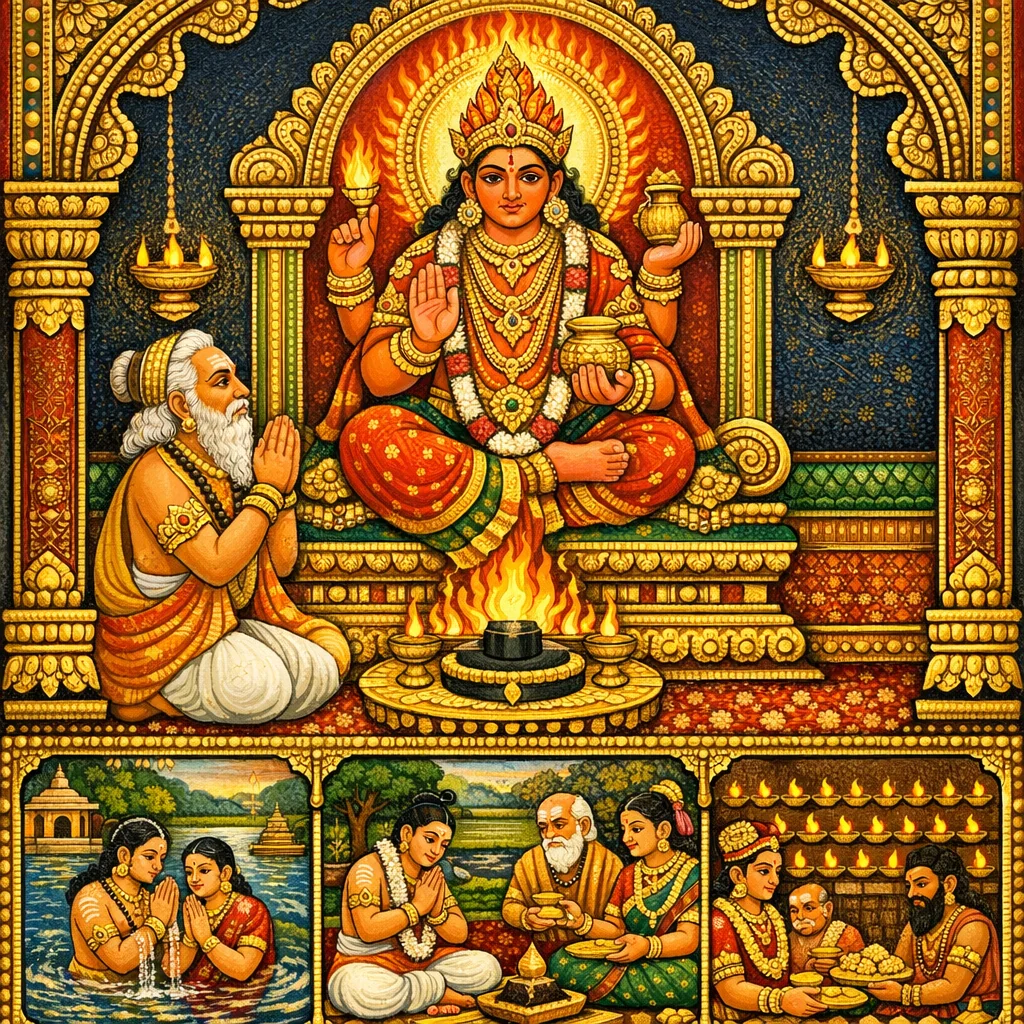
Adhyaya 109
Chapter 109 — Tīrtha-mahātmya (The Glory of Sacred Pilgrimage Places)
Agni begins by defining tīrtha-fruit (tīrtha-phala) as inseparable from self-restraint: disciplined hands, feet, and mind, a light diet, conquered senses, and avoidance of taking gifts are the ethical conditions that make pilgrimage spiritually effective. The text then equates pure pilgrimage and a three-night fast (kept without turning to other fords) with the merit of all sacrifices, presenting tīrtha-yātrā as a practical alternative to costly yajñas for those unable to perform elaborate rites. Pushkara is praised as a supreme tīrtha where divine presence intensifies at the three sandhyās; residence, japa, and śrāddha there are said to uplift lineages, grant Aśvamedha-like merit, and lead to Brahmaloka. The chapter proceeds as a catalogue of sacred geography, naming rivers, confluences, forests, mountains, and famed cities (Kurukṣetra, Prayāga, Vārāṇasī, Avanti, Ayodhyā, Naimiṣa, etc.), repeatedly linking bathing, dāna (especially food-giving in Kārttika), and remembrance/utterance with purification, heaven, or Brahmaloka. Kurukṣetra receives special emphasis: even its dust is salvific, and the presence of Sarasvatī and Viṣṇu-associated divinities makes it a high-intensity field of dharma.
Shlokas
Verse 1
अथ नवाधिकशततमो ऽध्यायः तीर्थमाहात्म्यं अग्निर् उवाच माहात्म्यं सर्वतीर्थानां वक्ष्ये यद्भक्तिमुक्तिदं यस्य हस्तौ च पादौ च मनश् चैव सुसंयतं
Now begins the one-hundred-and-ninth chapter, on the glory of the sacred pilgrimage places (tīrthas). Agni said: “I shall declare the greatness of all tīrthas—what bestows devotion and liberation—for one whose hands and feet, and whose mind as well, are well-restrained.”
Verse 2
विद्या तपश् च कीर्तिश् च स तीर्थफलमश्नुते स्वसंयतमिति घ प्रतिग्राहादुपावृत्तो लघ्वाहारो जितेन्द्रियः
Learning, austerity (tapas), and good repute—he attains the fruit of pilgrimage. He should be self-restrained, turn away from accepting gifts, take light food, and have conquered the senses.
Verse 3
निष्पपस्तीर्थयात्री तु सर्वयज्ञफलं लभेत् अनुपोष्य त्रिरात्रीणि तीर्थान्यनभिगम्य च
A pilgrim free from sin obtains merit equal to that of all sacrifices (yajña); and by observing a fast for three nights—without visiting other tīrthas—he gains that same fruit.
Verse 4
अदत्वा काञ्चनं गाश् च दरिद्रो नाम जायते तीर्थाभिओगमने तत् स्याद्यद्यज्ञेनाप्यते फलं
Without giving gold and cows, one becomes known as “poor.” But by undertaking a pilgrimage to the tīrthas, one obtains that very fruit which is gained even through a sacrifice (yajña).
Verse 5
पुष्करं परमं तीर्थं सान्निध्यं हि त्रिसन्ध्यकं दशकोटिसहस्राणि तीर्थानां विप्र पुष्करे
Pushkara is the supreme tīrtha. Indeed, at the three daily sandhyās (dawn, noon, and dusk) there is a special divine presence there. O brāhmaṇa, at Pushkara abide the merits of ten crores of thousands of tīrthas.
Verse 6
ब्रह्मा सह सुरैर् आस्ते मुनयः सर्वमिच्छवः देवाः प्राप्ताः सिद्धिमत्र स्नाताः पितृसुरार्चकाः
Brahmā abides here together with the gods; the sages (munis), desiring every spiritual attainment, also abide here. Here the gods attain perfection; and those who bathe here, as worshippers of the Pitṛs (ancestors) and the gods, attain fulfillment.
Verse 7
अश्वमेधफलं प्राप्य ब्रह्मलोकं प्रयान्ति ते कार्त्तिक्यामन्नदानाच्च निर्मलो ब्रह्मलोकभाक्
Gaining merit equal to that of the Aśvamedha sacrifice, they go to Brahmaloka. And by giving food in the month of Kārttika, one becomes purified and attains Brahmaloka.
Verse 8
पुष्करे दुष्करं गन्तुं पुष्करे दुष्करं तपः दुष्करं पुष्करे दानं वस्तुं चैव सुदुष्करं
To go to Puṣkara is difficult; austerity (tapas) at Puṣkara is difficult. Charity at Puṣkara is difficult, and dwelling there indeed is exceedingly difficult.
Verse 9
तत्र वासाज्जपच्छ्राद्धात् कुलानां शतमुद्धरेत् जम्बुमार्गं च तत्रैव तीर्थन्तण्डुलिकाश्रमं
By residing there—and by performing japa and śrāddha—one would uplift a hundred lineages. There itself are the sacred sites called Jambumārga and the tīrtha known as Taṇḍulikāśrama.
Verse 10
कर्णाश्रमं कोटितीर्थं नर्मदा चार्वुदं परं तीर्थञ्चर्मण्वती सिन्धुः सोमनाथः प्रभासकं
Karnāśrama; Koṭitīrtha; the Narmadā; the supreme holy place of Ārvuda; the sacred ford (tīrtha) of the Carmaṇvatī; the Sindhu; Somānātha; and Prabhāsa—these are holy places to be remembered.
Verse 11
सरस्वत्यब्धिसङ्गश् च सागरन्तीर्थमुत्तमं येति ख , ग , छ च अश्वमेधफलं चाप्येति घ ब्रह्मलोककमिति ख , ग , ङ , छ च दुष्करं गन्तुमिति ख वस्तुं तत्र सुदुष्करमिति ज कण्वाश्रममिति घ सरस्वत्यब्धिसञ्ज्ञयेति ग , घ , ज च पिण्डारकं द्वारका च गोमती सर्वसिद्धिदा
At the confluence of the Sarasvatī with the ocean lies the excellent sacred ford called Sāgara; one who goes there gains the merit of an Aśvamedha sacrifice and attains Brahmaloka. It is hard to reach, and dwelling there is exceedingly difficult. This place is also known as Kaṇvāśrama and is designated the “Sarasvatī–Ocean Confluence.” Piṇḍāraka, Dvārakā, and the river Gomatī bestow every spiritual attainment.
Verse 12
भूमितीर्थं ब्रह्मतुङ्गं तीर्थं पञ्चनदं परं भीमतीर्थं गिरीन्द्रञ्च देविका पापनाशिनी
Bhūmi-tīrtha, Brahma-tuṅga, the excellent tīrtha of Pañcanada, Bhīma-tīrtha, Girīndra, and Devikā—the remover of sins—are to be remembered as holy places.
Verse 13
तीर्थं विनशनं पुण्यं नागोद्भेदमघार्दनं तीर्थं कुमारकोटिश् च सर्वदानीरितानि च
The tīrtha called Vinaśana is meritorious; so too are Nāgodbheda, the sin-destroying tīrtha Aghārdana, and the tīrtha named Kumārakoṭi. All these are declared to be places of “universal gifting,” conferring the fruits of every charitable donation.
Verse 14
कुरुक्षेत्रं गमिष्यामि कुरुक्षेत्रे वसाम्यहं य एवं सततं ब्रूयात्सो ऽमलः प्राप्नुयाद्दिवं
“I shall go to Kurukṣetra; I dwell in Kurukṣetra.” Whoever continually utters this, purified of all taint, attains heaven.
Verse 15
तत्र विष्ण्वादयो देवास्तत्र वासाद्धरिं व्रजेत् सरस्वत्यां सन्निहित्यां स्नानकृद्ब्रह्मलोकभाक्
There the gods, beginning with Viṣṇu, reside; by dwelling there one attains Hari. And one who bathes when Sarasvatī (goddess/river) is present there becomes a sharer in Brahmā’s world, Brahmaloka.
Verse 16
पांशवोपि कुरुक्षेत्रे नयन्ति परमां गतिं धर्मतीर्थं सुवर्णाख्यं गङ्गाद्वारमनुत्तमं
Even the very dust of Kurukṣetra leads one to the highest attainment. There is the Dharma-tīrtha called Suvarṇa, and the unsurpassed Gaṅgā-dvāra, the Gateway of the Gaṅgā.
Verse 17
तीर्थं कणखलं पुण्यं भद्रकर्णह्रदन्तथा गङ्गासस्वतीसङ्गं ब्रह्मावर्तमघार्दनं
There is the holy tīrtha known as Kaṇakhala, likewise the Bhadrakarṇa Lake, the confluence of the Gaṅgā and Sarasvatī, and Brahmāvarta—these are all destroyers of sin.
Verse 18
भृगुतुङ्गञ्च कुब्जाम्रं गङ्गोद्भेदमघान्तकं वाराणसी वरन्तीर्थमविमुक्तमनुत्तमं
“(One should remember/recite) Bhṛgutunga, Kubjāmra, Gaṅgodbheda, and Aghāntaka; and also Vārāṇasī—the excellent tīrtha—Avimukta, the unsurpassed.”
Verse 19
कपालमोचनं तीर्थन्तीर्थराजं प्रयागकं गोमतीगङ्गयोः सङ्गं गङ्गा सर्वत्र नाकदा
Kapālamocana is a sacred ford; Prayāga is the king of sacred fords; the confluence of the Gomatī and the Gaṅgā is a holy meeting-place; and for the devoted the Gaṅgā is never absent anywhere.
Verse 20
तीर्थं राजगृहं पुण्यं शालग्राममघान्तकं ञ्ज्ञमिति छ भीमातीर्थमिति घ वामाद्दिवं ब्रजेदिति ज ब्रह्मलोकग इति ख , ग , घ , ङ , छ , ज च तत्र कर्णह्रदं तथेति ख भद्रकं तु ह्रदं तथेति ग , ङ च गङ्गोद्भेदमवन्तिकमिति ज वटेशं वामन्न्तीर्थं कालिकासङ्गमुत्तमं
“The holy ford called Rājagṛha is meritorious; so too Śālagrāma, the remover of sin. In some recensions it is read as ‘Ñjña’, and in another as ‘Bhīma-tīrtha’. Some read, ‘From Vāmana one goes to heaven’; and in several recensions it is stated that one ‘attains the world of Brahmā (Brahma-loka)’. There, some also read ‘Karṇa-hrada’, while others read ‘Bhadraka-hrada’. Another reading adds ‘Gaṅgodbheda’ and ‘Avantikā’. Further, Vaṭeśa, Vāmana-tīrtha, and the excellent confluence called Kālikā-saṅgama are mentioned.”
Verse 21
लौहित्यं करतोयाख्यं शोणञ्चाथर्षभं परं श्रीपर्वतं कोल्वगिरिं सह्याद्रिर्मलयो गिरिः
Lauhitya; the river known as Karatoyā; and also the Śoṇa; then the supreme Ṛṣabha (mountain); Śrīparvata; Kolvagiri; the Sahyādri; and Mount Malaya.
Verse 22
गोदावरी तुङ्गभद्रा कावेरो वरदा नदी तापी पयोष्णी रेवा च दण्डकारण्यमुत्तमं
Godāvarī, Tuṅgabhadrā, Kāverī, the river Varadā, Tāpi, Payoṣṇī, and Revā (Narmadā)—and the excellent Daṇḍaka forest-region (Daṇḍakāraṇya) are declared sacred and foremost.
Verse 23
कालञ्जरं मुञ्जवटन्तीर्थं सूर्पारकं परं मन्दाकिनी चित्रकूटं शृङ्गवेरपुरं परं
Kālañjara; the sacred ford (tīrtha) of Muñjavaṭa; the supreme Sūrpāraka; the Mandākinī river; Citrakūṭa; and the supreme city of Śṛṅgaverapura—these are to be revered as eminent holy places.
Verse 24
अवन्ती परमं तीर्थमयोध्या पापनाशनी नैमिषं परमं तीर्थं भुक्तिमुक्तिप्रदायकं
Avantī is the supreme sacred ford (tīrtha); Ayodhyā is the destroyer of sins. Naimiṣa is the supreme tīrtha, bestowing both worldly enjoyment (bhukti) and liberation (mukti).
Frequently Asked Questions
Self-restraint of body and mind, light diet, conquered senses, and turning away from accepting gifts; pilgrimage merit is tied to ethical discipline rather than travel alone.
It is described as hosting intensified divine presence at the three sandhyās; residence with japa and śrāddha uplifts lineages, and its merit is equated with major sacrifices and Brahmaloka attainment.
It states that a sinless pilgrim gains merit equal to all sacrifices, and that pilgrimage can yield the same fruit as yajña—making dharmic merit accessible beyond expensive ritual performance.
Kurukṣetra is portrayed as exceptionally potent: even its dust grants the highest attainment, gods reside there, and bathing when Sarasvatī is present yields Brahmaloka.