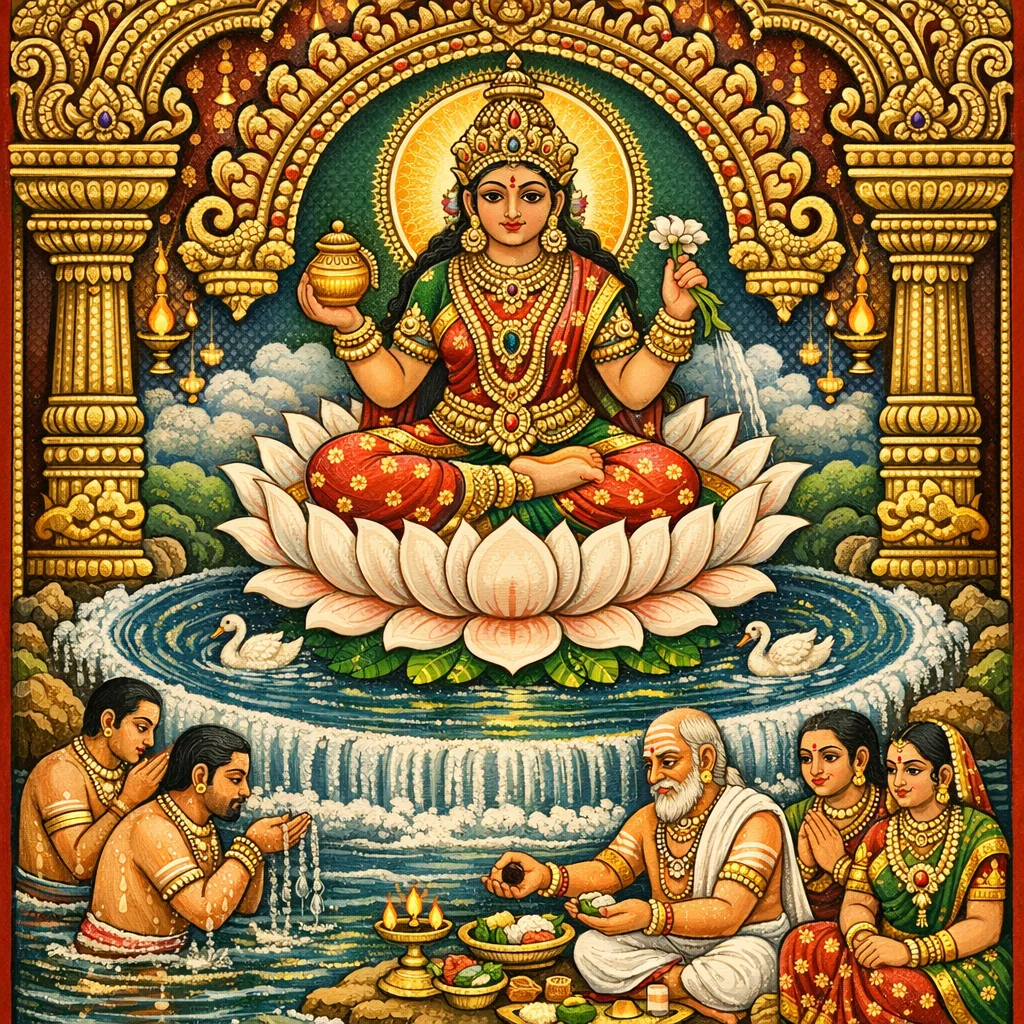
Adhyaya 110
गङ्गामाहात्म्यं (The Greatness of the Gaṅgā)
Continuing the Tīrtha-māhātmya, Lord Agni turns from the general glory of pilgrimage to a focused praise of the Gaṅgā as the supreme purifier in sacred geography. Lands touched by her flow are declared inherently sanctified, making geography itself a bearer of dharma. The Gaṅgā is set forth as the decisive ‘gati’ (refuge/way) for beings seeking the highest course, able through sustained worship to uplift both ancestral lines—forebears and descendants. Simple devotional acts—seeing, touching, drinking her waters, and reciting her praises—are extolled as immensely fruitful, surpassing severe penances; a month of devotion on her banks is equated with the fruit of all sacrifices. The funerary dimension is stressed: bone-remains placed in the Gaṅgā secure heavenly residence for as long as they remain there. The chapter ends by universalizing grace: even the hindered, such as the blind, attain godlike status through Gaṅgā-tīrtha, presenting the river as an accessible path to bhukti and mukti.
Shlokas
Verse 1
इत्य् आग्नेये महापुराणे तीर्थयात्रा माहात्म्यं नाम नवाधिकशततमो ऽध्यायः अथ दशाधिकशततमो ऽध्यायः गङामाहात्म्यं अग्निर् उवाच गङामाहात्म्यमाख्यास्ये सेव्या सा भुक्तिमुक्तिदा येषां मध्ये याति गङ्गा ते देशा पावना वराः
Thus, in the Agni Mahāpurāṇa ends the one-hundred-and-ninth chapter entitled “The Greatness of Pilgrimage.” Now begins the one-hundred-and-tenth chapter, “The Greatness of the Gaṅgā.” Agni said: “I shall recount the greatness of the Gaṅgā. She is to be revered; she bestows both worldly enjoyment and liberation. Those lands through whose midst the Gaṅgā flows are excellent and purifying.”
Verse 2
ह अग्निर् उवाच माहात्म्यं सर्वतीर्थानामित्यादिः, नैमिषं परमन्तीर्थं भुक्तिमुक्तिप्रदायकं इत्य् आग्नेये महापुराणे तीर्थयात्रामाहात्म्यमित्यन्तः पाठो झ पुस्तके नास्ति गतिर्गङ्गा तु भूतानां गतिमन्वेषतांअप्_११०००२अब् सदा गङ्गा तारयते चोभौ वंशौ नित्यं हि सेविता
Agni said: “(Here begins) the account of the glory of all sacred fords (tīrthas) and so on—‘Naimiṣa is the supreme sacred place, bestowing both worldly enjoyment and liberation (mokṣa).’” (In the Agni Mahāpurāṇa, the concluding reading ending with “tīrtha-yātrā-māhātmyam” is not found in the ‘Jha’ manuscript.) For beings who seek the highest course (gati), the Gaṅgā is truly the refuge and the way. Ever worshipped, the Gaṅgā continually delivers both lines of ancestry—forefathers and descendants.
Verse 3
चान्द्रायणसहस्राच्च गङ्गाम्भःपानमुत्तमं गङां मासन्तु संसेव्य सर्वयज्ञफलं लभेत्
Even more than a thousand Cāndrāyaṇa penances, the drinking of Gaṅgā water is supreme. By devotedly resorting to the Gaṅgā for a full month, one obtains the fruit of all sacrifices (yajña).
Verse 4
सकलाघहरी देवी स्वर्गलोकप्रदायिनी यावदस्थि च गङ्गायां तावत् स्वर्गे स तिष्ठति
The Goddess Gaṅgā removes all sins and bestows the heavenly world. For as long as a person’s bone-remains stay in the Gaṅgā, for that long he abides in heaven.
Verse 5
अन्धादयस्तु तां सेव्य देवैर् गच्छन्ति तुल्यतां गङ्गातीर्थसमुद्भूतमृद्धारी सो ऽघहार्कवत्
Even the blind and others, by resorting to the Gaṅgā-tīrtha—honored even by the gods—attain equality with them. That which arises from the sacred ford of the Gaṅgā bestows prosperity and removes sin, like the Sun dispelling darkness.
Verse 6
दर्शनात् स्पर्शनात् पानात्तथा गङ्गेतिकीर्तनात् पुनाति पुण्यपुरुषान् शतशीथ सहस्रशः
By merely seeing the Gaṅgā, by touching her waters, by drinking them, and likewise by singing or reciting the Gaṅgā’s praises, she purifies righteous people—hundreds and thousands, again and again.
Frequently Asked Questions
Darśana (seeing), sparśana (touching), pāna (drinking), and kīrtana (reciting/singing her praises) are explicitly listed as purifying acts.
It presents the Gaṅgā as both bhukti-mukti-dā (bestower of worldly enjoyment and liberation), where accessible devotional actions yield both material auspiciousness and ultimate spiritual release.
It states that the Gaṅgā, when continually worshipped, delivers both lines of ancestry—forefathers and descendants—highlighting intergenerational merit.
Yes. It notes that a concluding reading ending with “tīrtha-yātrā-māhātmyam” is not found in the ‘Jha’ manuscript, indicating a textual variant.