Adhyaya 120
Adhyaya 120 — भुवनकोषः (Bhuvanakośa: Cosmic Geography and Cosmological Measures)
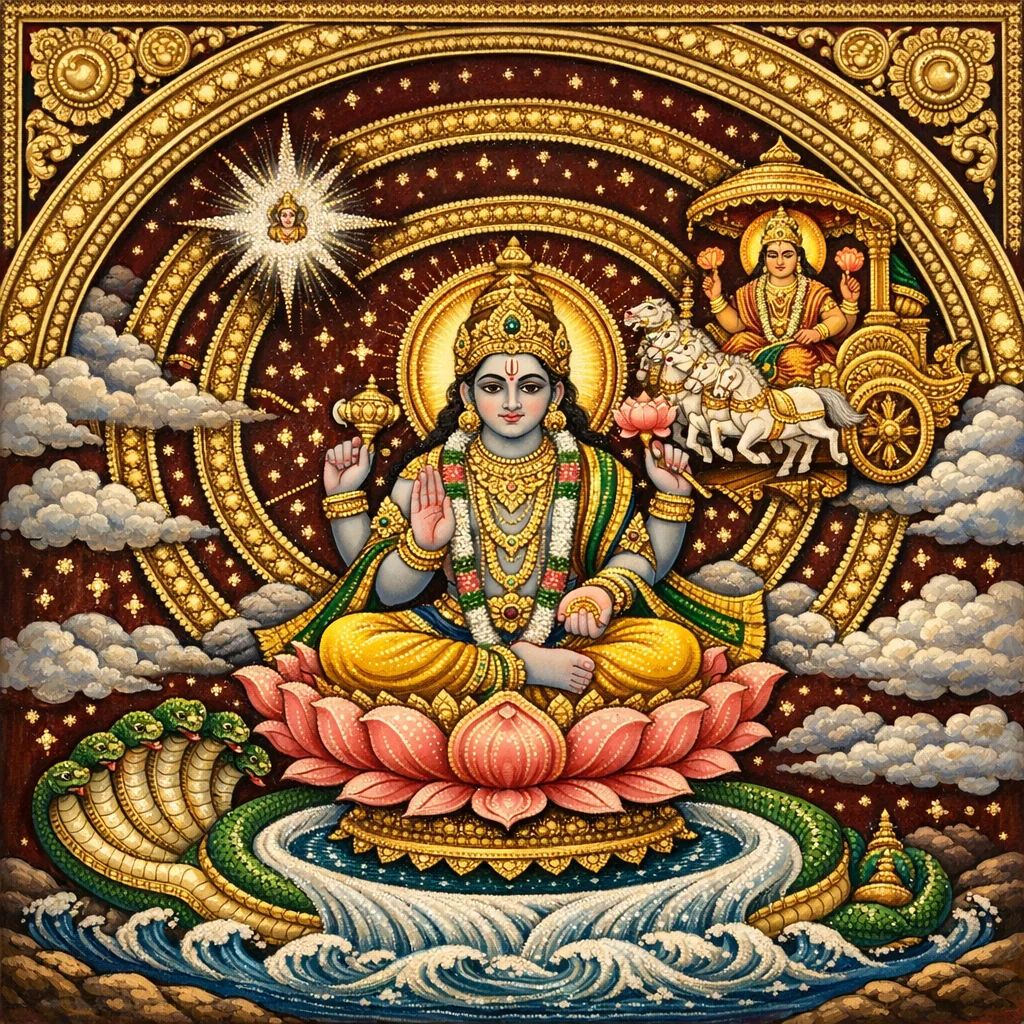
Agni teaches Vasiṣṭha a systematic cosmography: the earth’s dimensions, the seven netherworlds (Atala through Pātāla) with their varied terrains, and Śeṣa/Ananta as the tāmasa support of the earth. The account then rises through the hell-realms below, the Sun’s illumination of the world, and a graded set of astronomical distances—Sun, Moon, the nakṣatra-maṇḍala, and the planetary spheres—culminating in Dhruva and the higher lokas (Maharloka, Janaloka, Tapoloka, Satyaloka/Brahmaloka). It describes the cosmic egg (brahmāṇḍa) and its successive envelopes (water, fire, wind, space, bhūtādi, mahat, pradhāna), blending Sāṅkhya-like tattva language with Vaiṣṇava theology: Viṣṇu and Śakti as the causal power of manifestation. A jyotiḥśāstra-style section details the Sun’s chariot, the time-wheel, horses as Vedic metres, and the śiśumāra-form in the heavens with Dhruva at its tail; Gaṅgā’s celestial emergence is praised, and remembrance of her is said to destroy sin. The chapter closes by affirming Viṣṇu as the ground of being and knowledge, and by promising spiritual merit to one who recites this Bhuvanakośa.
Shlokas
Verse 1
झ च स्वादूदका द्वित्रिगुणेति ख , छ च स्वादूदका तु द्विगुणेति घ , ज च स्वादूदका तु द्विगुणेति ग , ङ च पञ्चाशत्कोटिविस्तृतेति छ अथ विंशत्यधिकशततमो ऽध्यायः भुवनकोषः अग्निर् उवाच विस्तारस्तु स्मृतो भूमेः सहस्राणि च सप्ततिः उच्छ्रायो दशसाहस्रं पातालञ्चैकमेककं
“(In the metrical/mnemonic scheme:) jha—‘the sweet waters are twice and thrice (in extent)’; kha—; cha—‘the sweet waters are indeed double’; gha—; ja—‘the sweet waters are indeed double’; ga—; ṅa—‘(it is) expanded to fifty koṭis’; cha—.” Now begins the one hundred and twentieth chapter, “Bhuvanakośa (Cosmic Geography)”. Agni said: The breadth of the Earth is remembered as seventy thousand yojanas; its height is ten thousand; and each of the Pātālas is one thousand yojanas.
Verse 2
अतलं वितलञ्चैव नितलञ्च गभस्तिमत् महाख्यं सुतलञ्चाग्र्यं पातालञ्चापि सप्तमं
Atala, Vitala, and Nitala; then Gabhastimat; Mahākhya; the excellent Sutala; and Pātāla as the seventh—these are the seven netherworlds.
Verse 3
कृष्णपीतारुणाः शुक्लशर्कराशैलकाञ्चनाः भूमयस्तेषु रम्येषु सन्ति दैत्यादयः सुखं
There are lands of black, yellow, and ruddy hue, and also lands of white gravel, mountainous regions, and golden ground. In those delightful regions, the Daityas and others dwell happily.
Verse 4
पातालानामधश्चास्ते शेषो विष्णुश् च तामसः गुणानन्त्यात्स चानन्ततः शिरसा धारयन्महीं
Below the Pātālas lies Śeṣa—also called Viṣṇu in his tāmasa (cosmic) aspect. Because his qualities are endless, he is known as Ananta; upon his head he upholds the earth.
Verse 5
भुवो ऽधो नरका नैके न पतेत्तत्र वैष्णवः रविणा भासिता पृथ्वी यावत्तायन्नभो मतं
Below the earth there are many hell-realms; a Vaiṣṇava (devotee of Viṣṇu) does not fall there. It is held that the earth remains illumined by the Sun for as long as the sky extends above.
Verse 6
भूमेर्योजनलक्षन्तु विशिष्ठरविमण्डलं रवेर् लक्षेण चन्द्रश् च लक्षान्नाक्षत्रमिन्दुतः
The Sun’s disk is said to extend one hundred thousand yojanas relative to the Earth; the Moon is measured as one hundred thousand (yojanas) in relation to the Sun; and from the Moon, the circle of lunar mansions (nakṣatra-maṇḍala) is one hundred thousand (yojanas).
Verse 7
द्विलक्षाद्भाद्बुधश्चास्ते बुधाच्छुक्रो द्विलक्षतः द्विलक्षेण कुजः शुक्राद्भौमाद् द्विलक्षतो गुरुः
From Bhā (the Sun), Budha (Mercury) is situated at a distance of two lakṣas; from Budha, Śukra (Venus) is at two lakṣas. Two lakṣas from Śukra is Kuja (Mars); and from Bhauma (Mars), Guru (Jupiter) is at two lakṣas.
Verse 8
गुरोर्द्विलक्षतः सौरित्ल्लक्षात्सप्तर्षयः शनेः लक्षाद् ध्रुवो ह्य् ऋषिभ्यस्तु त्रैलोक्यञ्चोच्छ्रयेण च
At a distance of two lakṣas from Guru (Jupiter) is Sauri (Saturn); at a distance of one lakṣa from Śani (Saturn) are the Seven Sages (the Saptarṣis constellation). One lakṣa beyond the Sages is Dhruva (the Pole Star); and above that, rising higher still, is the threefold world (trailokya).
Verse 9
ध्रुवात् कोट्या महर्लोको यत्र ते कल्पवासिनः जनो द्विकोटितस्तस्माद्यत्रासन् सनकादयः
At a distance of one koṭi (ten million yojanas) from Dhruva lies Maharloka, where beings who endure for an entire kalpa reside. At twice that distance from there is the region where Sanaka and the other primordial sages dwell.
Verse 10
जनात्तपश्चाष्तकोट्या वैराजा यत्र देवताः षणवत्या तु कोटीनान्तपसः सत्यलोककः
With an austerity-measure of eight koṭis is attained the Janas-world, where the deities called Vairājas dwell; and with an austerity-measure of ninety-six koṭis of tapas is attained Satyaloka.
Verse 11
अपुनर्मारका यत्र ब्रह्मलोको हि स स्मृतः पादगम्यस्तु भूल्लोको भुवः सूर्यान्तरः स्मृतः
That realm where there is no return to death is indeed remembered as Brahmaloka. The Bhūloka (earthly world) is said to be reachable by foot, while Bhuvaḥ (Bhuvarloka) is remembered as the region lying in the interval up to the Sun.
Verse 12
स्वर्गलोको ध्रुवान्तस्तु नियुतानि चतुर्दश एतदण्डकटाहेन वृतो ब्रह्माण्डविस्तरः
The heavenly realm, extending up to Dhruva (the Pole Star), measures fourteen niyutas; and the expanse of the Brahmāṇḍa (cosmic egg) is enclosed by this ‘egg-like cauldron’ (aṇḍa-kaṭāha).
Verse 13
वारिवह्न्यनिलाकाशैस्ततो भूतादिना वहिः वृतं दशगुणैर् अण्डं भूतादिर्महता तथा
Then, externally, the cosmic egg is enclosed by water, fire, wind, and space; and beyond these it is enveloped by Bhūtādi (the principle of the elements) in tenfold measure, and Bhūtādi in turn is likewise enclosed by Mahat (the Great Principle).
Verse 14
दशोत्तराणि शेषाणि एकैकस्मान्मामुने महान्तञ्च समावृत्य प्रधानं समवस्थितं
O sage, the remaining principles—those numbering ten and above—each arise from the preceding one; and, enveloping even the Mahat (the Great Principle), Pradhāna (Primordial Nature) stands as the underlying ground.
Verse 15
अनन्तस्य न तस्यान्तः सङ्ख्यानं नापि विद्यते हेतुभूतमशेषस्य प्रकृतिः सा परा मुने
Of the Infinite (Ananta) there is no end; nor is any enumeration possible. That supreme Prakṛti, O sage, is the causal ground of all without remainder.
Verse 16
असङ्ख्यातानि शाण्डानि तत्र जातानि चेदृशां दारुण्यग्निर्यथा तैलं तिले तद्वत् पुमानिति
Countless ‘śāṇḍas’ are born there for such persons; and just as fierce fire draws out oil from sesame seeds, so (that torment extracts the essence of their being)—thus it is said.
Verse 17
प्रधाने च स्थितो व्यापी चेतनात्मात्मवेदनः प्रधानञ्च पुमांश् चैव सर्वभूतात्मभृतया
All-pervading, abiding even in Pradhāna (primordial Nature), the conscious Self—self-luminous through self-knowledge—sustains as the inner Self of all beings both Pradhāna and the Person (Puruṣa).
Verse 18
विष्णुशक्त्या महाप्राज्ञ वृतौ संश्रयधर्मिणौ तयोः सैव पृथग्भावे कारणं संश्रयस्य च
O greatly wise one, Viṣṇu and His Śakti are mutually encompassed (as it were) and are of the nature of dependence; and that very (Śakti) is the cause both of their appearing as distinct and of the relation of dependence itself.
Verse 19
अ वै इति ङ अयुतानि इति ज सङ्ख्यानं नैव विद्यते इति घ , झ च सङ्ख्यानं न च विद्यते इति ग पुमानपि इति घ , झ च प्रधाने ऽवस्थितं इति ख , ग , ङ च सर्वभूतानुभूतया इति ङ द्वयोरिति झ क्षोभकारणभूतश् च सर्गकाले महामुने यथा शैत्यं जले वातो विभर्ति कणिकागतं
“A” and “vai” are indicated by the marker ṅa; “ayutāni” by ja. The phrase “its number is not at all known” is denoted by gha and also jha; and “its number is not known” by ga. “Even the male (principle)” is denoted by gha and also jha. “Situated in the Pradhāna (primordial nature)” is denoted by kha, ga, and ṅa; and “by the experience of all beings” by ṅa; “of the two” by jha. And it is the cause of agitation at the time of creation, O great sage—just as wind carries coldness in water, present there in minute particles.
Verse 20
जगच्छक्तिस् तथा विष्णोः प्रधानप्रतिपादिकां विष्णुशक्तिं समासाद्य देवाद्याः सम्भवन्ति हि
Likewise, the world-power (jagat-śakti) is indeed Viṣṇu’s; it is that which indicates and functions as Pradhāna. Having attained that power of Viṣṇu, the gods and the rest come into manifestation.
Verse 21
स च विष्णुः स्वयं ब्रह्म यतः सर्वमिदं जगत् योजनानां सहस्राणि भास्करस्य रथो नव
And that Viṣṇu indeed is Brahman Himself, from whom this entire universe arises. The chariot of the Sun (Bhāskara) measures nine thousand yojanas.
Verse 22
ईशादण्डस्तथैवास्य द्विगुणो मुनिसत्तम
Likewise, O best of sages, its īśa-daṇḍa (the controlling, principal rod) is to be made double in measure.
Verse 23
सार्धकोटिस् तथा सप्तनियुतान्यधिकानि वै अप्_१२००२२चेयोजनानान्तु तस्याक्षस्तत्र चक्रं प्रतिष्ठितं त्रिनाभिमतिपञ्चारं षण्णेमि द्व्ययनात्मकं
Its axle measures one and a half kroṭis, and moreover seven niyutas of yojanas. Upon that axle a wheel is fixed—having three hubs, fifty spokes, six rims, and constituted of two courses (or two layers).
Verse 24
संवत्सरमयं कृत्स्नं कालचक्रं प्रतिष्ठितं चत्वारिंशत्सहस्राणि द्वितीयक्षो विवस्वतः
The entire wheel of Time is established as consisting of years. For Vivasvat (the Sun), forty thousand (units) constitute the second measure of time.
Verse 25
पञ्चान्यानि तु सार्धानि स्यन्दनस्य महामते अक्षप्रमाणमुभयोः प्रमाणन्तदद्युगार्धयोः
O wise one, the chariot (syandana) should have five and a half (units) more in measure. The axle-length on both sides is the standard measure, and that same measure applies to half of the yoke as well.
Verse 26
ह्रस्वो ऽक्षस्तद्युगार्धञ्च ध्रुवाधारं रथस्य वै हयाश् च सप्त छन्दांसि गायत्र्यादीनि सुव्रत
The axle is short, and so too is half of the yoke; the fixed support (dhruvādhāra) indeed is the chariot’s base. And the horses are the seven Vedic metres—beginning with Gāyatrī, O you of good vows.
Verse 27
उदयास्तमनं ज्ञेयं दर्शनादर्शनं रवेः यावन्मात्रप्रदेशे तु वशिष्ठो ऽवस्थितो ध्रुवः
Sunrise and sunset are to be understood as the appearance and disappearance of the Sun. In the region bounded by the measure of the visible horizon, the star Vasiṣṭha remains fixed as Dhruva (the Pole Star).
Verse 28
स्वयमायाति तावत्तु भूमेराभूतसम्प्लवे ऊर्धोत्तरमृषिभ्यस्तु ध्रुवो यत्र व्यवस्थितः
Until the dissolution (cataclysm) of the earth comes to pass, it (that celestial body/point) arrives there of itself—into the higher northern region, beyond the sages—where Dhruva is established.
Verse 29
एतद्विष्णुपदं दिव्यं तृतीयं व्योम्नि भास्वरं निर्धूतदोषपङ्कानां यतीनां स्थानमुत्तमं
This is the divine Viṣṇu-pada—the third, radiant realm in the sky—the highest station of yatis (ascetics) who have wholly shaken off the mire of faults.
Verse 30
भूमेराहूतसम्प्लवे इति घ , ज च ततो गङ्गा प्रभवति स्मरणात् पाशनाशनी दिवि रूपं हरेर्ज्ञेयं शिशुमाराकृति प्रभो
“At the samplava (inundation) invoked for the earth”—so the textual tradition indicates. From that the river Gaṅgā comes forth; by mere remembrance of her she destroys the noose (of bondage and sin). And, O Lord, one should understand that Hari’s form in the heavens is shaped as a śiśumāra, a celestial dolphin/alligator-like constellation-form.
Verse 31
स्थितः पुच्छे ध्रुवस्तत्र भ्रमन् भ्रामयति ग्रहान् स रथो ऽधिष्ठिता देवैर् आदित्यैर् ऋषिभिर्वरैः
There, Dhruva, stationed at the tail-end of that celestial formation, revolves and thereby causes the planets to revolve. That chariot is presided over by the gods—by the Ādityas and by eminent ṛṣis.
Verse 32
गन्धर्वैर् अप्सरोभिश् च ग्रामणीसर्पराक्षसैः हिमोष्णवारिवर्षाणां कारणं भगवान् रविः
Through the agency of Gandharvas and Apsarases, and also of the Grāmaṇīs, serpents, and Rākṣasas, the Blessed Ravi (the Sun) becomes the operative cause of cold, heat, and the raining down of water.
Verse 33
ऋग्वेदादिमयो विष्णुः स शुभाशुभकारणं रथस्त्रिचक्रः सोमस्य कुन्दाभास्तस्य वाजिनः
Viṣṇu is constituted of the Ṛgveda and the other Vedas; he is the causal basis of what is auspicious and inauspicious. Soma’s chariot has three wheels, and his steeds are white like jasmine blossoms.
Verse 34
वामदक्षिणतो युक्ता दश तेन चरत्यसौ त्रयस्त्रिंशत्सहस्राणि त्रयस्त्रिंशच्छतानि च
Joined with the count of ten, and reckoned from the left and the right, it proceeds through thirty-three thousand and thirty-three hundreds (i.e., 33,300).
Verse 35
त्रयस्त्रिंशत्तथा देवाः पिवन्ति क्षणदाकरं एकां कलाञ्च पितर एकामारश्मिसंस्थिताः
Likewise, the thirty-three gods ‘drink’ one kṣaṇa of the Sun; and the Pitṛs, stationed in the Sun’s rays, ‘drink’ one kalā.
Verse 36
वाय्वग्निद्रव्यसम्भूतो रथश् चन्द्रसुतस्य च अष्टाभिस्तुरगैर् युक्तो बुधस्तेन चरत्यपि
The chariot of Budha (Mercury), the son of the Moon, is formed from substances of wind and fire; yoked with eight horses, Budha moves along in it as well.
Verse 37
शुक्रस्यापि रथो ऽष्टाश्वो भौमस्यापि रथस् तथा वृहस्पते रथो ऽष्टाश्वः शनेरष्टाश्वको रथः
Venus, too, has a chariot drawn by eight horses; Mars likewise has such a chariot. Jupiter’s chariot is drawn by eight horses, and Saturn’s chariot also has eight horses.
Verse 38
स्वर्भानोश् च रथो ऽष्टाश्वः केतोश्चाष्टाश्वको रथः यदद्य वैष्णवः कायस्ततो विप्र वसुन्धरा
Svarbhānu (Rāhu) has a chariot yoked with eight horses, and Ketu too has a chariot drawn by eight horses. From the very day that the body (form) became Vaiṣṇava, O brāhmaṇa, the Earth (Vasundharā) became steady/benefited accordingly.
Verse 39
सर्वपापप्रणाशिनीति ज ऋषभो रवेरिति ग , घ , ङ , ज च सरथ इत्य् आदिः, राक्षसैर् इत्यन्तः पाठः झ पुस्तके नास्ति कुन्दाभास्तत्र वाजिन इति क , घ , ङ च क्षणदाचरमिति झ पद्माकरा समुद्भूता पर्वताद्यादिसंयुता ज्योतिर्भुवननद्यद्रिसमुद्रवनकं हरिः
From the lotus-lake (Padmākarā) there arose a sacred expanse, joined with mountains and all else. Hari (Viṣṇu) pervades as the luminous world—its rivers, mountains, oceans, and forests—and by that all-encompassing presence becomes the remover of all sins.
Verse 40
यदस्ति नास्ति तद्विष्णुर्विष्णुज्ञानविजृम्भितं न विज्ञानमृते किञ्चिज् ज्ञानं विष्णुः परम्पदं
Whatever exists and whatever does not exist—this is all Viṣṇu; it is the unfoldment of Viṣṇu’s knowledge. Nothing whatsoever stands apart from true discernment; knowledge is Viṣṇu, the supreme state.
Verse 41
तत् कुर्याद् येन विष्णुः स्यात् सत्यं ज्ञानमनन्तकं पठेद् भुवनकोषं हि यः सो ऽवाप्तसुखात्मभाक्
One should do that by which Viṣṇu is attained—He who is Truth itself, Knowledge itself, and the Infinite. Indeed, whoever recites the Bhuvanakośa (the compendium of the worlds) becomes a soul endowed with attained happiness.
Verse 42
ज्योतिःशास्त्रादिविध्याश् च शुभाशुभाधिपो हरिः
And in the disciplines beginning with Jyotiḥśāstra (astral science) as well—Hari is the sovereign regulator of the auspicious and the inauspicious.
Frequently Asked Questions
Precise cosmological and astronomical metrics (yojana, lakṣa, koṭi, niyuta) for Earth’s dimensions, the stacked lokas, planetary distances, and the construction-measures of the Sun’s chariot (axle, wheel, spokes, rims), framed within a theological cosmology.
It turns cosmography into devotion and discernment: locating Viṣṇu as the ground of all tattvas and worlds, praising Gaṅgā’s purifying remembrance, and promising sukha to the reciter—thereby aligning jyotiḥśāstra-style knowledge with purification and liberation-oriented contemplation.
A symbolic celestial configuration described as Hari’s form in the heavens, with Dhruva positioned at its tail, used to explain cosmic rotation and devotional visualization of the sky as a theophany.
The brahmāṇḍa is described with successive enclosures and higher principles (bhūtādi, mahat, pradhāna), while asserting that Viṣṇu and Śakti are the causal power behind manifestation, integrating tattva-analysis into Vaiṣṇava theism.