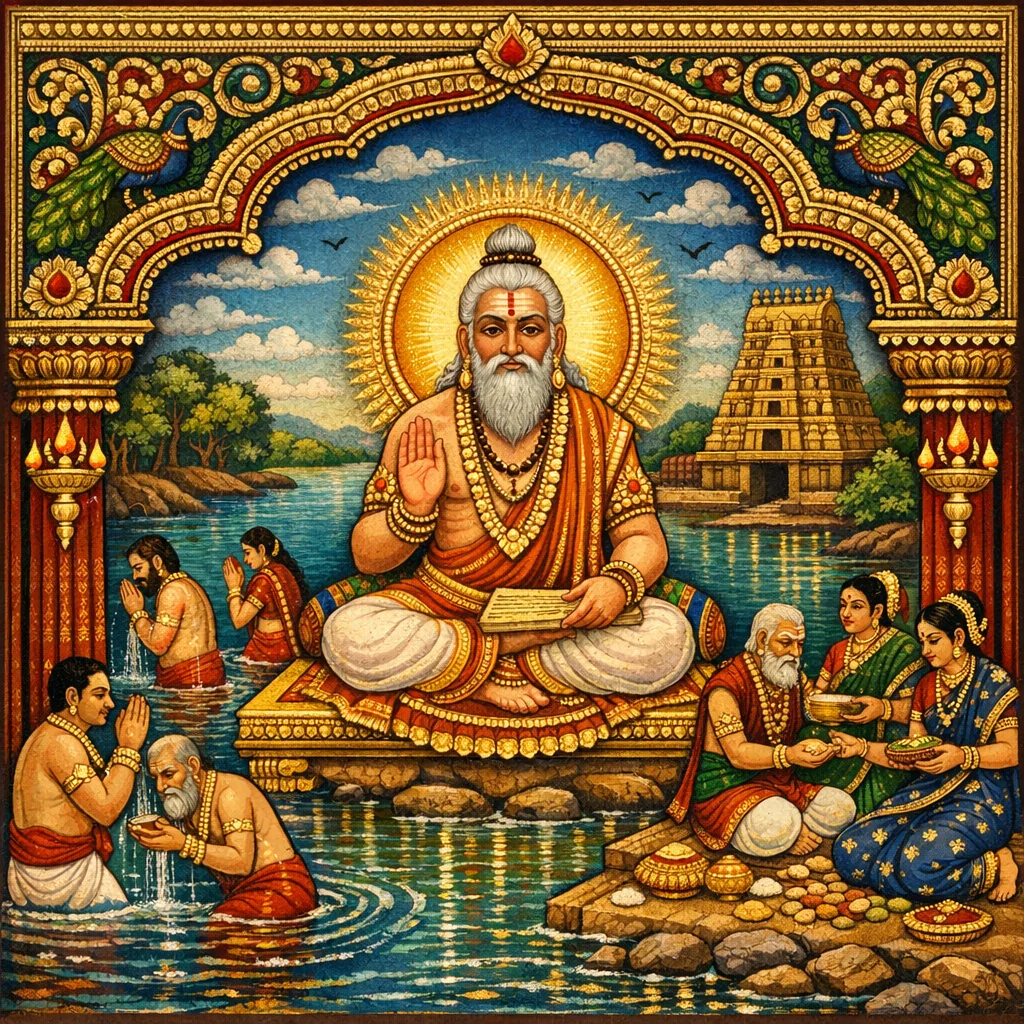
Adhyaya 112
Prayāga-māhātmya (Conclusion Notice)
This unit serves as a transitional colophon marking the completion of the Prayāga-māhātmya within the Agneya Purāṇa’s tīrtha corpus. By formally closing the preceding discourse, it preserves the Purāṇic pedagogy that teaches sacred geography as applied dharma: particular places are presented as means of merit (puṇya), purification, and aligning worldly life with liberation (mokṣa). The closure also signals the systematic progression of Agneya Vidyā, moving from one tīrtha’s ritual-theological profile to the next and building a coherent map of kṣetras that supports the Purāṇa’s wider encyclopedic aims (ritual, iconography, governance, and allied sciences).
Shlokas
Verse 1
इत्य् आग्नेये महापुराणे प्रयागमाहात्म्यं नाम एकादशाधिकशततमो ऽध्यायः अथ द्वादशाधिकशततमो ऽध्यायः वाराणसीमाहात्म्यम् अग्निर् उवाच वाराणसी परं तीर्थं गौर्यै प्राह महेश्वरः भुक्तिमुक्तिप्रदं पुण्यं वसतां गृणतां हरिं
Thus, in the Agni Mahāpurāṇa ends the one-hundred-and-twelfth chapter entitled “The Greatness of Prayāga.” Now begins the one-hundred-and-thirteenth chapter, “The Greatness of Vārāṇasī.” Agni said: “Vārāṇasī is the supreme tīrtha; Maheśvara declared it to Gaurī. It is holy, granting both worldly enjoyment (bhukti) and liberation (mukti) to those who dwell there and to those who praise Hari.”
Verse 2
रुद्र उवाच गौरीक्षेत्रं न मुक्तं वै अविमुक्तं ततः स्मृतं अन्नदानाद्दिवमिति ख , ग , घ , ङ , छ , ज च तीर्थं वानरकं परमिति ख , ग , घ , ङ च वाराणसीमिति ख , घ च वसतां शृणुतां हरिमिति ग , घ , ङ च जप्तं तप्तं दत्तममविमुक्ते विलाक्षयं
Rudra said: “This is Gaurī’s sacred region; it is truly ‘not forsaken,’ therefore it is remembered as Avimukta. ‘By the gift of food one attains heaven.’ It is the supreme tīrtha called Vānaraka, and it is also called Vārāṇasī. For those who dwell there and for those who listen there, the fruit is Hari. Whatever japa is recited, whatever tapas is performed, and whatever dāna is given in Avimukta becomes imperishable.”
Verse 3
अश्मना चरणौ हत्वा वसेत्काशीन्न हि त्यजेत् हरिश् चन्द्रं परं गुह्यं गुह्यमाम्नातकेश्वरं
Even if one has struck (another’s) feet with a stone, one should dwell in Kāśī and never abandon it—for there are Hariścandra, the supremely secret tīrtha, and the secret liṅga Āmnātakeśvara.
Verse 4
जप्येश्वरं परं गुह्यं गुह्यं श्रीपर्वतं तथा महालयं परं गुह्यं भृगुश् चण्डेश्वरं तथा
Japyeśvara—supremely secret—and likewise Śrīparvata, a secret holy place; Mahālaya, supremely secret; and also the Bhṛgu tīrtha and Caṇḍeśvara as well.
Verse 5
केदारं परमं गुह्यमष्टौ सन्त्यविमुक्तके गुह्यानां परमं गुह्यमविमुक्तं परं मम
Kedāra is the supreme secret; in Avimukta there are eight such sacred mysteries. Among all secrets, Avimukta is the highest secret—it is My supreme abode.
Verse 6
द्वियोजनन्तु पूर्वं स्याद् योजनार्धं तदन्यथा वरणा च नदी चासीत् तयोर्मध्ये वाराणसी
On the eastern side it extends for two yojanas; on the other side it is one-and-a-half yojanas. There are the rivers Varaṇā and Asī; Vārāṇasī lies between those two.
Verse 7
अत्र स्नानं जपो होमो मरणं देवपूजनं श्राद्धं दानं निवासश् च यद्यत् स्याद्भुक्तिमुक्तिदं
Here, whatever occurs—bathing, mantra-recitation (japa), fire-offering (homa), even death, worship of the gods, śrāddha rites, gifting (dāna), and residence—becomes a bestower of both worldly enjoyment and liberation (mukti).
Frequently Asked Questions
Purāṇas often preserve transmission markers that close one adhyāya and cue the next; here it signals a curated sequence of tīrthas within the Bhuvanakośa–Tīrtha-māhātmya framework.
It reinforces modular organization—each tīrtha is treated as a discrete knowledge-unit, enabling systematic traversal of sacred geography alongside the Purāṇa’s other vidyās.