Adhyaya 192
Chapter Arc: द्रोण के अस्त्रों से कटती हुई पाण्डव-सेना में यह भय फैलता है कि रण में उन्हें कोई जीत नहीं सकता—देवों सहित भी नहीं; फिर भी पांचाल-सृञ्जय महारथी उन्हीं पर टूट पड़ते हैं। → द्रोण के अजेय-प्रतीत पराक्रम के सामने पाण्डव-पक्ष एक कठोर युक्ति पर विचार करता है—अश्वत्थामा के मारे जाने की (असत्य/अर्धसत्य) घोषणा से गुरु का मन तोड़ना। युधिष्ठिर इस उपाय से भीतर ही भीतर जूझते हैं; अन्य अधिकांश इसे युद्ध-धर्म की विवशता मानकर स्वीकारते हैं। → भीम गदा से ‘अश्वत्थामा’ नामक हाथी को मार गिराते हैं और उसी क्षण ‘अश्वत्थामा हतः’ का घोष उठता है; युधिष्ठिर से सत्य की प्रतिष्ठा के सहारे इस वाक्य को विश्वसनीय बनाने का दबाव पड़ता है—यहीं अध्याय का नैतिक-रण अपने चरम पर पहुँचता है। → द्रोण के सामने सत्य-प्रतिष्ठित वचन की शक्ति का उपयोग करने की तैयारी बनती है; युधिष्ठिर कठिन मन से उस युक्ति की ओर झुकते हैं, जबकि द्रोण अभी भी रण में ब्रह्मास्त्र तक प्रकट कर पांचालों के बाणसमूहों को विध्वस्त करते रहते हैं। → असत्य-घोष के प्रभाव से क्या द्रोण शस्त्र त्यागेंगे, या क्रोध में और प्रलयकारी अस्त्र चलाएँगे—युद्ध का पलड़ा अगले क्षण किस ओर झुकेगा?
Shlokas
Verse 1
इस प्रकार श्रीमहाभारत द्रोणपर्वके अन्तर्गत द्रोणवधपर्वमें संकुलयुद्धविषयक एक सौ नवासीवाँ अध्याय पूरा हुआ ॥/ १८९ ॥। ऑपन-- माल बछ। जि ३. जिधर बाणके फलका रुख हो, उससे विपरीत रुखवाले दो काँटोंसे युक्त बाणको “कर्णी” कहते हैं। शरीरमें धँस जानेपर यदि उसे निकाला जाय तो वह आँतोंको भी अपने साथ खींच लेता है, इसलिये निन्द्य है। २. 'नालीक” नामक बाण अत्यन्त छोटा होता है, वह शरीरमें पूरा-का-पूरा डूब जाता है, अतः उसे निकालना कठिन हो जाता है। 3. बाणके डंडे और फलके संधि-स्थानमें, जो अत्यन्त पतला होता है, उस बाणको “वस्तिक' कहते हैं। उसे शरीरसे निकालनेपर वह बीचसे टूट जाता है, फल भीतर रह जाता है और केवल डंडा बाहर निकल पाता है। ४. 'सूची” नामक बाण भी कर्णके ही समान होता है। अन्तर इतना ही है कि इसमें बहुत-से कण्टक होते हैं। ५. कुछ लोग “कपिश' को भी सूचीके ही समान मानते हैं। किन्हींके मतमें 'कपिश” का फल बंदरकी हड्डीका बना होता है। अधिकांश लोगोंका मत है कि “कपिश' काले लोहेका बना होता है, उसका हलका आघात लगनेपर भी वह शरीरमें गहराईतक घुस जाता है। मेदिनीकोषके अनुसार कपिशका अर्थ काला है भी। ६-७. जिसका फल गायकी हड्डीका बना हो, वह “गवास्थिज” और जिसका हाथीकी हड्डीका बना हो, वह “गजास्थिज' कहलाता है। इसका असर भी विषलिप्त बाणके समान ही होता है। नवर्त्याधेकशततमो<् ध्याय: द्रोणाचार्यका घोर कर्म, ऋषियोंका द्रोणको अस्त्र त्यागनेका आदेश तथा अभ्रृत्थामाकी मृत्यु सुनकर द्रोणका जीवनसे निराश होना संजय उवाच पज्चालानां ततो द्रोणो5प्यकरोत् कदनं महत् | यथा क्ुद्धों रणे शक्रो दानवानां क्षयं पुरा,संजय कहते हैं--राजन्! तदनन्तर द्रोणाचार्यने कुपित होकर रणभूमिमें पांचालोंका उसी प्रकार संहार आरम्भ किया, जैसे पूर्वकालमें इन्द्रने दानवोंका विनाश किया था
Sañjaya said: O King, thereafter Droṇa too, inflamed with anger, began a great slaughter of the Pāñcālas on the battlefield—just as, in former times, Indra, wrathful in war, brought about the destruction of the Dānavas. The verse frames Droṇa’s violence as a cosmic-scale act of retribution, raising the ethical tension between a warrior’s duty in battle and the moral cost of rage-driven annihilation.
Verse 2
द्रोणास्त्रेण महाराज वध्यमाना: परे युधि । नात्रसन्त रणे द्रोणात् सत्त्ववन्तो महारथा:,महाराज! द्रोणाचार्यके अस्त्रसे मारे जानेवाले शत्रुदलके महारथी वीर बड़े धैर्यशाली थे, अतः: वे रणभूमिमें उनसे तनिक भी भयभीत न हुए
Sañjaya said: “O King, though the opposing warriors were being struck down in battle by Droṇa’s celestial weapon, the great chariot-fighters among them—men of steadfast courage—did not lose heart. On that field they showed no fear of Droṇa, even amid the deadly onslaught.”
Verse 3
युध्यमाना महाराज पज्चाला: सृञ्जयास्तथा । द्रोणमेवा भ्ययुर्युद्धे योधयन्तो महारथा:,राजेन्द्र! युद्धपरायण पांचाल और सूंजय महारथी संग्राममें द्रोणाचार्यके साथ युद्ध करते हुए उन्हींकी ओर बढ़े आ रहे थे
Sañjaya said: O King, the Pāñcālas and the Sṛñjayas—great chariot-warriors intent on battle—advanced straight toward Droṇa, engaging him in combat. The verse underscores the grim resolve of kṣatriya warfare: disciplined courage directed toward a formidable teacher-commander, where duty to one’s side overrides personal reverence.
Verse 4
तेषां तु च्छाद्यमानानां पञ्चालानां समन्ततः । अभवद् भैरवो नादो वध्यतां शरवृष्टिभि:
Sañjaya said: As the Pāñcālas were being covered on all sides, a dreadful roar arose—while they were being struck down beneath a rain of arrows. The verse underscores the brutal momentum of battle, where martial prowess turns into overwhelming violence and the human cost becomes audible in the very soundscape of war.
Verse 5
बाणोंकी वर्षासे आच्छादित हो सब ओरसे मारे जानेवाले पांचालवीरोंका भयंकर आर्तनाद सुनायी देने लगा ।। वध्यमानेषु संग्रामे पडचालेषु महात्मना । उदीर्यमाणे द्रोणास्त्रे पाण्डवान् भयमाविशत्,संग्राममें जब इस प्रकार महामनस्वी ट्रोणाचार्यके द्वारा पांचाल-सैनिक मारे जाने लगे और आचार्य द्रोणके अस्त्र लगातार बरसने लगे, तब पाण्डवोंके मनमें बड़ा भय समा गया
Sañjaya said: As the great-souled warrior cut down the Pāñcālas in the thick of battle, and as Droṇa’s weapon-force surged forth without pause, fear entered the hearts of the Pāṇḍavas. The scene is framed not as mere spectacle but as the moral pressure of war: when a master of arms unleashes overwhelming power, even seasoned fighters are shaken, and the cost borne by allied troops becomes a stark ethical weight upon the leaders who must respond.
Verse 6
दृष्टवाश्वनरयोधानां विपुलं च क्षयं युधि । पाण्डवेया महाराज नाशशंसुर्जयं तदा,महाराज! युद्धस्थलमें घोड़ों और मनुष्य-योद्धाओंका वह महान् विनाश देखकर पाण्डवोंकी अपनी विजयकी आशा जाती रही
Sañjaya said: O great king, seeing the vast destruction in battle of horsemen and human warriors, the sons of Pāṇḍu then no longer held confidence in victory. The spectacle of indiscriminate slaughter on the field shook their resolve, revealing how war’s mounting ruin can erode even a righteous side’s hope and steadiness.
Verse 7
कच्चिद् द्रोणो न न: सर्वान् क्षपयेत् परमास्त्रवित् । समिद्ध: शिशिरापाये दहन् कक्षमिवानल:,(वे सोचने लगे--) “जैसे ग्रीष्म-ऋतुमें प्रजज्लित अग्नि सूखे जंगल या घास-फ़ूसको जलाकर भस्म कर देती है, उसी प्रकार उत्तम अस्त्रोंके ज्ञाता आचार्य द्रोण कहीं हम सब लोगोंका संहार न कर डालें
Sañjaya said: “Could it be that Droṇa—master of the highest weapons—will destroy all of us, like a blazing fire at the end of winter, burning up dry brushwood?”
Verse 8
न चैनं संयुगे कश्चित् समर्थ: प्रतिवीक्षितुम् । न चैनमर्जुनो जातु प्रतियुध्येत धर्मवित्,“रणभूमिमें दूसरा कोई योद्धा उनकी ओर देखनेमें भी समर्थ नहीं है (युद्ध करना तो दूरकी बात है) और धर्मके ज्ञाता अर्जुन कदापि उनके साथ (मन लगाकर) युद्ध नहीं करेंगे!
Sañjaya said: “In the press of battle, no warrior is capable even of facing him with a steady gaze—let alone fighting him. And Arjuna, though a knower of dharma, will never truly engage him in combat.”
Verse 9
त्रस्तान् कुन्तीसुतान् दृष्टवा द्रोणसायकपीडितान् । मतिमान् श्रेयसे युक्त: केशवो<र्जुनमब्रवीत्,कुन्तीके पुत्रोंको द्रोणाचार्यके बाणोंसे पीड़ित एवं भयभीत देखकर उनके कल्याणमें लगे हुए बुद्धिमान् भगवान् श्रीकृष्णने अर्जुनसे इस प्रकार कहा--
Sañjaya said: Seeing the sons of Kuntī shaken with fear and tormented by Droṇa’s arrows, the wise Keśava—ever intent on their welfare—spoke to Arjuna. The moment frames Kṛṣṇa’s role as a discerning guide who responds to crisis not with panic, but with counsel aimed at the righteous good amid the violence of war.
Verse 10
नैष युद्धे न संग्रामे जेतुं शक्य: कथउ्चन । सभथनुर्धन्विनां श्रेष्ठो देवेरेपि सवासवै:,'पार्थ! ये द्रोणाचार्य सम्पूर्ण धनुर्धरोंमें श्रेष्ठ हैं, जबतक इनके हाथोंमें धनुष रहेगा, तबतक इन्हें युद्धमें इन्द्रसहित सम्पूर्ण देवता भी किसी प्रकार जीत नहीं सकते
Sañjaya said: “In battle or in open combat, he cannot be conquered by any means. He is the foremost among chariot-warriors and bowmen; even the gods, Indra included, are not able to defeat him.” The statement underscores the moral weight of facing a teacher-warrior like Droṇa: victory is not merely a matter of force, but of confronting an opponent whose mastery and standing make the contest ethically and strategically daunting.
Verse 11
न्यस्तशस्त्रस्तु संग्रामे शक््यो हन्तुं भवेन्नृभि: । आस्थीयतां जये योगो धर्ममुत्सृज्य पाण्डवा:
Sañjaya said: “In battle, a man who has laid down his weapons can indeed be slain by warriors. Therefore, O Pāṇḍavas, take up the means to victory—casting aside dharma.”
Verse 12
अश्वत्थाम्नि हते नैष युध्येदिति मतिर्मम
Sañjaya said: “When Aśvatthāman is slain, my judgment is that this man will no longer fight.”
Verse 13
एतन्नारोचयदू राजन् कुन्तीपुत्रो धनंजय:
Sañjaya said: “O King, this proposal did not find favor with Dhanaṃjaya (Arjuna), the son of Kuntī.”
Verse 14
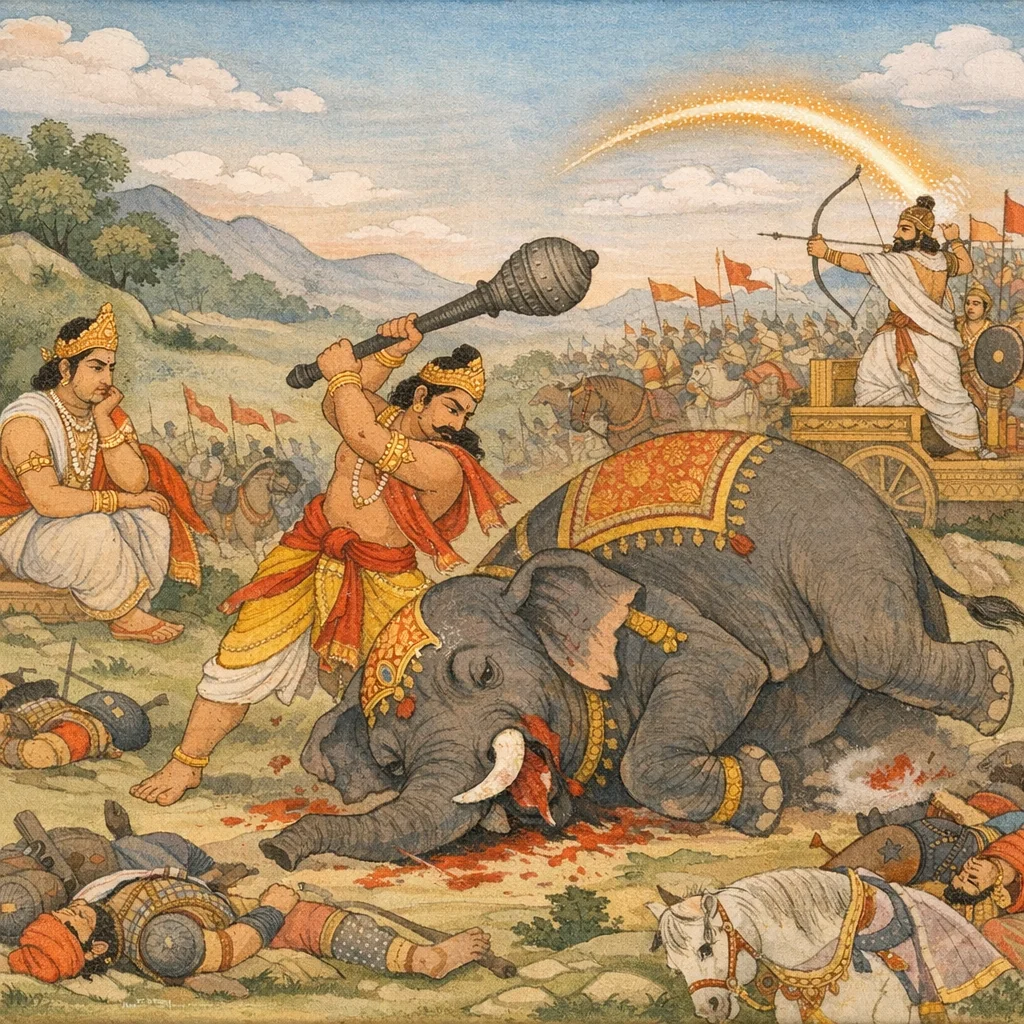
ततो भीमो महाबाहुरनीके स्वे महागजम्,राजन्! तब महाबाहु भीमसेनने अपनी ही सेनाके एक विशाल हाथीको गदासे मार डाला। उसका नाम था अअश्वत्थामा। शत्रुओंको मथ डालनेवाला वह भयंकर गजराज मालवाके राजा इन्द्रवर्माका था
Sanjaya said: Then Bhima of mighty arms, O King, struck down with his mace a huge elephant within his own battle-array. That formidable elephant—named Aśvatthāmā—was a terrifying crusher of foes, belonging to Indravarman, the king of Mālava. The moment underscores the brutal confusion of war, where even the naming of a beast becomes morally charged, foreshadowing how truth and deception will be weaponized amid the struggle for victory.
Verse 15
जघान गदया राजजन्नश्वत्थामानमित्युत । परप्रमथनं घोरं मालवस्येन्द्रवर्मण:,राजन्! तब महाबाहु भीमसेनने अपनी ही सेनाके एक विशाल हाथीको गदासे मार डाला। उसका नाम था अअश्वत्थामा। शत्रुओंको मथ डालनेवाला वह भयंकर गजराज मालवाके राजा इन्द्रवर्माका था
Sañjaya said: O King, Bhīmasena struck down with his mace a huge elephant from his own army, named Aśvatthāmā. That dreadful lord of elephants—one who crushed the enemy ranks—belonged to Indravarman, the king of the Mālavas. The act forms part of the grim stratagem of war, where appearances and names are used to shape belief and morale amid the ethical strain of battle.
Verse 16
भीमसेनस्तु सत्रीडमुपेत्य द्रोणमाहवे । अश्वत्थामा हत इति शब्दमुच्चैश्न॒कार ह,उसे मारकर भीमसेन लजाते-लजाते युद्धस्थलमें द्रोणाचार्यके पास गये और बड़े जोरसे बोले--'अश्व॒त्थामा मारा गया
Sañjaya said: Then Bhīmasena, approaching Droṇa on the battlefield with visible reluctance and shame, loudly proclaimed the words, “Aśvatthāmā has been slain!”—a calculated utterance meant to shake Droṇa’s resolve and exploit his paternal attachment amid the moral pressures of war.
Verse 17
लक प्र | अश्वत्थामेति हि गज: ख्यातो नाम्ना हतो5भवत् | कृत्वा मनसि तं॑ भीमो मिथ्या व्याहृृतवांस्तदा,“अश्वत्थामा” नामसे विख्यात हाथी मारा गया था, उसीको मनमें रखकर भीमसेनने उस समय वह झूठी बात कही थी
Sañjaya said: A certain elephant, famous by the name “Aśvatthāman,” had been slain. Keeping that very fact in mind, Bhīma at that moment uttered a falsehood—saying “Aśvatthāmā”—so that the hearers would take it to mean Droṇa’s son. The episode highlights a deliberate use of ambiguity in war, where tactical advantage is sought at the cost of truthfulness and moral clarity.
Verse 18
भीमसेनवच: श्रुत्वा द्रोणस्तत् परमाप्रियम् । मनसा सन्नगात्रो$भूदू यथा सैकतमम्भसि
Sañjaya said: Hearing Bhīmasena’s words—utterly unwelcome to him—Droṇa became inwardly shaken; his limbs seemed to sink and lose strength, like sand collapsing in water. The verse highlights how harsh speech and grievous news can unseat even a great warrior-teacher, revealing the moral weight of words amid the violence of war.
Verse 19
भीमसेनका वह अत्यन्त अप्रिय वचन सुनकर द्रोणाचार्य मन-ही-मन शोकसे व्याकुल हो सन्न रह गये। जैसे पानी पड़ते ही बालू गल जाता है, उसी प्रकार उस दुःखद संवादसे उनका सारा शरीर शिथिल हो गया ।। शड्कमान: स तम्मिथ्या वीर्यज्ञ: स्वसुतस्य वै । हतः स इति च श्रुत्वा नैव धैर्यादकम्पत,फिर उनके मनमें यह संदेह हुआ कि सम्भव है, यह बात झूठी हो; क्योंकि वे अपने पुत्रके बल-पराक्रमको जानते थे; अतः उसके मारे जानेकी बात सुनकर भी धैर्यसे विचलित न हुए
Sanjaya said: Hearing Bhimasena’s exceedingly harsh and unwelcome words, Drona—struck inwardly by grief—became as if stunned. As sand collapses the moment water falls upon it, so too his whole body slackened under that sorrowful exchange. Yet, even while shaken, he began to suspect that the report might be false, for he knew well the strength and prowess of his own son. Therefore, though he heard that ‘he has been slain,’ he did not at once waver from his composure.
Verse 20
स लब्ध्वा चेतनां द्रोण: क्षणेनैव समाश्चवसत् | अनुचिन्त्यात्मन: पुत्रमविषहमरातिभि:,उनके मनमें बारंबार यह विचार आया कि मेरा पुत्र तो शत्रुओंके लिये असहा है; अतः क्षणभरमें ही सचेत होकर उन्होंने अपने-आपको सँभाल लिया
Sañjaya said: Regaining consciousness, Droṇa recovered his composure in a single moment. Reflecting again and again on his own son—one whom the enemies could not endure—he steadied himself, drawing resolve from that thought amid the turmoil of war.
Verse 21
स पार्षतमभिद्रुत्य जिघांसुर्मुत्युमात्मन: । अवाकिरत् सहस्रेण तीक्ष्णानां कडुकपत्रिणाम्,तत्पश्चात् अपनी मृत्युस्वरूप धृष्टद्युम्नको मार डालनेकी इच्छासे वे उसपर टूट पड़े और कंकपत्रयुक्त सहस्रों तीखे बाणोंद्वारा उन्हें आच्छादित करने लगे
Sañjaya said: Rushing straight at the son of Pṛṣata (Dhṛṣṭadyumna), intent on making him the very death of himself, he showered him with a thousand sharp arrows, feathered with heron-plumes, covering him on all sides. The scene underscores the war’s grim logic: personal vows and destined enmities drive combatants to seek decisive, even annihilating, blows rather than restraint.
Verse 22
त॑ विंशतिसहस्राणि पञठ्चालानां नरर्षभा: । तथा चरन्तं संग्रामे सर्वतो5वाकिरज्छरै:,इस प्रकार संग्राममें विचरते हुए द्रोणाचार्यपर बीस हजार नरश्रेष्ठ पांचालवीर सब ओरसे बाणोंकी वर्षा करने लगे
Sañjaya said: Those twenty thousand bull-like warriors of the Pañcālas, seeing Droṇa moving about in the thick of battle, showered him from every side with volleys of arrows. The scene underscores how, in war, collective fury and strategic necessity can converge upon a single formidable figure, turning the battlefield into a test of endurance, duty, and restraint.
Verse 23
शरैस्तैराचितं द्रोणं नापश्याम महारथम् । भास्करं जलदै रुद्ध वर्षास्विव विशाम्पते,प्रजानाथ! जैसे वर्षाकालमें मेघोंकी घटासे आच्छादित हुए सूर्य नहीं दिखायी देते हैं, उसी प्रकार उन बाणोंके ढेरसे दबे हुए महारथी द्रोणको हमलोग नहीं देख पाते थे
Sañjaya said: O lord of the people, we could no longer see Droṇa, that great chariot-warrior, for he was completely covered by those arrows—just as, in the rainy season, the sun is hidden from sight when blocked by masses of clouds. The image underscores how the violence of battle can eclipse even the most eminent warrior, reducing fame and prowess to mere visibility amid the storm of weapons.
Verse 24
विधूय तान् बाणगणाम् पज्चालानां महारथ: । प्रादुश्चक्रे ततो द्रोणो ब्राह्ममस्त्रं परंतप:
Sañjaya said: Having shaken off that volley of arrows from the Pāñcālas, Droṇa—the great chariot-warrior, a scorcher of foes—then brought forth the Brahmā-weapon. In the moral atmosphere of the epic, this marks a grave escalation: when ordinary martial exchange fails, a commander resorts to higher, more perilous divine force, raising the ethical weight of responsibility for restraint and proportionality in war.
Verse 25
ततो व्यरोचत द्रोणो विनिध्नन् सर्वसैनिकान्,तदनन्तर सम्पूर्ण सैनिकोंका विनाश करते हुए द्रोणाचार्यकी बड़ी शोभा होने लगी। उन्होंने उस महासमरमें पांचालवीरोंके मस्तक और सुवर्णभूषित परिघ-जैसी मोटी भुजाएँ काट गिरायीं
Sañjaya said: Then Droṇa shone forth, striking down the warriors of the host. Thereafter, as he wrought the destruction of the assembled troops, Droṇācārya’s splendor grew great. In that vast battle he cut down the heads of the Pāñcāla heroes, and he hewed off their thick arms—adorned with gold and like iron clubs—casting them to the ground. The scene underscores the terrible efficiency of martial skill when yoked to the compulsions of war, where prowess becomes radiant even as it multiplies ruin.
Verse 26
शिरांस्पपातयच्चापि पज्चालानां महामृधे । तथैव परिघाकारान् बाहूनू कनकभूषणान्,तदनन्तर सम्पूर्ण सैनिकोंका विनाश करते हुए द्रोणाचार्यकी बड़ी शोभा होने लगी। उन्होंने उस महासमरमें पांचालवीरोंके मस्तक और सुवर्णभूषित परिघ-जैसी मोटी भुजाएँ काट गिरायीं
Verse 27
ते वध्यमाना: समरे भारद्वाजेन पार्थिवा: । मेदिन्यामन्वकीर्यन्त वातनुन्ना इव द्रुमा:,समरांगणमें द्रोणाचार्यके द्वारा मारे जानेवाले वे पांचालनरेश आँधीके उखाड़े हुए वृक्षोंक समान धरतीपर बिछ गये
Sañjaya said: As they were being cut down in battle by Bhāradvāja (Droṇācārya), those kings fell and lay scattered upon the earth, like trees uprooted and hurled down by a storm—an image that underscores the terrible momentum of war, where royal power and pride collapse before superior skill and fate.
Verse 28
कुञ्जराणां च पततां हयौघानां च भारत । अगम्यरूपा पृथिवी मांसशोणितकर्दमा,भरतनन्दन! धराशायी होते हुए हाथियों और अश्वसमूहोंके मांस तथा रक्तसे कीच जम जानेके कारण वहाँकी भूमिपर चलना-फिरना असम्भव हो गया
Sañjaya said: “O Bhārata, with elephants fallen and masses of horses strewn about, the earth became impassable—turned into a mire of flesh and blood.” The line underscores the moral horror of battle: when dharma collapses into unchecked violence, the very ground of human action becomes unfit to tread.
Verse 29
हत्वा विंशतिसाहस्रान् पञज्चालानां रथव्रजान् । अतिष्ठदाहवे द्रोणो विधूमो5ग्निरिव ज्वलन्,उस समय पांचालोंके बीस हजार रथियोंका संहार करके द्रोणाचार्य युद्धस्थलमें धूमरहित प्रज्वलित अग्निके समान खड़े थे
Sañjaya said: Having slain twenty thousand of the Pāñcālas’ chariot-warriors, Droṇa stood firm on the battlefield, blazing like a smokeless fire. The image underscores both the terrifying efficiency of martial skill and the moral weight of mass killing in a war where duty and destruction are tightly intertwined.
Verse 30
तथैव च पुन: क्रुद्धों भारद्वाज: प्रतापवान् | वसुदानस्य भल्लेन शिर: कायादपाहरत्
Sañjaya said: Just so, once again, the mighty Bhāradvāja (Droṇa), inflamed with wrath, with a sharp bhalla-arrow struck down Vasudāna, severing and carrying off his head from his body. The episode underscores how, in the fury of battle, prowess and anger combine to produce swift and irreversible consequences, where the warrior’s duty is enacted through lethal skill rather than restraint.
Verse 31
प्रतापी भरद्वाजनन्दनने पुनः पूर्ववत् कुपित होकर एक भल््लके द्वारा वसुदानका मस्तक धड़से अलग कर दिया ।। पुन: पठ्चशतान् मत्स्यान् षघट्सहस्रांश्ष संजयान् । हस्तिनामयुतं हत्वा जघानाश्वायुतं पुन:,इसके बाद मत्स्यदेशके पचास योद्धाओंका, सृंजयवंशके छः: हजार सैनिकोंका तथा दस हजार हाथियोंका संहार करके उन्होंने पुन: दस हजार घुड़सवारोंकी सेनाका सफाया कर दिया
Sanjaya said: The valiant son of Bharadvāja, once again enraged as before, severed Vasudāna’s head from his body with a single broad-headed arrow. Thereafter he slew five hundred warriors of the Matsya country, six thousand men of the Sṛñjayas, and ten thousand elephants; and again he destroyed ten thousand horsemen. The passage underscores the terrifying momentum of battlefield wrath—heroic prowess displayed through mass slaughter, raising the ethical tension between martial duty and the human cost of war.
Verse 32
क्षत्रियाणामभावाय दृष्ट्वा द्रोणमवस्थितम् | ऋषयो< भ्यागतास्तूर्ण हव्यवाहपुरोगमा:,इस प्रकार द्रोणाचार्यको क्षत्रियोंका विनाश करनेके लिये उद्यत देख तुरंत ही अग्निदेवको आगे करके बहुत-से महर्षि वहाँ आये
Sañjaya said: Seeing Droṇa standing ready with the intent of bringing about the destruction of the Kṣatriyas, many great seers hurried to that place, with Agni (the Fire-god) leading them—seeking to restrain an annihilating course and to recall the demands of dharma even amid war.
Verse 33
विश्वामित्रो जमदग्निर्भरद्वाजो5थ गौतम: । वसिष्ठ: कश्यपोअत्रिक्ष ब्रह्मलोक॑ निनीषव:,विश्वामित्र, जमदग्नि, भरद्वाज, गौतम, वसिष्ठ, कश्यप और अत्रि--ये सब लोग उन्हें ब्रह्मलोक ले जानेकी इच्छासे वहाँ पधारे थे
Sañjaya said: Viśvāmitra, Jamadagni, Bharadvāja, Gautama, Vasiṣṭha, Kaśyapa, and Atri—these great seers arrived there, intent on escorting him to Brahmaloka. Their coming signals the recognition of a life’s spiritual merit even amid the harshness of war, and frames the moment as one where righteous destiny and higher worlds are invoked beyond immediate battlefield outcomes.
Verse 34
सिकताः: पृश्नयो गर्गा वालखिल्या मरीचिपा: । भृगवोडज़्िरसश्वैव सूक्ष्माश्चान्ये महर्षय:,साथ ही सिकत, पृश्नि, गर्ग, सूर्युकी किरणोंका पान करनेवाले वालखिल्य, भृगु, अंगिरा तथा अन्य सूक्ष्मरूपधारी महर्षि भी वहाँ आये थे
Sañjaya said: Sikatā, the Pṛśnis, Garga, the Vālakhilya sages who subsist on the rays of the Sun, the Bhṛgus, the Aṅgirases, and other great seers of subtle form also arrived there. Their presence underscores that even amid the violence of war, the moral order is witnessed and judged by the highest spiritual authorities.
Verse 35
त एनमन्नुवन् सर्वे द्रोणमाहवशोभिनम् । अधर्मत:ः कृतं युद्ध समयो निधनस्य ते
Sañjaya said: All of them then pressed after Droṇa, who was resplendent in battle. (They declared,) “This fight has been waged unrighteously; now the appointed time for your death has come.”
Verse 36
न्यस्यायुधं रणे द्रोण समीक्षास्मानवस्थितान् । नात:ः क्रूरतरं कर्म पुनः कर्तुमिहाहसि
Sañjaya said: “O Droṇa, having laid down your weapons in the midst of battle and seeing us standing ready, you ought not to commit any deed here more cruel than this.”
Verse 37
उन सबने संग्राममें शोभा पानेवाले द्रोणाचार्यसे इस प्रकार कहा--'द्रोण! तुम हथियार नीचे डालकर यहाँ खड़े हुए हमलोगोंकी ओर देखो। अबतक तुमने अधर्मसे युद्ध किया है, अब तुम्हारी मृत्युका समय आ गया है, इसलिये अब फिर यह क्रूरतापूर्ण कर्म न करो ।। वेदवेदाड़्रविदुष: सत्यधर्मरतस्य ते । ब्राह्मणस्य विशेषेण तवैतन्नोपपद्यते,“तुम वेद और वेदांगोंके विद्वान हो, विशेषतः सत्य और धर्ममें तत्पर रहनेवाले ब्राह्मण हो, तुम्हारे लिये यह क्रूर कर्म शोभा नहीं देता
Sanjaya said: All of them addressed Drona—who sought glory on the battlefield—saying, “Drona, lay down your weapons and look at us standing here. Until now you have fought unrighteously; now the time of your death has come. Therefore do not commit this cruel deed again. You are learned in the Vedas and their auxiliaries; and as a Brahmin especially devoted to truth and dharma, such brutality does not befit you.”
Verse 38
त्यजायुधममोधेषो तिष्ठ वर्त्मनि शाश्वते । परिपूर्णश्च॒ कालस्ते वस्तुं लोकेउद्य मानुषे,“अमोघ बाणवाले द्रोणाचार्य! अस्त्र-शस्त्रोंका परित्याग कर दो और अपने सनातन मार्गपर स्थित हो जाओ। आज इस मनुष्यलोकमें तुम्हारे रहनेका समय पूरा हो गया
Sañjaya said: “O unfailing one, lay down your weapons and stand upon the eternal path. Today, your allotted time to remain in this human world has been fulfilled.” The utterance frames the warrior’s end not merely as defeat in battle, but as a moral summons to relinquish violence and return to the timeless order (dharma) when one’s destined span is complete.
Verse 39
ब्रह्मास्त्रेण त्वया दग्धा अनस्त्रज्ञा नरा भुवि | यदेतदीदृशं विप्र कृतं कर्म न साधु तत्,“इस भूतलपर जो लोग ब्रह्मास्त्र नहीं जानते थे, उन्हें भी तुमने ब्रह्मास्त्रसे ही दग्ध किया है। ब्रह्मन! तुमने जो ऐसा कर्म किया है, यह कदापि उत्तम नहीं है
Sañjaya said: “By your Brahmāstra you have burned even men on the earth who had no knowledge of weapons. O brāhmaṇa, this deed of yours—done in such a manner—is not righteous, nor is it commendable.”
Verse 40
न्यस्यायुधं रणे विप्र द्रोण मा त्वं चिरं कृथा: । मा पापिष्ठतरं कर्म करिष्यसि पुनर्द्धिज,“विप्रवर द्रोण! रणभूमिमें अपना अस्त्र-शस्त्र रख दो, इस कार्यमें विलम्ब न करो। ब्रह्म! अब फिर ऐसा अत्यन्त पापपूर्ण कर्म न करना”
Sañjaya said: “O Brahmin, Droṇa—lay down your weapons on the battlefield; do not delay in this. O twice-born, do not again commit an act even more sinful.”
Verse 41
इति तेषां वच: श्रुत्वा भीमसेनवचश्न तत् । धृष्टय्युम्नं च सम्प्रेक्ष्य रणे स विमना5भवत्,उन ऋषियोंकी यह बात सुनकर, भीमसेनके कथनपर विचार कर और रणभूमिमें धृष्टद्यम्नको सामने देखकर आचार्य द्रोणका मन उदास हो गया
Sañjaya said: Hearing those sages’ words, reflecting as well on Bhīmasena’s statement, and seeing Dhṛṣṭadyumna before him on the battlefield, Ācārya Droṇa’s heart grew heavy and downcast. In that moment, the clash of duty and foreboding—spoken counsel, a warrior’s warning, and the visible agent of fate—darkened his resolve amid the demands of war.
Verse 42
संदिह्ामानो व्यथित: कुन्तीपुत्रं युधिष्ठिरम् । अहतं वा हतं वेति पप्रच्छ सुतमात्मन:,वे संदेहमें पड़े हुए थे, अतः उन्होंने व्यथित होकर अपने पुत्रके मारे जाने या नहीं मारे जानेका समाचार कुन्तीपुत्र युधिष्ठिससे पूछा
Sañjaya said: Torn by doubt and shaken with anxiety, he questioned Kuntī’s son Yudhiṣṭhira, asking whether his own son had been slain or was still unharmed. The verse highlights the moral strain of war: even amid strategy and victory, a father’s fear for his child and the uncertainty of truth press upon the mind.
Verse 43
स्थिरा बुद्धि्हिं द्रोणस्य न पार्थो वक्ष्यतेडनृतम् । त्रयाणामपि लोकानामैश्वर्यार्थे कथठ्चन,द्रोणाचार्यके मनमें यह दृढ़ विश्वास था कि कुन्तीपुत्र युधिष्ठिर तीनों लोकोंके राज्यके लिये भी किसी प्रकार झूठ नहीं बोलेंगे
Sañjaya said: Droṇa’s conviction was firm: the son of Pṛthā (Yudhiṣṭhira) would never utter a falsehood—under any circumstance, not even for the sake of sovereignty over all the three worlds. The line underscores the moral authority Yudhiṣṭhira is believed to embody, and how that reputation becomes a decisive factor amid the deceptions of war.
Verse 44
तस्मात् तं परिपप्रच्छ नान्यं कज्चिद् द्विजर्षभ: । तस्मिंस्तस्य हि सत्याशा बाल्यात् प्रभूति पाण्डवे,अतः जन द्विजश्रेष्ठने उन्हींसे वह बात पूछी, दूसरे किसीसे नहीं, क्योंकि बचपनसे ही पाण्डुपुत्रकी सचाईमें आचार्यका विश्वास था
Sañjaya said: Therefore the best of the twice-born questioned him—and no one else—for from childhood onward he had placed his trust in the Pāṇḍava’s truthfulness. The choice of whom to ask reflects an ethical reliance on proven integrity amid the pressures of war.
Verse 45
ततो निष्पाण्डवामुर्वी करिष्यन्तं युधां प्रतिम् । द्रोणं ज्ञात्वा धर्मराजं गोविन्दो व्यथितो<ब्रवीत्,उस समय योद्धाओंमें श्रेष्ठ द्रोण इस पृथ्वीको पाण्डवरहित कर डालनेके लिये उद्यत थे। उनका यह विचार जानकर भगवान् श्रीकृष्णने व्यथित हो धर्मराज युधिष्ठिरसे कहा --
Verse 46
यद्यर्थदिवसं द्रोणो युध्यते मन्युमास्थित: । सत्यं ब्रवीमि ते सेना विनाशं समुपैष्यति,“राजन! यदि क्रोधमें भरे हुए द्रोणाचार्य आधे दिन भी युद्ध करते रहें तो मैं सच कहता हूँ, तुम्हारी सेनाका सर्वनाश हो जायगा
Sañjaya said: “O King, if Droṇācārya, possessed by wrath, continues to fight even for half a day, I tell you the truth—your army will move toward total destruction.”
Verse 47
स भवांस्त्रातु नो द्रोणात् सत्याज्ज्यायो$नूतं वच: । अनृतं जीवितस्यार्थे वदन्न स्पृश्यतेडनृतैः,“अतः तुम द्रोणसे हमलोगोंको बचाओ; इस अवसरपर असत्यभाषणका महत्त्व सत्यसे भी बढ़कर है। किसीकी प्राणरक्षाके लिये यदि कदाचित् असत्य बोलना पड़े तो उस बोलनेवालेको झूठका पाप नहीं लगता”
Sañjaya said: “Therefore, please save us from Droṇa. At this moment, a word that is untrue is weightier than truth itself. If, for the sake of preserving life, one must at times speak an untruth, the speaker is not tainted by the sin of falsehood.”
Verse 48
तयो: संवदतोरेवं भीमसेनो<ब्रवीदिदम्,वे दोनों इस प्रकार बातें कर ही रहे थे कि भीमसेन बोल उठे--“महाराज! महामना द्रोणके वधका ऐसा उपाय सुनकर मैंने आपकी सेनामें विचरनेवाले मालवनरेश इन्द्रवर्माके अश्वत्थामानामसे विख्यात गजराजको, जो ऐरावतके समान शक्तिशाली था, युद्धमें पराक्रम करके मार डाला। फिर द्रोणाचार्यके पास जाकर कहा--'ब्रह्मन्! अश्व॒त्थामा मारा गया, अब युद्धसे निवृत्त हो जाइये।” परंतु इन पुरुषप्रवर द्रोणने निश्चय ही मेरी बातपर विश्वास नहीं किया है
Sanjaya said: As the two were conversing in this way, Bhimasena spoke: “O King! Having heard of the stratagem meant to bring about the death of the high-minded Drona, I slew in battle—by sheer prowess—the mighty elephant-king famed by the name ‘Ashvatthama,’ belonging to Indravarma, the Malava ruler who ranged within your army, and strong like Airavata. Then I went to Dronacharya and declared, ‘O Brahmin, Ashvatthama has been slain; now withdraw from the fight.’ Yet that foremost of men, Drona, has certainly not believed my words.”
Verse 49
श्र॒त्वैवं तु महाराज वधोपायं महात्मन: । गाहमानस्य ते सेनां मालवस्येन्द्रवर्मण:,वे दोनों इस प्रकार बातें कर ही रहे थे कि भीमसेन बोल उठे--“महाराज! महामना द्रोणके वधका ऐसा उपाय सुनकर मैंने आपकी सेनामें विचरनेवाले मालवनरेश इन्द्रवर्माके अश्वत्थामानामसे विख्यात गजराजको, जो ऐरावतके समान शक्तिशाली था, युद्धमें पराक्रम करके मार डाला। फिर द्रोणाचार्यके पास जाकर कहा--'ब्रह्मन्! अश्व॒त्थामा मारा गया, अब युद्धसे निवृत्त हो जाइये।” परंतु इन पुरुषप्रवर द्रोणने निश्चय ही मेरी बातपर विश्वास नहीं किया है
Sañjaya said: “O King, having heard this stratagem for the slaying of that great-souled one, Indravarman of Mālava—while moving about within your army—pressed into the fray.”
Verse 50
अश्वृत्थामेति विख्यातो गज: शक्रगजोपम: । निहतो युधि विक्रम्य ततो*हं द्रोणमब्रुवम्,वे दोनों इस प्रकार बातें कर ही रहे थे कि भीमसेन बोल उठे--“महाराज! महामना द्रोणके वधका ऐसा उपाय सुनकर मैंने आपकी सेनामें विचरनेवाले मालवनरेश इन्द्रवर्माके अश्वत्थामानामसे विख्यात गजराजको, जो ऐरावतके समान शक्तिशाली था, युद्धमें पराक्रम करके मार डाला। फिर द्रोणाचार्यके पास जाकर कहा--'ब्रह्मन्! अश्व॒त्थामा मारा गया, अब युद्धसे निवृत्त हो जाइये।” परंतु इन पुरुषप्रवर द्रोणने निश्चय ही मेरी बातपर विश्वास नहीं किया है
Sañjaya said: “A mighty elephant, famed by the name ‘Aśvatthāman’ and comparable to Indra’s elephant, was slain in battle after a display of valor. Then I went to Droṇa and said: ‘O Brahmin, Aśvatthāman has been killed; now withdraw from the fight.’” The line carries the ethical tension of wartime speech: a statement crafted to break Droṇa’s resolve by exploiting a name shared with his son, blurring truth and deception for strategic ends.
Verse 51
अभश्रृत्थामा हतो ब्रद्यन्निवर्तस्वाहवादिति । नूनं नाश्रद्धद् वाक्यमेष मे पुरुषर्षभ:,वे दोनों इस प्रकार बातें कर ही रहे थे कि भीमसेन बोल उठे--“महाराज! महामना द्रोणके वधका ऐसा उपाय सुनकर मैंने आपकी सेनामें विचरनेवाले मालवनरेश इन्द्रवर्माके अश्वत्थामानामसे विख्यात गजराजको, जो ऐरावतके समान शक्तिशाली था, युद्धमें पराक्रम करके मार डाला। फिर द्रोणाचार्यके पास जाकर कहा--'ब्रह्मन्! अश्व॒त्थामा मारा गया, अब युद्धसे निवृत्त हो जाइये।” परंतु इन पुरुषप्रवर द्रोणने निश्चय ही मेरी बातपर विश्वास नहीं किया है
Sanjaya said: “Saying, ‘Aśvatthāmā has been slain,’ I told him, ‘Withdraw from the battle.’ Yet this bull among men—Drona—surely did not place faith in my words.”
Verse 52
स त्वं गोविन्दवाक्यानि मानयस्व जयैषिण: । द्रोणाय निहतं शंस राजन् शारद्वतीसुतम्,“नरेश्वर! अतः आप विजय चाहनेवाले भगवान् श्रीकृष्णकी बात मान लीजिये और द्रोणाचार्यसे कह दीजिये कि “अश्वत्थामा मारा गया”
Sanjaya said: “Therefore, O King, honor the words of Govinda, who seeks victory. Go and tell Droṇa that the son of Śāradvatī—Aśvatthāmā—has been slain.” The line presses a wartime expedient: using a claim meant to break Droṇa’s will, raising a sharp ethical tension between strategic necessity and truthfulness.
Verse 53
त्वयोक्तो नैव युध्येत जातु राजन् द्विजर्षभ: । सत्यवान् हि त्रिलोकेडस्मिन् भवान् ख्यातो जनाधिप,“राजन! जनेश्वर! आपके कह देनेपर द्विजश्रेष्ठ द्रोण कदापि युद्ध नहीं करेंगे; क्योंकि आप तीनों लोकोंमें सत्यवादीके रूपमें विख्यात हैं!
Sañjaya said: “O King, best of rulers! If you were to command it, the bull among Brahmins—Droṇa—would never fight at all; for in these three worlds you are renowned as a speaker of truth.”
Verse 54
तस्य तद् वचन श्रुत्वा कृष्णवाक्यप्रचोदित: । भावित्वाच्च महाराज वक्तुं समुपचक्रमे,“महाराज! भीमकी यह बात सुनकर श्रीकृष्णके आदेशसे प्रेरित हो भावीवश राजा युधिष्ठिर वह झूठी बात कहनेको तैयार हो गये
Sañjaya said: Hearing those words, and urged on by Kṛṣṇa’s counsel, King Yudhiṣṭhira—overpowered by what was to come—began to speak that untruth. The moment marks a grave ethical turning-point: the pressure of war and strategy compels even the dharma-minded king toward a lie, revealing the tragic cost of victory.
Verse 55
तमतथ्यभये मग्नो जये सक्तो युधिष्ठिर: । (अश्वत्थामा हत इति शब्दमुच्चैश्नचार ह ।) अव्यक्तमब्रवीद् राजन् हत: कुञ्जर इत्युत,एक ओर तो वे असत्यके भयमें डूबे हुए थे और दूसरी ओर विजयकी प्राप्तिके लिये भी आसकत्तिपूर्वक प्रयत्नशील थे; अतः राजन! उन्होंने “अश्वत्थामा मारा गया” यह बात तो उच्च स्वरसे कही, परंतु “हाथीका वध हुआ है,” यह बात धीरेसे कही
Sañjaya said: Yudhiṣṭhira, sunk in fear of falsehood yet also intent on securing victory, proclaimed aloud, “Aśvatthāmā has been slain”; but, O King, he uttered indistinctly the qualifying words, “the elephant has been killed.” The moment exposes the ethical strain of war: a truth spoken in a way designed to mislead, driven by the perceived necessity of winning.
Verse 56
तस्य पूर्व रथ: पृथ्व्याश्चतुरड्गुलमुच्छित: । बभूवैव॑ं च तेनोक्ते तस्य वाहा: स्पृशन्महीम्,इसके पहले युधिष्ठिरका रथ पृथ्वीसे चार अंगुल ऊँचे रहा करता था, किंतु उस दिन उनके इस प्रकार असत्य बोलते ही उनके रथके घोड़े धरतीका स्पर्श करके चलने लगे
Sañjaya said: Formerly, his chariot used to remain raised four finger-breadths above the earth. But on that day, the moment he spoke in this manner—departing from strict truth—his horses began to move while touching the ground. The narrative marks a visible loss of moral radiance: even a slight compromise with truth causes an immediate diminishment of the extraordinary merit that had upheld him.
Verse 57
युधिष्ठिरात् तु तद् वाकयं श्रुत्वा द्रोणो महारथ: । पुत्रव्यसनसंतप्तो निराशो जीविते5भवत्,युधिष्ठिरके मुँहले यह वचन सुनकर महारथी द्रोणाचार्य पुत्रशोकसे संतप्त हो अपने जीवनसे निराश हो गये
Sañjaya said: Hearing those words from Yudhiṣṭhira, Droṇa—the great chariot-warrior—was scorched by the calamity of his son’s loss and became hopeless about his own life. The verse highlights how even a mighty warrior can be inwardly undone when grief overwhelms discernment, showing the moral weight of speech and the psychological toll of war.
Verse 58
आगस्कृतमिवात्मानं पाण्डवानां महात्मनाम् | ऋषिवाक्येन मन्वान: श्रुत्वा च निहतं सुतम्,अपने पुत्रके मारे जानेकी बात सुनकर महर्षियोंके कथनानुसार वे अपने आपको महात्मा पाण्डवोंका अपराधी-सा मानने लगे
Sanjaya said: Hearing that his son had been slain, and taking to heart the sages’ pronouncement, he began to regard himself as though he had committed an offence against the great-souled Pāṇḍavas—his mind turning from mere grief to a sense of moral culpability amid the ruin of war.
Verse 59
योद्धुंनाशकनुवद् राजन् यथापूर्वमरिंदम:,उनकी चेतनाशक्ति लुप्त होने लगी। वे अत्यन्त उद्विग्न हो उठे। राजन! उस समय धृष्टद्युम्मनको सामने देखकर भी शत्रुओंका दमन करनेवाले द्रोणाचार्य पूर्ववत् युद्ध न कर सके
Sanjaya said: O King, the subduer of foes could not fight as before. His power of awareness began to fail, and he became intensely agitated. O King, at that time, even while seeing Dhrishtadyumna before him, Drona—renowned for crushing enemies—was unable to wage war in his former manner. The verse underscores how inner collapse and moral-emotional shock can blunt even a great warrior’s outward prowess.
Verse 116
यथा व: संयुगे सर्वान् न हन्याद् रुक्मवाहन: । “जब ये संग्राममें हथियार डाल देंगे, तभी मनुष्योंद्वारा मारे जा सकते हैं। अतः पाण्डवो! “गुरुका वध करना उचित नहीं है” इस धर्मभावनाको छोड़कर उनपर विजय पानेके लिये कोई यत्न करो; जिससे सुवर्णमय रथवाले द्रोणाचार्य तुम सब लोगोंका वध न कर डालें
Sañjaya said: “Act in such a way in this battle that the golden-charioted one (Droṇa) does not slay all of you. Do not cling to the scruple, ‘It is not right to kill the guru’; rather, make some effort to overcome him, so that Droṇācārya, mounted on his splendid chariot, does not destroy you all.”
Verse 126
त॑ हतं संयुगे कश्चिदस्मै शंसतु मानव: । “मेरा विश्वास है कि अश्वत्थामाके मारे जानेपर ये युद्ध नहीं कर सकते। कोई मनुष्य उनसे जाकर कहे कि *युद्धमें अश्वत्थामा मारा गया'
Sañjaya said: “Let some man go and report to him that Aśvatthāmā has been slain in battle. I am convinced that, once he hears Aśvatthāmā is dead, he will no longer be able to continue this war.”
Verse 133
अन््ये त्वरोचयन् सर्वे कृच्छेण तु युधिष्ठिर: । राजन! कुन्तीपुत्र अर्जुनको यह बात अच्छी नहीं लगी, किंतु अन्य सब लोगोंने इस युक्तिको पसंद कर लिया। केवल कुन्तीनन्दन युधिष्ठिर बड़ी कठिनाईसे इस बातपर राजी हुए
Sañjaya said: All the others approved of the proposal; but Yudhiṣṭhira consented only with great difficulty—his assent coming after inner struggle, mindful of what is proper and of the moral weight of the course being urged.
Verse 190
इति श्रीमहाभारते द्रोणपर्वणि द्रोणवधपर्वणि युधिष्ठिरासत्यक थने नवत्यधिकशततमो<ध्याय:
Thus, in the Śrī Mahābhārata, within the Droṇa Parva—specifically the section concerning the slaying of Droṇa—ends the one-hundred-and-ninetieth chapter, dealing with the account of Yudhiṣṭhira’s untruth. The colophon marks a grave ethical turning point in the war: the pressure of victory drives even the most dharma-bound king into a compromised statement, showing how warfare corrodes moral clarity and burdens the righteous with lasting responsibility.
Verse 2436
वधाय तेषां शूराणां पञ्चालानाममर्षित: । तब शत्रुओंको संताप देनेवाले महारथी द्रोणाचार्यने पांचालोंके उन बाणसमूहोंको नष्ट करके शूरवीर पांचालोंके वधके लिये अमर्षयुक्त होकर ब्रह्मास्त्र प्रकट किया
Sañjaya said: Burning with indignation and intent on the destruction of those heroic Pāñcālas, the great chariot-warrior Droṇācārya—who brought torment to his enemies—first annihilated their volleys of arrows. Then, driven by wrath and resolved to slay the valiant Pāñcāla fighters, he manifested the Brahmāstra. The episode underscores how, in the heat of war, anger can push a warrior toward the most extreme and perilous weapons, raising grave ethical stakes for all combatants.