Adhyaya 12
Śākadvīpa–Pramāṇa–Varṇana (Measurements and Description of Śākadvīpa)
Upa-parva: Bhūmi–Dvipāntara–Jyotiṣa Saṃvāda (Cosmographic Discourse on Continents, Oceans, and Luminaries)
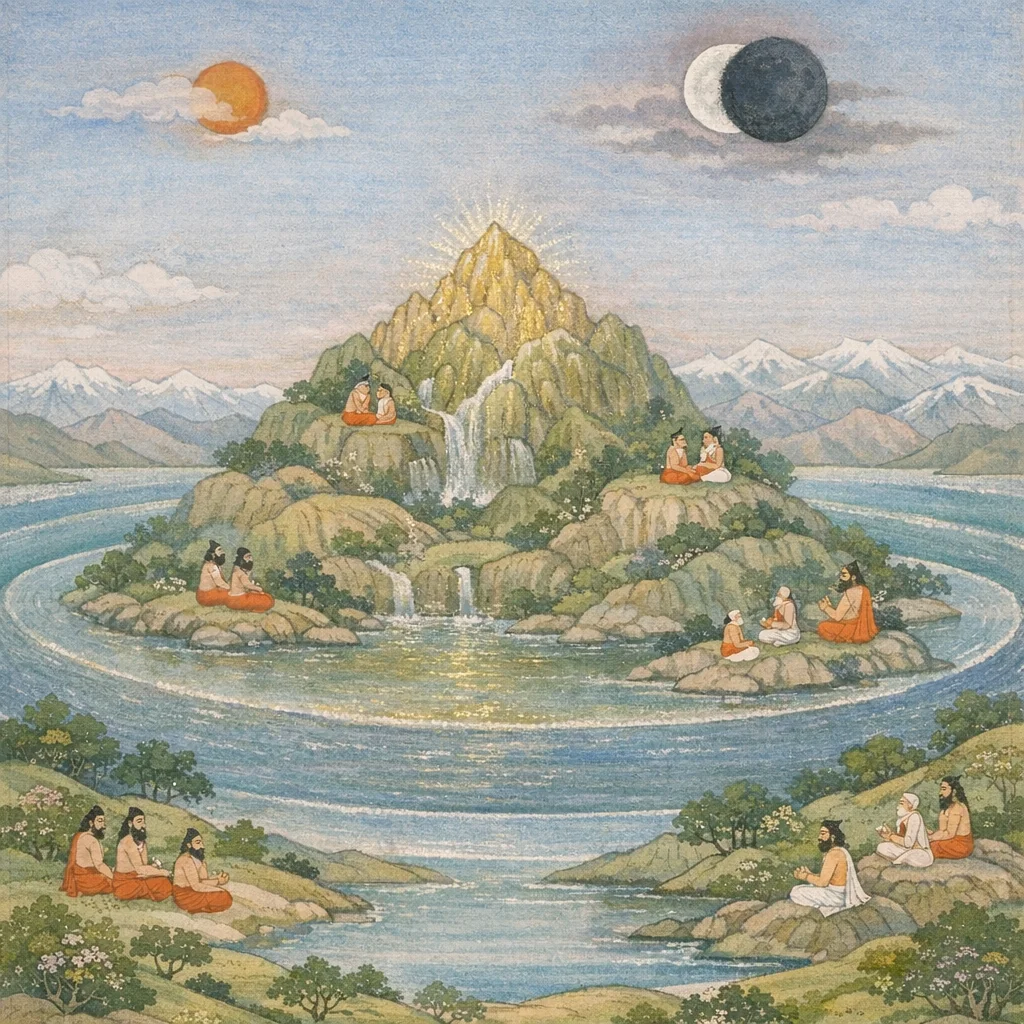
Dhṛtarāṣṭra requests precise dimensions of Jambūkhāṇḍa, the surrounding ocean, and further islands (Śāka, Kuśa, Śālmala, Krauñca), including celestial phenomena (Rāhu; Soma and Arka). Sañjaya answers by outlining a seven-island schema and gives quantitative measures: Jambū-parvata’s diameter is stated in yojanas, and the salt ocean is described as double in extent, circular, and adorned with diverse regions and mountains. He then introduces Śākadvīpa as double the measure of Jambūdvīpa, encircled by the milk ocean, and characterized by auspicious settlements where famine and mortality are absent. At Dhṛtarāṣṭra’s insistence, Sañjaya expands: he names prominent mountains (including Meru and others), describes how rains originate, and explains the ‘Śyāma’ designation by associating it with Kṛṣṇa’s presence and radiance. The chapter enumerates rivers (including Gaṅgā in multiple courses and several named streams), notes that countless sacred rivers cannot be fully listed, and describes four communities (Magā, Maśakā, Mānasā, Mandagā) with occupational tendencies. The account culminates in a governance motif: no king, no punishment system—mutual protection through adherence to svadharma—followed by a closure stating the limits of what can be said about Śākadvīpa.
Chapter Arc: संजय धृतराष्ट्र से कहता है कि उत्तर दिशा के द्वीपों और लोक-रचनाओं की एक प्राचीन, श्रुतिपरंपरा में सुरक्षित कथा है—जहाँ भूगोल स्वयं धर्म-ज्ञान का मानचित्र बन जाता है। → वर्णन क्रमशः विस्तृत होता जाता है: कुश, क्रौंच, पुष्कर आदि द्वीप; उनके चारों ओर घृत, दधिमण्ड, सुरा, जल, क्षीर आदि समुद्र; और यह नियम कि द्वीप-पर्वत-समुद्र परस्पर उत्तरोत्तर द्विगुण विस्तार वाले हैं—मानव-बुद्धि के लिए असीम विस्तार का दबाव रचता है। → पुष्करद्वीप में मणिरत्न-समृद्ध पुष्कर पर्वत का वर्णन और उसके आगे देव-गन्धर्व-सेवित प्रदेशों, ब्रह्मा के नित्य निवास तथा असंख्य, अतुल परिमाण वाले दिव्य गजराज (जैसे सुप्रतीक) आदि का उल्लेख—यहाँ दृश्य-वैभव और ब्रह्माण्डीय माप का चरम उत्कर्ष आता है। → संजय इस ‘भूमिपर्व’ के श्रवण-फल को भी जोड़ता है: जो राजा इसे मनोयोग से सुनता है, उसकी श्री, आयु, बल, कीर्ति और तेज बढ़ते हैं—ज्ञान को राजधर्म की समृद्धि से बाँधकर अध्याय को फलश्रुति में स्थिर करता है। → कुरुक्षेत्र के युद्ध-वृत्तांत से हटकर यह ब्रह्माण्ड-भूगोल आगे और भी लोकों/देशों की ओर संकेत करता है, मानो अगला वर्णन इस असीम रचना के और गूढ़ स्तर खोल देगा।
Shlokas
Verse 1
# द्वादशोड् ध्याय: कुश, क्रौंच और पुष्कर आदि द्वीपोंका तथा राहु, सूर्य एवं चन्द्रमाके प्रमाणका वर्णन संजय उवाच उत्तरेषु च कौरव्य द्वीपेषु श्रूयते कथा । एवं तत्र महाराज ब्रुवतश्न निबोध मे,संजय बोले--महाराज! कुरुनन्दन! इसके बाददवाले द्वीपोंके विषयमें जो बातें सुनी जाती हैं, वे इस प्रकार हैं; उन्हें आप मुझसे सुनिये
Sañjaya said: “O scion of the Kurus, O king, there is a traditional account heard regarding the northern islands. Now, as I relate it, listen attentively and understand from me.”
Verse 2
घृततोय: समुद्रो5त्र दधिमण्डोदको5पर: । सुरोद: सागरश्वैव तथान्यो जलसागर:,क्षीरोद समुद्रके बाद घृतोद समुद्र है। फिर दधिमण्डोदक समुद्र है। इनके बाद सुरोद समुद्र है, फिर मीठे पानीका सागर है
Sañjaya said: “Here there is an ocean of clarified butter; another is an ocean of the watery portion of curds. There is also an ocean of surā (fermented liquor), and yet another is a sea of fresh water.” In this descriptive passage, the narrator evokes a world of extraordinary abundance and variety, setting a vast, almost otherworldly backdrop against which human choices and the coming conflict will unfold.
Verse 3
परस्परेण द्विगुणा: सर्वे द्वीपा नराधिप । पर्वताश्न महाराज समुद्रै: परिवारिता:,महाराज! इन समुद्रोंसे घिरे हुए सभी द्वीप और पर्वत उत्तरोत्तर दुगुने विस्तारवाले हैं
Sañjaya said: O lord of men, O great king, all the islands are each successively twice as extensive as the previous, and the mountains too—each encircled by the surrounding seas. The description underscores an ordered, measurable cosmos, where creation is structured and bounded, inviting the listener to reflect on proportion, limits, and the vastness within which human conflict unfolds.
Verse 4
गौरस्तु मध्यमे द्वीपे गिरिर्मान:शिलो महान् । पर्वत: पश्चिमे कृष्णो नारायणसखो नृप,नरेश्वर! इनमेंसे मध्यम द्वीपमें मनः:शिला (मैनसिल)-का एक बहुत बड़ा पर्वत है; जो “गौर” नामसे विख्यात है। उसके पश्चिममें “कृष्ण” पर्वत है, जो नारायणको विशेष प्रिय है
Verse 5
तत्र रत्नानि दिव्यानि स्वयं रक्षति केशव: । प्रसन्नश्चाभवत् तत्र प्रजानां व्यद्धत् सुखम्,स्वयं भगवान् केशव ही वहाँ दिव्य रत्नोंको रखते और उनकी रक्षा करते हैं। वे वहाँकी प्रजापर प्रसन्न हुए थे, इसलिये उनको सुख पहुँचानेकी व्यवस्था उन्होंने स्वयं की है
Verse 6
कुशस्तम्ब: कुशद्वीपे मध्ये जनपदै: सह । सम्पूज्यते शाल्मलिश्न द्वीपे शाल्मलिके नूप,नरेश्वर! कुशद्वीपमें कुशोंका एक बहुत बड़ा झाड़ है, जिसकी वहाँके जनपदोंमें रहनेवाले लोग पूजा करते हैं। उसी प्रकार शाल्मलिद्वीपमें शाल्मलि (सेंमर) वृक्षकी पूजा की जाती है
Sañjaya said: In the midst of Kuśadvīpa there stands a great clump of kuśa-grass, and the people of its provinces worship it. In the same way, in Śālmalidvīpa, O king among rulers, the śālmalī (silk-cotton) tree is worshipped. The account underscores how different lands uphold their own sacred symbols and local forms of reverence.
Verse 7
क्रौज्चद्वीपे महाक्रौड्चो गिरी रत्नचयाकर: । सम्पूज्यते महाराज चातुर्वण्येन नित्यदा,क्रौंचद्वीपमें महाक्रौंच नामक एक महान् पर्वत है, जो रत्नराशिकी खान है। महाराज! वहाँ चारों वर्णॉके लोग सदा उसीकी पूजा करते हैं
Sañjaya said: “O great king, in the island-continent called Krauñcadvīpa there stands a mighty mountain named Mahākrauñca, a veritable mine of heaps of jewels. There, people of all four social orders continually worship it.”
Verse 8
गोमन्त: पर्वतो राजन् सुमहान् सर्वधातुक: । यत्र नित्यं निवसति श्रीमानू कमललोचन:
Sañjaya said: “O King, there is the mountain Gomanta—vast and rich in every kind of mineral. There, ever dwelling, is the illustrious one, the lotus-eyed (Lord), abiding in constant presence.”
Verse 9
मोक्षिश्रि: संस्तुतो नित्यं प्रभुनारायणो हरि: । राजन! वहीं गोमन्त नामक विशाल पर्वत है, जो सम्पूर्ण धातुओंसे सम्पन्न है। वहाँ मोक्षकी इच्छा रखनेवाले उपासकोंके मुखसे अपनी स्तुति सुनते हुए सबके स्वामी श्रीमान् कमलनयन भगवान् नारायण नित्य निवास करते हैं ।। ८ ह ।। कुशद्वीपे तु राजेन्द्र पर्वतो विद्रुमैश्वचित:
Sanjaya said: O King, there is indeed a vast mountain named Gomanta, rich in every kind of mineral. There the blessed Lord Narayana—Hari, the sovereign of all, lotus-eyed and glorious—dwells eternally, hearing His own praise sung from the mouths of devotees who seek liberation. And in Kusadvipa too, O best of kings, there is a mountain adorned with coral-like splendor.
Verse 10
द्युतिमान् नाम कौरव्य तृतीय: कुमुदो गिरि:,कौरव्य! वहीं परम कान्तिमान् कुमुद नामक तीसरा पर्वत है। चौथा पुष्पवान, पाँचवाँ कुशेशय और छठा हरिगिरि है। ये छः कुशद्वीपके श्रेष्ठ पर्वत हैं
Sañjaya said: “O Kauravya, the third mountain there is the splendid one named Kumuda.” In this cosmographical listing, the narrator continues to map the sacred geography of Kuśadvīpa, presenting named peaks as markers of order and structure in the world.
Verse 11
कौरव्य! वहीं परम कान्तिमान् कुमुद नामक तीसरा पर्वत है। चौथा पुष्पवान, पाँचवाँ कुशेशय और छठा हरिगिरि है। ये छः कुशद्वीपके श्रेष्ठ पर्वत हैं
Sañjaya said: “O descendant of the Kurus, there is also the exceedingly radiant third mountain named Kumuda. The fourth is Puṣpavān, the fifth Kuśeśaya, and the sixth Harigiri. These six are the foremost mountains of Kuśadvīpa.”
Verse 12
तेषामन्तरविष्कम्भो द्विगुण: सर्वभागश: । औद्िदं प्रथम वर्ष द्वितीयं वेणुमण्डलम्,इन पर्वतोंके बीचका विस्तार सब ओरसे उत्तरोत्तर दूना होता गया है। कुशद्वीपके पहले वर्षका नाम उद्धिद् है। दूसरेका नाम वेणुमण्डल है राजन्! जिसमें हमलोग निवास करते हैं और जहाँ हमारे पूर्वजोंने पुण्यकर्मोंका अनुष्ठान किया है, यह वही भारतवर्ष है। आपने इसका पूरा-पूरा वर्णन सुन लिया है ।। इति श्रीमहा भारते भीष्मपर्वणि भूमिपर्वणि उत्तरद्वीपादिसंस्थानवर्णने द्वादशोडध्याय:
Sañjaya said: “Between those (regions), the intervening breadth becomes, in every part, progressively twice as great. The first division (varṣa) of Kuśadvīpa is called Audida; the second is called Veṇumaṇḍala. Thus the arrangement of the continents and their divisions is being set forth as part of the cosmic geography that frames human life and duty.”
Verse 13
चतुर्थ: पुष्पवान् नाम पञ्चमस्तु कुशेशय: । षष्ठो हरिगिरिराम षडेते पर्वतोत्तमा:,तृतीयं सुरथाकारं चतुर्थ कम्बलं स्मृतम् । धृतिमत् पज्चमं वर्ष षष्ठ॑ वर्ष प्रभाकरम् तीसरेका नाम सुरथाकार, चौथेका कम्बल, पाँचवेंका धृतिमान् और छठे वर्षका नाम प्रभाकर है
Sañjaya said: “Among them, the fourth is called Puṣpavān, the fifth Kuśeśaya, and the sixth Harigiri-rāma—these six are renowned as excellent mountains. Likewise, the third region is remembered as Surathākāra, the fourth as Kambala, the fifth as Dhṛtimat, and the sixth region as Prabhākara.”
Verse 14
सप्तमं कापिल वर्ष सप्तैते वर्षलम्भका: । एतेषु देवगन्धर्वा: प्रजाश्न॒ जगतीश्वर,सातवाँ वर्ष कापिल कहलाता है। ये सात वर्षसमुदाय हैं। पृथ्वीपते! इन सबमें देवता, गन्धर्व तथा मनुष्य सानन्द विहार करते हैं। उनमेंसे किसीकी मृत्यु नहीं होती है। नरेश्वर! वहाँ लुटेरे अथवा म्लेच्छ-जातिके लोग नहीं हैं
Sañjaya said: “The seventh region is called Kāpila; these are the seven great divisions of the earth. O lord of the world, within these dwell the gods, Gandharvas, and human beings, enjoying their abodes in contentment. There is no death among them; and, O king, there are no robbers or barbarous (mleccha) tribes there.”
Verse 15
विहरन्ते रमन्ते च न तेषु म्रियते जन: । न तेषु दस्यव: सन्ति म्लेच्छजात्योडपि वा नूप,सातवाँ वर्ष कापिल कहलाता है। ये सात वर्षसमुदाय हैं। पृथ्वीपते! इन सबमें देवता, गन्धर्व तथा मनुष्य सानन्द विहार करते हैं। उनमेंसे किसीकी मृत्यु नहीं होती है। नरेश्वर! वहाँ लुटेरे अथवा म्लेच्छ-जातिके लोग नहीं हैं
Sañjaya said: “There, beings wander and take delight; among them no person dies. O king, in those regions there are no robbers, nor even people of foreign (mleccha) stock.”
Verse 16
गौरप्रायो जन: सर्व: सुकुमारश्न पार्थिव । अवशिष्ठेषु सर्वेषु वक्ष्यामि मनुजेश्वर,मनुजेश्वर! इन वर्षोके सभी लोग प्राय: गोरे और सुकुमार होते हैं। अब मैं शेष सम्पूर्ण द्वीपोंके विषयमें बताता हूँ
Sañjaya said: “O king, the people in these regions are for the most part fair-complexioned and delicate in build. Now, O lord of men, I shall describe to you all the remaining islands as well.”
Verse 17
यथाश्रुतं महाराज तदव्यग्रमना: शृणु । क्रौज्चद्वीपे महाराज क्रौज्चो नाम महागिरि:,महाराज! मैंने जैसा सुन रखा है, वैसा ही सुनाऊँगा। आप शान्तचित्त होकर सुनिये। क्रौंचद्वीपमें क्रौंच नामक विशाल पर्वत है
Sañjaya said: “O great king, listen with an undistracted mind as I relate it exactly as I have heard. In Krauñca-dvīpa, O king, there is a mighty mountain named Krauñca.”
Verse 18
क्रौज्चात् परो वामनको वामनादनन््धकारक: । अन्धकारात् परो राजन् मैनाक: पर्वतोत्तम:,राजन! क्रौंचके बाद वामन पर्वत है, वामनके बाद अन्धकार और अन्धकारके बाद मैनाक नामक श्रेष्ठ पर्वत है। प्रभो! मैनाकके बाद उत्तम गोविन्द गिरि है। गोविन्दके बाद निबिड नामक पर्वत है
Verse 19
मैनाकात् परतो राजन् गोविन्दो गिरिरुत्तम: । गोविन्दात् परतो राजन् निबिडो नाम पर्वतः,राजन! क्रौंचके बाद वामन पर्वत है, वामनके बाद अन्धकार और अन्धकारके बाद मैनाक नामक श्रेष्ठ पर्वत है। प्रभो! मैनाकके बाद उत्तम गोविन्द गिरि है। गोविन्दके बाद निबिड नामक पर्वत है
Verse 20
परस्तु द्विगुणस्तेषां विष्कम्भो वंशवर्धन । देशांस्तत्र प्रवक्ष्यामि तन्मे निगदत: शृणु,कुरुवंशकी वृद्धि करनेवाले महाराज! इन पर्वतोंके बीचका विस्तार उत्तरोत्तर दूना होता गया है। उनमें जो देश बसे हुए हैं, उनका परिचय देता हूँ; सुनिये
Sañjaya said: “O increaser of the Kuru line, the breadth between those ranges became successively twice as great. Now I shall describe the regions that lie there; listen as I recount them.”
Verse 21
क्रौज्चस्य कुशलो देशो वामनस्य मनोनुग: । मनोनुगात् परश्नोष्णो देश: कुरुकुलोद्वह,क्रौंचपर्वतके निकट कुशल नामक देश है। वामन-पर्वतके पास मनोनुग देश है। कुरुकुलश्रेष्ठ! मनोनुगके बाद उष्ण देश आता है
Sañjaya said: Near the Krauñca mountain lies the region called Kuśala. Close to the Vāmana mountain is the land named Manonuga. O foremost of the Kuru line, beyond Manonuga comes the land called Uṣṇa—thus he continues to map the world’s regions in ordered sequence.
Verse 22
उष्णात् पर: प्रावरक: प्रावारादन्धकारक: । अन्धकारकदेशात् तु मुनिदेश: पर: स्मृत:,उष्णके बाद प्रावरक, प्रावरकके बाद अन्धकारक और अन्धकारकके बाद उत्तम मुनिदेश बताया गया है
Sañjaya said: Beyond the region called Uṣṇa lies Prāvaraka; beyond Prāvara lies Andhakāraka; and beyond Andhakāraka is said to be the excellent land known as Munideśa. The passage maps successive territories, suggesting an ordered geography that moves from harshness and obscurity toward a domain associated with sages.
Verse 23
मुनिदेशात् परश्रैव प्रोच्यते दुन्दुभिस्वन: । सिद्धचारणसंकीर्णो गौरप्रायो जनाधिप
Sañjaya said: “O lord of men, from the region of the sages and from elsewhere as well, there is heard a sound like the beating of a great war-drum—an auspicious, deep resonance—amidst a throng of Siddhas and Cāraṇas, with a bright, whitish radiance prevailing.”
Verse 24
पुष्करे पुष्करो नाम पर्वतो मणिरत्नवान्,पुष्करद्वीपमें पुष्कर नामक पर्वत है, जो मणियों तथा रत्नोंसे भरा हुआ है
Sañjaya said: In Puṣkara-dvīpa there is a mountain named Puṣkara, rich with gems and precious stones—an image of the world’s wondrous abundance that stands apart from the battlefield’s moral strain, reminding the listener that creation holds both splendor and conflict within the same cosmic order.
Verse 25
तत्र नित्यं प्रभवति स्वयं देव: प्रजापति: । त॑ पर्युपासते नित्यं देवा: सर्वे महर्षय:
Sañjaya said: “There, Prajāpati—the divine Lord—ever manifests by his own power. And there, all the gods and the great seers continually attend upon him in reverent service.”
Verse 26
जम्बूद्वीपात् प्रवर्तन्ते रत्नानि विविधान्युत
Sañjaya said: From Jambūdvīpa arise and are brought forth many kinds of precious gems—an image of the earth’s abundance that frames the coming account with a sense of vast, ordered prosperity amid the unfolding war narrative.
Verse 27
द्वीपेषु तेषु सर्वेषु प्रजानां कुरुसत्तम । ब्रह्मचर्येण सत्येन प्रजानां हि दमेन च
Sañjaya said: “O best of the Kurus, in all those islands the people were sustained and guided through the disciplines of brahmacarya, truthfulness, and self-restraint—virtues by which society is held together and protected.”
Verse 28
आरोग्यायु:प्रमाणाभ्यां द्विगुणं द्विगुणं तत: । जम्बूद्वीपसे अनेक प्रकारके रत्न अन्यान्य सब द्वीपोंमें वहाँकी प्रजाओंके उपयोगके लिये भेजे जाते हैं। कुरुश्रेष्ठ! ब्रह्मचर्य, सत्य और इन्ट्रियसंयमके प्रभावसे उन सब द्वीपोंकी प्रजाओंके आरोग्य और आयुका प्रमाण जम्बूद्वीपकी अपेक्षा उत्तरोत्तर दूना माना गया है ।। एको जनपदो राजन ड्ीपेष्वेतेषु भारत । उक्ता जनपदा येषु धर्मश्लैक: प्रदृश्यते,भरतवंशी नरेश! वास्तवमें इन देशोंमें एक ही जनपद है। जिन द्वीपोंमें अनेक जनपद बताये गये हैं, उनमें भी एक प्रकारका ही धर्म देखा जाता है
Sanjaya said: In those islands, the measure of health and the span of life are said to increase twofold, and again twofold beyond that, in comparison to Jambudvipa. Many kinds of jewels from Jambudvipa are sent to the other islands for the use of their peoples. O best of the Kurus, by the power of celibacy, truthfulness, and restraint of the senses, the inhabitants of those islands are regarded as progressively superior in health and longevity to those of Jambudvipa. O king, O Bharata, among these islands there is, in essence, but one realm; even where many provinces are described, a single, uniform dharma is seen to prevail.
Verse 29
ईश्वरो दण्डमुद्यम्य स्वयमेव प्रजापति: । दीपानेतान् महाराज रक्ष॑स्तिषछ्ठति नित्यदा,महाराज! सबके ईश्वर प्रजापति ब्रह्मा स्वयं ही दण्ड लेकर इन द्वीपोंकी रक्षा करते हुए इनमें नित्य निवास करते हैं
Sañjaya said: “O great king, the Lord—Prajāpati himself—raises the rod of authority and, abiding here continually, protects these islands.”
Verse 30
स राजा स शिवो राजन् स पिता प्रपितामह: । गोपायति नरश्रेष्ठ प्रजाःसजडपण्डिता:,नरश्रेष्ठ! प्रजापति ही वहाँके राजा हैं। वे कल्याणस्वरूप होकर सबका कल्याण करते हैं। राजन! वे ही पिता और प्रपितामह हैं। जडसे लेकर चेतनतक समस्त प्रजाकी वे ही रक्षा करते हैं
Sañjaya said: “O King, he is truly the king; he is auspiciousness itself. He acts for the welfare of all. He is as a father and even a grandsire to his people. O best of men, he protects the subjects in their entirety—both the dull-witted and the wise.”
Verse 31
भोजन चात्र कौरव्य प्रजा: स्वयमुपस्थितम् | सिद्धमेव महाबाहो तद्धि भुञ्जन्ति नित्यदा,महाबाहु कुरुनन्दन! यहाँकी प्रजाओंके पास सदा पका-पकाया भोजन स्वयं उपस्थित हो जाता है और उसीको खाकर वे लोग रहते हैं
Sañjaya said: “O Kauravya, in this land the people find their food already prepared and appearing of itself. O mighty-armed one, they live day after day by eating that ready fare.” The statement underscores an ideal of effortless sustenance and social well-being—an image of a realm where basic needs are naturally met, contrasting with the scarcity and violence that war brings.
Verse 32
ततः परं समा नाम दृश्यते लोकसंस्थिति: । चतुरस््र॑ महाराज त्रयस्त्रिंशत् तु मण्डलम्,उसके बाद समानामवाली लोगोंकी बस्ती देखी जाती है। महाराज! वह चौकोर बसी हुई है। उसमें तैंतीस मण्डल हैं
Sañjaya said: “Thereafter, O King, there appears a settlement of people known as Samā. It is laid out in a square plan, and within it are thirty-three districts (maṇḍalas).” In the larger narrative, this description functions as a measured, almost cartographic reporting of the world’s ordered habitations—suggesting that even amid the impending chaos of war, human society is conceived in structured, countable forms.
Verse 33
तत्र तिष्ठन्ति कौरव्य चत्वारो लोकसम्मता: । दिग्गजा भरतश्रेष्ठ वामनैरावतादय:
There, O scion of the Kurus, stand four elephants renowned throughout the worlds—the mighty guardians of the quarters, O best of the Bharatas—Vāmana, Airāvata, and the others. Their presence signals the ordered might and auspicious power that uphold royal authority even amid the approaching chaos of war.
Verse 34
कुरुनन्दन! भरतश्रेष्ठ)! वहाँ लोकविख्यात वामन, ऐरावत, सुप्रतीक और अंजन--ये चार दिग्गज रहते हैं ।। सुप्रतीकस्तथा राजन् प्रभिन्नकरटामुख: । तस्याहं परिमाणं तु न संख्यातुमिहोत्सहे
Sanjaya said: “O delight of the Kurus, O best of the Bharatas! In that quarter dwell four world-renowned guardian elephants—Vāmana, Airāvata, Supratīka, and Añjana. And Supratīka, O King, has a face with temples streaming in rut; I do not venture to compute his vast measure here.”
Verse 35
तत्र वै वायवो वान्ति दिग्भ्य: सर्वाभ्य एव हि
Sañjaya said: “There, indeed, the winds were blowing—from every direction, without exception.” In the war-setting he describes, nature itself seems stirred on all sides, heightening the sense of an all-encompassing, inescapable conflict and the moral pressure of the moment.
Verse 36
असम्बद्धा महाराज तान् निगृह्नन्ति ते गजा: । पुष्करै: पद्मसंकाशैविंकसद्धिमहाप्र भै:
Sañjaya said: O King, those elephants seize and crush them without restraint, striking with their lotus-like trunks—fully spread, radiant, and blazing with great splendor—amid the tumult of battle. The scene underscores how, once war is unleashed, force often moves beyond measured control, overwhelming combatants regardless of order or intention.
Verse 37
शतधा पुनरेवाशु ते तान् मुज्चन्ति नित्यश: । श्वसद्धिर्मुच्यमानास्तु दिग्गजैरिह मारुता:
Sañjaya said: Again and again, swiftly and incessantly, the winds here are released in a hundredfold—set free with hissing force, as though driven by the mighty elephants of the quarters. The scene conveys the relentless, multiplied surge of violent motion on the battlefield, where nature itself seems to echo the unceasing pressure of war.
Verse 38
आगच्छन्ति महाराज ततस्तिष्ठन्ति वै प्रजा: । वहाँ सब दिशाओंसे खुली हुई हवा आती है। उसे वे चारों दिग्गज ग्रहण करके रोक रखते हैं। फिर वे विकसित कमलसदृश परम कान्तिमान् शुण्डदण्डके अग्रभागसे उस हवाको सैकड़ों भागोंमें करके तुरंत ही सब ओर छोड़ते हैं, यह उनका नित्यका काम है। महाराज! साँस लेते हुए उन दिग्गजोंके मुखसे मुक्त होकर जो वायु यहाँ आती है, उसीसे सारी प्रजा जीवन धारण करती है ।। धृतराष्ट उवाच परो वै विस्तरो>त्यर्थ त्वया संजय कीर्तित:
Dhṛtarāṣṭra said: “O great king, the subjects come forward and then stand in their places. Sanjaya, you have described this matter at very great length.”
Verse 39
दर्शितं द्वीपसंस्थानमुत्तरं ब्रूहि संजय । धृतराष्ट्र बोले--संजय! तुमने द्वीपोंकी स्थितिके विषयमें तो बड़े विस्तारके साथ वर्णन किया है। अब जो अन्तिम विषय--सूर्य, चन्द्रमा तथा राहुका प्रमाण बताना शेष रह गया है, उसका वर्णन करो ।। ३८ ह || संजय उवाच उक्ता द्वीपा महाराज ग्रहं वै शुणु तत्त्वतः,संजय बोले--महाराज! मैंने द्वीपोंका वर्णन तो कर दिया। अब ग्रहोंका यथार्थ वर्णन सुनिये। कौरव-श्रेष्ठत राहुकी जितनी बड़ी लंबाई-चौड़ाई सुननेमें आती है, वह आपको बताता हूँ। महाराज! सुना है कि राहु ग्रह मण्डलाकार है
Sanjaya said: “O great king, I have described the continents (dvīpas). Now hear, in accordance with the truth, the account of the heavenly bodies (grahas).” In the wider narrative frame, this continues Sanjaya’s orderly exposition for Dhritarashtra—moving from the earth’s divisions to the celestial sphere—signaling a disciplined, step-by-step pursuit of knowledge rather than speculation.
Verse 40
स्वर्भानो: कौरवश्रेष्ठ यावदेव प्रमाणत: । परिमण्डलो महाराज स्वर्भानु: श्रूयते ग्रह:,संजय बोले--महाराज! मैंने द्वीपोंका वर्णन तो कर दिया। अब ग्रहोंका यथार्थ वर्णन सुनिये। कौरव-श्रेष्ठत राहुकी जितनी बड़ी लंबाई-चौड़ाई सुननेमें आती है, वह आपको बताता हूँ। महाराज! सुना है कि राहु ग्रह मण्डलाकार है
Sañjaya said: “O best of the Kurus, I shall tell you, as far as its measure is known, the extent of Svarbhānu (Rāhu). O great king, Svarbhānu is heard of as a planet, circular in form.”
Verse 41
योजनानां सहस्राणि विष्कम्भो द्वादशास्य वै । परिणाहेन षट्त्रिंशद् विपुलत्वेन चानघ,निष्पाप नरेश! राहु ग्रहका व्यासगत विस्तार बारह हजार योजन है और उसकी परिधिका विस्तार छत्तीस हजार योजन है
Sañjaya said: “O blameless, sinless king! The diameter of Rāhu is indeed twelve thousand yojanas, and by circumference it measures thirty-six thousand yojanas.”
Verse 42
षष्टिमाहु: शतान्यस्य बुधा: पौराणिकास्तथा । चन्द्रमास्तु सहस्राणि राजन्नेकादश स्मृत:,पौराणिक विद्वान् उसकी विपुलता (मोटाई) छः: हजार योजनकी बताते हैं। राजन! चन्द्रमाका व्यास ग्यारह हजार योजन है
Sañjaya said: “O King, the learned Paurāṇic authorities declare that its thickness measures sixty hundreds (i.e., six thousand) yojanas. And the Moon, O King, is remembered to have a diameter of eleven thousand yojanas.”
Verse 43
विष्कम्भेण कुरुश्रेष्ठ त्रयस्त्रिंशत् तु मण्डलम् । एकोनषष्टिविष्कम्भं शीतरश्मेर्महात्मन:,कुरुश्रेष्ठ उनकी परिधि या मण्डलका विस्तार तैंतीस हजार योजन बताया गया है और महामना शीतरश्मि चन्द्रमाका वैपुल्यगत विस्तार (मोटाई) उनसठ सौ योजन है
Sañjaya said: O best of the Kurus, the circumference (or circular extent) of the orb is described as thirty-three thousand yojanas in diameter; and the great-souled Śītaraśmi—the Moon—has a thickness (diameter) of fifty-nine hundred yojanas. Thus, the cosmic measures are set forth with precision, reflecting an ordered universe that frames the moral struggle about to unfold.
Verse 44
सूर्यस्त्वष्टोी सहस्राणि द्वे चान्ये कुरुनन्दन । विष्कम्भेण ततो राजन् मण्डलं त्रिंशता समम्,कुरुनन्दन! सूर्यका व्यासगत विस्तार दस हजार योजन है और उनकी परिधि या मण्डलका विस्तार तीस हजार योजन है तथा उनकी विपुलता अद्बावन सौ योजनकी है। अनघ! इस प्रकार शीघ्रगामी परम उदार भगवान् सूर्यके त्रिविध विस्तारका वर्णन सुना जाता है
Sañjaya said: “O delight of the Kurus, the Sun measures two thousand (yojanas) in diameter; and, O King, its circular disc is thirty thousand (yojanas) in circumference.” In this cosmological description, the epic underscores the ordered vastness of the universe—an order that stands in contrast to the human disorder of war, reminding the listener that dharma is to be sought within a world governed by measure and law.
Verse 45
अष्टपञ्चाशतं राजन् विपुलत्वेन चानघ । श्रूयते परमोदार: पतगो5सौ विभावसु:,कुरुनन्दन! सूर्यका व्यासगत विस्तार दस हजार योजन है और उनकी परिधि या मण्डलका विस्तार तीस हजार योजन है तथा उनकी विपुलता अद्बावन सौ योजनकी है। अनघ! इस प्रकार शीघ्रगामी परम उदार भगवान् सूर्यके त्रिविध विस्तारका वर्णन सुना जाता है
Sañjaya said: “O King, O sinless one, the Sun—Vibhāvasu, that supremely generous, swift-moving ‘winged’ luminary—is heard to have a vast measure of fifty-eight (hundred) in breadth.”
Verse 46
एतत् प्रमाणमर्कस्य निर्दिष्टमिह भारत | स राहुश्छादयत्येती यथाकालं महत्तया
Sañjaya said: “O Bhārata, this is the established measure regarding the Sun as stated here: Rāhu, by his vast power, comes and covers it at the appointed time.”
Verse 47
चन्द्रादित्यौ महाराज संक्षेपो5यमुदाह्नत: । इत्येतत् ते महाराज पृच्छत: शास्त्रचक्षुषा
Sañjaya said: “O King, I have thus stated in brief the matter concerning the Moon and the Sun. This is what I have declared to you, O great king, in response to your inquiry—an inquiry made with the discerning eye of sacred knowledge.”
Verse 48
सर्वमुक्तं यथातत्त्वं तस्माच्छममवाप्रुहि । भारत! यहाँ सूर्यका प्रमाण बताया गया, इन दोनोंसे अधिक विस्तार रखनेके कारण राहु यथासमय इन सूर्य और चन्द्रमाको आच्छादित कर लेता है। महाराज! आपके प्रश्नके अनुसार शास्त्रदृष्टिसे ग्रहोंके विषयमें संक्षेपसे बताया गया। ये सारी बातें मैंने आपके सामने यथार्थरूपसे उपस्थित की हैं। अतः आप शान्ति धारण कीजिये || ४६-४७ ह ।। यथोद्दिष्टं मया प्रोक्ते सनिर्माणमिदं जगत्
Sanjaya said: “I have stated everything exactly as it truly is; therefore, O Bharata, regain your calm. As I had indicated, I have described this universe together with its ordering and formation.”
Verse 49
तस्मादाश्व॒स कौरव्य पुत्र दुर्योधन प्रति । इस जगत्का स्वरूप कैसा है और इसका निर्माण किस प्रकार हुआ है, ये सब बातें मैंने शास्त्रोक्त रीतिसे बतायी हैं; अतः कुरुनन्दन! आप अपने पुत्र दुर्योधनकी ओरसे निश्चिन्त रहिये || ४८ $ ।। श्रुत्वेदं भरतश्रेष्ठ भूमिपर्व मनोनुगम्,भरतश्रेष्ठ जो राजा इस भूमिपर्वको मनोयोगपूर्वक सुनता है, वह श्रीसम्पन्न, सफलमनोरथ तथा श्रेष्ठ पुरुषोंद्वारा सम्मानित होता है और उसके बल, आयु, कीर्ति तथा तेजकी वृद्धि होती है
Sanjaya said: Therefore, O Kaurava, be reassured regarding your son Duryodhana. I have explained, in the manner taught by the scriptures, what the nature of this world is and how its creation came about. Hence, O delight of the Kurus, set aside anxiety on Duryodhana’s account. O best of the Bharatas, whoever—especially a king—listens with focused attention to this ‘Bhūmi-parvan’ (the discourse on the earth/world) becomes endowed with prosperity; his aims bear fruit; he is honored by noble men; and his strength, lifespan, fame, and splendor increase.
Verse 50
श्रीमान् भवति राजन्य: सिद्धार्थ: साधुसम्मत: । आयुर्बलं च कीर्तिश्व तस्य तेजश्न वर्धते,भरतश्रेष्ठ जो राजा इस भूमिपर्वको मनोयोगपूर्वक सुनता है, वह श्रीसम्पन्न, सफलमनोरथ तथा श्रेष्ठ पुरुषोंद्वारा सम्मानित होता है और उसके बल, आयु, कीर्ति तथा तेजकी वृद्धि होती है
Verse 51
य: शृणोति महीपाल पर्वणीदं यतव्रत: । प्रीयन्ते पितरस्तस्य तथैव च पितामहा:,भूपाल! जो मनुष्य दृढ़तापूर्वक संयम एवं व्रतका पालन करते हुए प्रत्येक पर्वके दिन इस प्रसंगको सुनता है, उसके पितर और पितामह पूर्ण तृप्त होते हैं
Sañjaya said: O king, the person who, observing self-restraint and vowed discipline, listens to this account on each sacred festival day—his ancestors and forefathers are fully pleased and satisfied.
Verse 52
इदं तु भारतं वर्ष यत्र वर्तामहे वयम् । पूर्व: प्रवर्तितं पुण्यं तत् सर्व श्रुतववानसि
Sanjaya said: “This is the land called Bhārata, in which we now live. You have heard in full of the ancient, sacred tradition that was set in motion by those of old.”
Verse 96
सुधामा नाम दुर्धर्षो द्वितीयो हेमपर्वत:ः । राजेन्द्र! कुशद्वीपमें सुधामा नामसे प्रसिद्ध दूसरा सुवर्णमय पर्वत है, जो मूँगोंसे भरा हुआ और दुर्गम है
Sañjaya said: “O king of kings, in Kuśadvīpa there is a second mountain known as Sudhāmā—golden in splendor, hard to assail, filled with coral-like riches, and difficult to traverse.”
Verse 236
एते देशा महाराज देवगन्धर्वसेविता: । मुनिदेशके बाद जो देश है, उसे दुन्दुभिस्वन कहते हैं। वह सिद्धों और चारणोंसे भरा हुआ है। जनेश्वर! वहाँके लोग प्राय: गोरे होते हैं। महाराज! इन सभी देशोंमें देवता और गन्धर्व निवास करते हैं
Sañjaya said: “O great king, these regions are frequented and inhabited by divine beings and Gandharvas.” In the wider description, the narration highlights distant lands associated with sacred or semi-divine presence—suggesting that the world beyond the battlefield is vast, morally textured, and populated by beings whose lives are oriented toward higher disciplines and refined culture, contrasting with the impending human conflict.
Verse 256
वाम्भि्मनो5नुकूलाभि: पूजयन्तो जनाधिप । वहाँ स्वयं प्रजापति भगवान् ब्रह्मा नित्य निवास करते हैं। जनेश्वर! सम्पूर्ण देवता और महर्षि मनोनुकूल वचनोंद्वारा प्रतिदिन उनकी पूजा करते हुए सदा उन्हींकी उपासनामें लगे रहते हैं
Sanjaya said: “O lord of men, they worship him with words that accord with the heart. There, the blessed Prajāpati Brahmā himself dwells perpetually. O ruler of people, all the gods and great seers, day after day, adore him with pleasing speech and remain constantly devoted to his worship.”
Verse 346
असंख्यात: स नित्यं हि तिर्यगूर्ध्वमधस्तथा । राजन! इनमेंसे सुप्रतीक नामक गजराज, जिसके गण्डस्थलसे मदकी धारा बहती रहती है, उसका परिमाण कैसा और कितना है, यह मैं नहीं बता सकता। वह नीचे-ऊपर तथा अगल-बगलमें सब ओर फैला हुआ है। वह अपरिमित है
Sañjaya said: “O King, it is truly beyond counting—immeasurable at all times—spreading sideways, upward, and downward as well. Its extent cannot be precisely stated.”
Frequently Asked Questions
Dhṛtarāṣṭra seeks verifiable structure—dimensions (viṣkambha), surrounding oceans, and the named islands—then demands a detailed expansion of Śākadvīpa beyond a brief synopsis.
The chapter links prosperity and social stability to disciplined svadharma: communities are portrayed as self-regulating, with ethical conduct substituting for coercive authority, implying that order can be sustained through internalized norms.
Yes. Sañjaya explicitly marks the discourse boundary by stating that only so much can be spoken and heard about Śākadvīpa, functioning as a catalog-closure rather than a ritual phalaśruti.