Adhyaya 19
अक्रूरस्य यमुनादर्शनम्, मथुराप्रवेशः, रजकवधः, माल्यजीवकवरदानम्
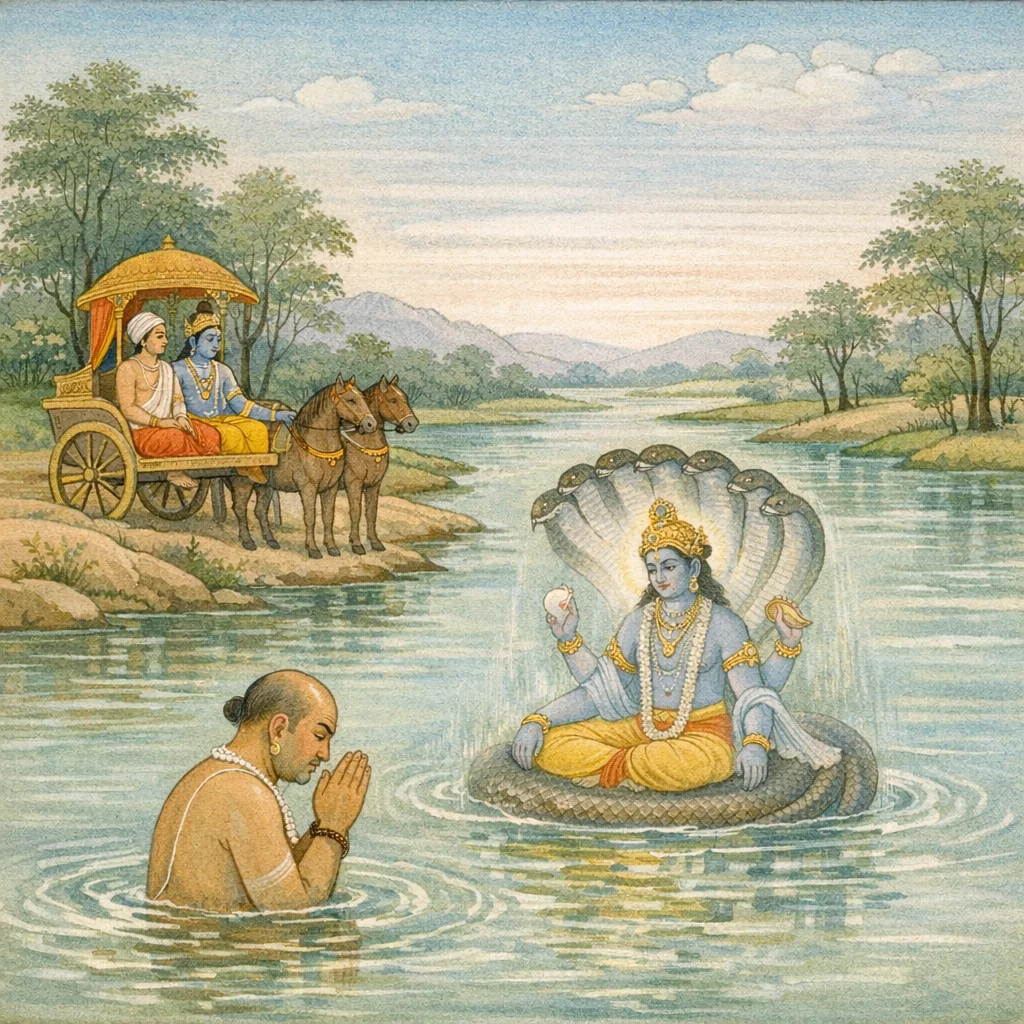
Parashara tells Maitreya: Akrura enters the waters of the Yamuna and worships Vishnu with flowers and incense offered in the mind; renouncing sense-objects, he attains samadhi and returns to the chariot. Seeing Rama and Krishna seated there just as before, he is astonished, and Krishna understands his wonder. Reaching Mathura, Akrura advises the proper manner of entering the city; on the royal road Rama-Krishna become the cause of the people’s joy and amazement. On the way Kamsa’s washerman insults them; Krishna strikes him down with a single slap, takes the garments, and, clad in yellow and blue, goes to the garland-maker’s house. Malyajivaka bows again and again with divine faith and offers fragrant flowers; Krishna, pleased, grants a boon that Sri’s prosperity and both worldly and spiritual fruits will never leave him. At last the two depart, honored and worshiped.
Shlokas
Verse 1
एवम् अन्तर् जले विष्णुम् अभिष्टूय स यादवः अर्चयाम् आस सर्वेशं पुष्पधूपैर् मनोमयैः
Thus, within the waters, that Yādava—having offered praise to Viṣṇu—began to worship the Lord of all, presenting flowers and incense fashioned by the mind itself.
Verse 2
परित्यक्तान्यविषयं मनस् तत्र निवेश्य सः ब्रह्मभूते चिरं स्थित्वा विरराम समाधितः
Casting away every other object of sense, he fixed his mind there alone; and, having long abided in that state of Brahman, he became still—resting in samādhi.
Verse 3
कृतकृत्यम् इवात्मानं मन्यमानो महामतिः आजगाम रथं भूयो निर्गम्य यमुनाम्भसः
Thinking of himself as though his purpose were fully accomplished, that great-souled one came back again to the chariot, emerging from the waters of the Yamunā.
Verse 4
रामकृष्णौ च ददृशे यथापूर्वं रथे स्थितौ विस्मिताक्षस् तदाक्रूरस् तं च कृष्णो ऽभ्यभाषत
Then Akrūra beheld Rāma and Kṛṣṇa, seated in the chariot just as before. His eyes widened in astonishment—and Kṛṣṇa, perceiving him thus, addressed him.
Verse 5
नूनं ते दृष्टम् आश्चर्यम् अक्रूर यमुनाजले विस्मयोत्फुल्लनयनो भवान् संलक्ष्यते यतः
Surely, O Akrūra, you have beheld some marvel in the waters of the Yamunā; for your eyes are widened with astonishment, and it is plain from your very look.
Verse 6
अन्तर् जले यद् आश्चर्यं दृष्टं तत्र मयाच्युत तद् अत्रापि हि पश्यामि मूर्तिमत् पुरतः स्थितम्
O Acyuta, the wondrous vision I beheld within the waters—here too I see it again: the very same marvel, embodied, standing manifest before me.
Verse 7
जगद् एतन् महाश्चर्यं रूपं यस्य महात्मनः तेनाश्चर्यपरेणाहं भवता कृष्ण संगतः
This entire universe is the wondrous form of that exalted Great Soul; and thus, O Kṛṣṇa, you—ever intent on revealing that very wonder—have brought me into your company.
Verse 8
तत् किम् एतेन मथुरां प्रयामो मधुसूदन बिभेमि कंसाद् धिग् जन्म परपिण्डोपजीविनाम्
“What is the use of all this, O Madhusūdana? Shall we go on to Mathurā? I fear Kaṃsa. Fie upon a life that survives by dependence on another’s bread!”
Verse 9
इत्य् उक्त्वा चोदयाम् आस तान् हयान् वातरंहसः संप्राप्तश् चातिसायाह्ने सो ऽक्रूरो मथुरां पुरीम्
Having spoken thus, Akrūra urged on those horses, swift as the wind; and by the late afternoon he arrived at the city of Mathurā.
Verse 10
विलोक्य मथुरां रामं कृष्णं चाह स यादवः पद्भ्यां यातं महावीर्यौ रथेनैको विशाम्य् अहम्
Beholding Mathurā, that Yādava said to Rāma and Kṛṣṇa: “You two, mighty in valor, have come on foot; I alone shall enter the city by chariot.”
Verse 11
गन्तव्यं वसुदेवस्य न भवद्भ्यां तथा गृहम् युवयोर् हि कृते वृद्धः स कंसेन निरस्यते
You must not go to Vasudeva’s house by the usual way. Because of you two, that aged man is being driven out and harried by Kaṃsa—his very home is no longer safe.
Verse 12
इत्य् उक्त्वा प्रविवेशाथ सो ऽक्रूरो मथुरां पुरीम् प्रविष्टौ रामकृष्णौ च राजमार्गम् उपागतौ
Having spoken thus, Akrūra entered the city of Mathurā. Rāma and Kṛṣṇa too, reaching the royal highway, made their entrance—moving onward in accord with the Lord’s lila that orders kings and realms.
Verse 13
स्त्रीभिर् नरैश् च सानन्दं लोचनैर् अभिवीक्षितौ जग्मतुर् लीलया वीरौ मत्तौ बालगजाव् इव
Women and men alike watched them with delighted eyes. The two heroic youths moved on in playful ease—like two young elephants, intoxicated with their own exuberant vigor.
Verse 14
भ्रममाणौ तु तौ दृष्ट्वा रजकं रङ्गकारकम् अयाचेतां सुरूपाणि वासांसि रुचिराननौ
As they wandered on, they saw a washerman and a dyer. Those two radiant-faced youths asked him for fine, well-made garments.
Verse 15
कंसस्य रजकः सो ऽथ प्रसादारूढविस्मयः बहून्य् आक्षेपवाक्यानि प्राहोच्चै रामकेशवौ
Then Kamsa’s washerman, emboldened by the king’s favor, cried out loudly and spoke many taunting, insulting words to Rama and Keshava.
Verse 16
ततस् तलप्रहारेण कृष्णस् तस्य दुरात्मनः पातयाम् आस कोपेन रजकस्य शिरो भुवि
Then Krishna, angered, struck that wicked washerman down with a single blow of his palm, and his head fell to the ground. In this swift act, the Lord made dharma unmistakably manifest.
Verse 17
हत्वादाय च वस्त्राणि पीतनीलाम्बरौ ततः कृष्णरामौ मुदा युक्तौ मालाकारगृहं गतौ
Having slain him and taken the garments, Krishna and Rama then donned yellow and deep-blue robes and, rejoicing together, went to the garland-maker’s house.
Verse 18
विकासिनेत्रयुगलो मालाकारो ऽपि विस्मितः एतौ कस्य कुतो वैतौ मैत्रेयाचिन्तयत् ततः
The garland-maker too, his eyes widening in astonishment, stood amazed. Then Maitreya reflected: “To whom do these two belong, and from where have they come?”
Verse 19
पीतनीलाम्बरधरौ तौ दृष्ट्वातिमनोहरौ स तर्कयाम् आस तदा भुवं देवाव् उपागतौ
Seeing those two, clad in yellow and dark-blue garments and utterly captivating, he reasoned within himself that two gods had then descended to the earth.
Verse 20
विकासिमुखपद्माभ्यां ताभ्यां पुष्पाणि याचितः भुवं विष्टभ्य हस्ताभ्यां पस्पर्श शिरसा महीम्
With his face like a lotus in bloom, he asked the two for flowers. Then, bracing himself on the ground with both hands, he bowed so deeply that his head touched the earth.
Verse 21
प्रसादपरमौ नाथौ मम गेहम् उपागतौ धन्यो ऽहम् अर्चयिष्यामीत्य् आह तौ माल्यजीवकः
“O noble Lords, whose very nature is grace—you have come to my home. Blessed am I!” Thus Mālyajīvaka spoke, resolved: “I shall worship you both.”
Verse 22
ततः प्रहृष्टवदनस् तयोः पुष्पाणि कामतः चारूण्य् एतान्य् अथैतानि प्रददौ स विलोभयन्
Then, his face bright with delight, he sought to please them and offered the two lovely flowers, chosen according to their desire.
Verse 23
पुनः पुनः प्रणम्यासौ मालाकारो नरोत्तमौ ददौ पुष्पाणि चारूणि गन्धवन्त्य् अमलानि च
Again and again the garland-maker bowed in reverence, offering to the two best of men flowers—lovely, fragrant, and pure.
Verse 24
मालाकाराय कृष्णो ऽपि प्रसन्नः प्रददौ वरम् श्रीस् त्वां मत्संश्रया भद्र न कदाचित् त्यजिष्यति
Pleased, Śrī Kṛṣṇa granted a boon to the garland-maker: “Auspicious one—Śrī (Lakṣmī), who abides in Me, shall never, at any time, abandon you.”
Verse 25
बलहानिर् न ते सौम्य धनहानिस् तथैव च यावद् दिनानि तावच् च न नशिष्यति संततिः
O gentle one, your strength shall not diminish, nor shall your wealth decline; for as many days as are ordained, so long your progeny shall not fail—your lineage will not be cut off.
Verse 26
भुक्त्वा च भोगान् विपुलांस् त्वम् अन्ते मत्प्रसादजम् ममानुस्मरणं प्राप्य दिव्यं लोकम् अवाप्स्यसि
Having enjoyed abundant delights, in the end—by the grace that comes from Me—you will attain remembrance of Me; and through that recollection you shall reach the divine realm.
Verse 27
धर्मे मनश् च ते भद्र सर्वकालं भविष्यति युष्मत्संततिजातानां दीर्घम् आयुर् भविष्यति
O noble one, your mind shall remain established in dharma at all times; and those born in your lineage shall be blessed with long life.
Verse 28
नोपसर्गादिकं दोषं युष्मत्संततिसंभवः संप्राप्स्यति महाभाग यावत् सूर्यो भविष्यति
O greatly fortunate one, no affliction—no calamity or taint of any kind—shall ever befall the descendants of your lineage, for as long as the Sun endures.
Verse 29
इत्य् उक्त्वा तद्गृहात् कृष्णो बलदेवसहायवान् निर्जगाम मुनिश्रेष्ठ मालाकारेण पूजितः
Having spoken thus, O best of sages, Krishna—supported by Balarama—departed from that house, honored with reverent worship by the garland-maker.
Frequently Asked Questions
It frames Krishna as Vishnu who is simultaneously ‘within the waters’ and ‘before the eyes’—a narrative device teaching Antaryāmin-bhāva and the non-contradiction of transcendence and immanence.
The rājāśraya-born arrogance (कंसप्रसादजन्य गर्व) becomes adharma when it turns into cruelty and insult; Krishna’s swift punishment functions as dharma-prakaṭīkaraṇa—making moral order unmistakable.