Adhyaya 16
ऋभु-निदाघ-संवादः — अधः-ऊर्ध्व-दृष्टान्तेन अद्वैतबोधः (राजा-गज-उपमा) तथा मोक्षफलश्रुति
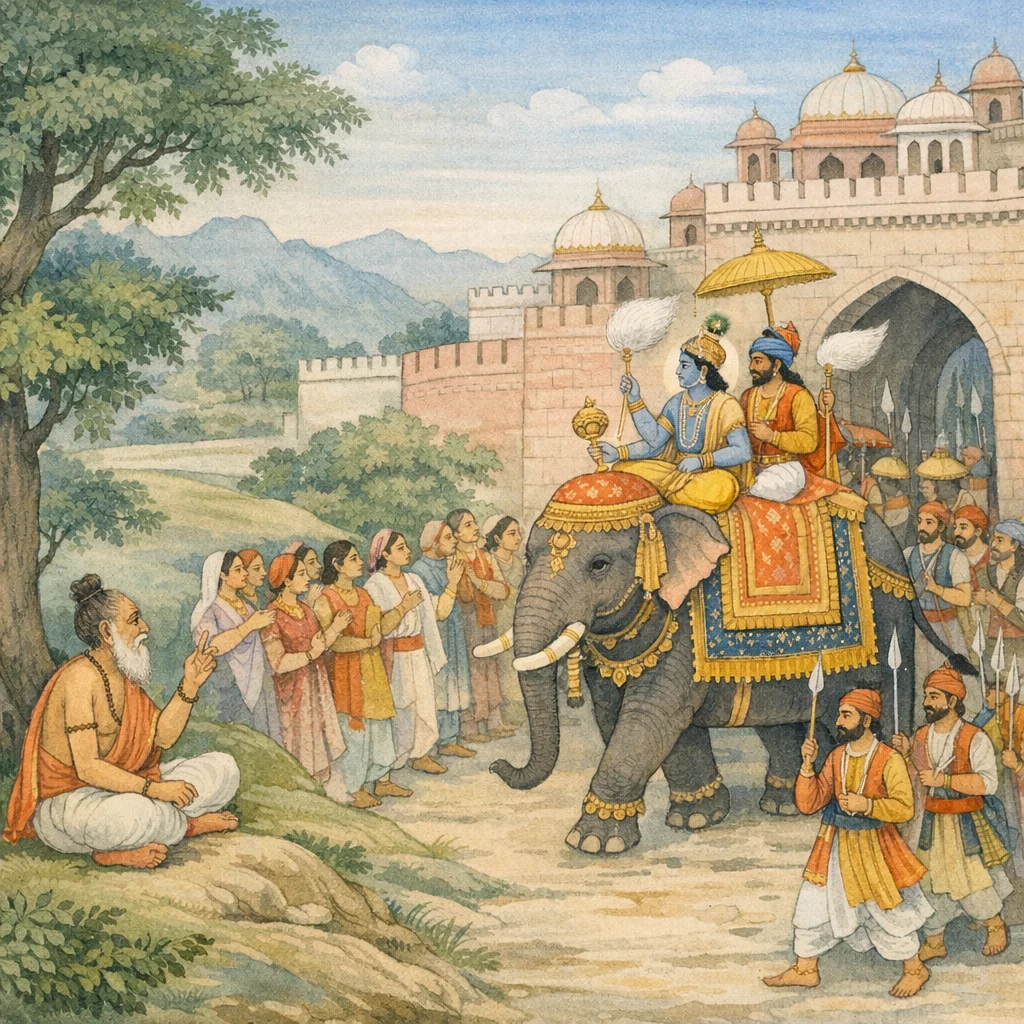
Parāśara tells Maitreya that after a thousand years Ṛbhu returns to the same city to complete Nidāgha’s training in the knowledge of dispassion (vairāgya-jñāna). Outside the city Nidāgha stands apart from the crowd as the king enters with a mighty retinue; Ṛbhu approaches and asks why he is alone. The dialogue moves from identifying the “king” versus “the other” to the king-and-elephant example of what “below” and “above” mean. Ṛbhu teaches a critique of standpoint: relational labels depend on position and therefore cannot define the Self (Ātman). Nidāgha recognizes Ṛbhu as his guru, receives the essence of paramārtha—advaitha—attains abheda-darśana, and is liberated. Parāśara adds that as one sky appears many-colored, the one Ātman seems divided to deluded sight; in truth everything is Acyuta alone. The fruit is declared: the king abandons bheda and gains apavarga in this very life, and devoted hearing/recitation purifies the mind and makes one fit for mukti.
Shlokas
Verse 1
ऋभुर् वर्षसहस्रे तु समतीते नरेश्वर निदाघज्ञानदानाय तद् एव नगरं ययौ
O king, when a thousand years had passed, Ṛbhu went again to that very city, intent on granting Nidāgha the cool wisdom of detachment that quenches the heat and weariness of worldly life.
Verse 2
नगरस्य बहिः सो ऽथ निदाघं ददृशे मुनिः महाबलपरीवारे पुरं विशति पार्थिवे
Then, outside the city, the sage beheld Nidāgha, just as the king, surrounded by a retinue of great might, was entering the royal town.
Verse 3
दूरे स्थितं महाभागं जनसंमर्दवर्जकम् क्षुत्क्षामकण्ठम् आयान्तम् अरण्यात् ससमित्कुशम्
From afar they saw a greatly blessed and noble one, shunning the crush of people, his throat parched with hunger, coming from the forest bearing sacred fuel-sticks and kuśa grass.
Verse 4
दृष्ट्वा निदाघं स ऋभुर् उपगम्याभिवाद्य च उवाच कस्माद् एकान्ते स्थीयते भवता द्विज
Seeing Nidāgha, Ṛbhu approached, offered respectful salutations, and said: “O brāhmaṇa, why do you remain standing here in solitude?”
Verse 5
भो विप्र जनसंमर्दो महान् एष नरेश्वरे प्रविविक्षौ पुरं रम्यं तेनात्र स्थीयते मया
“O brāhmaṇa, there is a great press of people around the king. Since he is about to enter that splendid city, I shall remain here for the time being.”
Verse 6
नराधिपो ऽत्र कतमः कतमश् चेतरो जनः कथ्यतां मे द्विजश्रेष्ठ त्वम् अभिज्ञो मतो मम
Which one here is the sovereign king, and which is the other man? Tell me, O best of the twice-born; for in my judgment you are the one who truly knows.
Verse 7
यो ऽयं गजेन्द्रम् उन्मत्तम् अद्रिशृङ्गसमुच्छ्रितम् अधिरूढो नरेन्द्रो ऽयं परिलोकस् तथेतरः
This king, mounted upon a lordly elephant—maddened and towering like a mountain-peak—seems to gaze beyond the common world; and yet he is also of this world, moving among men.
Verse 8
एतौ हि गजराजानौ युगपद् दर्शितौ मम भवता न विशेषेण पृथक्चिह्नोपलक्षणौ
For you have shown me these two lordly elephants at the very same time, yet you have not distinguished them by any particular, separate marks by which one might be recognized apart from the other.
Verse 9
तत् कथ्यतां महाभाग विशेषो भवतानयोः ज्ञातुम् इच्छाम्य् अहं को ऽत्र गजः को वा नराधिपः
Tell me then, O great and fortunate one, the distinguishing truth between these two. I wish to know clearly: here, which is the elephant, and which indeed is the lord among men—the king?
Verse 10
गजो यो ऽयम् अधो ब्रह्मन्न् उपर्य् अस्यैव भूपतिः वाह्यवाहकसंबन्धं को न जानाति वै द्विज
O Brahmin, the elephant is below, and above it stands the king. Who indeed, O twice-born, does not understand the relation between the bearer and what is borne?
Verse 11
जानाम्य् अहं यथा ब्रह्मंस् तथा माम् अवबोधय अधःशब्दनिगद्यं किं किं चोर्ध्वम् अभिधीयते
O revered Brahman, I grasp it in one way; yet instruct me clearly in the true meaning. When the word “below” is spoken, what all is intended by it—and likewise, what is designated as “above”?
Verse 12
इत्य् उक्तः सहसारुह्य निदाघः प्राह तम् ऋभुम् श्रूयतां कथयाम्य् एष यन् मां त्वं परिपृच्छसि
Thus addressed, Nidāgha at once climbed up and said to Ṛbhu: “Listen—now I shall tell you precisely what it is that you ask of me.”
Verse 13
उपर्य् अहं यथा राजा त्वम् अधः कुञ्जरो यथा अवबोधाय ते ब्रह्मन् दृष्टान्तो दर्शितो मया
“As I stand above like a king, so you are below like an elephant. O Brahman, I have shown you this illustration so that you may understand clearly.”
Verse 14
त्वं राजेव द्विजश्रेष्ठ स्थितो ऽहं गजवद् यदि तद् एव त्वं ममाचक्ष्व कतमस् त्वम् अहं तथा
O best of the twice-born—if you stand here like a king and I remain like an elephant held in check, then tell me plainly: which of us are you, and which of us am I, in truth?
Verse 15
इत्य् उक्तः सत्वरस् तस्य प्रगृह्य चरणाव् उभौ निदाघः प्राह भगवान् आचार्यस् त्वम् ऋभुर् ध्रुवम्
Thus addressed, Nidāgha—without hesitation—reverently took hold of both his feet and said: “Blessed one, you are surely my teacher; you are indeed Ṛbhu.”
Verse 16
नान्यस्याद्वैतसंस्कारसंस्कृतं मानसं तथा यथाचार्यस्य तेन त्वां मन्ये प्राप्तम् अहं गुरुम्
In none other do I behold a mind so refined by the disciplines of non-dual wisdom as in a true ācārya; therefore I regard you as the Guru I have attained.
Verse 17
तवोपदेशदानाय पूर्वशुश्रूषणादृतः गुरुस् ते ऽहम् ऋभुर् नाम्ना निदाघ समुपागतः
Nidāgha, I have come to you—I, your teacher named Ṛbhu—moved by the reverence you once showed through devoted service, and wishing now to impart instruction to you.
Verse 18
तद् एतद् उपदिष्टं ते संक्षेपेण महामते परमार्थसारभूतं यद् अद्वैतम् अशेषतः
Thus, O great-minded one, I have taught you this in brief—the very essence of the highest truth: that non-dual Reality, in its fullness, without remainder.
Verse 19
एवम् उक्त्वा ययौ विद्वान् निदाघं स ऋभुर् गुरुः निदाघो ऽप्य् उपदेशेन तेनाद्वैतपरो ऽभवत्
Having spoken thus, the wise guru Ṛbhu departed from Nidāgha; and Nidāgha too—through that very instruction—became devoted to the realization of non-duality.
Verse 20
सर्वभूतान्य् अभेदेन ददृशे स तदात्मनः तथा ब्रह्म ततो मुक्तिम् अवाप परमां द्विजः
Seeing all beings without any sense of difference—as none other than the Self—and realizing Brahman in the same way, that twice-born sage attained the supreme liberation thereafter.
Verse 21
तथा त्वम् अपि धर्मज्ञ तुल्यात्मरिपुबान्धवः भव सर्वगतं जानन्न् आत्मानम् अवनीपते
O knower of dharma, O lord of the earth: be even-minded toward foe and friend; knowing the Self to be all-pervading, abide firmly in that understanding.
Verse 22
सितनीलादिभेदेन यथैकं दृश्यते नभः भ्रान्तदृष्टिभिर् आत्मापि तथैकः सन् पृथक् पृथक्
Just as the one sky is seen as divided—white, blue, and the like—by eyes deluded by appearance, so too the Self, though truly One, is perceived again and again as though separate and many.
Verse 23
एकः समस्तं यद् इहास्ति किंचित् तद् अच्युतो वास्ति परं ततो ऽन्यत् सो ऽहं स च त्वं स च सर्वम् एतद् आत्मस्वरूपं त्यज भेदमोहम्
All that exists here—whatever it may be—is One alone: Acyuta, the Imperishable. Beyond Him there is no other. He is ‘I’; He is also ‘you’; He is this entire universe. Know this as the very nature of the Self, and abandon the delusion of division.
Verse 24
इतीरितस् तेन स राजवर्यस् तत्याज भेदं परमार्थदृष्टिः स चापि जातिस्मरणाप्तबोधस् तत्रैव जन्मन्य् अपवर्गम् आप
Thus instructed by him, that best of kings—his vision fixed on the highest truth—abandoned all sense of division. And awakened by the knowledge gained through remembrance of former births, he attained apavarga, final release, in that very life.
Verse 25
इति भरतनरेन्द्रसारवृत्तं कथयति यश् च शृणोति भक्तियुक्तः स विमलमतिर् एति नात्ममोहं भवति च संसरणेषु मुक्तियोग्यः
Thus, whoever recites—or listens with devotion—to this essential account of King Bharata’s life becomes pure in understanding; he does not fall into delusion about the Self, and amid the rounds of samsara he becomes fit for liberation.
Frequently Asked Questions
Because it exposes how “above/below” and “bearer/born” are relational and viewpoint-dependent; by destabilizing these categories, the disciple is led from nāma-rūpa relations to the non-dual Self that is not captured by such distinctions.
It illustrates bhrānti: the one, undivided reality appears diversified due to the perceiver’s limitation. Likewise, the one Ātman (identified here with Acyuta) is seen as many selves and beings through bheda-moha.
As advaitha without remainder: all that exists is Acyuta alone—He is ‘I,’ ‘you,’ and the entire universe—so liberation is the collapse of bheda-buddhi into abheda-jñāna.
Devotional hearing/recitation purifies understanding, prevents ātma-moha (self-delusion), and makes one qualified for liberation even while living within saṃsāra.