Adhyaya 14
परमार्थ-निर्णयः—श्रेयस्-भेदः, कर्म-ध्यान-सीमा, एकात्मदर्शनम्
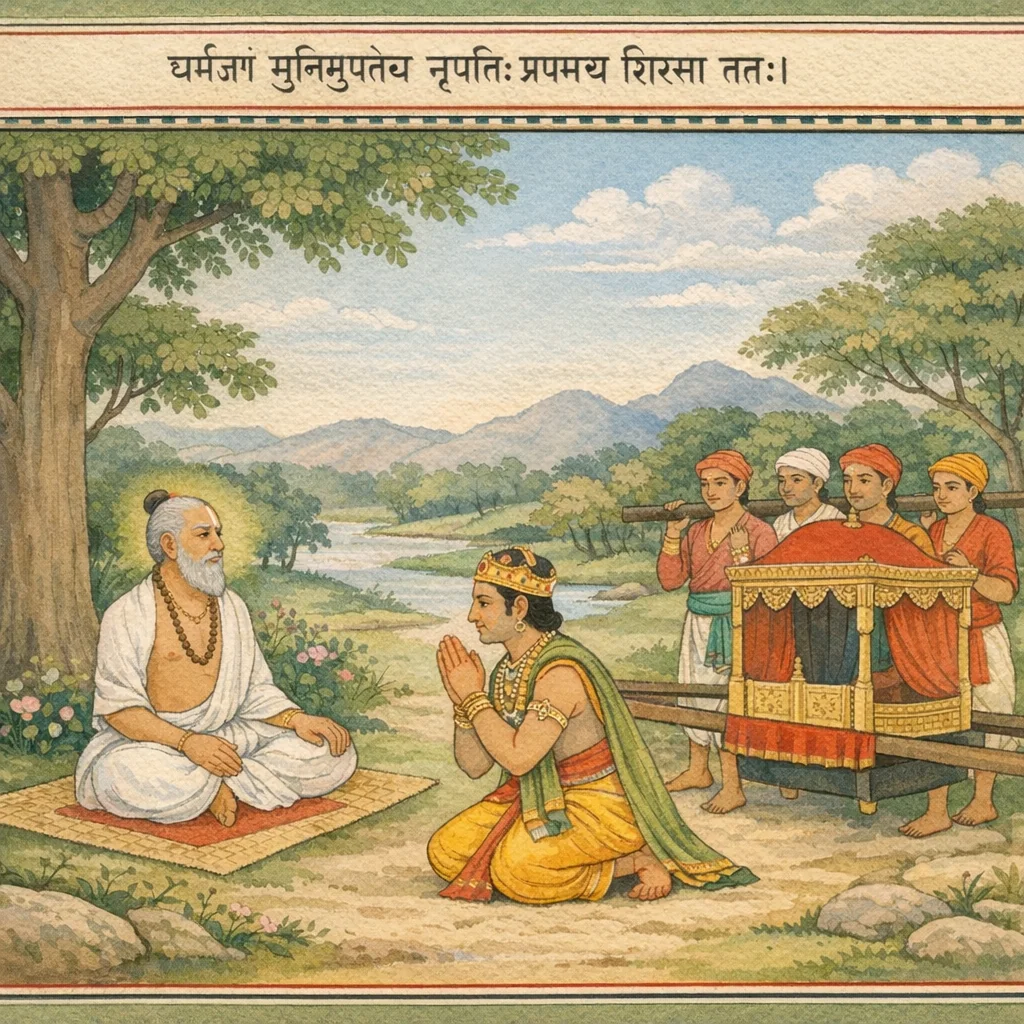
Following the king’s humbled stance, the teaching turns to paramārtha. Maitreya says the doctrine both unsettles and uplifts the mind, praising the universal reach of viveka-jñāna. Parāśara explains that many ‘goods’ (śreyas)—ritual merit, wealth, sons, kingship, even heaven gained by yajña—are only provisional; the supreme śreyas is realizing the unity of Ātman with Paramātman (Viṣṇu). He criticizes seeking the imperishable through perishable ritual materials, and warns that even meditation, if treated as a separative act, falls short of non-dual paramārtha. The chapter ends with a concise definition: the One Self is all-pervading, equal, pure, nirguṇa, beyond prakṛti, unborn and imperishable; distinctions of name and jāti are superimpositions. True knowledge is seeing one consciousness in oneself and others; analogies like flute-notes and wind show apparent multiplicity upon an undivided reality.
Shlokas
Verse 1
निशम्य तस्येति वचः परमार्थसमन्वितम् प्रश्रयावनतो भूत्वा तम् आह नृपतिर् द्विजम्
Having heard those words, filled with the highest truth, the king bowed in reverent humility and addressed that brāhmaṇa.
Verse 2
भगवन् यत् त्वया प्रोक्तं परमार्थमयं वचः श्रुते तस्मिन् भ्रमन्तीव मनसो मम वृत्तयः
O Blessed One, when I hear your speech, so full of the highest truth, the movements of my mind seem to whirl and wander, as though unsettled by its very profundity.
Verse 3
एतद् विवेकविज्ञानं यद् अशेषेषु जन्तुषु भवता दर्शितं विप्र तत् परं प्रकृतेर् महत्
O brāhmaṇa, this discerning wisdom you have revealed—applicable to all beings without exception—is the supreme principle, greater than Prakṛti itself and even beyond Mahat, the Great Cosmic Intellect.
Verse 4
नाहं वहामि शिबिकां शिबिका न मयि स्थिता शरीरम् अन्यद् अस्मत्तो येनेयं शिबिका धृता
“I do not carry the palanquin; nor does the palanquin rest upon me. This body is other than the Self—by this body alone is the palanquin borne.”
Verse 5
गुणप्रवृत्त्या भूतानां प्रवृत्तिः कर्मचोदिता प्रवर्तन्ते गुणाश् चैते किं ममेति त्वयोदितम्
By the stirring of the guṇas, the activity of beings is set in motion, driven by karma. The guṇas themselves revolve in their own course; tell me then—what is this notion of “mine” you have spoken of?
Verse 6
एतस्मिन् परमार्थज्ञ मम श्रोत्रपथं गते मनो विह्वलताम् एति परमार्थार्थितां गतम्
O knower of the highest truth: when this teaching entered the pathway of my hearing, my mind grew overwhelmed, turning wholly toward the longing for the Supreme Meaning.
Verse 7
पूर्वम् एव महाभागं कपिलर्षिम् अहं द्विज प्रष्टुम् अभ्युद्यतो गत्वा श्रेयः किं न्व् इत्य् असंशयम्
Earlier, O noble brāhmaṇa, I set out with firm resolve to question the illustrious sage Kapila—seeking without doubt to know: “What, indeed, is śreyas, the highest good?”
Verse 8
तदन्तरे च भवता यद् इदं वाक्यम् ईरितम् तेनैव परमार्थार्थं त्वयि चेतः प्रधावति
And in the midst of this, the very words you have spoken draw my heart toward you alone; for through them the highest purport of ultimate reality has become my single pursuit.
Verse 9
कपिलर्षिर् भगवतः सर्वभूतस्य वै किल विष्णोर् अंशो जगन्मोहनाशायोर्वीम् उपागतः
Indeed, the sage Kapila is an emanated portion of Lord Viṣṇu, the Blessed One who is the very Self of all beings; he descended upon the earth to destroy the delusion that bewilders the world.
Verse 10
स एव भगवान् नूनम् अस्माकं हितकाम्यया प्रत्यक्षताम् अत्र गतो यथैतद् भवतोच्यते
Surely it is that very Blessed Lord Himself who—seeking our welfare—has come here in direct manifestation, just as you declare.
Verse 11
तन् मह्यं प्रणताय त्वं यच् छ्रेयः परमं द्विज तद् वदाखिलविज्ञानजलवीच्युदधिर् भवान्
To me—bowed down in reverence—declare, O twice-born one, that supreme good which is truly highest; for you are an ocean whose waves are the waters of all knowledge.
Verse 12
भूप पृच्छसि किं श्रेयः परमार्थं नु पृच्छसि श्रेयांस्य् अपरमार्थानि अशेषाण्य् एव भूपते
O King, you ask about what is beneficial—yet do you ask about the supreme end itself? For, O lord of the earth, all the so‑called ‘benefits’ that are not rooted in the highest truth are, in the end, entirely without ultimate substance.
Verse 13
देवताराधनं कृत्वा धनसंपदम् इच्छति पुत्रान् इच्छति राज्यं च श्रेयस् तत्प्राप्तिलक्षणम्
Having performed the worship of the deities, a man seeks prosperity and wealth; he seeks sons, and he seeks kingship as well—yet the true ‘higher good’ (śreyas) is known by the mark that it leads one beyond such acquisitions to its own attainment.
Verse 14
कर्म यज्ञात्मकं श्रेयः स्वर्लोकफलदायि यत् श्रेयः प्रधानं च फले तद् एवानभिसंहिते
Ritual action performed as sacrifice (yajña) is indeed a wholesome good, for it bestows the fruit of heaven. Yet even there, the highest ‘good’ is not the heaven itself, but the primacy of the intended result—so it is declared, when no other ulterior aim has been secretly entertained.
Verse 15
आत्मा ध्येयः सदा भूप योगयुक्तैस् तथा परम् श्रेयस् तस्यैव संयोगः श्रेयो यः परमात्मनः
O King, those established in Yoga should ever contemplate the Self; and the highest good is this alone—the blessed union of the individual self with the Supreme Self, the Paramātman.
Verse 16
श्रेयांस्य् एवम् अनेकानि शतशो ऽथ सहस्रशः सन्त्य् अत्र परमार्थास् तु न त्व् एते श्रूयतां च मे
Thus there are hundreds—indeed thousands—of teachings that promise welfare and merit; yet their supreme purport, the paramārtha, is not truly grasped through them. Therefore listen to me, as I declare that highest meaning.
Verse 17
धर्माय त्यज्यते किं तु परमार्थो धनं यदि व्ययश् च क्रियते कस्मात् कामप्राप्त्युपलक्षणः
If wealth is relinquished for the sake of dharma, then it truly becomes the highest purpose; but if riches are spent for any other end, why praise that outlay as more than a mere sign of desire fulfilled?
Verse 18
पुत्रश् चेत् परमार्थाख्यः सो ऽप्य् अन्यस्य नरेश्वर परमार्थभूतः सो ऽन्यस्य परमार्थो हि तत्पिता
O king, even if a son is proclaimed to be the ‘highest good’ (paramārtha), he is so only in relation to another; for the father of that son becomes the ‘highest good’ for someone else.
Verse 19
एवं न परमार्थो ऽस्ति जगत्य् अस्मिंश् चराचरे परमार्थो हि कार्याणि कारणानाम् अशेषतः
Thus, in this world of the moving and the unmoving, there is no ultimate reality as an independent thing; for what is called the Highest Truth is that all effects, without remainder, abide in their causes.
Verse 20
राज्यादिप्राप्तिर् अत्रोक्ता परमार्थतया यदि परमार्था भवन्त्य् अत्र न भवन्ति च वै ततः
Here, the attainment of kingship and the like is spoken of only insofar as it serves the Supreme End; but if it does not truly become an instrument of that Highest Purpose, then it is not the Supreme Purpose at all.
Verse 21
ऋग्यजुःसामनिष्पाद्यं यज्ञकर्म मतं तव परमार्थभूतं तत्रापि श्रूयतां गदतो मम
You regard the sacrificial rite—brought forth from the Ṛg, Yajus, and Sāman—as the highest path; yet even within that sacrifice there is a supreme inner purport. Hear it from me as I speak.
Verse 22
यत् तु निष्पाद्यते कार्यं मृदा कारणभूतया तत् कारणानुगमनाज् ज्ञायते नृप मृण्मयम्
O king, whatever is produced from clay—clay being its material cause—is known, by tracing it back to that cause, as nothing other than ‘made of clay’.
Verse 23
एवं विनाशिभिर् द्रव्यैः समिदाज्यकुशादिभिः निष्पाद्यते क्रिया या तु सा भवित्री विनाशिनी
Thus, any rite carried out by means of perishable substances—firewood, ghee, kuśa grass, and the like—must itself be destined to perish; for a sacrificial act fashioned from what decays cannot be imperishable.
Verse 24
अनाशी परमार्थश् च प्राज्ञैर् अभ्युपगम्यते तत् तु नाशि न संदेहो नाशिद्रव्योपपादितम्
The wise acknowledge the Supreme Reality to be imperishable; but whatever is asserted to be perishable is, beyond doubt, only something inferred and constructed from perishing substances.
Verse 25
तद् एवाफलदं कर्म परमार्थो मतस् तव मुक्तिसाधनभूतत्वात् परमार्थो न साधनम्
That very action is truly fruitless—thus you have understood the paramārtha. For the Supreme End is itself the ground of liberation and the reality that is the means; therefore it is not to be treated as a mere instrument.
Verse 26
ध्यानं चैवात्मनो भूप परमार्थार्थशब्दितम् भेदकारि परेभ्यस् तत् परमार्थो न भेदवान्
O King, contemplation of the Self is indeed called the pursuit of paramārtha. Yet when it is set apart as a distinct act or object, it becomes a maker of difference; for paramārtha itself is without division.
Verse 27
परमात्मात्मनोर् योगः परमार्थ इतीष्यते मिथ्यैतद् अन्यद्रव्यं हि नैति तद्द्रव्यतां यतः
Paramārtha is declared to be the yoga—union—of the Supreme Self and the individual self. Whatever is grasped as a separate “other substance” is false, for it can never become that very Reality.
Verse 28
तस्माच् छ्रेयांस्य् अशेषाणि नृपैतानि न संशयः परमार्थस् तु भूपाल संक्षेपाच् छ्रूयतां मम
Therefore, O king, without doubt these are all the various paths to welfare and auspiciousness. Yet, O protector of the earth, hear from me in brief the paramārtha—the highest truth that stands above them all.
Verse 29
एको व्यापी समः शुद्धो निर्गुणः प्रकृतेः परः जन्मवृद्ध्यादिरहित आत्मा सर्वगतो ऽव्ययः
He is One—all-pervading, the same in all, and perfectly pure; beyond the guṇas and higher than prakṛti. Free from birth, growth, and every change, He is the Self, present everywhere, and imperishable.
Verse 30
परज्ञानमयो ऽसद्भिर् नामजात्यादिभिर् विभुः न योगवान् न युक्तो ऽभून् नैव पार्थिव योक्ष्यति
The all-pervading Lord is pure, transcendent consciousness; yet the deluded fasten upon Him unreal distinctions—name, caste, and the like. In truth He has never been bound, never joined to limitation; O king, He will never be bound at any time.
Verse 31
तस्यात्मपरदेहेषु सतो ऽप्य् एकमयं हि यत् विज्ञानं परमार्थो ऽसौ द्वैतिनो ऽतत्त्वदर्शिनः
That discerning knowledge by which—though the Self exists in one’s own body and in the bodies of others—it is realized as a single, undivided reality: that alone is the highest truth. Those who insist on duality, failing to behold the real, do not perceive this essence.
Verse 32
वेणुरन्ध्रविभेदेन भेदः षड्जादिसंज्ञितः अभेदव्यापिनो वायोस् तथा तस्य महात्मनः
By the differing apertures of the flute, distinctions arise that are known as the notes beginning with ṣaḍja; yet the wind that pervades them is itself undivided—and so too is that great-souled Reality which, though one, appears as many.
Verse 33
एकत्वं रूपभेदश् च बाह्यकर्मप्रवृत्तिजः देवादिभेदे ऽपध्वस्ते नास्त्य् एवावरणो हि सः
Oneness—and even the seeming difference of forms—arises from engagement in outward activity. When the distinction of “gods and the rest” is dissolved, there is truly no veil remaining; for That (Supreme Reality) is not a thing that can be covered.
Frequently Asked Questions
Paramārtha is the imperishable, non-dual reality—realized as the one Self/Paramātman beyond prakṛti and guṇas—by which all distinctions are understood as superimposed and all beings are seen as one in essence.
They are acknowledged as śreyas in a limited sense (e.g., svarga-phala), but their fruits are perishable because they are produced through perishable means; thus they cannot be the final, imperishable paramārtha.