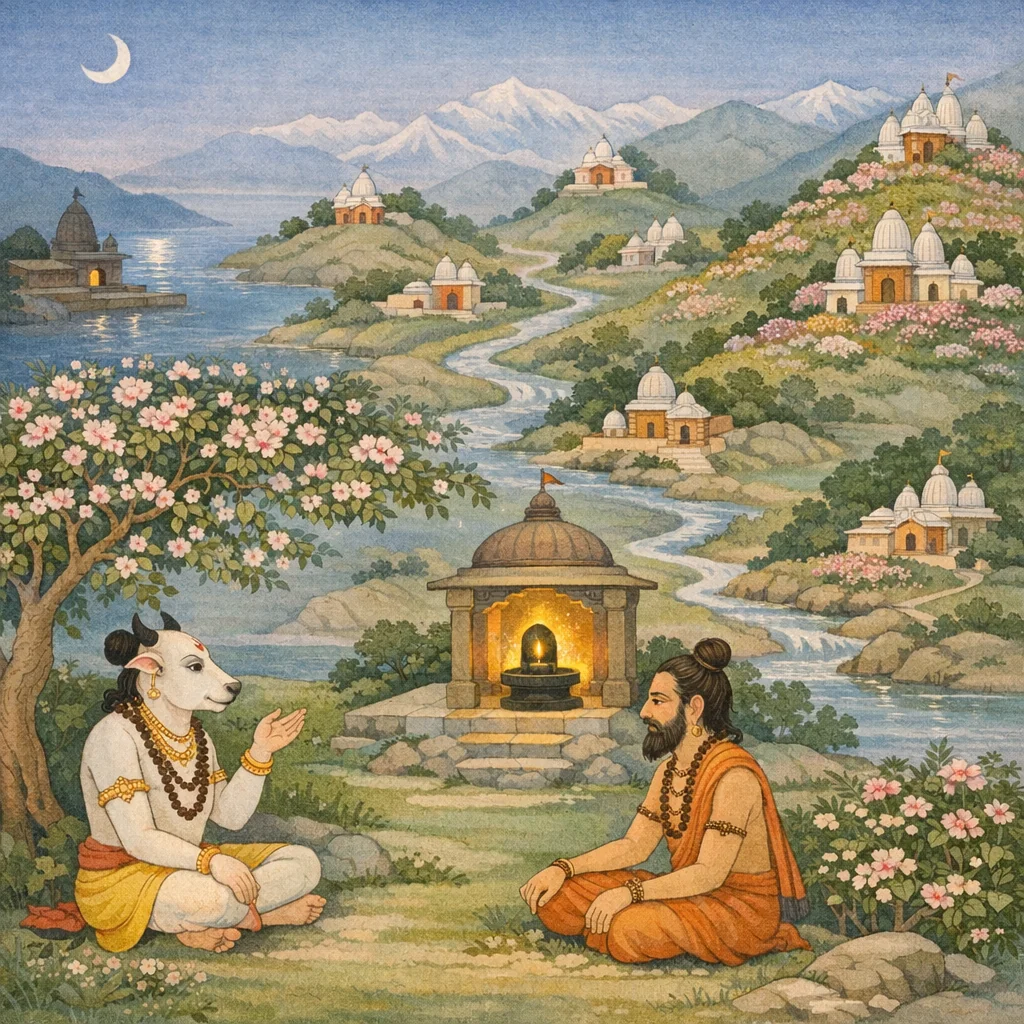
द्वादशज्योतिर्लिङ्गावतारकथनम् (Account of the Twelve Jyotirliṅga Manifestations)
This chapter is a didactic catalogue spoken by Nandīśvara, who urges a sage (“mune”) to hear of Śiva’s twelve supreme manifestations as Jyotirliṅgas—luminous liṅga-forms established in specific sacred places. Their darśana (devotional beholding), and even their touch, is said to bestow universal auspiciousness. The text lists the canonical names and sites: Somnātha, Mallikārjuna, Mahākāla, Oṃkāreśvara, Kedāra, Bhīmaśaṅkara, Viśveśa, Tryambaka, Vaidyanātha, Nāgeśa, Rāmeśa, and Ghuśmeśa. It then begins a place-by-place theological and ritual annotation (with Somnātha and the opening of Mallikārjuna), linking each liṅga to salvific benefits—removal of disease, destruction of sin—and to local tīrtha features such as Caṃdrakuṇḍa, thus serving as a practical pilgrimage guide. The inner teaching is that transcendent Śiva is identical with immanent, locatable signs: metaphysics expressed as sacred topography.
Shlokas
Verse 1
नन्दीश्वर उवाच । अवताराञ्छृणु विभोर्द्वादशप्रमितान्परान् । ज्योतिर्लिङ्गस्वरूपान्वै नानोति कारकान्मुने
Nandīśvara said: “O sage, hear of the Supreme Lord’s exalted incarnate manifestations, twelve in number—indeed, those very forms that appear as Jyotirliṅgas, bringing about many kinds of divine effects.”
Verse 2
सौराष्ट्रे सोमनाथश्च श्रीशैले मल्लिकार्जुनः । उज्जयिन्यां महाकाल ओंकारे चामरेश्वरः
In Saurāṣṭra He is Somnātha; on Śrīśaila He is Mallikārjuna; in Ujjayinī He is Mahākāla; and at Oṃkāra He is Āmareśvara—Shiva, the one Lord, graciously manifesting in these sacred forms for the uplift of devotees.
Verse 3
केदारो हिमव त्पृष्टे डाकिन्याम्भीमशंकरः । वाराणस्यां च विश्वेशस्त्र्यम्बको गौतमीतटे
On the slopes of the Himālaya is Kedāra; in Ḍākinī dwells Bhīmaśaṅkara; in Vārāṇasī is Viśveśa; and on the bank of the Gautamī (Godāvarī) is Tryambaka. Thus the Lord is revered in these sacred abodes through His manifest (saguṇa) forms that bestow grace and liberation upon devotees.
Verse 4
वैद्यनाथश्चिताभूमौ नागेशो दारुकावने । सेतुबन्धे च रामेशो घुश्मेशश्च शिवालये
Vaidyanātha is manifest in the cremation-ground; Nāgeśa in the Dārukā forest; Rāmeśa at Setubandha; and Ghuśmeśa in Śivālaya, the abode of Śiva. These are revered holy stations where the Lord is worshipped in His saguṇa Liṅga-form for the uplift of bound souls (paśu).
Verse 5
अवतारद्वादशकमेतच्छम्भोः परात्मनः । सर्वानन्दकरं पुंसान्दर्शनात्स्पर्शनान्मुने
O sage, this is the set of twelve descents (avatāras) of Śambhu, the Supreme Self. For embodied beings it bestows perfect bliss—merely by being seen, and even by being touched.
Verse 6
तत्राद्यस्सोमनाथो हि चन्द्रदुःखक्षयंकरः । क्षयकुष्ठादिरोगाणां नाशकः पूजनान्मुने
There, the first is indeed Somanātha, who brings the Moon’s sorrow to an end. O sage, by worshipping him, ailments such as consumption and leprosy are destroyed.
Verse 7
शिवावतारस्सोमेशो लिंगरूपेण संस्थितः । सौराष्ट्रे शुभदेशे च शशिना पूजितः पुरा
Someśa—an incarnation of Lord Śiva—abides there established in the form of the Liṅga. In the auspicious land of Saurāṣṭra, he was worshipped in ancient times by Śaśin, the Moon.
Verse 8
चंद्रकुण्डं च तत्रैव सर्वपापविनाशकम् । तत्र स्नात्वा नरो धीमान्सर्वरोगैः प्रमुच्यते
There itself is the Candrakuṇḍa, the sacred pool that destroys all sins. By bathing there, a wise person is freed from all diseases.
Verse 9
सोमेश्वरं महालिंगं शिवस्य परमात्मकम् । दृष्ट्वा प्रमुच्यते पापाद्भुक्तिं मुक्तिं च विन्दति
Having beheld the great Liṅga of Someśvara—the supreme embodiment of Lord Śiva—one is freed from sin and attains both bhukti (worldly fulfillment) and mukti (final liberation).
Verse 10
मल्लिकार्जुनसंज्ञश्चावतारश्शंकरस्य वै । द्वितीयः श्रीगिरौ तात भक्ताभीष्टफलप्रदः
O dear one, the incarnation of Śaṅkara known as Mallikārjuna is indeed the second manifestation; on the sacred Śrīgiri He grants devotees the fruits of their cherished wishes.
Verse 11
संस्तुतो लिंगरूपेण सुतदर्शनहेतुतः । गतस्तत्र महाप्रीत्या स शिवः स्वगिरेर्मुने
Praised in the form of the Liṅga, with the purpose of granting the sight of his son, that Lord Śiva went there with great delight, O sage of Svagiri.
Verse 12
ज्योतिर्लिंगं द्वितीयन्तद्दर्शनात्पूजनान्मुने । महासुखकरं चान्ते मुक्तिदन्नात्र संशयः
O sage, this second Jyotirliṅga—by its darśana and by worship—bestows great bliss, and in the end grants mukti (liberation). Of this there is no doubt.
Verse 13
महाकालाभिधस्तातावतारश्शंकरस्य वै । उज्जयिन्यां नगर्य्यां च बभूव स्वजनावनः
O dear one, Śaṅkara truly manifested an incarnation known as Mahākāla; and in the city of Ujjayinī he became the protector of his own devotees.
Verse 14
दूषणाख्यासुरं यस्तु वेदधर्मप्रमर्दकम् । उज्जयिन्यां गतं विप्रद्वेषिणं सर्वनाशनम्
Now is spoken of the asura named Dūṣaṇa—one who trampled the dharma of the Vedas, who went to Ujjayinī, who hated the brāhmaṇas, and who brought ruin upon all.
Verse 15
वेदविप्रसुतध्यातो हुङ्कारेणैव स द्रुतम् । भस्मसात्कृतवांस्तं च रत्नमाल निवासिनम्
Meditated upon by the Veda-born brāhmaṇa, he swiftly uttered a single “Huṅkāra”; and in an instant he reduced to ashes that resident of Ratnamālā.
Verse 16
तं हत्वा स महाकालो ज्योतिर्लिंगस्वरूपतः । देवैस्स प्रार्थितोऽतिष्ठत्स्वभक्तपरिपालकः
Having slain him, Mahākāla—manifesting as the very form of the Jyotirliṅga—remained there when the gods entreated Him, for He is the protector and sustainer of His own devotees.
Verse 17
महाकालाह्वयं लिंगं दृष्ट्वाभ्यर्च्य प्रयत्नतः । सर्वान्कामानवाप्नोति लभते परतो गतिम्
Having beheld the Liṅga renowned as Mahākāla, and worshipped it with sincere effort, one attains all rightful desires and thereafter reaches the supreme course—liberation in Śiva’s grace.
Verse 18
ओङ्कारः परमेशानो धृतः शम्भो परात्मनः । अवतारश्चतुर्थो हि भक्ताभीष्टफलप्रदः
Śambhu, the Supreme Lord, the inner Self of all beings, assumed the form of Oṅkāra (Om). Truly, this is the fourth incarnation, granting devotees the fruits they desire.
Verse 19
विधिना स्थापितो भक्त्या स्वलिंगात्पार्थिवान्मुने । प्रादुर्भूतो महादेवो विन्ध्यकामप्रपूरकः
O sage, when the earthen liṅga was duly established with devotion from one’s own liṅga (the self-manifest sign of Śiva), Mahādeva Himself appeared, fulfilling the desire connected with the Vindhya (region/mountain).
Verse 20
देवैस्संप्रार्थितस्तत्र द्विधारूपेण संस्थितः । भुक्तिमुक्तिप्रदो लिंगरूपो वै शक्तवत्सल
There, when earnestly entreated by the gods, he became established in a twofold form—truly as the Liṅga, the bestower of both worldly enjoyment and liberation—ever affectionate to Śakti (the Divine Power).
Verse 21
प्रणवे चैव चोंकारनामासील्लिंगमुत्तमम् । परमेश्वरनामासीत्पार्थिवश्च मुनीश्वर
O lord among sages, in the sacred Praṇava—‘Oṃ’—the supreme Liṅga was present, bearing the very name Oṃkāra; and the earthly (manifest) form was known as Parameśvara.
Verse 22
भक्ताभीष्टप्रदो ज्ञेयो योपि दृष्टोर्चितो मुने । ज्योतिर्लिंगे महादिव्ये वर्णिते ते महामुने
O sage, know that whoever—even by merely beholding and worshipping—that supremely divine Jyotirliṅga of which you have been speaking, O great seer, attains the grace by which the devotees’ cherished wishes are fulfilled.
Verse 23
केदारेशोवतारस्तु पंचमः परमश्शिवः । ज्योतिर्लिंगस्वरूपेण केदारे संस्थितस्य च
The fifth manifestation is Kedāreśa—Paramashiva Himself—who abides at Kedāra in the very form of the Jyotirliṅga, the Liṅga of divine light.
Verse 24
नरनारायणाख्यौ याववतारौ हरेर्मुने । तत्प्रार्थितश्शिवस्तत्स्थैः केदारे हिमभूधरे
O sage, the two incarnations of Hari known as Nara and Nārāyaṇa—having prayed there—besought Lord Śiva; and Śiva, entreated by those ascetics abiding in that place, manifested at Kedāra on the snow-clad Himalayan mountain.
Verse 25
ताभ्यां च पूजितो नित्यं केदारेश्वरसंज्ञकः । भक्ताभीष्टप्रदः शम्भुर्दर्शनादर्चनादपि
Worshipped daily by those two, Śambhu—renowned there by the name Kedāreśvara—grants the devotees’ cherished desires, even through mere darśana (sacred sight) and also through formal worship.
Verse 26
अस्य खण्डस्य स स्वामी सर्वेशोपि विशेषतः । सर्वकामप्रदस्तात सोवतारश्शिवस्य वै
He is the presiding Lord of this section, indeed the Supreme Lord in a special sense. O dear one, he is the bestower of all desired aims—truly an incarnation (avatāra) of Lord Śiva.
Verse 27
भीमशंकरसंज्ञस्तु षष्ठः शम्भोर्महाप्रभोः । अवतारो महालीलो भीमासुरविनाशनः
The sixth incarnation of the great Lord Śambhu is known as Bhīmaśaṅkara. This mighty manifestation, full of divine play, destroyed the demon Bhīmāsura.
Verse 28
सुदक्षिणाभिधम्भक्तङ्कामरूपेश्वरन्नृपम् । यो ररक्षाद्भुतं हत्वासुरन्तं भक्तदुःखदम्
He—Kāmarūpeśvara (Lord Śiva, the Lord of Kāmarūpa)—marvellously protected the devoted king named Sudakṣiṇa by slaying the demon who brought suffering upon the devotees.
Verse 29
भीमशङ्करनामा स डाकिन्यां संस्थितस्स्वयम् । ज्योतिर्लिंगस्वरूपेण प्रार्थितस्तेन शंकरः
There, Śaṅkara Himself abides in the land of Ḍākinī, renowned as Bhīmaśaṅkara. In the very form of a Jyotirliṅga, that Śaṅkara was invoked and supplicated by him.
Verse 30
विश्वेश्वरावतारस्तु काश्यां जातो हि सप्तमः । सर्वब्रह्माण्डरूपश्च भुक्तिमुक्तिप्रदो मुने
O sage, the seventh incarnation is Viśveśvara, who was indeed born in Kāśī. He is the form of the entire cosmos and bestows both bhukti (worldly enjoyment) and mukti (liberation).
Verse 31
पूजितस्सर्वदेवैश्च भक्त्या विष्ण्वादिभिस्सदा । कैलासपतिना चापि भैरवेणापि नित्यशः
He is ever worshipped with devotion by all the gods—by Viṣṇu and the other deities—and is also worshipped constantly by the Lord of Kailāsa (Śiva) and by Bhairava.
Verse 32
ज्योतिर्लिंगस्वरूपेण संस्थितस्तत्र मुक्तिदः । स्वयं सिद्धस्वरूपो हि तथा स्वपुरि स प्रभुः
Established there in the very form of the Jyotirliṅga, the Lord bestows liberation. Indeed, that Prabhu is self-manifest and ever-accomplished in nature, and likewise abides in His own divine city as the sovereign presence.
Verse 33
काशीविश्वेशयोर्भक्त्या तन्नामजपकारकाः । निर्लिप्ताः कर्मभिर्न्नित्यं केवल्यपदभागिनः
Those who, with devotion to Kāśī and to Viśveśa (Lord Śiva as the Lord of the Universe), constantly engage in the japa of His Name remain ever untouched by karmic actions and become sharers in the state of Kevalya—liberation in Śiva’s oneness.
Verse 34
त्र्यंबकाख्योऽवतारो यः सोष्टमो गौतमीतटे । प्रार्थितो गौतमेनाविर्बभूव शशिमौलिनः
The eighth descent of Lord Śiva was known as Tryambaka. On the bank of the Gautamī, the Moon-crested Lord manifested Himself, invoked by the prayers of Gautama.
Verse 35
गौतमस्य प्रार्थनया ज्योतिर्लिंग स्वरूपतः । स्थितस्तत्राचलः प्रीत्या तन्मुनेः प्रीतिकाम्यया
At Gautama’s earnest prayer, Lord Śiva—manifest as the Jyotirliṅga—remained established there, unmoving and gracious, out of loving delight, desiring to bestow joy upon that sage.
Verse 36
तस्य सन्दर्शनात्स्पर्शाद्दर्शनाच्च महेशितुः । सर्वे कामाः प्रसिध्यन्ति ततो मुक्तिर्भवेदहो
By merely beholding Him, by touching that sacred form or emblem, and by receiving the darśana of Mahēśvara, all desired aims are fulfilled; and from that, indeed, liberation (moksha) arises.
Verse 37
शिवानुग्रहतस्तत्र गंगा नाम्ना तु गौतमी । संस्थिता गौतमप्रीत्या पावनी शंकरप्रिया
By Śiva’s grace, the river Gaṅgā became established there under the name Gautamī. Abiding for the joy of Gautama, she is a purifier and dearly beloved of Śaṅkara.
Verse 38
वैद्यनाथावतारो हि नवमस्तत्र कीर्तितः । आविर्भूतो रावणार्थं बहुलीलाकरः प्रभुः
Indeed, the incarnation as Vaidyanātha is proclaimed there as the ninth. The Lord, the sovereign Master who performs many divine līlā, manifested especially for the sake of Rāvaṇa.
Verse 39
तदानयनरूपं हि व्याजं कृत्वा महेश्वरः । ज्योतिर्लिंगस्वरूपेण चिताभूमौ प्रतिष्ठितः
Then Maheśvara, adopting the pretext of being brought there, became established upon the cremation-ground as the Jyotirliṅga—His luminous Liṅga-form—revealing the Lord who transcends form while graciously accepting a worshipful manifestation for the liberation of souls.
Verse 40
वैद्यनाथेश्वरो नाम्ना प्रसिद्धोभूज्जगत्त्रये । दर्शनात्पूजनाद्भक्त्या भुक्तिमुक्तिप्रदः स हि
He became renowned in the three worlds by the name Vaidyanātheśvara. Indeed, through devoted darśana and pūjā, He bestows both bhukti (worldly enjoyment) and mukti (liberation).
Verse 41
वैद्यनाथेश्वरशिवमाहात्म्यमनुशासनम् । पठतां शृण्वतां चापि भुक्तिमुक्तिप्रदं मुने
O sage, this sacred injunction concerning the glory of Lord Vaidyanātheśvara Śiva grants both bhukti and mukti to those who recite it and to those who listen to it.
Verse 42
इति श्रीशिवमहापुराणे तृतीयायां शतरुद्रसंहितायां सनत्कुमार नन्दीश्वरसंवादे द्वादशज्योतिर्लिंगावतारवर्णनं नाम द्विचत्वारिंशोध्यायः
Thus, in the Śrī Śiva Mahāpurāṇa, in the Third Saṃhitā—Śatarudrasaṃhitā—within the dialogue between Sanatkumāra and Nandīśvara, concludes the forty-second chapter entitled “The Description of the Manifestation of the Twelve Jyotirlingas.”
Verse 43
हत्वा दारुकनामानं राक्षसन्धर्मघातकम् । स्वभक्तं वैश्यनाथं च प्रारक्षत्सुप्रियाभिधम्
Having slain the demon named Dāruka, the destroyer of dharma, Lord Śiva protected His own devotee Vaiśyanātha, renowned by the name Supriyā.
Verse 44
लोकानामुपकारार्थं ज्योतिर्लिंगस्वरूपधृक् । सन्तस्थौ सांबिकश्शम्भुर्बहुलीलाकरः परः
For the welfare of all the worlds, the Supreme Śambhu—who bears the form of the Jyotirliṅga and is ever united with Ambikā—manifested and remained established, performing many divine līlās.
Verse 45
तद्दृष्ट्वा शिवलिंगन्तु मुने नागेश्वराभिधम् । विनश्यन्ति द्रुतं चार्च्य महापातकराशयः
O sage, upon beholding the Śiva-liṅga known as Nāgeśvara and worshipping it, heaps of the gravest sins are swiftly destroyed.
Verse 46
रामेश्वरावतारस्तु शिवस्यैकादशः स्मृतः । रामचन्द्रप्रियकरो रामसंस्थापितो मुने
O sage, the Rāmeśvara incarnation is remembered as the eleventh manifestation of Lord Śiva. It is especially dear to Rāmacandra, and it was established as a sacred presence by Rāma himself.
Verse 47
ददौ जयवरं प्रीत्या यो रामाय सुतोषितः । आविर्भूतस्य लिंगस्तु शंकरो भक्तवत्सलः
Pleased and fully satisfied with Rāma, He lovingly granted him the boon of victory. Indeed, Śaṅkara—ever affectionate to His devotees—manifested there as the Liṅga.
Verse 48
रामेण प्रार्थितोऽत्यर्थं ज्योतिर्लिंगस्वरूपतः । सन्तस्थौ सेतुबन्धे च रामसंसेवितो मुने
O sage, earnestly entreated by Rāma, Lord Śiva—manifesting as the very form of the Jyotirliṅga—abode at Setubandha, being devoutly worshipped there by Rāma.
Verse 49
रामेश्वरस्य महिमाद्भुतोऽभूद्भुवि चातुलः । भुक्तिमुक्तिप्रदश्चैव सर्वदा भक्तकामदः
On earth, the wondrous glory of Rāmeśvara became incomparable—ever bestowing both worldly enjoyment and liberation, and unfailingly fulfilling the wishes of devotees.
Verse 50
तं च गंगाजलेनैव स्नापयिष्यति यो नरः । रामेश्वरं च सद्भक्त्या स जीवन्मुक्त एव हि
That person who bathes the Rāmeśvara Liṅga with Ganges-water alone, and worships Rāmeśvara with true devotion—he indeed becomes liberated while living.
Verse 51
इह भुक्त्वाखिलान्भोगान्देवतादुर्ल्लभानपि । अतः प्राप्य परं ज्ञानं कैवल्यं मोक्षमाप्नुयात्
Having enjoyed here all pleasures—even those difficult to obtain for the gods—one should thereafter attain the supreme knowledge and, through it, reach kaivalya: liberation (mokṣa).
Verse 52
घुश्मेश्वरावतारस्तु द्वादशश्शंकरस्य हि । नानालीलाकरो घुश्मानन्ददो भक्तवत्सलः
Ghuśmeśvara is indeed the twelfth manifestation of Śaṅkara. Performing many divine līlās, he bestows joy upon Ghuśmā and is ever tenderly devoted to his devotees.
Verse 53
दक्षिणस्यान्दिशि मुने देवशैलसमीपतः । आविर्बभूव सरसि घुश्माप्रियकरः प्रभुः
O sage, in the southern quarter, near the divine mountain, the Lord—dear to Ghuśmā and bestower of what delights her—manifested Himself within the lake.
Verse 54
सुदेह्यमारितं घुश्मापुत्रं साकल्यतो मुने । तुष्टस्तद्भक्तितश्शम्भुर्योरक्षद्भक्तवत्सलः
O sage, Śambhu—ever tender toward His devotees—was pleased by her devotion, and thus protected and restored Ghuśmā’s slain son, making him whole in every way.
Verse 55
तत्प्रार्थितस्स वै शम्भुस्तडागे तत्र कामदाः । ज्योतिर्लिंग स्वरूपेण तस्थौ घुश्मेश्वराभिधः
Thus entreated, Śambhu indeed remained there at that lotus-pond which grants desired boons, manifesting as a Jyotirliṅga, renowned by the name Ghuśmeśvara.
Verse 56
तन्दृष्ट्वा शिवलिंगन्तु समभ्यर्च्य च भक्तितः । इह सर्वसुखम्भुक्त्वा ततो मुक्तिं च विन्दति
Having beheld that Śiva-liṅga and worshipped it with devotion, one enjoys every happiness in this very world and thereafter attains liberation (mukti).
Verse 57
इति ते हि समाख्याता ज्योतिर्लिंगावली मया । द्वादशप्रमिता दिव्या भुक्तिमुक्तिप्रदायिनी
Thus, I have indeed narrated to you the sacred series of Jyotirliṅgas—twelve in number—divine in nature, bestowing both worldly fulfillment (bhukti) and liberation (mukti).
Verse 58
एतां ज्योतिर्लिंगकथां यः पठेच्छृणुयादपि । मुच्यते सर्वपापेभ्यो भुक्तिं मुक्तिं च विन्दति
Whoever recites—or even listens to—this sacred account of the Jyotirliṅga is freed from all sins and attains both bhukti (rightful worldly well-being) and mukti (liberation), through the grace of Lord Śiva.
Verse 59
शतरुद्राभिदा चेयम्वर्णिता संहिता मया । शतावतारसत्कीर्तिस्सर्वकामफलप्रदा
Thus have I narrated this Saṃhitā known as the Śatarudra. It proclaims the sacred glory of Śiva’s hundred manifestations and bestows the fruits of all righteous aspirations.
Verse 60
इमां यः पठते नित्यं शृणुयाद्वा समाहितः । सर्वान्कामानवाप्नोति ततो मुक्तिं लभेद्ध्रुवम्
Whoever, with a collected mind, daily recites this teaching—or even listens to it—attains all desired aims; and thereafter, most certainly, obtains mukti, liberation.
Frequently Asked Questions
The chapter advances a theological argument of ‘manifest equivalence’: Śiva’s supreme reality is made accessible through twelve geographically anchored Jyotirliṅga manifestations, whose darśana/pūjā yields tangible results (sin-destruction, disease-relief) and ultimate liberation.
The Jyotirliṅga functions as a symbol of transcendent consciousness appearing as ‘jyoti’ (luminous sign) within the world; the associated tīrthas (e.g., Caṃdrakuṇḍa) encode purification as an outward ritual correlative of inner transformation—turning metaphysical Śiva-Tattva into a navigable sacred landscape.
The Adhyāya foregrounds twelve Jyotirliṅga forms: Somnātha, Mallikārjuna, Mahākāla, Oṃkāreśvara (Amareśvara), Kedāra, Bhīmaśaṅkara, Viśveśa, Tryambaka, Vaidyanātha, Nāgeśa, Rāmeśa, and Ghuśmeśa—each tied to a distinct locale and salvific efficacy.