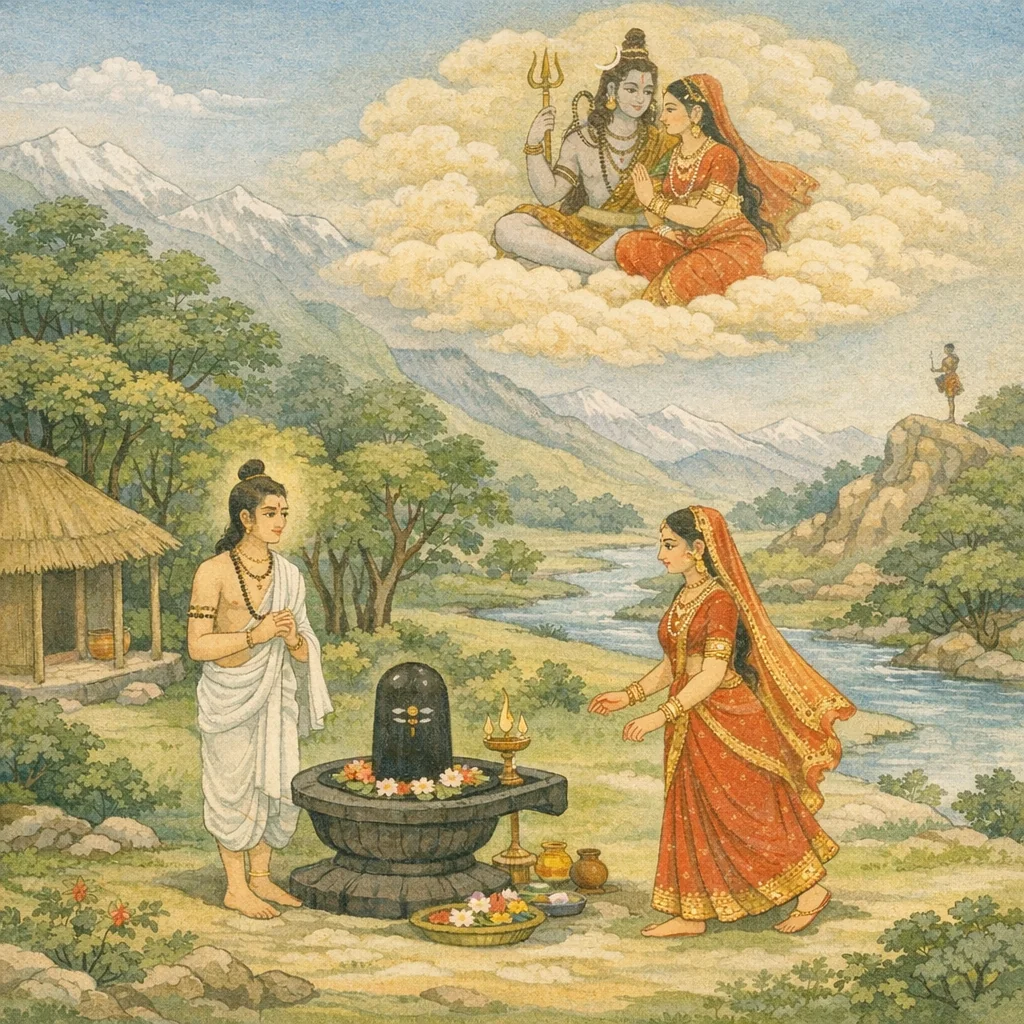
शुक्रोत्पत्तिः तथा महेश्वरदर्शनम् (Śukra’s Emergence and the Vision of Maheśvara)
Adhyāya 49 centers on a stotra-mantra: Sanatkumāra offers an expansive hymn of salutations to Śiva, a dense litany of epithets proclaiming his sovereignty, mastery of time, ascetic power, fierce manifestations, and universal immanence. The hymn, treated as a supreme mantra (mantravara), immediately proves efficacious when Śukra miraculously emerges from the “abdominal enclosure” and exits by the liṅga-path—signifying both wondrous birth and ritual-symbolic rebirth under Śiva’s rule. Gaurī then takes Śukra for the purpose of obtaining a son, and Viśveśvara fashions him into a radiant being, ageless and deathless, splendid like “a second Śaṅkara.” After three thousand years on earth, Śukra is said to be reborn from Maheśvara as a muni and repository of Vedic knowledge. The chapter turns to a vision: Śukra beholds Parameśvara, and nearby the daitya Andhaka performs severe tapas, dried upon a śūla, setting the scene for the Andhaka cycle. A sequence of names and iconographic descriptors (Virūpākṣa, Nīlakaṇṭha, Pinākin, Kapardin, Tripuraghna, Bhairava, etc.) presents Śiva’s manifold forms, emphasizing his terrifying yet salvific power, yogic depth, and lordship over the three worlds.
Shlokas
Verse 1
सनत्कुमार उवाच । ॐ नमस्ते देवेशाय सुरासुरनम स्कृताय भूतभव्यमहादेवाय हरितपिगललोचनाय बलाय बुद्धिरूपिणे वैयाघ्रवसनच्छदायारणेयाय त्रैलोक्यप्रभवे ईश्वराय हराय हरितनेत्राय युगान्तकरणायानलायगणेशायलोकपालाय महाभुजायमहाहस्ताय शूलिने महादंष्ट्रिणे कालाय महेश्वरायअव्ययाय कालरूपिणे नीलग्रीवाय महोदराय गणाध्यक्षाय सर्वात्मने सर्वभावनाय सर्वगाय मृत्युहंत्रे पारियात्रसुव्रताय ब्रह्मचारिणे वेदान्त गाय तपोंतगाय पशुपतये व्यंगाय शूलपाणये वृषकेतवे हरये जटिने शिखंडिने लकुटिने महायशसे भूतेश्वराय गुहावासिने वीणा पणवतालंबते अमराय दर्शनीयाय बालसूर्यनिभाय श्मशानवासिने भगवते उमापतये अरिन्दमाय भगस्याक्षिपातिने पूष्णोर्दशननाशनाय कूरकर्तकाय पाशहस्ताय प्रलयकालाय उल्कामुखायाग्निकेतवे मुनये दीप्ताय विशांपतये उन्नयते जनकाय चतुर्थकाय लोक सत्तमाय वामदेवाय वाग्दाक्षिण्याय वामतो भिक्षवे भिक्षुरूपिणे जटिने स्वयंजटिलाय शक्रहस्तप्रतिस्तंभकाय वसूनां स्तंभाय क्रतवे क्रतुकराय कालाय मेधाविने मधुकराय चलाय वानस्पत्याय वाजसनेति समाश्रमपूजिताय जगद्धात्रे जगत्कर्त्रे पुरुषाय शाश्वताय ध्रुवाय धर्माध्यक्षाय त्रिवर्त्मने भूतभावनाय त्रिनेत्राय बहुरूपाय सूर्यायुतसमप्रभाय देवाय सर्वतूर्यनिनादिने सर्वबाधाविमोचनाय बंधनाय सर्वधारिणे धर्म्मोत्तमाय पुष्पदंतायापि भागाय मुखाय सर्वहराय हिरण्यश्रवसे द्वारिणे भीमाय भीमपराक्रमाय ओंनमो नमः । सनत्कुमार उवाच । इमं मन्त्रवरं जप्त्वा शुक्रो जठरपंजरात् । निष्क्रान्तो लिंगमार्गेण शंभोश्शुक्रमिवोत्कटम्
Sanatkumāra said: “Oṁ, salutations to You, Lord of the gods—revered by devas and asuras alike—Mahādeva who is the ground of past and future; the One with tawny-green eyes; Power itself and the very form of Intelligence; clad in tiger-skin; dwelling in the forest; Lord and source of the three worlds; Hara with green-hued eyes; the Fire that brings the end of the age; the Lord of Gaṇas and protector of the worlds; mighty-armed and mighty-handed; bearer of the trident; with formidable fangs; Time itself; Maheśvara, imperishable, assuming the form of Time; blue-throated, great-bellied; ruler of the hosts; the Self of all and the quickener of all states of being; moving everywhere; the slayer of Death; the great-vowed one of Pāriyātra; the celibate; singer of Vedānta; the one who has reached the summit of tapas; Paśupati; the unmanifest and the manifest; trident-bearing; marked by the bull; Hari; the matted-haired ascetic; crested; club-bearing; of great fame; Lord of beings; cave-dweller; attended by vīṇā, paṇava and cymbals; deathless and beautiful to behold; radiant like the rising sun; dweller in the cremation-ground; the Blessed Lord, husband of Umā; crusher of foes; the one who cast down Bhaga’s eyes; the one who broke Pūṣan’s teeth; the doer of harsh deeds; holder of the noose; Time of dissolution; flame-faced; fire-bannered; the sage; the blazing one; lord of the people; the uplifter; progenitor; the fourth; the best of worlds; Vāmadeva; gracious in speech; the left-going mendicant; taking the form of a beggar; matted-haired, self-matted; restrainer of Indra’s hand; the support of the Vasus; the sacrifice and the maker of sacrifice; Time; the intelligent one; the honey-maker; the moving one; lord of forests; worshipped in every āśrama; sustainer and maker of the world; the eternal Person; steady and unshaken; overseer of dharma; the threefold path; benefactor of beings; three-eyed; many-formed; shining like ten-thousand suns; the God resounding with all instruments; liberator from every affliction; the binder and the bearer of all; the supreme of dharma; Puṣpadanta; Bhaga; the very Face; the taker-away of all; golden-eared/famed; the gate-keeper; the terrible one of terrible valor—Oṁ, salutations again and again.” Sanatkumāra said: “Having repeated this excellent mantra, Śukra came forth from the prison of the belly, emerging through the path of the Liṅga—powerful, like the seed of Śambhu itself.”
Verse 2
गौर्या गृहीतः पुत्रार्थं विश्वेशेन ततः कृतः । अजरश्चामरः श्रीमान्द्वितीय इव शंकरः
For the sake of obtaining a son, he was accepted by Gaurī; then he was fashioned by Viśveśa (Lord Śiva). He became ageless and deathless, radiant with auspicious splendor—like a second Śaṅkara himself.
Verse 3
त्रिभिर्वर्षसहस्रैस्तु समतीतैर्महीतले । महेश्वरात्पुनर्जातः शुक्रो वेदनिधिर्मुनिः
After three thousand years had passed upon the earth, the sage Śukra—an ocean-treasury of Vedic knowledge—was born again through the grace and power of Maheśvara (Lord Śiva).
Verse 4
ददर्श शूले संशुष्कं ध्यायंतं परमेश्वरम् । अंधकं धैर्यसद्वन्यदानवेशं तपस्विनम्
He beheld Andhaka—the lord of the Dānavas—withered by austerity, steadfast in courage, seated upon a trident, absorbed in meditation on Parameśvara (Lord Śiva), living like a forest-ascetic and shining with the power of tapas.
Verse 5
महादेवं विरूपाक्षं चन्द्रार्द्धकृतशेखरम् । अमृतं शाश्वतं स्थाणुं नीलकंठं पिनाकिनम्
I bow to Mahādeva—Virūpākṣa, whose crest is adorned with the half-moon; the Deathless, the Everlasting; Sthāṇu, the Steadfast Lord; Nīlakaṇṭha, the Blue-throated; and Pinākin, bearer of the Pināka bow.
Verse 6
वृषभाक्षं महाज्ञेयं पुरुषं सर्वकामदम् । कामारिं कामदहनं कामरूपं कपर्दिनम्
I take refuge in the Lord whose banner is the Bull—the Supreme One to be truly known, Puruṣa, bestower of all rightful aims. He is the foe of Kāma, the burner of desire; yet he assumes whatever form is sought, and he is Kapardin, bearer of the matted locks.
Verse 7
विरूपं गिरिशं भीमं स्रग्विणं रक्तवाससम् । योगिनं कालदहनं त्रिपुरघ्नं कपालिनम्
They beheld the Lord of the mountains—wondrous in form and awe-inspiring—garlanded and clad in red; the great Yogi who burns up even Kāla (Time/Death), the Slayer of Tripura, the skull-bearing ascetic Kapālin—Śiva himself.
Verse 8
गूढव्रतं गुप्तमंत्रं गंभीरं भावगोचरम् । अणिमादिगुणाधारत्रिलोक्यैश्वर्य्यदायकम्
It is a hidden vow and a secret mantra—profound, and reached through inner devotion. It is the support of the powers beginning with aṇimā, and it bestows sovereignty and prosperity throughout the three worlds.
Verse 9
वीरं वीरहणं घोरं विरूपं मांसलं पटुम् । महामांसादमुन्मत्तं भैरवं वै महेश्वरम्
He is the hero and the slayer of heroes—terrible, awe-inspiring, beyond ordinary appearance; strong-bodied and supremely capable. He is the Great Devourer of all flesh (all embodied existence), intoxicated with His own boundless power—Bhairava indeed, the Great Lord Maheśvara.
Verse 10
त्रैलोक्यद्रावणं लुब्धं लुब्धकं यज्ञसूदनम् । कृत्तिकानां सुतैर्युक्तमुन्मत्तकृत्तिवाससम्
He was a terror that could shake the three worlds—avaricious, a hunter by nature, and a destroyer of sacrifices (yajña). He was accompanied by the sons of the Kṛttikās and was seen in a frenzied state, clad in a skin-garment.
Verse 11
गजकृत्तिपरीधानं क्षुब्धं भुजगभूषणम् । दद्यालंबं च वेतालं घोरं शाकिनिपूजितम्
He wore an elephant-hide as his garment, and on his agitated body serpents served as ornaments. He was accompanied by a terrifying Vetāla, hanging close by—one revered by the Śākinīs—revealing the awe-inspiring, fierce aspect of Śiva.
Verse 12
अघोरं घोरदैत्यघ्नं घोरघोषं वनस्पतिम् । भस्मांगं जटिलं शुद्धं भेरुंडशतसेवितम्
I bow to Śiva—Aghora, the non-terrifying Reality—who yet destroys the terrifying hosts of demons; whose thunderous roar is fearsome; who stands firm like the lordly tree of the forest; whose limbs are sanctified with sacred ash (bhasma); who is matted-haired (jaṭā) and perfectly pure; and who is attended by hundreds of mighty bhairava-like beings.
Verse 13
भूतेश्वरं भूतनाथं पञ्चभूताश्रितं खगम् । क्रोधितं निष्ठुरं चण्डं चण्डीशं चण्डिकाप्रियम्
He beheld the Lord of beings, the Master of all spirits and creatures—He who pervades the five great elements—moving swiftly like a bird; enraged, unyielding, fiercely terrible: Caṇḍeśa, the beloved of the Goddess Caṇḍikā.
Verse 14
चण्डं तुंगं गरुत्मंतं नित्यमासवभोजनम् । लेलिहानं महारौद्रं मृत्युं मृत्योरगोचरम्
He is fierce and exalted, winged with irresistible swiftness, ever the consumer of the intoxicating essence; tongue outstretched in blazing wrath—He is Death itself, yet beyond the reach of death.
Verse 15
मृत्योर्मृत्युं महासेनं श्मशानारण्यवासिनम् । रागं विरागं रागांधं वीतरागशताचितम्
He is the Death of death itself, the commander of the mighty hosts, the One who dwells in cremation-grounds and forest-solitudes. He is seen as passion and as dispassion; as the one blinded by passion and as the one adorned with hundreds of minds wholly free from passion.
Verse 16
सत्त्वं रजस्तमोधर्ममधर्मं वासवानुजम् । सत्यं त्वसत्यं सद्रूपमसद्रूपमहेतुकम्
He is the very principle of sattva, rajas, and tamas; He is called both dharma and adharma, and even the younger brother of Indra. He is truth and yet beyond the grasp of falsehood; He is the real form and also that which appears unreal—indeed, the causeless One who stands prior to all causes.
Verse 17
अर्द्धनारीश्वरं भानुं भानुकोटिशतप्रभम् । यज्ञं यज्ञपतिं रुद्रमीशानं वरदं शिवम्
The devotee contemplates Śiva as Ardhanārīśvara; as the Sun whose radiance outshines hundreds of millions of suns; as the very Sacrifice and the Lord of sacrifice; as Rudra, the Supreme Īśāna, the bestower of boons—Śiva, the auspicious Lord.
Verse 18
अष्टोत्तरशतं ह्येतन्मूर्तीनां परमात्मनः । शिवस्य दानवो ध्यायन्मुक्तस्तस्मान्महाभयात्
Indeed, these are the one hundred and eight manifestations of the Supreme Self, Lord Śiva. Meditating upon them, even the asura was freed from that great terror.
Verse 19
दिव्येनामृतवर्षेण सोऽभिषिक्तः कपर्दिना । तुष्टेन मोचितं तस्माच्छूलाग्रादवरोपितः
Then Kapardin (Lord Śiva), pouring a divine rain of nectar, consecrated him. Pleased, Śiva released him and brought him down from the tip of the trident.
Verse 20
उक्तश्चाथ महादैत्यो महेशानेन सोंऽधकः । असुरस्सांत्वपूर्वं यत्कृतं सर्वं महात्मना
Then the great Daitya Andhaka was addressed by Maheśāna (Lord Śiva). The Asura heard in full whatever the great-souled Lord had done and spoken beforehand—first seeking to conciliate him with gentle counsel.
Verse 21
ईश्वर उवाच । भो भो दैत्येन्द्रतुष्टोऽस्मि दमेन नियमेन च । शौर्येण तव धैर्येण वरं वरय सुव्रत
Īśvara (Lord Śiva) said: “O mighty lord of the Daityas! I am pleased with you for your self-restraint and disciplined observances, and also for your valor and steadfast courage. O man of noble vows—choose a boon; ask for a boon.”
Verse 22
आराधितस्त्वया नित्यं सर्वनिर्धूतकल्मषः । वरदोऽहं वरार्हस्त्वं महादैत्येन्द्रसत्तम
You have worshipped Me constantly, and thus all your impurities have been completely washed away. I am the giver of boons; you are worthy of a boon, O best among the great lords of the Daityas.
Verse 23
प्राणसंधारणादस्ति यच्च पुण्यफलं तव । त्रिभिर्वर्षसहस्रैस्तु तेनास्तु तव निर्वृतिः
Whatever meritorious fruit has accrued to you through the discipline of sustaining the life-breath, may your contentment and peace be secured by that merit for three thousand years.
Verse 24
सनत्कुमार उवाच । एतच्छ्रुत्वांधकः प्राह वेपमानः कृतांजलिः । भूमौ जानुद्वयं कृत्वा भगवंतमुमापतिम्
Sanatkumāra said: Hearing this, Andhaka—trembling and with palms joined in reverence—spoke, placing both knees upon the earth before the Blessed Lord Umāpati (Śiva), the Consort of Umā.
Verse 25
अंधक उवाच । भगवन्यन्मयोक्तोऽसि दीनोदीनः परात्परः । हर्षगद्गदया वाचा मया पूर्वं रणाजिरे
Andhaka said: “O Lord, You are the Supreme beyond the supreme, yet You are compassion itself toward the lowly and the distressed. Earlier on the battlefield, overwhelmed with joy, I spoke to You with a voice choked with emotion.”
Verse 26
यद्यत्कृतं विमूढत्वात्कर्म लोकेषु गर्हितम् । अजानता त्वां तत्सर्वं प्रभो मनसि मा कृथाः
Whatever blameworthy deeds I have done in this world out of delusion—done without truly knowing You—O Lord, do not hold any of that in Your mind against me.
Verse 27
पार्वत्यामपि दुष्टं यत्कामदोषात्कृतं मया । क्षम्यतां मे महादेव कृपणो दुःखितो भृशम्
Even against Pārvatī, whatever wicked act I committed through the fault of desire—O Mahādeva, please forgive me. I am wretched and deeply afflicted with sorrow.
Verse 28
दुःखितस्य दया कार्या कृपणस्य विशेषतः । दीनस्य भक्तियुक्तस्य भवता नित्यमेव हि
Always show compassion to the sorrow-stricken—especially to the helpless and the poor; indeed, you must ever bestow constant mercy upon the humble devotee endowed with bhakti.
Verse 29
सोहं दीनो भक्तियुक्त आगतश्शरणं तव । रक्षा मयि विधातव्या रचितोऽयं मयांजलिः
I, though wretched, yet endowed with devotion, have come to you for refuge. Grant me protection—behold, I have made this reverent offering of folded hands (añjali).
Verse 30
इयं देवी जगन्माता परितुष्टा ममोपरि । क्रोधं विहाय सकलं प्रसन्ना मां निरीक्षताम्
“May this Goddess—the Mother of the universe—who is pleased with me, set aside all anger and, becoming gracious, look upon me with favor.”
Verse 31
क्वास्याः क्रोधः क्व कृपणो दैत्योऽहं चन्द्रशेखर । तत्सोढा नाहमर्द्धेन्दुचूड शंभो महेश्वर
“Where is her wrath, and where am I—a wretched Daitya? O Candraśekhara! I am not capable of bearing it. O Śambhu, O Maheśvara, O Lord with the crescent moon as Your crest!”
Verse 32
क्व भवान्परमोदारः क्व चाहं विवशीकृतः । कामक्रोधादिभिर्दोषैर्जरसा मृत्युना तथा
Where are You—supremely noble and generous—and where am I, made helpless? I am overpowered by faults such as desire and anger, and likewise by old age and death.
Verse 33
अयं ते वीरकः पुत्रो युद्धशौंडो महाबलः । कृपणं मां समालक्ष्य मा मन्युवशमन्वगाः
This is your heroic son—battle-hardened and immensely strong. Seeing me in this pitiable state, do not fall under the sway of anger.
Verse 34
तुषारहारशीतांशुशंखकुन्देन्दुवर्ण भाक् । पश्येयं पार्वतीं नित्यं मातरं गुरुगौरवात्
Out of reverence for the Guru and the weight of his sacred authority, may I ever behold Mother Pārvatī—she whose hue is like a garland of snow, the cool-rayed moon, the sacred conch, the jasmine blossom, and the lunar orb.
Verse 35
नित्यं भवद्भ्यां भक्तस्तु निर्वैरो दैवतैः सह । निवसेयं गणैस्सार्द्धं शांता त्मा योगचिंतकः
“Ever devoted to you both, and free from hostility even toward the other gods, may I dwell together with the gaṇas—peaceful in heart and steadfast in contemplation of Yoga.”
Verse 36
मा स्मरेयं पुनर्जातं विरुद्धं दानवोद्भवम् । त्वत्कृपातो महेशान देह्येतद्वरमुत्तमम्
O Maheśāna, by Your grace may I never again remember—or be drawn back into—the renewed birth that arises from demoniac opposition. Grant me this supreme boon.
Verse 37
सनत्कुमार उवाच । एतावदुक्त्वा वचनं दैत्येन्द्रो मौनमास्थितः । ध्यायंस्त्रिलोचनं देवं पार्वतीं प्रेक्ष्य मातरम्
Sanatkumāra said: Having spoken these words, the lord of the Daityas fell silent. He meditated on the three-eyed Lord (Śiva), and, looking upon Pārvatī as the Mother, he fixed his awareness upon her.
Verse 38
ततो दृष्टस्तु रुद्रेण प्रसन्नेनैव चक्षुषा । स्मृतवान्पूर्ववृत्तांतमात्मनो जन्म चाद्भुतम्
Then, when he was looked upon by Rudra with gracious, tranquil eyes, he at once remembered the former course of events—and also the wondrous manner of his own birth.
Verse 39
तस्मिन्स्मृते च वृत्तांते ततः पूर्णमनोरथः । प्रणम्य मातापितरौ कृतकृत्योऽभवत्ततः
When that account was thus recalled, he then became fulfilled in his heart’s desire. Bowing down to his mother and father, he thereafter felt that his duty had been accomplished.
Verse 40
पार्वत्या मूर्ध्न्युपाघ्रातश्शंकरेण च धीमता । तथाऽभिलषितं लेभे तुष्टाद्बालेन्दुशेखरात्
When the wise Lord Śaṅkara, the crescent-moon-crested One, lovingly touched and smelled Pārvatī’s head in blessing, He was pleased; and from that delighted Bālenduśekhara she obtained exactly what she had desired.
Verse 41
एतद्वस्सर्वमाख्यातमन्धकस्य पुरातनम् । गाणपत्यं महादेवप्रसादात्परसौख्यदम्
Thus I have narrated to you in full this ancient account of Andhaka—how, by the grace of Mahādeva, the state of being a Gaṇa (gaṇapatya) was obtained, bestowing the highest bliss.
Verse 42
मृत्युंजयश्च कथितो मंत्रो मृत्युविनाशनः । पठितव्यः प्रयत्नेन सर्वकामफलप्रदः
Thus has the Mṛtyuñjaya mantra been declared—the destroyer of death. It should be recited with earnest effort, for it bestows the fruits of all righteous desires.
Verse 49
इति श्रीशिवमहापुराणे द्वितीयायां रुद्रसंहितायां पञ्चमे युद्धखण्डे अंधकगण जीवितप्राप्तिवर्णनं नामैकोनपञ्चाशत्तमोऽध्यायः
Thus, in the Śrī Śiva Mahāpurāṇa, in the second section—Rudrasaṃhitā—within the fifth division, the Yuddhakhaṇḍa, concludes the forty-ninth chapter entitled “The Description of Andhaka’s host attaining life again.”
Frequently Asked Questions
Sanatkumāra transmits a powerful Śiva-stotra/mantra whose efficacy is shown through Śukra’s extraordinary emergence and subsequent divine re-fashioning, followed by Śukra’s later rebirth from Maheśvara and the narrative setup for the Andhaka episode.
The ‘liṅga-path’ emergence and the mantravara frame rebirth as a Śaiva sacral transformation: identity and power are reconstituted through Śiva’s mantraic presence, not merely through biological lineage.
Multiple Śiva-forms are foregrounded through epithets—Virūpākṣa, Nīlakaṇṭha, Pinākin, Kapardin, Tripuraghna, Bhairava—presenting Śiva as yogin, time (kāla), cosmic lord, and fierce remover of obstacles to dharma.