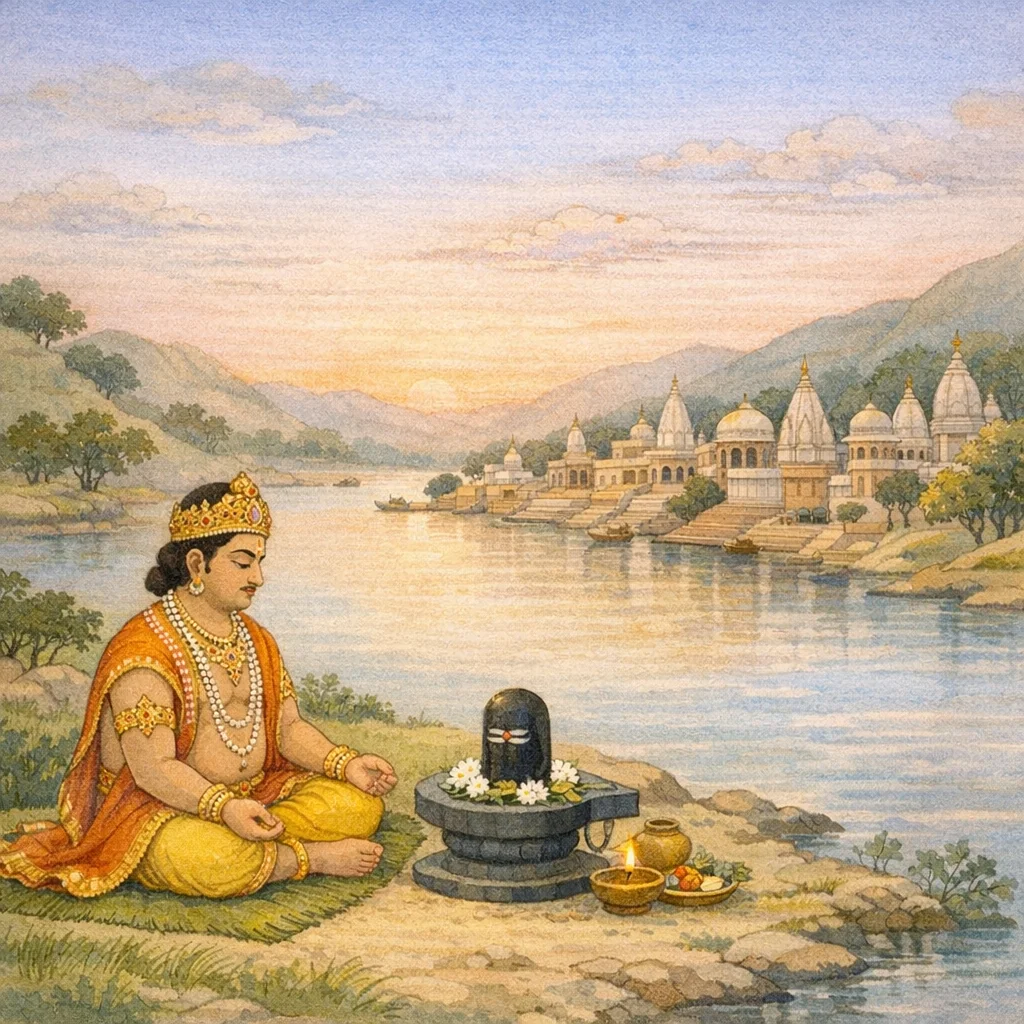
अलकापतेः तपः-लिङ्गप्रतिष्ठा च वरप्राप्तिः / The Lord of Alakā: Austerity, Liṅga-Establishment, and the Receiving of a Boon
Adhyāya 19, narrated by Brahmā, recalls a prior kalpa: in the Padma-kalpa Pulastya begot Viśravas, and from him arose Vaiśravaṇa (Kubera), lord of the splendid city of Alakā, fashioned with cosmic craftsmanship. The account then turns to the saving method: Alakāpati undertakes exceedingly fierce tapas to please Tryambaka (Śiva) and journeys toward luminous Kāśī (Citprakāśikā), a sacred realm that also signifies inner consciousness. A yogic-devotional discipline is taught—awakening Śiva within, unwavering ananya-bhakti, steady dhyāna, and the cultivation of śivaikya—while the mind is purified by the “fire of tapas” and freed from kāma and krodha. He establishes a Śāṃbhava liṅga and worships it with “flowers of true feeling” (sadbhāva). After vast years of austerity, Viśveśvara appears graciously; as the devotee’s mind is absorbed in the liṅga and Śiva is praised as Sthāṇu, the Lord declares himself the boon-giver and invites Alakāpati to state his request. Thus the chapter links lineage and kingship with devotional qualification, presenting liṅga-pratiṣṭhā, meditation, and passionless discipline as the cause of divine darśana and varadāna.
Shlokas
Verse 1
ब्रह्मोवाच । पाद्मे कल्पे मम सुरा ब्रह्मणो मानसात्सुतात् । पुलस्त्याद्विश्रवा जज्ञे तस्य वैश्रवणस्सुतः
Brahmā said: In the Padma-kalpa, from Pulastya—my mind-born son—was born Viśravā; and from him was born his son Vaiśravaṇa (Kubera).
Verse 2
तेनेयमलका भुक्ता पुरी विश्वकृता कृता । आराध्य त्र्यंबकं देवमत्युग्रतपसा पुरा
By him this Alakā was enjoyed and ruled—the city fashioned by the Creator of the universe—after he had formerly worshipped Lord Tryambaka (Śiva) with exceedingly fierce austerities.
Verse 3
व्यतीते तत्र कल्पे वै प्रवृत्ते मेघवाहने । याज्ञदत्तिरसौ श्रीदस्तपस्तेपे सुदुस्सहम्
When that aeon had passed and the new kalpa called “Meghavāhana” had begun, the venerable Śrīdāsa—known as Yājñadatti—undertook an exceedingly difficult austerity.
Verse 4
भक्ति प्रभावं विज्ञाय शंभोस्तद्दीपमात्रतः । पुरा पुरारेस्संप्राप्य काशिकां चित्प्रकाशिकाम्
Having understood the power of devotion to Śambhu—even from so little as a mere lamp-like sign of worship—in ancient times one attained, through Purāri (Śiva), the foe of Pura, the city of Kāśikā, illuminator of pure Consciousness.
Verse 5
शिवैकादशमुद्बोध्य चित्तरत्नप्रदीपकैः । अनन्यभक्तिस्नेहाढ्यस्तन्मयो ध्याननिश्चलः
By the lamp-like illuminations of the mind’s jewel—pure awareness—he awakens the elevenfold presence of Śiva; filled with exclusive loving devotion, becoming one with That, he remains unwavering and steady in meditation.
Verse 6
शिवैक्यं सुमहापात्रं तपोग्निपरिबृंहितम् । कामक्रोधमहाविघ्नपतंगाघात वर्जितम्
It is oneness with Śiva—a most exalted vessel, strengthened by the fire of austerity—free from the burning strikes of the moths of great obstacles such as desire and anger.
Verse 7
प्राणसंरोधनिर्वातं निर्मलं निर्मलेक्षणात् । संस्थाप्य शांभवं लिंगं सद्भावकुसुमार्चितम्
Having, through the stillness born of breath-restraint, attained a windless (undisturbed) and pure state—and by the power of his purified vision—he established the Śāmbhava Liṅga and worshipped it with the flowers of true inner devotion.
Verse 8
तावत्तताप स तपस्त्वगस्थिपरिशेषितम् । यावद्बभूव तद्वर्णं वर्षाणामयुतं शतम्
He performed that austerity so intensely that only skin and bone remained, and he continued until that condition endured for a hundred ayutas of years.
Verse 9
ततस्सह विशालाक्ष्या देवो विश्वेश्वररस्वयम् । अलकापतिमालोक्य प्रसन्नेनांतरात्मना
Then the Lord Himself—Viśveśvara (Shiva), the Sovereign of the universe—together with the large‑eyed goddess, looked upon the lord of Alaka; and in His inmost being He became gracious and pleased.
Verse 10
लिंगे मनस्समाधाय स्थितं स्थाणुस्वरूपिणम् । उवाच वरदोऽस्मीति तदाचक्ष्वालकापते
Fixing his mind in deep samādhi upon the Liṅga—where the Immovable Lord, Sthāṇu, abides in His very form—He spoke: “I am the Bestower of boons.” O Lord of Alakā, relate that account.
Verse 11
उन्मील्य नयने यावत्स पश्यति तपोधनः । तावदुद्यत्सहस्रांशु सहस्राधिकतेजसम्
As soon as the ascetic, rich in the power of austerity, opened his eyes and beheld it, he saw a radiance like the rising sun, blazing with splendour a thousandfold greater.
Verse 12
पुरो ददर्श श्रीकंठं चन्द्रचूडमुमाधवम् । तत्तेजः परिभूताक्षितेजाः संमील्य लोचने
Before him he beheld Śrīkaṇṭha—Śiva, the moon-crested Lord, the beloved of Umā. Overpowered by that Lord’s radiance, the splendour of his own eyes was subdued, and he closed his eyes.
Verse 13
उवाच देवदेवेशं मनोरथपदातिगम् । निजांघ्रिदर्शने नाथ दृक्सामर्थ्यं प्रयच्छ मे
He spoke to the Lord of lords, who transcends all objects of desire: “O Nātha, grant me the power of vision to behold Your own holy feet.”
Verse 14
अयमेव वरो नाथ यत्त्वं साक्षान्निरीक्ष्यसे । किमन्येन वरेणेश नमस्ते शशिशेखर
“This alone is the boon, O Lord: that You are beheld directly. What need is there of any other boon, O Īśa? Salutations to You, O Moon-crested One.”
Verse 15
इति तद्वचनं श्रुत्वा देवदेव उमापतिः । ददौ दर्शनसामर्थ्यं स्पृष्ट्वा पाणितलेन तम्
Hearing those words, the God of gods—Umāpati, Lord Śiva—touched him with the palm of His hand and bestowed the power of divine vision, that he might behold the Lord as He truly is.
Verse 16
प्रसार्य नयने पूर्वमुमामेव व्यलोकयत् । तोऽसौ याज्ञदत्तिस्तु तत्सामर्थ्यमवाप्य च
Opening his eyes, he first beheld Umā alone. Then that Yājñadatta, having gained strength and capacity through her grace, became empowered.
Verse 17
शंभोस्समीपे का योषिदेषा सर्वांगसुन्दरी । अनया किं तपस्तप्तं ममापि तपसोऽधिकम्
“Who is this woman standing near Śambhu, exquisitely beautiful in every limb? What tapas has she performed—seemingly greater even than my own—by which she has attained such closeness to the Lord?”
Verse 18
अहो रूपमहो प्रेम सौभाग्यं श्रीरहो भृशम् । इत्यवादीदसौ पुत्रो मुहुर्मुहुरतीव हि
“Ah, what beauty! Ah, what love! How great the good fortune—how abundant the splendor!” Thus that son spoke again and again, repeatedly, in overwhelming wonder.
Verse 19
इति श्रीशिवमहापुराणे द्वितीयायां रुद्रसंहितायां प्रथमखण्डे कैलासगमनोपाख्याने कुबेरस्य शिवमित्रत्ववर्णनो नामैकोनविंशोऽध्यायः
Thus, in the Śrī Śiva Mahāpurāṇa—within the Second section, the Rudra Saṃhitā, in the First Khaṇḍa, in the narrative of the journey to Kailāsa—ends the nineteenth chapter, entitled “The Description of Kubera’s Friendship with Śiva.”
Verse 20
अथ देव्यब्रवीद्देव किमसौ दुष्टतापसः । असकृद्वीक्ष्य मां वक्ति कुरु त्वं मे तपःप्रभाम्
Then the Goddess said, “O Lord, who is this wicked ascetic? Again and again he looks at me and speaks improper words. Do you, therefore, make manifest to me the power and radiance born of your tapas, so that he may be restrained.”
Verse 21
असकृद्दक्षिणेनाक्ष्णा पुनर्मामेव पश्यति । असूयमानो मे रूपप्रेम सौभाग्यसंपद
Again and again, with his right eye, he keeps looking only at me. Free from envy, he abides in loving attraction to my form, and thus attains auspicious fortune and prosperity.
Verse 22
इति देवीगिरं श्रुत्वा प्रहस्य प्राह तां प्रभुः । उमे त्वदीयः पुत्रोऽयं न च क्रूरेण चक्षुषा
Hearing thus the words of the Goddess, the Lord smiled and spoke to her: “O Umā, this is indeed your own son—do not look upon him with a cruel gaze.”
Verse 23
संपश्यति तपोलक्ष्मीं तव किं त्वधिवर्णयेत् । इति देवीं समाभाष्य तमीशः पुनरब्रवीत्
“One beholds the splendour born of your tapas—how could anyone possibly describe it fully?” Having thus addressed the Goddess, the Lord (Śiva) spoke to her again.
Verse 24
वरान्ददामि ते वत्स तपसानेन तोषितः । निधीनामथ नाथस्त्वं गुह्यकानां भवेश्वरः
“O dear child, pleased by your austerity (tapas), I grant you boons. You shall become the lord of treasures and the sovereign over the Guhyakas—Śiva’s secret attendants.”
Verse 25
यक्षाणां किन्नराणां च राज्ञां राज च सुव्रतः । पतिः पुण्यजनानां च सर्वेषां धनदो भव
“O Suvrata, become the king of kings—lord of the Yakṣas and the Kinnaras as well. Become the master of the Puṇyajanas, and for all of them be Dhanada, the bestower of wealth.”
Verse 26
मया सख्यं च ते नित्यं वत्स्यामि च तवांतिके । अलकां निकषा मित्र तव प्रीतिविवृद्धये
“I shall maintain eternal friendship with you, and I shall dwell near you. O friend, I shall remain close to Alakā, for the increase of your joy and affection.”
Verse 27
आगच्छ पादयोरस्याः पत ते जननी त्वियम् । याज्ञदत्ते महाभक्त सुप्रसन्नेन चेतसा
“Come—fall at her feet. She is your mother. O Yājñadatta, great devotee, do so with a mind perfectly serene and filled with grace.”
Verse 28
ब्रह्मोवाच । इति दत्त्वा वरान्देवः पुनराह शिवां शिवः । प्रसादं कुरु देवेशि तपस्विन्यंगजेऽत्र वै
Brahmā said: Having thus granted the boons, Lord Śiva again spoke to Śivā: “O Goddess, sovereign of the gods, bestow your gracious favor here upon this ascetic Aṅgaja indeed.”
Verse 29
इत्याकर्ण्य वचश्शंभोः पार्वती जगदम्बिका । अब्रवीद्याज्ञदत्तिं तं सुप्रसन्नेन चेतसा
Hearing these words of Śambhu, Pārvatī—the Mother of the universe—spoke to that Yājñadatti with a heart wholly serene and gracious.
Verse 30
देव्युवाच । वत्स ते निर्मला भक्तिर्भवे भवतु सर्वदा । भवैकपिंगो नेत्रेण वामेन स्फुटितेन ह
The Goddess said: “Beloved child, may your stainless devotion remain forever fixed upon Bhava (Lord Śiva). May Bhava—the tawny-hued One—behold you with His left eye, clearly opened.”
Verse 31
देवेन दत्ता ये तुभ्यं वरास्संतु तथैव ते । कुबेरो भव नाम्ना त्वं मम रूपेर्ष्यया सुत
“May the boons granted to you by the Lord indeed come to fruition. You shall be known by the name Kubera—O son born from jealousy over My form.”
Verse 32
इति दत्त्वा वरान्देवो देव्या सह महेश्वरः । धनदायाविवेशाथ धाम वैश्वेश्वराभिधम्
Thus, having granted the boons, Lord Maheśvara—together with the Goddess—then entered the abode of Dhanadā, known as Vaiśveśvara.
Verse 33
इत्थं सखित्वं श्रीशंभोः प्रापैष धनदः पुरम् । अलकान्निकषा चासीत्कैलासश्शंकरालयः
Thus, having attained friendship with the blessed Śambhu, Dhanadā (Kubera) returned to his city. And near Alakā was Kailāsa—the abode of Śaṅkara.
Frequently Asked Questions
The lord of Alakā (linked to Vaiśravaṇa/Kubera) undertakes extreme tapas and establishes/worships a Śāmbhava liṅga; pleased, Śiva (Viśveśvara/Tryambaka) appears and offers a boon (varadāna).
The chapter encodes a yogic template: mind fixed in the liṅga, steadiness in dhyāna, and purification from kāma–krodha culminate in śivaikya (Śiva-identification) and divine revelation—outer ritual mirroring inner stabilization.
Śiva is highlighted as Tryambaka (the propitiated deity), Viśveśvara (lord of the universe appearing in grace), and Sthāṇu-svarūpin (the immovable, steadfast form), with the liṅga as the central icon of presence.