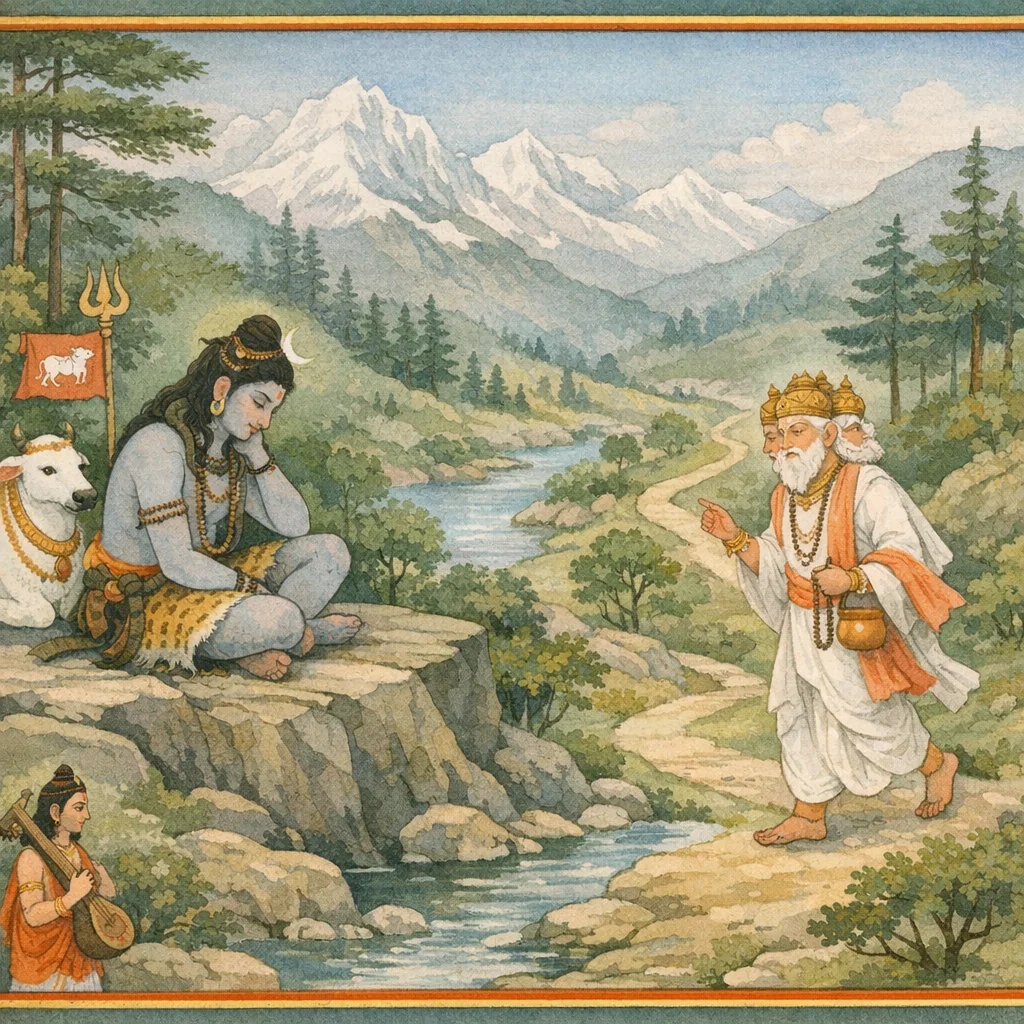
सतीप्राप्तिविषये ब्रह्मरुद्रसंवादः | The Brahmā–Śiva Dialogue on Attaining Satī
Adhyāya 18 unfolds as a nested dialogue: Nārada asks Brahmā what happened after he left Rudra’s side. Brahmā recounts approaching Mahādeva in the Himavat region and witnessing Śiva’s inner agitation—recurring doubt and yearning to attain Satī. Śiva, deliberately speaking in a “worldly” manner, questions Brahmā, the eldest among the gods, about what steps have been taken for Satī’s sake and seeks an account to ease his love-torment stirred by Manmatha. Śiva insists on his single-minded orientation to Satī, rejects all alternatives, and declares her attainability on the ground of their non-difference (abheda). Brahmā consoles him, interprets his words as consistent with social propriety, and affirms that Satī, as Brahmā’s daughter, is to be given to Śiva—this marriage already intended and divinely resolved. The remaining verses typically expand the assurances, procedures, and the harmony of divine will with cosmic and social order.
Shlokas
Verse 1
नारद उवाच । रुद्रपार्श्वे त्वयि गते किमभूच्चरितं ततः । का वार्ता ह्यभवत्तात किं चकार हरः स्वयम्
Narada said: “O dear one, when you went to the side of Rudra (Lord Śiva), what happened thereafter? What news arose then, and what did Hara Himself do?”
Verse 2
ब्रह्मोवाच । अथाहं शिवमानेतुं प्रसन्नः परमेश्वरम् । आसदं हि महादेवं हिमवद्गिरिसंस्थितम्
Brahmā said: “Then, with my heart made serene, I set out to bring Lord Śiva, the Supreme Lord. Indeed, I approached Mahādeva who was abiding upon the Himālaya mountain.”
Verse 3
मां वीक्ष्य लोकस्रष्टारमायांतं वृषभध्वजः । मनसा संशयं चक्रे सतीप्राप्तौ मुहुर्मुहुः
Seeing me—the creator of the worlds—approach, Vṛṣabhadhvaja (Śiva, whose banner bears the bull) again and again became doubtful in his mind about the gaining of Satī.
Verse 4
अथ प्रीत्या हरो लोक गतिमाश्रित्य लीलया । सत्या भक्त्या च मां क्षिप्रमुवाच प्राकृतो यथा
Then Lord Hara, pleased and out of playful grace, assuming an ordinary worldly manner, quickly spoke to me—moved by Satī’s sincere devotion.
Verse 5
ईश्वर उवाच । किमकार्षीत्सुरज्येष्ठ सत्यर्थे त्वत्सुतस्स माम् । कथयस्व यथा स्वांतं न दीर्ये मन्मथेन हि
Īśvara (Lord Śiva) said: “O foremost among the gods, what did your son do to Me for the sake of truth? Tell Me exactly as it is in your heart—for indeed I am not shaken or broken by Manmatha, the god of desire.”
Verse 6
धावमानो विप्रयोगो मामेव च सतीं प्रति । अभिहंति सुरज्येष्ठ त्यक्त्वान्यां प्राणधारिणीम्
O elder of the gods, this rushing pain of separation strikes only me—and Satī as well; it has abandoned all others who still sustain their lives and falls upon us alone.
Verse 7
सतीति सततं ब्रह्मन् वद कार्यं करोम्यहम् । अभेदान्मम सा प्राप्या तद्विधे क्रियतां तथा
“O Brahmā, keep saying ‘Satī, Satī’ continually; I shall do what must be done. Since she is non-different from me, she is to be attained by me—therefore let the proper means for that be arranged accordingly.”
Verse 8
ब्रह्मोवाच । इति रुद्रोक्तवचनं लोकाचारसुगर्भितम् । श्रुत्वाहं नारदमुने सांत्वयन्नगदं शिवम्
Brahmā said: “O sage Nārada, having thus heard the words spoken by Rudra—words that were deeply imbued with the proprieties of worldly conduct—I then sought to console that faultless Lord Śiva.”
Verse 9
ब्रह्मोवाच । सत्यर्थं यन्मम सुतो वदति स्म वृषध्वज । तच्छ्रणुष्व निजासाध्य सिद्धमित्यवधारय
Brahmā said: “O Vṛṣadhvaja (Śiva, whose banner bears the bull), what my son has spoken is truly full of meaning. Listen to it; know it as your own unfailing means, already established as certain.”
Verse 10
देया तस्मै मया पुत्री तदर्थं परिकल्पिता । ममाभीष्टमिदं कार्यं त्वद्वाक्यादधिकं पुनः
“I shall give my daughter to him; she has been destined for that very purpose. This undertaking is dear to my heart—indeed, once again, it is even more compelling than your words.”
Verse 11
मत्पुत्र्याराधितश्शंभुरेतदर्थं स्वयं पुनः । सोप्यन्विष्यति मां यस्मात्तदा देया मया हरे
“For this very purpose my daughter has worshipped Śambhu; therefore He Himself will come again seeking me. Since He will search for me, O Hari, at that time I shall give (my daughter) to Him.”
Verse 12
शुभे लग्न सुमुहूर्ते समागच्छतु सोंतिकम् । तदा दास्यामि तनयां भिक्षार्थं शंभवे विधे
“Let the auspicious astrological moment and the most favorable muhūrta arrive. Then, O Brahmā (Vidhātā), I shall give my daughter to Śambhu, in response to his request as a mendicant.”
Verse 13
इत्युवाच स मां दक्षस्तस्मात्त्वं वृषभध्वज । शुभे मुहूर्ते तद्वेश्म गच्छ तामानयस्व च
Thus Dakṣa spoke to me: “Therefore, O Lord bearing the bull as Your emblem, go to that house at an auspicious moment and bring her here.”
Verse 14
ब्रह्मोवाच । इति श्रुत्वा मम वचो लौकिकी गतिमाश्रितः । उवाच विहसन्रुद्रो मुने मां भक्तवत्सलः
Brahmā said: “Having thus heard my words, Rudra—assuming a worldly manner—smilingly spoke to me, O sage, for he is ever affectionate to his devotees.”
Verse 15
रुद्र उवाच । गमिष्ये भवता सार्द्धं नारदेन च तद्गृहम् । अहमेव जगत्स्रष्टस्तस्मात्त्वं नारदं स्मर
Rudra said: “I shall go with you, and with Nārada as well, to that house. I alone am the Creator of the world; therefore remember Nārada and call upon him.”
Verse 16
मरीच्यादीन् स्वपुत्रांश्च मानसानपि संस्मर । तैः सार्द्धं दक्षनिलयं गमिष्ये सगणो विधे
“Remember Marīci and the other sages—your own sons, including the mind-born progeny. Along with them, O Creator (Brahmā), I shall go with my gaṇas to Dakṣa’s abode.”
Verse 17
ब्रह्मोवाच । इत्याज्ञप्तोहमीशेन लोकाचारपरेण ह । संस्मरं नारदं त्वां च मरीच्यदीन्सुतांस्तथा
Brahmā said: “Thus commanded by the Lord, who upholds the proper order of worldly conduct, I set forth, remembering Nārada, you, and likewise the sons of Marīci and the other sages.”
Verse 18
इति श्रीशिवमहापुराणे द्वितीयायां रुद्रसंहितायां द्वितीये सतीखंडे कन्यादानवर्णनो नामाष्टादशोऽध्यायः
Thus ends the eighteenth chapter, called “The Description of Kanyādāna (the ceremonial giving of the maiden),” in the second book of the Śrī Śiva Mahāpurāṇa—within the second (Rudra) Saṃhitā, in the second section, the Satī Khaṇḍa.
Verse 19
विष्णुस्समागतस्तूर्णं स्मृतो रुद्रेण शैवराट् । सस्वसैन्यः कमलया गरुडारूढं एव च
Remembered by Rudra, Viṣṇu promptly arrived—the sovereign Lord devoted to Śiva—together with his own forces, accompanied by Kamalā (Lakṣmī), and mounted upon Garuḍa.
Verse 20
अध चैत्रसिते पक्षे नक्षत्रे भगदैवते । त्रयोदश्यां दिने भानौ निगच्छत्स महेश्वरः
Then, in the dark fortnight of the month of Caitra, under the asterism whose presiding deity is Bhaga, on the thirteenth lunar day, as the Sun moved onward, Mahādeva—the Supreme Lord—set forth.
Verse 21
सर्वैस्सुरगणैस्सार्द्धं ब्रह्मविष्णु पुरस्सरैः । तथा तैर्मुनिभिर्गच्छन् स बभौ पथि शंकरः
Accompanied by all the hosts of the gods, with Brahmā and Viṣṇu at the forefront, and attended as well by those sages, Śaṅkara proceeded along the way, shining with divine splendour.
Verse 22
मार्गे समुत्सवो जातो देवादीनां च गच्छताम् । तथा हरगणानां च सानंदमनसामति
On the way, a great festivity arose among the gods and the other celestial beings as they proceeded; likewise among the hosts of Hara, whose minds were filled with joy.
Verse 24
ततः क्षणेन बलिना बलीवर्देन योगिना । स विष्णुप्रमुखः प्रीत्या प्राप दक्षालयं हरः
Then, in a moment, Lord Hara—mighty, master of yoga, and borne by the powerful bull—set out with affectionate goodwill, accompanied by Viṣṇu and the foremost of the gods, and reached Dakṣa’s residence.
Verse 25
ततो दक्षो विनीतात्मा संप्रहृष्टतनूरुहः । प्रययौ सन्मुखं तस्य संयुक्तस्सकलैर्निजैः
Then Dakṣa, his mind made humble and his body thrilled with joy, went forth to meet him face to face, accompanied by all his own people.
Verse 26
सर्वे सुरगणास्तत्र स्वयं दक्षेण सत्कृताः । पार्श्वे श्रेष्ठं च मुनिभिरुपविष्टा यथाक्रमम्
There, all the hosts of gods were personally honored by Dakṣa. The sages too, in proper order, sat down in the most distinguished places at his side.
Verse 27
परिवार्याखिलान्देवान्गणांश्च मुनिभिर्यथा । दक्षस्समानयामास गृहाभ्यंतरतश्शिवम्
Having duly gathered all the gods, the attendant hosts, and the sages, Dakṣa then conducted Śiva into the inner precincts of his house, in the manner befitting great seers—though Śiva, the Lord (Pati), remains ever beyond all worldly honor and dishonor.
Verse 28
अथ दक्षः प्रसन्नात्मा स्वयं सर्वेश्वरं हरम् । समानर्च विधानेन दत्त्वासनमनुत्तमम्
Then Dakṣa, his heart pleased, personally worshipped Hara—the Lord of all—according to the proper rite, and offered Him an unsurpassed seat of honour.
Verse 29
ततो विष्णुं च मां विप्रान्सुरान्सर्वान्गणांस्तथा । पूजयामास सद्भक्त्या यथोचितविधानतः
Then, in proper order, he worshipped Viṣṇu and me (Śiva), and also the brāhmaṇas, all the devas, and the gaṇas— with true devotion, according to the proper rites.
Verse 30
कृत्वा यथोचितां पूजां तेषां पूज्यादिभिस्तथा । चकार संविदं दक्षो मुनिभिर्मानसैः पुनः
Having duly performed the proper worship of those venerable sages with the requisite offerings and honors, Dakṣa again entered into formal consultation and deliberation with the mind-born (Mānasa) sages.
Verse 31
ततो मां पितरं प्राह दक्षः प्रीत्या हि मत्सुतः । प्रणिपत्य त्वया कर्म कार्यं वैवाहिकं विभो
Then Dakṣa—my son—addressed me, his father, with affection: “O Lord, having bowed down in reverence, you must perform the rites of marriage.”
Verse 32
बाढमित्यहमप्युक्त्वा प्रहृष्टैनांतरात्मना । समुत्थाय ततोऽकार्षं तत्कार्यमखिलं तथा
Saying, “So be it,” I too replied; and, inwardly delighted, I rose up and then carried out that entire task exactly as she had said.
Verse 33
ततश्शुभे मुहूर्ते हि लग्ने ग्रहबलान्विते । सती निजसुतां दक्षो ददौ हर्षेण शंभवे
Then, at an auspicious moment—when the ascendant was strengthened by the planets—Dakṣa joyfully gave his own daughter Satī to Śambhu (Lord Śiva) in marriage.
Verse 34
उद्वाहविधिना सोपि पाणिं जग्राह हर्षितः । दाक्षायण्या वरतनोस्तदानीं वृषभध्वजः
Then, in accordance with the proper marriage rites, the Bull-bannered Lord (Śiva) joyfully took the hand of the fair-limbed Dākṣāyaṇī (Satī) at that very time.
Verse 35
अहं हरिस्त्वदाद्या वै मुनयश्च सुरा गणाः । नेमुस्सर्वे संस्तुतिभि स्तोषयामासुरीश्वरम्
“I—Hari (Viṣṇu)—and all those beginning with you, along with the sages and the hosts of devas, all bowed down and, with hymns of praise, extolled the Supreme Lord (Īśvara).”
Verse 36
समुत्सवो महानासीन्नृत्यगानपुरस्सरः । आनन्दं परमं जग्मुस्सर्वे मुनिगणाः सुराः
A grand festival arose, led by dancing and singing. All the hosts of sages and the gods attained supreme joy, delighting in the auspicious presence and glory of Śiva.
Verse 37
कन्या दत्त्वा कृत्तार्थोऽभूत्तदा दक्षो हि मत्सुतः । शिवाशिवौ प्रसन्नौ च निखिलं मंगलालयम्
Having given his daughter in marriage, Dakṣa—my son—felt his purpose fulfilled. And Śiva and Śivā (Satī) were pleased; everything became an abode of auspiciousness.
Frequently Asked Questions
A Brahmā–Śiva exchange in which Brahmā approaches Śiva in the Himavat region and confirms the intended giving of Satī (Brahmā’s daughter) to Śiva, framing the union as already determined.
Śiva’s insistence that Satī is attainable due to abheda encodes a Śaiva metaphysic: Śakti is not ‘other’ than Śiva, so the narrative of marriage functions as a symbolic articulation of ontological unity.
Śiva appears in multiple epithets—Hara/Rudra/Vṛṣabhadhvaja/Mahādeva—signaling a single deity operating across relational (lover), cosmic (lord), and social (participant in lokācāra) registers.