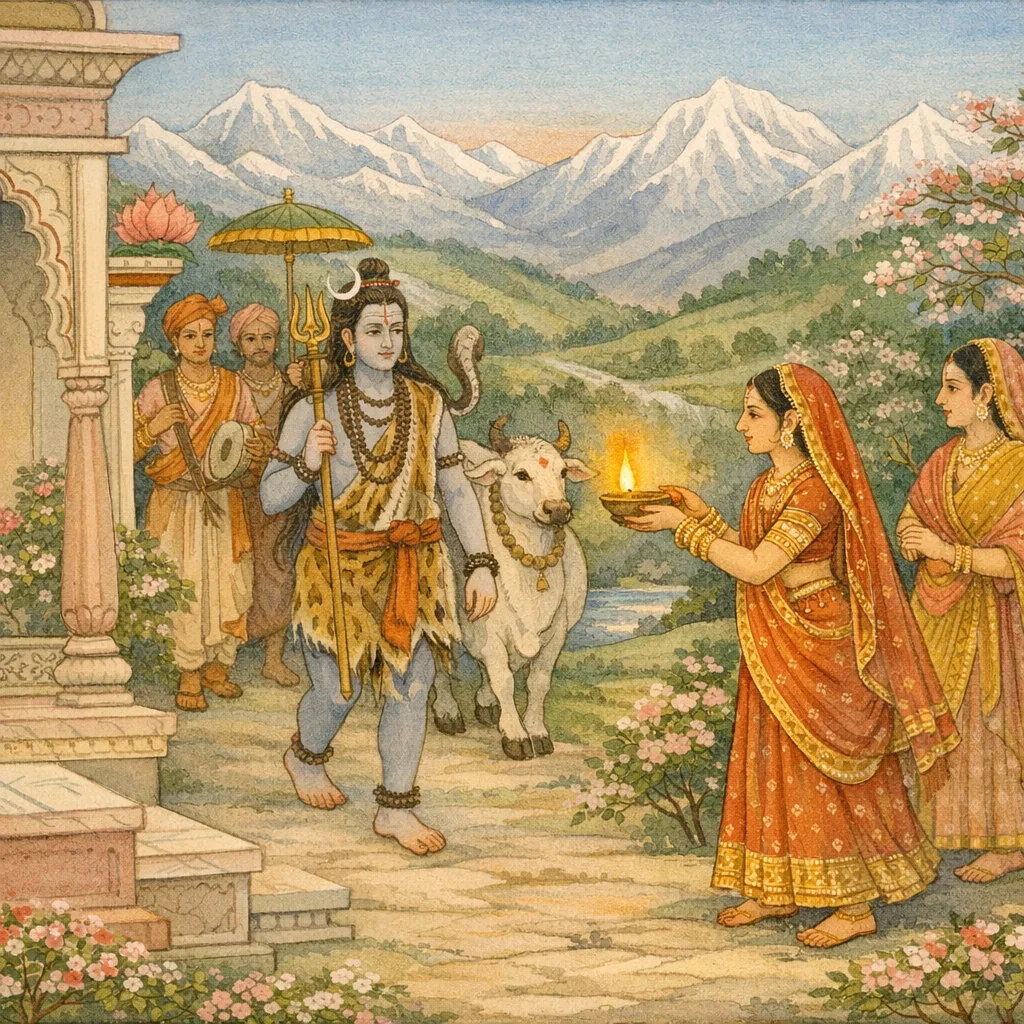
महेश्वरागमनं तथा नीराजन-सत्कारवर्णनम् / The Arrival of Maheśvara and the Rite of Welcome (Nīrājana)
Adhyāya 46 describes Śiva’s auspicious arrival at Himācala’s abode in a joyful procession witnessed by all, attended by his gaṇas, the devas, and other celestial and sage companions. Menā, the honored lady of the house and Himācala’s beloved, rises and goes within to prepare a proper reception. Satī/Pārvatī then comes to the threshold holding a lamp-vessel to perform nīrājana—the protective, auspicious rite of circling light—accompanied by groups of ṛṣis and women, highlighting communal participation in sacred welcome. Menā beholds Maheśāna/Śaṅkara in devotional splendor: one face, three eyes, a gentle smile, radiant complexion, jeweled crown and ornaments, garlands, fine garments, and adornments of sandal, agaru, musk, and kuṅkuma, with luminous eyes. The chapter centers on this ritualized encounter (darśana and satkāra), where divine presence is recognized through beauty, radiance, and auspicious signs, uniting theology with household liturgy and public celebration.
Shlokas
Verse 1
ब्रह्मोवाच । अथ शंभुः प्रसन्नात्मा सदूतं स्वगणैस्सुरैः । सर्वैरन्यैर्गिरेर्द्धाम जगाम सकुतूहलम्
Brahmā said: Then Śambhu, his heart serene and gracious, set out—together with the messenger, with his own gaṇas, with the gods, and with all the others—for the mountain’s abode, filled with holy curiosity.
Verse 2
मेनापि स्त्रीगणैस्तैश्च हिमाचलवरप्रिया । तत उत्थाय स्वगृहा भ्यंतरं सा जगाम ह
Menā too—beloved of the noble Himācala—was with those groups of women. Then she rose and went into the inner part of her own residence.
Verse 3
नीराजनार्थं शम्भोश्च दीपपात्रकरा सती । सर्वर्षिस्त्रीगणैस्साकमगच्छद्द्वारमादरात्
To perform the nīrājana (ārati) for Śambhu, Satī—holding a lamp-vessel in her hand—went reverently to the doorway, accompanied by the gathered groups of the sages’ women.
Verse 4
तत्रागतं महेशानं शंकरं गिरिजावरम् । ददर्श प्रीतितो मेना सेवितं सकलैस्सुरैः
There, Menā beheld Mahēśāna—Śaṅkara, the supreme bridegroom of Girijā—arrived in that place, joyfully seeing Him attended and honored by all the gods.
Verse 5
चारुचंपकवर्णाभं ह्येकवक्त्रं त्रिलोचनम् । ईषद्धास्यप्रसन्नास्यं रत्नस्वर्णादिभूषितम्
He appeared with a charming radiance like the campaka flower—single-faced and three-eyed—his countenance serene with a gentle smile, adorned with ornaments of gems, gold, and the like.
Verse 6
मालतीमालया युक्तं सद्रत्नमुकुटोज्ज्वलम् । सत्कंठाभरणं चारुवलयांगदभूषितम्
Adorned with a garland of jasmine (mālatī), shining with a splendid crown set with precious gems, wearing fine ornaments upon the neck, and beautified with charming bracelets and armlets.
Verse 7
वह्निशौचेनातुलेन त्वतिसूक्ष्मेण चारुणा । अमूल्यवस्त्रयुग्मेन विचित्रेणातिराजितम्
It was adorned with an incomparable purity like fire, exceedingly subtle and beautiful—shining resplendently with a wondrous pair of priceless garments.
Verse 8
चन्दनागरुकस्तूरीचारुकुंकुम भूषितम् । रत्नदर्पणहस्तं च कज्जलोज्ज्वललोचनम्
Adorned with sandalpaste, agaru, musk, and beautiful vermilion, holding a jeweled mirror in the hand, with eyes made radiant by collyrium—thus was that auspicious form described.
Verse 9
सर्वस्वप्रभयाच्छन्नमतीवसुमनोहरम् । अतीव तरुणं रम्यं भूषितांगैश्च भूषितम्
Veiled in the radiance of all splendour, he appeared exceedingly enchanting—youthful and delightful in every way, and adorned with beautifully ornamented limbs.
Verse 10
कामिनीकांतमव्यग्रं कोटिचन्द्राननांबुजम् । कोटिस्मराधिकतनुच्छविं सर्वांगसुंदरम्
He was the beloved of women, ever composed and untroubled; his lotus-like face shone like ten million moons. His bodily radiance surpassed that of countless Kāmas, and every limb of his was perfectly beautiful—an auspicious, saguṇa vision that draws the mind into devotion.
Verse 11
ईदृग्विधं सुदेवं तं स्थितं स्वपुरतः प्रभुम् । दृष्ट्वा जामातरं मेना जहौ शोकम्मुदाऽन्विता
Seeing that supremely auspicious Lord—so divine in form—standing right before her, Menā beheld her son-in-law and, filled with joy, at once cast off her sorrow.
Verse 12
प्रशशंस स्वभाग्यं सा गिरिजां भूधरं कुलम् । मेने कृतार्थमात्मानं जहर्ष च पुनः पुनः
She praised her own good fortune and extolled Girijā and the noble mountain-born lineage. Considering herself fulfilled in purpose, she rejoiced again and again.
Verse 13
नीराजनं चकारासौ प्रफुल्लवदना सती । अवलोकपरा तत्र मेना जामातरं मुदा
With a face blossoming in joy, that noble lady performed the nīrājana (ārati). There, Menā—absorbed in gazing—looked upon her son-in-law with delight.
Verse 14
गिरिजोक्तमनुस्मृत्य मेना विस्मयमागता । मनसैव ह्युवाचेदं हर्षफुल्लाननाम्बुजा
Recalling what Girijā (Pārvatī) had said, Menā was filled with wonder. With her mind alone she spoke these words—her lotus-like face blossoming with joy.
Verse 15
यद्वै पुरोक्तं च तया पार्वत्या मम तत्र च । ततोधिकं प्रपश्यामि सौन्दर्य्यं परमेशितुः
Whatever Pārvatī had previously spoken to me about Him—I now behold it directly, and I perceive the beauty of the Supreme Lord to be even greater than what was described.
Verse 16
महेशस्य सुलावण्यमनिर्वाच्यं च संप्रति । एवं विस्मयमापन्ना मेना स्वगृहमाययौ
At that moment, Mahesha’s exquisite beauty was truly beyond description. Thus overwhelmed with wonder, Menā returned to her own home.
Verse 17
प्रशशंसुर्युवतयो धन्या धन्या गिरेः सुता । दुर्गा भगवतीत्येवमूचुः काश्चन कन्यकाः
Some young maidens praised her, repeatedly exclaiming, “Blessed, blessed indeed is the Daughter of the Mountain! She is Durgā; she is Bhagavatī, the Blessed Goddess,” and thus they spoke.
Verse 18
न दृष्टो वर इत्येवमस्माभिर्द्दानगोचरः । धन्या हि गिरिजा देवीमूचुः काश्चन कन्यकाः
Some maidens said to the Goddess Girijā: “Indeed, we have not seen any bridegroom who could come within the reach of such a gift as you. Truly, you are blessed.”
Verse 19
जगुर्गन्धर्व्वप्रवरा ननृतुश्चाप्सरोगणाः । दृष्ट्वा शंकररूपं च प्रहृष्टास्सर्वदेवताः
The foremost Gandharvas sang, and the hosts of Apsarās danced. Beholding Śaṅkara’s manifested form, all the gods became filled with joy.
Verse 20
नानाप्रकारवाद्यानि वादका मधुराक्षरम् । नानाप्रकारशिल्पेन वादयामासुरादरात्
With reverent care, the musicians played many kinds of instruments, producing sweet and melodious sounds, and they performed with artistry in many varied styles—an auspicious celebration offered in devotion.
Verse 21
हिमाचलोऽपि मुदितो द्वाराचारमथाकरोत् । मेनापि सर्वनारीभिर्महोत्सवपुरस्सरम्
Himācala too, filled with joy, then arranged the proper ceremonial observances at the doorway; and Menā as well—together with all the women—went forth in front, leading the way for the great festive celebration.
Verse 22
परपुच्छां चकारासौ मुदिता स्वगृहं ययौ । शिवो निवेदितं स्थानं जगाम गणनिर्जरैः
Having inquired further, she—delighted—returned to her own abode. And Śiva, accompanied by the gaṇas and the deathless attendants, went to the place that had been indicated to Him.
Verse 23
एतस्मिन्नन्तरे दुर्गां शैलान्तःपुरचारिका । बहिर्जग्मुस्समादाय पूजितुं कुलदेवताम्
Meanwhile, the women attendants of the mountain-palace took Durgā with them and went outside, intending to worship their family deity.
Verse 24
तत्र तां ददृशुर्देवा निमेषरहिता मुदा । सुनीलांजनवर्णाभां स्वांगैश्च प्रतिभूषिताम्
There the gods beheld Her with joy, their eyes unblinking. She shone with the hue of deep blue collyrium, and was adorned with ornaments upon her own limbs.
Verse 25
त्रिनेत्रादृतनेत्रांतामन्यवारितलोचनाम् । ईषद्धास्यप्रसन्नास्यां सकटाक्षां मनोहराम्
She was so captivating that even the Three‑eyed Lord cherished her with the corners of His eyes; her glance could be checked by none. With a gentle smile and a serene, radiant face, she cast sidelong looks—altogether enchanting.
Verse 26
सुचारुकबरीभारां चारुपत्रक शोभिताम् । कस्तूरीबिन्दुभिस्सार्द्धं सिन्दूरबिन्दुशोभिताम्
Her beautiful mass of braided hair was exquisitely arranged and adorned with charming floral ornaments; and she shone with delicate dots of musk, together with radiant spots of vermilion, enhancing her auspicious, divine beauty.
Verse 27
रत्नेन्द्रसारहारेण वक्षसा सुविराजिताम् । रत्नकेयूरवलयां रत्नकङ्कणमंडिताम्
Her chest shone resplendently with a necklace wrought from the finest essence of royal gems; her arms and wrists were adorned with jeweled armlets, bangles, and gem-studded bracelets.
Verse 28
सद्रत्नकुण्डलाभ्यां च चारुगण्डस्थलोज्ज्वलाम् । मणिरत्नप्रभामुष्टिदन्तराजिविराजिताम्
Adorned with excellent jeweled earrings, her radiant, lovely cheeks shone; and her smile—made splendid by rows of teeth gleaming like the luster of gems—illumined her face.
Verse 29
मधुबिम्बाधरोष्ठां च रत्नयावकसंयुताम् । रत्नदर्प्पणहस्तां च क्रीडापद्मविभूषिताम्
Her lips were like the sweet bimba-fruit, adorned with yāvak dye like a jewel’s red. In her hand she held a mirror set with gems, and she was graced with a lotus meant for playful sport.
Verse 30
चन्दनागुरुकस्तूरीकुंकुमेनाति च र्चिताम् । क्वणन्मंजीरपादां च रक्तांघ्रितलराजिताम्
She was exquisitely honored with sandal paste, agaru, musk, and kuṅkuma; her feet, adorned with tinkling anklets, shone with the beauty of reddened soles.
Verse 31
प्रणेमुश्शिरसा देवीं भक्तियुक्ताः समेनकाम् । सर्वे सुरादयो दृष्ट्वा जगदाद्यां जगत्प्रसूम्
Beholding the Goddess—the Primordial One, the Mother who gives birth to the worlds—all the gods and other celestial beings bowed their heads to her in devotion, and their desires were brought into perfect harmony and duly fulfilled.
Verse 32
त्रिनेत्रो नेत्रकोणेन तां ददर्श मुदान्वितः । शिवः सत्याकृतिं दृष्ट्वा विजहौ विरहज्वरम्
The Three‑eyed Lord glanced at her from the corner of His eye, filled with joy. Beholding that true form—Satyā, the very embodiment of Satī—Śiva cast off the fever of separation.
Verse 33
शिवस्सर्वं विसस्मार शिवासंन्यस्तलोचनः । पुलकांचितसर्वाङ्गो हर्षाद्गौरीविलोचनः
Fixing His gaze upon Śivā (Pārvatī), Lord Śiva forgot all else. His whole body thrilled with gooseflesh, and, overcome with joy, He looked upon Gaurī with loving eyes.
Verse 34
अथ कालीबहिः पुर्य्यां गत्वा पूज्य कुलाम्बिकाम् । विवेश भवनं रम्यं स्वपितुस्सद्विजाङ्गना
Thereupon, the noble maiden went out to the city called Kālībahi, worshipped Kulāmbikā, the Mother-Goddess of the clan, and then entered the delightful residence of her own father.
Verse 35
शङ्करोपि सुरैस्सार्द्धं हरिणा ब्राह्मणा तथा । हिमाचलसमुद्दिष्टं स्वस्थानमगमन्मुदा
Śaṅkara too, together with the gods—and likewise with Hari and the brāhmaṇas—joyfully went to His own abode, to the place that had been indicated by Himācala.
Verse 36
तत्र सर्वे सुखं तस्थुस्सेवन्तश्शङ्करं यथा । सम्मानिता गिरीशेन नानाविधसुसम्पदा
There, all of them remained in comfort, attending upon Śaṅkara as was fitting. Honoured by Girīśa, the Lord of the Mountain, they were endowed with many kinds of auspicious prosperity.
Verse 46
इति श्रीशिवमहापुराणे द्वितीयायां रुद्रसंहितायां तृतीये पार्वतीखण्डे वरागमादिवर्णनं नाम षट्चत्शरिंशोऽध्यायः
Thus ends the forty-sixth chapter, called “The Description beginning with Varāgama,” in the Pārvatī-khaṇḍa (third section) of the Rudra-saṃhitā (second division) of the Śrī Śiva Mahāpurāṇa.
Frequently Asked Questions
Śiva (Maheśvara/Śaṅkara) arrives with his attendants at Himācala’s residence, where Menā and Satī/Pārvatī prepare and perform an auspicious welcome, including nīrājana at the doorway.
Nīrājana ritualizes recognition of divinity: the circling light marks protection, auspiciousness, and surrender, turning a social act of hospitality into a liturgical affirmation of Śiva’s grace-bearing presence.
Śiva is presented as Maheśāna with trilocana (three eyes), serene smile, youthful radiance, and lavish ornaments/garlands/fragrant unguents—iconic markers that encode sovereignty, purity, and auspicious presence for devotees.