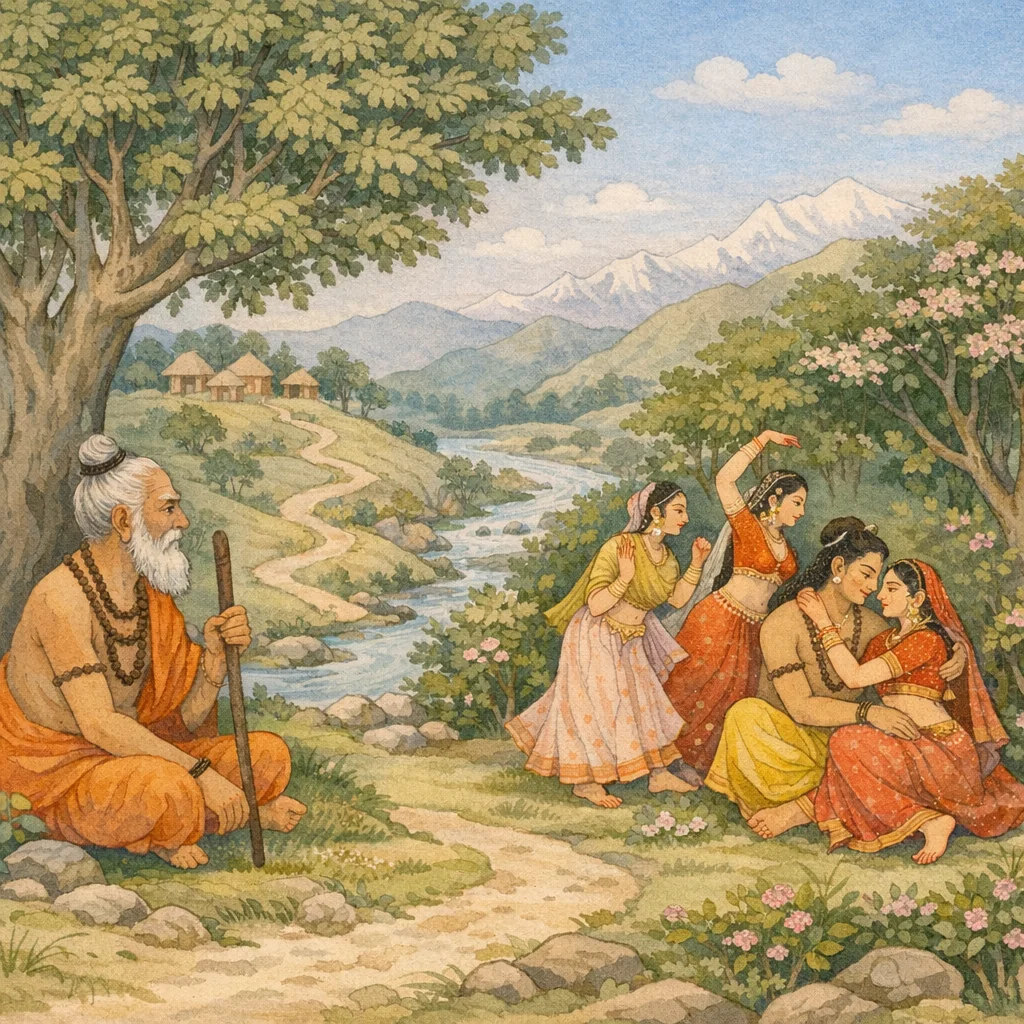
अनरण्य-वंशवर्णनम् तथा पिप्पलादस्य कामोत्पत्तिः (Genealogy of King Anaraṇya and Pippalāda’s arousal of desire)
Vasiṣṭha introduces a royal lineage descending from Manu and highlights King Anaraṇya, ruler of the seven continents (saptadvīpa) and an exemplary devotee of Śambhu. Though he performs many yajñas with Bhṛgu as his purohita, he refuses even the offered rank of Indra, showing dispassion (vairāgya) and Śiva-bhakti above celestial power. The narrative then describes his household: many sons, one dearly cherished daughter (Sundarī/Padmā), and numerous fortunate queens. As the daughter reaches youth, a letter/message is sent, setting the stage for what follows. The scene shifts to the sage Pippalāda, who on his way back to his āśrama sees a gandharva engrossed in erotic play with women and skilled in kāmaśāstra. The sight awakens kāma (desire) in the ascetic; despite his tapas, his mind turns toward marriage and household life (dāra-saṃgraha). The chapter thus frames a moral-psychological turning point: how a sensory encounter can disturb ascetic focus and redirect life-choices, to be addressed in the remaining verses.
Shlokas
Verse 1
वसिष्ठ उवाच । मनोर्वंशोद्भवो राजा सोऽनरण्यो नृपेश्वर । इन्द्रसावर्णिसंज्ञस्य चतुर्दशमितस्य हि
Vasiṣṭha said: O lord of kings, that ruler Anaraṇya was born in the lineage of Manu. He belonged to the Manvantara known as Indra-Sāvarṇi, the fourteenth in the sequence.
Verse 2
अनरण्यो नृपश्रेष्ठस्स प्तद्वीपमहीपतिः । शम्भुभक्तो विशेषेण मङ्गलारण्यजो बली
Anaraṇya, foremost among kings, sovereign of the earth with its seven continents, was a mighty ruler—one who, in a special and devoted way, was a bhakta of Śambhu (Śiva), born in the auspicious forest of Maṅgalāraṇya.
Verse 3
भृगुं पुरोधसं कृत्वा शतं यज्ञांश्चकार सः । न स्वीचकार शक्रत्वं दीयमानं सुरैरपि
Appointing Bhṛgu as his officiating priest (purohita), he performed a hundred yajñas. Yet even when the gods offered him Indra’s sovereignty, he did not accept that Indrahood.
Verse 4
बभूवश्शतपुत्राश्च राज्ञस्तस्य हिमालय । कन्यैका सुन्दरी नाम्ना पद्मा पद्मालया समा
O Himālaya, that king had a hundred sons; and one daughter, a beautiful maiden named Padmā, radiant and pure like Padmālayā (Lakṣmī), the lotus-dwelling goddess.
Verse 5
यस्स्नेहः पुत्रशतके कन्यायाञ्च ततोऽधिकः । नृपस्य तस्य तस्यां हि बभूव नगसत्तम
O best of mountains, that king’s affection for his daughter was greater than the love one might have even for a hundred sons; indeed, a deep attachment arose in him toward her.
Verse 6
प्राणाधिकाः प्रियतमा महिष्यस्सर्वयोषितः । नृपस्य पत्न्यः पञ्चासन्सर्वास्सौभाग्यसंयुता
The king’s chief queens were dearer to him than his own life, and were the most beloved among all women. The king had five wives, and all of them were endowed with good fortune and auspicious marital prosperity.
Verse 7
सा कन्या यौवनस्था च बभूव स्वपितुर्गृहे । पत्रं प्रस्थापयामास सुवरान यनायसः
That maiden, having attained youth, remained in her father’s house; and she sent a letter, dispatching excellent persons as messengers.
Verse 8
एकदा पिप्पलादर्षिर्गर्न्तुं स्वाश्रममुत्सुकः । तपःस्थाने निर्जने च गन्धर्वं स ददर्श ह
Once, the sage Pippalāda, eager to return to his own hermitage, saw a Gandharva in a solitary place set apart for austerities.
Verse 9
स्त्रीयुतं मग्नचित्तं च शृङ्गारे रससागरे । विहरन्तं महाप्रेम्णा कामशास्त्रविशारदम्
He was accompanied by a woman, his mind deeply absorbed, sporting in the ocean of erotic delight with great love—well-versed in the treatises on desire.
Verse 10
दृष्ट्वा तं मुनिशार्दूलः सकामः संबभूव सः । तपत्स्वदत्तचित्तश्चाचिंतयद्दारसंग्रहम्
Seeing her, that tiger among sages became stirred with desire. Though devoted to austerity, his mind turned and he began to contemplate taking a wife.
Verse 11
एवंवृत्तस्य तस्यैव पिप्पलादस्य सन्मुनेः । कियत्कालो गतस्तत्र कामोन्मथितचेतसः
Thus, while that very noble sage Pippalāda was in such a state, his mind agitated by desire, how much time passed there (in that condition)?
Verse 12
एकदा पुष्पभद्रायां स्नातुं गच्छन्मुनीश्वरः । ददर्श पद्मां युवतीं पद्मामिव मनोरमाम्
Once, as the lordly sage was going to bathe in Puṣpabhadrā, he beheld the maiden Padmā—charming like a lotus itself.
Verse 13
केयं कन्येति पप्रच्छ समीपस्थाञ्जनान्मुनिः । जना निवेदयांचक्रुर्नत्वा शापनियन्त्रिताः
The sage asked the nearby people, “Who is this maiden?” Bowing down, those people—restrained by a curse—then reported the matter to him.
Verse 14
जना ऊचुः । अनरण्यसुतेयं वै पद्मा नाम रमापरा । वरारोहा प्रार्थ्यमाना नृपश्रेष्ठैर्गुणालया
The people said: “She is indeed the daughter of Anaraṇya, named Padmā, the supreme embodiment of beauty and fortune, like Rāmā herself. A noble maiden of graceful form, she is sought in marriage by the best of kings, for she is an abode of virtues.”
Verse 15
ब्रह्मोवाच । तच्छ्रुत्वा स मुनिर्वाक्यं जनानां तथ्यवादिनाम् । चुक्षोभातीव मनसि तल्लिप्सुर भवच्च सः
Brahmā said: Hearing those words of the people—truth-speaking as they were—the sage was greatly stirred in his mind, and he became intent on obtaining that very thing.
Verse 16
मुनिः स्नात्वाभीष्टदेवं सम्पूज्य विधिवच्छिवम् । जगाम कामी भिक्षार्थमनरण्यसभां गिरे
Having bathed, the sage—yearning within his heart for the fulfillment of his aim—worshipped Lord Śiva, his chosen Deity, in the proper manner. Then he went to the assembly at Anaraṇya mountain to seek alms.
Verse 17
राजा शीघ्रं मुनिं दृष्ट्वा प्रणनाम भयाकुलः । मधुपर्कादिकं दत्त्वा पूजयामास भक्तितः
Seeing the sage at once, the king—overwhelmed with fear—quickly bowed down. Offering madhuparka and other honors, he worshipped him with devotion.
Verse 18
कामात्सर्वं गृहीत्वा च ययाचे कन्यकां मुनिः । मौनी बभूव नृपतिः किञ्चिनिर्वक्तुमक्षमः
Then the sage—stirred by desire—accepted everything and asked for the maiden. The king, however, fell silent, unable to utter a single word.
Verse 19
मुनिर्ययाचे कन्यां स तां देहीति नृपेश्वर । अन्यथा भस्मसात्सर्वं करिष्यामि क्षणेन च
The sage demanded the maiden, saying, “O lord among kings, give her to me. Otherwise, in an instant I shall reduce everything to ashes.”
Verse 20
सर्वे बभूववुराच्छन्ना गणास्तत्तेजसा मुने । रुरोद राजा सगणो दृष्ट्वा विप्रं जरातुरम्
O sage, all the gaṇas were overwhelmed and covered by that radiance of the muni. Seeing the brāhmaṇa worn down by old age, the king—together with his attendants—broke into tears.
Verse 21
महिष्यो रुरुदुस्सर्वा इतिकर्त्तव्यताक्षमाः । मूर्च्छामाप महाराज्ञी कन्यामाता शुचाकुला
All the female buffaloes began to cry out, helpless and unsure what should be done. Overwhelmed by sorrow, the queen—the girl’s mother—fainted away, her heart shaken by grief.
Verse 22
बभूवुस्तनयास्सर्वे शोकाकुलि तमानसाः । सर्वं शोकाकुलं जातं नृपसम्बन्धि शैलप
All the king’s sons became overwhelmed with grief in their minds. Everything connected with the royal household, and the mountain-dwelling kin as well, likewise fell into sorrow.
Verse 23
एतस्मिन्नन्तरे प्राज्ञो द्विजो गुरुरनुत्तमः । पुरोहितश्च मतिमानागतो नृपसन्निधिम्
Meanwhile, the wise Brāhmaṇa preceptor—excellent beyond compare, and also the discerning royal priest—arrived into the king’s presence.
Verse 24
राजा प्रणम्य सम्पूज्य रुरोद च तयोः पुरः । सर्वं निवेदयांचक्रे पप्रच्छोचितमाशु तत्
The king bowed down and duly honored them; then, weeping in their presence, he disclosed everything and quickly asked what was proper to be done.
Verse 25
अथ राज्ञो गुरुर्विप्रः पण्डितश्च पुरोहितः । अपि द्वौ शास्त्रनीतिज्ञौ बोधयामासतुर्नृपम्
Then the king’s preceptor—a learned brāhmaṇa—and his priest, both wise and skilled in scripture and righteous policy, instructed the ruler and made him understand his proper course of action.
Verse 26
शोकाकुलाश्च महिषीर्नृपबालांश्च कन्यकाम् । उत्तमा नीतिमादृत्य सर्वेषां हितकारिणीम्
Those queens, the royal children, and the maiden were overwhelmed with grief. Yet she—Uttamā—embracing the highest wise conduct, acted for the welfare of them all.
Verse 27
गुरुपुरोधसावूचतुः । शृणु राजन्महाप्राज्ञ वचो नौ सद्धितावहम् । मा शुचः सपरीवारश्शास्त्रे कुरु मतिं सतीम्
The Guru and the royal priest said: “O King, great in wisdom, listen to our words that bring true benefit. Do not grieve—together with all your attendants. Place your mind firmly in the śāstras (sacred teaching).”
Verse 28
अद्य वाब्ददिनान्ते वा दातव्या कन्यका नृप । पात्राय विप्रायान्यस्मै कस्मै चिद्वा विशेषतः
O King, whether today itself or at the close of the year and the day, the maiden should be given in marriage—preferably to a worthy brāhmaṇa, or else, in particular, to some other suitable person.
Verse 29
सत्पात्रं ब्राह्मणादन्यन्न पश्यावो जगत्त्रये । सुतां दत्त्वा च मुनये रक्ष स्वां सर्वसम्पदम्
In the three worlds we see no worthier recipient than a true brāhmaṇa. Therefore, give your daughter to the sage, and thereby protect your own complete prosperity and well-being.
Verse 30
राजन्नेकनिमित्तेन सर्वसंपद्विनश्यति । सर्वं रक्षति तं त्यक्त्वा विना तं शरणागतम्
O King, by a single wrong cause all prosperity is ruined. Abandoning the One who protects everything and taking refuge elsewhere, a person becomes bereft of true shelter.
Verse 31
वसिष्ठ उवाच । राजा प्राज्ञवचः श्रुत्वा विलप्य च मुहुर्मुहुः । कन्यां सालंकृतां कृत्वा मुनीन्द्राय ददौ किल
Vasiṣṭha said: Hearing the wise man’s words, the king lamented again and again. Then, having adorned his daughter, he indeed gave her to the lord of sages.
Verse 32
कान्तां गृहीत्वा स मुनिर्विवाह्य विधिवद्गिरे । पद्मां पद्मोपमां तां वै मुदितस्स्वालयं ययौ
Taking his beloved (Padmā) and duly performing the marriage rites in the proper manner on the mountain, the sage—joyful in heart—departed with that lotus-like Padmā to his own abode.
Verse 33
राजा सर्वान्परित्यज्य दत्त्वा वृद्धाय चात्मजाम् । ग्लानिं चित्ते समाधाय जगाम तपसे वनम्
Abandoning everything, the king gave his own daughter in marriage to the aged man. Then, fixing a grave weariness within his mind, he departed to the forest to undertake tapas (austerities), turning from worldly bonds toward the path that leads the bound soul (paśu) to Lord Śiva, the liberating Lord (Pati).
Verse 34
इति श्रीशिवमहापुराणे द्वितीयायां रुद्रसंहितायां तृतीये पार्वतीखण्डेऽनरण्यचरितवर्णनं नाम चतुस्त्रिंशोऽध्यायः
Thus, in the Śrī Śiva Mahāpurāṇa—within the Second Rudra-saṃhitā, in the Third section, the Pārvatī-khaṇḍa—ends the thirty-fourth chapter, entitled “The Description of the Deeds of Anaraṇya.”
Verse 35
पूज्याः पुत्राश्च भृत्याश्च मूर्च्छामापुर्नृपं विना । शुशुचुः श्वाससंयुक्तं ज्ञात्वा सर्वेपरे जनाः
Without the king, the venerable elders, his sons, and the attendants fell into a swoon. And all the other people, realizing that he was still breathing, wept aloud.
Verse 36
अनरण्यो वनं गत्वा तपस्तप्त्वाति शंकरम् । समाराध्य ययौ भक्त्या शिवलोकमनामयम्
Anaraṇya went to the forest and undertook intense austerities, worshipping Lord Śaṅkara with deep devotion; having fully propitiated Him, he attained Śivaloka—the flawless, sorrowless abode of Śiva.
Verse 37
नृपस्य कीर्तिमान्नाम्ना ज्येष्ठपुत्रोथ धार्मिकः । पुत्रवत्पालयामास प्रजा राज्यं चकार ह
The king’s eldest son, named Kīrtimān, was truly righteous, established in dharma. He protected the subjects as his own children and duly governed the kingdom.
Verse 38
इति ते कथितं शैलानरण्यचरितं शुभम् । कन्यां दत्त्वा यथारक्षद्वंशं चाप्यखिलं धनम्
Thus I have told you the auspicious account of the King of Mountains (Himālaya) and the forest-dweller. Having given his daughter in marriage, he protected his lineage and preserved all his wealth as well.
Verse 39
शैलराज त्वमप्येवं सुतां दत्त्वा शिवाय च । रक्ष सर्वकुलं सर्वान्वशान्कुरु सुरानपि
O King of Mountains, you too—having thus given your daughter to Śiva—protect your entire lineage. Bring everyone under your harmonious guidance, and keep even the gods themselves in due order.
Frequently Asked Questions
The chapter introduces King Anaraṇya’s exemplary Śiva-devotion and sets up the Pippalāda episode where an ascetic’s desire is awakened after witnessing a gandharva engaged in erotic enjoyment.
It signals vairāgya and priority of Śiva-bhakti over svarga-oriented ambition, modeling a hierarchy where devotion and inner orientation outrank even divine office.
Śambhu/Śiva as the devotional pole; kāma (desire) as a destabilizing force; and the gandharva as the narrative catalyst that redirects Pippalāda’s mental trajectory.