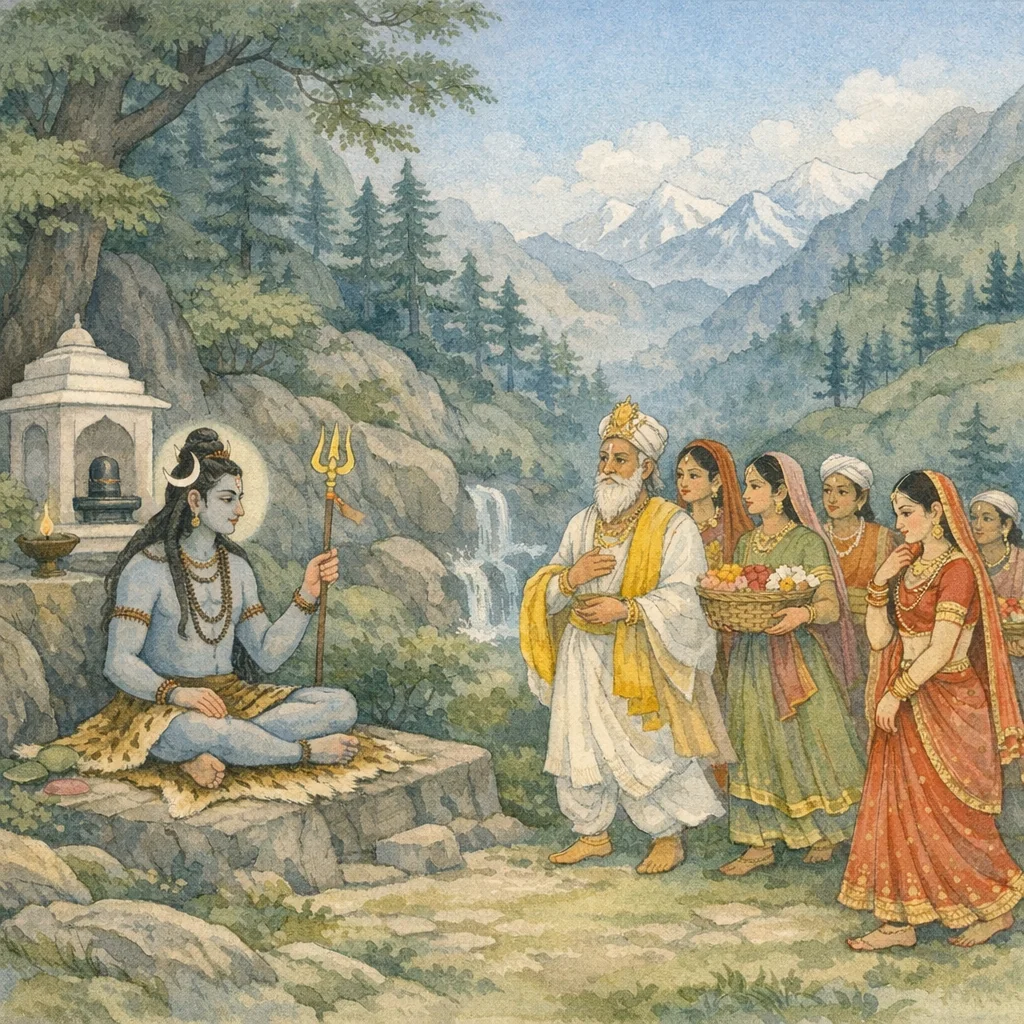
काली-परिचयः / Himagiri Presents Kālī (Pārvatī) to Śiva
This adhyāya tells how Himagiri, king of mountains, approaches Śiva with auspicious flowers and fruits and with his daughter—here identified as Kālī (Pārvatī)—moved by her longing to worship and serve Śiva. Framed by Brahmā, Himagiri bows to the Lord of the three worlds and petitions on his daughter’s behalf, asking leave for her continual sevā to Śaṅkara, together with her companions, stressing that it depends upon Śiva’s consent and grace. Śiva then beholds the maiden at the threshold of youth, and the text turns to an ornate rūpa-varṇana: lotus-like complexion, moon-like face, wide eyes, graceful limbs, and a charm so extraordinary that even minds trained in meditation could be shaken by her darśana. The chapter thus joins devotional intent (ārādhana/sevā) with aesthetic-theological revelation, presenting the Goddess’s form as a seat of beauty (rasa) and metaphysical power (śakti), preparing for later developments in the Pārvatī narrative.
Shlokas
Verse 1
ब्रह्मोवाच । अथ शैलपतिर्हृष्टः सत्पुष्पफलसंचयम् । समादाय स्वतनयासहितोऽगाद्धरांतिकम्
Brahmā said: Then the Lord of the Mountain (Himālaya), delighted at heart, gathered a fine collection of flowers and fruits and, accompanied by his own daughter, went to the presence of Dharā (the Earth).
Verse 2
स गत्वा त्रिजगन्नाथं प्रणम्य ध्यानतत्परम् । अर्थयामास तनयां कालीं तस्मै हृदाद्भुताम्
Then he went to the Lord of the three worlds and, bowing down to Him who was absorbed in meditation, he entreated Him for a daughter—Kālī—marvelous and dear to his heart.
Verse 3
फलपुष्पादिकं सर्वं तत्तदग्रे निधाय सः । अग्रे कृत्वा सुतां शम्भुमिदमाह च शैलराट्
Placing in front (of Śambhu) all those offerings—fruits, flowers, and the like—he then set his daughter before Lord Śambhu; and the king of mountains spoke these words.
Verse 4
हिमगिरिरुवाच । भगवंस्तनया मे त्वां सेवितुं चन्द्रशेखरम् । समुत्सुका समानीता त्वदाराधनकांक्षया
Himālaya (Himagiri) said: “O Blessed Lord, my daughter—eager to serve You, O Candraśekhara—has been brought here, for she longs to worship You.”
Verse 5
सखीभ्यां सह नित्यं त्वां सेवतामेव शंकरम् । अनुजानीहि तां नाथ मयि ते यद्यनुग्रहः
“Along with her two companions, let her ever remain in attendance upon you—upon Śaṅkara alone. O Lord, grant her this permission, if indeed you have grace toward me.”
Verse 6
ब्रह्मोवाच । अथ तां शंकरोऽपश्यत्प्रथमारूढयौवनाम् । फुल्लेन्दीवरपत्राभा पूर्णचन्द्रनिभाननाम्
Brahmā said: Then Śaṅkara beheld her, just entering the first bloom of youth—radiant like the petals of a fully opened blue lotus, her face resembling the full moon.
Verse 7
समस्तलीलासंस्थानशुभवेषविजृम्भिकाम् । कम्बुग्रीवां विशालाक्षीं चारुकर्णयुगोज्ज्वलाम्
She shone forth with an exquisite form fit for every divine play—her figure well-proportioned, her attire auspicious and radiant. Her neck was conch-like, her eyes wide and luminous, and her beauty was heightened by her lovely pair of ears.
Verse 8
मृणालायतपर्य्यन्तबाहुयुग्ममनोहराम् । राजीवकुड्मलप्रख्यौ घनपीनौदृढौस्तनौ
Her charming pair of arms extended down to her knees like tender lotus-stalks. Her breasts were like lotus-buds—full, firm, and well-rounded—revealing the auspicious perfection of the Divine Mother’s embodied form.
Verse 9
बिभ्रतीं क्षीणमध्यां च त्रिवलीमध्यराजिताम् । स्थलपद्मप्रतीकाशपादयुग्मविराजिताम्
She bore a slender waist, adorned with three graceful folds at her midsection, and shone with a pair of feet radiant like lotus-flowers on firm ground—thus was the Goddess (Pārvatī) described in her auspicious, saguna form.
Verse 10
ध्यानपंजरनिर्बद्धमुनिमानसमप्यलम् । दर्शनाद्भ्रंशने शक्तां योषिद्गणशिरोमणिम्
She was the crown-jewel among women—so powerful that, merely by being seen, she could unsettle even the mind of a sage firmly bound within the cage of meditation.
Verse 11
दृष्ट्वा तां तादृशीं तात ध्यानिनां च मनोहराम् । विग्रहे तन्त्रमन्त्राणां वर्द्धिनीं कामरूपिणीम्
Seeing her in that wondrous manner, dear one—so captivating even to yogic meditators—she appeared as the embodied form of Tantra and Mantra, the increaser of their power, and the Goddess who assumes whatever form she wills.
Verse 12
इति श्रीशिवमहापुराणे द्वितीयायां रुद्रसंहितायां तृतीये पार्वतीखण्डे शिवहिमाचलसम्वादवर्णनं नाम द्वादशोऽध्यायः
Thus, in the Śrī Śiva Mahāpurāṇa, in the Second Saṃhitā (Rudra-saṃhitā), in the Third Khaṇḍa (Pārvatī-khaṇḍa), ends the twelfth chapter entitled “The Description of the Dialogue between Śiva and Himācala.”
Verse 14
ववन्द शीर्ष्णा च पुनर्हिमाचलः स संशयं प्रापददीनसत्त्वः । उवाच वाक्यं जगदेकबन्धुं गिरीश्वरो वाक्यविदां वरिष्ठः
Then Himācala once again bowed his head in reverence; his spirit, grown faint, fell into doubt. Thereupon Girīśvara—foremost among those who know the right use of words, and the one true kinsman of the whole world—spoke to him.
Verse 15
हिमाचल उवाच । देवदेव महादेव करुणाकर शंकर । पश्य मां शरणम्प्राप्तमुन्मील्य नयने विभो
Himācala said: “O God of gods, O Mahādeva, compassionate Śaṅkara—O all-pervading Lord! Open Your eyes and look upon me, for I have come seeking refuge in You.”
Verse 16
शिव शर्व महेशान जगदानन्दकृत्प्रभो । त्वां नतोऽहं महादेव सर्वापद्विनिवर्तकम्
O Śiva—Śarva, Maheśāna, Lord who bestows bliss upon the worlds! O Mahādeva, I bow to You, the remover of every calamity and obstacle.
Verse 17
न त्वां जानंति देवेश वेदाश्शास्त्राणि कृत्स्नशः । अतीतो महिमाध्वानं तव वाङ्मनसोः सदा
O Lord of the gods, the Vedas and all the śāstras do not fully know You. The path of Your glory ever transcends the reach of speech and mind.
Verse 18
अतद्व्यावृत्तितस्त्वां वै चकितं चकितं सदा । अभिधत्ते श्रुतिः सर्वा परेषां का कथा मता
Because You are beyond all that is “not That”—beyond every limiting description—the whole Śruti, the Vedic revelation, speaks of You as ever wondrous, ever astonishing. If even the Śruti declares You thus, what can anyone else’s opinion say about describing You?
Verse 19
जानंति बहवो भक्तास्त्वत्कृपां प्राप्य भक्तितः । शरणागत भक्तानां न कुत्रापि भ्रमादिकम्
Many devotees, through devotion, come to know Your grace after receiving it. For devotees who have taken refuge in You, there is nowhere any delusion and the like.
Verse 20
विज्ञप्तिं शृणु मत्प्रीत्या स्वदासस्य ममाधुना । तव देवाज्ञया तात दीनत्वाद्वर्णयामि हि
Out of affection for me, please listen now to this humble petition of mine, for I am your own servant. O dear one, by your divine command I shall indeed describe my helpless plight.
Verse 21
सभाग्योहं महादेव प्रसादात्तव शंकर । मत्वा स्वदासं मां नाथ कृपां कुरु नमोऽस्तु ते
O Mahādeva, O Śaṅkara, by your grace I am truly fortunate. O Lord, regarding me as your own servant, bestow your compassion upon me—obeisance to you.
Verse 22
प्रत्यहं चागमिष्यामि दर्शनार्थं तव प्रभो । अनया सुतया स्वामिन्निदेशं दातुमर्हसि
“O Lord, I shall come every day to behold you. O Master, please deign to give your instruction through this daughter of mine.”
Verse 23
ब्रह्मोवाच । इत्याकर्ण्य वचस्तस्योन्मील्य नेत्रे महेश्वरः । त्यक्तध्यानः परामृश्य देवदेवोऽब्रवीद्वचः
Brahmā said: Thus hearing his words, Maheśvara opened His eyes. Setting aside His meditation and reflecting for a moment, the Lord of the gods spoke these words.
Verse 24
महेश्वर उवाच । आगंतव्यं त्वया नित्यं दर्शनार्थं ममाचल । कुमारीं सदने स्थाप्य नान्यथा मम दर्शनम्
Maheśvara said: “O Mountain (Himālaya), you must come regularly to behold Me. Establish the maiden (Pārvatī) in your home; otherwise, you shall not obtain My darśana.”
Verse 25
ब्रह्मोवाच । महेशवचनं श्रुत्वा शिवातातस्तथाविधम् । अचलः प्रत्युवाचेदं गिरिशं नतकमधरः
Brahmā said: Having heard Mahesha’s words spoken in that manner, Śiva’s father—Acala (Himālaya)—with his head bowed, replied to Girīśa (Lord Śiva).
Verse 26
हिमाचल उवाच । कस्मान्मयानया सार्द्धं नागंतव्यं तदुच्यताम् । सेवने किमयोग्येयं नाहं वेद्म्यत्र कारणम्
Himācala said: “Tell me why I should not go there together with her. Am I in some way unfit for this act of service? I do not understand the reason for it.”
Verse 27
ब्रह्मोवाच । ततोऽब्रवीद्गिरिं शंभुः प्रहसन्वृषभध्वजः । लोकाचारं विशेषेण दर्शयन्हि कुयोगिनाम्
Brahmā said: Then Śambhu, the Bull-bannered Lord, smiling, spoke to the Mountain (Himālaya), especially demonstrating the ways of worldly conduct—so as to expose the misguided yogins.
Verse 28
शंभुरुवाच । इयं कुमारी सुश्रोणी तन्वी चन्द्रानना शुभा । नानेतव्या मत्समीपे वारयामि पुनः पुनः
Śambhu said: “This maiden—fair-hipped, slender, moon-faced, and auspicious—must not be brought near Me. Again and again I forbid it.”
Verse 29
मायारूपा स्मृता नारी विद्वद्भिर्वेदपारगैः । युवती तु विशेषेण विघ्नकर्त्री तपस्विनाम्
The learned—those who have mastered the Vedas—declare that “woman” is a manifestation of Māyā. A young woman, in particular, is said to become a cause of obstacles for ascetics engaged in austerity.
Verse 30
अहं तपस्वी योगी च निर्लिप्तो मायया सदा । प्रयोजनं न युक्त्या वै स्त्रिया किं मेस्ति भूधर
I am an ascetic and a yogin, ever unattached, ever untouched by Māyā. What purpose, indeed, could there be for me in relation to a woman? Tell me, O bearer of the mountain.
Verse 31
एवं पुनर्न वक्तव्यं तपस्विवरसंश्रित । वेदधर्मप्रवीणस्त्वं यतो ज्ञानिवरो बुधः
“Therefore, O you who have taken refuge in the foremost of ascetics, do not speak thus again. You are well-versed in the Vedic path of dharma; hence you are a wise one—indeed, the best among knowers.”
Verse 32
भवत्यचल तत्संगाद्विषयोत्पत्तिराशु वै । विनश्यति च वैराग्यं ततो भ्रश्यति सत्तपः
O steadfast one, from association with that (worldly influence), the arising of sense-objects quickly occurs. Detachment (vairāgya) is then destroyed, and from that the true, sattvic austerity falls away.
Verse 33
अतस्तपस्विना शैल न कार्या स्त्रीषु संगतिः । महाविषयमूलं सा ज्ञानवैराग्यनाशिनी
Therefore, O Mountain, an ascetic should not cultivate intimate association with women; for such attachment becomes the root of powerful sense-enjoyments and destroys both true knowledge and dispassion (vairāgya).
Verse 34
ब्रह्मोवाच । इत्याद्युक्त्वा बहुतरं महायोगी महेश्वरः । विरराम गिरीशं तं महायोगिवरः प्रभुः
Brahmā said: Having spoken thus, and much more besides, that Mahāyogī—Maheśvara, the Lord—fell silent; that Girīśa, supreme among yogins, the all-powerful Master, then paused.
Verse 35
एतच्छ्रुत्वा वचनं तस्य शंभोर्निरामयं निःस्पृहं निष्ठुरं च । कालीतातश्चकितोऽभूत्सुरर्षे तद्वत्किंचिद्व्याकुलश्चास तूष्णीम्
O sage among the gods, hearing those words of Śambhu—sound, desireless, and stern—Kālī’s father was startled; likewise, he grew somewhat agitated and remained silent.
Verse 36
तपस्विनोक्तं वचनं निशम्य तथा गिरीशं चकितं विचार्य्य । अतः प्रणम्यैव शिवं भवानी जगाद वाक्यं विशदन्तदानीम्
Hearing the ascetic’s words and, somewhat astonished, reflecting upon Girīśa (Lord Śiva), Bhavānī bowed to Śiva and, at that moment, spoke with clear intent.
Frequently Asked Questions
Himagiri approaches Śiva with offerings and formally petitions that his daughter Kālī be allowed to worship and serve Śiva; Śiva then views her and the text elaborates her divine form.
It encodes śakti as a metaphysical force: the Goddess’s form is not merely aesthetic but spiritually efficacious, capable of unsettling even meditative minds, underscoring darśana as transformative.
Śiva is invoked as Trijagannātha, Śaṅkara, and Candraśekhara; the daughter is explicitly named Kālī while functioning within the Pārvatī narrative framework.