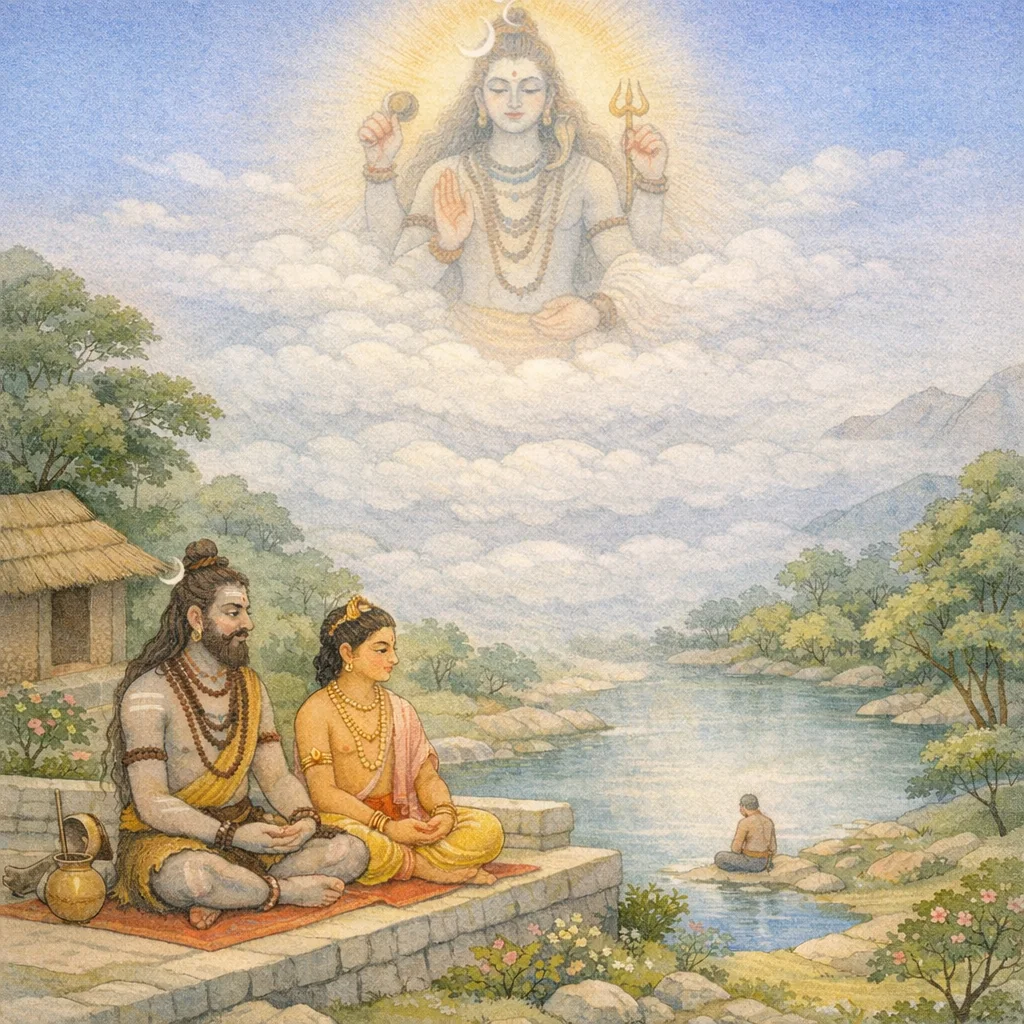
अद्वैतशैवसिद्धान्ते पुरुष-प्रकृति-विचारः (Puruṣa–Prakṛti Analysis in Advaita Śaiva Doctrine)
Adhyāya 17 offers a philosophical clarification prompted by Vāmadeva’s doubt: earlier teaching placed Puruṣa above Prakṛti, yet another statement seems to place him below, contracted by māyā. Śrī Subrahmaṇya answers from an explicitly Advaita-Śaiva standpoint: duality is contingent and perishable, whereas non-dual Brahman/Śiva is supreme and imperishable. Śiva is praised as omniscient, omnipotent, attributeless, and the generative source of the divine triad; “saccidānanda” is cited as a doctrinal description. The chapter then explains that Śiva, by free will and His own māyā, appears as “Puruṣa” in a contracted state, called bhoktṛ (enjoyer/experiencer) through the fivefold limitation beginning with kalā (kalādi pañcaka). When the two-level ontology—higher and lower standpoints—is understood, these placements are not contradictory. Finally, a tattva-style account traces bondage as an evolute sequence: from the guṇas arise buddhi (determinative intellect), then ahaṅkāra, then the cognitive faculties and the mind marked by saṃkalpa–vikalpa, mapping experiential bondage as prakṛti-based unfolding.
Shlokas
Verse 1
वामदेव उवाच । नियत्यधस्तात्प्रकृतेरुपरिस्थः पुमानिति । पूर्वत्र भवता प्रोक्तमिदानीं कथमन्यथा
Vāmadeva said: “Earlier you declared that the Puruṣa—the conscious Self—abides below Niyati and above Prakṛti. How is it that now you speak otherwise?”
Verse 2
मायया संकुचद्रूपस्तदधस्तादिति प्रभो । इति मे संशयं नाथ छेत्तुमर्हसि तत्त्वतः
“O Lord, it is said that through Māyā the Real appears contracted, as though ‘lower and lower’ in descending degrees. O Master, this is my doubt—please dispel it in accordance with truth.”
Verse 3
श्रीसुबह्मण्य उवाच । अद्वैतशैववादोऽयं द्वैतन्न सहते क्वचित् । द्वैतं च नश्वरं ब्रह्माद्वैतम्परमनश्वरम्
Śrī Subrahmaṇya said: “This Shaiva teaching is non-dual; it does not admit duality at any time. Duality is perishable, whereas the supreme Brahman is non-dual and imperishable.”
Verse 4
सर्वज्ञस्सर्वकर्ता च शिवस्सर्वेश्वरोऽगुणः । त्रिदेवजनको ब्रह्मा सच्चिदानन्दविग्रहः
Shiva is omniscient and the doer of all; He is the Lord of all, beyond the guṇas, without attributes. He is Brahmā—the progenitor of the three gods—whose very form is Existence, Consciousness, and Bliss (Sat-Cit-Ānanda).
Verse 5
स एव शंकरो देवस्स्वेच्छया च स्वमायया । संकुचद्रूप इव सन्पुरुषस्संबभूव ह
That very Lord Śaṅkara, by His own free will and by His own Māyā, became manifest as the Supreme Person, as though assuming a contracted (limited) form.
Verse 6
कलादि पञ्चकेनैव भोक्तृत्वेन प्रकल्पितः । प्रकृतिस्थः पुमानेष भुङ्क्ते प्रकृतिजान्गुणान्
Conditioned by Prakṛti, this individual self is constituted as the experiencer through the fivefold set beginning with kalā; dwelling within Prakṛti, the soul partakes of the qualities born of Prakṛti.
Verse 7
इति स्थानद्वयान्तस्थः पुरुषो न विरोधकः । संकुचन्निजरूपाणां ज्ञानादीनां समष्टिमान्
Thus, the indwelling Person who abides within the twofold locus is not opposed to anything. Contracting His own powers—such as knowledge and the rest—He remains the unified totality of them all.
Verse 8
सत्त्वादिगुणसाध्यं च बुध्यादित्रितयात्मकम् । चित्तम्प्रकृतितत्त्वं तदासीत्सत्त्वादिकारणात्
Citta (mind-stuff) is an evolute of Prakṛti: it is produced through the guṇas beginning with sattva, and it is constituted of the triad beginning with buddhi (intellect). It arises through the causal operation of those guṇas (sattva and the rest).
Verse 9
सात्त्विकादिविभेदेन गुणाः प्रकृतिसम्भवाः । गुणेभ्यो बुद्धिरुत्पन्ना वस्तुनिश्चयकारिणी
The guṇas—distinguished as sattva and the rest—arise from Prakṛti. From those guṇas is born buddhi (intellect), whose function is to ascertain and determine the true nature of things.
Verse 10
ततो महानहङ्कारस्ततो बुद्धीन्द्रियाणि च । जातानि मनसो रूपं स्यात्संकल्पविकल्पकम्
Thereafter arises the great principle of egoity (ahaṅkāra); from that, the cognitive faculties and the sense-powers are produced. The form of manas (mind) is that which functions through saṅkalpa and vikalpa—through resolve and doubt, through intention and alternative imagining.
Verse 11
बुद्धीन्द्रियाणि श्रोत्रं त्वक् चक्षुर्जिह्वा च नासिका । शब्दः स्पर्शश्च रूपं च रसो गन्धश्च गोचरः
The organs of perception are the ear, skin, eyes, tongue, and nose; and their respective fields of experience are sound, touch, form, taste, and smell.
Verse 12
बुद्धीन्द्रियाणां कथितः श्रोत्रादिक्रमतस्ततः । वैकारिकादहंकारात्तन्मात्राण्यभवन्क्रमात्
Thus the cognitive senses were described in due order—beginning with hearing and the rest. Thereafter, from the vaikarika (sāttvika) aspect of ahaṅkāra, the subtle elements, the tanmātras, arose one after another.
Verse 13
तानि प्रोक्तानि सूक्ष्माणि मुनिभि स्तत्त्वदर्शिभिः । कर्मेन्द्रियाणि ज्ञेयानि स्वकार्य्यसहितानि च
These have been declared subtle by the sages who behold the tattvas, the true principles. They are to be understood as the organs of action (karmendriyas), each together with its own proper function.
Verse 14
विप्रर्षे वाक्करौ पादौ पायूपस्थौ च तत्क्रियाः । वचनादानगमनविसर्ग्गानन्दसंज्ञिताः
O brahmin sage, speech, the hands, the feet, the anus, and the generative organ—and their respective functions—are known as speaking, grasping (giving and taking), going, excretion, and enjoyment (sexual bliss).
Verse 15
भूतादिकादहंकारात्तन्मात्राण्यभवन्क्रमात् । तानि सूक्ष्माणि रूपाणी शब्दादीनामिति स्थितिः
From the bhūtādi (tāmasika) aspect of ahaṅkāra, egoity, the tanmātras arose in due sequence. These are the subtle forms—beginning with śabda (sound) and the rest—such is the established order.
Verse 16
तेभ्यश्चाकाशवाय्वग्निजलभूमिजनिः क्रमात् । विज्ञेया मुनिशार्दूल पञ्चभूतमितीष्यते
From those subtle principles, in due sequence, arise space, air, fire, water, and earth. Know this, O tiger among sages—this is what is taught as the “five great elements” (pañcabhūtas).
Verse 17
इति श्रीशिवमहापुराणे षष्ठ्यां कैलाससंहितायां शिवाद्वैतज्ञानकथनादि सृष्टिकथनं नाम सप्तदशोऽध्यायः
Thus, in the Śrī Śiva Mahāpurāṇa, in the Sixth Book, the Kailāsa-saṃhitā, ends the seventeenth chapter, entitled “The narration beginning with the teaching of Śiva’s non-dual knowledge, and the account of creation.”
Verse 18
वामदेव उवाच । भूतसृष्टिः पुरा प्रोक्ता कलादिभ्यः कथम्पुनः । अन्यथा प्रोच्यते स्कन्द संदेहोऽत्र महान्मम
Vāmadeva said: “Earlier, the creation of beings was described as arising from the kalās and the other principles. How, then, is it now being explained in a different way, O Skanda? On this point, a great doubt has arisen in me.”
Verse 19
आत्मतत्त्वमकारस्स्याद्विद्या स्यादुस्ततः परम् । शिवतत्त्वम्मकारस्स्याद्वामदेवेति चिंत्यताम्
Let the letter “A” be contemplated as the principle of the individual self (ātma-tattva), and the supreme knowledge (vidyā) as that which transcends it. Let the letter “Ma” be contemplated as the principle of Śiva (śiva-tattva), to be meditated upon as Vāmadeva.
Verse 20
बिन्दुनादौ तु विज्ञेयौ सर्वतत्त्वार्थकावुभौ । तत्रत्या देवतायाश्च ता मुने शृणु साम्प्रतम्
Know indeed that Bindu and Nāda—both—signify the meaning of all tattvas (principles of reality). And now, O sage, listen as I tell you of the deities that abide there, in that Bindu–Nāda reality.
Verse 21
ब्रह्मा विष्णुश्च रुद्रश्च महेश्वरसदाशिवौ । ते हि साक्षाच्छिवस्यैव मूर्तयः श्रुतिविश्रुताः
Brahmā, Viṣṇu, Rudra, Maheśvara, and Sadāśiva—these are indeed the very manifestations of Śiva Himself, as is well proclaimed in the Śruti (the Vedas).
Verse 22
इत्युक्तम्भवता पूर्वमिदानीमुच्यतेऽन्यथा । तन्मात्रेभ्यो भवन्तीति सन्देहोऽत्र महान्मम
“Earlier, revered sir, you stated it in one way; but now it is being expressed differently. That they arise from the tanmātras—about this, a great doubt has arisen in me.”
Verse 23
कृत्वा तत्करुणां स्कन्द संशयं छेत्तुमर्हसि । इत्याकर्ण्य मुनेर्वाक्यं कुमारः प्रत्यभाषत
“O Skanda, having shown that compassion, you should indeed dispel my doubt.” Hearing the sage’s words thus, Kumāra (Skanda) replied.
Verse 24
श्रीसुब्रह्मण्य उवाच । तस्माद्वेति समारभ्य भूतसृष्टिक्रमे मुने । ताञ्छृणुष्व महाप्राज्ञ सावधानतया द रात्
Śrī Subrahmaṇya said: “O sage, beginning from the words ‘therefore (from that)’, listen with careful attention—O greatly wise one—to the orderly process by which the elements are brought forth.”
Verse 25
जातानि पञ्च भूतानि कलाभ्य इति निश्चितम् । स्थूलप्रपञ्चरूपाणि तानि भूतपतेर्वपुः
It is certain that the five great elements are born from the divine kalās, the emanatory powers. Those elements, assuming the form of the gross manifested universe, are indeed the very body of Bhūtapati, Śiva the Lord of beings.
Verse 26
शिवतत्त्वादि पृथ्व्यन्तं तत्त्वानामुदयक्रमे । तन्मात्रेभ्यो भवन्तीति वक्तव्यानि क्रमान्मुने
O sage, in describing the sequence in which the tattvas arise—from the Śiva-tattva down to the earth-element—you should explain, in proper order, that these are produced from the tanmātras, the subtle elements.
Verse 27
तन्मात्राणां कलानामप्यैक्यं स्याद्भूतकारणम् । अविरुद्धत्व मेवात्र विद्धि ब्रह्माविदांवर
The unified integration of the tanmātras, and even of the kalās, becomes the causal basis of the elements. Know this here as complete non-contradiction, O best among the knowers of Brahman.
Verse 28
स्थूलसूक्ष्मात्मके विश्वे चन्द्रसूर्य्यादयो ग्रहाः । सनक्षत्राश्च संजातास्तथान्ये ज्योतिषां गणाः
Within this universe—composed of both the gross and the subtle—were produced the planets such as the Moon and the Sun; the nakṣatras (constellations) also came into being, and likewise other multitudes of luminous celestial bodies.
Verse 29
ब्रह्मविष्णुमहेशादिदेवता भूतजातयः । इन्द्रादयोऽपि दिक्पाला देवाश्च पितरोऽसुराः
Brahmā, Viṣṇu, Maheśa and the other deities; all classes of beings; Indra and the other guardians of the directions; the gods, the Pitṛs (ancestral spirits), and even the Asuras—all are included.
Verse 30
राक्षसा मानुषाश्चान्ये जंगमत्वविभागिनः । पशवः पक्षिणः कीटाः पन्नगादि प्रभेदिनः
Rakshasas, humans, and other beings—distinguished by their condition of moving life—exist as beasts, birds, insects, and the many classes beginning with serpents, each according to its own variety.
Verse 31
तरुगुल्मलतौषध्यः पर्वताश्चाष्ट विश्रुताः । गंगाद्यास्सरितस्सप्त सागराश्च महर्द्धयः
Trees, shrubs, creepers, and medicinal herbs; the eight renowned mountains; the seven rivers beginning with the Gaṅgā; and the great, splendid oceans—all these are spoken of as the celebrated constituents of the manifested world-order, upheld under the sovereignty of Lord Śiva.
Verse 32
यत्किंचिद्वस्तुजातन्तत्सर्वमत्र प्रतिष्ठितम् । विचारणीयं सद्बुध्या न बहिर्मुनिसत्तम
Whatever class of things exists—everything is established here (within this very reality/inner Self). Therefore, O best of sages, it should be contemplated with right intelligence, not sought outside.
Verse 33
स्त्रीपुंरूपमिदं विश्वं शिवशक्त्यात्मकं बुधैः । भवादृशैरुपास्यं स्याच्छिवज्ञानविशारदैः
The wise know this entire universe to appear in the forms of female and male, and to be of the very nature of Śiva together with Śakti. Therefore, by those like you—skilled in the knowledge of Śiva—it should indeed be worshipped as Śiva-Śakti.
Verse 34
सर्वं ब्रह्मेत्युपासीत सर्वं वै रुद्र इत्यपि । श्रुतिराह मुने तस्मात्प्रपञ्चात्मा सदाशिवः
One should contemplate and worship (the truth) as: “All is Brahman,” and also as: “All indeed is Rudra.” Thus the Śruti declares, O sage; therefore Sadāśiva is the very Self of the manifest universe (prapañca).
Verse 35
अष्टत्रिंशत्कलान्याससामर्थ्याद्वैतभावना । सदाशिवोऽहमेवेति भावि तात्मा गुरुः शिवः
By the power gained through the nyāsa of the thirty-eight kalās, there arises the contemplation of non-duality: “I am none other than Sadāśiva.” Such is the inward realization; the Guru is Śiva Himself.
Verse 36
एवं विचारी सच्छिष्यो गुरुस्स्यात्स शिवस्स्वयम् । प्रपञ्चदेवतायंत्रमंत्रात्मा न हि संशयः
Thus, a true disciple endowed with discernment becomes fit to be a guru—indeed, he is Shiva Himself. Without any doubt, he realizes that Shiva is the very essence of all manifestation: the Deities of the cosmos, the sacred yantras, and the mantras.
Verse 37
आचार्य्य रूपया विप्र संछिन्नाखिलबन्धनः । शिशुः शिवपदासक्तो गुर्वात्मा भवति धुवम्
O Brāhmaṇa, by the Guru’s very form as the ācārya, all bonds are completely cut. Even a mere child—when devoted to Śiva’s state, to Śiva’s feet—surely becomes one whose very self is the Guru, established in the Guru-principle that leads to Śiva.
Verse 38
यदस्ति वस्तु तत्सर्वं गुण प्राधान्ययोगतः । समस्तं व्यस्तमपि च प्रणवार्थम्प्रचक्षते
Whatever entity exists—everything whatsoever—when understood through the predominance of the guṇas, is declared to be the very meaning of the Praṇava (Oṃ), whether considered as a whole (the cosmos) or as distinct parts (beings and principles).
Verse 39
रागादिदोषरहितं वेदसारः शिवो दिशः । तुभ्यम्मे कथितम्प्रीत्याऽद्वैतज्ञानं शिवप्रियम्
Shiva, free from faults such as attachment and the very essence of the Vedas, is truly the supreme refuge and the highest goal. To you, out of affection, I have expounded this non-dual wisdom, dear to Lord Shiva.
Verse 40
यो ह्यन्यथैतन्मनुते मद्वचो मदगर्वितः । देवो वा मानवस्सिद्धो गन्धर्वो मनुजोऽपि वा
Whoever, puffed up with pride, construes my words in some other way—whether god, human, Siddha, Gandharva, or any man—errs by deviating from my command.
Verse 41
दुरात्मनस्तस्य शिरश्छिंद्यां समतयाद्ध्रुवम् । सच्छक्त्या रिपुकालाग्निकल्पया न हि संशयः
With unwavering resolve, I shall surely sever the head of that evil-minded one—by true divine power, fierce like the fire of Time (Kāla) that consumes enemies; of this there is no doubt.
Verse 42
भवानेव मुने साक्षाच्छिवाद्वैतविदांवरः । शिवज्ञानोपदेशे हि शिवाचारप्रदर्शकः
O sage, you indeed are directly the foremost among the knowers of Śiva’s non-dual truth; for in imparting the knowledge of Śiva, you clearly demonstrate the right conduct and discipline of Śaiva practice.
Verse 43
यद्देहभस्मसम्पर्कात्संछिन्नाघव्रजोऽशुचिः । महापिशाचः सम्प्राप्य त्वत्कृपातस्सतां गतिम्
By contact with the ash from your body, that impure great piśāca—whose mass of sins was cut away—attained, through your grace, the blessed state attained by the virtuous.
Verse 44
शिवयोगीति संख्यातत्रिलोक विभवो भवान् । भवत्कटाक्षसम्पर्कात्पशु पशुपतिर्भवेत्
You are renowned as the Śiva-yogin, endowed with the majesty of the three worlds. By the touch of your gracious glance, even the bound soul (paśu) becomes Paśupati, attaining lordship through Śiva’s liberating grace.
Verse 45
तव तस्य मयि प्रेक्षा लोकाशिक्षार्थमादरात् । लोकोपकारकरणे विचरन्तीह साधवः
Your regard—his and yours—shown toward me with reverence is meant to instruct the world. For in this world the virtuous sādhus wander about, engaged in doing what benefits all beings.
Verse 46
इदं रहस्यम्परमं प्रतिष्ठितमतस्त्वयि । त्वमपि श्रद्धया भक्त्या प्रणवेष्वेव सादरम्
This supreme secret is firmly established in you; therefore, you too should, with faith and devotion, reverently apply yourself to the Pranava (Oṁ) alone.
Verse 47
उपविश्य च तान्सर्वान्संयोज्य परमेश्वरे । शिवाचारं ग्राहयस्व भूतिरुद्राक्षमिश्रितम्
“Seat them all, unite them in devotion to the Supreme Lord, and make them adopt Śiva’s sacred discipline—worship marked by holy ash (bhasma) and Rudrākṣa beads.”
Verse 48
त्वं शिवो हि शिवाचारी सम्प्राप्ताद्वैतभावतः । विचरंलोकरक्षायै सुखमक्षयमाप्नुहि
“You are indeed Śiva—one who lives by Śiva’s own sacred discipline—having realized non-dual awareness. Therefore, move about to protect the worlds, and attain imperishable bliss.”
Verse 49
सूत उवाच । श्रुत्वेदमद्भुतमतं हि षडाननोक्तं वेदान्तनिष्ठितमृषिस्तु विनम्रमूर्त्तिः । भूत्वा प्रणम्य बहुशो भुवि दण्डवत्तत्पादारविन्दविहरन्मधुपत्वमाप
Sūta said: “Having heard this wondrous doctrine spoken by Ṣaḍānana (Kārttikeya), grounded in Vedānta, that sage—humble in bearing—again and again fell full-length upon the earth in daṇḍavat obeisance. Then, roaming about the lotus-feet of that Lord, he attained the state of a bee, ever drinking their honey-like bliss.”
Frequently Asked Questions
It resolves an apparent contradiction about whether Puruṣa is above or below Prakṛti by introducing a two-standpoint explanation: Śiva is supreme in non-duality, yet appears as a contracted Puruṣa through māyā within the prakṛti-based order.
Saṃkoca explains how the unlimited (Śiva) can be spoken of as an ‘enjoyer’ bound to guṇas without compromising non-duality: limitation is an adopted condition (via kalādi pañcaka), not the ultimate nature of reality.
The chapter emphasizes Śiva as nirguṇa and saccidānanda in doctrinal terms, and also as the freely self-manifesting Lord who becomes the functional Puruṣa (puruṣa-bhāva) for the purposes of cosmology and experience.