Sarga 12
अगस्त्याश्रमप्रवेशः तथा दिव्यायुधप्रदानम् (Entry into Agastya’s Hermitage and the Gift of Divine Weapons)
आरण्यकाण्ड
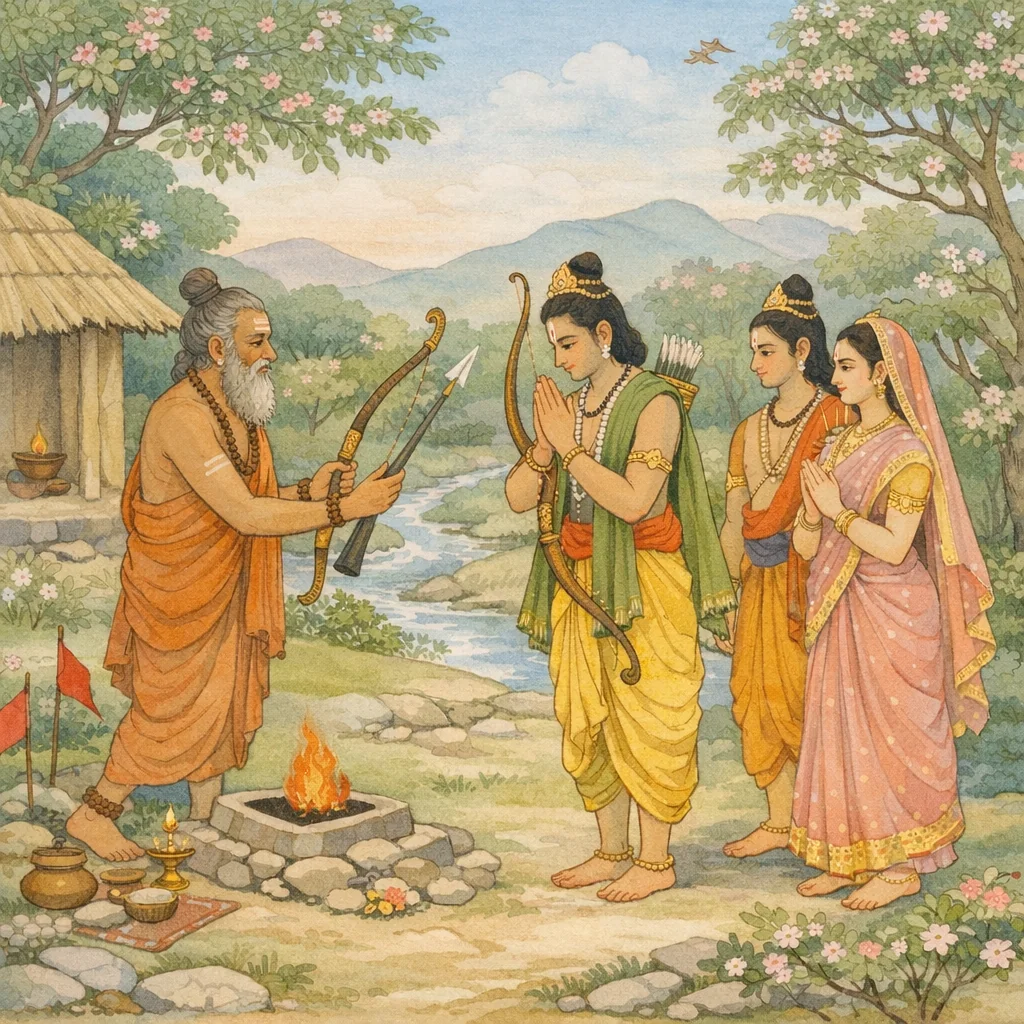
Lakṣmaṇa enters the precincts of Agastya’s āśrama and addresses the sage’s disciple, identifying himself and requesting an audience for Rāma, Sītā, and himself, forest-dwellers by their father’s command. The disciple reports within; Agastya, who has long awaited Rāma’s coming, orders that they be received at once with proper hospitality. Rāma is led inside and beholds the hermitage’s sacred landscape—altars and sites linked with many deities—revealing an integrated ritual cosmos within the ascetic settlement. Agastya emerges with his disciples; Rāma recognizes him as a treasury of tapas, prostrates in reverence, and he, Sītā, and Lakṣmaṇa stand with folded palms. Agastya offers seat and water, feeds them according to vānaprastha custom, and teaches atithi-dharma: offerings to the sacred fire and due honor to guests are obligatory, and neglect bears moral consequence. He then bestows divine weapons—a Vaiṣṇava bow fashioned by Viśvakarman, an unfailing arrow given by Brahmā, two quivers of inexhaustible arrows, and a sword with sheath granted by Indra—presenting arms as dharmically sanctioned instruments for protection in the forest.
Shlokas
Verse 1
सप्रविश्याऽश्रमपदं लक्ष्मणो राघवानुजः।अगस्त्यशिष्यमासाद्य वाक्यमेतदुवाच ह।।।।
Lakṣmaṇa, the younger brother of Rāma, entered the hermitage-ground and, meeting a disciple of Agastya, spoke these words.
Verse 2
राजा दशरथो नाम ज्येष्ठस्तस्य सुतो बली।रामः प्राप्तो मुनिं द्रष्टुं भार्यया सह सीतया।।।।
The valiant Rāma, eldest son of King Daśaratha, has arrived with his wife Sītā, seeking to behold the sage.
Verse 3
लक्ष्मणो नाम तस्याहं भ्राता त्ववरजो हितः।अनुकूलश्च भक्तश्च यदि ते श्रोत्रमागतः।।।।
I am his younger brother, named Lakṣmaṇa—his well-wisher, ever supportive and devoted—if indeed you have heard of me.
Verse 4
ते वयं वनमत्युग्रं प्रविष्टाः पितृशासनात्।द्रष्टुमिच्छामहे सर्वे भगवन्तं निवेद्यताम्।।।।
By our father’s command we have entered this most formidable forest; all of us wish to see the revered sage—please announce us to him.
Verse 5
तस्य तद् वचनं श्रुत्वा लक्ष्मणस्य तपोधनः।तथेत्युक्त्वाऽग्निशरणं प्रविवेश निवेदितुम्।।।।
Hearing Lakṣmaṇa’s words, the ascetic—rich in the treasure of austerity—replied, “So be it,” and entered the fire-sanctuary to deliver the message.
Verse 6
स प्रविश्य मुनिश्रेष्ठं तपसा दुष्प्रधर्षणम्।कृताञ्जलिरुवाचेदं रामागमनमञ्जसा।।।।यथोक्तं लक्ष्मणेनैव शिष्योऽगस्त्यस्य सम्मतः।
Entering promptly, Agastya’s favored disciple—hands folded in reverence—reported to the foremost sage, unassailable through the power of austerity, the arrival of Rāma, exactly as Lakṣmaṇa had said.
Verse 7
पुत्रौ दशरथस्येमौ रामो लक्ष्मण एव च।।।।प्रविष्टावाश्रमपदं सीतया सह भार्यया।
These two sons of Daśaratha—Rāma and Lakṣmaṇa—have entered the hermitage grounds, accompanied by Sītā, Rāma’s wife.
Verse 8
द्रष्टुं भवन्तमायातौ शुश्रूषार्थमरिन्दमौ।।।।यदत्रानन्तरं तत्त्वमाज्ञापयितुमर्हसि।
Those two subduers of enemies have come to behold your venerable presence and to serve you; be pleased to command what should rightly be done next in this matter.
Verse 9
ततश्शिष्यादुपश्रुत्य प्राप्तं रामं सलक्ष्मणम्।।।।वैदेहीं च महाभागामिदं वचनमब्रवीत्।
Then, having heard from the disciple that Rāma had arrived with Lakṣmaṇa, and that the greatly fortunate Vaidehī (Sītā) was also present, the sage spoke these words.
Verse 10
दिष्ट्या रामश्चिरस्याद्य द्रष्टुं मां समुपागतः।।।।मनसा काङ्क्षितं ह्यस्य मयाप्यागमनं प्रति।
By good fortune, Rāma has come today—after a long time—to see me. Indeed, I too had been longing in my heart for his coming.
Verse 11
गम्यतां सत्कृतो रामस्सभार्यस्सहलक्ष्मणः।।।।प्रवेश्यतां समीपं मे किं चासौ न प्रवेशितः।
Go at once; receive Rāma with due honor—along with his wife and with Lakṣmaṇa—and usher him into my presence. Why has he not been brought in until now?
Verse 12
एवमुक्तस्तु मुनिना धर्मज्ञेन महात्मना।। ।।अभिवाद्याब्रवीच्छिष्यस्तथेति नियताञ्जलिः।
Thus instructed by the great sage—knower of dharma—the disciple bowed in reverence and replied with folded hands, “So be it.”
Verse 13
ततो निष्क्रम्य सम्भ्रान्तश्शिष्यो लक्ष्मणमब्रवीत्।।।।क्वासौ रामो मुनिं द्रष्टुमेतु प्रविशतु स्वयम्।
Then the disciple hurried out and said to Lakṣmaṇa, “Where is Rāma? Let him come to see the sage—let him enter in person.”
Verse 14
ततो गत्वाऽऽश्रमपदं शिष्येण सह लक्ष्मणः।। ।।दर्शयामास काकुत्स्थं सीतां च जनकात्मजाम्।
Then Lakṣmaṇa, going with the disciple to the hermitage-grounds, pointed out Kakutstha Rāma and also Sītā, the daughter of Janaka.
Verse 15
तं शिष्यः प्रश्रितो वाक्यमगस्त्यवचनं ब्रुवन्।।।।प्रावेशयद्यथान्यायं सत्कारार्हं सुसत्कृतम्।
Speaking Agastya’s message with humility, the disciple ushered him in according to proper custom, honoring him well—him who was worthy of such hospitality.
Verse 16
प्रविवेश ततो रामस्सीतया सहलक्ष्मणः।।।।प्रशान्तहरिणाकीर्णमाश्रमं ह्यवलोकयन्।
Then Rāma entered the hermitage with Sītā and Lakṣmaṇa, gazing upon the āśrama filled with calm, undisturbed deer.
Verse 17
स तत्र ब्रह्मणः स्थानमग्नेः स्थानं तथैव च।।।।विष्णोः स्थानं महेन्द्रस्य स्थानं चैव विवस्वतः।सोमस्थानं भगस्थानं स्थानं कौबेरमेव च।।।।दातुर्विधातुः स्थानेच वायोः स्थानं तथैव च।नागराजस्य च स्थानमनन्तस्य महात्मनः।।।।स्थानं तथैव गायत्र्या वसूनां स्थानमेव च।स्थानं च पाशहस्तस्य वरुणस्य महात्मनः।।।।कार्तिकेयस्य च स्थानं धर्मस्थानं च पश्यति।
There he beheld the consecrated places—Brahmā’s, Agni’s, Viṣṇu’s, Mahendra’s, and Vivasvat’s; the places of Soma, Bhaga, and Kubera; of Dhātṛ and Vidhātṛ, and of Vāyu; the place of the serpent-king Ananta, the great-souled; the place of Gāyatrī and of the Vasus; the place of Varuṇa, the great noose-bearer; and also the places of Kārtikeya and of Dharma.
Verse 18
स तत्र ब्रह्मणः स्थानमग्नेः स्थानं तथैव च।।3.12.17।। विष्णोः स्थानं महेन्द्रस्य स्थानं चैव विवस्वतः। सोमस्थानं भगस्थानं स्थानं कौबेरमेव च।।3.12.18।। धातुर्विधातुः स्थानं च वायोः स्थानं तथैव च। नागराजस्य च स्थानमनन्तस्य महात्मनः।।3.12.19।। स्थानं तथैव गायत्र्या वसूनां स्थानमेव च। स्थानं च पाशहस्तस्य वरुणस्य महात्मनः।।3.12.20।। कार्तिकेयस्य च स्थानं धर्मस्थानं च पश्यति।
There he beheld the consecrated stations of Brahmā and Agni; of Viṣṇu, Mahendra, and the Sun; of Soma, Bhaga, and Kubera; of Dhātṛ and Vidhātṛ, and of Vāyu; of Ananta, the great serpent-king; of Gāyatrī and the Vasus; of the great Varuṇa, bearer of the noose; and also the stations of Kārtikeya and of Dharma.
Verse 19
स तत्र ब्रह्मणः स्थानमग्नेः स्थानं तथैव च।।3.12.17।। विष्णोः स्थानं महेन्द्रस्य स्थानं चैव विवस्वतः। सोमस्थानं भगस्थानं स्थानं कौबेरमेव च।।3.12.18।। दातुर्विधातुः स्थानेच वायोः स्थानं तथैव च। नागराजस्य च स्थानमनन्तस्य महात्मनः।।3.12.19।। स्थानं तथैव गायत्र्या वसूनां स्थानमेव च। स्थानं च पाशहस्तस्य वरुणस्य महात्मनः।।3.12.20।। कार्तिकेयस्य च स्थानं धर्मस्थानं च पश्यति।
In that hermitage he beheld the sacred stations of many deities—beginning with Brahmā and Agni and ending with the station of Dharma itself—revealing a place ordered by righteousness and made holy by consecration.
Verse 20
स तत्र ब्रह्मणः स्थानमग्नेः स्थानं तथैव च।।3.12.17।। विष्णोः स्थानं महेन्द्रस्य स्थानं चैव विवस्वतः। सोमस्थानं भगस्थानं स्थानं कौबेरमेव च।।3.12.18।। दातुर्विधातुः स्थानेच वायोः स्थानं तथैव च। नागराजस्य च स्थानमनन्तस्य महात्मनः।।3.12.19।। स्थानं तथैव गायत्र्या वसूनां स्थानमेव च। स्थानं च पाशहस्तस्य वरुणस्य महात्मनः।।3.12.20।। कार्तिकेयस्य च स्थानं धर्मस्थानं च पश्यति।
There Rāma also saw the sacred places dedicated to Gāyatrī and to the Vasus, and likewise the place of the great Varuṇa, bearer of the noose. He also saw the place of Kārttikeya and the very place set apart for Dharma.
Verse 21
ततश्शिष्यैः परिवृतो मुनिरप्यभिनिष्पतत्।।।।तं ददर्शाग्रतो रामो मुनीनां दीप्ततेजसाम्।
Then the sage came forth, surrounded by his disciples, and Rāma saw him approaching at the head of those ascetics whose splendor blazed with spiritual power.
Verse 22
अब्रवीद्वचनं वीरो लक्ष्मणं लक्ष्मिवर्धनम्। ।।एष लक्ष्मण निष्क्रामत्यगस्त्यो भगवानृषिः।औदार्येणावगच्छामि निधानं तपसामिमम्।। ।।
The heroic Rāma said to Lakṣmaṇa, increaser of good fortune: “Look, Lakṣmaṇa—venerable Ṛṣi Agastya is coming out. From his noble bearing I recognize him as a true treasury of austerity (tapas).”
Verse 23
अब्रवीद्वचनं वीरो लक्ष्मणं लक्ष्मिवर्धनम्। 3.12.22।। एष लक्ष्मण निष्क्रामत्यगस्त्यो भगवानृषिः। औदार्येणावगच्छामि निधानं तपसामिमम्।। 3.12.23।।
The heroic Rāma said to Lakṣmaṇa, increaser of fortune: “Look, Lakṣmaṇa—Agastya, the venerable sage, is coming forth. From his noble bearing I recognize him as a treasury of austerities (tapas).”
Verse 24
एवमुक्त्वा महाबाहुरगस्त्यं सूर्यवर्चसम्।जग्राह परमप्रीतस्तस्य पादौ परन्तपः।।।।
Having spoken thus, mighty-armed Rāma—scorcher of foes—rejoicing greatly, reverently clasped the feet of Agastya, who shone with the splendor of the sun.
Verse 25
अभिवाद्य तु धर्मात्मा तस्थौ रामः कृताञ्जलिः।सीतया सह वैदेह्या तदा रामः सलक्ष्मणः।।।।
After offering salutations, righteous-souled Rāma stood with hands folded in añjali—together with Sītā of Videha, and with Lakṣmaṇa.
Verse 26
प्रतिजग्राह काकुत्स्थमर्चयित्वासनोदकैः।कुशलप्रश्नमुक्त्वा च आस्यतामिति चाब्रवीत्।। ।।
Agastya welcomed Rāma of the Kakutsthas, honoring him with a seat and water; after asking about his welfare, he said, “Please, be seated.”
Verse 27
अग्निं हुत्वा प्रदायार्घ्यमतिथीन् प्रतिपूज्य च।वानप्रस्थ्येन धर्मेण स तेषां भोजनं ददौ।। ।।
After offering oblations into the sacred fire and presenting the arghya, he duly honored the guests according to the forest-hermit’s dharma, and then provided them with food.
Verse 28
प्रथमं चोपविश्याथ धर्मज्ञो मुनिपुङ्गवः।उवाच राममासीनं प्राञ्जलिं धर्मकोविदम्।।।।
Then the foremost sage, learned in Dharma, first took his seat and spoke to Rāma—who sat with folded hands, well-versed in the ways of Dharma.
Verse 29
अग्निं हुत्वा प्रदायार्घ्यमतिथिं प्रतिपूजयेत्।अन्यथा खलु काकुत्स्थ तपस्वी समुदाचरन्।।।।दुःसाक्षीव परे लोके स्वानि मांसानि भक्षयेत्।
“Only after offering oblations into the fire and presenting the arghya should one honor a guest. Otherwise, O Kakutstha, a host—though an ascetic—who acts differently will, in the next world, like a false witness, have to eat his own flesh.”
Verse 30
राजा सर्वस्य लोकस्य धर्मचारी महारथः।।।।पूजनीयश्च मान्यश्च भवान् प्राप्तः प्रियातिथिः।
You are the king of all the worlds, a follower of Dharma, a great chariot-warrior, worthy of worship and honor; you have come to me as a beloved guest.
Verse 31
एवमुक्त्वा फलैर्मूलैः पुष्पैरन्यैश्च राघवम्।। ।।पूजयित्वा यथाकामं पुनरेव ततोऽब्रवीत्।
Having spoken thus, he honored Rāghava with fruits, roots, flowers, and other offerings as desired; then afterward he addressed him again.
Verse 32
इदं दिव्यं महच्चापं हेमरत्नविभूषितम्।।।।वैष्णवं पुरुषव्याघ्र निर्मितं विश्वकर्मणा।अमोघस्सूर्यसङ्काशो ब्रह्मदत्तश्शरोत्तमः।।।।
O tiger among men, here is a great divine bow adorned with gold and gems—Viṣṇu’s own, fashioned by Viśvakarman. And here is an excellent arrow, unfailing and radiant like the sun, bestowed by Brahmā.
Verse 33
इदं दिव्यं महच्चापं हेमरत्नविभूषितम्।।3.12.32।। वैष्णवं पुरुषव्याघ्र निर्मितं विश्वकर्मणा। अमोघस्सूर्यसङ्काशो ब्रह्मदत्तश्शरोत्तमः।।3.12.33।।
O tiger among men, this great divine bow, adorned with gold and gems, belongs to Viṣṇu and was fashioned by Viśvakarman; and this superb arrow—unfailing, sun-bright—was granted by Brahmā.
Verse 34
दत्तौ मम महेन्द्रेण तूणी चाक्षयसायकौ।सम्पूर्णौ निशितैर्बाणैर्ज्वलद्भिरिव पावकैः।।।।महारजतकोशोऽयमसिर्हेमविभूषितः।
Mahendra (Indra) gave me these two quivers with inexhaustible arrows, filled with sharp shafts blazing like fire; and this sword adorned with gold, with its great silver scabbard.
Verse 35
अनेन धनुषा राम हत्वा संख्ये महासुरान्।।।।आजहार श्रियं दीप्तां पुरा विष्णुर्दिवौकसाम्।
With this bow, O Rāma, Viṣṇu once slew the great asuras in battle and restored shining prosperity to the gods.
Verse 36
तद्धनुस्तौ च तूणीरौ शरं खङ्गं च मानद।। ।।जयाय प्रतिगृह्णीष्व वज्रं वज्रधरो यथा।
O bestower of honor, accept this bow, the two quivers, the arrow, and the sword for victory—just as Indra, wielder of the thunderbolt, takes up his vajra.
Verse 37
एवमुक्त्वा महातेजाः समस्तं तद्वरायुधम्।दत्वा रामाय भगवानगस्त्यः पुनरब्रवीत्।।।।
Having spoken thus, the radiant lord Agastya bestowed upon Rāma all those excellent weapons, and then spoke again.
Frequently Asked Questions
The sarga centers on correct reception of guests: Agastya emphasizes that a host must first honor the sacred fire and then worship the guest with arghya and due rites; neglecting this order is framed as a serious moral breach with consequences beyond this life.
Dharma is enacted through disciplined procedure: reverence to tapas, humility before sages, and hospitality as a ritual duty. Power (weapons) becomes legitimate only when conferred within a dharmic framework aimed at protection rather than conquest.
Agastya’s āśrama is mapped as a sacral micro-geography containing multiple deity-sthānas/altars and an agniśaraṇa (fire-sanctuary), highlighting forest hermitages as cultural centers of ritual continuity and pan-deity worship.