Sarga 11
पञ्चाप्सरो-सरः कथनम् तथा अगस्त्याश्रममार्गनिर्देशः (Panchapsara Lake Account and Directions to Agastya)
अरण्यकाण्ड
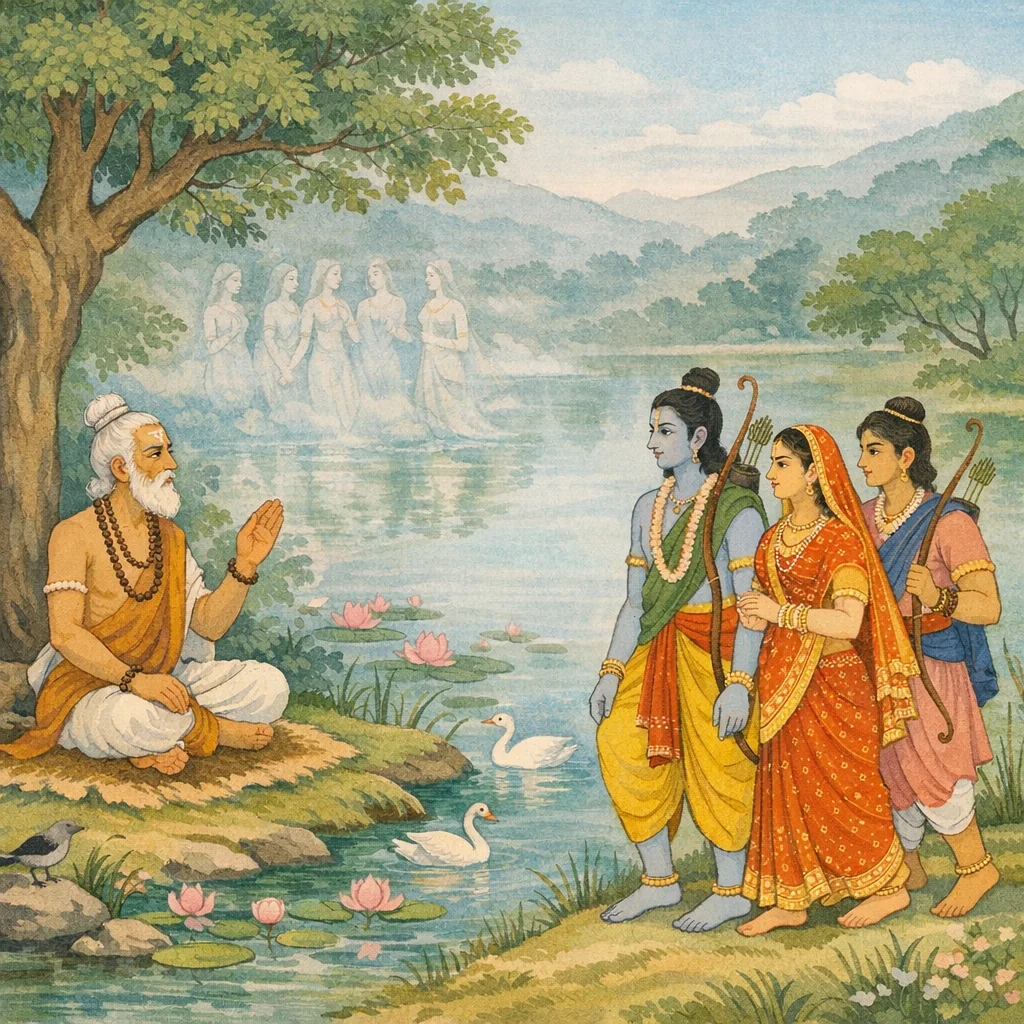
In Sarga 11, Rama leads the way, Sita stays protected in the middle, and Lakshmana follows with bow in hand, forming a disciplined procession. Reaching a clear lake filled with uncanny sounds, they question the sage Dharmabrata, who explains the origin of Panchāpsarā-taṭāka: it arose through Mandakarni’s tapas and later became linked with five apsarases sent by the gods to disturb his penance. The narrative then widens into an itinerary summary: Rama’s reverent stays at many hermitages, for varying lengths of time, are gathered as a favorable decade of forest-dwelling. Returning to Sutikshna’s ashram, Rama asks to visit Agastya; Sutikshna gives exact directions—distances in yojanas, the southern route, and an overnight halt by lotus-ponds—and urges immediate departure. Rama reaches the hermitage of Agastya’s brother (identified here, in translation tradition, as Sudarsana) and is received with proper observance: sandhya rites and hospitality of roots and fruits. Setting out at dawn toward Agastya, Rama tells Lakshmana the Ilvala–Vatapi episode and Agastya’s decisive protection of brahmins; at last they behold Agastya’s hermitage and its civilizing, pacifying influence over the southern quarter, including the Vindhya motif and the calming of hostile beings.
Shlokas
Verse 1
अग्रतः प्रययौ रामस्सीता मध्ये सुमध्यमा।पृष्ठतस्तु धनुष्पाणिर्लक्ष्मणोऽनुजगाम ह।।।।
Rāma went ahead; Sītā, slender-waisted, walked in the middle; and Lakṣmaṇa, bow in hand, followed behind.
Verse 2
तौ पश्यमानौ विविधान् शैलप्रस्थान्वनानि च।नदीश्च विविधा रम्या जग्मतुस्सीतया सह।।।।
Rāma and Lakṣmaṇa went on with Sītā, gazing upon varied mountain-slopes, forests, and many delightful rivers.
Verse 3
सारसांश्चक्रवाकांश्च नदीपुलिनचारिणः।सरांसि च सपद्मानि युक्तानि जलजैः खगैः।।।।
He beheld saras swans and cakravāka birds roaming along the river-banks, and lotus-filled lakes thronged with water-born birds.
Verse 4
यूथबद्धांश्च पृषतान्मदोन्मत्तान् विषाणिनः।महिषांश्च वराहांश्च नागांश्च द्रुमवैरिणः।।।।
(They beheld) deer moving in herds; horned beasts maddened by the rut; and also buffaloes, wild boars, and elephants—foes of trees, for they uproot them.
Verse 5
ते गत्वा दूरमध्वानं लम्बमाने दिवाकरे।ददृशुस्सहिता रम्यं तटाकं योजनायतम्।।।।पद्मपुष्करसम्बाधं गजयूथैरलङ्कृतम्।सारसैर्हंसकादम्बैस्सङ्कुलं जलचारिभिः।।।।
After traveling a long distance, as the sun was sinking, they together beheld a delightful tank stretching for a yojana—thick with lotuses—adorned by herds of elephants and crowded with cranes, swans, and other water-dwelling creatures.
Verse 6
ते गत्वा दूरमध्वानं लम्बमाने दिवाकरे।ददृशुस्सहिता रम्यं तटाकं योजनायतम्।।3.11.5।।पद्मपुष्करसम्बाधं गजयूथैरलङ्कृतम्।सारसैर्हंसकादम्बैस्सङ्कुलं जलचारिभिः।।3.11.6।।
They beheld a delightful lake crowded with lotuses and lilies, adorned by herds of elephants, and teeming with cranes, swans, and other aquatic creatures.
Verse 7
प्रसन्नसलिले रम्ये तस्मिन्सरसि शुश्रुवे।गीतवादित्रनिर्घोषो न तु कश्चन दृश्यते।।।।
At that lovely lake with clear water, they heard the sound of singing and musical instruments—yet no one at all was to be seen.
Verse 8
ततः कौतूहलाद्रामो लक्ष्मणश्च महाबलः।मुनिं धर्मभृतं नाम प्रष्टुं समुपचक्रमे।।।।
Thereafter, out of curiosity, Rama and mighty Lakshmana began to question the sage named Dharmabhṛt, the bearer of Dharma.
Verse 9
इदमत्यद्भुतं श्रुत्वा सर्वेषां नो महामुने।कौतूहलं महज्जातं किमिदं साधु कथ्यताम्।।।।वक्तव्यं यदि चेदविप्र नातिगुह्यमपि प्रभो।
O great sage, hearing this most wondrous matter, a great curiosity has arisen in all of us. What is it? Please explain it clearly. If it is not too secret, O venerable brāhmaṇa, do tell us, O lord.
Verse 10
तेनैवमुक्तो धर्मात्मा राघवेण मुनिस्तदा।।।।प्रभवं सरसः कृत्स्नमाख्यातुमुपचक्रमे।
Thus addressed by Rāghava, the righteous sage then began to recount in full the origin of that lake.
Verse 11
इदं पञ्चाप्सरो नाम तटाकं सार्वकालिकम्।।।।निर्मितं तपसा राम मुनिना माण्डकर्णिना।
“O Rāma, this lake—called Pañcāpsarā and ever filled—was created by the sage Māṇḍakarṇi through austerity (tapas).”
Verse 12
स हि तेपे तपस्तीव्रं माण्डकर्णिर्महामुनिः।।।।दशवर्षसहस्राणि वायुभक्षो जलाश्रयः।
For the great sage Māṇḍakarṇi undertook intense tapas for ten thousand years—subsisting on air and standing within the waters.
Verse 13
ततः प्रव्यथितास्सर्वे देवास्साग्निपुरोगमाः।।।।अब्रुवन् वचनं सर्वे परस्परसमागताः।
Thereafter all the gods, led by Agni and greatly disturbed, assembled together and spoke among themselves.
Verse 14
अस्माकं कस्यचित् स्थानमेष प्रार्थयते मुनिः।।।।इति संविग्नमनसस्सर्वे ते त्रिदिवौकसः।
Thinking, “This sage is asking for some place that belongs to us,” all the gods, dwellers of heaven, became inwardly agitated.
Verse 15
तत्र कर्तुं तपोविघ्नं देवैस्सर्वैर्नियोजिताः।।।।प्रधानाप्सरसः पञ्च विद्युच्चलितवर्चसः।
There, to obstruct the sage’s austerities, all the gods deputed five foremost apsarases, radiant like flickering lightning.
Verse 16
अप्सरोभिस्ततस्ताभिर्मुनिर्दृष्टपरावरः।।।।नीतो मदनवश्यत्वं सुराणां कार्यसिद्धये।
Then that sage—one who knew the higher and the lower—was drawn under the sway of desire by those apsarases, so that the gods’ purpose might succeed.
Verse 17
ताश्चैवाप्सरसः पञ्च मुनेः पत्नीत्वमागताः।।।।तटाके निर्मितं तासामस्मिन्नन्तर्हितं गृहम्।
Those five apsarases indeed attained the state of wives of the sage; and for them, within that lake, a dwelling had been built—hidden from sight.
Verse 18
तथैवाप्सरसः पञ्च निवसन्त्यो यथासुखम्।।।।रमयन्ति तपोयोगान्मुनिं यौवनमास्थितम्।
So too, those five apsarases dwelt there at ease, delighting the sage who, through the power of his austerities and yoga, retained his youthfulness.
Verse 19
तासां सङ्क्रीडमानानामेष वादित्रनिस्स्वनः।।।।श्रूयते भूषणोन्मिश्रो गीतशब्दो मनोहरः।
As they sported, the sound of instruments was heard—sweet song mingled with the tinkling of ornaments, delightful to the mind.
Verse 20
आश्चर्यमिति तस्यैतद्वचनं भावितात्मनः।।।।राघवः प्रतिजग्राह सह भ्रात्रा महायशाः।
Glorious Rāghava, together with his brother, received the words of that self-mastered sage and replied, “This is wondrous!”
Verse 21
एवं कथयमानस्य ददर्शाश्रममण्डलम्।।।।कुशचीरपरिक्षिप्तं ब्राह्म्या लक्ष्म्या समावृतम्।
As he spoke thus, Rāma beheld the precincts of the hermitage, strewn with kuśa grass and bark-garments, pervaded by a serene brahminical radiance.
Verse 22
प्रविश्य सह वैदेह्या लक्ष्मणेन च राघवः।।।।उवास मुनिभिस्सर्वैः पूज्यमानो महायशाः।
The illustrious Rāghava entered with Vaidehī and Lakṣmaṇa, and stayed there, being honored by all the sages.
Verse 23
तदा तस्मिन्सकाकुत्थ्सः श्रीमत्याश्रममण्डले।।।।उषित्वा तु सुखं तत्र पूज्यमानो महर्षिभिः।जगाम चाश्रमांस्तेषां पर्यायेण तपस्विनाम्।।।।येषामुषितवान् पूर्वं सकाशे स महास्त्रवित्।
Then, in that splendid hermitage-settlement, Rāma of the Kakutstha line, wielder of mighty weapons, having dwelt there in comfort and been honored by the great seers, went in due order to the hermitages of those ascetics with whom he had earlier stayed.
Verse 24
तदा तस्मिन्सकाकुत्थ्सः श्रीमत्याश्रममण्डले।।3.11.23।।उषित्वा तु सुखं तत्र पूज्यमानो महर्षिभिः।जगाम चाश्रमांस्तेषां पर्यायेण तपस्विनाम्।।3.11.24।।येषामुषितवान् पूर्वं सकाशे स महास्त्रवित्।
This line repeats the same continuous verse-unit as 3.11.23: Rama, honored by great sages, moved in sequence among the ascetics’ hermitages where he had earlier stayed.
Verse 25
क्वचित्परिदशान्मासानेकं संवत्सरं क्वचित्।।।।क्वचिच्छ चतुरो मासान् पञ्च षट्चापरान्क्वचित्।अपरत्राधिकं मासादप्यर्धमधिकं क्वचित्।।।।त्रीन्मासानष्टमासांश्च राघवो न्यवसत्सुखम्।
In some places Rāma stayed about ten months; in others, a full year. Somewhere he stayed four months, elsewhere five or six; in another place more than a month, and in another even more by half a month—thus also for three months or for eight months—Rāghava dwelt at ease.
Verse 26
क्वचित्परिदशान्मासानेकं संवत्सरं क्वचित्।।3.11.25।।क्वचिच्छ चतुरो मासान् पञ्च षट्चापरान्क्वचित्।अपरत्राधिकं मासादप्यर्धमधिकं क्वचित्।।3.11.26।।त्रीन्मासानष्टमासांश्च राघवो न्यवसत्सुखम्।
At times he stayed ten months, at times a full year; sometimes four months, sometimes five or six; elsewhere more than a month, and at times even more than an added half-month. Thus Rāghava dwelt at ease for three months and also for eight, calmly observing the discipline of exile.
Verse 27
तथा संवसतस्तस्य मुनीनामाश्रमेषु वै।।।।रमतश्चानुकूल्येन ययुस्संवत्सरा दश।
As he thus dwelt in the sages’ hermitages, delighting in that life in harmony, ten years passed for him in a favourable course.
Verse 28
परिवृत्य च धर्मज्ञो राघवस्सह सीतया।।।।सुतीक्ष्णस्याश्रमं श्रीमान्पुनरेवाजगाम ह।
Having made the round, Rāma—knower of dharma—together with Sītā, came once again to the splendid hermitage of Sutīkṣṇa.
Verse 29
स तमाश्रममासाद्य मुनिभिः प्रतिपूजितः।।।।तत्रापि न्यवसद्रामः कञ्चित्कालमरिन्दमः।
Reaching that hermitage, Rāma—the subduer of foes—was duly honoured by the sages, and there too he stayed for some time.
Verse 30
तदाश्रमस्थो विनयात्कदाचित्तं महामुनिम्।।।।उपासीनस्सकाकुत्स्थस्सुतीक्ष्णमिदमब्रवीत्।
Once, while dwelling in the hermitage, the prince of Kakutstha sat near the great sage Sutikshna; and, in humility, he spoke these words.
Verse 31
अस्मिन्नरण्ये भगवानगस्त्यो मुनिसत्तमः।।।।वसतीति मया नित्यं कथाः कथयतां श्रुतम्।
In this forest, they say, dwells the blessed Agastya, best among sages; I have continually heard this from those who recount these sacred accounts.
Verse 32
न तु जानामि तं देशं वनस्यास्य महत्तया।।।।कुत्राश्रमपदं रम्यं महर्षेस्तस्य धीमतः।
But I cannot discern that place—so vast is this forest—where the lovely hermitage-site of that wise great seer lies.
Verse 33
प्रसादात्तत्र भवतस्सानुजस्सह सीतया।।।।अगस्त्यमभिगच्छेयमभिवादयितुं मुनिम्।
By your favor, I wish to go there with my brother and with Sītā, to approach Agastya and offer respectful salutations to the sage.
Verse 34
मनोरथो महानेष हृदि मे परिवर्तते।।।।यद्यहं तं मुनिवरं शुश्रूषेयमपि स्वयम्।
A great longing keeps turning in my heart—that I might personally attend upon and serve that best of sages.
Verse 35
इति रामस्य स मुनिश्श्रुत्वा धर्मात्मनो वचः।।।।सुतीक्ष्णः प्रत्युवाचेदं प्रीतो दशरथात्मजम्।
Hearing these words of righteous-souled Rāma, the sage Sutīkṣṇa, gladdened at heart, replied thus to Daśaratha’s son.
Verse 36
अहमप्येतदेव त्वां वक्तुकामस्सलक्ष्मणम्।।।।अगस्त्यमभिगच्छेति सीतया सह राघव।
I too wished to tell you this very thing, O Rāghava: go to Agastya, together with Sītā and Lakṣmaṇa.
Verse 37
दिष्ट्या त्विदानीमर्थेऽस्मिन् स्वयमेव ब्रवीषि माम्।।।।अहमाख्यामि ते वत्स यत्रागस्त्यो महामुनिः।
Happily, you yourself have spoken to me of this matter now, dear child; I will tell you where the great sage Agastya dwells.
Verse 38
योजनान्याश्रमात्तात याहि चत्वारि वै ततः।।।।दक्षिणेन महान् श्रीमानगस्त्यभ्रातुराश्रमः।
Dear child, go four yojanas from this hermitage; beyond that, to the south, lies the great and splendid hermitage of Agastya’s brother.
Verse 39
स्थलप्राये वनोद्देशे पिप्पलीवनशोभिते।।।।बहुपुष्पफले रम्ये नानाशकुनिनादिते।
In that tract of forest—mostly level ground—adorned with groves of pippalī trees, lovely with many flowers and fruits, it resounded with the calls of varied birds.
Verse 40
पद्मिन्यो विविधास्तत्र प्रसन्नसलिलाश्शिवाः।।।।हंसकारण्डवाकीर्णाश्चक्रवाकोपशोभिताः।तत्रैकां रजनीं व्युष्य प्रभाते राम गम्यताम्।।।।
There are many lotus-ponds there, with clear and auspicious waters, filled with swans and ducks and beautified by cakravāka birds. Spend one night there, O Rāma, and then depart at dawn.
Verse 41
पद्मिन्यो विविधास्तत्र प्रसन्नसलिलाश्शिवाः।।3.11.40।।हंसकारण्डवाकीर्णाश्चक्रवाकोपशोभिताः।तत्रैकां रजनीं व्युष्य प्रभाते राम गम्यताम्।।3.11.41।।
O Rāma, there are many lotus-filled lakes there, with clear and auspicious waters, thronged with swans and ducks and beautified by cakravāka birds. Spend a single night there, and then proceed at dawn.
Verse 42
दक्षिणां दिशमास्थाय वनषण्डस्य पार्श्वतः।तत्रागस्त्याश्रमपदं गत्वा योजनमन्तरा।।।।
Set out toward the south, along the side of a dense grove; going on for another yojana, you will reach the site of the sage Agastya’s hermitage (āśrama).
Verse 43
रमणीये वनोद्धेशे बहुपादपसंवृते।रंस्यते तत्र वैदेही लक्ष्मणश्च सह त्वया।।।।स हि रम्यो वनोद्देशो बहुपादपसङ्कुलः।
In that enchanting stretch of forest, thick with many trees, Vaidehī will delight there in your company—and so will Lakṣmaṇa. For that forest-tract is truly lovely, crowded with trees.
Verse 44
यदि बुद्धिः कृता द्रष्टुमगस्त्यं तं महामुनिम्।।।।अद्यैव गमने बुद्धिं रोचयस्व महायशः।
O illustrious one, if you have resolved to behold the great sage Agastya, then decide to set out this very day.
Verse 45
इति रामो मुनेश्श्रुत्वा सह भ्रात्राभिवाद्य च।।।।प्रतस्थेऽमुद्दिश्य सानुजस्सीतया सह।
Having heard the sage’s words, Rāma—after respectfully saluting him along with his brother—set out in that direction, together with Sītā.
Verse 46
पश्यन्वनानि रम्याणि पर्वतांश्चाभ्रसन्निभान्।।।।सरांसि सरितश्चैव पथि मार्गवशानुगाः।सुतीक्ष्णेनोपदिष्टेन गत्वा तेन पथा सुखम्।।।।इदं परमसंहृष्टो वाक्यं लक्ष्मणमब्रवीत्।
Going along the path shown by Sūtīkṣṇa, Rāma joyfully beheld delightful forests, mountains like clouds, and the lakes and rivers that lay along their route. Greatly pleased, he spoke these words to Lakṣmaṇa.
Verse 47
पश्यन्वनानि रम्याणि पर्वतांश्चाभ्रसन्निभान्।।3.11.46।।सरांसि सरितश्चैव पथि मार्गवशानुगाः।सुतीक्ष्णेनोपदिष्टेन गत्वा तेन पथा सुखम्।।3.11.47।।इदं परमसंहृष्टो वाक्यं लक्ष्मणमब्रवीत्।
Following Sūtīkṣṇa’s directions, Rāma went on joyfully, beholding lovely forests, cloud-like mountains, and the lakes and rivers along the way; then, greatly delighted, he spoke to Lakṣmaṇa.
Verse 48
एतदेवाश्रमपदं नूनं तस्य महात्मनः।।।।अगस्त्यस्य मुनेर्भ्रातुर्दृश्यते पुण्यकर्मणः।
Surely, this is the hermitage-site of that great-souled man—the brother of sage Agastya—renowned for holy deeds, which now comes into view.
Verse 49
यथा हि मे वनस्यास्य ज्ञाताः पथि सहस्रशः।।।।सन्नताः फलभारेण पुष्पभारेण च द्रुमाः।
Just as I was told along the way, this forest holds trees by the thousand, bending low beneath the weight of fruits and of blossoms as well.
Verse 50
पिप्पलीनां च पक्वानां वनादस्मादुपागतः।।।।गन्धोऽयं पवनोक्षिप्तस्सहसा कटुकोदयः।
This sudden, pungent and astringent fragrance—borne swiftly upon the wind—has come from this forest, from the ripe pippalī figs.
Verse 51
तत्र तत्र च दृश्यन्ते सङ्क्षिप्ताः काष्ठसञ्चयाः।।।।लूनाश्च पथि दृश्यन्ते दर्भा वैडूर्यवर्चसः।
Here and there, heaps of gathered firewood are visible; and along the path lie cut darbha grasses, gleaming like vaidūrya gems.
Verse 52
एतच्च वनमध्यस्थं कृष्णाभ्रशिखरोपमम्।।।।पावकस्याश्रमस्थस्य धूमाग्रं सम्प्रदृश्यते।
And there—standing amid the forest—one can clearly see the crest of smoke rising from the hermitage fire, like the peak of a dark cloud.
Verse 53
विविक्तेषु च तीर्थेषु कृतस्नाना द्विजातयः।।।।पुष्पोपहारं कुर्वन्ति कुसुमैस्स्वयमर्जितै।
In secluded tīrthas, the twice-born, having completed their sacred bath, offer flower-oblations with blossoms they themselves have gathered.
Verse 54
तत्सुतीक्ष्णस्य वचनं यथा सौम्य मया श्रुतम्।।।।अगस्त्यस्याश्रमो भ्रातुर्नूनमेष भविष्यति।
Just as I heard from Sutīkṣṇa, O gentle one, this surely must be the hermitage (āśrama) of Agastya’s brother.
Verse 55
निगृह्य तपसा मृत्युं लोकानां हितकाम्यया।।3.11.55।।यस्य भ्रात्रा कृतेयं दिक्छरण्या पुण्यकर्मणा।
By tapas he restrained Death itself, seeking the welfare of the worlds; by that brother, whose deeds are holy, this region has been made a refuge.
Verse 56
धारयन् ब्राह्मणं रूपमिल्वलस्संस्कृतं वदन्।।।।आमन्त्रयति विप्रान्स्मश्राद्धमुद्दिश्य निर्घृणः।
Ilvala—cruel at heart—would assume a brahmin’s form, speak refined Sanskrit, and invite the vipras on the pretext of performing a śrāddha rite.
Verse 57
भ्रातरं संस्कृतं कृत्वा ततस्तं मेषरूपिणम्।।।।तान् द्विजान्भोजयामास श्राद्धदृष्टेन कर्मणा।
Then, after ‘consecrating’ his brother who had taken a ram’s form, he fed those twice-born according to the rites prescribed for śrāddha.
Verse 58
भ्रातरं संस्कृतं कृत्वा ततस्तं मेषरूपिणम्।।3.11.57।।तान् द्विजान्भोजयामास श्राद्धदृष्टेन कर्मणा।
Then, having prepared his brother who had taken the form of a ram, he fed those Brahmins in accordance with the rites of the Śrāddha ceremony.
Verse 59
ततो भुक्तवतां तेषां विप्राणामिल्वलोऽब्रवीत्।।।।वातापे निष्क्रमन्वेति स्वरेण महता वदन्।
Then, once those Brahmins had finished their meal, Ilvala cried out in a loud voice: "O Vātāpi, come forth!"
Verse 60
ततो भ्रातुर्वचश्श्रुत्वा वातापिर्मेषवन्नदन्।।।।भित्त्वा भित्त्वा शरीराणि ब्राह्मणानां विनिष्पतत्।
Then, hearing his brother's call, Vātāpi would bleat like a ram and burst forth, ripping open the bodies of the Brahmins.
Verse 61
ब्राह्माणानां सहस्राणि तैरेवं कामरूपिभिः।।।।विनाशितानि संहत्य नित्यशः पिशिताशनैः।
Thus, thousands of Brahmins were destroyed day after day by those flesh-eating demons who could assume any form at will.
Verse 62
अगस्त्येन तदा देवैः प्रार्थितेन महर्षिणा।।।।अनुभूय किल श्राद्धे भक्षितस्समहासुरः।
Then the great sage Agastya, entreated by the gods, came to the śrāddha; and when the same stratagem was tried, that mighty asura was indeed eaten.
Verse 63
ततस्सम्पन्नमित्युक्त्वा दत्त्वा हस्तोदकं ततः।।।।भ्रातरं निष्क्रमस्वेति चेल्वलस्सोऽभ्यभाषत।
Then, saying, “It is complete,” and giving the hand-water, Ilvala called out to his brother: “Come out!”
Verse 64
स तं तथा भाषमाणं भ्रातरं विप्रघातिनम्।।।।अब्रवीत्प्रहसन्धीमानगस्त्यो मुनिसत्तमः।
As Ilvala spoke in that way—the slayer of brahmins—Agastya, wise and foremost among sages, laughed and replied.
Verse 65
कुतो निष्क्रमितुं शक्तिर्मया जीर्णस्य रक्षसः।।।।भ्रातुस्ते मेषरूपस्य गतस्य यमसादनम्।
How could your brother—the rākṣasa in the form of a ram—come out, when I have already digested him? He has gone to Yama’s abode.
Verse 66
अथ तस्य वचश्श्रुत्वा भ्रातुर्निधनसंश्रयम्।।।।प्रधर्षयितुमारेभे मुनिं क्रोधान्निशाचरः।
Then, hearing those words that confirmed his brother’s death, the night-ranger, enraged, began to assault the sage.
Verse 67
सोऽभिद्रवन्मुनिश्रेष्ठं मुनिना दीप्ततेजसा।।।।चक्षुषानलकल्पेन निर्दग्धो निधनं गतः।
Rushing upon the foremost of sages, he was consumed by that ascetic of blazing power—by a fire-like glance—and thus met his end.
Verse 68
तस्यायमाश्रमो भ्रातुस्तटाकवनशोभितः।।।।विप्रानुकम्पया येन कर्मेदं दुष्करं कृतम्।
This is his brother’s hermitage, adorned with lakes and forests—belonging to one who, out of compassion for brahmins, accomplished this difficult deed.
Verse 69
एवं कथयमानस्य तस्य सौमित्रिणा सह।रामस्यास्तं गतस्सूर्यस्सन्ध्याकालोऽभ्यवर्ततः।।।।
As Rama continued speaking thus with Saumitri (Lakṣmaṇa), the sun set, and the hour of evening twilight came upon them.
Verse 70
उपास्य पश्चिमां सन्ध्यां सह भ्रात्रा यथाविधि।प्रविवेशाऽश्रमपदं तमृषिं सोऽभ्यवादयत्।।।।
Having duly performed the western twilight worship with his brother, Rama entered the hermitage and respectfully greeted the sage.
Verse 71
सम्यक् प्रतिगृहीतश्च मुनिना तेन राघवः।न्यवसत्तां निशामेकां प्राश्य मूलफलानि च।।।।
Properly welcomed by that venerable sage, Rāghava ate roots and fruits and spent a night there.
Verse 72
तस्यां रात्य्रां व्यतीतायां विमले सूर्यमण्डले।भ्रातरं तमगस्त्यस्य ह्यामन्त्रयत राघवः।।।।
When that night had passed and the sun’s orb shone clear, Rāghava took leave of Agastya’s brother.
Verse 73
अभिवादये त्वां भगवन् सुखमध्युषितो निशाम्।आमन्त्रये त्वां गच्छामि गुरुं ते द्रष्टुमग्रजम्।।।।
O venerable one, I bow to you; the night has been comfortably spent. I now take your leave, for I wish to go and see your revered elder brother.
Verse 74
गम्यतामिति तेनोक्तो जगाम रघुनन्दनः।यथोद्दिष्टेन मार्गेण वनं तच्चावलोकयन्।।।।
Told by him, “You may go,” Raghunandana set out along the indicated path, observing that forest as he went.
Verse 75
नीवारान्पनसांस्तालांस्तिमिशान्वञ्चुलान्धवान्।चिरिबिल्वान्मधूकांश्च बिल्वानपि च तिन्दुकान्।।।।
They passed by wild rice, jackfruit trees, palmyras, timiśa trees, vañcula trees, dhava trees, long-standing bilva trees, madhūka trees, and also bilva and tinduka trees.
Verse 76
पुष्पितान्पुष्पिताग्राभिर्लताभिरनुवेष्टितान्।ददर्श रामश्शतशस्तत्र कान्तारपादपान्।।।।हस्तिहस्तैर्विमृदितान्वानरैरुपशोभितान्।मत्तैश्शकुनिसङ्घैश्च शतशश्च प्रणादितान्।।।।
There Rama beheld hundreds of forest trees, entwined with creepers and crowned with blossoms; some were crushed beneath elephants’ trunks, some made splendid by monkeys, and many resounded with the cries of flocks of birds intoxicated with joy.
Verse 77
पुष्पितान्पुष्पिताग्राभिर्लताभिरनुवेष्टितान्।ददर्श रामश्शतशस्तत्र कान्तारपादपान्।।3.11.76।।हस्तिहस्तैर्विमृदितान्वानरैरुपशोभितान्।मत्तैश्शकुनिसङ्घैश्च शतशश्च प्रणादितान्।।3.11.77।।
In that wild forest Rama beheld hundreds of trees—blossom-topped and entwined with creepers—some pressed down by elephants’ trunks, some made splendid by monkeys, and many ringing with the cries of flocks of exhilarated birds.
Verse 78
ततोऽब्रवीत्समीपस्थं रामो राजीवलोचनः।पृष्ठतोऽनुगतं वीरं लक्ष्मणं लक्ष्मिवर्धनम्।।।।
Then lotus-eyed Rama spoke to the valiant Lakshmana, who stood close by and followed just behind him—whose very presence heightened dignity and grace.
Verse 79
स्निग्धपत्रा यथा वृक्षा यथा क्षान्ता मृगद्विजाः।आश्रमो नातिदूरस्थो महर्षेर्भावितात्मनः।।।।
The trees bear glossy leaves, and the beasts and birds are calm; therefore the hermitage of that great seer, disciplined in spirit, cannot be far from here.
Verse 80
अगस्त्य इति विख्यातो लोके स्वेनैव कर्मणा।आश्रमो दृश्यते तस्य परिश्रान्तश्रमापहः।।।।
He is renowned in the world as Agastya by his own deeds; now his hermitage comes into view—a refuge that dispels the weariness of the weary.
Verse 81
प्राज्यधूमाकुलवनश्चीरमालापरिष्कृतः।प्रशान्तमृगयूथश्च नानाशकुनिनादितः।।।।
The forest is filled with abundant sacrificial smoke; it is adorned with rows of bark garments, with herds of tranquil animals, and it resounds with the calls of many kinds of birds.
Verse 82
तस्येदमाश्रमपदं प्रभावाद्यस्य राक्षसैः।दिगियं दक्षिणा त्रासाद्दृश्यते नोपभुज्यते।।।।
This is the site of his hermitage; because of his spiritual power, the demons look toward this southern quarter in fear, yet they cannot prey upon it.
Verse 83
यदा प्रभृति चाक्रान्ता दिगियं पुण्यकर्मणा।तदा प्रभृति निर्वैराः प्रशान्ता रजनीचराः।।।।
From the time this quarter was occupied by that man of holy deeds, from that time onward the night-roamers became pacified, laying aside their hostility.
Verse 84
नाम्ना चेयं भगवतो दक्षिणा दिक्प्रदक्षिणा।प्रथिता त्रिषु लोकेषु दुर्धर्षा क्रूरकर्मभिः।।।।
This southern quarter, made auspicious by the Blessed Sage, became renowned in the three worlds and proved unassailable to those of cruel deeds.
Verse 85
मार्गं निरोद्धुं निरतो भास्करस्याचलोत्तमः।निदेशं पालयन्यस्य विन्ध्यशैला न वर्धते।।।।अयं दीर्घायुषस्तस्य लोके विश्रुतकर्मणः।अगस्त्यस्याश्रम श्रीमान्विनीतजनसेवितः।।।।
Ever intent on obstructing the Sun’s course, the mighty Vindhya mountain ceased to grow further, in obedience to his command.
Verse 86
मार्गं निरोद्धुं निरतो भास्करस्याचलोत्तमः।निदेशं पालयन्यस्य विन्ध्यशैला न वर्धते।।3.11.85।।अयं दीर्घायुषस्तस्य लोके विश्रुतकर्मणः।अगस्त्यस्याश्रम श्रीमान्विनीतजनसेवितः।।3.11.86।।
This is the splendid hermitage of Agastya—long-lived and renowned in the world for his deeds—attended by humble, disciplined people.
Verse 87
एष लोकार्चितस्साधुर्हिते नित्यरतस्सताम्।अस्मानभिगतानेष श्रेयसा योजयिष्यति।।।।
This sage, honoured by the whole world and ever devoted to the welfare of the virtuous, will surely guide us—who have come to him—toward what is truly beneficial.
Verse 88
आराधयिष्याम्यत्राहमगस्त्यं तं महामुनिम्।शेषं च वनवासस्य सौम्य वत्स्याम्यहं प्रभो।।।।
Here I shall honour and serve that great sage Agastya; and, O gentle one, my lord, I will spend the remaining time of our forest-exile here in this very spirit of devotion.
Verse 89
अत्र देवास्सगन्धर्वास्सिद्धाश्च परमर्षयः।अगस्त्यं नियताहारं सततं पर्युपासते।।।।
Here the gods with the Gandharvas, the Siddhas, and the highest sages continually attend upon Agastya, who is disciplined in his food and conduct.
Verse 90
नात्र जीवेन्मृषावादी क्रूरो वा यदि वा शठः।नृशंसः कामवृत्तो वा मुनिरेष तथाविधः।।।।
Here no liar can live—nor one who is cruel, deceitful, wicked, or driven by lust—for such is the power and purity of this sage.
Verse 91
अत्र देवाश्च यक्षाश्च नागाश्च पतगैस्सह।वसन्ति नियताहारा धर्ममाराधयिष्णवः।।।।
Here gods, Yakṣas, Nāgas, and even birds dwell together—disciplined in their food—devoted to the practice and honouring of Dharma.
Verse 92
अत्र सिद्धा महात्मानो विमानैजस्सूर्यसन्निभैः।त्यक्तदेहा नवैर्देहैः स्वर्याताः परमर्षयः।।।।
Here perfected beings and great-souled supreme sages, casting off their bodies, have gone to heaven in sun-bright aerial chariots—taking on renewed bodies.
Verse 93
यक्षत्वममरत्वं च राज्यानि विविधानि च।अत्र देवाः प्रयच्छन्ति भूतैराराधिताश्शुभैः।।।।
Here the gods—pleased by the worship of benevolent beings—grant the state of Yakṣa-hood, even immortality among the gods, and various kinds of sovereignty and kingdoms.
Frequently Asked Questions
The key action is disciplined forest-conduct anchored in inquiry and reverence: Rama responds to a wondrous but unseen sound by respectfully questioning a sage, then follows prescribed guidance to approach Agastya—showing that correct action in uncertain spaces proceeds through humility, ritual propriety, and reliance on realized teachers.
Tapas is portrayed as a force that shapes both nature and society: it can create enduring sacred spaces (Panchapsara), preserve moral order (Agastya’s protection of brahmins), and establish zones where harmful conduct cannot thrive—implying that inner discipline has outward, civilizational consequences.
Panchapsara Lake as an etiological landmark; the hermitage network culminating in Sutikshna’s āśrama; the southern route measured in yojanas; lotus-ponds as an overnight waypoint; Agastya’s hermitage as a dharmic frontier marker in the south; and the Vindhya motif indicating Agastya’s wider cosmological authority.