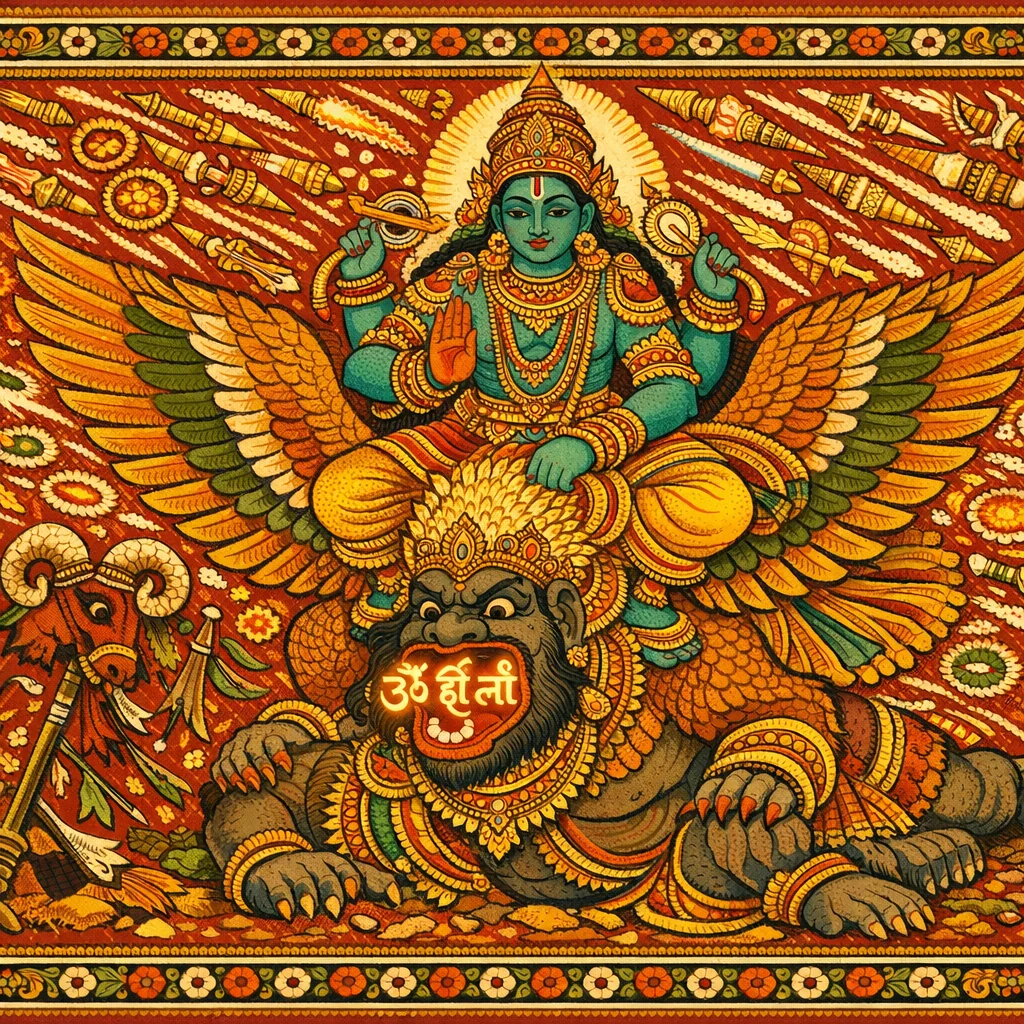
Adhyaya 152: Vishnu’s Battle with Mathana, Mahisha, and Shumbha; Garuḍa’s Withdrawal
दानवदैत्ययुद्धे विष्णुगरुडविजयः
Speaker: Sūta (narrator), Implied Śaunaka and Ṛṣis (listeners in the Purāṇic frame), Keśava/Viṣṇu (direct speech to Garuḍa, Mahīṣa, Śumbha)
Continuing the war narrative, after Grasana’s death the Dānavas unleash a barrage of weapons, but Śrī Viṣṇu counters them with superior astras. Viṣṇu instructs Garuḍa to press toward Mathana’s chariot, then permits him to withdraw briefly from fatigue. Viṣṇu duels Mathana and crushes him with the gadā. Mahīṣa attacks, wounds Garuḍa, and tries to swallow both; Viṣṇu fills and seals Mahīṣa’s mouth with divinely empowered missiles, felling him yet sparing him because Brahmā has declared him immune to weapons. Śumbha intensifies the fight; Viṣṇu destroys his ram-banner, wounds him, and warns that a maiden will kill him. Nimi and Śumbha strike Viṣṇu and Garuḍa down for a moment; they revive and retreat swiftly, leaving the conflict open for what follows.
Key Concepts
Shlokas in Adhyaya 152
Verse 1
तस्मिन्विनिहते दैत्ये ग्रसने लोकनायके निर्मर्यादमयुध्यन्त हरिणा सह दानवाः //
When that Daitya—Grasana, the leader of the worlds—had been slain, the Dānavas then fought on with Hari, casting all restraint aside.
Verse 2
पट्टिशैर्मुशलैः पाशैर् गदाभिः कुणपैरपि तीक्ष्णाननैश्च नाराचैश् चक्रैः शक्तिभिरेव च //
They struck with battle-axes, clubs, nooses, and maces; also with barbed missiles; with sharp-pointed arrows, discus-weapons, and spears as well.
Verse 3
तानस्त्रान्दानवैर्मुक्तांश् चित्रयोधी जनार्दनः एकैकं शतशश्चक्रे बाणैरग्निशिखोपमैः //
Those missiles released by the Dānavas, Janārdana—the wondrous master of battle—countered by turning each one into hundreds, striking them with arrows blazing like tongues of fire.
Verse 4
ततः क्षीणायुधप्राणा दानवा भ्रान्तचेतसः अस्त्राण्यादातुमभवन्न् असमर्था यदा रणे //
Then the Dānavas—spent of their weapons and strength, and bewildered in mind—became unable, in the midst of battle, to take up their missiles, being powerless on the battlefield.
Verse 5
तदा मृतैर्गजैरश्वैर् जनार्दनमयोधयन् समन्तात्कोटिशो दैत्याः सर्वतः प्रत्ययोधयन् //
Then the Daityas, in their millions, attacked Janārdana from every side, assailing Him all around with elephants and horses—even with those that were already dead.
Verse 6
बहु कृत्वा वपुर्विष्णुः किंचिच्छान्तभुजो ऽभवत् उवाच च गरुत्मन्तं तस्मिन्सुतुमुले रणे //
After assuming many forms, Viṣṇu became somewhat calm and composed; and in that exceedingly tumultuous battle, He spoke to Garuḍa.
Verse 7
गरुत्मन्कच्चिदश्रान्तस् त्वमस्मिन्नपि साम्प्रतम् यद्यश्रान्तो ऽसि तद्याहि मथनस्य रथं प्रति //
O Garutmān (Garuḍa), are you still unwearied even now? If you are indeed not fatigued, then go at once toward Mathana’s chariot.
Verse 8
श्रान्तो ऽस्यथ मुहूर्तं त्वं रणादपसृतो भव इत्युक्तो गरुडस्तेन विष्णुना प्रभविष्णुना //
Then mighty Viṣṇu said to Garuḍa: “You are weary—withdraw from the battlefield for a moment.” Thus was Garuḍa addressed by Viṣṇu, the supremely powerful Lord.
Verse 9
आससाद रणे दैत्यं मथनं घोरदर्शनम् दैत्यस्त्वभिमुखं दृष्ट्वा शङ्खचक्रगदाधरम् //
On the battlefield he confronted the Daitya named Mathana, fearsome to behold. And the Daitya, seeing him advancing face to face—bearing the conch, discus, and mace—stood ready to engage.
Verse 10
जघान भिन्दिपालेन शितबाणेन वक्षसि तत्प्रहारमचिन्त्यैव विष्णुस्तस्मिन्महाहवे //
He struck him on the chest with a bhindipāla and with a keen, sharp arrow; yet in that great battle, Viṣṇu—the inconceivable—regarded that blow as nothing.
Verse 11
जघान पञ्चभिर्बाणैर् मार्जितैश्च शिलाशितैः पुनर्दशभिर् आकृष्टैस् तं तताड स्तनान्तरे //
He struck him with five arrows—polished and stone-pointed—and then again, drawing ten more, he smote him in the space between the breasts, upon the chest.
Verse 12
विद्धो मर्मसु दैत्येन्द्रो हरिबाणैरकम्पत स मुहूर्तं समाश्वास्य जग्राह परिघं तदा //
Pierced in his vital points by Hari’s arrows, the lord of the Daityas did not waver. Regaining his breath for a moment, he then seized a parigha, a massive iron club.
Verse 13
जघ्ने जनार्दनं चापि परिघेणाग्निवर्चसा विष्णुस्तेन प्रहारेण किंचिदाघूर्णितो ऽभवत् //
He struck Janārdana as well with a parigha blazing like fire; by that blow, Viṣṇu was for a moment shaken and slightly reeled.
Verse 14
ततः क्रोधविवृत्ताक्षो गदां जग्राह माधवः मथनं सरथं रोषान् निष्पिपेषाथ रोषतः //
Then Mādhava, his eyes widened with anger, seized his mace; and in fury he crushed Mathana together with his chariot—indeed, out of wrath.
Verse 15
स पपाताथ दैत्येन्द्रः क्षयकाले ऽचलो यथा तस्मिन्निपतिते भूमौ दानवे वीर्यशालिनि //
Then the lord of the Daityas fell—like a mountain collapsing at the end of time. When that mighty, valorous Dānava crashed down upon the earth, he lay struck down.
Verse 16
अवसादं ययुर्दैत्याः कर्दमे करिणो यथा ततस्तेषु विपन्नेषु दानवेष्वतिमानिषु //
The Daityas sank into despondency—like elephants mired in mud. Then, when those overproud Dānavas had fallen into ruin,
Verse 17
प्रकोपाद्रक्तनयनो महिषो दानवेश्वरः प्रत्युद्ययौ हरिं रौद्रः स्वबाहुबलमास्थितः //
Blazing with fury, the Dānava overlord Mahiṣa—his eyes reddened—rose up in savage wrath to confront Hari, relying on the strength of his own arms.
Verse 18
तीक्ष्णधारेण शूलेन महिषो हरिमर्दयन् शक्त्या च गरुडं वीरो महिषो ऽभ्यहनद्धृदि //
With a sharp-edged trident, the valiant Mahiṣa struck at Hari (Viṣṇu), and with a spear he smote Garuḍa, dealing a blow to his chest.
Verse 19
ततो व्यावृत्य वदनं महाचलगुहानिभम् ग्रस्तुमैच्छद्रणे दैत्यः स गरुत्मन्तमच्युतम् //
Then, turning his face—like a cavern in a great mountain—the Daitya, in the midst of battle, sought to swallow Garuḍa and Acyuta (Viṣṇu) together.
Verse 20
अथाच्युतो ऽपि विज्ञाय दानवस्य चिकीर्षितम् वदनं पूरयामास दिव्यैरस्त्रैर्महाबलः //
Then Acyuta, the Unfailing Lord, discerning the Dānava’s intent, the mighty one filled his mouth with divine missiles.
Verse 21
महिषस्याथ ससृजे बाणौघं गरुडध्वजः पिधाय वदनं दिव्यैर् दिव्यास्त्रपरिमन्त्रितैः //
Then the Garuḍa-bannered Lord (Viṣṇu) loosed a torrent of arrows at Mahiṣa, sealing his mouth with celestial missiles empowered by divine weapon-mantras.
Verse 22
स तैर्बाणैरभिहतो महिषो ऽचलसंनिभः परिवर्तितकायो ऽधः पपात न ममार च //
Struck by those arrows, the buffalo—vast as a mountain—rolled over and fell down; yet he did not die.
Verse 23
महिषं पतितं दृष्ट्वा भूमौ प्रोवाच केशवः महिषासुर मत्तस्त्वं वधं नास्त्रैरिहार्हसि //
Seeing Mahiṣa fallen upon the ground, Keśava spoke: “O Mahiṣāsura, you are not fit to be slain by weapons at my hands here.”
Verse 24
योषिद्वध्यः पुरोक्तो ऽसि साक्षात्कमलयोनिना उत्तिष्ठ जीवितं रक्ष गच्छास्मात्संगराद्द्रुतम् //
“You have already been declared ‘not to be slain’ directly by the Lotus-born (Brahmā). Rise up—protect your life, and quickly depart from this battlefield.”
Verse 25
तस्मिन्पराङ्मुखे दैत्ये महिषे शुम्भदानवः संदष्टौष्ठपुटः कोपाद् भ्रुकुटीकुटिलाननः //
When that buffalo-demon turned away, the asura Śumbha, biting his lips in wrath, his face twisted by a furrowed brow, seethed with anger.
Verse 26
निर्मथ्य पाणिना पाणिं धनुरादाय भैरवम् सज्यं चकार स धनुः शरांश्चाशीविषोपमान् //
Clenching one hand with the other, he took up the dreadful Bhairava-bow, strung it, and readied arrows comparable to venomous serpents.
Verse 27
स चित्रयोधी दृढमुष्टिपातस् ततस्तु विष्णुं गरुडं च दैत्यः बाणैर्ज्वलद्वह्निशिखानिकाशैः क्षिप्तैरसंख्यैः परिघातहीनैः //
Then that Daitya—an astonishing warrior, hard-fisted in his blows—assailed both Viṣṇu and Garuḍa, hurling countless arrows like blazing tongues of fire, striking without any pause.
Verse 28
विष्णुश्च दैत्येन्द्रशराहतो ऽपि भुशुण्डिमादाय कृतान्ततुल्याम् तया भुशुण्ड्या च पिपेष मेषं शुम्भस्य पत्त्रं धरणीधराभम् //
Even though Viṣṇu was struck by the demon-king’s arrows, he seized a bhuśuṇḍī (a heavy mace) like Death itself, and with it he crushed Śumbha’s ram-bannered standard, mountain-like in its bulk.
Verse 29
तस्मादवप्लुत्य हताच्च मेषाद् भूभौ पदातिः स तु दैत्यनाथः ततो महीस्थस्य हरिः शरौघान् मुमोच कालानलतुल्यभासः //
Therefore, leaping down from the ram—slain as well—the lord of the Daityas stood upon the ground as a foot-soldier. Then Hari, standing on the earth, released volleys of arrows, blazing with a splendor like the Kāla-fire at the end of the age.
Verse 30
शरैस्त्रिभिस्तस्य भुजं बिभेद षड्भिश्च शीर्षं दशभिश्च केतुम् विष्णुर्विकृष्टैः श्रवणावसानं दैत्यस्य विव्याध विवृत्तनेत्रः //
With three arrows he split the demon’s arm; with six he struck his head; with ten he shattered his banner. Then Viṣṇu, drawing his bow to the full, pierced the Daitya up to the end of his ear, as the demon’s eyes rolled wide in shock.
Verse 31
स तेन विद्धो व्यथितो बभूव दैत्येश्वरो विस्रुतशोणितौघः ततो ऽस्य किंचिच् चलितस्य धैर्याद् उवाच शङ्खाम्बुजशार्ङ्गपाणिः //
Pierced by that blow, the lord of the Daityas was pained, as torrents of blood streamed forth. Then, seeing his courage falter slightly, the Bearer of the conch, lotus, and Śārṅga bow spoke to him.
Verse 32
कुमारिवध्यो ऽसि रणं विमुञ्च शुम्भासुर स्वल्पतरैरहोभिः वधं न मत्तो ऽर्हसि चेह मूढ वृथैव किं युद्धसमुत्सुको ऽसि //
You are destined to be slain by a maiden—abandon this battle, O Shumbha-asura, for your days are but few. You do not deserve death at my hands here, fool; why are you vainly so eager for war?
Verse 33
जम्भो वचो विष्णुमुखान्निशम्य निमिश्च निष्पेष्टुमियेष विष्णुम् गदामथोद्यम्य निमिः प्रचण्डां जघान गाढां गरुडं शिरस्तः //
Hearing the words that came from Viṣṇu’s mouth, Nimi sought to crush Viṣṇu. Then Nimi, raising his exceedingly fierce mace, struck Garuḍa hard upon the head.
Verse 34
शुम्भो ऽपि विष्णुं परिघेण मूर्ध्नि प्रमृष्टरत्नौघविचित्रभासा तौ दानवाभ्यां विषमैः प्रहारैर् निपेतुरुर्व्यां घनपावकाभौ //
Śumbha too struck Viṣṇu on the head with an iron bludgeon; their bodies shone with a variegated radiance, as if polished by streams of jewels. Then, assailed by those two demons with unequalled blows, the two fell upon the earth—like a cloud and fire crashing down together.
Verse 35
तत्कर्म दृष्ट्वा दितिजास्तु सर्वे जगर्जुरुच्चैः कृतसिंहनादाः धनूंषि चास्फोट्य सुराभिघातैर् व्यदारयन्भूमिमपि प्रचण्डाः वासांसि चैवादुधुवुः परे तु दध्मुश्च शङ्खानकगोमुखौघान् //
Seeing that deed, all the sons of Diti roared aloud, raising lion-like battle-cries. Snapping their bows, and raging with blows meant for the gods, those fierce ones seemed to rend even the earth. Others shook out their garments, and they also blew hosts of conches, and the war-horns called ānaka and gomukha.
Verse 36
अथ संज्ञामवाप्याशु गरुडो ऽपि सकेशवः पराङ्मुखो रणात्तस्मात् पलायत महाजवः //
Then, quickly regaining consciousness, Garuḍa too—along with Keśava—turned away from that battlefield and fled with great speed.
Frequently Asked Questions
The chapter teaches that even divine power operates within cosmic law: boons and destiny (niyati) set constraints on who can be slain and by whom. Viṣṇu can subdue Mahīṣa and Śumbha, yet he explicitly spares them because Brahmā’s boon and the prophecy of a maiden-slayer govern their end.
This adhyāya is primarily mythic-epic narrative (Matsya Avatar/Viṣṇu-centered warfare). It does not present Vāstu-śāstra measurements, rājadhrama injunctions, or genealogical lists; instead it emphasizes astras, boons, fate, and divine strategy in battle.