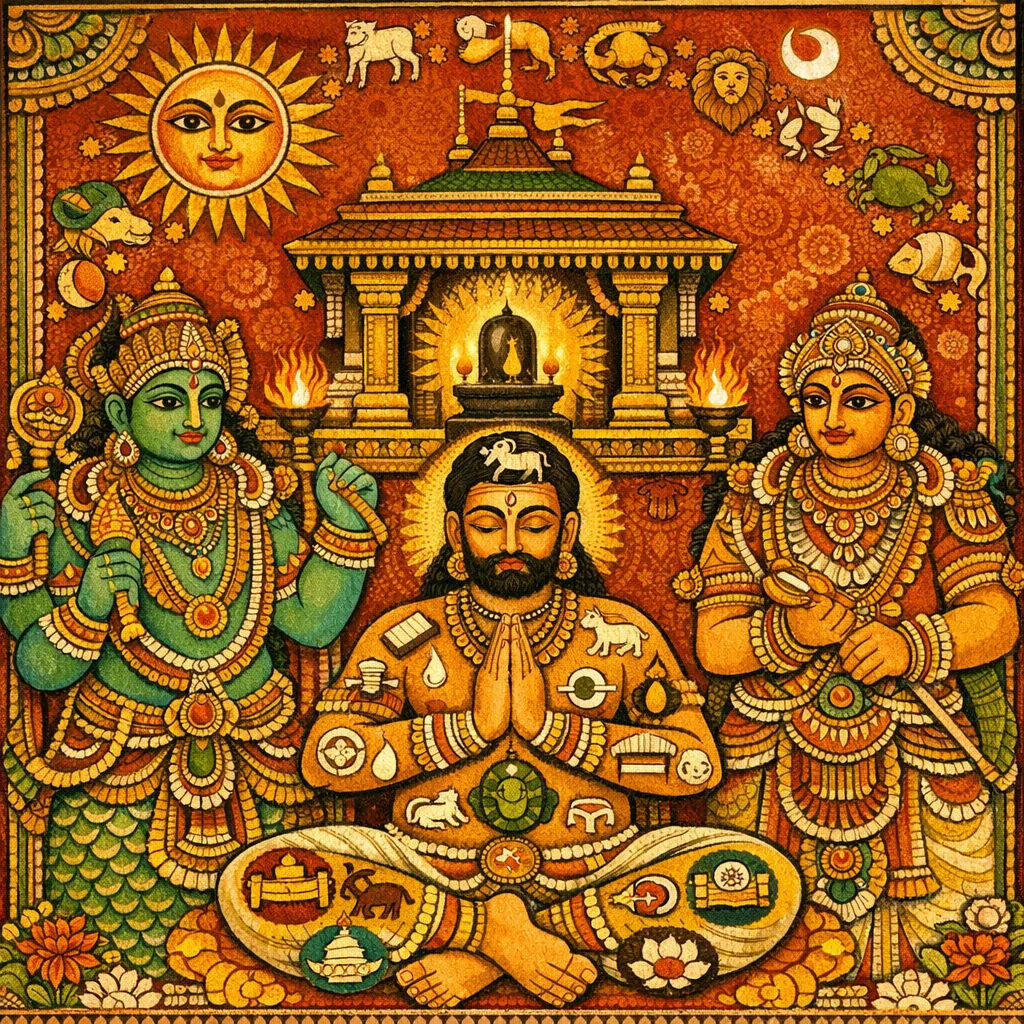
Adhyaya 55: The Ravi-Śayana (Āditya-Śayana) Vrata: Night-Meal Substitute Fasting, Surya-on-Śiva-Liṅga Worship, and Secret Merits
रविशयन-व्रत (आदित्यशयन) तथा इन्दुमौलि-शिवोपासना
Speaker: Nārada, Īśvara (Lord Śiva)
Nārada asks for the best vow that grants fasting-like merit to those unable to fast. Īśvara replies that in the Āditya-śayana/Raviśayana vrata a night-meal (nakta) is permitted, and its reward is inexhaustible. He marks an especially powerful timing: Saptamī joined with the Hastā nakṣatra on a Sunday, together with Saṃkrānti, called Sārvakāmikī. The rite centers on worship of Umā–Maheśvara with Sūrya’s names and on performing Sūrya-pūjā upon the Śiva-liṅga, declaring Śiva and Sūrya to be non-different. It then teaches a detailed nakṣatra-wise contemplation and worship of the deity’s body parts, followed by a Viśveśvara-focused Śiva-stotra. The observance includes sāttvic dietary restraints, prescribed gifts on key days, feeding brāhmaṇas, and a grand concluding dāna: a golden lotus-seat, bed-articles, and a kapilā cow with silver hooves and gold horns. The teaching is proclaimed secret, to be given only to disciplined devotees, promising prosperity, freedom from disease and sorrow, destruction of sin, and even the uplift of ancestors from hell to heaven.
Key Concepts
Shlokas in Adhyaya 55
Verse 1
*नारद उवाच उपवासेष्वशक्तस्य तदेव फलमिच्छतः अनभ्यासेन रोगाद्वा किमिष्टं व्रतमुत्तमम् //
Nārada said: For one who is unable to undertake fasts, yet desires the same merit—whether from lack of practice or because of illness—what is the most excellent and acceptable vow (vrata) to observe?
Verse 2
*ईश्वर उवाच उपवासे ऽप्यशक्तानां नक्तं भोजनमिष्यते यस्मिन्व्रते तदप्यत्र श्रूयतामक्षयं महत् //
Īśvara said: Even for those unable to keep a full fast, a single meal at night (nakta-bhojana) is permitted in that vow. Now hear of the great, imperishable merit that arises from it.
Verse 3
आदित्यशयनं नाम यथावच्छंकरार्चनम् येषु नक्षत्रयोगेषु पुराणज्ञाः प्रचक्षते //
The rite called “Āditya-śayana,” and likewise the proper worship of Śaṅkara—so the knowers of the Purāṇas declare—are to be performed in those specific combinations of lunar mansions and yogas (nakṣatra-yogas).
Verse 4
यदा हस्तेन सप्तम्याम् आदित्यस्य दिनं भवेत् सूर्यस्य चाथ संक्रान्तिस् तिथिः सा सार्वकामिकी //
When the seventh lunar day (Saptamī) coincides with the nakṣatra Hastā and falls on a Sunday, and at that time the Sun’s transit (saṃkrānti) also occurs, that tithi is called “Sārvakāmikī,” able to fulfill all desires.
Verse 5
उमामहेश्वरस्यार्चाम् अर्चयेत्सूर्यनामभिः सूर्यार्चां शिवलिङ्गे च प्रकुर्वन् पूजयेद्यतः //
One should worship the sacred image of Umā and Maheśvara by reciting the names of Sūrya; and, performing the worship of Sūrya upon the Śiva-liṅga as well, one should duly offer reverence, for this method is enjoined as efficacious.
Verse 6
उमापते रवेर्वापि न भेदो दृश्यते क्वचित् यस्मात्तस्मान्मुनिश्रेष्ठ गृहे शम्भुं समर्चयेत् //
O best of sages, no distinction is ever perceived between Umāpati (Śiva) and Ravi (the Sun). Therefore, for that reason, one should duly worship Śambhu (Śiva) within one’s home.
Verse 7
हस्ते च सूर्याय नमो ऽस्तु पादाव् अर्काय चित्रासु च गुल्फदेशम् स्वातीषु जङ्घे पुरुषोत्तमाय धात्रे विशाखासु च जानुदेशम् //
Salutation be to Sūrya in the hands, and to Arka in the feet. In Citrā is the region of the ankles; in Svātī are the shanks; to Puruṣottama (the Supreme Person) belong the calves; and in Viśākhā is the region of the knees—thus the deity’s body is contemplated through the lunar mansions.
Verse 8
तथानुराधासु नमो ऽभिपूज्यम् ऊरुद्वयं चैव सहस्रभानोः ज्येष्ठास्वनङ्गाय नमो ऽस्तु गुह्यम् इन्द्राय सोमाय कटी च मूले //
Likewise, in Anurādhā, salutations to the One worthy of worship—Sahasrabhānu, the thousand-rayed Sun—and may both thighs be placed under his protection. In Jyeṣṭhā, salutations to Anaṅga; may the secret organ be entrusted to Indra and Soma, and may the hips and the root region be safeguarded by these deities.
Verse 9
पूर्वोत्तराषाढयुगे च नाभिं त्वष्ट्रे नमः सप्ततरंगमाय तीक्ष्णांशवे च श्रवणे च कुक्षौ पृष्ठं धनिष्ठासु विकर्तनाय //
In the paired nakṣatras Pūrvāṣāḍhā and Uttarāṣāḍhā, one should meditate upon the navel; obeisance to Tvaṣṭṛ, Lord of the sevenfold waves (rays). In Śravaṇa, one should meditate upon the belly; obeisance to Tīkṣṇāṃśu, the Sun of sharp rays. In Dhaniṣṭhā, one should meditate upon the back; obeisance to Vikartana, the radiant and scorching Sun.
Verse 10
चक्षुःस्थलं ध्वान्तविनाशनाय जलाधिपर्क्षे परिपूजनीयम् पूर्वोत्तराभाद्रपदाद्वये च बाहू नमश्चण्डकराय पूज्यौ //
The region of the eyes should be duly worshipped for the destruction of darkness, and it is to be especially revered when the Moon is in the asterism Jalādhipa. And in the paired nakṣatras Pūrvabhādrapadā and Uttarabhādrapadā, the two arms also are to be worshipped with reverence for Caṇḍakara, the Sun.
Verse 11
साम्नामधीशाय करद्वयं च संपूजनीयं द्विज रेवतीषु नखानि पूज्यानि तथाश्विनीषु नमो ऽस्तु सप्ताश्वधुरंधराय //
Obeisance to the bearer of the chariot drawn by seven horses. O twice-born one, in the nakṣatra Revatī the pair of hands should be specially worshipped for the Lord who presides over the Sāmans; likewise, in the Aśvinīs, the nails should be worshipped.
Verse 12
कठोरधाम्ने भरणीषु कण्ठं दिवाकरायेत्यभिपूजनीया ग्रीवाग्निऋक्षे ऽधरमम्बुजेशे सम्पूजयेन्नारद रोहिणीषु //
In the nakṣatra Bharaṇī, one should duly worship the Lord’s throat, invoking Him as “Kaṭhoradhāman” (He of firm radiance). In the nakṣatra of Agni (Kṛttikā), one should worship the neck; and in Rohiṇī, O Nārada, one should worship the lower lip, calling Him “Ambujeśa” (Lord of the lotus).
Verse 13
मृगोत्तमाङ्गे दशना मुरारेः संपूजनीया हरये नमस्ते नमः सवित्रे रसनां शंकरे च नासाभिपूज्या च पुनर्वसौ च //
Upon the “mṛgottamāṅga” (the excellent deer emblem set upon the head), the teeth of Murāri are to be duly worshipped—obeisance to Hari. The tongue is to be worshipped with salutations to Savitṛ and to Śaṅkara; and the nose also is to be worshipped with salutations to Punarvasu.
Verse 14
ललाटमम्भोरुहवल्लभाय पुष्ये ऽलका वेदशरीरधारिणे सार्पे ऽथ मौलिं विबुधप्रियाय मघासु कर्णाविति गोगणेशे //
On the Puṣya nakṣatra, one should adorn the forehead with the tilaka for Viṣṇu, the beloved of the lotus. On the Aśleṣā (Sārpa) nakṣatra, the side-locks of hair (alaka) are prescribed for Brahmā, whose body is the Vedas. Then, for Śiva, beloved of the gods, the topknot/crown (mauli) is prescribed; and on Maghā, the ears are prescribed—thus is the ordinance for Gaṇeśa among the divine hosts.
Verse 15
पूर्वासु गोब्राह्मणवन्दनाय नेत्राणि संपूज्यतमानि शम्भोः अथोत्तराफल्गुनिभे भ्रुवौ च विश्वेश्वरायेति च पूजनीये //
On the eastern side, for paying homage to cows and Brahmins, one should reverently worship the supremely sacred eyes of Śambhu (Śiva). Then, on the northern side—shining like the nakṣatra Uttarāphālgunī—one should worship the eyebrows as well, with the invocation: “Salutations to Viśveśvara.”
Verse 16
नमो ऽस्तु पाशाङ्कुशशूलपद्मकपालसर्पेन्दुधनुर्धराय गजासुरानङ्गपुरान्धकादिविनाशमूलाय नमः शिवाय //
Salutations to Śiva, who bears the noose (pāśa), the goad (aṅkuśa), the trident (śūla), the lotus (padma), the skull (kapāla), the serpent (sarpa), the moon (indu), and the bow (dhanu); who is the root-cause of the destruction of Gajāsura, of the city of Kāma (Ananga), and of Andhaka and others. Salutations to Śiva.
Verse 17
इत्यादि चास्त्राणि च पूज्य नित्यं विश्वेश्वरायेति शिवो ऽभिपूज्यः भोक्तव्यमत्रैवमतैलशाकम् अमांसमक्षारमभुक्तशेषम् //
Thus, these rites and sacred ordinances (astra) are to be honored daily; and Śiva is to be duly worshipped with the invocation, “Salutations to Viśveśvara.” One should then eat only what is appropriate here: greens cooked without oil, without meat, without alkaline (impurifying) additives, and not food left over from another’s eating.
Verse 18
इत्येवं द्विज नक्तानि कृत्वा दद्यात् पुनर्वसौ शालेयतण्डुलप्रस्थम् औदुम्बरमये घृतम् //
Thus, O twice-born one (dvija), after performing the night-observances (nakta), on the day of Punarvasu one should give as a gift a prastha-measure of fine śāli rice, and ghee (ghṛta) placed in a vessel made of udumbara wood.
Verse 19
संस्थाप्य पात्रे विप्राय सहिरण्यं निवेदयेत् सप्तमे वस्त्रयुग्मं च पारणे त्वधिकं भवेत् //
Having placed the offering in a suitable vessel, one should present it to a brāhmaṇa together with gold; on the seventh day, a pair of garments should also be given. At the concluding rite of breaking the observance (pāraṇa), the gift should be made in a larger measure.
Verse 20
चतुर्दशे तु सम्प्राप्ते पारणे नारदाब्दिके ब्राह्मणान्भोजयेद्भक्त्या गुडक्षीरघृतादिभिः //
When the fourteenth day arrives—at the time of pāraṇa, the breaking of the fast in the Nārada-year observance—one should, with devotion, feed the brāhmaṇas with jaggery, milk, ghee, and the like.
Verse 21
कृत्वा तु काञ्चनं पद्मम् अष्टपत्त्रं सकर्णिकम् शुद्धमष्टाङ्गुलं तच्च पद्मरागदलान्वितम् //
One should fashion a golden lotus with eight petals and a central pericarp; it should be pure, eight aṅgulas in measure, and furnished with petals set with padmarāga (ruby).
Verse 22
शय्यां विलक्षणां कृत्वा विरुद्धग्रन्थिवर्जिताम् सोपधानकविश्रामस्वास्तरव्यजनानि च //
Having made a well-designed bed—free from improper knots and faulty joinings—one should also provide a pillow, a resting support, a comfortable bedding-spread, and a fan.
Verse 23
भाजनोपानहछत्त्रचामरासनदर्पणैः भूषणैरपि संयुक्तां फलवस्त्रानुलेपनैः //
Along with vessels, footwear, a parasol, a chāmara (fly-whisk), a seat, and a mirror—also furnished with ornaments—the gift should be accompanied by fruits, garments, and unguents (anulepana), such as fragrant pastes.
Verse 24
तस्यां विधाय तत्पद्मम् अलंकृत्य गुणान्वितम् कपिलां वस्त्रसंयुक्तां सुशीलां च पयस्विनीम् //
Upon it, having fashioned that lotus-seat and adorning it with auspicious marks and virtues, one should offer a tawny cow—clothed, of good conduct, and abundant in milk.
Verse 25
रौप्यखुरीं हेमशृङ्गीं सवत्सां कांस्यदोहनाम् दद्यान्मन्त्रेण पूर्वाह्णे न चैनामभिलङ्घयेत् //
In the forenoon, with the proper mantra, one should gift a cow whose hooves are adorned as with silver and whose horns are adorned as with gold, together with her calf and a bronze milking vessel; and one should not transgress against her or violate the prescribed observance.
Verse 26
यथैवादित्यशयनम् अशून्यं तव सर्वदा कान्त्या धृत्या श्रिया रत्या तथा मे सन्तु सिद्धयः //
Just as the couch of the Sun (Āditya-śayana) is ever not devoid of your radiance, steadfastness, prosperity, and delight, so too may such perfections (siddhis) ever be mine.
Verse 27
यथा न देवाः श्रेयांसं त्वदन्यमनघं विदुः तथा माम् उद्धराशेषदुःखसंसारसागरात् //
Just as even the gods know none more beneficent and excellent than You, O sinless Lord, so too rescue me from the ocean of worldly existence, filled with unending sorrow.
Verse 28
ततः प्रदक्षिणीकृत्य प्रणिपत्य विसर्जयेत् शय्यागवादि तत्सर्वं द्विजस्य भवनं नयेत् //
Thereafter, having circumambulated (in pradakṣiṇā) and bowed down, one should respectfully take leave; and all those gifts—such as the bed and the cow—should be conveyed to the Brāhmaṇa’s residence.
Verse 29
नैतद्विशीलाय न दाम्भिकाय कुतर्कदुष्टाय विनिन्दकाय प्रकाशनीयं व्रतमिन्दुमौलेर् यश्चापि निन्दामधिकां विधत्ते //
This vow of Indumauli (Śiva) is not to be disclosed to one of bad conduct, nor to a hypocrite, nor to one corrupted by perverse reasoning, nor to a fault-finder; nor should it be revealed to anyone who promotes excessive disparagement (of others or of the vow).
Verse 30
भक्ताय दान्ताय च गुह्यमेतद् आख्येयम् आनन्दकरं शिवस्य इदं महापातकभिन् नराणाम् अप्यक्षरं वेदविदो वदन्ति //
This secret teaching—joy-giving and belonging to Śiva—should be proclaimed only to one who is devoted and self-controlled. For human beings it shatters even the gravest sins; the knowers of the Veda declare it to be imperishable.
Verse 31
न बन्धुपुत्रेण धनैर्वियुक्तः पत्नीभिरानन्दकरः सुराणाम् नाभ्येति रोगं न च शोकदुःखं या वाथ नारी कुरुते ऽतिभक्त्या //
A man is not left bereft of kinsmen, sons, or wealth; he becomes a source of delight even to the gods. He does not fall into disease, nor into grief and sorrow—when a woman (his wife) acts with exceptional devotion.
Verse 32
इदं वसिष्ठेन पुरार्जुनेन कृतं कुबेरेण पुरंदरेण यत्कीर्तनेनाप्यखिलानि नाशम् आयान्ति पापानि न संशयो ऽस्ति //
This (hymn) was composed by Vasiṣṭha, by Purārjuna, by Kubera, and by Purandara; by merely reciting it, all sins are destroyed—of this there is no doubt.
Verse 33
इति पठति शृणोति वा य इत्थं रविशयनं पुरुहूतवल्लभः स्यात् / अपि नरकगतान्पितॄन् अशेषान् अपि दिवमानयतीह यः करोति //
Whoever thus reads (this account) or even listens to it becomes dear to Puruhūta (Indra). And whoever performs this Raviśayana observance here can even lead all his ancestors—though they have fallen into hell—up to heaven.
Frequently Asked Questions
It teaches the Raviśayana (Āditya-śayana) vrata as a high-merit alternative for those who cannot do full fasting, allowing nakta-bhojana (one meal at night). It emphasizes correct timing, Surya–Shiva integrated worship (including Sūrya-names offered to Śiva and Sūrya-arcana on the Śiva-liṅga), purity of diet, and completion through dāna and brāhmaṇa-bhojana.
This chapter is primarily Dharma in the form of vrata-vidhi (ritual observance), calendrical dharma (tithi–nakṣatra–yoga timing), mantra/stotra worship, dietary discipline, and dāna. It does not treat Vastu-śāstra, Rajadharma/statecraft, or genealogical lists in this adhyaya.
It is the conjunction when Saptamī tithi coincides with the nakṣatra Hastā, falls on a Sunday, and also has the Sun’s saṃkrānti. The text calls this tithi “Sārvakāmikī,” stating it can fulfill all desires when used for the prescribed worship.
It states there is no real distinction between Umāpati (Śiva) and Ravi (Sūrya). Therefore, worship may be performed in a unified way—reciting Sūrya’s names while worshipping Umā–Maheśvara, and performing Sūrya worship upon the Śiva-liṅga—culminating in honoring Śiva as Viśveśvara.
It prescribes measured gifts like fine śāli rice and ghee in an udumbara-wood vessel (with gold), garments on the seventh, feeding brāhmaṇas with jaggery, milk, and ghee at pāraṇa, and an elaborate concluding dāna including a golden eight-petaled lotus, a well-made bed with accessories, household/comfort items, ornaments, and a kapilā cow with calf—adorned with silver hooves and gold horns—given with mantra in the forenoon.