Adhyaya 1: Prologue to the Matsya Purana and the Manu–Pralaya Rescue Narrative (Matsya Avatar Prelude)
मात्स्यावतारप्रस्तावना तथा मनुप्रलय-रक्षणोपाख्यानम्
Speaker: Sūta, Śaunaka and the Naimiṣāraṇya Ṛṣis, Lord Viṣṇu as Matsya (speaking within Sūta’s narration), Vaivasvata Manu (within Sūta’s narration)
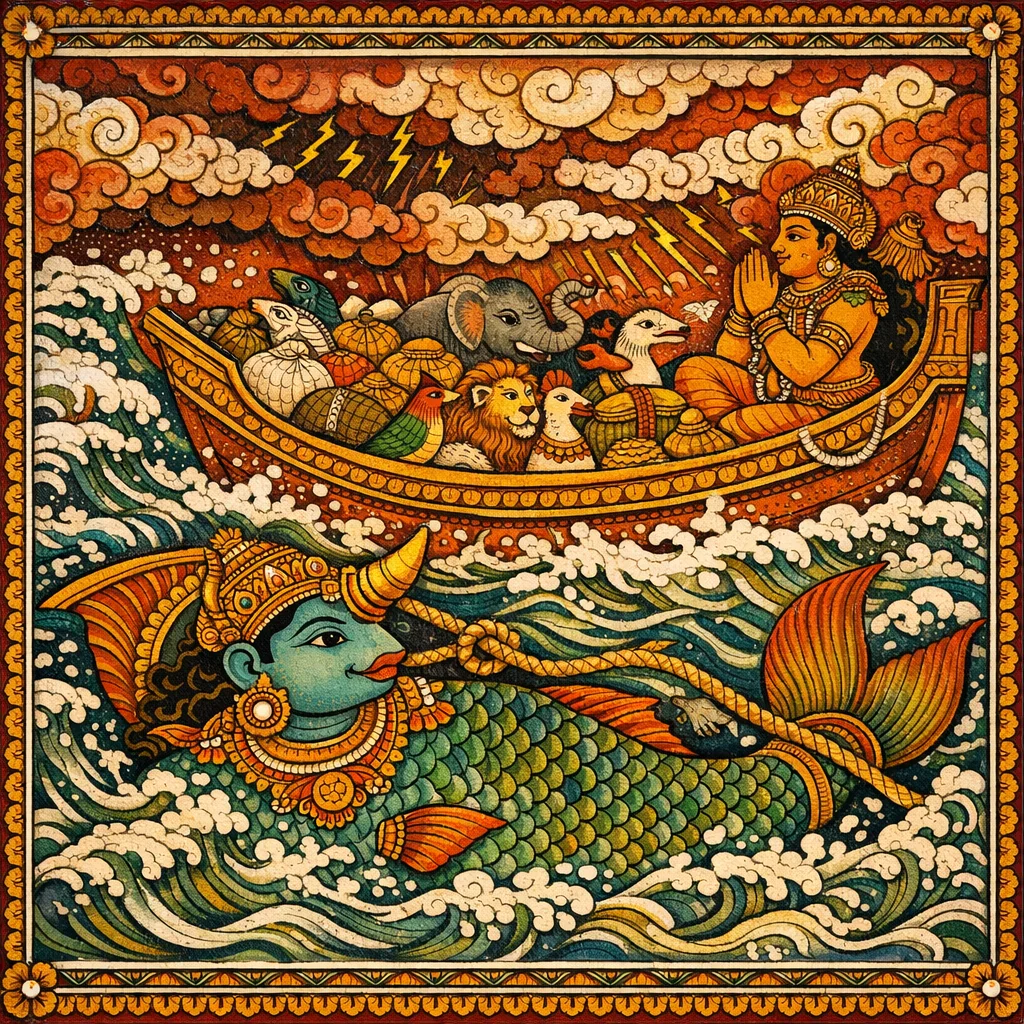
At Naimiṣāraṇya, after a long sattra, the sages ask Sūta to recite the nectar-like Purāṇas again, inquiring especially into creation and why Viṣṇu assumed the Matsya (Fish) form, along with questions on Śiva’s Bhairava/Kapālin aspects. Sūta begins the Matsya Purāṇa as spoken by Viṣṇu, recounting Manu’s austerities and Brahmā’s boon; Manu seeks the power to protect all beings at Pralaya. Later, during pitṛ-tarpaṇa, a small fish falls into Manu’s hands and swiftly grows, forcing him to move it from vessel to vessel until it fills the ocean. Manu recognizes the fish as Vāsudeva and offers salutations. Matsya foretells the deluge, presents the gods’ boat, instructs Manu to load all kinds of life and seeds, and to bind the boat to Matsya’s horn amid the yuga-end winds, promising Manu the status of Prajāpati at the dawn of Kṛtayuga.
Key Concepts
Shlokas in Adhyaya 1
Verse 1
पातालादुत्पतिष्णोर् मकरवसतयो यस्य पुच्छाभिघाताद् ऊर्ध्वं ब्रह्माण्डखण्डव्यतिकरविहितव्यत्ययेनापतन्ति विष्णोर्मत्स्यावतारे सकलवसुमतीमण्डलं व्यश्नुवानास् तस्यास्योदीरितानां ध्वनिर् अपहरताद् अश्रियं वः श्रुतीनाम् //
May the reverberation of the words uttered from the mouth of Viṣṇu in his Matsya incarnation remove all inauspiciousness from your Vedic recitations—he whose tail-strike made the makaras dwelling in Pātāla leap upward and fall in disordered inversion amid the clashing fragments of the cosmic egg, as he pervaded the whole circle of the earth.
Verse 2
नारायणं नमस्कृत्य नरं चैव नरोत्तमम् देवीं सरस्वतीं चैव ततो जयम् उदीरयेत् //
Having bowed to Nārāyaṇa, to Nara—the best of men—and also to Goddess Sarasvatī, one should then pronounce the word “Jaya” (Victory) and begin.
Verse 3
अजो ऽपि यः क्रियायोगान् नारायण इति स्मृतः त्रिगुणाय त्रिवेदाय नमस् तस्मै स्वयम्भुवे //
Salutation to that Self-born One—though unborn—who, through the discipline of sacred action (kriyā-yoga), is remembered as Nārāyaṇa; who is the Lord of the three guṇas and the very essence of the three Vedas.
Verse 4
सूतमेकाग्रमासीनं नैमिषारण्यवासिनः मुनयो दीर्घसत्त्रान्ते पप्रच्छुर् दीर्घसंहिताम् //
At the close of a long sacrificial session, the sages dwelling in Naimiṣāraṇya questioned Sūta, who was seated with focused attention, about the extensive sacred compendium.
Verse 5
प्रवृत्तासु पुराणीषु धर्म्यासु ललितासु च कथासु शौनकाद्यास् तु अभिनन्द्य मुहुर्मुहुः //
As the Purāṇic narratives began—righteous in purport and delightful in expression—Śaunaka and the other sages repeatedly offered their approval and praise.
Verse 6
कथितानि पुराणानि यान्यस्माकं त्वयानघ तान्येवामृतकल्पानि श्रोतुम् इच्छामहे पुनः //
O sinless one, the Purāṇas that you have already narrated to us—those very accounts, nectar-like in their essence, we wish to hear again.
Verse 7
कथं ससर्ज भगवंल् लोकनाथश्चराचरम् कस्माच्च भगवान् विष्णुर् मत्स्यरूपत्वम् आश्रितः //
How did the Blessed Lord, the Protector of the worlds, create this entire universe of the moving and the unmoving? And for what reason did Lord Viṣṇu assume the form of a Fish (Matsya)?
Verse 8
भैरवत्वं भवस्यापि पुरारित्वं च केन हि कस्य हेतोः कपालित्वं जगाम वृषभध्वजः //
By whom, indeed, did Bhava (Śiva) come to be known as Bhairava, and as the Slayer of Tripura? And for what reason did the Bull-bannered Lord (Śiva) assume the state of being a skull-bearer (Kapālin)?
Verse 9
सर्वम् एतत् समाचक्ष्व सूत विस्तरशः क्रमात् त्वद्वाक्येनामृतस्येव न तृप्तिरिह जायते //
O Sūta, recount all of this—fully, in due order and at length; for from your words, like nectar, no satisfaction arises here (we never feel ‘enough’).
Verse 10
*सूत उवाच पुण्यं पवित्रम् आयुष्यम् इदानीं शृणुत द्विजाः मात्स्यं पुराणमखिलं यज्जगाद गदाधरः //
Sūta said: “O twice-born sages, listen now to the Matsya Purāṇa in its entirety—meritorious, purifying, and life-enhancing—just as it was proclaimed by the mace-bearing Lord (Viṣṇu).”
Verse 11
पुरा राजा मनुर् नाम चीर्णवान् विपुलं तपः पुत्रे राज्यं समारोप्य क्षमावान् रविनन्दनः //
Long ago, a king named Manu—patient and forbearing, a descendant of the Sun—performed great austerities, having first entrusted the kingship to his son.
Verse 12
मलयस्यैकदेशे तु सर्वात्मगुणसंयुतः समदुःखसुखो वीरः प्राप्तवान् योगम् उत्तमम् //
In a certain region of the Malaya mountains, that heroic one—endowed with every noble quality and even-minded in sorrow and happiness—attained the highest Yoga.
Verse 13
बभूव वरदश् चास्य वर्षायुतशते गते वरं वृणीष्व प्रोवाच प्रीतः स कमलासनः //
And after a hundred thousand years had passed, the Lotus-seated One (Brahmā), pleased with him, became a giver of boons and said: “Choose a boon.”
Verse 14
एवमुक्तो ऽब्रवीद् राजा प्रणम्य स पितामहम् एकम् एवाहम् इच्छामि त्वत्तो वरमनुत्तमम् //
Thus addressed, the king spoke—having bowed to Pitāmaha (Brahmā): “From you I seek one boon alone—the unsurpassed boon.”
Verse 15
भूतग्रामस्य सर्वस्य स्थावरस्य चरस्य च भवेयं रक्षणायालं प्रलये समुपस्थिते //
When the dissolution (Pralaya) arrives, I shall be fully sufficient to protect the entire multitude of beings—both the immovable and the moving.
Verse 16
एवमस्त्विति विश्वात्मा तत्रैवान्तरधीयत पुष्पवृष्टिः सुमहती खात्पपात सुरार्पिता //
Saying, “So be it,” the Universal Self (the Lord) vanished from that very spot; and then a very great shower of flowers, offered by the gods, fell down from the sky.
Verse 17
कदाचिदाश्रमे तस्य कुर्वतः पितृतर्पणम् पपात पाण्योर् उपरि शफरी जलसंयुता //
Once, while he was in his hermitage performing the libation-offering to the ancestors (pitṛ-tarpaṇa), a small fish, still wet with water, fell upon the palms of his hands.
Verse 18
दृष्ट्वा तच्छफरीरूपं स दयालुर्महीपतिः रक्षणायाकरोद्यत्नं स तस्मिन्करकोदरे //
Seeing it in the form of a small fish, that compassionate king made an effort to protect it, placing it there in the hollow of his hand.
Verse 19
अहोरात्रेण चैकेन षोडशाङ्गुलविस्तृतः सो ऽभवन्मत्स्यरूपेण पाहि पाहीति चाब्रवीत् //
In just one day and night, it grew to a breadth of sixteen aṅgulas; then, taking the form of a fish, it cried out, “Protect me, protect me!”
Verse 20
स तमादाय मणिके प्राक्षिपज्जलचारिणम् तत्रापि चैकरात्रेण हस्तत्रयम् अवर्धत //
Taking that water-moving creature, he placed it into a jar; yet even there, within a single night, it grew by three hand-spans.
Verse 21
पुनः प्राहार्तनादेन सहस्रकिरणात्मजम् स मत्स्यः पाहि पाहीति त्वामहं शरणं गतः //
Again, with a trembling, distressed cry, I have sought refuge in you—O Matsya, offspring of the thousand-rayed (Sun): “Protect me, protect me!”
Verse 22
ततः स कूपे तं मत्स्यं प्राहिणोद् रविनन्दनः यदा न माति तत्रापि कूपे मत्स्यः सरोवरे //
Then the son of the Sun (Manu) placed that fish into a well. When the fish could not be contained even there in the well, he moved the fish to a lake.
Verse 23
क्षिप्तो ऽसौ पृथुतामागात् पुनर् योजनसंमिताम् तत्राप्याह पुनर् दीनः पाहि पाहि नृपोत्तम //
When it was cast into the water, it again grew to a vast size—measuring a yojana. Even there, distressed, it once more said: “Protect me, protect me, O best of kings!”
Verse 24
ततः स मनुना क्षिप्तो गङ्गायामप्यवर्धत यदा तदा समुद्रे तं प्राक्षिपन्मेदिनीपतिः //
Then, when Manu cast it into the Gaṅgā, it continued to grow there as well; and so, time after time, the lord of the earth (Manu) threw it into the ocean.
Verse 25
यदा समुद्रमखिलं व्याप्यासौ समुपस्थितः तदा प्राह मनुर्भीतः को ऽपि त्वमसुरेश्वरः //
When he expanded to pervade the entire ocean and stood before him, the frightened Manu spoke: “Who indeed are you, O lord of the Asuras?”
Verse 26
अथवा वासुदेवस्त्वम् अन्य ईदृक्कथं भवेत् योजनायुतविंशत्या कस्य तुल्यं भवेद्वपुः //
Or else, you must be Vāsudeva Himself—for how could anyone else be like this? Whose body could ever be comparable, spanning twenty thousand yojanas?
Verse 27
ज्ञातस्त्वं मत्स्यरूपेण मां खेदयसि केशव हृषीकेश जगन्नाथ जगद्धाम नमो ऽस्तु ते //
I have recognized You in the form of the Fish; yet You trouble me (by testing me). O Keśava, O Hṛṣīkeśa, O Lord of the universe, O abode of the universe—salutations to You.
Verse 28
एवमुक्तः स भगवान् मत्स्यरूपी जनार्दनः साधु साध्विति चोवाच सम्यग्ज्ञातस् त्वयानघ //
Thus addressed, the Blessed Lord Janārdana, who had assumed the form of a Fish, replied, “Well done, well done! O sinless one, you have understood Me correctly.”
Verse 29
अचिरेणैव कालेन मेदिनी मेदिनीपते भविष्यति जले मग्ना सशैलवनकानना //
In a very short time, O lord of the earth, this Earth will be submerged in water—along with her mountains, forests, and groves.
Verse 30
नौर् इयं सर्वदेवानां निकायेन विनिर्मिता महाजीवनिकायस्य रक्षणार्थं महीपते //
O king, this boat has been fashioned by the assembled host of all the gods for the protection of the great multitude of living beings.
Verse 31
स्वेदाण्डजोद्भिदो ये वै ये च जीवा जरायुजाः अस्यां निधाय सर्वांस् तान् अनाथान् पाहि सुव्रत //
O you of excellent vow, protect all those helpless beings—those born of sweat, those born from eggs, those sprouting from the earth, and those born from the womb—having placed them all within this vessel.
Verse 32
युगान्तवाताभिहता यदा भवति नौर् नृप शृङ्गे ऽस्मिन्मम राजेन्द्र तदेमां संयमिष्यसि //
O king, when the boat is struck by the end-of-the-age winds, then, O best of kings, you shall secure it to this horn of mine.
Verse 33
ततो लयान्ते सर्वस्य स्थावरस्य चरस्य च प्रजापतिस्त्वं भविता जगतः पृथिवीपते //
Then, at the end of the dissolution of all beings—both the immovable and the moving—O lord of the earth, you will become Prajāpati, the progenitor of the world.
Verse 34
एवं कृतयुगस्यादौ सर्वज्ञो धृतिमान्नृपः मन्वन्तराधिपश्चापि देवपूज्यो भविष्यसि //
Thus, at the beginning of the Kṛtayuga, O king, you will be all-knowing and steadfast; you will also become the lord of a Manvantara, and you will be revered—worshipped even by the gods.
Frequently Asked Questions
Adhyaya 1 teaches dharmic preservation during cosmic crisis: Manu embodies the ideal protector-king who responds with compassion (saving the small fish) and obedience to divine instruction (gathering beings into the boat). The chapter frames Pralaya not as mere catastrophe but as a cyclical transition where righteous leadership, guided by Viṣṇu (Matsya), safeguards life and enables renewal at the start of Kṛtayuga.
This chapter primarily covers Creation-cycle theology (Pralaya and yuga transition) and Rajadharma in archetypal form (the king as guardian of beings). It also establishes Purāṇic transmission (Sūta narrating to the Naimiṣāraṇya sages). Vastu-śāstra and detailed genealogies are not yet developed here; they are foreshadowed by the sages’ broader questions about cosmic origins and divine forms.
Matsya first tests Manu’s compassion through the ever-growing fish that cannot be contained in smaller waters. After revealing Himself, Matsya warns of imminent flooding, provides a boat made by the gods, instructs Manu to place all classes of beings inside, and tells him to fasten the boat to Matsya’s horn when yuga-end winds strike—thus ensuring survival through Pralaya and Manu’s role as future progenitor (Prajāpati).