Adhyaya 201
Dharma-vyādha’s Analysis of Moral Decline and the Mahābhūta–Guṇa Schema (धर्मव्याधोपदेशः)
Upa-parva: Dharma-vyādha Upākhyāna (The Narrative of the Righteous Hunter-Butcher)
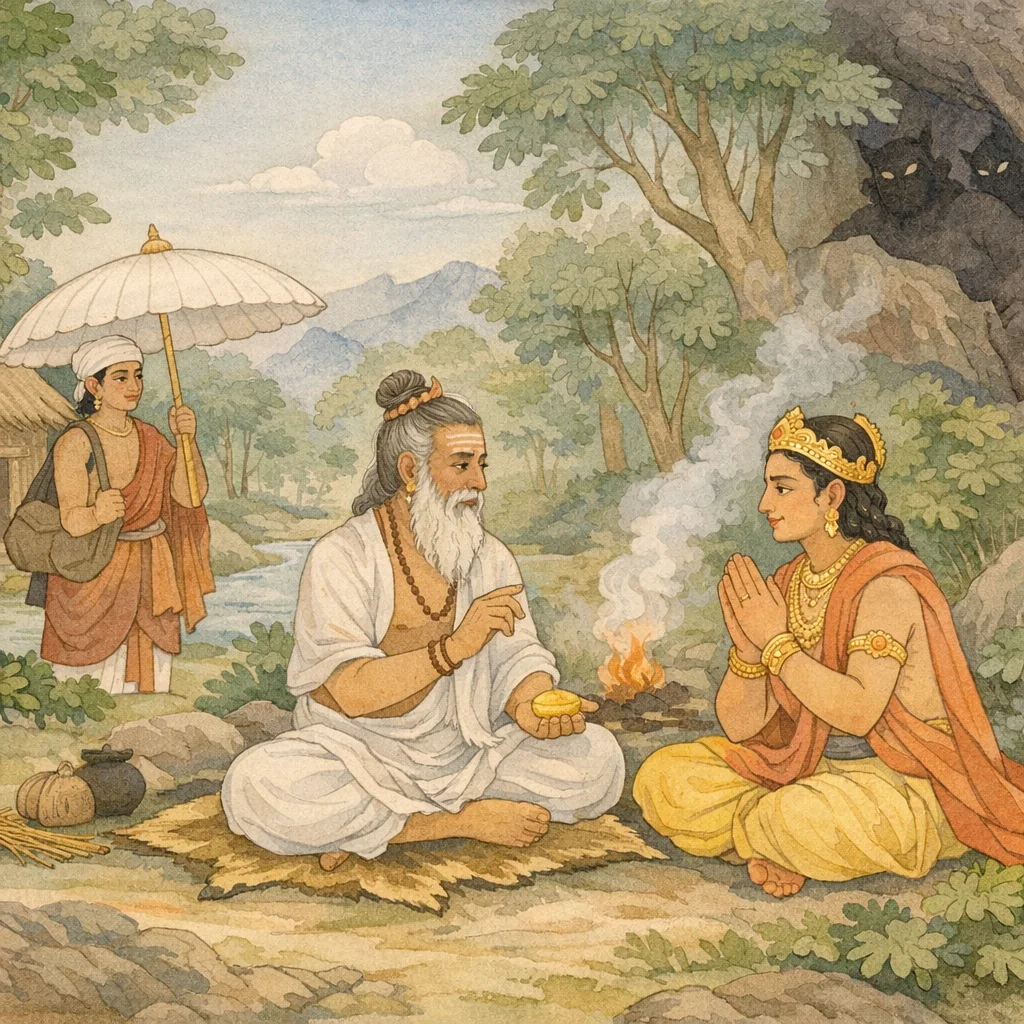
Mārkaṇḍeya introduces the continuation of the dharma-vyādha’s instruction to Yudhiṣṭhira. The vyādha outlines a causal chain in human cognition: mind first engages objects for ‘knowing,’ then attachment forms, followed by desire and anger. From repeated pursuit of pleasing forms and scents arises rāga (attraction) and then dveṣa (aversion), which mature into lobha (greed) and moha (delusion). Under these pressures, one loses clear judgment about dharma, performing ‘righteous’ acts as pretexts (vyāja) for gain; even when restrained by friends and learned persons, the person rationalizes wrongdoing with scriptural-sounding replies. Adharma expands in thought, speech, and action; virtues decay and the person gravitates toward similarly disposed companions, resulting in suffering here and harm beyond. The vyādha then presents the corrective: early recognition of faults through prajñā, skillful composure in pleasure and pain, and service to the virtuous—through which dharmic understanding arises. A brāhmaṇa praises the teaching, calling the speaker rishi-like. The vyādha affirms honoring brāhmaṇas and proceeds to a compact metaphysical account: the five great elements and their qualities, the emergence of mind (manas), intellect (buddhi), ego (ahaṃkāra), the senses, and the three guṇas—summarized as a structured tally culminating in a ‘twenty-four’ analytic frame, before inviting further questions.
Chapter Arc: वनवास में धर्म-जिज्ञासा से उद्वेलित पाण्डुनन्दन (युधिष्ठिर) महर्षि मार्कण्डेय से पूछते हैं—दान किस अवस्था में, किसे, किस प्रकार दिया जाए कि फल शुद्ध और अक्षय हो; और कौन-सा दान निन्दित होकर दाता को ही गिरा देता है। → मार्कण्डेय दान के सूक्ष्म विधान खोलते हैं—निन्दित दान, निन्दित जन्म/अयोग्य पात्र, श्राद्ध में ग्राह्य-अग्राह्य ब्राह्मण, दानपात्र के लक्षण, तथा दान के साथ शौच (वाक्-शौच, कर्म-शौच, जल-शौच) की अनिवार्यता। वे बताते हैं कि दान केवल वस्तु नहीं, दाता की नीयत, पात्र की योग्यता और विधि की शुद्धि का संयुक्त संस्कार है। → उपदेश का शिखर तब आता है जब ऋषि ‘शौच’ को स्वर्ग-मार्ग का निर्णायक घोषित करते हैं—तीन प्रकार के शौच से युक्त व्यक्ति के लिए स्वर्ग निश्चित है; और जो दान/कर्म में अशुद्ध, कपटी या अयोग्य-पात्र-सेवी है, उसे भयावह परिणाम (राक्षसी यातना, दुर्गम शून्य-आकाश-सा मार्ग, श्राद्ध-विधि का विघटन) भोगना पड़ता है। → अध्याय दान के सकारात्मक फल-चित्रों से स्थिर होता है—विशुद्ध सुवर्ण, छत्र, अश्व आदि उत्तम दानों से लोक-प्राप्ति, पथिक-विश्राम, आतप-निवारण जैसे लोकहितकारी दानों की प्रशंसा; साथ ही उपवास/नियमों के फल और इन्द्रिय-त्याग की कठिनता का विवेचन कर यह निष्कर्ष कि धर्म का सार ‘शुद्धि + करुणा + योग्य-पात्र’ है। → युधिष्ठिर के मन में यह प्रश्न शेष रह जाता है कि जब पात्र-निर्णय और विधि इतनी सूक्ष्म है, तब संकट-काल में त्वरित दान/श्राद्ध करते समय त्रुटि से कैसे बचा जाए—और आगे के उपदेश की भूमि बनती है।
Shlokas
Verse 1
#:73:.8 #:23:.7 () हि 2 7 द्विशततमो<्ध्याय: निन्दित दान
Vaiśampāyana said: Having heard then from the greatly fortunate sage Mārkaṇḍeya the account concerning King Indradyumna and the attainment of heaven, that king reflected upon it in its full import.
Verse 2
कीदृशीषु हावस्थासु दत्त्वा दानं महामुने
Vaiśaṃpāyana said: “O great sage, in what kinds of circumstances and conditions does a gift, once given, truly count as meritorious charity?”
Verse 3
गार्हस्थ्ये5प्यथवा बाल्ये यौवने स्थविरे5पि वा । यथा फलं समश्नाति तथा त्वं कथयस्व मे,“मनुष्य बाल्यावस्था या गृहस्थाश्रममें, जवानीमें अथवा बुढ़ापेमें दान देनेसे जैसा फल पाता है, उसका मुझसे वर्णन कीजिये”
Vaiśampāyana said: “Whether in the householder’s stage, or in childhood, youth, or even old age—tell me how a person partakes of the fruit of giving in each case; describe to me the result as it is experienced.”
Verse 4
मार्कण्डेय उवाच वृथा जन्मानि चत्वारि वृथा दानानि षोडश । वृथा जन्म ह्[पुत्रस्य ये च धर्मबहिष्कृता:
Mārkaṇḍeya said: “Four kinds of births are in vain, and sixteen kinds of gifts are in vain. Indeed, the birth of one who is without a son is in vain, and so too of those who are cast out from dharma.”
Verse 5
परपाकेषु ये5श्रन्ति आत्मार्थ च पचेत् तु यः । पर्यश्नन्ति वृथा ये च तदसत्यं प्रकीर्त्यते
Mārkaṇḍeya said: “Those who toil in another’s kitchen, and the one who cooks only for his own sake; and those who eat without due purpose or right—such conduct is proclaimed ‘asat’ (untrue/inauthentic).”
Verse 6
आरूढपतिते दत्तमन्यायोपहृतं च यत् । व्यर्थ तु पतिते दान॑ ब्राह्मणे तस्करे तथा
Mārkaṇḍeya said: “A gift given to one who has fallen after having taken up the higher discipline (the ‘ārūḍha-patita’) is fruitless; likewise, whatever is offered from wealth obtained through injustice is also fruitless. So too, charity given to a fallen brāhmaṇa, and to a thief, comes to nothing.”
Verse 7
गुरौ चानृतिके पापे कृतघ्ने ग्रामयाजके । वेदविक्रयिणे दत्तं तथा वृषलयाजके
Mārkaṇḍeya said: “A gift given to a teacher who is deceitful, sinful, and untruthful; to an ungrateful person; to a village-priest who performs rites for hire; to one who sells the Veda; and likewise to a priest who officiates for outcastes—such giving is ethically tainted and does not yield the pure merit expected of dāna.”
Verse 8
ब्रह्मबन्धुषु यद् दत्तं यद् दत्तं वृषलीपतौ । स्त्रीजनेषु च यद् दत्तं व्यालग्राहे तथैव च
Mārkaṇḍeya said: “Whatever gift is given to a ‘Brahmin only in name’—one who lacks true Brahminical conduct—whatever is given to the husband of a low-born woman, whatever is given to womenfolk as a class without discernment, and likewise whatever is given when one is under the grip of a predator or robber: such giving is held to be ethically defective, for it is made without due regard for worthiness, purpose, and right circumstance.”
Verse 9
परिचारकेषु यद् दत्तं वृथा दानानि षोडश । पिता आदि गुरुजन
Mārkaṇḍeya said: “Gifts given to certain unworthy recipients become futile; such ‘fruitless gifts’ are said to be sixteen in number. And the person who, veiled by tamas, gives out of fear or anger—such a donor experiences the consequence of those gifts in a painful way in a future birth (even from the womb). By contrast, one who gives to truly worthy brāhmaṇas enjoys the result of that gift in due measure, according to the magnitude of the merit.”
Verse 10
भुदुक्ते च दानं तत् सर्व गर्भस्थस्तु नर: सदा । ददद् दान द्विजातिभ्यो वृद्धभावेन मानव:
Mārkaṇḍeya said: “When a gift is made in fear, agitation, darkness of mind, or with anger, a person experiences the entire result of that giving in a future birth while still in the womb—meaning that such tamasic charity ripens as suffering. But the human being who gives with mature, reverent intent to the twice-born (worthy Brahmins) enjoys the fruit of that gift in a greater measure, according to the excellence of the recipient and the giver’s inner disposition.”
Verse 11
राजन! इसीलिये मनुष्यको चाहिये कि वह स्वर्ग-मार्गपर अधिकार पानेकी इच्छासे सभी अवस्थाओंमें (श्रेष्ठ) ब्राह्मणोंको ही सब प्रकारके दान दे
Markandeya said: “O King, therefore a person who seeks the right to tread the path to heaven should, in every condition of life, give all kinds of gifts specifically to worthy Brahmins.”
Verse 12
युधिछिर उवाच चातुर्वर्ण्यस्य सर्वस्य वर्तमाना: प्रतिग्रहे । केन विप्रा विशेषेण तारयन्ति तरन्ति च
Yudhiṣṭhira said: “O great sage, when brāhmaṇas accept gifts from all the four social orders, by what particular discipline or principle do they, in a special way, uplift others and also cross over themselves?”
Verse 13
तस्मात् सर्वास्ववस्थासु सर्वदानानि पार्थिव | दातव्यानि द्विजातिभ्य: स्वर्गमार्गजिगीषया
Mārkaṇḍeya said: “Therefore, O king, in every condition of life and at all times, gifts should be given to the twice-born, by one who seeks to win the path to heaven. For by japa, by the recitation of mantras, by sacrificial offerings, by self-study and the study of the Veda, the Brāhmaṇas fashion a ‘boat made of the Veda’; with it they ferry others across, and they themselves cross over as well.”
Verse 14
ब्राह्मणांस्तोषयेद् यस्तु तुष्यन्ते तस्य देवता: । वचनाच्चापि विप्राणां स्वर्गलोकमवाप्लनुयात्
Mārkaṇḍeya said: “Whoever pleases the brāhmaṇas thereby pleases the gods as well. And by the word of the brāhmaṇas—by their blessing—a person may attain the world of heaven.”
Verse 15
पितृदैवतपूजाभिर््राह्यिणाभ्यर्चनेन च । अनन्तं पुण्यलोकं तु गन्तासि त्वं न संशय:,राजन! तुम पितरों और देवताओंकी पूजासे तथा ब्राह्मणोंका आदर-सत्कार करनेसे अक्षय पुण्यलोकमें जाओगे, इसमें संशय नहीं है
Mārkaṇḍeya said: “By worshipping the Pitṛs and the gods, and by honoring and reverently serving the brāhmaṇas, you will surely attain an imperishable, boundless realm of merit—of this, O king, there is no doubt.”
Verse 16
युधिष्ठिरो महाराज पुन: पप्रच्छ तं॑ मुनिम् । वैशम्पायनजी कहते हैं--जनमेजय! महाभाग मार्कण्डेयजीके मुखसे राजर्षि इन्द्रद्युम्नको पुनः स्वर्गकी प्राप्तिका वृत्तान्त सुनकर राजा युधिष्ठिरने उन मुनीश्वरसे फिर प्रश्न किया
Vaiśampāyana said: After hearing from the venerable Mārkaṇḍeya the account of how the royal sage Indradyumna regained heaven, King Yudhiṣṭhira again questioned that seer: “If a person’s body is overwhelmed by phlegm and other humors, and he is dying and has become unconscious—yet he longs for the merit-bearing world of heaven—then indeed the Brāhmaṇas should be duly honored (as an act of dharma and merit).”
Verse 17
श्राद्धकाले तु यत्नेन भोक्तव्या हाजुगुप्सिता: । दुर्वर्गः कुनखी कुछी मायावी कुण्डगोलकी
Mārkaṇḍeya said: “At the time of the śrāddha, one should make a careful effort to feed only those who are not blameworthy. Those who are of degraded conduct, whose nails are diseased, who are afflicted with loathsome illness, who are deceitful, and those of censured birth—such persons are to be avoided in śrāddha. For if the śrāddha is performed with improper recipients, it becomes condemned, and a condemned śrāddha harms the patron just as fire consumes dry wood.”
Verse 18
वर्जनीया: प्रयत्नेन काण्डपृष्ठाश्न देहिनः । जुगुप्सितं हि यच्छाद्धं दहत्यग्निरिवेन्धनम्
Mārkaṇḍeya said: In a śrāddha one must, with careful effort, exclude those embodied persons who live by base means—those who subsist on impure, contemptible remnants, like food left upon the back of a broken pot. For a śrāddha that becomes blameworthy is truly repulsive, and it destroys the patron just as fire consumes its fuel. (In context, the rite is to be offered to worthy brāhmaṇas; feeding the unfit turns the ancestral offering into a cause of harm rather than merit.)
Verse 19
ये ये श्राद्धे न युज्यन्ते मूकान्धवधिरादय: । तेडपि सर्वे नियोक्तव्या मिश्रिता वेदपारगै:
Mārkaṇḍeya said: “Those brāhmaṇas who are described as unfit to be engaged in a śrāddha—such as the mute, the blind, the deaf, and others—may nevertheless all be included, provided they are seated and engaged together with brāhmaṇas learned in the Vedas.”
Verse 20
प्रतिग्रहश्च वै देय: शृणु यस्य युधिष्ठिर । प्रदातारं तथा55त्मानं यस्तारयति शक्तिमान्
Mārkaṇḍeya said: “Receiving (a gift) too must be done as a duty—listen, O Yudhiṣṭhira, to the rule for it. One should accept only from such a capable giver as has the power, through his giving, to uplift both the recipient and himself.”
Verse 21
तस्मिन् देयं द्विजे दानं सर्वागमविजानता । प्रदातारं यथा55त्मानं तारयेद् यः स शक्तिमान्
Mārkaṇḍeya said: Therefore, a person who truly understands the whole body of sacred learning should give charity to that brāhmaṇa who has the power to ferry across both the giver and himself from the ocean of worldly existence. Such a brāhmaṇa alone is to be regarded as truly capable.
Verse 22
न तथा हविषो होमैर्न पुष्पैननिलेपनै: । अग्नय: पार्थ तुष्यन्ति यथा हृतिथिभोजने
Mārkaṇḍeya said: “O Pārtha, son of Kuntī—Fire is not pleased so much by oblations poured in sacrifice, nor by offerings of flowers and fragrant unguents, as he is by the feeding of guests with a willing heart.”
Verse 23
तस्मात् त्वं सर्वयत्नेन यतस्वातिथिभोजने । पादोदकं पादघृतं दीपमन्न॑ प्रतिश्रयम्
Therefore, you should strive with every effort to honor and feed guests. Offer them water for washing the feet, unguent or ghee for the feet, a lamp, food, and proper shelter—these courtesies uphold dharma and sustain the sacred bond between householder and wayfarer.
Verse 24
देवमाल्यापनयन द्विजोच्छिष्टावमार्जनम्
Mārkaṇḍeya said: “O best of kings, removing in due time the sandalwood, flowers, and other offerings placed upon the deity’s image; cleansing away what remains after the Brahmins have eaten; adorning them with sandal paste and garlands; serving and worshipping them; and gently massaging their feet and limbs—each one of these acts, even by itself, carries greater merit than the gift of a cow. Such service, grounded in reverence and humility, is declared a superior form of dharma.”
Verse 25
आकल्प: परिचर्या च गात्रसंवाहनानि च । अन्नैकैकं नृपश्रेष्ठ गोदानाद्धयतिरिच्यते
Mārkaṇḍeya said: “Ruler among men, even a single act such as attentive personal service, proper attendance, or massaging the limbs (of the worthy) surpasses the merit of gifting a cow. Such humble, timely service—done with reverence—outweighs grand donations, because it directly honors and supports those who embody dharma.”
Verse 26
इन्द्रलोक॑ त्वनुभवेत् पुरुषस्तद् ब्रवीहि मे । “महामुने! किन अवस्थाओंमें दान देकर मनुष्य इन्द्रलोकका सुख भोगता है? यह मुझे बतानेकी कृपा करें”
Vaiśaṁpāyana said: “Tell me this: by what kind of gift does a man come to enjoy the world of Indra? There is no doubt that by giving a tawny cow (kapilā) one is freed from sin. Therefore one should adorn a kapilā cow and give her to a twice-born (a Brahmin).”
Verse 27
श्रोत्रियाय दरिद्राय गृहस्थायाग्निहोत्रिणे | पुत्रदाराभिभूताय तथा हानुपकारिणे
Mārkaṇḍeya said: “A gift should be given to a Brahmin who is truly learned in the Veda, who is poor, who lives the disciplined life of a householder and maintains the daily Agnihotra; one who is oppressed by the burdens of wife and children and, due to poverty, must endure their reproach; and one from whom the giver has received no return, nor can reasonably expect any return in the future.”
Verse 28
एवंविधेषु दातव्या न समृद्धेषु भारत । को गुणो भरतश्रेष्ठ समृद्धेष्वभिवर्जितम्,भारत! ऐसे ही लोगोंको गोदान करना चाहिये, धनवानोंको नहीं। भरतश्रेष्ठ! धनवानोंको देनेसे क्या लाभ है?
Mārkaṇḍeya said: “Gifts should be given to people of this kind, O Bhārata—not to those already prosperous. O best of the Bharatas, what real merit is gained by giving to the wealthy, who lack nothing?”
Verse 29
एकस्यैका प्रदातव्या न बहूनां कदाचन | सा गौर्विक्रयमापन्ना हन्यात् त्रिपुरुषं कुलम्
Mārkaṇḍeya said: “A cow should be given only to one rightful recipient—never to many at once. If that cow is driven into sale (treated as merchandise after being given), she can bring ruin upon a family for three generations.”
Verse 30
सुवर्णस्य विशुद्धस्य सुवर्ण य: प्रयच्छति
Mārkaṇḍeya said: “Whoever gives gold—gold that is pure and refined—performs a meritorious act.”
Verse 31
अनड्वाहं तु यो दद्याद् बलवन्तं धुरंधरम्
Mārkaṇḍeya said: “Whoever gives a strong draught-bull—one capable of bearing the yoke and carrying burdens—earns great merit.”
Verse 32
वसुन्धरां तु यो दद्याद् द्विजाय विदुरात्मने
Mārkaṇḍeya said: “Whoever would give the very earth—land and its wealth—to a worthy brāhmaṇa of disciplined and discerning spirit…”
Verse 33
पृच्छन्ति चात्र दातारं वदन्ति पुरुषा भुवि
Mārkaṇḍeya said: “Here on earth, when people ask about a giver and speak of one who provides, even the person who points out where food may be obtained is praised as equal to the giver of food—of this there is no doubt.”
Verse 34
अध्वनि क्षीणगात्राश्न पांसुपादावगुण्ठिता: । तेषामेव श्रमार्तानां यो हान्न॑ं कथयेद् बुध:
Mārkaṇḍeya said: “Worn out in their limbs on the road, their feet covered with dust, those very people are afflicted by exhaustion. A wise person should speak of (and provide) food for them—relief that answers their immediate suffering.”
Verse 35
तस्मात् त्वं सर्वदानानि हित्वान्नं सम्प्रयच्छ ह
Therefore, you should set aside all other kinds of gifts and, at all times, offer food—indeed, give nourishment.
Verse 36
यथाशक्ति च यो दद्यादन्नं विप्रेषु संस्कृतम्
Mārkaṇḍeya said: “Whoever, according to his means, gives properly prepared food to Brahmins—such a person upholds the ethic of righteous generosity, honoring sacred guests through fitting nourishment.”
Verse 37
अन्नमेव विशिष्ट हि तस्मात् परतरं न च
Mārkaṇḍeya said: “Food alone is truly preeminent; nothing surpasses it. Therefore food is the most important of all things—there is no second thing greater than it. In the Vedas, food is spoken of as Prajāpati; Prajāpati is understood as the Year (saṁvatsara). The Year itself is of the nature of sacrifice, and within sacrifice the welfare and stability of all beings are established.”
Verse 38
अन्न प्रजापतिश्नोक्त: स च संवत्सरो मतः । संवत्सरस्तु यज्ञोडसौ सर्व यज्ञे प्रतेष्ठितम्
Mārkaṇḍeya said: “Food is declared in the Vedas to be Prajāpati; and Prajāpati is understood as the Year (saṁvatsara). The Year itself is that very Sacrifice (yajña), and everything finds its foundation in sacrifice. Therefore, food is the most vital of all things—nothing surpasses it.”
Verse 39
तस्मात् सर्वाणि भूतानि स्थावराणि चराणि च । तस्मादन्नं विशिष्ट हि सर्वेभ्य इति विश्रुतम्,यज्ञसे समस्त चराचर प्राणी उत्पन्न होते हैं। अत: अन्न ही सब पदार्थोसे श्रेष्ठ है। यह बात सर्वत्र प्रसिद्ध है
Mārkaṇḍeya said: “From food arise all beings—both the immobile and the mobile. Therefore food is indeed superior to all else; this is a truth widely acknowledged.”
Verse 40
येषां तटाकानि महोदकानि वाप्यश्च कूपाश्च प्रतिश्रयाश्व अन्नस्य दानं मधुरा च वाणी यमस्य ते निर्वचना भवन्ति
Mārkaṇḍeya said: “Those who cause deep, water-filled tanks to be made—along with stepwells, wells, and shelters for travelers—who give food in charity and speak with gentle sweetness: for them, Yama’s jurisdiction becomes inoperative. In other words, they need not even hear Yama’s summons, for such merit places them beyond his punitive reach.”
Verse 41
धान्यं श्रमेणार्जितवित्तसंचितं विप्रे सुशीले च प्रयच्छते यः । वसुन्धरा तस्य भवेत् सुतुष्टा धारां वसूनां प्रतिमुज्चतीव
Mārkaṇḍeya said: “Whoever gives to a virtuous, well-conducted brāhmaṇa the grain and wealth that he has earned through his own labor and carefully stored—upon him the Earth-goddess becomes exceedingly pleased, as though she were releasing for him a flowing stream of riches.”
Verse 42
अन्नदा: प्रथमं यान्ति सत्यवाक् तदनन्तरम् | अयाचितप्रदाता च सम॑ यान्ति त्रयो जना:
Mārkaṇḍeya said: “Those who give food attain heaven first. After them goes the one who speaks truth. Next goes the giver who offers without being asked. Thus these three—each devoted to a distinct form of merit—reach the same blessed destination.”
Verse 43
वैशम्पायन उवाच कौतूहलसमुत्पन्न: पर्यपृच्छद् युधिष्ठिर: । मार्कण्डेयं महात्मानं पुनरेव सहानुज:
Vaiśampāyana said: “O King Janamejaya! Thereafter, Dharmarāja Yudhiṣṭhira, together with his brothers, was seized by great curiosity and once more questioned the great-souled Mārkaṇḍeya as follows—”
Verse 44
यमलोकस्य चाध्वानमन्तरं मानुषस्य च । कीदृशं किम्प्रमाणं वा कथं वा तन्महामुने । तरन्ति पुरुषाश्वैव केनोपायेन शंस मे
“O great sage! How far is the road between the world of men and the realm of Yama? What is it like, and how vast is it? And by what means may men cross beyond the perils there? Tell me.”
Verse 45
मार्कण्डेय उदाच सर्वगुह्मृतमं प्रश्न॑ पवित्रमृषिसंस्तुतम् । कथयिष्यामि ते राजन् धर्म्य धर्मभूतां वर
Mārkaṇḍeya said: “O King, best among the righteous, you have asked a question that is most secret, deeply purifying, in harmony with dharma, and praised even by the seers. Listen—I shall now explain this dharmic matter to you.”
Verse 46
षडशीतिसहस्तराणि योजनानां नराधिप । यमलोकस्य चाध्वानमन्तरं मानुषस्य च,महाराज! मनुष्यलोक और यमलोकके मार्ममें छियासी हजार योजनोंका अन्तर है
“O lord of men, O great king—between the human world and the realm of Yama there lies a distance of eighty-six thousand yojanas.”
Verse 47
आकाशं तदपानीयं घोरं कान्तारदर्शनम् । न तत्र वृक्षच्छाया वा पानीयं केतनानि च
“That region was like empty sky—devoid of water—its aspect a dreadful wilderness. There were no trees to cast shade, no drinking water, and no dwellings or shelters to be found there.”
Verse 48
नीयते यमदूतैस्तु यमस्याज्ञाकरैर्बलात्
Vaiśampāyana said: He is forcibly led away by Yama’s messengers—those who carry out the Lord of Death’s commands—showing how inexorable the consequences of one’s deeds become when the time of judgment arrives.
Verse 49
नरा: स्त्रियस्तथैवान्ये पृथिव्यां जीवसंज्ञिता: । यमराजकी आज्ञाका पालन करनेवाले यमदूत इस पृथ्वीपर आकर यहाँके पुरुषों, स्त्रियों तथा अन्य जीवोंको बलपूर्वक पकड़ ले जाते हैं || ४८ ई ।।
Vaiśampāyana said: “Men, women, and all other beings known as living creatures upon the earth—these are seized and carried off by Yama’s messengers, who come to this world to enforce the command of Yamarāja. Those who, O king, have made excellent gifts to Brāhmaṇas—gifts of many kinds such as fine horses and other conveyances—travel that onward path in comfort by means of those very vehicles. And those who have given umbrellas proceed there shading themselves with the umbrellas they have earned, warding off the heat as they go.”
Verse 50
हयादीनां प्रकृष्टानि ते5ध्वानं यान्ति वै नरा: । संनिवार्यातपं यान्ति छत्रेणैव हि छत्रदा:
Vaiśampāyana said: Those men who, in this world, have made excellent gifts of horses and other conveyances to brāhmaṇas travel onward on that very path with ease, as if borne by those same vehicles. Likewise, the givers of umbrellas proceed while warding off the sun by means of the umbrella they have obtained there. The passage underscores the moral logic of dāna: what one gives in righteousness becomes one’s own support and protection in the journey beyond.
Verse 51
तृप्ताश्चैवान्नदातारो हातृप्ताश्चाप्यनन्नदा: | वस्त्रिणो वस्त्रदा यान्ति अवस्त्रा यान्त्यवस्त्रदा:
Vaiśampāyana said: Those who have given food proceed on their journey satisfied by nourishment; but those who have not given food go on, still unsated, bearing the pain of hunger. Those who have given garments travel clothed, while those who have not given garments must go unclothed. The passage underscores the moral law that charity directly shapes one’s condition in the onward course after death.
Verse 52
हिरण्यदा: सुखं यान्ति पुरुषास्त्वभ्यलंकृता: । भूमिदास्तु सुखं यान्ति सर्वे: कामै: सुतर्पिता:
Vaiśaṃpāyana said: Those men who give gold proceed happily on that path, adorned with many ornaments. But those who give land go happily as well, fully satisfied with every desired enjoyment—having attained complete fulfillment through the fruits of their generosity.
Verse 53
यान्ति चैवापरिक्लिष्टा नस: सस्यप्रदायका: । नरा: सुखतरं यान्ति विमानेषु गृहप्रदा:
Vaiśampāyana said: Those men who give away cultivated fields that yield grain depart from this world without distress. Those who donate houses depart even more happily, borne along in celestial aerial cars, enjoying superior ease and comfort.
Verse 54
पानीयदा हाूतृषिता: प्रह्ृष्टमनसो नरा: । पन्थानं द्योतयन्तश्न यान्ति दीपप्रदा: सुखम्
Vaiśampāyana said: Those men who have given drinking-water do not suffer the torment of thirst; with delighted minds they proceed to that realm. And those who have given lamps travel happily, lighting up the path as they go.
Verse 55
गोप्रदास्तु सुखं यान्ति निर्मुक्ता: सर्वपातकै: । विमानै्हससंयुक्तैर्यान्ति मासोपवासिन:
Vaiśampāyana said: Those who give cows depart in happiness, freed from every sin. Those who observe a month-long fast travel onward in celestial chariots yoked with swans.
Verse 56
तथा बर्लिप्रयुक्तैश्न षष्ठरात्रोपवासिन: । त्रिरात्र क्षपते यस्तु एकभक्तेन पाण्डव
Vaiśampāyana said: “Likewise, O Pāṇḍava, those who undertake a fast of six nights, and he who passes three nights subsisting on a single daily meal—such disciplined observances, when properly undertaken, are spoken of as efficacious.”
Verse 57
पानीयस्य गुणा दिव्या: प्रेतलोकसुखावहा:
Vaiśampāyana said: “The virtues of offering drinking water are divine and bring happiness in the realm of the departed. The power of giving water is truly extraordinary; it bestows comfort in the world beyond. For those righteous souls who give water, a river called Puṣpodakā is obtained on their path; they drink its cool water, sweet like nectar.”
Verse 58
तत्र पुष्योदका नाम नदी तेषां विधीयते | शीतलं सलिल तत्र पिबन्ति हामृतोपमम्
Vaiśampāyana said: There, a river named Puṣyodakā is ordained for them. In that place they drink its cool water, comparable to nectar—an otherworldly reward granted to the righteous who have practiced the meritorious gift of water, bringing comfort and happiness in the next world.
Verse 59
ये च दुष्कृतकर्माण: पूय॑ं तेषां विधीयते । एवं नदी महाराज सर्वकामप्रदा हि सा,महाराज! इस प्रकार वह नदी सम्पूर्ण कामनाओंको देनेवाली है; किंतु जो पापी जीव हैं उनके लिये उस नदीका जल पीब बन जाता है
Vaiśampāyana said: “But for those whose deeds are evil, that same water is ordained to become pus. Thus, O great king, the river is indeed a giver of all desired boons—yet to sinful beings it turns into something foul.”
Verse 60
तस्मात् त्वमपि राजेन्द्र पूजयैनान् यथाविधि । अध्वनि क्षीणगात्रश्व पथि पांसुसमन्वित:
Therefore, O best of kings, you too should honor these persons in the proper manner. For on the journey—when the body and the horses are worn out, and the road is choked with dust—such due respect and right conduct become especially necessary.
Verse 61
पृच्छते हुन्नदातारं गृहमायाति चाशया । त॑ पूजयाथ यत्नेन सो3तिथित्रद्यमिणश्व॒ सः
Vaiśampāyana said: He inquires after the giver of food and comes to one’s house with hope. Therefore, honor that guest with careful attention; for the guest is one who embodies and tests dharma.
Verse 62
अतः राजेन्द्र! तुम भी इन ब्राह्मणोंका विधिपूर्वक पूजन करो। जो रास्ता चलनेसे थककर दुबला हो गया है, जिसका शरीर धूलसे भरा है और जो अन्नदाताका पता पूछता हुआ भोजनकी आशासे घरपर आ जाता है, उसका तुम यत्नपूर्वक सत्कार करो; क्योंकि वह अतिथि है, इसलिये ब्राह्मण ही है। अर्थात् ब्राह्मणके ही तुल्य है ।।
Vaiśampāyana said: “Therefore, O best of kings, you too should worship these Brahmins in the proper manner. Whoever, worn thin from travel, his body coated with dust, comes to a house in hope of food while asking for the giver of alms—receive him with careful honor; for he is an atithi (a guest), and thus he is Brahmin indeed, equal to a Brahmin. All the gods, together with Indra, follow such a guest as he goes. If that guest is duly honored in a house, the gods are pleased; but if he is not honored, they return disappointed.”
Verse 63
तस्मात् त्वमपि राजेन्द्र पूजयैनं यथाविधि । एतत् ते शतशः प्रोक्ते कि भूय: श्रोतुमिच्छसि
Therefore, O best of kings, you too should honor this guest in the proper manner. I have told you this again and again; what more do you still wish to hear?
Verse 64
युधिछिर उवाच पुन: पुनरहं श्रीतुं कथां धर्मसमा श्रयाम् । पुण्यामिच्छामि धर्मज्ञ कथ्यमानां त्वया विभो,युधिष्ठिरे कहा--धर्मज्ञ विभो! आपके द्वारा कही हुई पुण्यमय धर्मकी चर्चा मैं बारंबार सुनना चाहता हूँ
Yudhiṣṭhira said: “Again and again I wish to hear this discourse that rests upon dharma. O knower of dharma, O mighty one—tell me that sacred account as you have been relating it.”
Verse 65
मार्कण्डेय उदाच धर्मान्तरं प्रति कथां कथ्यमानां मया नृप । सर्वपापहरां नित्यं शृणुष्वावहितो मम
Markandeya said: “O king, I shall now relate another discourse concerning dharma. It is ever capable of removing all sins. Listen to me with full attention.”
Verse 66
कपिलायां तु दत्तायां यत् फल ज्येष्ठपुष्करे । तत् फलं भरतश्रेष्ठ विप्राणां पादधावने,भरतश्रेष्ठ! ज्येष्ठपुष्करतीर्थमें कपिला गौ दान करनेसे जो फल मिलता है वही ब्राह्मणोंका चरण धोनेसे प्राप्त होता है
O best of the Bharatas, the merit that is gained by gifting a tawny Kapilā cow at the sacred ford of Jyeṣṭha-Puṣkara—that very same merit is obtained by washing the feet of Brahmins.
Verse 67
द्विजपादोदकक्लिन्ना यावत् तिष्ठति मेदिनी । तावत् पुष्करपर्णेन पिबन्ति पितरो जलम्,ब्राह्मणोंके चरण पखारनेके जलसे जबतक पृथ्वी भीगी रहती है, तबतक पितरलोग कमलके पत्तेसे जल पीते हैं
So long as the earth remains moistened by the water that has washed a brāhmaṇa’s feet, for that very duration the Pitṛs drink that water, as if from a lotus leaf.
Verse 68
स्वागतेनाग्नयस्तृप्ता आसनेन शतक्रतुः । पितर: पादशौचेन अन्नाद्येन प्रजापति:
Yudhiṣṭhira said: “By welcoming a brāhmaṇa, the sacred fires are satisfied; by offering him a seat, Indra (Śatakratu) is satisfied; by washing his feet, the Pitṛs (ancestral spirits) are satisfied; and by providing him food fit to be eaten, Prajāpati (Brahmā) is satisfied.”
Verse 69
यावद् वत्सस्य वै पादौ शिरश्रैव प्रदृश्यते । तस्मिन् काले प्रदातव्या प्रयत्नेनान्तरात्मना
“When a pregnant cow is in the act of calving, and only the calf’s face and two feet are seen emerging, at that very time one should, with earnest effort and a purified heart, give that cow in charity.”
Verse 70
अन्तरिक्षगतो वत्सो यावद् योन्यां प्रदृश्यते । तावत् गौ पृथिवी ज्ञेया यावद् गर्भ न मुडचति
Yudhiṣṭhira said: “So long as the calf, in the very act of being born, is seen hanging in mid-air while still emerging from the womb, and so long as the cow has not completely released the fetus from her body, that cow should be regarded as identical with the Earth herself.”
Verse 71
यावन्ति तस्या रोमाणि वत्सस्य च युधिष्ठिर । तावद् युगसहस््राणि स्वर्गलोके महीयते
Yudhiṣṭhira said: “O Yudhiṣṭhira, for as many hairs as there are on that cow and her calf, for that many thousands of yugas the giver is honored and established in the heavenly world.”
Verse 72
सुवर्णनासां यः कृत्वा सुखुरां कृष्णधेनुकाम् । तिलै: प्रच्छादितां दद्यात् सर्वरत्नैरलंकृताम्
Yudhiṣṭhira said: “O Bhārata, one who prepares a black cow for gifting—fitting it with a golden nose-ornament, adorning its hooves with fine silver, decorating it with all kinds of jewels, and covering it with sesame seeds—and then gives it in charity; and one who, having received such a gift, offers it again to another worthy and excellent person—such a person becomes entitled to the highest fruit.”
Verse 73
प्रतिग्रहं गृहीत्वा यः पुनर्ददति साधवे । फलानां फलमश्नाति तदा दत्त्वा च भारत
Yudhiṣṭhira said: “He who, having accepted a gift, gives it again to a worthy and virtuous person, partakes of the very ‘fruit of fruits’—the highest merit—O Bhārata. Thus, even after receiving, by re-giving in the right spirit and to the right recipient, one attains the supreme result of charity.”
Verse 74
ससमुद्रगुहा तेन सशैलवनकानना । चतुरन्ता भवेद् दत्ता पृथिवी नात्र संशय:,उस गौके दानसे समुद्र, गुफा, पर्वत, वन और काननोंसहित चारों दिशाओंकी भूमिके दानका पुण्य प्राप्त होता है, इसमें संशय नहीं है
Yudhiṣṭhira said: “By that act, it is as though the entire earth—bounded by the four quarters and inclusive of oceans, caves, mountains, forests, and groves—has been given in charity. Of this there is no doubt.”
Verse 75
अन्तर्जानुशयो यस्तु भुड्क्ते संसक्तभाजन: । यो द्विज: शब्दरहितं स क्षमस्तारणाय वै
Yudhiṣṭhira said: “That brahmin who eats in silence, keeping his hands drawn within his knees and remaining closely attentive to his bowl, is truly capable of ‘ferrying across’—saving himself and also benefiting others.”
Verse 76
अपानपा न गदितास्तथान्ये ये द्विजातय: । जपन्ति संहितां सम्यक ते नित्यं तारणक्षमा:
Yudhiṣṭhira said: “Those born as twice-born, and others as well, who do not utter what is improper and who correctly recite the sacred Saṃhitā in japa—such people are ever capable of delivering (themselves and others) across (the peril of sin and worldly bondage).”
Verse 77
जो मदिरा नहीं पीते, जिनपर किसी प्रकारका दोष नहीं लगाया गया है तथा जो अन्य द्विज विधिपूर्वक वेदोंकी संहिताका पाठ करते हैं, वे सदा दूसरोंको तारनेमें समर्थ होते हैं ७६ ।।
Yudhiṣṭhira said: “Those who do not drink intoxicants, against whom no fault is alleged, and those other twice-born who duly recite the Vedic Saṃhitās—such people are always capable of helping others cross over (from sin and suffering). Whatever there is that is offered as havya in sacrifice or as kavya in ancestral rites, a learned śrotriya Brahmin is entitled to receive it. A gift given to a worthy śrotriya bears fruit like an oblation poured into a blazing fire.”
Verse 78
मन्युप्रहरणा विप्रा न विप्रा: शस्त्रयोधिन: । निहन्युर्मन्युना विप्रा वजपाणिरिवासुरान्
Yudhiṣṭhira said: “For brāhmaṇas, wrath itself is the weapon; brāhmaṇas are not fighters who rely on steel arms. By the force of righteous anger they can destroy the guilty—just as Indra, bearing the thunderbolt in his hand, strikes down the asuras.”
Verse 79
धर्मश्रितेयं तु कथा कथितेयं तवानघ । या श्र॒ुत्वा मुनयः प्रीता नैमिषारण्यवासिन:,निष्पाप युधिष्ठिर! यह मैंने धर्मयुक्त कथा कही है। इसे सुनकर नैमिषारण्यनिवासी मुनि बड़े प्रसन्न हुए थे
O sinless one, this narrative I have told you is grounded in dharma. Hearing it, the sages dwelling in Naimiṣāraṇya were greatly delighted—affirming that a discourse aligned with righteousness brings clarity and joy to the wise.
Verse 80
वीतशोकभयक्रोधा विपाप्मानस्तथैव च । श्रुत्वेमां तु कथां राजन् न भवन्तीह मानवा:,राजन्! इस कथाको सुनकर मनुष्य शोक, भय, क्रोध और पापसे रहित हो फिर इस संसारमें जन्म नहीं लेते हैं
Yudhiṣṭhira said: “O King, having heard this account, people become free from grief, fear, anger, and sin; and, indeed, they do not take birth again in this world.”
Verse 81
युधिछिर उवाच कि तच्छौचं भवेद् येन विप्र: शुद्ध: सदा भवेद् | तदिच्छामि महाप्राज्ञ श्रोतुं धर्मभृतां वर
Yudhiṣṭhira said: “What is that purity (śauca) by which a brāhmaṇa remains ever pure? O greatly wise one, best among the upholders of dharma, I wish to hear it.”
Verse 82
मार्कण्डेय उदाच वाक्शौचं कर्मशौचं च यच्च शौचं जलात्मकम् | त्रिभि: शौचैरुपेतो यः स स्वर्गी नात्र संशय:
Markandeya said: “O King, purity is of three kinds—purity of speech, purity of action, and the bodily purity that is effected through water. Whoever is endowed with these three purities becomes fit for heaven; of this there is no doubt.”
Verse 83
सायं प्रातश्न संध्यां यो ब्राह्मणो5भ्युपसेवते । प्रजपन् पावनीं देवीं गायत्रीं वेदमातरम्
Yudhiṣṭhira said: “That brāhmaṇa who faithfully performs the twilight observances at both dawn and dusk, and who recites the purifying Goddess Gāyatrī—the Mother of the Vedas—becomes, by her grace, supremely pure and free from sin. Even if he were to accept as a gift the whole earth up to the encircling ocean, he would still not fall into peril.”
Verse 84
स तया पावितो देव्या ब्राह्मणो नष्टकिल्बिष: । न सीदेत् प्रतिगृह्लानो महीमपि ससागराम्
Yudhiṣṭhira said: “Purified by that divine Goddess, a brāhmaṇa becomes free from sin. Even if he were to accept as a gift the whole earth up to the encircling ocean, he would not fall into distress—so great is the sanctifying power of the Goddess (Gāyatrī) for one who lives by sacred discipline.”
Verse 85
ये चास्य दारुणा: केचिद् ग्रहा: सूर्यादयो दिवि | ते चास्य सौम्या जायन्ते शिवा: शिवतरा: सदा
Yudhiṣṭhira said: “Even those harsh celestial influences—among the heavenly bodies such as the Sun—that would otherwise be dreadful for a person, become gentle for him; through the power of that sacred practice (the Gāyatrī-japa), they turn ever auspicious, bringing comfort and the highest welfare.”
Verse 86
सर्वे नानुगतं चैनं दारुणा: पिशिताशना: । घोररूपा महाकाया धर्षयन्ति द्विजोत्तमम्,भयंकर रूप और विशाल शरीरवाले, समस्त क्रूरकर्मा, मांसभक्षी राक्षस भी गायत्रीजपपरायण उस श्रेष्ठ द्विजपर आक्रमण नहीं कर सकते
Yudhiṣṭhira said: “All those savage, flesh-eating rākṣasas—terrifying in form and huge in body—are unable to assail this best of twice-born men. His steadfastness in sacred recitation (japa) makes him unassailable.”
Verse 87
नाध्यापनाद् याजनाद् वा अन्यस्माद् वा प्रतिग्रहात् | दोषो भवति विप्राणां ज्वलिताग्निसमा द्विजा:
Yudhiṣṭhira said: “For brāhmaṇas, no moral taint arises from teaching, from officiating at sacrifices, or from accepting gifts in other proper ways. Such twice-born men, devoted to their rites, are like blazing fire—radiant and purifying—so these livelihood-duties do not stain them.”
Verse 88
दुर्वेदा वा सुवेदा वा प्राकृता: संस्कृतास्तथा । ब्राह्मणा नावमन्तव्या भस्मच्छन्ञा इवाग्नय:
Yudhiṣṭhira said: “Whether Brahmins are poorly learned in the Veda or well learned, whether they are refined by good conduct or appear uncultivated like ordinary people, they must not be treated with contempt; for they are like fires hidden beneath ashes.”
Verse 89
यथा श्मशाने दीप्तौजा: पावको नैव दुष्यति । एवं विद्वानविद्दान् वा ब्राह्मणो दैवतं महत्
Yudhiṣṭhira said: “Just as a blazing fire is not tainted even in a cremation ground, so too a brāhmaṇa—whether learned or unlearned—should be regarded as a great divinity.”
Verse 90
प्राकारैश्न पुरद्वारैः प्रासादैश्व पृथग्विधै: । नगराणि न शोभन्ते हीनानि ब्राह्मणोत्तमै:
Yudhiṣṭhira said: “Cities do not truly shine merely because they have ramparts, gates, and many kinds of palaces. A city bereft of the best of Brāhmaṇas has no real splendor.”
Verse 91
वेदाढ्या वृत्तसम्पन्ना ज्ञानवन्तस्तपस्विन: । यत्र तिष्ठन्ति वै विप्रास्तन्नाम नगरं नूप,राजन! वेदज्ञ, सदाचारी, ज्ञानी और तपस्वी ब्राह्मण जहाँ निवास करते हों, उसीका नाम नगर है
Yudhiṣṭhira said: “O king of the Nūpas, a place truly deserves the name ‘city’ only where Brahmin sages—rich in Vedic learning, endowed with upright conduct, possessed of wisdom, and devoted to austerity—actually reside.”
Verse 92
व्रजे वाप्यथवारण्ये यत्र सन्ति बहुश्रुता: । तत् तन्नगरमित्याहु: पार्थ तीर्थ च तद् भवेत्
Yudhiṣṭhira said: “Whether it is a cowherds’ settlement or a forest—wherever there dwell learned men, well-versed in sacred lore—that place is rightly called a ‘city’. And, O Pārtha, such a place becomes a tīrtha as well.”
Verse 93
रक्षितारं च राजानं ब्राह्मणं च तपस्विनम् । अभिगम्याभिपूज्याथ सद्यः पापात् प्रमुच्यते
Yudhiṣṭhira said: By approaching and duly honoring a king who protects his subjects, and a Brahmin devoted to austerity, a person is immediately released from sin. The verse teaches that reverence for rightful worldly guardianship and genuine spiritual discipline purifies one’s conduct and restores alignment with dharma.
Verse 94
पुण्यतीर्थाभिषेकं च पवित्राणां च कीर्तनम् । सद्धिः सम्भाषणं चैव प्रशस्तं कीर्त्यते बुधै:
Yudhiṣṭhira said: “Bathing at sacred fords and holy places, the recitation of purifying mantras, and respectful conversation with the virtuous—these are all praised by the wise as excellent practices.”
Verse 95
साधुसज्भरमपूतेन वाक्सुभाषितवारिणा | पवित्रीकृतमात्मानं सन््तो मन्यन्ति नित्यश:,सत्संगसे पवित्र किये हुए वाणीके सुन्दर सम्भाषणरूप जलसे अभिकषिक्त श्रेष्ठ पुरुष अपनेको सदा पवित्र हुआ मानते हैं
Yudhiṣṭhira said: “By the pure water of well-spoken words—speech that is free from taint and enriched by the company of the good—noble people feel their inner self has been cleansed. Thus, through constant association with the virtuous and refined conversation, they regard themselves as continually purified.”
Verse 96
त्रिदण्डधारणं मौनं जटाभारो5थ मुण्डनम् । वल्कलाजिनसंचवेष्ट ब्रतचर्याभिषेचनम्
Yudhiṣṭhira said: “Bearing the triple staff, observing silence, carrying the heavy burden of matted locks—or else shaving the head; wrapping oneself in bark-garments and deer-skin; undertaking vows and ritual bathing—such outward disciplines, when the inner disposition is not purified, become fruitless. True worth lies not in the marks of renunciation but in purity of intention and conduct.”
Verse 97
अग्निहोत्रं वने वास: शरीरपरिशोषणम् | सर्वाण्येतानि मिथ्या स्युर्यदि भावो न निर्मल:
Yudhiṣṭhira said: “Offering the daily fire-sacrifice, dwelling in the forest, and even mortifying the body—none of these has true worth if one’s inner disposition is not pure. Without a cleansed heart, outward austerities become empty show rather than dharma.”
Verse 98
न दुष्करमनाशि त्वं सुकरं हाशनं विना । विशुद्धि चक्षुरादीनां षण्णामिन्द्रियगामिनाम्
Yudhiṣṭhira said: “For one who does not eat, nothing is truly difficult; even what is ordinarily hard becomes easy without food. And by such restraint, the six sense-faculties—beginning with the eye—are purified and brought under control.”
Verse 99
ये पापानि न कुर्वन्ति मनोवाक्कर्मबुद्धिभि: । ते तपन्ति महात्मानो न शरीरस्य शोषणम्
Yudhiṣṭhira said: “Those great-souled ones are truly practicing austerity who commit no sin through mind, speech, action, or understanding. Austerity is not merely the drying up of the body.”
Verse 100
न ज्ञातिभ्यो दया यस्य शुक्लदेहोडविकल्मष: । हिंसा सा तपसस्तस्य नानाशित्वं तप: स्मृतम्
Yudhiṣṭhira said: “He whose body has been made outwardly pure through vows and fasting, and who avoids diverse sinful acts, yet feels no compassion for his own kinsmen—such hardness of heart becomes a violence that destroys his austerity. Austerity is not merely the abandonment of food.”
Verse 101
तिष्ठन् गृहे चैव मुनिर्नित्यं शुचिरलंकृत: । यावज्जीवं दयावांश्व सर्वपापै: प्रमुच्यते
“Even while dwelling at home, one who lives ever in purity, adorned with virtues, and throughout life holds compassion for all beings—should be regarded as a muni; he is released from all sins.”
Verse 102
न हि पापानि कर्माणि शुद्धयबन्त्यनशनादिभि: । सीदत्यनशनादेव मांसशोणितलेपन:
Yudhiṣṭhira said: “Sinful deeds are not purified merely by fasting and similar austerities. One who is smeared with flesh and blood only wastes away by fasting alone.”
Verse 103
भोजन छोड़ने आदिसे पापकर्मोंका शोधन हो जाता हो, ऐसी बात नहीं है। हाँ, भोजन त्याग देनेसे यह रक्त-मांससे लिपा हुआ शरीर अवश्य क्षीण हो जाता है ।।
Yudhiṣṭhira said: “It is not true that by abandoning food from the outset one purges sinful deeds. At most, renouncing food makes this body—smeared with blood and flesh—waste away. And when a person performs acts not sanctioned by the śāstras, the only fruit is hardship; no other gain follows, and sin is not thereby removed. Nor do sacred rites—such as the Agnihotra—burn away one’s past deeds when the doer is empty within, that is, without faith and right intention. Outward austerity alone does not cleanse wrongdoing.”
Verse 104
पुण्यादेव प्रव्रजन्ति शुद्धयन्त्यमशनानि च । न मूलफलभभक्षित्वान्न मौनान्नानिलाशनात्
Yudhiṣṭhira said: “By merit (puṇya) alone do people truly renounce the world, and by merit alone do fasts become purifying. Not by merely living on roots and fruits, not by silence, and not by ‘living on air’ does one attain purity. Outer austerities, when devoid of inner purity and selfless intention, do not cleanse a person; it is the ethical power of genuine merit that leads to the higher path.”
Verse 105
शिरसो मुण्डनाद् वापि न स्थानकुटिकासनात् । न जटाधारणाद्ू वापि न तु स्थण्डिलशय्यया
Yudhiṣṭhira said: “Not by shaving the head, nor by dwelling in a fixed place in a little hut, nor by merely wearing matted locks, nor by sleeping on bare ground does one become purified. The highest good is attained through the power of merit born of inner purity; and even fasting becomes a cause of purification only when it is joined to selfless intention—not when it is mere outward austerity.”
Verse 106
नित्यं हनशनादू् वापि नाग्निशुश्रूषणादपि । न चोदकप्रवेशेन न च क्ष्माशयनादपि
Yudhiṣṭhira said: “A person does not attain purity or the highest good merely through constant fasting, nor by tending the sacred fire, nor by immersing oneself in water, nor by sleeping on the bare earth. Such outward austerities, when divorced from inner merit and selfless intention, do not by themselves bring true purification or the supreme path.”
Verse 107
ज्ञानेन कर्मणा वापि जरामरणमेव च । व्याधयश्र प्रहीयन्ते प्राप्यते चोत्तमं पदम्,तत्त्वज्ञान या सत्कर्मसे ही जरा, मृत्यु तथा रोगोंका नाश होता है और उत्तम पद (मुक्ति)-की प्राप्ति होती है
Yudhiṣṭhira said: “By true knowledge, or even by righteous action, old age and death—and diseases as well—are cast off; and the highest state is attained.”
Verse 108
बीजानि हाग्निदग्धानि न रोहन्ति पुनर्यथा । ज्ञानदग्धैस्तथा क्लेशैरनत्मा संयुज्यते पुन:
Yudhiṣṭhira said: “Just as seeds scorched by fire do not sprout again, so too, when afflictions such as ignorance have been burned away by true knowledge, the non-self (the mind-body complex) does not again become conjoined with them. In this lies the ethical promise of liberation: knowledge severs the roots of suffering so that bondage does not recur.”
Verse 109
आत्मना विप्रहीणानि काष्ठकुड्योपमानि च । विनश्यन्ति न संदेह: फेनानीव महार्णवे
Yudhiṣṭhira said: “Those who are bereft of the Self—like mere wooden walls, hollow and without inner strength—surely perish; there is no doubt. They vanish like foam upon the vast ocean.”
Verse 110
जीवात्मासे परित्यक्त होनेपर सारे शरीर काठ और दीवारकी भाँति जडवत् होकर महासागरमें उठे हुए फेनोंकी तरह नष्ट हो जाते हैं, इसमें संशय नहीं है ।।
Yudhiṣṭhira says: When the individual self departs, the body becomes inert like wood or a wall and perishes like foam rising on the great ocean—of this there is no doubt. But if, even by a single verse or half a verse, one comes to know the Supreme Self who abides hidden in the heart-cave of all beings, then for that person the practical need of exhaustive scriptural study is fulfilled—because the essence has been grasped.
Verse 111
द्वयक्षरादभिसंधाय केचिच्छलोकपदाड्कितै: । शतैरन्यै: सहसैश्न प्रत्ययो मोक्षलक्षणम्
Yudhiṣṭhira said: Some, fixing their mind on a mere two-syllabled utterance, come to know the Supreme Reality; others understand the nature of the Supreme through hundreds and even thousands of scriptural sentences, marked out in verses and words. However it is reached, true awakening—clear inner certainty—is the sign of liberation.
Verse 112
नायं लोको<स्ति न परो न सुखं संशयात्मन: । ऊचुर्ज्ञनिविदो वृद्धा: प्रत्ययो मोक्षलक्षणम्
For one whose mind is filled with doubt, neither this world nor the next truly yields fruit, nor does happiness arise. The aged and wise—those who have turned away from mere worldly knowing—declare that firm inner certainty is the mark of liberation.
Verse 113
विदितार्थस्तु वेदानां परिवेद प्रयोजनम् । उद्विजेत् स तु वेदेभ्यो दावाग्नेरिव मानव:
Yudhiṣṭhira said: “When a person has truly understood the meaning of the Vedas and has fully discerned their real purpose, that knower of the Vedas turns away from the Vedas that merely prescribe ritual action—just as people withdraw from a raging forest-fire.”
Verse 114
शुष्क॑ तर्क परित्यज्य आश्रयस्व श्रुति स्मृतिम् एकाक्षराभिसम्बद्धं तत्त्वं हेतुभिरिच्छसि । बुद्धिर्न तस्य सिद्धयेत साधनस्य विपर्ययात्
Yudhiṣṭhira said: “Abandon barren disputation and take refuge in the teachings of Śruti and Smṛti. If you wish to understand—by sound reasoning and with certainty—the Reality that is bound up with the single syllable (Oṃ), then know this: without adopting the proper means, one’s intellect cannot arrive at a settled realization of that truth.”
Verse 115
वेदपूर्व वेदितव्यं प्रयत्नात् तत् वै वेदस्तस्य वेद: शरीरम् । वेदस्तत्त्वं तत्समासोपलब्धौ क्लीबस्त्वात्मा ततू स वेद्यस्य वेद्यम्
Yudhiṣṭhira said: “What is grounded in the Veda must be known with earnest effort; for that indeed is ‘Veda’. For the one who truly knows, the Veda itself becomes the very body (support) of knowledge. Its essence is realized when it is grasped in its concise synthesis; but when the self falls into impotence—into lack of inner strength and clarity—then even what ought to be known remains merely an object of knowing, not a lived realization.”
Verse 116
इसलिये जाननेयोग्य परमात्मतत्त्वका ज्ञान वेदोंके द्वारा ही यत्नपूर्वक प्राप्त करना चाहिये; क्योंकि वह परमात्मतत्त्व वेदस्वरूप है। वेद उसका शरीर है। उस परमात्मतत्त्वको सहजभावसे प्राप्त करानेमें वेद हेतु है। यह जीवात्मा स्वयं समर्थ नहीं है; क्योंकि वह तत्त्व वेद्यका भी वेद्य है
Yudhiṣṭhira said: Therefore, one should strive to gain the knowledge of the Supreme Reality through the Vedas alone, for that Supreme Reality is of the very nature of the Vedas—the Vedas are, as it were, His body. The Vedas are the means by which that Supreme Reality is attained with natural ease. The individual self is not sufficient by itself, because that Reality is profoundly subtle—an object of knowledge even beyond what is ordinarily knowable. The Vedas also declare the lifespan of the gods and the blessings and results of actions; accordingly, in every age the power and fortunes of embodied beings in the world come to fruition in the manner laid down.
Verse 117
इन्द्रियाणां प्रसादेन तदेतत् परिवर्जयेत् । तस्मादनशनं दिव्यं निरुद्धेन्द्रियगोचरम्
Yudhiṣṭhira said: “By the purification of the senses, a person should renounce these enjoyments of sense-objects. This divine ‘fasting’—that is, not taking hold of the objects of the senses—arises from the senses’ clarity and restraint, when their range is held in check.”
Verse 118
तपसा स्वर्गगमनं भोगो दानेन जायते | ज्ञानेन मोक्षो विज्ञेयस्तीर्थस्नानादघक्षय:
Yudhiṣṭhira said: “By austerity one gains passage to heaven; by giving, one gains the enjoyments of life. By knowledge, one should understand liberation to be attainable; and by bathing at sacred fords (tīrthas), sins are diminished.”
Verse 119
वैशम्पायन उवाच एवमुक्तस्तु राजेन्द्र प्रत्युवाच महायशा: । भगवन् श्रोतुमिच्छामि प्रधानविधिमुत्तमम्
Vaiśampāyana said: Thus addressed, O best of kings, the illustrious Yudhiṣṭhira replied: “Revered sir, I now wish to hear the foremost and excellent procedure—the principal rule—concerning the rite of giving.”
Verse 120
मार्कण्डेय उवाच यत् त्वमिच्छसि राजेन्द्र दानधर्म युधिष्ठिर । इष्ट चेद॑ं सदा महूं राजन् गौरवतस्तथा
Mārkaṇḍeya said: “O best of kings, Yudhiṣṭhira, the dharma of giving that you wish to hear from me is always dear to me, O king—precisely because it is noble and worthy of honor.”
Verse 121
शृणु दानरहस्यानि श्रुतिस्मृत्युदितानि च । छायायां करिण: श्राद्ध तत् कर्णपरिवीजिते । दश कल्पायुतानीह न क्षीयेत युधिछ्िर
Mārkaṇḍeya said: “Listen, O Yudhiṣṭhira, to the subtle principles of giving as taught in Śruti and Smṛti. A śrāddha performed in the shade of an elephant—where a gentle fanning like the movement of its ears is felt—does not lose its merit here for ten thousand kalpa-units.”
Verse 122
जीवनाय समाक्तलिन्नं वसु दत्त्वा महीयते । वैश्यं तु वासयेद् यस्तु सर्वयज्ञै: स इष्टवान्
Mārkaṇḍeya said: “One who gives wealth to sustain another’s life is honored. And whoever provides a dwelling and support to a Vaiśya—such a person is regarded as having performed all sacrifices.”
Verse 123
जो जीविकाके लिये राँधा हुआ अन्नका दान करता है, वह स्वर्गलोकमें प्रतिष्ठित होता है। जो आश्रयकी खोज करनेवाले राहगीर-अतिथिको ठहरनेके लिये जगह दे वह सम्पूर्ण यज्ञोंका अनुष्ठान पूर्ण कर लेता है ।।
Mārkaṇḍeya said: One who, for the sake of livelihood, gives cooked food in charity becomes firmly established in heaven. And one who grants lodging to a traveler-guest seeking shelter thereby completes all sacrifices. As a heavily laden boat is borne onward even against the current, so is such a person carried forward by the merit of hospitality and food-giving, and freed from great sins.
Verse 124
विप्लवे विप्रदत्तानि दधिमस्त्वक्षयाणि च । पूर्वकी ओर बहनेवाली नदीका प्रवाह जहाँ पश्चिमकी ओर मुड़ गया हो
Mārkaṇḍeya said: Even in times of upheaval, offerings made to Brahmins—such as curds and other dairy gifts—are declared inexhaustible in merit. The teaching stresses that charity aligned with sacred times and places, and given to worthy recipients, yields lasting spiritual fruit: gifts on festival days multiply, and gifts at seasonal transitions increase still more. Especially praised are donations at major calendrical junctions—solstices, equinoxes, zodiacal ingresses, and eclipses—where giving is upheld as a durable investment in dharma and purification.
Verse 125
अयने विषुवे चैव षडशीतिमुखेषु च । चन्द्रसूयोपरागे च दत्तमक्षयमुच्यते
Mārkaṇḍeya said: “A gift given at the turning of the sun’s course (the beginnings of Uttarāyaṇa or Dakṣiṇāyaṇa), at the equinoxes, at the key solar ingresses known as the ‘six-and-eighty gateways,’ and at lunar or solar eclipses is declared imperishable in merit. Charity, when aligned with sacred times, becomes a lasting act of dharma whose spiritual fruit does not diminish.”
Verse 126
ऋतुषु दशगुणं वदन्ति दत्तं शतगुणमृत्वयनादिदषु ध्रुवम् । भवति सहस्रगुणं दिनस्य राहो- विंषुवति चाक्षयमश्लुते फलम्
Mārkaṇḍeya said: “They declare that a gift given at seasonal occasions yields tenfold merit; on the days marking the solstices and other sacred transitions it yields a hundredfold without fail. A gift given on the day of an eclipse bears a thousandfold result; and when given at the equinox it becomes inexhaustible in its fruit.”
Verse 127
नाभूमिदो भूमिमश्राति राजन् नायानदो यानमारुह्य याति । यान् यान् कामानू ब्राह्मुणे भ्यो ददाति तांसतान् कामान् जायमान: स भुड्क्ते
Mārkaṇḍeya said: “O King, one who has not given land in charity does not enjoy the earth in the world beyond; one who has not given a vehicle does not ride upon a vehicle there. Whatever desirable things a person gives to Brahmins in this life—those very enjoyments he obtains to experience when he is born again.”
Verse 128
अग्नेरपत्यं प्रथम सुवर्ण भूर्वैष्णवी सूर्यसुताश्च॒ गाव: । लोकास्त्रयस्तेन भवन्ति दत्ता यः काज्चनं गाश्न महीं च दद्यात्
Mārkaṇḍeya said: “Gold is first declared to be the offspring of Fire; the Earth is Vaiṣṇavī, belonging to Viṣṇu; and the cows are said to be the daughters of the Sun. Therefore, whoever gives gold, cows, and land is, as it were, bestowing the three worlds.”
Verse 129
सुवर्ण अग्निकी प्रथम संतान है। भूमि भगवान् विष्णुकी पत्नी है तथा गौएँ भगवान् सूर्यकी कन्याएँ हैं, अतः जो कोई सुवर्ण, गौ और पृथ्वीका दान करता है, उसके द्वारा तीनों लोकोंका दान सम्पन्न हो जाता है ।।
Mārkaṇḍeya said: “Gold is said to be the first-born of Fire; the Earth is the consort of Lord Viṣṇu; and cows are the daughters of Lord Sūrya. Therefore, whoever gives in charity gold, cows, and land is regarded as having, in effect, given the three worlds. Indeed, in the three worlds no act has ever been known to yield a more enduring merit than giving—how could anything surpass it now? Hence, men of discerning intellect declare charity to be the foremost and highest of meritorious deeds.”
Verse 199
इस प्रकार श्रीमह्याभारत वनपवके अन्तर्गत मार्कण्डेयसमास्यापर्वमें इन्द्रहुम्नोपाख्यानविषयक एक सौ निन्यानबेवाँ अध्याय पूरा हुआ
Thus ends the one-hundred-and-ninety-ninth chapter of the Indradyumna episode, within the Markandeya-samāsya section of the Vana Parva of the sacred Mahābhārata. Here the narration, as recounted by Vaiśampāyana, comes to a formal close for this portion.
Verse 200
इति श्रीमहाभारते वनपर्वणि मार्कण्डेयसमास्यापर्वणि दानमाहात्म्ये द्विशततमो<5ध्याय:
Thus, in the Śrī Mahābhārata, within the Vana Parva—specifically in the Markandeya-samāsya sub-section—ends the two-hundredth chapter on the greatness of giving (dāna).
Verse 233
प्रयच्छन्ति तु ये राजन् नोपसर्पन्ति ते समम् | इसलिये तुम सभी उपायोंसे अतिथियोंको भोजन देनेका प्रयत्न करो। राजन्! जो लोग अतिथिको चरण धोनेके लिये जल
Mārkaṇḍeya said: “O King, those who give to guests do not meet the same fate as those who do not. Therefore, strive by every means to feed guests. O King, people who offer a guest water for washing the feet, oil for anointing the feet, a lamp for light, food to eat, and a place to stay—such people do not go to Yama’s realm.”
Verse 296
न तारयति दातार ब्राह्मणं नैव नैव तु । एक गौ एक ही ब्राह्मणको देनी चाहिये; बहुतोंको कभी नहीं (क्योंकि एक ही गौ यदि बहुतोंको दी गयी
Mārkaṇḍeya said: “Such a gift carries neither the giver nor the Brahmin recipient across (to spiritual merit)—not at all.” In this teaching he warns: a cow should be given to a single Brāhmaṇa, never divided among many; for if a donated cow is sold and its price apportioned, the sanctity of the gift is destroyed, and it brings harm upon the donor’s lineage for three generations, saving neither donor nor recipient.
Verse 303
सुवर्णानां शतं तेन दत्त भवति शाश्वतम् । जो उत्तम वर्णवाले विशुद्ध ब्राह्मणको सुवर्ण-दान करता है उसे निरन्तर सौ स्वर्णमुद्राओंके दानका फल प्राप्त होता है
Mārkaṇḍeya said: “By that act, the gift becomes everlasting.” Whoever donates gold to a pure Brāhmaṇa of excellent qualities gains enduring merit, equal to the fruit of continually giving a hundred gold coins.
Verse 316
स निस्तरति दुर्गाणि स्वर्गलोक॑ च गच्छति । जो लोग कंधेपर जुआ उठानेमें समर्थ बलवान बैल ब्राह्मणोंको दान करते हैं, वे दुःख और संकटोंसे पार होकर स्वर्गलोकमें जाते हैं
Mārkaṇḍeya said: “He who makes such a gift crosses over hardships and perilous straits, and attains the world of heaven.” Here the merit praised is the donation to brāhmaṇas of strong oxen fit to bear the yoke, for dāna is upheld as a dharmic means to pass beyond suffering and win an auspicious destiny after death.
Verse 326
दातारं हानुगच्छन्ति सर्वे कामाभिवाज्छिता: । जो दिद्वान् ब्राह्मणको भूमिदान करता है, उस दाताके पास सभी मनोवाजञ्छित भोग स्वतः आ जाते हैं
Mārkaṇḍeya said: “All desired enjoyments follow after a giver.” For the wise donor—especially one who grants land to a brāhmaṇa—every wished-for comfort and prosperity comes of its own accord.
Verse 343
अन्नदातृसम: सो<पि कीर््यते नात्र संशय: । यदि कोई रास्तेके थके-माँदे
Mārkaṇḍeya said: “He too is praised as equal to a giver of food—of this there is no doubt. For when a weary, emaciated traveler arrives on the road, feet caked with dust, hungry and thirsty, and asks, ‘Is there anyone here who will give food?’—the learned person who directs him to where food may be obtained is also regarded as an annadātā, a giver of food.”
Verse 353
न हीदृशं पुण्यफलं विचित्रमिह विद्यते । अतः युधिष्ठिर! तुम सारे दानोंको छोड़कर केवल अन्नदान करते रहो। इस संसारमें अन्नदानके समान विचित्र एवं पुण्यदायक दूसरा कोई दान नहीं है
Mārkaṇḍeya said: “In this world there is no merit-bearing result so remarkable as this. Therefore, O Yudhiṣṭhira, setting aside other gifts, keep practicing the gift of food alone. In human life no charity equals feeding others—none is so wondrous in its effects, none so fruitful in virtue.”
Verse 366
स तेन कर्मणा$5प्रोति प्रजापतिसलोकताम् | जो अपनी शक्तिके अनुसार अच्छे ढंगसे तैयार किया हुआ भोजन ब्राह्मणोंको अर्पित करता है वह उस पुण्यकर्मके प्रभावसे प्रजापतिके लोकमें जाता है
Mārkaṇḍeya said: “By that meritorious act, one attains residence in the same world as Prajāpati. Whoever, according to one’s capacity, offers well-prepared food to brāhmaṇas goes—by the power of that pious deed—to Prajāpati’s realm.”
Verse 4736
विश्रमेद् यत्र वै श्रान्त: पुरुषो5ध्वनि कर्शित: । उसके मार्ममें जलरहित शून्य आकाशमात्र है। वह देखनेमें बड़ा भयानक और दुर्गम है। वहाँ न तो वृक्षोंकी छाया है
Vaiśampāyana said: “It is a place where a man, exhausted and worn down by the road, would wish to rest. Yet within it there is no water—only an empty expanse like the sky. It appears terrifying and hard to traverse: there is no shade of trees, no water, and no spot at all where a travel-wearied creature might pause even for a moment.”
Verse 5636
अन्तरा चैव नाश्नाति तस्य लोका हानामया: । जो लोग छठी राततक उपवास करते हैं
Vaiśampāyana said: “One who refrains from eating in the intervening period attains worlds free from decline and disease. Those who fast up to the sixth night are said to travel in peacock-yoked aerial cars. O son of Pāṇḍu, those who eat only once and then pass three nights sustained by that alone—without taking food in between—reach meritorious realms untouched by illness and sorrow.”
Verse 9836
विकारि तेषां राजेन्द्र सुदुष्करकरं मन: । राजेन्द्र! चक्षु आदि इन्द्रियोंके आहारको छोड़ देना कठिन नहीं है; क्योंकि इन्द्रियोंके छहों विषयोंका उपभोग न करनेसे वह अपने-आप सुगमतासे हो जाता है
Yudhiṣṭhira said: “O king, among them the mind is prone to change and disturbance, and therefore it is what makes self-control exceedingly difficult. Renouncing the ‘food’ of the senses—refraining from their objects—is not so hard, for when one does not indulge in the six sense-objects, withdrawal can come naturally; but the mind, being highly mutable, cannot be mastered without inner purification of one’s disposition.”
Frequently Asked Questions
The dilemma is how a person who knows dharma can still drift into wrongdoing by rationalizing greed: performing outwardly ‘righteous’ acts as a pretext for wealth, and defending choices with scriptural rhetoric despite ethical decay.
Ethical failure is processual and preventable: identify faults early with prajñā, cultivate steadiness amid pleasure and pain, and keep sustained company with sādhus—thereby generating stable dharma-buddhi rather than reactive desire-based action.
No explicit phalaśruti is stated; the meta-commentary appears as the brāhmaṇa’s validation of the teaching’s authority and the chapter’s shift to a structured metaphysical enumeration, positioning ethical discipline within a broader account of mind and constituents.
Read Mahabharata in the Vedapath app
Scan the QR code to open this directly in the app, with audio, word-by-word meanings, and more.