Adhyaya 41
Sanatsujāta-Āhvāna (Summoning Sanatsujāta) — Vidura’s Invocation and Dhṛtarāṣṭra’s Doubt
Upa-parva: Sanatsujātīya Parva (Prelude: Summoning Sanatsujāta)
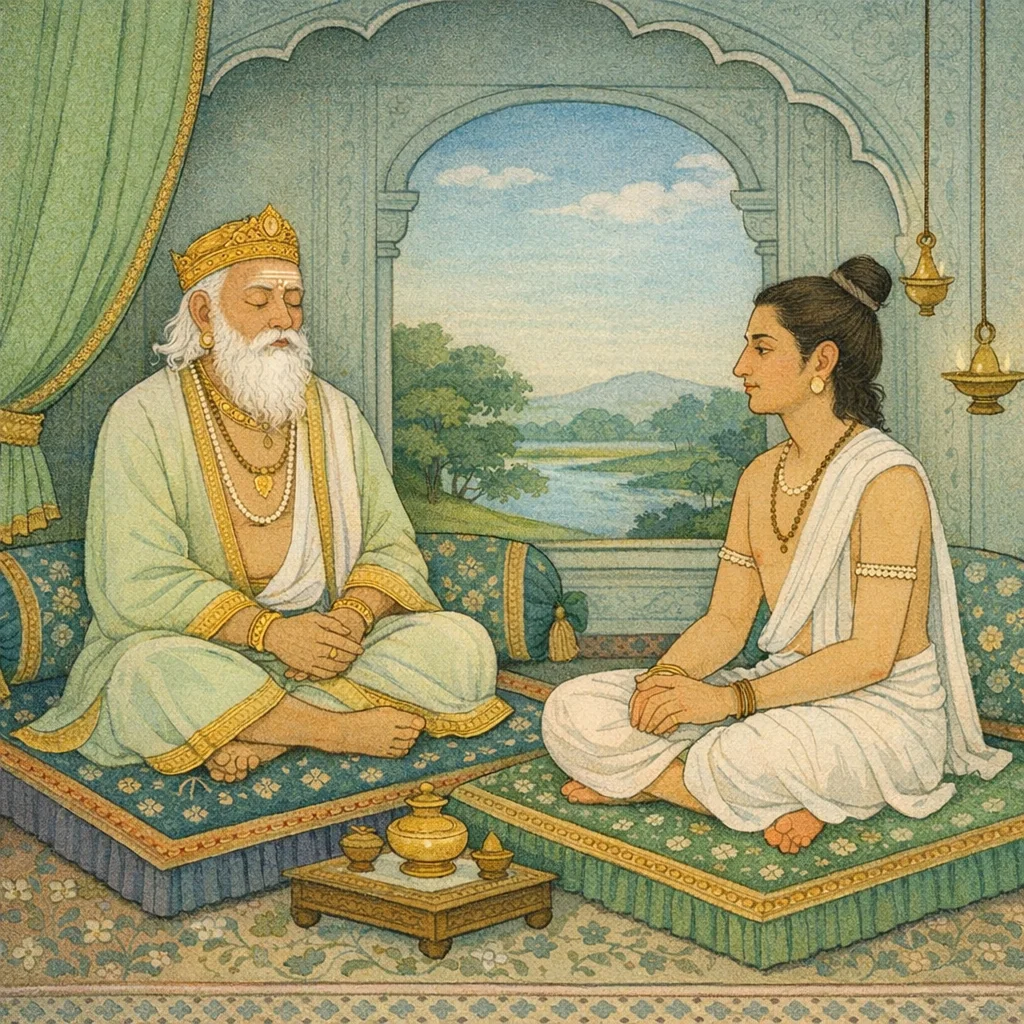
Chapter 41.0 opens with Dhṛtarāṣṭra requesting any remaining, unspoken counsel from Vidura, acknowledging the unusual depth of Vidura’s speech. Vidura responds by pointing to the “ancient, eternal” Kumāra—Sanatsujāta—who has taught that death is not ultimate, and who can articulate both esoteric and accessible teachings grounded in the heart. Dhṛtarāṣṭra presses Vidura to speak directly; Vidura demurs, citing his birth in a śūdra womb and claiming he is not fit to expand beyond what he has already conveyed, while affirming the permanence of the Kumāra’s wisdom. Dhṛtarāṣṭra then asks for the means of meeting that ancient teacher “here and now” in the body. Vaiśaṃpāyana narrates that Vidura meditates upon the sage; the sage, discerning the thought, appears and is received with proper rites. Vidura then petitions Sanatsujāta to resolve Dhṛtarāṣṭra’s mental doubt—one Vidura cannot answer—so that the king may become transcendent to pleasure and pain, and endure opposites such as gain/loss, fear/anger, hunger/thirst, lethargy/restlessness, and desire/anger.
Chapter Arc: विदुर के वचनों से उद्विग्न धृतराष्ट्र, राजसभा में सनत्सुजात को बुलाकर एक ही प्रश्न को पकड़ लेते हैं—यदि ‘मृत्यु नहीं’ तो देव-दानव तप करके ‘अमृतत्व’ क्यों चाहते रहे? → सनत्सुजात ‘मृत्यु’ के अर्थ को उलट देते हैं: कोई उसे कर्म-फल की अनिवार्यता मानता है, कोई अज्ञानजन्य भ्रान्ति। धृतराष्ट्र की जिज्ञासा बढ़ती है—कर्म, भोग, और देह-बंधन कैसे मनुष्य को मृत्यु के चक्र में घुमाते हैं? → उपदेश का शिखर तब आता है जब सनत्सुजात स्पष्ट करते हैं कि ‘मृत्यु’ का मूल अज्ञान है; कर्म-फल में आसक्ति और भोग-योग देही को बाँधते हैं, और विवेक-योग/सदर्थ-ज्ञान के अभाव में वह उससे ‘तर’ नहीं पाता। → सनत्सुजात क्षत्रिय-धर्म के भीतर ब्रह्म-प्राप्ति का मार्ग दिखाते हैं—संयम, सत्य, आर्जव, ह्री, दम, शौच, विद्या जैसे द्वारों से दुर्लभ ‘ब्राह्मी श्री’ (आध्यात्मिक समृद्धि) मिलती है; मान (अहंकार/प्रतिष्ठा) और मौन (अन्तर्मुख साधना) का सहवास कठिन है—इसलिए भीतर की साधना को प्रधान करो। → धृतराष्ट्र के भीतर ज्ञान की झलक तो पड़ती है, पर प्रश्न शेष रहता है—क्या वह इस उपदेश को अपने पुत्र-मोह और राज्य-आसक्ति पर लागू कर पाएँगे?
Shlokas
Verse 1
अत द्विचत्वारिशोड् ध्याय: सनत्सुजातजीके द्वारा धृतराष्ट्रके विविध प्रश्नोंका उत्तर वैशम्पायन उवाच ततो राजा धृतराष्ट्रो मनीषी सम्पूज्य वाक्यं विदुरेरितं तत् सनत्सुजातं रहिते महात्मा पप्रच्छ बुद्धि परमां बुभूषन्,वैशम्पायनजी कहते हैं--जनमेजय! तदनन्तर बुद्धिमान एवं महामना राजा धुृतराष्ट्रने विदुरके कहे हुए उस वचनका भलीभाँति आदर करके उत्कृष्ट ज्ञानकी इच्छासे एकान्तमें सनत्सुजात मुनिसे प्रश्न किया
Vaiśampāyana said: Then the wise king Dhṛtarāṣṭra, having duly honored the counsel spoken by Vidura, questioned the great-souled sage Sanatsujāta in private, desiring to understand the highest wisdom.
Verse 2
धृतराष्ट उवाच सनत्सुजात यदिदं शृणोमि न मृत्युरस्तीति तव प्रवादम् । देवासुरा ह्याचरन् ब्रह्मचर्य- ममृत्यवे तत् कतरन्नु सत्यम्,धृतराष्ट्र बोले--सनत्सुजातजी! मैं यह सुना करता हूँ कि मृत्यु है ही नहीं, ऐसा आपका सिद्धान्त है। साथ ही यह भी सुना है कि देवता और असुरोंने मृत्युसे बचनेके लिये ब्रह्मचर्यका पालन किया था। इन दोनोंमें कौन-सी बात यथार्थ है?
Dhṛtarāṣṭra said: “Sanatsujāta, I hear this doctrine of yours—that death does not truly exist. Yet I also hear that the gods and the asuras practiced brahmacarya in order to become free from death. Of these two accounts, which is the truth?”
Verse 3
सनत्युजात उवाच अमृत्यु: कर्मणा केचिन्मृत्युर्नास्तीति चापरे । शृणु मे ब्रुवतो राजन् यथैतन्मा विशड्किथा:,सनत्सुजातने कहा--राजन्! (इस विषयमें दो पक्ष हैं) मृत्यु है और वह (ब्रह्मचर्ययालनरूप) कर्मसे दूर होती है--यह एक पक्ष है और "मृत्यु है ही नहीं--यह दूसरा पक्ष है। परंतु यह बात जैसी है, वह मैं तुम्हें बताता हूँ, सुनो और मेरे कथनमें संदेह न करना
Sanatsujāta said: “Some hold that death exists, yet can be overcome by disciplined practice; others declare that death does not exist at all. O King, listen as I explain the truth of this matter—just as it is—and do not doubt my words.”
Verse 4
उभे सत्ये क्षत्रियैतस्य विद्धि मोहान्मृत्यु: सम्मतो5यं कवीनाम् । प्रमाद॑ वै मृत्युमहं ब्रवीमि तथाप्रमादममृतत्वं ब्रवीमि,क्षत्रिय! इस प्रश्नके उक्त दोनों ही पहलुओंको सत्य समझो। कुछ विद्वानोंने मोहवश इस मृत्युकी सत्ता स्वीकार की है; किंतु मेरा कहना तो यह है कि प्रमाद ही मृत्यु है और अप्रमाद ही अमृत है
Know, O Kshatriya, that both aspects of this matter are true. Some poets and sages, through delusion, have accepted death as a real and final power; but I declare that heedlessness itself is death, and that freedom from heedlessness is immortality.
Verse 5
प्रमादाद् वै असुरा: पराभव- न्नप्रमादाद् ब्रह्मभूता: सुराश्ष । नैव मृत्युर्व्याघ्र इवात्ति जन्तून् न हास्य रूपमुपलभ्यते हि,प्रमादके ही कारण असुरगण (आसुरी सम्पत्तिवाले) मृत्युसे पराजित हुए और अप्रमादसे ही देवगण (दैवी सम्पत्तिवाले) ब्रह्मस्वरूप हुए। यह निश्चय है कि मृत्यु व्याप्रके समान प्राणियोंका भक्षण नहीं करती, क्योंकि उसका कोई रूप देखनेमें नहीं आता
Sanatsujāta teaches that the asura-like disposition meets defeat through heedlessness, while the deva-like disposition attains a brahman-like state through vigilance and wakefulness. Death, he says, does not visibly devour beings the way a tiger does, for death has no form that can be directly perceived; it overcomes through the inner cause of negligence rather than by a seen, graspable shape.
Verse 6
यम॑ त्वेके मृत्युमतो<न्यमाहु- रात्मावसन्नममृतं ब्रह्मचर्यम् । पितृलोके राज्यमनुशास्ति देव: शिव: शिवानामशिवो5शिवानाम्,कुछ लोग इस प्रमादसे भिन्न “यम” को मृत्यु कहते हैं और हृदयसे दृढ़तापूर्वक पालन किये हुए ब्रह्मचर्यको ही अमृत मानते हैं। यमदेव पितृलोकमें राज्य-शासन करते हैं। वे पुण्यात्माओंके लिये मंगलमय और पापियोंके लिये अमंगलमय हैं
Some declare that this ‘Yama’ is none other than Death; others say that steadfastly upheld brahmacarya—self-restraint rooted in the heart—is immortality itself. The god Yama rules and administers the realm of the ancestors; to the virtuous he is auspicious, and to the wicked he is inauspicious.
Verse 7
अस्यादेशान्रि:सरते नराणां क्रोध: प्रमादो लोभरूपश्न मृत्यु: । अहंगतेनैव चरन् विमार्गान् न चात्मनो योगमुपैति कश्चित्,इन यमकी आज्ञासे ही क्रोध, प्रमाद और लोभरूपी मृत्यु मनुष्योंके विनाशमें प्रवृत्त होती है। अहंकारके वशीभूत होकर विपरीत मार्गपर चलता हुआ कोई भी मनुष्य परमात्माका साक्षात्कार नहीं कर पाता
From the sway of this (inner) command, there issues forth among human beings a death in the forms of anger, heedlessness, and greed—driving them toward ruin. One who, mastered by ego, walks the wrong path does not attain union with the Self; no such person reaches true realization of the Supreme.
Verse 8
ते मोहितास्तद्वशे वर्तमाना इतः प्रेतास्तत्र पुन: पतन्ति । ततस्तान् देवा अनुविप्लवन्ते अतो मृत्युर्मरणाख्यामुपैति,मनुष्य (क्रोध, प्रमाद और लोभसे) मोहित होकर अहंकारके अधीन हो इस लोकसे जाकर पुनः-पुनः जन्म-मरणके चक्क्करमें पड़ते हैं। मरनेके बाद उनके मन, इन्द्रिय और प्राण भी साथ जाते हैं। शरीरसे प्राणरूपी इन्द्रियोंका वियोग होनेके कारण मृत्यु 'मरण' संज्ञाको प्राप्त होती है
Sanatsujāta explains that people, deluded and living under the sway of that delusion, depart from this world and then fall again and again into further states of existence. There, the divine powers unsettle and drive them onward, so that death comes to be known as “dying”—the repeated breaking of embodied life. The ethical point is that when a person is overpowered by passions such as anger, heedlessness, and greed, pride and bondage follow, and the cycle of repeated birth-and-death continues.
Verse 9
कर्मोदये कर्मफलानुरागा- स्तत्रानुयान्ति न तरन्ति मृत्युम् । सदर्थयोगानवगमात् समन्तात् प्रवर्तते भोगयोगेन देही,प्रारब्ध कर्मका उदय होनेपर कर्मके फलमें आसक्ति रखनेवाले लोग (देहत्यागके पश्चात) परलोकका अनुगमन करते हैं; इसीलिये वे मृत्युकी पार नहीं कर पाते। देहाभिमानी जीव परमात्मसाक्षात्कारके उपायको न जाननेसे विषयोंके उपभोगके कारण सब ओर (नाना प्रकारकी योनियोंमें) भटकता रहता है
Sanatsujāta says: When one’s operative karma comes to fruition, those who cling to the fruits of action follow the course of the other world after leaving the body; therefore they do not cross beyond Death. Not understanding on all sides the true discipline that leads to the highest good (realization of the Self), the embodied being—bound by identification with the body—keeps moving on through the enjoyment of sense-objects, wandering in many forms of existence.
Verse 10
तद् वै महामोहनमिन्द्रियाणां मिथ्यार्थयोगस्य गतिर्हि नित्या । मिथ्यार्थयोगाभिहतान्तरात्मा स्मरन्नुपास्ते विषयान् समन्तात्,इस प्रकार विषयोंका जो भोग है, वह अवश्य ही इन्द्रियोंको महान् मोहमें डालनेवाला है और इन झूठे विषयोंमें राग रखनेवाले मनुष्यकी उनकी ओर प्रवृत्ति होनी स्वाभाविक है। मिथ्याभोगोंमें आसक्ति होनेसे जिसके अन्त:करणकी ज्ञानशक्ति नष्ट हो गयी है, वह सब ओर विषयोंका ही चिन्तन करता हुआ मन-ही-मन उनका आस्वादन करता है
Indeed, the enjoyment of sense-objects is a great delusion for the senses; and for one who clings to unreal aims, the mind’s movement toward them becomes habitual. When the inner self has been struck down by attachment to such illusory enjoyments—its power of discernment impaired—one remembers and mentally serves the objects of desire on every side, tasting them inwardly even without outward action.
Verse 11
अभिध्या वै प्रथमं हन्ति लोकान् कामक्रोधावनुगृहाशु पश्चात् । एते बालान् मृत्यवे प्रापयन्ति धीरास्तु धैर्येण तरन्ति मृत्युम्,पहले तो विषयोंका चिन्तन ही लोगोंको मारे डालता है। इसके बाद वह काम और क्रोधको साथ लेकर पुनः जल्दी ही प्रहार करता है। इस प्रकार ये विषय-चिन्तन (काम और क्रोध) ही विवेकहीन मनुष्यों-को मृत्युके निकट पहुँचाते हैं; परंतु जो स्थिर बुद्धिवाले पुरुष हैं, वे धैर्यसे मृत्युके पार हो जाते हैं
Sanatsujāta says: “First, brooding desire (fixation on sense-objects) strikes people down. Then, quickly, it attacks again, taking desire and anger as its allies. In this way, this fixation—together with desire and wrath—drives the undiscerning toward death; but the steadfast and wise cross beyond death by firmness and self-control.”
Verse 12
सोभिध्यायन्नुत्पतितान् निहन्या- दनादरेणाप्रतिबुध्यमान: । नैनं मृत्युर्मुत्युरिवात्ति भूत्वा एवं विद्वान यो विनिहन्ति कामान्,(अत: जो मृत्युको जीतनेकी इच्छा रखता है,) उसे चाहिये कि परमात्माका ध्यान करके विषयोंको तुच्छ मानकर उन्हें कुछ भी न गिनते हुए उनकी कामनाओंको उत्पन्न होते ही नष्ट कर डाले। इस प्रकार जो विद्वान विषयोंकी इच्छाको मिटा देता है, उसको [साधारण प्राणियोंकी] मृत्युकी भाँति मृत्यु नहीं मारती (अर्थात् वह जन्म-मरणसे मुक्त हो जाता है)
Let a seeker, fixing his mind on the Supreme, strike down desires the moment they arise—treating sense-objects with utter disregard and not being lulled into heedlessness by them. For one who thus, with understanding, destroys cravings, Death does not devour him as it devours ordinary beings; he passes beyond the cycle of birth and dying.
Verse 13
कामानुसारी पुरुष: कामाननु विनश्यति । कामान् व्युदस्य धुनुते यत् किंचित् पुरुषो रज:,कामनाओंके पीछे चलनेवाला मनुष्य कामनाओंके साथ ही नष्ट हो जाता है; परंतु ज्ञानी पुरुष कामनाओंका त्याग कर देनेपर जो कुछ भी जन्म-मरणरूप दुःख है, उन सबको वह नष्ट कर देता है
Sanatsujāta teaches that a person who follows after desires is ruined along with those very desires. But the wise person, having cast off desire, shakes away whatever inner defilement remains and thereby overcomes the suffering bound up with repeated birth and death.
Verse 14
तमो<प्रकाशो भूतानां नरको<यं प्रदृश्यते । मुहान्त इव धावन्ति गच्छन्त: श्वभ्रवत् सुखम्,काम ही समस्त प्राणियोंके लिये मोहक होनेके कारण तमोमय और अज्ञानरूप है तथा नरकके समान दुःखदायी देखा जाता है। जैसे मद्यपानसे मोहित हुए पुरुष चलते-चलते गड्ढडेकी ओर दौड़ पड़ते हैं, वैसे ही कामी पुरुष भागोंमें सुख मानकर उनकी ओर दौड़ते हैं
Sanatsujāta teaches that desire (kāma) is a deluding force: it is darkness without illumination for living beings, and it is seen to be hell-like in the suffering it brings. As men intoxicated by drink, confused in mind, may run while walking and rush toward a pit, so do those driven by desire hurry toward sense-objects, mistaking them for happiness—only to fall into harm.
Verse 15
अमूढवत्ते: पुरुषस्येह कुर्यात् कि वै मृत्युस्तार्ण इवास्य व्याघ्र: । अमन्यमान: क्षत्रिय किंचिदन्य- न्नाधीयीत निर्णुदन्निवास्य चायु:,जिसके चित्तकी वृत्तियाँ विषयभोगोंसे मोहित नहीं हुई हैं, उस ज्ञानी पुरुषका इस लोकमें तिनकोंके बनाये हुए व्याप्रके समान मृत्यु क्या बिगाड़ सकती है? इसलिये राजन! विषयभोगोंके मूल कारणरूप अज्ञानको नष्ट करनेकी इच्छासे दूसरे किसी भी सांसारिक पदार्थको कुछ भी न गिनकर उसका चिन्तन त्याग देना चाहिये
For a person whose mental movements are not deluded by sense-enjoyments, what harm can Death do here—like a tiger made of straw? Therefore, O Kṣatriya, wishing to uproot the ignorance that is the very root of worldly enjoyment, one should regard no other worldly thing as worth counting, and should abandon brooding over it—thus, as it were, driving away the span of life’s fear and bondage.
Verse 16
स क्रोधलो भौ मोहवानन्तरात्मा स वै मृत्युस्त्वच्छरीरे य एष: । एवं मृत्युं जायमानं विदित्वा ज्ञाने तिष्ठन् न बिभेतीह मृत्यो: । विनश्यते विषये तस्य मृत्यु- मृत्योर्यथा विषयं प्राप्य मर्त्य:,यह जो तुम्हारे शरीरके भीतर अन्तरात्मा है, मोहके वशीभूत होकर यही क्रोध, लोभ (प्रमाद) और मृत्युरूप हो जाता है। इस प्रकार मोहसे होनेवाली मृत्युकों जानकर जो ज्ञाननिष्ठ हो जाता है, वह इस लोकमें मृत्युसे कभी नहीं डरता। उसके समीप आकर मृत्यु उसी प्रकार नष्ट हो जाती है, जैसे मृत्युके अधिकारमें आया हुआ मरणथधर्मा मनुष्य
That inner Self within your body, when overpowered by delusion, becomes anger and greed—and indeed becomes death itself. Knowing thus how death is born from delusion, one who stands firm in true knowledge does not fear death in this world. For death, when it comes near such a person, is destroyed—just as a mortal perishes when he falls within the domain of Death.
Verse 17
धृतराष्ट्र रवाच यानेवाहुरिज्यया साधुलोकान् द्विजातीनां पुण्यतमान् सनातनान् | तेषां परार्थ कथयन्तीह वेदा एतद् विद्वान नोपैति कथं नु कर्म,धृतराष्ट्र बोले--द्विजातियोंके लिये यज्ञोंद्वारा जिन पवित्रतम सनातन एवं श्रेष्ठ लोकोंकी प्राप्ति बतायी गयी है, यहाँ वेद उन्हींको परम पुरुषार्थ कहते हैं। इस बातको जाननेवाला दविद्दान् उत्तम कर्मोंका आश्रय क्यों न ले
Dhṛtarāṣṭra said: “Those eternal and most meritorious worlds for the twice-born which are said to be attained through sacrifice—here the Vedas themselves proclaim these as the highest human aim. Knowing this, why would a wise person not take refuge in righteous action? How, then, could one fail to pursue such karma?”
Verse 18
सनत्युजात उवाच एवं ह्ुविद्वानुपयाति तत्र तत्रार्थजातं च वदन्ति वेदा: । अनीह आयाति परं परात्मा प्रयाति मार्गेण निहत्य मार्गान्,सनत्सुजातने कहा--राजन्! अज्ञानी पुरुष इस प्रकार भिन्न-भिन्न लोकोंमें गमन करता है तथा वेद कर्मके बहुत-से प्रयोजन भी बताते हैं; परंतु जो निष्काम पुरुष है, वह ज्ञानमार्गके द्वारा अन्य सभी मार्गोंका बाध करके परमात्मस्वरूप होता हुआ ही परमात्माको प्राप्त होता है
Sanatsujāta said: “Thus the unknowing person goes from one state to another, and the Vedas also speak of many aims connected with action. But the desireless person, by the path of knowledge, subdues all other paths and—abiding as the Supreme Self—attains the Supreme.”
Verse 19
धृतराष्ट्र रवाच को5सौ नियुद्धक्ते तमजं पुराणं स चेदिदं सर्वमनुक्रमेण । कि वास्य कार्यमथवा सुखं च तन्मे विद्वन् ब्रूहि सर्व यथावत्,धृतराष्ट्र बोले--विद्वन! यदि वह परमात्मा ही क्रमश: इस सम्पूर्ण जगतके रूपमें प्रकट होता है तो उस अजन्मा और पुरातन पुरुषपर कौन शासन करता है? अथवा उसे इस रूपमें आनेकी क्या आवश्यकता है और क्या सुख मिलता है?--यह सब मुझे ठीक-ठीक बताइये
Dhṛtarāṣṭra said: “Learned one, if that unborn and ancient Being manifests, in due order, as this entire universe, then who can command or govern Him? And what purpose is served by His appearing in this form—what benefit or ‘happiness’ accrues to Him thereby? Tell me all this correctly and in full.”
Verse 20
सनत्युजात उवाच दोषो महानत्र विभेदयोगे हानादियोगेन भवन्ति नित्या: । तथास्य नाधिक्यमपैति किंचि- दनादियोगेन भवन्ति पुंस:,सनत्सुजातने कहा--तुम्हारे इस प्रश्नके अनुसार जीव और ब्रह्मका विशेष भेद प्राप्त होता है, जिसे स्वीकार कर लेनेपर वेदविरोधरूप महान् दोषकी प्राप्ति होती है। अतएव अनादि मायाके सम्बन्धसे जीवोंका कामसुख आदिसे सम्बन्ध होता रहता है। ऐसा होनेपर भी जीवकी महत्ता नष्ट नहीं होती; क्योंकि मायाके सम्बन्धसे जीवके देहादि पुनः उत्पन्न होते रहते हैं
Sanatsujāta said: “A grave fault arises here if one insists on a doctrine of absolute separation; for through association with loss and the like, such conditions appear as though constant. Yet the person’s true excellence is not diminished in the least; for it is only through beginningless association that these states come to be for embodied beings.”
Verse 21
य एतद् वा भगवान् स नित्यो विकारयोगेन करोति विश्वम् । तथा च तच्छक्तिरिति सम मन्यते तथार्थयोगे च भवन्ति वेदा:,जो नित्यस्वरूप भगवान् हैं, वे ही परब्रह्म मायाके सहयोगसे इस विश्वत्रह्माण्डकी सृष्टि करते हैं। वह माया उन्हीं परब्रह्मकी शक्ति है। महात्मा पुरुष इसे मानते हैं। इस प्रकारके अर्थके प्रतिपादनमें वेद भी प्रमाण हैं
Sanatsujāta said: “That eternal Lord brings forth this entire universe through the association of transformative power (māyā). That power is understood to be His own śakti. The wise accept it so; and in establishing this very meaning, the Vedas too stand as authoritative testimony.”
Verse 22
धघतयद्र उवाच ये5स्मिन् धर्मान् नाचरन्तीह केचित् तथा धर्मान् केचिदिहाचरन्ति । धर्म: पापेन प्रतिहन्यते स्वि- दुताहो धर्म: प्रतिहन्ति पापम्,धृतराष्ट्र बोले--इस जगत्में कुछ लोग ऐसे हैं, जो धर्मका आचरण नहीं करते तथा कुछ लोग उसका आचरण करते हैं, अतः धर्म पापके द्वारा नष्ट होता है या धर्म ही पापको नष्ट कर देता है?
Dhṛtarāṣṭra said: In this world, some people do not practice dharma, while others do practice it. Tell me then—does dharma get destroyed by sin, or does dharma itself destroy sin?
Verse 23
सनत्सुजात उवाच उभयमेव तत्रोपयुज्यते फलं धर्मस्यैवेतरस्य च,सनत्सुजातने कहा--राजन! धर्म और पाप दोनोंके पृथक्-पृथक् फल होते हैं और उन दोनोंका ही उपभोग करना पड़ता है
Sanatsujāta said: “O King, in that matter both results come to be experienced—the fruit of dharma and also the fruit of its opposite (adharma). Each bears its own distinct consequence, and one must undergo the enjoyment or suffering that follows from both.”
Verse 24
तस्मिन् स्थितो वाप्युभयं हि नित्यं ज्ञानेन विद्वान् प्रतिहन्ति सिद्धम् | तथान्यथा पुण्यमुपैति देही तथागतं पापमुपैति सिद्धम्,किंतु परमात्मामें स्थित होनेपर विद्वान् पुरुष उस (परमात्माके) ज्ञानके द्वारा अपने पूर्वकृत पाप और पुण्य दोनोंका नाश कर देता है; यह बात सदा प्रसिद्ध है। यदि ऐसी स्थिति नहीं हुई तो देहाभिमानी मनुष्य कभी पुण्यफलको प्राप्त करता है और कभी क्रमशः प्राप्त हुए पूर्वोपार्जित पापके फलका अनुभव करता है
Established in That (the Supreme Self), the wise person, by the knowledge of the Self, destroys both—merit and demerit—this is an ever-acknowledged truth. Otherwise, the embodied being, identifying with the body, at one time attains the fruit of merit, and at another time inevitably undergoes the ripened fruit of previously acquired sin.
Verse 25
गत्वोभयं कर्मणा युज्यते<स्थिरं शुभस्य पापस्य स चापि कर्मणा । धर्मेण पापं प्रणुदतीह विद्वान् धर्मो बलीयानिति तस्य सिद्धि:,इस प्रकार पुण्य और पापके जो स्वर्ग-नरकरूप दो अस्थिर फल हैं, उनका भोग करके वह (इस जगत्में जन्म ले) पुनः तदनुसार कर्मोमें लग जाता है; किंतु कर्मोंके तत्त्वको जाननेवाला पुरुष निष्कामधर्मरूप कर्मके द्वारा अपने पूर्वपापका यहाँ ही नाश कर देता है। इस प्रकार धर्म ही अत्यन्त बलवान् है। इसलिये निष्कामभावसे धर्माचरण करनेवालोंको समयानुसार अवश्य सिद्धि प्राप्त होती है
Having experienced both outcomes—those unstable fruits of merit and sin (heaven and hell)—a person is born again in this world and, in accordance with those results, becomes engaged once more in action. But the wise one who understands the truth of action drives away former sin here itself through dharma performed without selfish motive. Thus dharma is the stronger power; therefore, for those who practice dharma in a desireless spirit, success is surely attained in due course.
Verse 26
धघतयाट्र उवाच यानिहाहुः स्वस्य धर्मस्य लोकान् द्विजातीनां पुण्यकृतां सनातनान् । तेषां क्रमान् कथय ततो<पि चान्यान् नैतद् विद्वन् वेत्तुमिच्छामि कर्म,धृतराष्ट्र बोले-विद्वन! पुण्यकर्म करनेवाले द्विजातियोंको अपने-अपने धर्मके फलस्वरूप जिन सनातन लोकोंकी प्राप्ति बतायी गयी है, उनका क्रम बतलाइये तथा उनसे भिन्न जो अन्यान्य लोक हैं, उनका भी निरूपण कीजिये। अब मैं सकाम कर्मकी बात नहीं जानना चाहता
Dhṛtarāṣṭra said: “Learned one, describe in due order those eternal worlds that are said to be attained by the twice-born who perform meritorious deeds, each according to his own dharma. And also explain the other worlds distinct from those. I do not wish to know about action performed with desire for its fruits.”
Verse 27
सनत्युजात उवाच येषां व्रतेडथ विस्पर्धा बले बलवतामिव । ते ब्राह्मणा इतः प्रेत्य ब्रह्मलोकप्रकाशका:,सनत्सुजातने कहा--जैसे दो बलवान वीरोंमें अपना बल बढ़ानेके निमित्त एक- दूसरेसे स्पर्धा रहती है, उसी प्रकार जो निष्कामभावसे यम-नियमादिके पालनमें दूसरोंसे बढ़नेका प्रयास करते हैं, वे ब्राह्मण यहाँसे मरकर जानेके बाद ब्रह्मलोकमें अपना प्रकाश फैलाते हैं
Sanatsujāta said: Just as two mighty warriors contend with one another in strength in order to increase their power, so too those brāhmaṇas who, with disciplined vows, strive to excel in observances and self-restraint—free from selfish desire—after departing from this world shine forth in the realm of Brahman, spreading their radiance there.
Verse 28
येषां धर्मे च विस्पर्धा तेषां तज्ज्ञानसाधनम् | ते ब्राह्मणा इतो मुक्ता: स्वर्ग यान्ति त्रिविष्टपम्,जिनकी धर्मके पालनमें स्पर्धा है, उनके लिये वह ज्ञानका साधन है; किंतु वे ब्राह्मण (यदि सकाम-भावसे उसका अनुष्ठान करें) तो मृत्युके पश्चात् यहाँसे देवताओंके निवासस्थान स्वर्गमें जाते हैं
For those who strive competitively in the observance of dharma, that very striving becomes a means toward true knowledge. But such Brahmins, once released from this world at death, go to heaven—Triviṣṭapa, the abode of the gods.
Verse 29
तस्य सम्यक् समाचारमाहुर्वेदविदो जना: । नैनं मन्येत भूयिष्ठं बाह्माभ्यन्तरं जनम्,ब्राह्मणके सम्यक् आचारकी वेदवेत्ता पुरुष प्रशंसा करते हैं, किंतु जो धर्मपालनमें बहिर्मुख है, उसे अधिक महत्त्व नहीं देना चाहिये। जो (निष्कामभावपूर्वक) धर्मका पालन करनेसे अन्तर्मुख हो गया है, ऐसे पुरुषको श्रेष्ठ समझना चाहिये। जैसे वर्षा-ऋतुमें तृण- घास आदिकी बहुतायत होती है, उसी प्रकार जहाँ ब्राह्मणके योग्य अन्न-पान आदिकी अधिकता मालूम पड़े, उसी देशमें रहकर वह जीवननिर्वाह करे। भूख-प्याससे अपनेको वष्ट नहीं पहुँचावे
Sanatsujāta said: “Those who know the Veda speak of his conduct as truly proper. Yet one should not value a person merely for outward or social markers—whether external or internal—if he is turned away from the actual practice of dharma. Rather, the truly superior person is the one who has become inwardly oriented through the selfless observance of dharma.”
Verse 30
यत्र मन्येत भूयिष्ठं प्रावषीव तृणोपलम् । अन्नं पान॑ ब्राह्मणस्य तज्जीवेन्नानुसंज्वरेत्,ब्राह्मणके सम्यक् आचारकी वेदवेत्ता पुरुष प्रशंसा करते हैं, किंतु जो धर्मपालनमें बहिर्मुख है, उसे अधिक महत्त्व नहीं देना चाहिये। जो (निष्कामभावपूर्वक) धर्मका पालन करनेसे अन्तर्मुख हो गया है, ऐसे पुरुषको श्रेष्ठ समझना चाहिये। जैसे वर्षा-ऋतुमें तृण- घास आदिकी बहुतायत होती है, उसी प्रकार जहाँ ब्राह्मणके योग्य अन्न-पान आदिकी अधिकता मालूम पड़े, उसी देशमें रहकर वह जीवननिर्वाह करे। भूख-प्याससे अपनेको वष्ट नहीं पहुँचावे
Sanatsujāta teaches that a Brahmin should sustain himself in a place where the means of simple livelihood—food and drink suitable for a Brahmin—are found in abundance, as grasses and plants abound in the rainy season. Living there, he should maintain life without tormenting himself with hunger and thirst.
Verse 31
यत्राकथयमानस्य प्रयच्छत्यशिवं भयम् | अतिरिक्तमिवाकुर्वन् स श्रेयान् नेतरो जन:,किंतु जहाँ अपना माहात्म्य प्रकाशित न करनेपर भय और अमंगल प्राप्त हो, वहाँ रहकर भी जो अपनी विशेषता प्रकट नहीं करता, वही श्रेष्ठ पुरुष है; दूसरा नहीं
When a person’s remaining silent and not speaking of himself brings about fear and ill-omen, even then the one who does not put on an air of superiority—who does not display himself as ‘something extra’—is the better man; not the other sort of person.
Verse 32
यो वा कथयमानस्य हाात्मानं नानुसंज्वरेत् । ब्रह्मास्वं नोपभुज्जीत तदन्न॑ सम्मतं सताम्,जो किसीको आत्मप्रशंसा करते देख जलता नहीं तथा ब्राह्मणके स्वत्वका उपभोग नहीं करता, उसके अन्नको स्वीकार करनेमें सत्पुरुषोंकी सम्मति है
He who does not burn with envy when another speaks in self-praise, and who does not appropriate what belongs to a brāhmaṇa, is a person whose food may rightly be accepted—such is the approval of the virtuous.
Verse 33
यथा स्वं वान्तमश्नाति शवा वै नित्यमभूतये । एवं ते वान्तमश्रन्ति स्ववीर्यस्योपसेवनात्,जैसे कुत्ता अपना वमन किया हुआ भी खा लेता है, उसी प्रकार जो अपने (ब्राह्मणत्वके) प्रभावका प्रदर्शन करके जीविका चलाते हैं, वे ब्राह्मण वमनका भोजन करनेवाले हैं और इससे उनकी सदा ही अवनति होती है
Sanatsujāta said: “Just as a dog, to its constant ruin, eats its own vomit, so too those people feed on what is like vomit—living by parading their own ‘power’ (their status and spiritual potency). By making a livelihood out of such self-display, they fall into continual degradation.”
Verse 34
नित्यमज्ञातचर्या मे इति मन्येत ब्राह्मण: । ज्ञातीनां तु वसन् मध्ये तं विदुर्ब्राह्मणं बुधा:,जो कुटुम्बीजनोंके बीचमें रहकर भी अपनी साधनाको उनसे सदा गुप्त रखनेका प्रयत्न करता है, ऐसे ब्राह्मणोंको ही विद्वान पुरुष ब्राह्मण मानते हैं
Sanatsujāta said: “A true brāhmaṇa should constantly regard his spiritual discipline as something to be kept unknown—thinking, ‘My conduct is ever unobserved.’ Even while living among his own kinsmen, the wise recognize as a brāhmaṇa the one who strives to keep his inner practice and austerity concealed from them.”
Verse 35
को हानन्तरमात्मानं ब्राह्मणो हन्तुमरहति । निर्लिड्रमचलं शुद्ध सर्वद्वैतविवर्जितम्,इस प्रकार जो भेदशून्य, चिह्लरहित, अविचल, शुद्ध एवं सब प्रकारके द्वैतसे रहित आत्मा है, उसके स्वरूपको जाननेवाला कौन ब्रह्मवेत्ता पुछ्ण उसका हनन (अधःपतन) करना चाहेगा?
Sanatsujāta said: Who among brahmins—one who truly knows—would ever wish to strike down (cause the fall of) the Self, which is without any mark or stain, unmoving, pure, and wholly free from all duality? The knower of that non-different Self has no impulse to harm it, for it is beyond injury and beyond the very notion of ‘otherness’ that makes violence conceivable.
Verse 36
तस्माद्धि क्षत्रियस्यापि ब्रह्मावसति पश्यति,इसलिये उपर्युक्तरूपसे जीवन बितानेवाला क्षत्रिय भी ब्रह्मके स््वरूपका अनुभव करता है तथा ब्रह्मको प्राप्त होता है
Therefore, even a kṣatriya—when living in the disciplined manner described above—comes to perceive Brahman dwelling within (as the indwelling reality) and thereby attains Brahman. The teaching affirms that realization is not barred by social role; righteous conduct and inner restraint make the highest knowledge accessible even amid a warrior’s duties.
Verse 37
योअन्यथा सन्तमात्मानमन्यथा प्रतिपद्यते । कि तेन न कृतं पापं चौरेणात्मापहारिणा,जो उक्त प्रकारसे वर्तमान आत्माको उसके विपरीत रूपसे समझता है, आत्माका अपहरण करनेवाले उस चोरने कौन-सा पाप नहीं किया?
Sanatsujāta said: “Whoever apprehends the Self that truly exists as something other than it is—what sin has not been committed by that thief who steals away his own Self?”
Verse 38
अश्रान्त: स्यादनादाता सम्मतो निरुपद्रव: । शिष्टो न शिष्टवत् स स्याद् ब्राह्माणो ब्रह्मवित् कवि:,जो कर्तव्य-पालनमें कभी थकता नहीं, दान नहीं लेता, सत्पुरुषोंमें सम्मानित और उपद्रवरहित है तथा शिष्ट होकर भी शिष्टताका विज्ञापन नहीं करता, वही ब्राह्मण ब्रह्मवेत्ता एवं विद्वान् है
Sanatsujāta says: A true brāhmaṇa is one who does not grow weary in doing what ought to be done, who does not accept gifts, who is honored among the virtuous and remains free from causing or attracting harm, and who—though genuinely cultured—does not advertise his refinement. Such a person is a knower of Brahman and a wise seer.
Verse 39
अनाढ्या मानुषे वित्ते आढ्या दैवे तथा क्रतौ । ते दुर्धर्षा दुष्प्र कम्प्पास्तान् विद्याद् ब्रह्मणस्तनुम्,जो लौकिक धनकी दृष्टिसे निर्धन होकर भी दैवी सम्पत्ति तथा यज्ञ-उपासना आदिसे सम्पन्न हैं, वे दुर्धर्ष हैं और किसी भी विषयसे चलायमान नहीं होते। उन्हें ब्रह्मकी साक्षात् मूर्ति समझना चाहिये
Sanatsujāta said: Those who are poor in merely human wealth, yet rich in divine treasure and in sacred rites (yajña and disciplined worship), are unassailable and not shaken by any circumstance. Such people should be recognized as the very embodiment of Brahman—living forms of the highest reality—because their stability comes from inner truth rather than external possessions.
Verse 40
सर्वान् स्विष्टकृतो देवान् विद्याद् य इह कश्नन । न समानो ब्राह्मणस्य तस्मिन् प्रयतते स्वयम्,यदि कोई इस लोकमें अभीष्ट सिद्ध करनेवाले सम्पूर्ण देवताओंको जान ले, तो भी वह ब्रह्मवेत्ताके समान नहीं होता; क्योंकि वह तो अभीष्ट फलकी सिद्धिके लिये ही प्रयत्न कर रहा है
Sanatsujāta says: Even if someone in this world were to know all the gods who are believed to grant desired successes, he still would not equal the true knower of Brahman. For that seeker of the gods strives only for the attainment of wished-for results, whereas the Brahman-knower stands beyond such goal-driven pursuit.
Verse 41
यमप्रयतमानं तु मानयन्ति स मानित: । न मान्यमानो मन्येत न मान्यमभिसंज्वरेत्,जो दूसरोंसे सम्मान पाकर भी अभिमान न करे और सम्माननीय पुरुषको देखकर जले नहीं तथा प्रयत्न न करनेपर भी विद्वानलोग जिसे आदर दें, वही वास्तवमें सम्मानित है
But he whom people honor even though he is not striving for honor—he alone is truly honored. One who is being respected should not grow proud, and on seeing a person worthy of respect he should not burn with jealousy.
Verse 42
लोक: स्वभाववृत्तिहिं निमेषोन्मेषवत् सदा । विद्वांसो मानयन्तीह इति मन्येत मानित:,जगत्में जब विद्वान् पुरुष आदर दें, तब सम्मानित व्यक्तिको ऐसा मानना चाहिये कि आँखोंको खोलने-मीचनेके समान अच्छे लोगोंकी यह स्वाभाविक वृत्ति है, जो आदर देते हैं इति श्रीमहाभारते उद्योगपर्वणि सनत्सुजातपर्वणि द्विचत्वारिंशो5ध्याय:
Sanatsujāta said: “In this world, the conduct that arises from one’s own nature goes on continually, like the opening and closing of the eyes. Therefore, when the learned show honor here, the one who is honored should understand it thus: ‘This is the natural disposition of good people—to offer respect.’”
Verse 43
अधर्मनिपुणा मूढा लोके मायाविशारदा: । न मान्यं मानयिष्यन्ति मान्यानामवमानिन:,किंतु इस संसारमें जो अधर्ममें निपुण, छल-कपटमें चतुर और माननीय पुरुषोंका अपमान करनेवाले मूढ़ मनुष्य हैं, वे आदरणीय व्यक्तियोंका भी आदर नहीं करते
Sanatsujāta said: In this world, those who are skilled in adharma, deluded in understanding, and adept at deceit do not honor what is truly worthy of honor. Habitual despisers of the honorable, they refuse respect even to those who deserve reverence—showing how adharma erodes the very capacity for ethical recognition and humility.
Verse 44
न वै मानं च मौनं च सहितौ वसत: सदा । अयं हि लोको मानस्य असौ मौनस्य तद् विदु:,यह निश्चित है कि मान और मौन सदा एक साथ नहीं रहते; क्योंकि मानसे इस लोकमें सुख मिलता है और मौनसे परलोकमें। ज्ञानीजन इस बातको जानते हैं
Sanatsujāta said: Pride and silence do not permanently dwell together. For this world rewards pride with its own kind of satisfaction and recognition, while silence—self-restraint and inwardness—bears fruit in the other world. The wise understand this distinction.
Verse 45
श्री: सुखस्येह संवास: सा चापि परिपन्थिनी । ब्राह्मी सुदुर्लभा श्रीहिं प्रज्ञाहीनेन क्षत्रिय,राजन्! लोकमें ऐश्वर्यरूपा लक्ष्मी सुखका घर मानी गयी है, पर वह भी (कल्याणमार्गमें) लुटेरोंकी भाँति विघ्न डालनेवाली है; किंतु ब्रह्मज्ञानमयी लक्ष्मी प्रज्ञाहीन मनुष्यके लिये सर्वथा दुर्लभ है
Sanatsujāta said: “In this world, prosperity (śrī) is regarded as the dwelling-place of comfort; yet that very prosperity can also become a highway-robber on the path of true welfare, obstructing one’s higher good. But the ‘Brahmic’ prosperity—wealth in the form of Brahman-knowledge—is exceedingly hard to obtain for a man who lacks discernment, O Kṣatriya king.”
Verse 46
द्वाराणि तस्येह वदन्ति सन््तो बहुप्रकाराणि दुराधराणि । सत्यार्जवे ह्वीर्दमशौचविद्या यथा न मोहप्रतिबोधनानि,संत पुरुष यहाँ उस बहाज्ञानमयी लक्ष्मीकी प्राप्तिके अनेकों द्वार बतलाते हैं, जो कि मोहको जगानेवाले नहीं हैं तथा जिनको कठिनतासे धारण किया जाता है। उनके नाम हैं-- सत्य, सरलता, लज्जा, दम, शौच और विद्या
The wise declare that here, in this world, there are many kinds of “gateways” to that higher good—gateways difficult to uphold: truthfulness, straightforwardness, modesty, self-restraint, purity, and true knowledge. These qualities do not awaken delusion; rather, they rouse one from it.
Frequently Asked Questions
Dhṛtarāṣṭra’s dilemma is epistemic and ethical: he senses that ordinary counsel is insufficient to dissolve his fear-driven uncertainty, and he seeks a teaching that can stabilize judgment beyond emotional and material opposites.
That the conquest of inner instability—especially fear of loss and mortality—precedes effective moral agency; hence a metaphysical clarification (via Sanatsujāta) is positioned as practical preparation for responsible rulership.
Rather than a formal phalaśruti, the chapter provides an explicit framing claim: hearing the forthcoming resolution will enable the king to move beyond sukha-duḥkha and endure paired opposites, indicating the intended transformative function of the instruction.