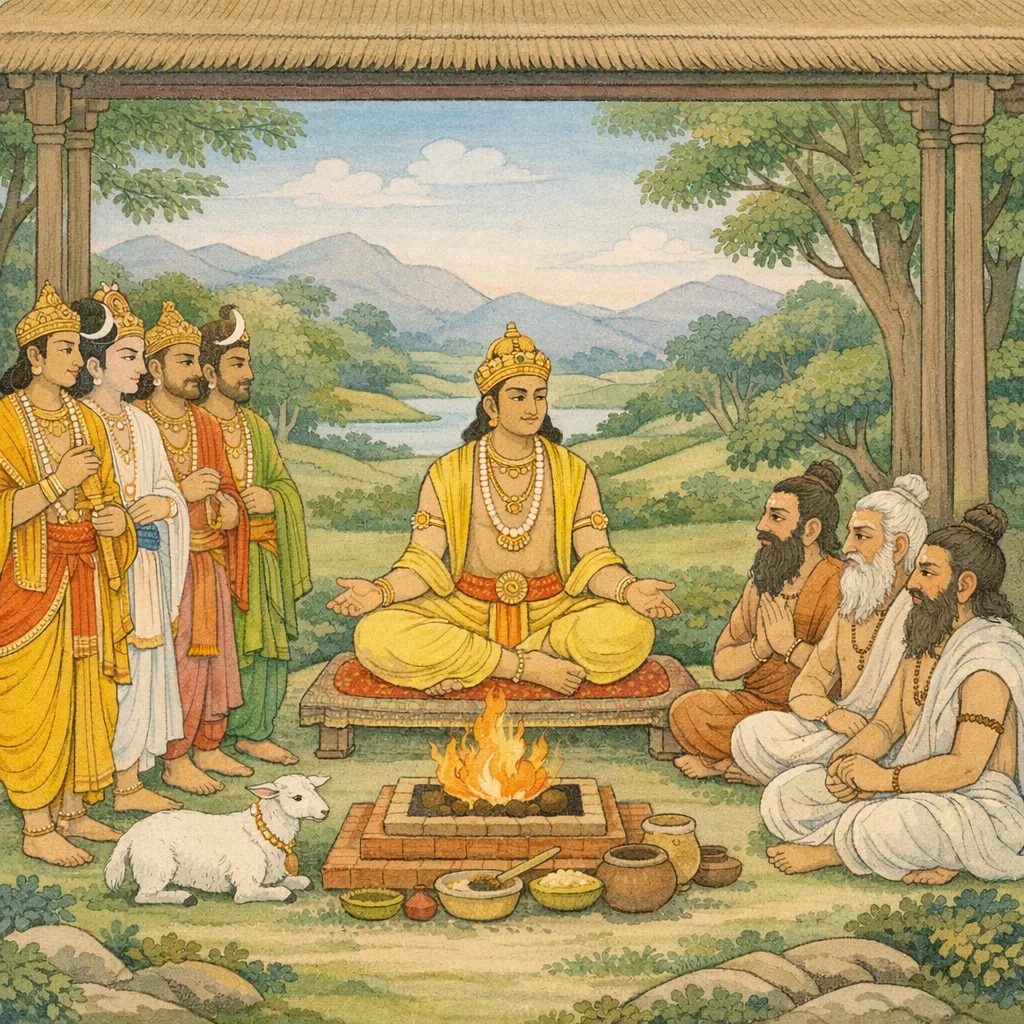
Adhyaya 338
Puruṣaikatva-vyākhyāna: The One Virāṭ Puruṣa and the Many ‘Puruṣas’ (Rudra–Brahmā Saṃvāda)
Upa-parva: Mokṣadharma Parva (Liberation Teachings Sub-Book)
Janamejaya asks whether there are many puruṣas or one, and which puruṣa is supreme, also inquiring about the ‘yoni’ (source/womb) spoken of in such discussions. Vaiśaṃpāyana responds that Sāṃkhya-Yoga analysts often speak of many puruṣas, yet he will explain the universal, guṇa-transcending Puruṣa as taught concisely by Vyāsa. He pays formal homage to Vyāsa and situates the teaching within the authority of the Puruṣa-sūkta, described as renowned across the Vedas and contemplated by eminent seers. An ancient narrative is then introduced: on the Vaijayanta mountain in the Milk Ocean, Brahmā practices concentrated contemplation on the Virāṭ Puruṣa. Rudra arrives, offers reverence, and asks why Brahmā has left a resplendent celestial abode to dwell alone. Brahmā states that he remains there to meditate single-pointedly on the Virāṭ. Rudra raises the doctrinal tension: Brahmā has created many puruṣas, and yet speaks of one Virāṭ Puruṣa as supreme. Brahmā affirms the plurality at one level but promises the ‘ādhāra’ (support) of the single Puruṣa: just as many beings can be said to have one yoni/source, so too the universe relates to one supreme, vast Puruṣa. The chapter culminates in a liberation-leaning claim: entering the eternal requires becoming ‘nirguṇa’ (beyond qualities) and approaching the supreme, nirguṇa reality as the final ground.
Chapter Arc: भीष्म युधिष्ठिर से कहते हैं कि ‘अज’ शब्द के अर्थ को लेकर देवताओं और ऋषियों के बीच एक प्राचीन विवाद हुआ था—और उसी एक शब्द ने यज्ञ-धर्म की दिशा बदल दी। → देवता ‘अजेन यष्टव्यम्’ का अर्थ ‘छाग (बकरा) से यज्ञ’ बताने लगते हैं, जबकि ब्राह्मण-ऋषि ‘अज’ को ‘अन्न/धान्य’ (अज = अजा नहीं, अन्न) मानते हैं। राजा वसु/उपरिचर वसु से निर्णय कराने की स्थिति बनती है; पक्षपात का भय बढ़ता है क्योंकि राजसत्ता का एक वचन शास्त्रार्थ को लोकाचार बना देता है। → देवताओं का मत जानकर वसु पक्ष-आश्रय से घोषणा कर देता है—‘अज’ का अर्थ ‘छाग’ है और यज्ञ पशु-बलि से ही होगा; यही वह क्षण है जहाँ शब्दार्थ का निर्णय धर्म-व्यवहार में हिंसा/अहिंसा की धुरी बन जाता है। → वसु बाद में विष्वक्सेन (नारायण) की पूजा आरम्भ करता है और नारायण-मुखोद्गत जप का आश्रय लेता है; परन्तु शास्त्रार्थ में पक्षपात के कारण उसे अधोगति/पतन का प्रसंग जुड़ता है—यह संकेत कि भक्ति भी तब तक रक्षक नहीं जब तक निर्णय में सत्य और निष्पक्षता न हो। → भीष्म संकेत देते हैं कि इस विवाद का फल केवल वसु तक सीमित नहीं—यज्ञ-धर्म की व्याख्या और राजधर्म की सत्यनिष्ठा पर आगे और भी गहरी शिक्षा निकलेगी।
Shlokas
Verse 1
अपने-आप बछ। से, सप्तत्रिशर्दाधिकॉत्रेशततमो< ध्याय: 940. 3283 लिये अजका अर्थ अन्न है, बकरा नहीं-- इस जानते हुए भी पक्षपात करनेके कारण राजा उपरिचरके अधः:पतनकी और भगवत्कृपासे उनके पुनरुत्थानकी कथा युधिछ्िर उवाच यदा भागवतोउत्यर्थमासीद् राजा महान् वसु: । किमर्थ स परिभ्रष्टो विवेश विवरं भुवः,युधिष्ठिरने पूछा--पितामह! राजा वसु जब भगवानके अत्यन्त भक्त और महान् पुरुष थे, तब वे स्वर्गसे भ्रष्ट होकर पातालमें कैसे प्रविष्ट हुए?
Yudhishthira said: “Grandfather, when the great king Vasu was exceedingly devoted to the Lord and renowned as a noble man, for what reason did he fall from heaven and enter the subterranean chasm of the earth?”
Verse 2
भीष्म उवाच अत्राप्युदाहरन्तीममितिहासं पुरातनम् । ऋषीणां चैव संवादं त्रिदशानां च भारत,भीष्मजीने कहा--भरतनन्दन! इस विषयमें ज्ञानीजन ऋषियों और देवताओंके संवादरूप इस प्राचीन इतिहासको उद्धृत किया करते हैं--
Bhishma said: “O Bharata (descendant of Bharata), in this very matter the wise also cite an ancient precedent—an old sacred narrative—framed as a dialogue between seers and the gods.”
Verse 3
अजेन यष्टव्यमिति प्राहुर्देवा द्विजोत्तमान् । स च च्छागो>प्यजो ज्ञेयो नान्य: पशुरिति स्थिति:,“अजके द्वारा यज्ञ करना चाहिये--ऐसा विधान है।' ऐसा कहकर देवताओंने वहाँ आये हुए सभी श्रेष्ठ ब्रह्मर्षियोंसे कहा, “यहाँ अजका अर्थ बकरा समझना चाहिये, दूसरा पशु नहीं, ऐसा निश्चय है”
Bhishma said: “The gods declared to the foremost of the twice-born, ‘One should perform the sacrifice with an aja.’ And it is settled that this ‘aja’ is to be understood as a goat; no other animal is intended.”
Verse 4
ऋषय ऊचु: बीजैर्यज्ञिषु यष्टव्यमिति वै वैदिकी श्रुति: । अजरसंज्ञानि बीजानि च्छागं नो हन्तुमर्हथ,ऋषियोंने कहा-- देवताओ! यज्ञोंमें बीजोंद्वारा यजन करना चाहिये, ऐसी वैदिकी श्रुति है। बीजोंका ही नाम अज है; अत: बकरेका वध करना हमें उचित नहीं है
The sages said: “Vedic revelation indeed declares that sacrifice in the rites should be performed by means of seeds (grains). Seeds themselves bear the designation ‘aja’; therefore, it is not proper for you to require us to kill a goat. Let the sacrifice be accomplished without violence, in accordance with the true intent of the śruti.”
Verse 5
नैष धर्म: सतां देवा यत्र वध्येत वै पशु: । इदं कृतयुगं श्रेष्ठ कथं वध्येत वै पशु:
Bhīṣma said: “O gods, this is not the dharma of the righteous—where an animal is to be slain. This is the excellent Kṛta Yuga; how, indeed, could an animal be killed here?”
Verse 6
देवताओ! जहाँ कहीं भी यज्ञमें पशुका वध हो, वह सत्पुरुषोंका धर्म नहीं है। यह श्रेष्ठ सत्ययुग चल रहा है। इसमें पशुका वध कैसे किया जा सकता है? ।। भीष्म उवाच तेषां संवदतामेवमृषीणां विबुधैः सह । मार्गगतो नृपश्रेष्ठस्तं देशं प्राप्तवान् वसु:,भीष्मजी कहते हैं--राजन्! इस प्रकार जब ऋषियोंका देवताओंके साथ संवाद चल रहा था, उसी समय नृपश्रेष्ठ वसु भी उस मार्गसे आ निकले और उस स्थानपर पहुँच गये
Bhishma said: “O gods! Wherever in a sacrifice an animal is slain, that is not the dharma of the righteous. This is the excellent Satya Yuga; how could an animal be killed in it?” While the sages were thus engaged in dialogue together with the gods, the foremost of kings, Vasu, happened to be traveling along that road and arrived at that very place.
Verse 7
अन्तरिक्षचर: श्रीमान् समग्रबलवाहन: । त॑ दृष्टवा सहसा<<यान्तं वसुं ते त्वन्तरिक्षगम्,श्रीमान् राजा उपरिचर अपनी सेना और वाहनोंके साथ आकाशमार्गसे चलते थे। उन अन्तरिक्षचारी वसुको सहसा आते देख ब्रह्मर्षियोंने देवताओंसे कहा--'ये नरेश हमलोगोंका संदेह दूर कर देंगे; क्योंकि ये यज्ञ करनेवाले, दानपति, श्रेष्ठ तथा सम्पूर्ण भूतोंके हितैषी एवं प्रिय हैं
Bhīṣma said: “That illustrious Vasu—moving through the mid-air, endowed with complete forces and conveyances—was seen approaching swiftly through the sky. On seeing that aerial-moving Vasu suddenly coming near, the brahmarṣis spoke to the gods: ‘This king will remove our doubt, for he is a performer of sacrifices, a generous giver, eminent, and a well-wisher and beloved of all beings.’”
Verse 8
ऊचुर्द्धिजातयो देवानेष च्छेत्स्यति संशयम् । यज्वा दानपति): श्रेष्ठ: सर्वभूतहितप्रिय:,श्रीमान् राजा उपरिचर अपनी सेना और वाहनोंके साथ आकाशमार्गसे चलते थे। उन अन्तरिक्षचारी वसुको सहसा आते देख ब्रह्मर्षियोंने देवताओंसे कहा--'ये नरेश हमलोगोंका संदेह दूर कर देंगे; क्योंकि ये यज्ञ करनेवाले, दानपति, श्रेष्ठ तथा सम्पूर्ण भूतोंके हितैषी एवं प्रिय हैं
The twice-born sages addressed the gods: “This king will resolve our doubt.” For he is a performer of sacrifices, a lord of gifts, eminent among men, and beloved as one devoted to the welfare of all beings. The illustrious King Uparicara was moving along the path of the sky with his army and vehicles. Seeing the Vasus—those who move through the mid-air—arrive suddenly, the Brahmarishis spoke to the gods, confident that such a righteous and generous ruler would clarify what was uncertain.
Verse 9
कथंस्विदन्यथा ब्रूयादेष वाक््यं महान् वसु: । एवं ते संविदं कृत्वा विबुधा ऋषयस्तथा
Bhīṣma said: “How indeed could this great Vasu speak otherwise than this? Having thus reached an understanding among themselves, the wise sages too spoke and acted in the same manner.”
Verse 10
भो राजन् केन यष्टव्यमजेनाहोस्विदौषधै:
Bhīṣma said: “O King, by what means should one perform the sacrifice—by a goat, or indeed by medicinal herbs?”
Verse 11
स तान् कृताञ्जलि र्भूत्वा परिपप्रच्छ वै वसु:
Then Vasu, joining his palms in reverence, respectfully questioned them further—approaching the elders with humility as he sought clarity on the right course and its deeper meaning.
Verse 12
ऋषय ऊचु: धान्यैर्यष्टव्यमित्येव पक्षो5स्माकं नराधिप
The sages said: “O king, our position is firmly this alone—that the sacrifice should be performed with grains.”
Verse 13
भीष्म उवाच देवानां तु मतं ज्ञात्वा वसुना पक्षसंश्रयात्
Bhishma said: Having understood the intention of the gods, and taking refuge on the side of Vasu (aligning himself with Vasu’s party), he acted in accordance with that divine resolve—showing how one’s choice of allegiance, when guided by higher counsel, shapes the course of duty.
Verse 14
छागेनाजेन यष्टव्यमेवमुक्तं वचस्तदा । भीष्मजी कहते हैं--राजन्! देवताओंका मत जानकर राजा वसुने उन्हींका पक्ष लेकर कह दिया कि अजका अर्थ है, छाग (बकरा); अतः उसीके द्वारा यज्ञ करना चाहिये ।। १३६ || कुपितास्ते ततः सर्वे मुनय: सूर्यवर्चस:
Bhishma said: “At that time, the statement was made: ‘The sacrifice should indeed be performed with a chāga (goat), for this is what is meant by “aja”.’ Having taken the side of the gods and declaring this interpretation, King Vasu spoke accordingly. Then all those sages, radiant like the sun, became enraged.”
Verse 15
सुरपक्षो गृहीतस्ते यस्मात् तस्माद् दिवः पत,“राजन! तुमने यह जानकर भी कि अजका अर्थ अन्न है, देवताओंका पक्ष लिया है; इसलिये स्वर्गसे नीचे गिर जाओ। आजसे तुम्हारी आकाशमें विचरनेकी शक्ति नष्ट हो गयी। हमारे शापके आघातसे तुम पृथ्वीको भेदकर पातालमें प्रवेश करोगे
The sages said: “O king, though you knew that ‘aja’ means food—grain—yet you took the side of the gods. Therefore, fall down from heaven. From this day your power to move through the sky is lost; struck by our curse, you will split the earth and enter Pātāla, the netherworld.”
Verse 16
अद्यप्रभृति ते राजन्नाकाशे विहता गतिः । अस्मच्छापाभिघातेन महीं भिकत्त्वा प्रवेक्ष्यसि,“राजन! तुमने यह जानकर भी कि अजका अर्थ अन्न है, देवताओंका पक्ष लिया है; इसलिये स्वर्गसे नीचे गिर जाओ। आजसे तुम्हारी आकाशमें विचरनेकी शक्ति नष्ट हो गयी। हमारे शापके आघातसे तुम पृथ्वीको भेदकर पातालमें प्रवेश करोगे
Bhīṣma said: “From this day onward, O King, your power to move through the sky is destroyed. Struck by our curse, you will split the earth and enter the netherworld.”
Verse 17
(विरुद्ध वेदसूत्राणामुक्त यदि भवेन्नूप । वयं विरुद्धवचना यदि तत्र पतामहे ।।) “नरेश्वर! तुमने यदि वेद और सूत्रोंके विरुद्ध कहा हो तो हमारा यह शाप अवश्य लागू हो और यदि हम शास्त्रविरुद्ध वचन कहते हों तो हमारा पतन हो जाय” ।। ततस्तस्मिन् मुहूर्तेडथ राजोपरिचरस्तदा । अधो वै सम्बभूवाशु भूमेविंवरगो नूप,राजन्! ऋषियोंके इतना कहते ही उसी क्षण राजा उपरिचर आकाशसे नीचे आ गये और तत्काल पृथ्वीके विवरमें प्रवेश कर गये
Bhishma said: “O king, if what you have spoken is contrary to the Vedas and the Sutras, then let our curse truly take effect; but if we are the ones speaking against the scriptures, then may we fall from our standing.” As soon as the sages spoke thus, in that very moment King Uparichara swiftly descended from the sky and immediately entered a fissure in the earth.
Verse 18
स्मृतिस्त्वेने न हि जहौ तदा नारायणाज्ञया । देवास्तु सहिता: सर्वे वसो: शापविमोक्षणम्,उस समय भी भगवान् नारायणकी आज्ञासे उनकी स्मरणशक्ति उन्हें छोड़ न सकी। इधर सब देवता एकत्र होकर राजाको शापसे छुटकारा दिलानेका उपाय सोचने लगे। वे शान्तभावसे परस्पर बोले--'राजाने तो पुण्य-ही-पुण्य किया है। उन महात्मा नरेशको हमारे कारणसे ही यह शाप प्राप्त हुआ है
Bhīṣma said: By the command of Nārāyaṇa, his power of remembrance did not abandon him at that time. Meanwhile, all the gods assembled together and began to deliberate on how Vasu might be released from the curse. In calm-minded consultation they said to one another: “The king has performed nothing but merit; it is because of us that this curse has come upon that great-souled ruler.”
Verse 19
चिन्तयामासुरव्यग्रा: सुकृतं हि नृपस्य तत् । अनेनास्मत्कृते राज्ञा शाप: प्राप्तो महात्मना,उस समय भी भगवान् नारायणकी आज्ञासे उनकी स्मरणशक्ति उन्हें छोड़ न सकी। इधर सब देवता एकत्र होकर राजाको शापसे छुटकारा दिलानेका उपाय सोचने लगे। वे शान्तभावसे परस्पर बोले--'राजाने तो पुण्य-ही-पुण्य किया है। उन महात्मा नरेशको हमारे कारणसे ही यह शाप प्राप्त हुआ है
Bhishma said: The gods, untroubled in mind, began to reflect upon that king’s truly meritorious conduct. They acknowledged, “Because of us, this great-souled king has come under a curse,” and they deliberated on how to free him from it—while, by Lord Nārāyaṇa’s command, his power of remembrance did not abandon him.
Verse 20
अस्य प्रतिप्रियं कार्य सहितैनों दिवौकस: । इति बुद्ध्या व्यवस्याशु गत्वा निश्चयमीश्व॒रा:
Bhīṣma said: “The gods, together with Indra, quickly came to a firm resolve and set out with the understanding, ‘We must do what is beneficial in return for him (who has acted for our good).’”
Verse 21
ब्रह्मण्यदेवभक्तस्त्वं सुरासुरगुरुहरि:
Bhīṣma said: You are devoted to the Brahmanical order and to the gods; you are Hari, revered as the teacher of both the gods and the demons—one whose authority and devotion uphold dharma across all realms.
Verse 22
मानना तु द्विजातीनां कर्तव्या वै महात्मनाम्,“नृपश्रेष्ठ! तुम्हें महात्मा ब्राह्मणोंका सदा ही समादर करना चाहिये। अवश्य ही यह उनकी तपस्याका फल है; जिससे तुम आकाशसे सहसा भ्रष्ट होकर पातालमें चले आये हो
Bhishma said: Reverence must indeed be shown to the twice-born—those great-souled ones. O best of kings, you should always honor the great Brahmins. This is surely the fruit of their austerity: by its force you were suddenly cast down from the sky and made to fall into the nether regions.
Verse 23
अवश्यं तपसा तेषां फलितव्यं नृपोत्तम । यतस्त्वं सहसा भ्रष्ट आकाशान्मेदिनीतलम्,“नृपश्रेष्ठ! तुम्हें महात्मा ब्राह्मणोंका सदा ही समादर करना चाहिये। अवश्य ही यह उनकी तपस्याका फल है; जिससे तुम आकाशसे सहसा भ्रष्ट होकर पातालमें चले आये हो
Bhīṣma said: “O best of kings, the austerities of those great brāhmaṇas must surely have borne fruit—because you, all at once, have fallen down from the sky to the surface of the earth. Therefore a ruler should always honor such brāhmaṇas, for their spiritual power inevitably yields tangible consequences.”
Verse 24
एकं त्वनुग्रहं तुभ्यं दह्मो वै नृपसत्तम । यावत् त्वं शापदोषेण कालमासिष्यसेडनघ,“निष्पाप नृपशिरोमणे! हम तुम्हें अपना एक अनुग्रह प्रदान करते हैं। तुम शापदोषके कारण जबतक-जितने समयतक पृथ्वीके विवरमें रहोगे, तबतक एकाग्रचित्त ब्राह्मणोंद्वारा यज्ञोंमें दी हुई वसुधाराकी आहुति तुम्हें प्राप्त होती रहेगी
Bhīṣma said: “O best of kings, we grant you this single boon: for as long as you must remain (confined) due to the fault of a curse, so long shall the sacrificial offering of ‘vasudhārā’—poured in yajñas by concentrated-minded brāhmaṇas—continue to reach you.”
Verse 25
भूमेर्विवरगो भूत्वा तावत् त्वं कालमाप्स्यसि । यज्ञेषु सुहुतां विप्रैर्वसोर्धारां समाहितैः,“निष्पाप नृपशिरोमणे! हम तुम्हें अपना एक अनुग्रह प्रदान करते हैं। तुम शापदोषके कारण जबतक-जितने समयतक पृथ्वीके विवरमें रहोगे, तबतक एकाग्रचित्त ब्राह्मणोंद्वारा यज्ञोंमें दी हुई वसुधाराकी आहुति तुम्हें प्राप्त होती रहेगी
Bhīṣma said: “Having become one who dwells in a fissure of the earth, you will remain there for just that span of time. During that period, the oblations of the ‘stream of wealth’ (vasoḥ-dhārā) duly offered in sacrifices by concentrated brāhmaṇas will continue to reach you.”
Verse 26
प्राप्स्यसे5स्मदनुध्यानान्मा च त्वां ग्लानिरस्पृशत् । न क्षुत्पिपासे राजेन्द्र भूमेश्छिद्रे भविष्यत:
Bhīṣma said: “Through remembering and meditating upon me, you will attain what you seek; let no despondency touch you. O best of kings, there will be no hunger or thirst for you, even when the earth is in distress and scarcity prevails.”
Verse 27
वसोर्धाराभिपीतत्वात् तेजसा5<5प्यायितेन च | स देवो<स्मद्धरात् प्रीतो ब्रह्मलोक॑ हि नेष्पति
Bhīṣma said: “Because he has been satisfied by the stream of Vasu’s offerings (vasudhārā) and has also been strengthened by that sacred radiance, that deity—pleased with our act—will indeed lead (the worshipper) from this earthly realm to the world of Brahmā.”
Verse 28
'राजेन्द्र! हमारे चिन्तनसे तुम्हें वसुधाराकी प्राप्ति होगी, जिससे ग्लानि तुम्हारा स्पर्श नहीं कर सकेगी और इस पातालमें रहते हुए भी तुम्हें भूख और प्यासका कष्ट नहीं होगा; क्योंकि वसुधाराका पान करनेसे तुम्हारे तेजकी वृद्धि होती रहेगी। हमारे वरदानसे भगवान् श्रीहरि प्रसन्न हो तुम्हें ब्रह्मलोकमें ले जायँगे” ।। एवं दत्त्वा वरं राज्ञे सर्वे ते च दिवौकस: । गता: स्वभवनं देवा ऋषयश्न॒ तपोधना:,इस प्रकार राजाको वरदान देकर वे सब देवता तथा तपोधन ऋषि अपने-अपने स्थानको चले गये
Bhishma said: “O best of kings, through our contemplation you will obtain the Vasudhārā, by which remorse will not be able to touch you. Even while dwelling in this nether region, you will not suffer the torment of hunger and thirst, for by drinking the Vasudhārā your spiritual radiance will continue to increase. By our boon, the blessed Lord Śrī Hari, pleased with you, will lead you to Brahmaloka.” Having thus granted the boon to the king, all those celestial beings—gods and ascetic sages rich in austerity—departed to their respective abodes.
Verse 29
चक्रे वसुस्तत: पूजां विष्वक्सेनाय भारत । जप्यं जगौ च सततं नारायणमुखोद्गतम्,भारत! तदनन्तर वसुने भगवान् विष्वक्सेनकी पूजा आरम्भ की और भगवान् नारायणके मुखसे प्रकट हुए जपनीय मन्त्र (32 नमो नारायणाय) का निरन्तर जप करने लगे
Bhishma said: “Then Vasu, O Bharata, began the worship of Viṣvaksena. And he continually recited the sacred, japa-worthy mantra that had issued from the mouth of Nārāyaṇa.” The passage highlights devotion expressed through disciplined worship and steady repetition of a divinely revealed mantra.
Verse 30
तत्रापि पञ्चभिर्यज्जै: पजचकालानरिंदम । अयजद्धरिं सुरपतिं भूमेविवरगो5पि सन्,शत्रुदमन युधिष्ठिर! वहाँ पातालके विवरमें रहते हुए भी राजा उपरिचर पाँच समय पाँच यज्ञोंद्वारा देवेश्वर श्रीहरिकी आराधना करते थे
Bhīṣma said: “Even there, O subduer of foes, though dwelling in a cavern-like cleft beneath the earth, King Uparicara continued to worship Hari—the Lord of the gods—by performing the five sacrifices at the five daily times. Thus, steadfast devotion and disciplined ritual were maintained even in adverse and hidden circumstances.”
Verse 31
ततोअस्य तुष्टो भगवान् भक्त्या नारायणो हरि: । अनन्यभक्तस्य सतस्तत्परस्य जितात्मन:,उन्होंने अपने मनको जीत लिया था और वे सदा भगवान्के भजनमें ही लगे रहते थे। अपने उस अनन्य भक्तकी भक्तिसे भगवान् श्रीनारायण हरि बहुत संतुष्ट हुए
Then the Blessed Lord—Nārāyaṇa, Hari—became pleased with him because of his devotion. For he was a true, exclusive devotee, wholly devoted to the Lord, and self-controlled, having conquered his mind.
Verse 32
वरदो भगवान् विष्णु: समीपस्थं द्विजोत्तमम् । गरुत्मन्तं महावेगमाबभाषेप्सितं तदा,फिर उन वरदायक भगवान् विष्णुने अपने पास ही खड़े हुए महान् वेगशाली पश्षिराज गरुड़से अपनी अभीष्ट बात इस प्रकार कही--
Then the boon-giving Lord Viṣṇu addressed Garuḍa—best among the twice-born and of tremendous speed—who stood close by, and spoke to him the request that was in his heart. The scene underscores divine benevolence: the Lord, ready to grant boons, communicates his intended purpose directly to his devoted vehicle and ally.
Verse 33
द्विजोत्तम महाभाग पश्यतां वचनान्मम । सम्राड् राजा वसुर्नाम धर्मात्मा संशितव्रत:,“महाभाग पक्षिप्रवर! तुम मेरी आज्ञासे कठोर व्रतका पालन करनेवाले धर्मात्मा सम्राट् राजा वसुके पास जाकर उन्हें देखो
Bhishma said: “O best of the twice-born, O greatly fortunate one—heed my words. There is an emperor-king named Vasu, righteous in soul and steadfast in austere vows. Go to him at my command and see him.”
Verse 34
ब्राह्मणानां प्रकोपेन प्रविष्टो वसुधातलम् । मानितास्ते तु विप्रेन्द्रास्त्वं तु गच्छ द्विजोत्तम,'पक्षिराज! वे ब्राह्मणोंके कोपसे पातालमें प्रविष्ट हुए हैं। फिर भी उन्होंने श्रेष्ठ ब्राह्मणोंका सदा सम्मान ही किया है; अतः तुम उनके पास जाओ
Bhishma said: “Driven by the wrath of the Brahmins, he has entered the nether regions beneath the earth. Yet he always honored those foremost Brahmins. Therefore, O best of the twice-born—O king of birds—go to him.”
Verse 35
भूमेर्विवरसंगुप्तं गरुडेह ममाज्ञया । अधक्षरं नृपश्रेष्ठ खेचरं कुरु मा चिरम्,“गरुड! पृथ्वीके विवरमें सुरक्षितरूपसे रहनेवाले इन पातालचारी नृपश्रेष्ठ वसुको तुम मेरी आज्ञासे शीघ्र ही आकाशचारी बना दो”
Bhishma said: “O Garuḍa, by my command, without delay make that best of kings—kept safely concealed in a cleft of the earth—become one who can move through the sky.”
Verse 36
गरुत्मानथ विक्षिप्य पक्षौ मारुतवेगवान् | विवेश विवरं भूमेर्यत्रास्ते पार्थिवो वसु:,यह आज्ञा पाकर वायुके समान वेगशाली गरुड अपने दोनों पंख फैलाकर उड़े और पातालमें जहाँ राजा वसु विराजमान थे, घुस गये
Bhishma said: Then Garuḍa, swift as the wind, spread his wings and flew. Having received the command, he entered the opening in the earth and went down to the nether region where King Vasu was residing.
Verse 37
तत एनं समुत्क्षिप्प सहसा विनतासुत: । उत्पपात नभस्तूर्ण तत्र चैनममुज्चत
Then Vinatā’s son (Garuḍa) suddenly seized him and, swiftly rising into the sky, released him there.
Verse 38
विनतानन्दन गरुड सहसा राजाको वहाँसे ऊपर उठाकर तुरंत आकाशमें ले उड़े और वहीं इन्हें छोड़ दिया ।। अस्मिन् मुहूर्ते संजज्ञे राजोपरिचर: पुन: । सशरीरो गतश्चैव ब्रद्मलोकं नृपोत्तम:,उसी क्षण राजा वसु पुनः उपरिचर हो गये। फिर वे नृपश्रेष्ठ सशरीर ब्रह्मलोकमें चले गये
Garuda, Vinatā’s son, suddenly lifted the king from that place and at once bore him through the sky, leaving him there. In that very moment King Vasu again became Upacara; and that foremost of rulers, with his body intact, went to Brahmaloka.
Verse 39
एवं तेनापि कौन्तेय वाग्दोषाद् देवताज्ञया । प्राप्ता गतिरथस्तात् तु द्विजशापान्महात्मना,कुन्तीनन्दन! इस प्रकार उस महामनस्वी नरेशने भी देवताओंकी आज्ञासे वाचिक अपराध करनेके कारण ब्राह्मणोंके शापसे अधोगति प्राप्त की थी
Bhīṣma said: “So too, O son of Kuntī: by the command of the gods, that great-souled king, through a fault of speech, incurred the curse of the twice-born (brāhmaṇas) and thereby fell into a lower state. Thus, even a moment’s verbal transgression—especially against the venerable—can overturn one’s destiny.”
Verse 40
केवलं पुरुषस्तेन सेवितो हरिरीश्वर: । ततः शीघ्र॑ जहौ शापं ब्रह्मतोकमवाप च,फिर उन्होंने केवल पुरुषप्रवर भगवान् श्रीहरिका सेवन किया, जिससे वे उस शापसे शीघ्र ही छूट गये और ब्रह्मलोकमें जा पहुँचे
Bhīṣma said: He devoted himself exclusively to Hari, the Lord, the supreme Person. Therefore he quickly cast off the curse and attained Brahmaloka.
Verse 41
भीष्म उवाच एतत् ते सर्वमाख्यातं सम्भूता मानवा यथा । नारदो5पि यथा श्वेतं द्वीपं स गतवानृषि: । तत् ते सर्व प्रवक्ष्यामि शृुणुष्वैकमना नूप
Bhishma said: I have told you all of this—how mankind came into being. Now I shall also relate to you how the sage Narada journeyed to the White Island. I will explain everything in full; listen with a single, undistracted mind, O king.
Verse 93
अपृच्छन् सहिताभ्येत्य वसुं राजानमन्तिकात् । “ये महान् पुरुष वसु शास्त्रके विपरीत वचन कैसे कह सकते हैं।” ऐसी सम्मति करके देवताओं और ऋषियोंने एक साथ राजा वसुके पास आकर अपना प्रश्न उपस्थित किया --
Bhishma said: Having conferred among themselves, the gods and the sages approached King Vasu at close quarters and put a question to him. Their shared thought was: “How could a great man like Vasu ever utter words that run contrary to the śāstra?” Thus, with this concern for right conduct and scriptural authority, they came together to seek clarification from the king.
Verse 103
एतन्न: संशयं छिन्धि प्रमाणं नो भवान् मतः । “राजन! किसके द्वारा यज्ञ करना चाहिये? बकरेके द्वारा अथवा अन्नद्वारा? हमारे इस संदेहका आप निवारण करें। हमलोगोंकी रायमें आप ही प्रामाणिक व्यक्ति हैं'
Bhishma said: “Cut through this doubt of ours. In our view, you are the authoritative guide. O king, by what should a sacrifice be performed—by means of a goat, or by means of grain? Please resolve our uncertainty.”
Verse 116
कस्य वै को मतः कामो ब्रूत सत्य॑ द्विजोत्तमा: । तब राजा वसुने हाथ जोड़कर उन सबसे पूछा--'विप्रवरो! आपलोग सच-सच बताइये, आपलोगोंमेंसे किस पक्षको कौन-सा मत अभीष्ट है? कौन अजका अर्थ बकरा मानता है और कौन अन्न?”
Bhishma said: “Tell me truthfully, O best of Brahmins—whose preference is what? Which view does each of you hold?” In the narrative frame, the king (Vasu) respectfully asks the assembled Brahmins to state plainly their intended meaning—who takes ‘aja’ to mean a goat, and who takes it to mean grain—so that a decision may be made without deceit or partiality.
Verse 123
देवानां तु पशु: पक्षो मतो राजन् वदस्व नः । ऋषि बोले--नरेश्वर! हमलोगोंका पक्ष यह है कि अन्नसे यज्ञ करना चाहिये तथा देवताओंका पक्ष यह है कि छाग नामक पशुके द्वारा यज्ञ होना चाहिये। राजन! अब आप हमें अपना निर्णय बताइये
Bhishma said: “O King, the gods’ position is held to be that a sacrificial animal is required. Tell us your decision.”
Verse 143
ऊचुर्वसुं विमानस्थ॑ देवपक्षार्थवादिनम् । यह सुनकर वे सभी सूर्यके समान तेजस्वी ऋषि कुपित हो उठे और विमानपर बैठकर देवपक्षकी बात कहनेवाले वसुसे बोले--
Bhishma said: Hearing this, all those sages—radiant like the sun—were stirred to anger. They addressed Vasu, who was seated in a celestial chariot and was arguing in favor of the gods’ side, confronting him for taking a partisan stance against what they held to be the proper course.
Verse 203
ऊचुः संहृष्टमनसो राजोपरिचरं तदा । 'देवताओ! हमलोगोंको एक साथ होकर उनका अतिशय प्रिय करना चाहिये।” अपनी बुद्धिके द्वारा ऐसा निश्चय करके वे सभी देवता राजा उपरिचर वसुके पास जाकर प्रसन्नचित्त हो बोले--
Bhishma said: Then, with minds filled with delight, they addressed King Uparicara. “O gods! United together, we should do what is supremely pleasing to him.” Having resolved thus by their own discernment, all the gods went to King Uparicara Vasu and, with joyful hearts, spoke to him.
Verse 216
कामं स तव तुष्टात्मा कुर्याच्छापविमो क्षणम् । “राजन! तुम ब्रह्मण्यदेव भगवान् विष्णुके भक्त हो और वे श्रीहरि देवता तथा असुर सबके गुरु हैं। उनका मन तुमपर संतुष्ट है; इसलिये वे तुम्हारी इच्छाके अनुसार तुम्हें अवश्य शापसे मुक्त कर देंगे
Bhīṣma said: “Since that Lord’s heart is pleased with you, he can, if he so wills, release you from the curse (śāpa).”
Verse 336
इस प्रकार श्रीमहाभारत शान्तिपवके अन्तर्गत गोक्षधर्मपर्वमें नारायणकी महत्ताका वर्णनविषयक तीन सौ छत्तीसवाँ अध्याय पूरा हुआ
Thus ends the three hundred and thirty-sixth chapter of the Śānti Parva of the Śrī Mahābhārata, within the section known as the Gokṣa-dharma Parva, whose subject is the description of Nārāyaṇa’s greatness.
Verse 337
भीष्मजी कहते हैं--युथिष्ठिर! श्वेतद्वीपके निवासी पुरुष जैसे हैं, उनकी सारी स्थिति मैंने तुमसे कह सुनायी। अब देवर्षि नारद जिस प्रकार श्वेतद्वीपमें गये, वह सब प्रसंग तुमसे कहूँगा। तुम एकचित्त होकर सुनो ।। इति श्रीमहाभारते शान्तिपर्वणि मोक्षधर्मपर्वणि नारायणीये सप्तत्रिंशदधिकत्रिशततमो 5 ध्याय:
Bhīṣma said: “Yudhishthira, I have already described to you the entire condition and way of life of the men who dwell in Śvetadvīpa. Now I shall relate to you the whole episode of how the divine seer Nārada went to Śvetadvīpa. Listen with a single, undistracted mind.”
Verse 3337
इस प्रकार श्रीमहाभारत शान्तिपवके अन्तर्गत मोक्षधर्मपर्वमें नारयायणकी मह्दिमाका वर्णनविषयक तीन सौ सैतीसवाँ अध्याय पूरा हुआ
Thus ends the three hundred and thirty-seventh chapter of the Mokṣadharma section within the Śānti Parva of the Śrī Mahābhārata, a chapter devoted to describing the greatness of Nārāyaṇa.
Frequently Asked Questions
The chapter examines how philosophical discourse can speak of many puruṣas (as in Sāṃkhya-Yoga analysis) while still affirming a single supreme Virāṭ Puruṣa as the universal support and ultimate referent.
The instruction emphasizes a layered view: plurality can be acknowledged at the level of created beings, yet liberation-oriented understanding seeks the single foundational Puruṣa, approached through concentrated contemplation and transcendence of guṇas (nirguṇatva).
No explicit phalaśruti formula appears in the provided passage; the meta-orientation is instead doctrinal, implying soteriological significance by linking realization of the nirguṇa Puruṣa with entry into the eternal (sanātana).