Adhyaya 283
Adhyāya 283: Varṇa-vṛtti, Nyāya-ārjana, and the Decline-and-Restoration of Dharma (वर्णवृत्तिः न्यायार्जनं च)
Upa-parva: Rājadharmānuśāsana Upa-Parva (राजधर्मानुशासन उपपर्व)
Parāśara outlines a normative taxonomy of livelihood and acquisition: a brāhmaṇa’s wealth is ideally linked to gifts (pratigraha), a kṣatriya’s to martial protection and conquest, a vaiśya’s to lawful commerce and production, and a śūdra’s to service; even small means are praised when directed toward dharma. He then frames occupational transgression as a risk to social and personal standing, while also acknowledging contingencies where alternative livelihoods (trade, animal husbandry, crafts, performance-based work, and certain forms of sale) are permitted when customary subsistence fails. The chapter cautions against initiating socially censured actions, while valuing the cessation of prior misconduct as a significant ethical gain; it also treats intoxication-driven wrongdoing as impaired and not exemplary. A mythic-historical vignette describes how growing adharma—through arrogance, anger, loss of modest restraint, and delusion—leads to disorder and the misapplication of punishment, prompting divine recourse to Śiva to restore balance; thereafter, order, Vedic learning, and śāstric norms resume, and governance structures (Indra’s kingship and later rulers) are re-established. The concluding instruction to the ruler is programmatic: acquire prosperity without mixture of injustice, renounce harmful action, protect dependents through svadharma, cultivate virtues over faults, and ground truthfulness and welfare in a mind cleansed of inner blemish.
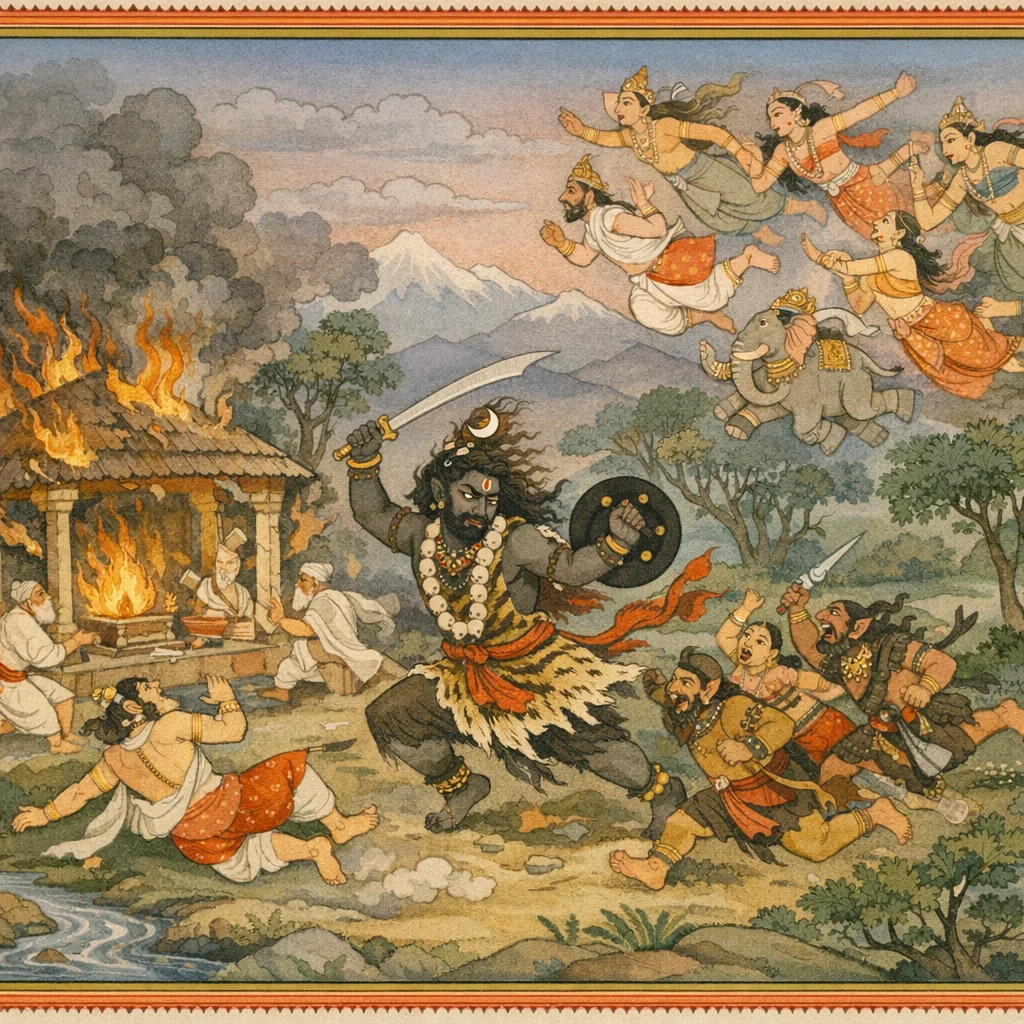
Chapter Arc: युधिष्ठिर के प्रश्न के उत्तर में वैशम्पायन प्राचीन कथा उठाते हैं—हिमालय के पृष्ठभाग में गङ्गाद्वार के शुभ देश में दक्ष का महायज्ञ, जहाँ देव, ऋषि, गन्धर्व, अप्सरा और लोकों के निवासी एकत्र हैं। → देवी के अपमान से उत्पन्न रोष का कारण बनकर रुद्र-तत्त्व जाग उठता है; शिव के रोमकूपों से रौद्र, रुद्रतुल्य गणेश्वर प्रकट होते हैं। वातावरण तिमिरमय हो जाता है—अग्नि नहीं जलती, सूर्य-प्रकाश फीका पड़ता है, ग्रह-नक्षत्र ढँकते हैं; यज्ञ की समृद्धि (षड्रस बहाती नदियाँ, भोग-विलास) के बीच विनाश की छाया उतरती है। → रुद्रकर्मा वीरभद्र और रुद्रगण यज्ञ में धावा बोलते हैं—यज्ञ को शीघ्र दग्ध करते हैं, देवांगनाओं को उछालते-फेंकते हैं, और अंततः यज्ञस्थल में ‘यज्ञ’ का शिर छिन्न कर भीषण गर्जना करते हैं; समस्त प्राणी भयाक्रान्त हो उठते हैं। → विनाश के बाद कथा का लक्ष्य ‘प्रसाद’ की ओर मुड़ता है—देवी के मन्यु को शांत कर, शिव के अनुग्रह से दक्ष के यज्ञ का संधान/समाधान कैसे हुआ, यह प्रसंग आगे के लिए स्थापित होता है; वीरभद्र अपनी पहचान स्पष्ट करता है कि वह न रुद्र है न देवी—वह रुद्र-आज्ञा का उपकरण है। → शिव-प्रसाद से दक्ष-यज्ञ का पुनर्संधान किस विधि से हुआ, और अपमान का प्रायश्चित्त किसने कैसे किया—यह रहस्य अगले प्रवाह में खुलने को ठहरता है।
Shlokas
Verse 1
(दाक्षिणात्य अधिक पाठका ह “लोक मिलाकर कुल ६३ ३ “लोक हैं) ८5 >> श््मु #* +/<< चतुरशीर्त्याधेकद्विशततमो< ध्याय: पार्वतीके रोष एवं खेदका निवारण करनेके लिये भगवान् शिवके द्वारा दक्षयज्ञका विध्वंस, दक्षद्वारा किये हुए शिवसहस्रनामस्तोत्रसे संतुष्ट होकर महादेवजीका उन्हें वरदान देना तथा इस स्तोत्रकी महिमा जनमेजय उवाच प्राचेतसस्य दक्षस्य कथ॑ं वैवस्वतेडन्तरे । विनाशमगमद् ब्रह्मन् हयमेध: प्रजापते:,जनमेजयने पूछा--ब्रह्मन्! वैवस्वत मन्वन्तरमें प्रचेताओंके पुत्र दक्षप्रजापतिका अश्वमेध यज्ञ कैसे नष्ट हो गया?
Janamejaya said: “O Brahmin, how did the Aśvamedha sacrifice of Dakṣa Prajāpati—son of the Pracetases—come to destruction during the Vaivasvata Manvantara?”
Verse 2
देव्या मन्युकृतं मत्वा क्रुद्धः सर्वात्मक: प्रभु: । प्रसादात् तस्य दक्षेण स यज्ञ: संधित: कथम् | एतद् वेदितुमिच्छेयं तन्मे ब्रूहि यथातथम्,दक्षके यज्ञमें मेरा आवाहन न होना पार्वतीके दुःखका कारण बन गया है-यह जानकर भगवान् शंकर, जो सम्पूर्ण प्राणियोंके आत्मा हैं, जब कुपित हो उठे, तब फिर उन्हींकी कृपापूर्ण प्रसन्नतासे दक्ष-प्रजापतिका यह यज्ञ कैसे सम्पन्न हुआ? मैं यह वृत्तान्त जानना चाहता हूँ, आप इसे यथार्थ रूपसे बतानेकी कृपा करें
Janamejaya said: “Knowing that the Goddess had been wronged and grieved, the Lord—who is the inner Self of all beings—became wrathful. Yet, by that very Lord’s gracious favor, how was Dakṣa’s sacrifice brought to completion? I wish to know this account; tell it to me exactly as it happened.”
Verse 3
वैशम्पायन उवाच पुरा हिमवतः पृष्े दक्षो वै यज्ञमाहरत् । गड़ाद्वारे शुभे देशे ऋषिसिद्धनिषेविते,वैशम्पायनजीने कहा--प्राचीन कालकी बात है--हिमालयके पार्श्ववर्ती गंगाद्वार (हरिद्वार) के शुभ देशमें, जहाँ ऋषियों तथा सिद्ध पुरुषोंका निवास है, प्रजापति दक्षने अपने यज्ञका आयोजन किया था
Vaiśampāyana said: Long ago, on the slopes of the Himālaya, Prajāpati Dakṣa undertook a sacrificial rite. It was held at the auspicious region of Gaṅgādvāra, a place frequented by seers and perfected beings—setting a sacred stage where ritual duty and its moral consequences would unfold.
Verse 4
गन्धर्वाप्सरसाकीर्णे नानाद्रुमलतावृते । ऋषिसड्चै: परिवृतं दक्ष धर्मभूतां वरम्,वह स्थान गन्धर्वों और अप्सराओंसे भरा था। भाँति-भाँतिके वृक्षसमूह और लताएँ वहाँ सब ओर छा रही थीं। धर्मात्माओंमें श्रेष्ठ प्रजापति दक्ष ऋषिसमुदायसे घिरे हुए बैठे। उस समय पृथ्वी, अन्तरिक्ष तथा स्वर्गलोकके निवासी भी वहाँ जुटे हुए थे और वे सब-के- सब हाथ जोड़कर प्रजापतिको प्रणाम करके उनकी सेवामें खड़े थे
Vaiśampāyana said: That place was filled with Gandharvas and Apsarases, and covered on every side with many kinds of trees and creepers. There sat Prajāpati Dakṣa—foremost among the righteous—surrounded by assemblies of Ṛṣis.
Verse 5
पृथिव्यामन्तरिक्षे च ये च स्वलोॉकवासिन: । सर्वे प्राजजलयो भूत्वा उपतस्थु: प्रजापतिम्,वह स्थान गन्धर्वों और अप्सराओंसे भरा था। भाँति-भाँतिके वृक्षसमूह और लताएँ वहाँ सब ओर छा रही थीं। धर्मात्माओंमें श्रेष्ठ प्रजापति दक्ष ऋषिसमुदायसे घिरे हुए बैठे। उस समय पृथ्वी, अन्तरिक्ष तथा स्वर्गलोकके निवासी भी वहाँ जुटे हुए थे और वे सब-के- सब हाथ जोड़कर प्रजापतिको प्रणाम करके उनकी सेवामें खड़े थे
Vaiśampāyana said: “Those who dwelt on the earth, in the mid-region (the atmosphere), and in the heavenly worlds—all of them, with palms joined in reverence, approached and stood in attendance upon Prajāpati.”
Verse 6
देवदानवगन्धर्वा: पिशाचोरगराक्षसा: । हाहाहूहृश्व गन्धर्वो तुम्बुरुनरिदस्तथा
Vaiśampāyana said: Devas, Dānavas, Gandharvas, Piśācas, Nāgas, and Rākṣasas were present; likewise the Gandharvas Hāhāhū and Hṛśva, and also Tumburu and Nārida—thus a great assembly of diverse beings is being enumerated, underscoring the cosmic scope of the occasion and the moral weight of what is to be heard or witnessed.
Verse 7
विश्वावसुर्विश्वसेनो गन्धर्वाप्सरसस्तथा । देवता, दानव, गन्धर्व, पिशाच, नाग, राक्षस, हाहा और हूहू नामक गन्धर्व, तुम्बुरु, नारद, विश्वावसु, विश्वसेन तथा दूसरे-दूसरे गन्धर्व और अप्सराएँ वहाँ उपस्थित थीं ।। ६३ || आदित्या वसवो रुद्रा: साध्या: सह मरुद्गणै:
Vaiśampāyana said: There were present Viśvāvasu and Viśvasena, along with hosts of Gandharvas and Apsarases. Deities and Dānavas, Gandharvas, Piśācas, Nāgas, and Rākṣasas were also there—together with the Gandharvas named Hāhā and Hūhū, as well as Tumburu and Nārada. In this way, many other Gandharvas and Apsarases had assembled at that place. Likewise, the Ādityas, Vasus, Rudras, and Sādhyas, accompanied by the companies of Maruts, were present.
Verse 8
ऊष्मपा: सोमपाश्चैव धूमपा आज्यपास्तथा
Vaiśampāyana said: “There are those who subsist on warmth, those who drink Soma, those who live on smoke, and likewise those who drink clarified butter.”
Verse 9
ऋषय: पितरश्वैव आगता ब्रह्मणा सह । ऊष्मपा (सूर्यकी किरणोंका पान करनेवाले), सोमपा (सोमरस पीनेवाले), धूमपा (यज्ञमें धूम-पान करनेवाले) और आज्यपा (घृत-पान करनेवाले) पितर और ऋषि भी ब्रह्माजीके साथ उस यज्ञमें पधारे थे ।। एते चान्ये च बहवो भूतग्रामाश्षतुर्विधा:
Vaiśampāyana said: The seers and the Fathers (Pitṛs) also arrived together with Brahmā. Those Pitṛs and Ṛṣis—called ‘drinkers of heat’ (ūṣmapā), ‘drinkers of Soma’ (somapā), ‘drinkers of sacrificial smoke’ (dhūmapā), and ‘drinkers of ghee’ (ājyapā)—came with Brahmā to that sacrifice. And besides these, many other multitudes of beings of four kinds were present as well.
Verse 10
आहूता मन्त्रिता: सर्वे देवाश्न सह पत्निभि:
Vaiśampāyana said: All the gods were summoned and consulted together, along with their wives—indicating a formal, collective deliberation where even the household dimension of divine order is included in the counsel.
Verse 11
विराजन्ते विमानस्था दीप्यमाना इवाग्नय: । जिन्हें निमन्त्रित करके बुलाया गया था, वे सब देवता अपनी पत्नियोंके साथ विमानपर बैठकर आते समय प्रज्वलित अग्निके समान प्रकाशित हो रहे थे ।। तान् दृष्टवा मत्युना5<विष्टो दधीचिर्वाक्यमब्रवीत्
Vaiśampāyana said: The gods—seated in their aerial chariots—shone forth like blazing fires. Those who had been invited and summoned came with their wives, mounted upon their vimānas, radiant as kindled flames. Seeing them, Dadhīci, seized by the shadow of death, spoke these words.
Verse 12
नायं यज्ञो न वा धर्मो यत्र रुद्रो न इज्यते । वधबन्धं प्रपन्ना वै कि नु कालस्य पर्यय:
Vaiśampāyana said: “That cannot truly be called a sacrifice, nor can it be called dharma, where Rudra is not worshipped. Having fallen into a condition of slaughter and captivity, what reversal of Time (fate) is this indeed?”
Verse 13
(महामुनि दधीचि भी उस यज्ञमण्डपमें उपस्थित थे। उन्होंने देखा कि देवता और दानव आदिका समाज तो खूब जुटा हुआ है; परंतु भगवान् शंकर दिखायी नहीं देते हैं। जान पड़ता है उनका आवाहन नहीं किया गया है। इससे उनके मनमें बड़ा दुःख हुआ।) उन सब देवताओंको वहाँ उपस्थित देख दधीचि क्रोधमें भर गये और बोले--'सज्जनो! जिसमें भगवान् शिवकी पूजा नहीं होती है, वह न यज्ञ है और न धर्म। यह यज्ञ भी भगवान् शिवके बिना यज्ञ कहनेयोग्य नहीं रहा। इसका आयोजन करनेवाले लोग वध और बन्धनकी किंनु मोहान्न पश्यन्ति विनाशं पर्युपस्थितम् । उपस्थित महाघोरं न बुध्यन्ति महाध्वरे,“इस महायज्ञमें अत्यन्त घोर विनाश उपस्थित होनेवाला है; किंतु मोहवश कोई देख नहीं रहे हैं-- समझ नहीं पाते हैं!
Blinded by delusion, they do not perceive the destruction that has drawn near. In this great sacrifice, a most dreadful calamity stands imminent, yet they fail to understand it. (In context, Dadhīci, seeing the gods assembled but Śiva not duly invoked or worshipped, laments that a rite without Śiva is neither true sacrifice nor true dharma, and warns that such neglect invites ruin.)
Verse 14
इत्युक्त्वा स महायोगी पश्यति ध्यानचक्षुषा । स पश्यति महादेवं देवीं च वरदां शुभाम्
Having spoken thus, the great yogin looks with the eye of meditation. In that inner vision he beholds Mahādeva, and also the auspicious Goddess, the bestower of boons.
Verse 15
नारद च महात्मानं तस्या देव्या: समीपत: । संतोष॑ं परम लेभे इति निश्चित्य योगवित्
Vaiśaṃpāyana said: Nārada, the knower of yoga, having ascertained that the great-souled one had attained supreme contentment in the presence of that goddess, became firmly convinced of it.
Verse 16
एकमन्त्रास्तु ते सर्वे येनेशो न निमन्त्रित: । ऐसा कहकर महायोगी दधीचिने जब ध्यान लगाकर देखा, तब उन्हें भगवान् शंकर और मंगलमयी वरदायिनी देवी पार्वतीजीका दर्शन हुआ। उनके पास ही महात्मा नारदजी भी दिखायी दिये, इससे उनको बड़ा संतोष हुआ। योगवेत्ता दधीचिको यह निश्चय हो गया कि ये सब देवता एकमत हो गये हैं। इसीलिये इन्होंने महेश्वरको यहाँ निमन्त्रित नहीं किया है ।। तस्माद् देशादपक्रम्य दधीचिर्वाक्यमब्रवीत्,यह बात ध्यानमें आते ही दधीचि यज्ञशालासे अलग हो गये और दूर जाकर कहने लगे --'सज्जनो! अपूजनीय पुरुषकी पूजा करनेसे और पूजनीय महापुरुषकी पूजा न करनेसे मनुष्य सदा ही नरहत्याके समान पापका भागी होता है
Vaiśampāyana said: “All of them are acting with a single resolve; for that very reason Maheśvara (Śiva), the Lord, has not been invited here.” Saying this, the great yogin Dadhīci entered meditation and beheld Lord Śaṅkara together with the auspicious, boon-giving Goddess Pārvatī; near them he also saw the great sage Nārada, and he felt deep satisfaction. Dadhīci, skilled in yoga, became certain that the gods had formed a unanimous plan—hence they had not invited Maheśvara here. Realizing this, he withdrew from that place, stepped away from the sacrificial hall, and, going to a distance, declared: “Good people! By honoring one who is not worthy of honor, and by failing to honor a truly worthy great person, a man ever becomes a sharer in sin equal to the killing of a human being.”
Verse 17
अपूज्यपूजनाच्चैव पूज्यानां चाप्यपूजनात् | नूघातकसमं पापं शश्चवत् प्राप्नोति मानव:,यह बात ध्यानमें आते ही दधीचि यज्ञशालासे अलग हो गये और दूर जाकर कहने लगे --'सज्जनो! अपूजनीय पुरुषकी पूजा करनेसे और पूजनीय महापुरुषकी पूजा न करनेसे मनुष्य सदा ही नरहत्याके समान पापका भागी होता है
Vaiśampāyana said: “By honoring one who is unworthy of honor, and by failing to honor those who truly deserve reverence, a person continually incurs sin equal to the killing of a human being.”
Verse 18
अनृतं नोक्तपूर्व मे न च वक्ष्ये कदाचन । देवतानामृषीणां च मध्ये सत्यं ब्रवीम्पहम्,“मैंने पहले कभी झूठ नहीं कहा है और आगे भी कभी झूठ नहीं कहूँगा। इन देवताओं तथा ऋषियोंके बीचमें मैं सच्ची बात कह रहा हूँ
“I have never spoken falsehood before, nor shall I ever speak it at any time. Here, in the midst of these gods and seers, I declare the truth.”
Verse 19
आगतं पशुभर्तरं स्रष्टारं जगत: पतिम् | अध्वरे हााग्रभोक्तारं सर्वेषां पश्यत प्रभुम,“भगवान् शंकर सम्पूर्ण जगत्की सृष्टि करनेवाले, सम्पूर्ण जीवोंके रक्षक, स्वामी तथा सबके प्रभु हैं। तुम सब लोग देख लेना, वे इस यज्ञमें प्रधान भोक्ताके रूपमें उपस्थित होंगे!
“Behold the Lord—the creator of the world, the protector of all beings, the sovereign of the universe. In this sacrifice he will be present as the foremost recipient of the offerings.”
Verse 20
दक्ष उवाच सन्ति नो बहवो रुद्रा: शूलहस्ता: कपर्दिन: । एकादशस्थानगता नाहं वेझि महेश्वरम्,दक्षने कहा--हाथोंमें शूल और मस्तकपर जटाजूट धारण करनेवाले बहुत-से रुद्र हमारे यहाँ रहते हैं। वे ग्यारह हैं और ग्यारह स्थानोंमें निवास करते हैं। उनके सिवा दूसरे किसी महेश्वरको मैं नहीं जानता
Dakṣa said: “Among us there are many Rudras—bearing tridents in their hands and wearing matted locks. They are eleven in number and dwell in eleven abodes. Beyond them, I do not recognize any other Maheśvara.”
Verse 21
दधीचिरुवाच सर्वेषामेव मन्त्रो5यं येनासौ न निमन्त्रित: । यथाह शंकरादूर्ध्व॑ नान्यं पश्यामि दैवतम् | तथा दक्षस्य विपुलो यज्ञोडयं न भविष्यति,दधीचि बोले--मैं जानता हूँ, आप सब लोगोंका ही यह मिल-जुलकर किया हुआ निश्चय है। इसीलिये उन महादेवजीको निमन्त्रित नहीं किया गया है; परंतु मैं भगवान् शंकरसे बढ़कर दूसरे किसी देवताको नहीं देखता। यदि यह सत्य है तो प्रजापति दक्षका यह विशाल यज्ञ निश्चय ही नष्ट हो जायगा
Dadhichi said: “This is indeed a concerted resolve of all of you, and that is why Śaṅkara has not been invited. But I see no deity higher than Lord Śaṅkara. If this is true, then this grand sacrifice of Prajāpati Dakṣa will not come to fruition—indeed, it is bound to be ruined.”
Verse 22
दक्ष उवाच एतन्मखेशाय सुवर्णपात्रे हवि: समस्तं विधिमन्त्रपूतम् | विष्णोर्नयाम्यप्रतिमस्य भागं प्रभुर्विभुश्नाहवनीय एष:,दक्षने कहा--महर्षे! देखो, विधिपूर्वक मन्त्रसे पवित्र की हुई यह सारी हवि सुवर्णके पात्रमें रखी हुई है। यह यज्ञेश्वर श्रीविष्णुकोी समर्पित है। भगवान् विष्णुकी कहीं समता नहीं है। मैं उन्हींको हविष्यका यह भाग अर्पित करूँगा। ये भगवान् विष्णु ही सर्वसमर्थ, व्यापक और यज्ञभाग अर्पित करनेके योग्य हैं
Dakṣa said: “O great sage, look—here in a golden vessel is the entire oblation, purified by the proper rite and by mantra. I now carry this portion to Viṣṇu, the incomparable Lord. For this very Viṣṇu is the sovereign and all-pervading one, and he alone is truly worthy to receive the sacrificial share.”
Verse 23
देव्युवाच कि नाम दान॑ नियमं तपो वा कुर्यामहं येन पतिर्ममाद्य । लभेत भागं भगवानचिन्त्यो हार्ध तथा भागमथो तृतीयम्,(दूसरी ओर कैलास पर्वतपर) पार्वती देवी (बहुत दुखी होकर) कह रही थीं--आह,, मैं कौन-सा व्रत, दान या तप करूँ, जिसके प्रभावसे आज मेरे पतिदेव अचिन्त्य भगवान् शंकरको यज्ञका आधा अथवा तिहाई भाग अवश्य प्राप्त हो?”
The Goddess said: “What gift, what vow of restraint, or what austerity should I undertake, by whose power my husband—today—may obtain his rightful share? May the inconceivable Lord receive a portion of the sacrifice: at least one half, or else a third.”
Verse 24
एवं ब्रुवाणां भगवान् स पत्नीं प्रह्ष्टरूप: क्षुभितामुवाच । न वेत्सि मां देवि कृशोदराड्ि कि नाम युक्त वचनं मखेशे,क्षोभमें भरकर इस प्रकार बोलती हुई पत्नीकी बात सुनकर भगवान् शंकर हर्षसे खिल उठे और इस प्रकार बोले--'देवि! कृशोदराज्लि! तू मुझे नहीं जानती, मैं सम्पूर्ण यज्ञोंका ईश्वर हूँ। मेरे विषयमें किस प्रकारके वचन कहना चाहिये, यह भी तुम नहीं जानती
As his wife spoke in this agitated manner, the Blessed Lord (Śaṅkara), his face bright with delight, addressed her: “O goddess, slender-waisted one, you do not truly know me. I am the Lord of all sacrifices. Nor do you understand what kind of speech is fitting when speaking about the Lord of the sacrifice.”
Verse 25
अहं विजानामि विशालनेत्रे ध्यानेन हीना न विदन्त्यसन्त: । तवाद्य मोहेन च सेन्द्रदेवा लोकास्त्रय: सर्वत एव मूढा:,“पर मैं सब कुछ जानता हूँ। विशाललोचने! जिनका चित्त एकाग्र नहीं है, वे ध्यानशून्य असाधु पुरुष मेरे स्वरूपको नहीं जानते। आज तुम्हारे इस मोहसे इन्द्र आदि देवताओंसहित तीनों लोक सब ओरसे किंकर्तव्य-विमूढ हो गये हैं
“But I know the truth myself, O wide-eyed one. Those whose minds are not gathered—devoid of meditation—impure and undisciplined men do not comprehend my real nature. Yet today, because of your delusion, the three worlds—together with Indra and the gods—have been thrown into bewilderment on every side, not knowing what ought to be done.”
Verse 26
मामध्वरे शंसितार: स्तुवन्ति रथन्तरं सामगाश्चोपगान्ति । मां ब्राह्मणा ब्रह्मविदो यजन्ते ममाध्वर्यव: कल्पयन्ते च भागम्,'यज्ञमें प्रस्तोतालोग मेरी स्तुति करते हैं। सामगान करनेवाले ब्राह्मण रथन्तर सामके रूपमें मेरी ही महिमाका गान करते हैं। वेदवेत्ता विप्र मेरा ही यजन करते और ऋत्विजलोग यज्ञमें मुझे ही भाग अर्पित करते हैं!
“In the sacrificial rite, the Prastotar officiants praise me; the Sāma-chanters approach, singing the Rathantara melody as my glorification. The Brahmins who know the Veda perform worship directed to me, and the Adhvaryu priests formally assign me my share of the oblation.”
Verse 27
देव्युवाच सुप्राकृतो5पि पुरुष: सर्व: स्त्रीजनसंसदि । स्तौति गर्वायते चापि स्वमात्मानं न संशय:,देवीने कहा--नाथ! अत्यन्त गँवार पुरुष भी क्यों न हो, प्राय: सभी स्त्रियोंके बीचमें अपनी प्रशंसाके गीत गाते और अपनी श्रेष्ठतापर गर्व करते हैं--इसमें तनिक भी संशय नहीं है
The Goddess said: “O Lord! Even a man of the coarsest nature, for the most part, amid an assembly of women, sings praises of himself and swells with pride in his own excellence—of this there is no doubt.”
Verse 28
श्रीभगवानुवाच नात्मानं॑ स्तौमि देवेशि पश्य मे तनुमध्यमे । यं स्रक्ष्यामि वरारोहे यागार्थे वरवर्णिनि,श्रीभगवान् शिव बोले--देवेश्वरि! तनुमध्यमे! वरारोहे! वरवर्णिनि! मैं अपनी प्रशंसा नहीं करता हूँ। मेरा प्रभाव देखो। जिसके कारण तुम्हें दुःख हुआ है, उस यज्ञको नष्ट करनेके लिये मैं जिस वीर पुरुषकी सृष्टि कर रहा हूँ” उसपर दृष्टिपात करो
The Blessed Lord said: “O Goddess, sovereign of the gods—O slender-waisted one, O fair-complexioned lady of noble hips—I do not praise myself. Behold my power. Look upon the hero whom I am about to bring forth for the sake of the sacrifice, to destroy that sacrifice which has become the cause of your sorrow.”
Verse 29
इत्युक्त्वा भगवान् पत्नीमुमां प्राणैरपि प्रियाम् । सो5सृजद् भगवान् वक्त्राद् भूतं॑ घोरं प्रहर्षणम्,अपने प्राणोंसे भी अधिक प्यारी पत्नी उमासे ऐसी बात कहकर भगवान् महेश्वरने अपने मुखसे एक अद्भुत एवं भयंकर प्राणीको प्रकट किया, जो उनका हर्ष बढ़ानेवाला था
Having spoken thus to Umā, his wife dearer to him than life itself, the Lord Maheshvara brought forth from his mouth a wondrous and dreadful being, one that heightened his exultation.
Verse 30
तमुवाचाक्षिप मखं दक्षस्येति महेश्वर: । ततो वक्त्राद् विमुक्तेन सिंहेनेकेन लीलया
Maheshvara said to him, “Overthrow Daksha’s sacrifice.” Then a single lion, released from his mouth, set about fulfilling that command with effortless ease.
Verse 31
मन्युना च महाभीमा महाकाली महेश्वरी
And in wrath—Mahākālī, exceedingly terrible; Maheshvarī, the supreme sovereign Goddess.
Verse 32
आत्मन: कर्मसक्षित्वे तेन सार्थ सहानुगा । उस समय भवानीके क्रोधसे प्रकट हुई अत्यन्त भयंकर रूपवाली महाकाली महेश्वरीने भी अपना पराक्रम दिखानेके लिये सेवकोंसहित उस वीरके साथ प्रस्थान किया था ।। ३१ *॥ देवस्यानुमतं मत्वा प्रणम्य शिरसा तत:,(वीरभद्रने किस प्रकार उस यज्ञका विध्वंस किया, यह प्रसंग आगे बताया जाता है--) महादेवजीकी अनुमति जानकर उसने मस्तक झुकाकर उन्हें प्रणाम किया। वह वीर अपने ही समान शौर्य, रूप और बलसे सम्पन्न था (उसकी कहीं उपमा नहीं थी)। भगवान् शिवका वह सब कुछ करनेमें समर्थ क्रोध ही मूर्तिमानू होकर उस वीरके रूपमें प्रकट हुआ था। उसके बल, वीर्य, शक्ति और पुरुषार्थका कहीं अन्त नहीं था। पार्वतीदेवीके क्रोध और खेदका निवारण करनेवाला वह पुरुष वीरभद्रके नामसे विख्यात हुआ
Dakṣa said: “As a witness to her own deed, she too—accompanied by her retinue—set out together with that hero.” In the surrounding narrative, this points to the manifestation of fierce divine agency: Mahākālī (the great, terrifying form of the Goddess) proceeds with attendants alongside the warrior-force that will dismantle the sacrificial arrogance. Ethically, the episode frames the destruction of the sacrifice not as random violence but as a corrective act against ritual pride and disrespect toward Śiva, restoring moral order when dharma is violated through hubris.
Verse 33
आत्मन: सदृश: शौर्याद् बलरूपसमन्वित: । स एव भगवान् क्रोध: प्रतिसरूपसमन्वित:,(वीरभद्रने किस प्रकार उस यज्ञका विध्वंस किया, यह प्रसंग आगे बताया जाता है--) महादेवजीकी अनुमति जानकर उसने मस्तक झुकाकर उन्हें प्रणाम किया। वह वीर अपने ही समान शौर्य, रूप और बलसे सम्पन्न था (उसकी कहीं उपमा नहीं थी)। भगवान् शिवका वह सब कुछ करनेमें समर्थ क्रोध ही मूर्तिमानू होकर उस वीरके रूपमें प्रकट हुआ था। उसके बल, वीर्य, शक्ति और पुरुषार्थका कहीं अन्त नहीं था। पार्वतीदेवीके क्रोध और खेदका निवारण करनेवाला वह पुरुष वीरभद्रके नामसे विख्यात हुआ
Daksha said: “He was like Śiva himself—endowed with unsurpassed valor, strength, and form. Indeed, that very divine Wrath of the Blessed Lord, capable of accomplishing all deeds, had taken embodied shape in the form of that hero.” In context, this introduces Vīrabhadra as the personification of Śiva’s righteous, world-correcting anger—an ethical warning that sacrificial ritual, when corrupted by pride and disrespect, invites the force that restores moral order.
Verse 34
अनन्तबलवीर्यश्ष॒ अनन्तबलपौरुष: । वीरभद्र इति ख्यातो देव्या मन्युप्रमार्जक:,(वीरभद्रने किस प्रकार उस यज्ञका विध्वंस किया, यह प्रसंग आगे बताया जाता है--) महादेवजीकी अनुमति जानकर उसने मस्तक झुकाकर उन्हें प्रणाम किया। वह वीर अपने ही समान शौर्य, रूप और बलसे सम्पन्न था (उसकी कहीं उपमा नहीं थी)। भगवान् शिवका वह सब कुछ करनेमें समर्थ क्रोध ही मूर्तिमानू होकर उस वीरके रूपमें प्रकट हुआ था। उसके बल, वीर्य, शक्ति और पुरुषार्थका कहीं अन्त नहीं था। पार्वतीदेवीके क्रोध और खेदका निवारण करनेवाला वह पुरुष वीरभद्रके नामसे विख्यात हुआ
Dakṣa said: “He was of limitless strength and valor, and of boundless might and manly prowess. He became renowned as Vīrabhadra—the one who wipes away the Goddess’s wrath.” In the narrative context, this introduces Vīrabhadra as the embodied, effective force of Śiva’s sanctioned anger, arising to restore moral balance after an affront to the divine order; his role is not mere violence but the rectification of a sacrificial act corrupted by pride and disrespect.
Verse 35
सो5सृजद् रोमकूपेभ्यो रौम्यान् नाम गणेश्वरान् । रुद्रतुल्या गणा रौद्रा रुद्रवीर्यपराक्रमा:,उसने अपने रोमकूपोंसे सैन्य नामवाले गणेश्वरोंको प्रकट किया, जो रुद्रके समान ही होनेके कारण रौद्रगण कहलाये। उन सबके बल-पराक्रम भी रुद्रके ही समान थे
Dakṣa said: “From the pores of his body he brought forth hosts of troop-lords called the Raumyas. Fierce like Rudra, they were known as the Raudra-gaṇas, and their strength and valor were equal to Rudra’s.”
Verse 36
ते निपेतुस्ततस्तूर्ण दक्षयज्ञविहिंसया । भीमरूपा महाकाया: शतशो5थ सहसत्रश:
Then, as Dakṣa’s sacrifice was being violently disrupted, they fell down at once—terrible in form and huge in body—dropping in by the hundreds and then by the thousands. The scene underscores how sacrificial order, when driven by pride or violated through aggression, can collapse into chaos and mass destruction.
Verse 37
तेन शब्देन महता त्रस्तास्तत्र दिवौकस:,उस महाभयंकर कोलाहलसे उस यज्ञमें पधारे हुए समस्त देवता व्याकुल हो उठे। पर्वत टूक-टूक होकर बिखर गये। धरती डोलने लगी, आँधी चलने लगी और समुद्रमें तूफान आ गया
Dakṣa said: “Struck by that tremendous sound, the gods who had assembled there for the sacrifice were thrown into panic. The uproar was so terrifying that mountains seemed to shatter and scatter, the earth began to tremble, violent winds arose, and the ocean was churned into a storm.”
Verse 38
पर्वताश्च व्यशीर्यन्त चकम्पे च वसुंधरा । मास्ताश्रैव घूर्णन्ते चुक्षुभे वरुणालय:,उस महाभयंकर कोलाहलसे उस यज्ञमें पधारे हुए समस्त देवता व्याकुल हो उठे। पर्वत टूक-टूक होकर बिखर गये। धरती डोलने लगी, आँधी चलने लगी और समुद्रमें तूफान आ गया
Dakṣa said: “Mountains were shattered and crumbled; the earth itself began to quake. Whirling winds rose up, and the ocean—Varuṇa’s abode—was thrown into violent turmoil.” In the narrative, these cosmic convulsions signal a breach of ritual and moral order: when a sacred act is disturbed by grave offense and conflict, nature mirrors the disorder, warning that adharma in a yajña does not remain confined to the altar but shakes the world.
Verse 39
अग्नयो नैव दीप्यन्ते नैव दीप्ति भास्कर: । ग्रहा नैव प्रकाशन्ते नक्षत्राणि न चन्द्रमा:,उस समय आग नहीं जलती थी, सूर्यका प्रकाश फीका पड़ गया; ग्रह, नक्षत्र और चन्द्रमा भी निस्तेज हो गये। इस प्रकार वहाँ चारों ओर अँधेरा छा गया। देवता, ऋषि और मनुष्य--सभी छिप गये--कोई दिखायी नहीं देते थे। दक्षसे अपमानित हुए रुद्रगण यज्ञशालामें सब ओर आग लगाने लगे
Dakṣa said: “The fires would not blaze; even the Sun’s radiance grew dim. The planets gave no light, nor did the stars or the Moon.” The scene signals a moral and cosmic disturbance: when sacred order is violated and the worthy are dishonoured, the very signs of auspiciousness withdraw, and darkness—outer and inner—spreads through the world.
Verse 40
ऋषयो न प्रकाशन्ते न देवा न च मानुषा: । एवं तु तिमिरीभूते निर्दहन्त्यपमानिता:,उस समय आग नहीं जलती थी, सूर्यका प्रकाश फीका पड़ गया; ग्रह, नक्षत्र और चन्द्रमा भी निस्तेज हो गये। इस प्रकार वहाँ चारों ओर अँधेरा छा गया। देवता, ऋषि और मनुष्य--सभी छिप गये--कोई दिखायी नहीं देते थे। दक्षसे अपमानित हुए रुद्रगण यज्ञशालामें सब ओर आग लगाने लगे
Dakṣa said: “Neither the seers were visible, nor the gods, nor even human beings. When everything had thus become shrouded in darkness, those who had been insulted began to burn (the place) in retaliation.”
Verse 41
प्रहरन्त्यपरे घोरा यूपानुत्पाटयन्ति च । प्रमर्दन्ति तथा चान्ये विमर्दन्ति तथा परे,दूसरे भयंकर भूत उसी यज्ञके सदस्योंको पीटने लगे। कुछ यूप उखाड़ने लगे। बहुतेरे रुद्रगण यज्ञकी सामग्रीको कुचलने और रौंदने लगे
Dakṣa said: “Some of those dreadful beings began striking the very participants of the sacrifice; others tore up the sacrificial posts. Still others crushed and trampled the ritual implements and offerings.” In this scene, the sanctity of yajña is violated, showing how uncontrolled wrath and hostility can overturn dharmic order and turn a sacred rite into a site of violence.
Verse 42
आधावन्ति प्रधावन्ति वायुवेगा मनोजवा: । चूर्ण्यन्ते यज्ञपात्राणि दिव्यान्याभरणानि च,वायु और मनके समान वेगशाली कितने ही पार्षद इधर-उधर दौड़ लगाने लगे। कुछ लोग यज्ञके उपयोगमें आनेवाले पात्रों तथा दिव्य आभूषणोंको चूर-चूर कर रहे थे
They ran and rushed about—attendants swift as the wind and as quick as thought. The sacrificial vessels were being smashed to powder, and even divine ornaments were being shattered.
Verse 43
विशीर्यमाणा दूृश्यन्ते तारा इव नभस्तले । दिव्यान्नपानभक्ष्याणां राशय: पर्वतोपमा:,उनके बिखरकर गिरते हुए टुकड़े आकाशगमें छिटके हुए तारोंके समान दिखायी देते थे। उस यज्ञभूमिमें जहाँ-तहाँ दिव्य अन्न, पान और भक्ष्य पदार्थोंके पर्वतों-जैसे ढेर दिखायी देते थे
The fragments, scattering as they fell, looked like stars strewn across the sky. And all over that sacrificial ground were heaps of celestial food, drink, and diverse delicacies, piled up like mountains.
Verse 44
क्षीरनद्यो5थ दृश्यते घृतपायसकर्दमा: । दघिमण्डोदका दिव्या: खण्डशर्करवालुका:,दूधकी दिव्य नदियाँ वहाँ बहती दीखती थीं, घी और खीरकी कीच जम गयी थी, दही और मट्ठा पानीकी तरह बह रहे थे तथा खाँड़ और शक्कर वहाँ बालूकी भाँति बिछ गये थे
Dakṣa said: “There, celestial rivers of milk could be seen flowing. The ground was thick with mire made of ghee and sweet rice; curd and buttermilk ran like water, and lumps of raw sugar and refined sugar lay strewn about like sand.”
Verse 45
षड् रसान् निवहन्त्येता गुडकुल्या मनोरमा: । उच्चावचानि मांसानि भक्ष्याणि विविधानि च,ये सब नदियाँ षट्रस भोजन प्रवाहित कर रही थीं। गुड़के रसकी छोटी-छोटी मनोरम नहरें दृष्टिगोचर होती थीं। नाना प्रकारके फलोंके गूदे और भाँति-भाँतिके भक्ष्य-पदार्थ प्रस्तुत किये गये थे
Those rivers carried along the six tastes of food. Delightful little channels of jaggery-syrup (guḍa) could be seen as well. And there were meats of many kinds, and diverse dishes set out to be eaten.
Verse 46
पानकानि च दिव्यानि लेह[चोष्याणि यानि च | भुज्जते विविधैर्वक्त्रैविलुम्पन्त्याक्षिपन्ति च,दिव्य पेय पदार्थ, लेह्ठ और चोष्य आदि जो-जो भोजन वहाँ उपलब्ध हुए, उन सबको वे रुद्रणण अपने विविध मुखोंद्वारा खाने, नष्ट करने और चारों ओर छींटने तथा फेंकने लगे
Daksha said: “There were celestial drinks, and all manner of foods that are to be licked and sucked. The Rudra-host, with their many different mouths, began to consume them—while also ravaging them, scattering them about, and flinging them in every direction.”
Verse 47
रुद्रकोपान्महाकाया: कालाग्निसदृशोपमा: । क्षोभयन् सुरसैन्यानि भीषयन्त: समन्ततः,वे विशालकाय भूत रुद्रदेवके क्रोधसे कालाग्निके समान होकर देवताओंकी सेनाओंको चारों ओरसे डराने और शक्षुब्ध करने लगे
Daksha said: “From Rudra’s wrath there arose gigantic beings, comparable to the fire of Time at the end of an age. They threw the hosts of the gods into turmoil and terrified them on every side.”
Verse 48
क्रीडन्ति विविधाकाराश्रिक्षिपु: सुरयोषित: । रुद्रक्रोधात् प्रयत्नेन सर्वदेवै: सुरक्षितम्
Dakṣa said: “The celestial women, assuming many different forms, sported about and then fled. Yet that place remained carefully guarded by all the gods, with great effort, out of fear of Rudra’s wrath.”
Verse 49
चकार भैरवं नादं सर्वभूतभयंकरम्
Dakṣa said: “He uttered a dreadful roar, terrifying to all beings.”
Verse 50
ततो ब्रह्मादयो देवा दक्षश्नैव प्रजापति:
Then Brahmā and the other gods, along with Dakṣa, the lord of creatures (Prajāpati), came there.
Verse 51
ऊचुः प्राउज्जलय: सर्वे कथ्यतां को भवानिति | तब ब्रह्मा आदि देवता तथा प्रजापति दक्ष--ये सब के-सब हाथ जोड़कर बोले --देवदेव! कहिये, आप कौन हैं?” || ५० है ।। वीरभद्र उवाच नाहं रुद्रो न वा देवी नैव भोक्तुमिहागत:
Brahmā and all the gods, together with Dakṣa the Prajāpati, with hands joined, said: “O God of gods, tell us—who are you?” Vīrabhadra replied: “I am neither Rudra nor the Goddess, nor have I come here to partake of offerings or enjoyments.”
Verse 52
द्रष्ट॑ वा नैव विप्रेन्द्रा_ नैव कौतूहलेन वा
Vīrabhadra said: “Not even to see it, O best of brāhmaṇas—nor even out of mere curiosity.”
Verse 53
तव यज्ञविघातार्थ सम्प्राप्तं विद्धि मामिह । मैं यहाँ आये हुए श्रेष्ठ ब्राह्मणोंका दर्शन करने या कौतूहलवश इस यज्ञका तमाशा देखनेके लिये नहीं आया हूँ। तुम्हें यह मालूम होना चाहिये कि मैं तुम्हारे इस यज्ञका विनाश करनेके लिये ही यहाँ आया हूँ ।। वीरभद्र इति ख्यातों रुद्रकोपाद् विनि:सृत:,मेरा नाम वीरभद्र है। रुद्रदेवके क्रोधसे मेरा प्राकटय हुआ है। यह नारी भद्रकालीके नामसे विख्यात है और देवी पार्वतीके कोपसे प्रकट हुई है। देवाधिदेव महादेवने हम दोनोंको यहाँ भेजा है। इसलिये हम दोनों इस यज्ञके निकट आये हैं
Vīrabhadra said: “Know that I have come here for the very purpose of disrupting your sacrifice. I have not arrived to behold the venerable brāhmaṇas assembled here, nor out of mere curiosity to watch this rite as a spectacle. Understand clearly: I have come to destroy this yajña. I am famed as Vīrabhadra, brought forth from Rudra’s wrath.”
Verse 54
भद्रकालीति विख्याता देव्या: कोपाद् विनि:सृता । प्रेषितो देवदेवेन यज्ञान्तिकमिहागतौ,मेरा नाम वीरभद्र है। रुद्रदेवके क्रोधसे मेरा प्राकटय हुआ है। यह नारी भद्रकालीके नामसे विख्यात है और देवी पार्वतीके कोपसे प्रकट हुई है। देवाधिदेव महादेवने हम दोनोंको यहाँ भेजा है। इसलिये हम दोनों इस यज्ञके निकट आये हैं
“She is renowned as Bhadrakālī, brought forth from the Goddess’s wrath. Sent by the God of gods, we have come here to the very vicinity of this sacrifice.”
Verse 55
शरणं गच्छ विप्रेन्द्र देवदेवमुमापतिम् । वरं क्रोधो5पि देवस्य वरदानं न चान्यत:,विप्रवर! तुम देवाधिदेव उमावललभ भगवान् शिवकी शरणमें जाओ। महादेवजीका क्रोध भी परम मंगलमय है और दूसरोंसे मिला हुआ वरदान भी मंगलकारक नहीं होता
Vīrabhadra said: “O best of brāhmaṇas, go for refuge to the God of gods, Umā’s lord (Śiva). Even the deity’s anger is preferable—for it can be ultimately auspicious—whereas a boon obtained from any other source is not truly beneficial.”
Verse 56
वीरभद्रवच: श्रुत्वा दक्षो धर्मभृतां वर: । तोषयामास स्तोत्रेण प्रणिपत्य महेश्वरम्,वीरभद्रकी यह बात सुनकर धर्मात्माओंमें श्रेष्ठ दक्षने भगवान् शिवके उद्देश्यसे प्रणाम करके निम्नांकित स्तोत्रके द्वारा उनकी स्तुति की--
Hearing the words of Vīrabhadra, Dakṣa—foremost among the upholders of dharma—bowed down to Maheśvara (Śiva) and sought to appease him by offering a hymn of praise.
Verse 57
प्रपद्ये देवमीशानं शाश्व॒तं ध्रुवमव्ययम् । महादेवं महात्मानं विश्वस्य जगत: पतिम्,“जो सम्पूर्ण जगत्के शासक, पालक, महान् आत्मा, नित्य, सनातन, अविकारी और आराध्यदेव हैं, उन महादेवजीकी आज मैं शरण लेता हूँ”
I take refuge in Īśāna—Mahādeva—eternal, steadfast, and imperishable: the great-souled Lord of the universe, who rules and protects the whole world.
Verse 58
प्राणापानौ संनिरुध्य वक्त्रस्थानेन यत्नतः । विचार्य सर्वतो दृष्टिं बहुदृष्टिरमित्रजित्
Vīrabhadra said: “With careful effort, restraining the in-breath and out-breath and fixing them at the region of the mouth, he then examined his gaze in every direction. Thus the foe-conqueror became ‘many-sighted’—fully alert and wide-ranging in perception.”
Verse 59
सहसा देवदेवेशो हाग्निकुण्डात् समुत्थित: । बिश्रत्सूर्यसहस्रस्थ तेज: संवर्तकोपम:
Suddenly the Lord of lords arose from the fire-pit, radiating a blaze like that of a thousand suns—terrible, world-ending in aspect, like the fire of cosmic dissolution.
Verse 60
स्मितं कृत्वाब्रवीद् वाक््यं ब्रूहि कि करवाणि ते । तब अनेक नेत्रोंवाले, शत्रुविजयी, महादेव अपने मुखोंद्वारा यत्नपूर्वक प्राण और अपान वायुको अवरुद्ध करके सम्पूर्ण दिशाओंमें दृष्टिपात करते हुए सहसा अग्निकुण्डसे निकल पड़े। प्रलयकालीन अग्निके समान तेजस्वी स्वरूपसे सहस्रों सूर्योकी प्रभा धारण किये वे दक्षके सामने खड़े हो गये और मुसकराकर बोले--'प्रजापते! बोलो, मैं आज तुम्हारा कौन- सा कार्य सिद्ध करूँ” || ५८-५९; || श्राविते च मखाध्याये देवानां गुरुणा तत:
With a faint smile, he spoke: “Speak—what shall I do for you?”
Verse 76
इन्द्रेण सहिता: सर्वे आगता यज्ञभागिन: । आदित्य, वसु, रुद्र, साध्य और मरुदगण--ये सब-के-सब इन्द्रके साथ यज्ञमें भाग लेनेके लिये वहाँ पधारे थे
Vaiśampāyana said: All the rightful sharers in the sacrificial offering arrived together with Indra. The Ādityas, Vasus, Rudras, Sādhyas, and the hosts of Maruts—every one of them—came there with Indra to receive their allotted portions in the sacrifice.
Verse 93
जरायुजाण्डजाश्वैव सहसा स्वेदजोद्धिजै: । ये तथा और भी बहुत-से चतुर्विध प्राणिसमुदाय जरायुज, अण्डज, स्वेदज और उद्भिज्ज वहाँ उपस्थित हुए थे
Vaiśampāyana said: There too were present, all at once, the fourfold classes of living beings—those born from the womb, those born from eggs, those born from sweat or moisture, and those that sprout from the earth—along with many other such groups. The narration underscores the vast, inclusive order of life, in which every mode of birth is gathered within a single moral cosmos.
Verse 283
इस प्रकार श्रीमह्या भारत शान्तिपर्वके अन्तर्गत गोक्षधर्मपर्वमें ज्वरकी उत्पत्तिविषयक दो सौ तिरासीवाँ अध्याय पूरा हुआ
Thus ends the two hundred and eighty-third chapter of the Śānti Parva of the Mahābhārata, within the section known as the Gokṣa-dharma sub-parvan, dealing with the origin of fever (jvara).
Verse 303
देव्या मन्युव्यपोहार्थ हतो दक्षस्य वै क्रतु: । महेश्वरने उस पुरुषको आज्ञा दी--'वीर! तुम दक्षके यज्ञका नाश कर दो।' फिर तो भगवानके मुखसे निकले हुए उस सिंहके समान पराक्रमी एक ही वीरने पार्वतीदेवीके दुःख और क्रोधका निवारण करनेके लिये खेलही खेलमें प्रजापति दक्षके उस यज्ञका विध्वंस कर डाला
Dharma’s order was overturned when Dakṣa’s sacrificial rite was destroyed, done expressly to remove the Goddess’s grief and anger. At Maheśvara’s command—“Hero, ruin Dakṣa’s sacrifice”—a single lion-like champion, born from the Lord’s very presence, effortlessly laid waste to Prajāpati Dakṣa’s yajña, as if in play, to appease Pārvatī.
Verse 366
ततः: किलकिलाशब्दैसकाशं पूरयन्निव । वे भयंकर रूपधारी विशालकाय रुद्रगण सैकड़ों और हजारोंकी टोलियाँ बनाकर अपनी किलकारियोंसे आकाशको गुँजाते हुए-से दक्षयज्ञका विध्वंस करनेके लिये बड़ी तेजीके साथ टूट पड़े
Then, as if filling the whole expanse with their shrill war-cries, the Rudra-hosts—terrifying in form and vast in body—gathered in bands by the hundreds and thousands. Making the sky resound with their clamour, they rushed with great speed to destroy Dakṣa’s sacrifice. The passage underscores how a ritual, when severed from reverence and right conduct, can become the occasion for ruin rather than merit.
Verse 483
त॑ यज्ञमदहच्छीघ्रं रुद्रकर्मा समनन््ततः । अनेक प्रकारकी आकृतिवाले वे रुद्रगण खेलते-कूदते और देवांगनाओंको दूर फेंक देते थे। यद्यपि सम्पूर्ण देवताओंने मिलकर प्रयत्नपूर्वक उस यज्ञकी रक्षा की थी तथापि रुद्रकर्मा वीरभद्रने रुद्रदेवके क्रोधसे प्रेरित हो सब ओरसे शीघ्र ही उसे जलाकर भस्म कर दिया
Daksha said: “Rudra’s agent swiftly set that sacrifice ablaze on every side. The Rudra-hosts, assuming many strange forms, sported wildly and hurled the celestial maidens away. Though all the gods together had striven to protect the rite, Vīrabhadra—driven by Rudra’s wrath—quickly burned the sacrifice from all directions and reduced it to ashes.”
Verse 496
छित्त्वा शिरो वै यज्ञस्थ ननाद च मुमोद च । तत्पश्चात् उसने ऐसी भीषण गर्जना की, जो समस्त प्राणियोंके मनमें भय उत्पन्न करनेवाली थी। फिर उसने यज्ञका सिर काटकर बड़े जोरसे सिंहनाद किया और मन-ही-मन आनन्दका अनुभव किया
Dakṣa said: “Having cut off the head at the sacrifice, he roared and exulted. Thereafter he let out a dreadful bellow that struck fear into the hearts of all living beings. Then, after severing the sacrifice’s head, he gave a mighty lion-like roar and inwardly tasted a grim satisfaction.”
Verse 513
देव्या मन्युकृतं मत्वा क्रुद्धः सर्वात्मक: प्रभु: । वीरभद्रने कहा--ब्रह्मन! मैं न तो रुद्र हूँ, न देवी हूँ और न यहाँ भोजन करनेके लिये ही आया हूँ। तुम्हारा यह यज्ञ देवी पार्वतीके रोषका कारण बन गया है--ऐसा जानकर सर्वात्मा भगवान् शिव कुपित हो उठे हैं
Knowing that this sacrifice has provoked the Goddess’s wrath, the Lord—who abides as the Self of all—has become enraged. The statement frames the disruption of ritual as a moral consequence: when a sacred act is performed with disrespect toward the divine and toward dharma, it rebounds as cosmic anger embodied here by Śiva’s fury.
Frequently Asked Questions
The dilemma is how to secure subsistence and state stability without violating justice: the text prioritizes varṇa-linked norms and lawful acquisition, yet permits certain alternative livelihoods under necessity, while warning against initiating socially censured or harmful practices.
Prosperity should be pursued through nyāya (justice) and restraint: renounce violence-oriented or unjust gain, protect dependents through svadharma, prefer virtues over faults, and cultivate an inner clarity that supports truthfulness and public welfare.
Yes: the chapter distinguishes between not initiating censured conduct and the high ethical value of abandoning previously adopted misconduct, presenting cessation as a major dharmic achievement even when prior error exists.