Adhyaya 12
शल्यपरिघातः (Śalya Under Encirclement) — Mahābhārata, Śalya-parva, Adhyāya 12
Upa-parva: Śalya-vadha (Battle Engagements Leading to Śalya’s Fall) — Context Unit
Saṃjaya reports that as Yudhiṣṭhira is pressured by Śalya, Sātyaki, Bhīmasena, Nakula, and Sahadeva surround the Madra king with their chariots and strike him with successive volleys. Observers (siddhas and assembled sages) register astonishment at the spectacle of a single commander being pressed by many mahārathas. Śalya counters by drawing a formidable bow and inflicting heavy arrow-wounds on the attackers, including targeted strikes that cut bows and hit drivers, demonstrating technical dominance and battlefield control. The exchange escalates into a contest of projectile interception: tomara, nārāca, śakti, gadā, and śataghnī are launched toward Śalya and are cut down mid-flight by his arrows. Śalya’s arrow-rain thickens into a near-opaque ‘darkness of arrows,’ disrupting visibility for both sides and producing awe among celestial spectators. Despite suppression, the Pāṇḍava charioteers remain engaged, maintaining proximity and pressure around Śalya as the engagement continues.
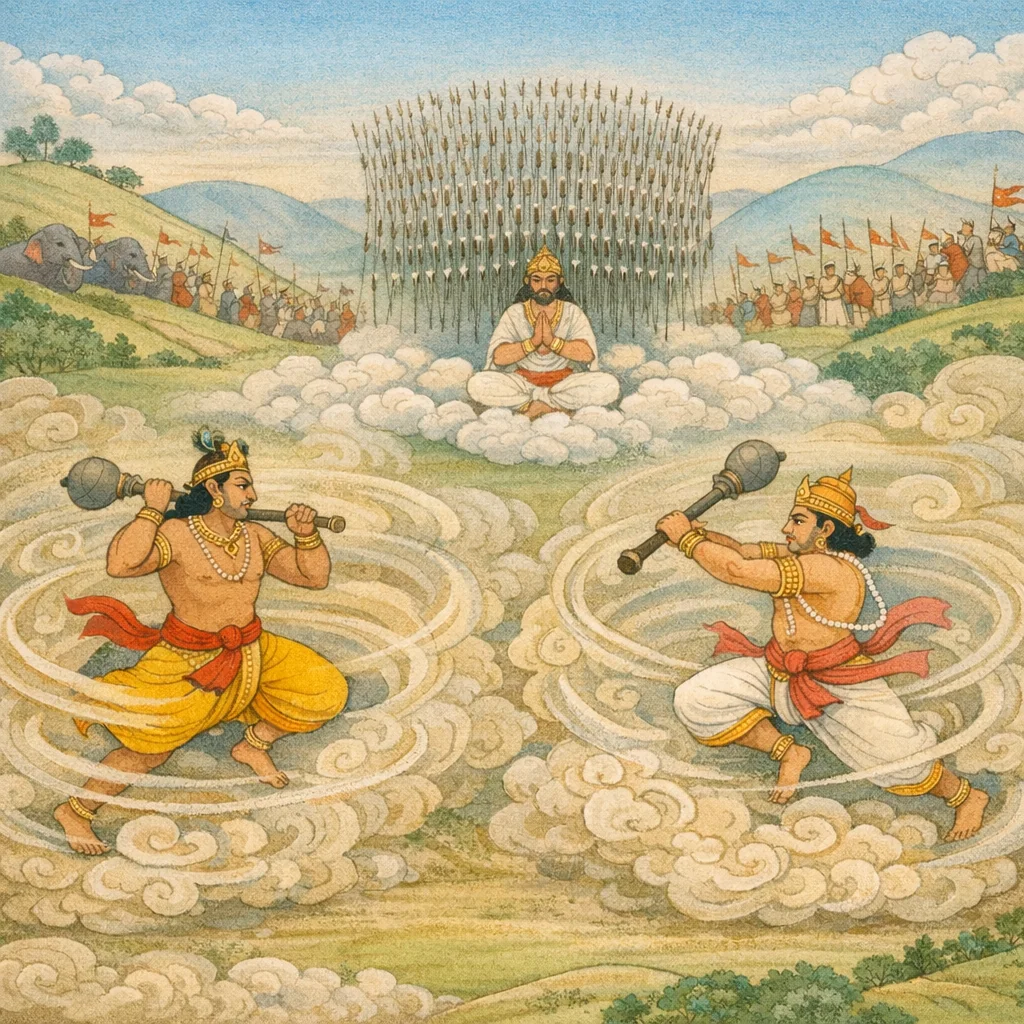
Chapter Arc: रणभूमि में शल्य का तेज प्रलयाग्नि-सा दीप्त है—यम के पाश, इन्द्र के वज्र और कैलास-शिखरों जैसी उपमाएँ उसके भय को मूर्त कर देती हैं; उसी क्षण भीम महागदा उठाकर उस पर झपटता है। → भीम और मद्रराज शल्य, दो पर्वतों की भाँति गदाएँ उठाकर मण्डलों में घूमते हुए एक-दूसरे पर प्रहार करते हैं; चोटों से डगमगाते, फिर सँभलते, वे बार-बार निकट आते हैं—भीम क्षणिक मूर्च्छा से उठकर फिर समाह्वान करता है और युद्ध और उग्र हो उठता है। → गदायुद्ध की चरम घड़ी के बाद शल्य का रथ युधिष्ठिर की ओर मुड़ता है; धर्मपुत्र के वक्ष पर बाणों का जाल-सा बिछ जाता है—मेघजाल की तरह घिरा हुआ—और सभा-सी दृष्टि रखने वाले योद्धा भी क्षण भर को स्तब्ध हो जाते हैं कि क्या राजा धराशायी होगा। → भीम और शल्य दोनों के मर्मस्थानों में गहरी चोटें लगने से वे अत्यन्त व्याकुल होते हैं; इसी अवसर पर कृपाचार्य शल्य को शीघ्र रण से हटाकर ले जाते हैं, जिससे तत्काल विनाश टलता है और मोर्चा पुनः सँभलता है। → कौरवदल दुर्योधन के अग्रणी होकर सिंहनाद करता हुआ आगे बढ़ता है; पाण्डव-वीर भी गर्जना कर उसकी ओर धावा करते हैं—अगला टकराव किसके पक्ष को तोड़ेगा, यह अनिश्चित रह जाता है।
Shlokas
Verse 1
०: >> अर द्ादशो<ड् ध्याय: भीमसेन और शल्यका भयानक गदायुद्ध तथा युधिष्ठिरके साथ शल्यका युद्ध, दुर्योधनद्वारा चेकितानका और युधिष्ठिरद्वारा चन्द्रसेन एवं द्रुमसेनका वध, पुनः युधिषिर और माद्रीपुत्रोंके साथ शल्यका युद्ध संजय उवाच पतितं प्रेक्ष्य यन्तारं शल्य: सर्वायसीं गदाम् | आदाय तरसा राजंस्तस्थौ गिरिरिवाचल:,संजय कहते हैं--राजन्! अपने सारथिको गिरा हुआ देख मद्रराज शल्य वेगपूर्वक लोहेकी गदा हाथमें लेकर पर्वतके समान अविचलभावसे खड़े हो गये
Sañjaya said: O King, seeing his charioteer fallen, Śalya, the lord of Madra, swiftly seized his all-iron mace and stood firm and unmoving, like a mountain—resolute amid the harsh law of war.
Verse 2
तं॑ दीप्तमिव कालाग्निं पाशहस्तमिवान्तकम् । सशृज्गभमिव कैलासं सवज़मिव वासवम्,वे प्रलयकालकी प्रज्वलित अग्नि, पाशधारी यमराज, शिखरयुक्त कैलास, वज्रधारी इन्द्र, त्रिशूलधारी रुद्र तथा जंगलके मतवाले हाथीके समान भयंकर जान पड़ते थे। भीमसेन बहुत बड़ी गदा हाथमें लेकर वेगपूर्वक उनके ऊपर टूट पड़े
Sañjaya said: He appeared terrifying—like the blazing fire of Time at the world’s end, like Death himself holding the noose, like Mount Kailāsa with its lofty peaks, and like Indra bearing the thunderbolt. Seeing him thus, Bhīmasena, gripping his massive mace, rushed forward with force to strike him down.
Verse 3
सशूलमिव हर्यक्ष॑ वने मत्तमिव द्विपम् | जवेनाभ्यपतद् भीम: प्रगृह् महतीं गदाम्,वे प्रलयकालकी प्रज्वलित अग्नि, पाशधारी यमराज, शिखरयुक्त कैलास, वज्रधारी इन्द्र, त्रिशूलधारी रुद्र तथा जंगलके मतवाले हाथीके समान भयंकर जान पड़ते थे। भीमसेन बहुत बड़ी गदा हाथमें लेकर वेगपूर्वक उनके ऊपर टूट पड़े
Sañjaya said: Like a bull bearing a sharp horn, like a rut-maddened elephant in the forest, Bhīma rushed forward with speed, gripping his massive mace.
Verse 4
तत:ः शड्खप्रणादश्च तूर्याणां च सहस्रश: । सिंहनादश्न संजज्ञे शूराणां हर्षवर्धन:
Sañjaya said: Then there arose the blare of conches and, in their thousands, the sounding of trumpets and other war-instruments. A lion-like roar also burst forth from the warriors, swelling their exhilaration and hardening their resolve for battle.
Verse 5
फिर तो शंखनाद, सहसौ्रों वाद्योका गम्भीर घोष तथा शूरवीरोंका हर्ष बढ़ानेवाला सिंहनाद सब ओर होने लगा ।। प्रेक्षनत: सर्वतस्तौ हि योधा योधमहाद्विपौ । तावकाश्षापरे चैव साधु साथ्वित्यपूजयन्
Then, on every side, there arose the blare of conches, the deep roar of countless instruments, and lion-like shouts that heightened the warriors’ exhilaration. Watching from all directions, the fighters acclaimed those two great “war-elephants” in battle, and even those stationed in the open spaces cried out, “Well done! Well done!”, honoring their prowess as the clash intensified.
Verse 6
योद्धाओंमें महान् गजराजके समान पराक्रमी उन दोनों वीरोंको देखकर आपके और शत्रुपक्षके योद्धा सब ओरसे “वाह-वाह” कहकर उनके प्रति सम्मान प्रकट करने लगे --[५॥।। न हि मद्राधिपादन्यो रामाद् वा यदुनन्दनात् | सोढुमुत्सहते वेगं भीमसेनस्य संयुगे,'संसारमें मद्रराज शल्य अथवा यदुनन्दन बलरामजीके सिवा दूसरा कोई ऐसा योद्धा नहीं है, जो युद्धमें भीमसेनका वेग सह सके
Sañjaya said: Seeing those two heroes—mighty in valor like a great lord of elephants—warriors on both your side and the enemy’s side, from every direction, cried “Bravo! Bravo!” and openly showed them honor. For in this world, apart from Śalya, king of Madra, or Balarāma, the delight of the Yadus, there is no other warrior who dares to withstand Bhīmasena’s onrush in battle.
Verse 7
तथा मद्राधिपस्यापि गदावेगं महात्मन: । सोदुमुत्सहते नानयो योधो युधि वृकोदरात्,“इसी प्रकार महामना मद्रराज शल्यकी गदाका वेग भी रणभूमिमें भीमसेनके सिवा दूसरा कोई योद्धा नहीं सह सकता'
Sañjaya said: “In the same way, the mighty rush of the mace wielded by the great-souled Śalya, lord of Madra, cannot be endured in battle by any warrior other than Vṛkodara (Bhīma).”
Verse 8
तौ वृषाविव नर्दन्तौ मण्डलानि विचेरतु: । आवर्तितौ गदाहस्तौ मद्रराजवृकोदरौ,शल्य और भीमसेन दोनों वीर हाथमें गदा लिये साँड़ोंकी तरह गर्जते हुए चक्कर लगाने और पैंतरे देने लगे
Sañjaya said: Shalya, the king of Madra, and Bhīmasena (Vṛkodara), both gripping their maces, roared like two bulls and began to circle in measured rounds, wheeling and feinting for advantage.
Verse 9
मण्डलावर्तमार्गेषु गदाविहरणेषु च । निर्विशेषम भूद् युद्ध तयो: पुरुषसिंहयो:,मण्डलाकार गतिसे घूमनेमें, भाँति-भाँतिके पैंतरे दिखानेकी कलामें तथा गदाका प्रहार करनेमें उन दोनों पुरुषसिंहोंमें कोई भी अन्तर नहीं दिखायी देता था, दोनों एक-से जान पड़ते थे
Sañjaya said: In their circling maneuvers, in the turning paths of combat, and in the artful play and striking of the mace, the fight between those two lion-like men showed no distinction at all—neither appeared superior; they seemed evenly matched in skill and prowess.
Verse 10
तप्तहेममयै: शुश्रे्बभूव भयवर्धिनी । अग्निजालैरिवाबद्धा पट्टा: शल्यस्य सा गदा,तपाये हुए उज्ज्वल सुवर्णमय पत्रोंसे जड़ी हुई शल्यकी वह भयंकर गदा आगकी ज्वालाओंसे लिपटी हुई-सी प्रतीत होती थी
Sañjaya said: Shalya’s mace, inlaid with blazing, radiant plates of gold, looked fearsome and deepened dread; it seemed as though it were bound about with nets of fire.
Verse 11
इस प्रकार श्रीमह्याभारत शल्यपर्वमें भीमरेन और शल्यका युद्धविषयक ग्यारहवाँ अध्याय पूरा हुआ,तथैव चरतो मार्गान् मण्डलेषु महात्मन: । विद्युदभ्रप्रतीिकाशा भीमस्य शुशुभे गदा इसी प्रकार मण्डलाकार गतिसे विचित्र पैंतरोंके साथ विचरते हुए महामनस्वी भीमसेनकी गदा बिजलीसहित मेघके समान सुशोभित होती थी
Sañjaya said: As Bhīmasena continued along his course in circling maneuvers, his mighty mace shone brilliantly—like a cloud streaked with lightning—proclaiming his martial mastery and fierce resolve in battle.
Verse 12
ताडिता मद्रराजेन भीमस्य गदया गदा । दहा[मानेव खे राजन् सासृजत् पावकार्चिष:,राजन! मद्रराजने अपनी गदासे जब भीमसेनकी गदापर चोट की, तब वह प्रज्वलित- सी हो उठी और उससे आगकी लपटें निकलने लगीं इति श्रीमहाभारते शल्यपर्वणि संकुलयुद्धे द्वादशोडध्याय:
Sañjaya said: O King, when Bhīmasena’s mace was struck by the mace of the king of Madra, it flared up as though burning in the sky, and sparks like tongues of fire burst forth.
Verse 13
तथा भीमेन शल्यस्य ताडिता गदया गदा । अज्जारवर्ष मुमुचे तदद्भुतमिवाभवत्,इसी प्रकार भीमसेनकी गदासे ताड़ित होकर शल्यकी गदा भी अंगारे बरसाने लगी। वह है कक अकन्5
Sañjaya said: Thus, when Śalya’s mace was struck by Bhīma’s mace, it began to shower burning embers, as though something wondrous had occurred.
Verse 14
महानागौ श्ज्ञैरिव महर्षभौ । तोत्रैरिव तदान्योन्यं गदाग्राभ्यां निजघ्नतु:,जैसे दो विशाल हाथी दाँतोंसे और दो बड़े-बड़े साँड़ सींगोंसे एक-दूसरेपर चोट करते हैं, उसी प्रकार अंकुशों-जैसी उन श्रेष्ठ गदाओंद्वारा वे दोनों वीर एक-दूसरेपर आघात करने लगे
Sañjaya said: Like two mighty elephants striking with their tusks, or like two great bulls clashing with their horns, the two foremost warriors began to smite one another with the tips of their maces, as though those maces were goads.
Verse 15
तौ गदाभिह्ठ तैगत्रि: क्षणेन रुधिरोक्षितौ । प्रेक्षणीयतरावास्तां पुष्पिताविव किंशुकौ,उन दोनोंके अंगोंमें गदाकी गहरी चोटोंसे घाव हो गये थे। अतः दोनों ही क्षणभरमें खूनसे नहा गये। उस समय खिले हुए दो पलाशवृक्षोंके समान वे दोनों वीर देखने ही योग्य जान पड़ते थे
Sañjaya said: Struck hard by the blows of their maces, both warriors’ limbs were quickly covered with wounds and drenched in blood. Even so, they stood all the more worth beholding—like two kiṁśuka (palāśa) trees in full bloom—revealing the grim splendor of valor amid the violence of war.
Verse 16
गदया मद्रराजस्य सव्यदक्षिणमाहत: । भीमसेनो महाबाहुर्न चचालाचलो तथा,मद्रराजकी गदासे दायें-बायें अच्छी तरह चोट खाकर भी महाबाहु भीमसेन विचलित नहीं हुए। वे पर्वतके समान अविचलभावसे खड़े रहे
Sañjaya said: Though struck hard on his left and right by the mace of the king of Madra, the mighty-armed Bhīmasena did not waver. He stood firm, unmoving like a mountain—an image of steadfast resolve amid the violence of war.
Verse 17
तथा भीमगदावेगैस्ताड्यमानो मुहुर्मुहुः । शल्यो न विव्यथे राजन् दन्तिनेव महागिरि:
Sañjaya said: Even as he was struck again and again by the furious momentum of Bhīma’s mace, Śalya did not flinch, O King—standing unmoved like a great mountain assailed by an elephant.
Verse 18
इसी प्रकार भीमसेनकी गदाके वेगसे बारंबार आहत होनेपर भी शल्यको उसी प्रकार व्यथा नहीं हुई, जैसे दन््तार हाथीके आघातसे महान् पर्वत पीड़ित नहीं होता ।। शुश्रुवे दिक्षु सर्वासु तयो: पुरुषसिंहयो: । गदानिपातसंहादो वज़योरिव नि:स्वन:,उस समय उन दोनों पुरुषसिंहोंकी गदाओंके टकरानेकी आवाज सम्पूर्ण दिशाओंमें दो वज्रोंक आघातके समान सुनायी देती थी
Sañjaya said: In the same way, though Śalya was struck again and again by the force of Bhīmasena’s mace, he felt no distress—just as a great mountain is not pained by the assault of a tusked elephant. Then, in every direction, there was heard the thunderous crash as the maces of those two lion-like heroes struck together—like the resounding impact of two thunderbolts.
Verse 19
निवृत्य तु महावीर्यों समुच्छितमहागदौ । पुनरन्तरमार्गस्थौ मण्डलानि विचेरतु:,महापराक्रमी भीमसेन और शल्य दोनों वीर अपनी विशाल गदाओंको ऊपर उठाये कभी पीछे लौट पड़ते, कभी मध्यम मार्गमें स्थित होते और कभी मण्डलाकार घूमने लगते थे
Sañjaya said: Then those two mighty heroes—Bhīmasena and Śalya—having raised their massive maces aloft, would at times draw back, at times hold the middle line of approach, and at times circle in sweeping rounds, each seeking the right opening in the duel.
Verse 20
अथाश्येत्य पदान्यष्टौ संनिपातो5भवत् तयो: । उद्यम्य लोहदण्डाभ्यामतिमानुषकर्मणो:,वे युद्ध करते-करते आठ कदम आगे बढ़ आये और लोहेके डंडे उठाकर एक-दूसरेको मारने लगे। उनका पराक्रम अलौकिक था। उन दोनोंमें उस समय भयानक संघर्ष होने लगा
Sañjaya said: Then, advancing eight paces toward one another, the two closed in. Lifting iron clubs, those men of superhuman prowess began to strike each other, and at that moment a dreadful, close-quarters struggle arose between them.
Verse 21
पोथयन्तौ तदान्योन्यं मण्डलानि विचेरतु: । क्रियाविशेषं कृतिनौ दर्शयामासतुस्तदा,वे दोनों युद्धकलाके विद्वान् वीर, एक-दूसरेको कुचलते हुए मण्डलाकार विचरते और अपना-अपना विशेष कार्य-कौशल प्रदर्शित करते थे
Sañjaya said: At that time the two accomplished warriors pressed hard against one another and moved in circling patterns, each displaying his own distinctive mastery of combat.
Verse 22
अथोट्यम्य गदे घोरे सशृज्भाविव पर्वतौ । तावाजघ्नतुरन्योन्यं मण्डलानि विचेरतु:,तदनन्तर वे पुनः अपनी भयंकर गदाएँ उठाकर शिखरयुक्त दो पर्वतोंके समान परस्पर आघात करने और मण्डलाकार गतिसे विचरने लगे
Sañjaya said: Then, lifting up their dreadful maces, the two warriors—like twin mountains crowned with peaks—struck one another in turn, while circling in ring-like motions.
Verse 23
क्रियाविशेषकृतिनौ रणभूमितले5चलौ । तौ परस्परसंरम्भाद् गदाभ्यां सुभशाहतौ
Sañjaya said: On the floor of the battlefield, those two—masters of varied and skillful maneuvers—stood firm and unmoving. Yet, driven by mutual fury, they struck each other with their maces with tremendous force.
Verse 24
युगपत पेततुर्वीरावुभाविन्द्रध्वजाविव । उभयो: सेनयोर्वीरास्तदा हाहाकृतो&$भवन्
Sañjaya said: At that very moment both heroes fell together, like two Indra-banners brought down. Then the warriors of both armies raised a cry of lament.
Verse 25
युद्धविषयक कार्यविशेषके ज्ञाता वे दोनों वीर अविचलभावसे रणभूमिमें डटे हुए थे। वे एक-दूसरेपर क्रोधपूर्वक गदाओंका प्रहार करके अत्यन्त घायल हो गये और दो इन्द्रध्वजोंके समान एक ही साथ पृथ्वीपर गिर पड़े। उस समय दोनों सेनाओंके वीर हाहाकार करने लगे ।। भृशं मर्माण्यभिहतावुभावास्तां सुविह्नलौ । ततः स्वरथमारोप्य मद्राणामृषभं रणे
Sañjaya said: Both champions, skilled in the special duties of war, stood fast upon the battlefield with unwavering hearts. In wrath they struck each other with their maces, were grievously wounded, and fell together upon the earth like two Indra-banners collapsing at once. Then the heroes of both armies raised a cry of anguish. With their vital points sorely smitten, both were left reeling; and in the midst of the fight they lifted the bull among the Madras and set him back upon his own chariot.
Verse 26
क्षीणवद् विद्धलत्वात् तु निमेषात् पुनरुत्थित:
Sañjaya said: Though he seemed utterly spent—his body slack and pierced with wounds—he rose again in the very next instant.
Verse 27
भीमसेनो गदापाणि: समाह्नयत मद्रपम् । इधर गदाधारी भीमसेन पलक मारते-मारते पुनः होशमें आकर उठ खड़े हुए और विह्वलताके कारण मतवाले पुरुषके समान मद्रराजको युद्धके लिये ललकारने लगे ।। ततस्तु तावका: शूरा नानाशस्त्रसमायुता:
Sañjaya said: Bhīmasena, mace in hand, challenged the king of Madra to combat. Thereupon the valiant warriors of your side, equipped with many kinds of weapons, moved to respond.
Verse 28
भुजावुच्छित्य शस्त्र च शब्देन महता तत:
Sañjaya said: Then, raising his arms and his weapon, he let out a great, resounding cry.
Verse 29
तदनीकमभिप्रेक्ष्य ततस्ते पाण्डुनन्दना:
Sañjaya said: Seeing that battle-array before them, the sons of Pāṇḍu then took their resolve and acted.
Verse 30
तेषामापततां तूर्ण पुत्रस्ते भरतर्षभ
Sañjaya said: “As those warriors rushed in swiftly, O bull among the Bharatas, your son (Duryodhana)…”
Verse 31
स पपात रथोपस्थे तव पुत्रेण ताडित:
Struck down by your son, he collapsed onto the chariot-seat—an image of how, in the fury of war, prowess and life can be overturned in an instant, and how the deeds of one’s own kin become the immediate instruments of fate on the battlefield.
Verse 32
चेकितानं हतं दृष्टवा पाण्डवेया महारथा:
Sañjaya said: Seeing Cekitāna slain, the great chariot-warriors of the Pāṇḍavas were struck by the shock of loss—an event that deepened their resolve even as it revealed the relentless cost of war.
Verse 33
तावकानामनीकेषु पाण्डवा जितकाशिन:
Sañjaya said: Among your forces, the Pāṇḍavas—having conquered Kāśi—stood arrayed, their presence signaling both hard-won prowess and the relentless momentum of the war’s moral and martial consequences.
Verse 34
व्यचरन्त महाराज प्रेक्षणीया: समनन््ततः । महाराज! विजयसे उल्लसित होनेवाले पाण्डव आपकी सेनाओंमें सब ओर निर्भय विचरते थे। उस समय वे देखने ही योग्य थे ।। ३३ $ ।। कृपश्च कृतवर्मा च सौबलश्न महारथ:
Sañjaya said: “O King, they moved about on every side—truly a sight worth beholding. And there were also Kṛpa, Kṛtavarmā, and the Saubala, a great chariot-warrior.”
Verse 35
भारद्वाजस्य हन्तारं भूरिवीर्यपराक्रमम्
Sañjaya said: (He beheld) the slayer of Bhāradvāja’s son—one endowed with abundant might and heroic prowess—standing forth in the battle’s grim moral haze, where valor and the burden of killing are inseparably entwined.
Verse 36
दुर्योधनो महाराज धृष्टद्युम्नमयोधयत् । राजाधिराज! आपका पुत्र दुर्योधन अत्यन्त बल-पराक्रमसे सम्पन्न द्रोणहन्ता धृष्टद्युम्नके साथ जूझने लगा ।। त्रिसाहस्रास्तथा राजंस्तव पुत्रेण चोदिता:
Sañjaya said: O great king, Duryodhana engaged Dhṛṣṭadyumna in battle. O emperor, your son Duryodhana—endowed with extraordinary strength and valor—closed with Dhṛṣṭadyumna, the slayer of Droṇa. And, O king, the troops in their thousands were likewise urged on by your son, pressing the fight forward.
Verse 37
विजये धृतसंकल्पा: समरे त्यक्तजीविता:
Sañjaya said: Resolute in their aim of victory, they entered the battle having cast aside attachment to life—men who chose steadfast purpose over self-preservation in the harsh demands of war.
Verse 38
प्राविशंस्तावका राजन् हंसा इव महत् सर: । नरेश्वरर जैसे हंस महान् सरोवरमें प्रवेश करते हैं, उसी प्रकार आपके सैनिक समरांगणमें विजयका दृढ़ संकल्प ले प्राणोंका मोह छोड़कर शत्रुओंकी सेनामें जा घुसे ।। ततो युद्धम भूद् घोरं परस्परवधैषिणाम्
Sañjaya said: O King, your warriors surged forward—like swans entering a vast lake—casting off attachment to life and entering the enemy ranks with firm resolve for victory. Then there arose a dreadful battle, as both sides sought one another’s destruction.
Verse 39
तस्मिन् प्रवत्ते संग्रामे राजन् वीरवरक्षये
Sañjaya said: “O King, when that battle had begun in earnest—bringing about the destruction of the foremost heroes—…”
Verse 40
श्रवणान्नामधेयानां पाण्डवानां च कीर्तनात्
Sañjaya said: “By merely hearing their names, and by the recitation of the Pāṇḍavas’ names as well…,”
Verse 41
तद्रज: पुरुषव्यात्र शोणितेन प्रशामितम्
Sañjaya said: O tiger among men, that dust was quenched and laid to rest by blood.
Verse 42
दिशश्नल विमला जातास्तस्मिंस्तमसि नाशिते । पुरुषसिंह! उस समय इतना खून बहा कि उससे वहाँ छायी हुई सारी धूल बैठ गयी। उस धूलजनित अन्धकारका नाश होनेपर सम्पूर्ण दिशाएँ स्वच्छ हो गयीं ।। तथा प्रवृत्ते संग्रामे घोररूपे भयानके
Sañjaya said: “O lion among men! When that darkness was dispelled, the directions became clear. So much blood flowed that the dust hanging over the field settled down; and when the dust-born gloom was destroyed, all quarters appeared bright again. Thus the battle raged on—terrible in form and fearful.”
Verse 43
ब्रह्मलोकपरा भूत्वा प्रार्थयन्तो जयं युधि
Sañjaya said: Having fixed their minds on Brahmaloka as the highest goal, they prayed for victory in battle.
Verse 44
सुयुद्धेन पराक्रान्ता नस: स्वर्गमभीप्सव: । सबका लक्ष्य था ब्रह्मलोककी प्राप्ति। वे सभी सैनिक युद्धमें विजय चाहते और उत्तम युद्धके द्वारा पराक्रम दिखाते हुए स्वर्गलोक पानेकी अभिलाषा रखते थे ।। भर्त॒पिण्डविमोक्षार्थ भर्त॒कार्यविनिश्चिता:
Sañjaya said: “With noble fighting they displayed valor, desiring heaven. Their common aim was the attainment of Brahmaloka. All those warriors sought victory in battle; by engaging in excellent combat and showing their prowess, they longed to win the heavenly world—resolved to fulfill their lord’s purpose and to free themselves from the debt of the sustenance they had received.”
Verse 45
नानारूपाणि शस्त्राणि विसृजन्तो महारथा:
Sañjaya said: The great chariot-warriors, hurling weapons of many kinds, pressed the battle forward—an image of war’s relentless momentum, where prowess and duty are asserted through disciplined violence rather than personal whim.
Verse 46
हत विध्यत गृह्नीत प्रहरध्वं निकृन्तत
Sañjaya said: “Strike down the enemy; pierce them; seize them; smite them; cut them to pieces.” In the heat of battle, this is a rallying cry that reflects the ruthless momentum of war, where the immediate ethic is victory and survival rather than deliberation.
Verse 47
तत: शल्यो महाराज धर्मपुत्रं युधिष्तिरम्
Sañjaya said: Then Śalya, O great king, addressed Yudhiṣṭhira, the son of Dharma—setting the stage for counsel and confrontation amid the moral strain of war.
Verse 48
तस्य पार्थो महाराज नाराचान् वै चतुर्दश
Sañjaya said: O King, then Pārtha (Arjuna) released fourteen nārāca arrows at him—an act of swift, disciplined martial response within the grim duties of war.
Verse 49
आवार्य पाण्डवं बाणैहन्तुकामो महाबल:
Sañjaya said: With a shower of arrows he checked the Pāṇḍava, and—being intent on killing—advanced with great might. The line underscores the war’s grim momentum: martial power is directed by a deliberate will to destroy, highlighting how intention (kāma/saṅkalpa) drives action amid the collapse of restraint in battle.
Verse 50
विव्याध समरे क्रुद्धो बहुभि: कड्कपत्रिभि: | महाबली शल्य पाण्डुपुत्र युधिष्ठिरको रोककर उन्हें मार डालनेकी इच्छासे समरांगणमें कंकपत्रयुक्त अनेक बाणोंद्वारा उनपर क्रोधपूर्वक प्रहार करने लगे ।। अथ भूयो महाराज शरेणानतपर्वणा
Sanjaya said: In the heat of battle, the mighty Shalya, aflame with wrath and bent on slaying Yudhishthira, the son of Pandu, struck him again and again on the field with many arrows fitted with heron-feathers. Then again, O King, with another arrow whose joints were bent downward, he pressed the attack.
Verse 51
युधिष्ठिरं समाजघ्ने सर्वसैन्यस्य पश्यत: । राजाधिराज! फिर उन्होंने सारी सेनाके देखते-देखते झुकी हुई गाँठवाले बाणसे युधिष्ठिरको घायल कर दिया ।। धर्मराजो5पि संक्रुद्धों मद्रराज॑ं महायशा:
Sanjaya said: Before the eyes of the entire army he struck Yudhishthira. O emperor among kings, as all the forces looked on, Shalya wounded Yudhishthira with knotty arrows bent downward. Then the righteous king Yudhishthira, famed for his glory, grew wrathful toward the king of Madra.
Verse 52
चन्द्रसेनं च सप्तत्या सूतं च नवभि: शरै:
Sanjaya said: He struck Candrasena with seventy arrows, and the charioteer with nine.
Verse 53
चक्ररक्षे हते शल्य: पाण्डवेन महात्मना
Sanjaya said: When the warrior who guarded the wheel-formation (cakra-vyūha) was slain by the great-souled Pandava, Shalya’s resolve was shaken—an ominous turn in the battle.
Verse 54
निजघान ततो राजंश्वेदीन् वै पज्चविंशतिम् । महात्मा पाण्डवके द्वारा अपने चक्ररक्षकके मारे जानेपर राजा शल्यने पचीस चेदि- योद्धाओंका संहार कर डाला || ५३ $ || सात्यकिं पड्चविंशत्या भीमसेनं च पठ्चभि:
Sanjaya said: Then, O King, Shalya struck down twenty-five Cedi (Śvedi) warriors. He also assailed Satyaki with twenty-five arrows and Bhimasena with five, thus continuing the relentless exchange of blows in the battle.
Verse 55
माद्रीपुत्रो शतेनाजी विव्याथ निशितै: शरै: । फिर सात्यकिको पचीस, भीमसेनको पाँच तथा माद्रीके पुत्रोंकी सौ तीखे बाणोंसे रणभूमिमें घायल कर दिया ।। एवं विचरतस्तस्य संग्रामे राजसत्तम
Sañjaya said: The son of Mādrī struck him in battle with a hundred keen arrows, grievously wounding him on the field. Thus, as that foremost of kings moved about in the thick of combat, the clash of arms continued—each warrior pressing his duty as he understood it amid the ruthless demands of war.
Verse 56
ध्वजाग्रं चास्य समरे कुन्तीपुत्रो युधिष्ठिर:
Sañjaya said: In the thick of battle, Kuntī’s son Yudhiṣṭhira struck at the very top of his opponent’s banner—an act meant not merely to damage a chariot’s emblem, but to challenge the enemy’s prestige and resolve amid the moral strain of war.
Verse 57
पाण्डुपुत्रेण वै तस्य केतुं छिन्न॑ महात्मना
Sañjaya said: That noble son of Pāṇḍu indeed cut down his banner—an act that, in the midst of battle, signified both tactical mastery and the moral resolve to break the enemy’s pride without wavering from his warrior-duty.
Verse 58
ध्वजं निपतितं दृष्टवा पाण्डवं च व्यवस्थितम्,संक़्रुद्धो मद्रराजो5भूच्छरवर्ष मुमोच ह । ध्वज नीचे गिर पड़ा और पाण्डुपुत्र युधिष्ठिर सामने खड़े हैं; यह देखकर मद्रराज शल्यको बड़ा क्रोध हुआ और वे बाणोंकी वर्षा करने लगे
Sañjaya said: Seeing the banner fallen and the Pāṇḍava (Yudhiṣṭhira) standing firm before him, the king of Madra, Śalya, was inflamed with anger and unleashed a rain of arrows. The moment underscores how, in the heat of war, wounded pride and the sight of an opponent’s steadfastness can provoke a surge of wrath that drives violent escalation.
Verse 59
शल्य: सायकवर्षेण पर्जन्य इव वृष्टिमान्
Sañjaya said: Śalya, pouring forth a rain of arrows, appeared like the rain-bearing cloud Parjanya in full downpour—an image that underscores how, in the fury of battle, martial prowess can resemble the overwhelming, impartial force of nature.
Verse 60
सात्यकिं भीमसेनं च माद्रीपुत्री च पाण्डवी
Sañjaya said: He beheld and named Sātyaki and Bhīmasena, and also the Pāṇḍava lady, the daughter of Mādrī—calling attention to these foremost figures amid the calamity of war, where lineage and loyalty sharpen both duty and grief.
Verse 61
एकैकं पज्चभिर्विद्ध्वा युधिष्ठिरमपीडयत् । सात्यकि, भीमसेन और माद्रीकुमार पाण्डुपुत्र नकुल-सहदेव--इनमेंसे प्रत्येकको पाँच- पाँच बाणोंसे घायल करके वे युधिष्ठिरको पीड़ा देने लगे || ६० $ ।। ततो बाणमयं जाल॑ विततं पाण्डवोरसि
Sañjaya said: Having pierced each of them with five arrows, he began to torment Yudhiṣṭhira. Then a net-like spread of arrows was cast across the Pāṇḍava’s chest—meant not only to wound bodies in battle, but to break the king’s resolve through the suffering of his companions.
Verse 62
तस्य शल्यो रणे क्रुद्धः शरै: संनतपर्वभि:
Sañjaya said: In that battle, Śalya, inflamed with anger, assailed him with arrows whose joints were well-set and firm—disciplined weaponry turned to destructive purpose amid the fury of war.
Verse 63
दिश: संछादयामास प्रदिशश्न महारथ: । रणभूमिमें कुपित हुए महारथी शल्यने झुकी हुई गाँठवाले बाणोंसे युधिष्ठिरकी सम्पूर्ण दिशाओं और विदिशाओंको ढक दिया ।। ६२ $ ।। ततो युधिष्ठिरो राजा बाणजालेन पीडित: । बभूवाद्धुतविक्रान्तो जम्भो वृत्रहणा यथा,उस समय अद्भुत पराक्रमी राजा युधिष्ठिर उस बाणसमूहसे वैसे ही पीड़ित हो गये, जैसे इन्द्रने जम्भासुरको संतप्त किया था
Sañjaya said: Enraged on the battlefield, the great chariot-warrior Śalya covered all the directions and intermediate quarters around Yudhiṣṭhira with a dense shower of arrows, their joints bent down as they flew. Then King Yudhiṣṭhira, pressed hard by that net of arrows, displayed astonishing valor—like Jambha when assailed by Vṛtrahan (Indra).
Verse 276
नानावादित्रशब्देन पाण्डुसेनामयोधयन् । तब आपके सैनिक नाना प्रकारके अस्त्र-शस्त्र लेकर भाँति-भाँतिके रणवाद्योंकी गम्भीर ध्वनिके साथ पाण्डव-सेनासे युद्ध करने लगे
Sañjaya said: With the clamour of many kinds of war-instruments, the troops set upon the Pāṇḍava army and began to fight—arms raised, weapons in hand—while the deep, varied sounds of the battlefield signalled the full onset of war and the hardening of hearts that such conflict demands.
Verse 283
अभ्यद्रवन् महाराज दुर्योधनपुरोगमा: । महाराज! दुर्योधन आदि कौरववीर दोनों हाथ और शस्त्र उठाकर महान् कोलाहल एवं सिंहनाद करते हुए शत्रुओंपर टूट पड़े
Sañjaya said: “O King, led by Duryodhana, the Kaurava heroes charged forward. Raising their arms and weapons, they surged upon the enemy with a great tumult and lion-like roars—an image of war’s fierce momentum, where pride and martial ardor drive men headlong into violence.”
Verse 303
प्रासेन चेकितानं वै विव्याध हृदये भृशम् । भरतश्रेष्ठ) आपके पुत्रने तुरंत ही एक प्रासका प्रहार करके उन आक्रमणकारी पाण्डव- योद्धाओंमेंसे चेकितानकी छातीपर गहरी चोट पहुँचायी
Sañjaya said: “With a spear, he struck Cekitāna fiercely in the region of the heart. In the grim momentum of battle, the act highlights how swiftly martial skill turns into lethal consequence, where valor and duty on the battlefield are inseparable from the tragic cost of violence.”
Verse 316
रुधिरौघपरिक्लिन्न: प्रविश्य विपुलं तम: | आपके पुत्रद्वारा ताड़ित होकर चेकितान अत्यन्त मूर्च्छित हो रथकी बैठकमें गिर पड़ा। उस समय उसका सारा शरीर खूनसे लथपथ हो गया था
Sañjaya said: “Soaked in a torrent of blood, he sank into vast darkness—overwhelmed and losing consciousness after being struck down by your son. Chekitāna collapsed into the seat of his chariot, his whole body drenched in blood, marking the brutal immediacy of war and the tragic cost of martial prowess when it turns into sheer destruction.”
Verse 323
असक्तमभ्यवर्षन्त शरवर्षाणि भागश: । चेकितानको मारा गया देख पाण्डव महारथी पृथक्-पृथक् बाणोंकी लगातार वर्षा करने लगे
Sañjaya said: “With unbroken intensity they poured down showers of arrows in measured volleys. Cekitāna, the twin sons of Mādrī, and Yuyudhāna (Sātyaki)—the Pāṇḍava champions—each in his own sector drenched the opposing great chariot-warriors with continuous flights of shafts. The scene underscores the disciplined coordination of battle, where prowess is joined to resolve and duty amid the harsh demands of war.”
Verse 346
अयोधयन् धर्मराजं मद्रराजपुरस्कृता: । तत्पश्चात् कृपाचार्य, कृतवर्मा और महारथी शकुनि मद्रराज शल्यको आगे करके धर्मराज युधिष्ठिरसे युद्ध करने लगे
Sañjaya said: “With the king of Madra placed at their head, they engaged Dharmarāja in battle. Thereafter, Kṛpa the preceptor, Kṛtavarmā, and the great chariot-warrior Śakuni—putting the Madra king Śalya in front—set upon Dharmarāja Yudhiṣṭhira to fight him. The scene underscores how, in the chaos of war, even revered elders and famed warriors rally behind a chosen leader to press a concentrated assault against the embodiment of dharma.”
Verse 363
अयोधयन्त विजयं द्रोणपुत्रपुरस्कृता: । राजन्! आपके पुत्रसे प्रेरित हो तीन हजार योद्धा अश्वत्थामाको अगुआ बनाकर अर्जुनके साथ युद्ध करने लगे
Sañjaya said: O King, urged on by your son, three thousand warriors—marching with Drona’s son, Aśvatthāmā, at their head—joined battle with Arjuna, striving to win victory.
Verse 386
अन्योन्यवधसंयुक्तमन्योन्यप्रीतिवर्धनम् । फिर तो एक-दूसरेके वधकी इच्छावाले उभयपक्षके सैनिकोंमें घोर युद्ध होने लगा। सभी एक-दूसरेके संहारके लिये सचेष्ट थे और वह युद्ध उनकी पारस्परिक प्रसन्नताको बढ़ा रहा था
Sañjaya said: The battle became one of mutual slaughter—each side intent on killing the other—yet it also heightened their exhilaration in combat. Thus the warriors strove for one another’s destruction as the fighting grew ever more terrible.
Verse 396
अनिलेनेरितं घोरमुन्तस्थौ पार्थिव रज: । राजन! बड़े-बड़े वीरोंका विनाश करनेवाले उस घोर संग्रामके आरम्भ होते ही वायुकी प्रेरणासे धरतीकी भयंकर धूल ऊपरको उठने लगी
Sañjaya said: Driven by the wind, a dreadful cloud of dust rose up from the earth. O King, at the very onset of that terrible battle—destined to destroy even the greatest heroes—the air’s force lifted the ground’s fearsome dust high.
Verse 403
परस्परं विजानीमो यदयुद्धयन्नभीतवत् । उस समय उस धूलके अन्धकारमें समस्त योद्धा निर्भय-से होकर युद्ध कर रहे थे। पाण्डव तथा कौरव-योद्धा जो अपना नाम लेकर परिचय देते थे, उसे ही सुनकर हमलोग एक-दूसरेको पहचान पाते थे
Sañjaya said: In that blinding darkness raised by dust, the warriors fought on without fear. Amid the confusion, we could recognize one another only by hearing the combatants call out their own names—whether Pāṇḍava or Kaurava—so that identity, not appearance, became the sole guide in the chaos of war.
Verse 423
तावकानां परेषां च नासीत् कश्चित् पराड्मुख: । इस प्रकार वह घोर एवं भयानक संग्राम चलने लगा। उस समय आपके और शत्रुपक्षके योद्धाओंमेंसे कोई भी युद्धसे विमुख नहीं हुआ
Sañjaya said: Among your warriors and among the opposing side, there was not a single man who turned his face away. Thus that dreadful and terrifying battle pressed on, and at that moment none from either host withdrew from the fight.
Verse 446
स्वर्गसंसक्तमनसो योधा युयुधिरे तदा । सभी योद्धा स्वामीके दिये हुए अन्नके ऋणसे उऋण होनेके लिये उनके कार्यको सिद्ध करनेका दृढ़ निश्चय किये मनमें स्वर्गकी अभिलाषा रखकर उस समय उत्साहपूर्वक युद्ध कर रहे थे
Sañjaya said: Then the warriors, their minds fixed on heaven, fought on. All those fighters, resolved to repay the debt of the food given by their lord and to accomplish his purpose, waged the battle with ardor, bearing the desire for heaven in their hearts.
Verse 453
अन्योन्यमभिगर्जन्त: प्रहरन्त: परस्परम् । नाना प्रकारके अस्त्र-शस्त्रोंका प्रयोग करके परस्पर प्रहार करनेवाले महारथी एक- दूसरेको लक्ष्य करके गर्जना करते थे
Sañjaya said: Roaring at one another and striking in turn, the great chariot-warriors hurled and wielded weapons of many kinds. Fixing each opponent as their target, they thundered challenges and dealt blow for blow.
Verse 463
इति सम वाच: श्रूयन्ते तव तेषां च वै बले । आपकी और पाण्डवोंकी सेनामें “मारो, बींध डालो, पकड़ो, प्रहार करो और टुकड़े- टुकड़े कर डालो' ये ही बातें सुनायी देती थीं
Sañjaya said: Thus, in both armies—yours and the Pāṇḍavas’—only such uniform cries were heard: “Kill! Pierce! Seize! Strike! Cut to pieces!”
Verse 476
विव्याध निशितैर्बाणै्न्तुकामो महारथम् | महाराज! तदनन्तर राजा शल्यने महारथी धर्मपुत्र राजा युधिष्ठिरको मार डालनेकी इच्छासे पैने बाणोंद्वारा बींध डाला
Sañjaya said: O great king, thereafter Śalya, the mighty chariot-warrior, desiring to kill the great warrior—Dharma’s son King Yudhiṣṭhira—pierced him with sharp, keen arrows.
Verse 486
मर्माण्युद्दिश्य मर्मज्ञो निचखान हसन्निव । महाराज! मर्मज्ञ कुन्तीकुमारने शल्यके मर्मस्थानोंको लक्ष्य करके हँसते हुए-से चौदह नाराच चलाये और उनके अंगोंमें धँसा दिये
Sañjaya said: O King, the expert in vital points, as though smiling, struck by aiming at the vulnerable spots. The son of Kuntī, skilled in the knowledge of vital organs, fixed his aim on Śalya’s vital regions and, as if with a calm smile, released fourteen iron arrows, lodging them deep in his limbs.
Verse 516
विव्याध निशितैर्बाणै: कड़कबर्हिणवाजितै: । तब महायशस्वी धर्मराजने भी अत्यन्त कुपित हो कंक और मोरकी पाँखोंवाले पैने बाणोंसे मद्रराज शल्यको क्षत-विक्षत कर दिया
Sañjaya said: Then the illustrious Dharmarāja, inflamed with intense anger, pierced Madra’s king Śalya with sharp arrows—arrows adorned with vulture and peacock feathers—so that Śalya was left wounded and torn. In the grim ethic of battle, the king who upholds dharma is shown acting with fierce resolve, meeting violence with disciplined force when duty demands it.
Verse 523
ट्रुमसेनं चतुःषष्ट्या निजघान महारथ: । इसके बाद महारथी युधिष्छिरने सत्तर बाणोंसे चन्द्रसेनको, नौ बाणोंसे शल्यके सारथिको और चौंसठ बाणोंसे ट्रमसेनको मार डाला
Sañjaya said: The great chariot-warrior struck down Trumasena with sixty-four arrows. In the same surge of battle, Yudhiṣṭhira—acting with the stern resolve demanded by kṣatriya-duty—also felled Candrasena with seventy arrows and Śalya’s charioteer with nine, pressing the war forward through precise, measured violence rather than reckless cruelty.
Verse 553
सम्प्रैषयच्छितान् पार्थ: शरानाशीविषोपमान् । नृपश्रेष्ठ) इस प्रकार संग्राममें विचरते हुए राजा शल्यको लक्ष्य करके कुन्तीकुमारने विषधर सर्पोंके समान भयंकर एवं तीखे बाण चलाये
Sañjaya said: Arjuna, the son of Kuntī, fixing his aim on King Śalya as he moved about the battlefield, discharged sharp and dreadful arrows—like venomous serpents—pressing the combat forward with relentless martial resolve.
Verse 563
प्रमुखे वर्तमानस्य भल्लेनापाहरद् रथात् । कुन्तीपुत्र युधिष्ठिरने समरांगणमें सामने खड़े हुए शल्यकी ध्वजाके अग्रभागको एक भल्लके द्वारा रथसे काट गिराया
Sañjaya said: As Śalya stood at the very front, Yudhiṣṭhira—the son of Kuntī—struck with a sharp bhalla-arrow and cut down the forward crest of Śalya’s banner, making it fall from the chariot. In the moral texture of the war, the act signals not mere aggression but the strategic unmaking of an opponent’s visible pride and rallying-sign, a reminder that symbols of power are as vulnerable as bodies in a dharma-contested battlefield.
Verse 573
निपतन्तमपश्याम गिरिशृज्भमिवाहतम् । महात्मा पाण्डुपुत्रके द्वारा कटकर गिरते हुए उस ध्वजको हमलोगोंने वज्ञजके आघातसे टूटकर नीचे गिरनेवाले पर्वत-शिखरके समान देखा था
Sañjaya said: We saw it falling—like a mountain-peak struck down. Thus, the great banner of the son of Pāṇḍu, cut at its base, toppled and descended, resembling a crag shattered by a mighty blow. The image underscores how, in war, even the proudest emblems of power are rendered fragile when fate and force converge.
Verse 593
अभ्यवर्षदमेयात्मा क्षत्रियान् क्षत्रियर्षभ: । अमेय आत्मबलसे सम्पन्न क्षत्रियशिरोमणि शल्य वृष्टिकारी मेघके समान क्षत्रियोंपर बाणोंकी वर्षा कर रहे थे
Sanjaya said: Shalya—the bull among warriors, of immeasurable spirit and boundless strength—poured down arrows upon the kshatriyas. Like a rain-bearing cloud, that crest-jewel of fighters rained a storm of shafts over the opposing warriors.
Verse 616
अपश्याम महाराज मेघजालमिवोदगतम् । महाराज! तदनन्तर हमलोगोंने पाण्डुपुत्र युधिष्ठिरकी छातीपर बाणोंका जाल-सा बिछा हुआ देखा, मानो आकाशमें मेघोंकी घटा घिर आयी हो
Sañjaya said: “O great king, we beheld it as though a net of clouds had risen. Thereafter we saw the son of Pāṇḍu, Yudhiṣṭhira, with a mesh of arrows spread across his chest, as if a dense mass of clouds had gathered in the sky.”
Verse 2536
अपोवाह कृप: शल्यं तूर्णणायोधनादथ । भीम और शल्य दोनोंके मर्मस्थानोंमें गहरी चोटें लगी थीं; इसलिये दोनों ही अत्यन्त व्याकुल हो गये थे। इतनेहीमें कृपाचार्य मद्रराज शल्यको अपने रथपर बिठाकर तुरंत ही युद्धभूमिसे दूर हटा ले गये
Sañjaya said: Then Kṛpa swiftly carried Śalya away from the field of battle. Both Bhīma and Śalya had sustained deep, vital wounds, and so each was thrown into extreme distress; in that moment, Kṛpācārya placed the king of Madra, Śalya, upon his chariot and quickly withdrew him from the battlefield.
Verse 2936
प्रययु: सिंहनादेन दुर्योधनपुरोगमान् । उस कौरवदलको धावा करते देख पाण्डव-वीर सिंहके समान गर्जना करके दुर्योधन आदिकी ओर बढ़ चले
Sañjaya said: With a lion-like roar, the Pāṇḍava heroes surged forward toward Duryodhana and those marching at his head. Seeing the Kaurava host charging, they answered with fearless, leonine cries and advanced to meet them.
Frequently Asked Questions
The tension lies in balancing collective necessity (many warriors press a single commander to protect Yudhiṣṭhira and stabilize the line) with the ideal of honorable, regulated engagement—maintaining open contest through recognized weapons and roles.
The chapter illustrates that battlefield advantage is not only force but also control of tempo and perception: disciplined counter-fire, protection of critical personnel (drivers), and denial of visibility can neutralize numerical pressure.
No explicit phalaśruti is presented in the supplied passage; the chapter’s significance is primarily narrative-technical—documenting late-war tactical intensity and the ethical strain on commanders as the epic approaches its terminal phase.