Adhyaya 11
Pitāmaha-sabhā-varṇana & Hariścandra-māhātmya (Description of Brahmā’s Assembly and the Eminence of Hariścandra)
Upa-parva: Sabhā-śruti (Narratives of Divine Assemblies and Royal Emulation)
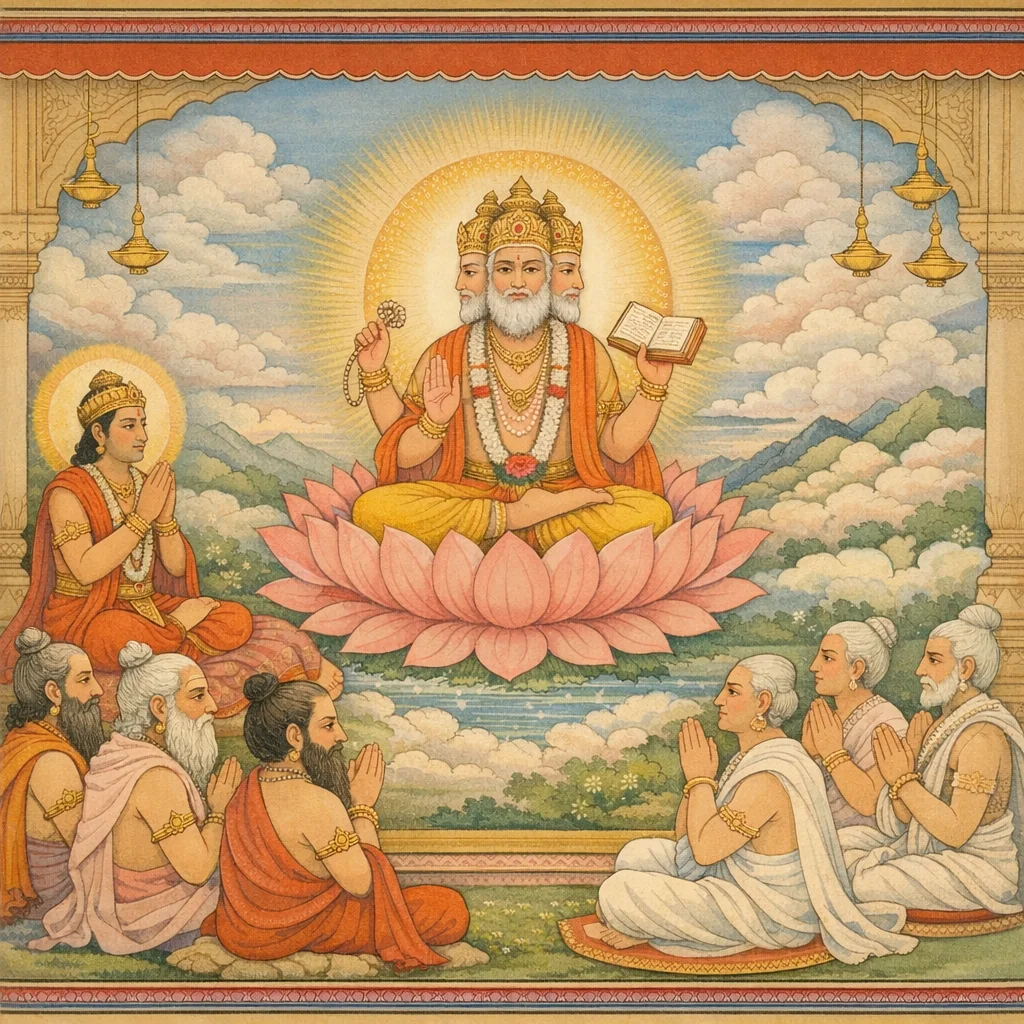
Nārada reports that in an earlier divine age Āditya (the Sun) visited the human realm and described to Nārada the Brahmā-sabhā as a brāhmī, mind-formed (mānasī) assembly whose form is difficult to delimit and whose radiance exceeds ordinary measures. Nārada, desiring direct vision, is conveyed to that assembly, which is portrayed as free from fatigue, hunger, thirst, and climatic discomfort, self-luminous, and not dependent on pillars—an image of stable, non-decaying order. The sabhā is populated by Brahmā (Svayaṃbhū) and an encyclopedic retinue: Prajāpatis, Ṛṣis, Vedas and Vedāṅgas, cosmic principles (elements, sense-objects, prakṛti/vikāra), time-units and cycles, deities, guardians, celestial musicians, and diverse classes of beings—suggesting that governance and cosmology are homologous. Nārada concludes that Yudhiṣṭhira’s human assembly is the foremost among human courts, having seen divine assemblies before. Yudhiṣṭhira then queries Hariścandra’s unique standing in Indra’s sabhā and asks after Pāṇḍu. Nārada explains Hariścandra’s eminence: universal conquest, performance of the rājasūya, and extraordinary generosity to officiants and Brahmins. He adds advisory cautions: the rājasūya is great yet impeded by disruptive forces; thus one must act with deliberation, constant vigilance, protection of cāturvarṇya, and sustained patronage. Nārada departs; Yudhiṣṭhira reflects on undertaking the rājasūya.
Chapter Arc: नारद मुनि युधिष्ठिर से कहते हैं—“तात, अब पितामह ब्रह्मा की उस सभा का वर्णन सुनो, जिसका स्वरूप शब्दों में बाँधना भी कठिन है।” → नारद सत्ययुग की एक दिव्य कथा उठाते हैं: भगवान सूर्य मानुष-रूप धारण कर स्वयम्भू ब्रह्मा की सभा देखने आते हैं। सभा ‘मानसी’ है—ब्रह्मा के संकल्प से प्रकट, अप्रमेय, अनिर्देश्य, और समस्त प्राणियों के मन को मोहित करने वाली। जैसे-जैसे वर्णन बढ़ता है, वहाँ उपस्थित देव-गण, पितर-गण, ऋषि-समूह, और लोकपालों की विराट उपस्थिति सभा को और भी अलौकिक बनाती जाती है। → सभा के मध्य में स्वयं ‘सर्वलोकपितामह’ ब्रह्मा—एकाकी होकर भी देवमाया द्वारा समस्त जगत का विधान करते हुए—निरंतर विराजमान हैं; और उनके चारों ओर वैराज, अग्निष्वात्त, सोमपा, गार्हपत्य आदि पितर-गण, बालखिल्य ऋषि, देवर्षि, तथा कार्तिकेय, नारायण, इन्द्र, वरुण, कुबेर, यम, महादेव आदि देवता प्रसन्नचित्त होकर उनकी उपासना करते हैं। यह दृश्य ब्रह्म-व्यवस्था के केंद्र का प्रत्यक्ष दर्शन बन जाता है। → नारद निष्कर्ष देते हैं कि ऐसी सभा लोकों में दुर्लभ है—और मनुष्यों में यदि किसी की सभा उससे तुल्य कही जा सकती है, तो वह युधिष्ठिर की सभा है। इस प्रकार दिव्य आदर्श का मानवीय प्रतिबिम्ब स्थापित होता है। → यह तुलना संकेत देती है कि युधिष्ठिर की सभा-समृद्धि और प्रतिष्ठा आगे किसी बड़े मोड़ (सभा-प्रसंग के आगामी घटनाक्रम) का कारण बनेगी।
Shlokas
Verse 1
अपना बा अर: 2 एकादशोब< ध्याय: ब्रह्माजीकी सभाका वर्णन नारद उवाच पितामहसभां तात कथ्यमानां निबोध मे । शक््यते या न निर्देष्टमेवंसूपेति भारत,नारदजी कहते हैं--तात भारत! अब तुम मेरे मुखसे कही हुई पितामह ब्रह्माजीकी सभाका वर्णन सुनो! वह सभा ऐसी है, इस रूपसे नहीं बतलायी जा सकती
Nārada said: “O son of Bharata, listen as I describe to you the assembly-hall of Pitāmaha Brahmā. That hall is of such a kind that it cannot be precisely indicated or fully described in this form.”
Verse 2
पुरा देवयुगे राजन्नादित्यो भगवान् दिव: । आगच्छन्मानुषं लोकं दिदृक्षुबिंगतक्लम:,राजन्! पहले सत्ययुगकी बात है, भगवान् सूर्य ब्रह्माजीकी सभा देखकर फिर मनुष्यलोकको देखनेके लिये बिना परिश्रमके ही द्युलोकसे उतरकर इस लोकमें आये और मनुष्यरूपसे इधर-उधर विचरने लगे। पाण्डुनन्दन! सूर्यदेवने मुझसे उस ब्राह्मी सभाका यथार्थत: वर्णन किया
Nārada said: “In an earlier divine age, O King, the blessed Āditya (the Sun), descending from the heavenly world without fatigue, came to the human realm, eager to observe it. Moving about here in human form, he then told me truthfully of that Brahmā assembly.”
Verse 3
चरन् मानुषरूपेण सभां दृष्टवा स्वयम्भुव: । स तामकथयन्महां ब्राह्मीं तत््वेन पाण्डव,राजन्! पहले सत्ययुगकी बात है, भगवान् सूर्य ब्रह्माजीकी सभा देखकर फिर मनुष्यलोकको देखनेके लिये बिना परिश्रमके ही द्युलोकसे उतरकर इस लोकमें आये और मनुष्यरूपसे इधर-उधर विचरने लगे। पाण्डुनन्दन! सूर्यदेवने मुझसे उस ब्राह्मी सभाका यथार्थत: वर्णन किया
Nārada said: “Having beheld the assembly of Svayambhū (Brahmā), the Sun-god descended effortlessly from the celestial realm to the world of men, and, assuming a human form, wandered here and there. O son of Pāṇḍu, O King, he later related to me, in accordance with the truth, a full account of that great Brahmā’s assembly.”
Verse 4
अप्रमेयां सभां दिव्यां मानसीं भरतर्षभ । अनिर्देश्यां प्रभावेण सर्वभूतमनोरमाम्,भरतश्रेष्ठ] वह सभा अप्रमेय, दिव्य, ब्रह्माजीके मानसिक संकल्पसे प्रकट हुई तथा समस्त प्राणियोंके मनको मोह लेनेवाली है। उसका प्रभाव अवर्णनीय है
Nārada said: “O bull among the Bharatas, that assembly-hall is immeasurable and divine—brought forth by Brahmā’s mental resolve. Its splendor is beyond description, and it captivates the minds of all beings.”
Verse 5
श्रुत्वा गुणानहं तस्या: सभाया: पाण्डवर्षभ | दर्शनेप्सुस्तथा राजन्नादित्यमिदमब्लुवम्,पाण्डुकुलभूषण युधिष्ठिर! उस सभाके अलौकिक गुण सुनकर मेरे मनमें उसके दर्शनकी इच्छा जाग उठी और मैंने सूर्यदेवसे कहा--
Nārada said: “Having heard of the extraordinary excellences of that assembly-hall, O bull among the Pāṇḍavas, a longing arose in me to behold it. Therefore, O king, I spoke these words to Āditya (the Sun), seeking the opportunity to see it.”
Verse 6
भगवन् द्रष्टमिच्छामि पितामहसभां शुभाम् | येन वा तपसा शक्या कर्मणा वापि गोपते,“'भगवन्! मैं भी ब्रह्माजीकी कल्याणमयी सभाका दर्शन करना चाहता हूँ। किरणोंके स्वामी सूर्यदेव! जिस तपस्यासे, सत्कर्मसे अथवा उपयुक्त ओषधियोंके प्रभावसे उस पापनाशिनी उत्तम सभाका दर्शन हो सके, वह मुझे बताइये। भगवन्! मैं जैसे भी उस सभाको देख सकूँ, उस उपायका वर्णन कीजिये'
Nārada said: “O Blessed Lord, I wish to behold the auspicious assembly-hall of the Grandfather (Brahmā). O Lord of the rays (Sun), by what austerity, or by what righteous action, is it possible to gain that vision? Tell me the means by which I may see that purifying, excellent sabhā.”
Verse 7
औषदधैीर्वा तथा युक्तैरुत्तमा पापनाशिनी । तन्ममाचक्ष्व भगवन् पश्येयं तां सभां यथा,“'भगवन्! मैं भी ब्रह्माजीकी कल्याणमयी सभाका दर्शन करना चाहता हूँ। किरणोंके स्वामी सूर्यदेव! जिस तपस्यासे, सत्कर्मसे अथवा उपयुक्त ओषधियोंके प्रभावसे उस पापनाशिनी उत्तम सभाका दर्शन हो सके, वह मुझे बताइये। भगवन्! मैं जैसे भी उस सभाको देख सकूँ, उस उपायका वर्णन कीजिये'
Nārada said: “O Blessed One, tell me this: by what means—through austerity, through meritorious action, or through the effective use of suitable medicinal herbs—may that supreme, sin-destroying assembly be beheld? Explain to me the method by which I might gain the vision of that auspicious hall.”
Verse 8
स तन्मम वच: श्रुत्वा सहस्रांशुर्दिवाकर: । प्रोवाच भरतश्रेष्ठ ब्रतं वर्षमहस्रिकम्,भरतश्रेष्ठ! मेरी वह बात सुनकर सहस्रों किरणोंवाले भगवान् दिवाकरने कहा--“तुम एकाग्रचित्त होकर ब्रह्माजीके व्रतका पालन करो। वह श्रेष्ठ व्रत एक हजार वर्षोमें पूर्ण होगा।' तब मैंने हिमालयके शिखरपर आकर उस महान् व्रतका अनुष्ठान आरम्भ कर दिया
Nārada said: “Hearing these words of mine, the Sun—Divākara, the thousand-rayed one—addressed me: ‘O best of the Bharatas, undertake with single-pointed mind the vow connected with Brahmā. That excellent observance will be completed in a thousand years.’ Thereupon I went to the summit of the Himālaya and began the performance of that great vow.”
Verse 9
ब्रह्म॒व्रतमुपास्स्व त्वं प्रयतेनानतरात्मना । ततो<हं हिमवत्पृष्ठे समारब्धो महाव्रतम्,भरतश्रेष्ठ! मेरी वह बात सुनकर सहस्रों किरणोंवाले भगवान् दिवाकरने कहा--“तुम एकाग्रचित्त होकर ब्रह्माजीके व्रतका पालन करो। वह श्रेष्ठ व्रत एक हजार वर्षोमें पूर्ण होगा।' तब मैंने हिमालयके शिखरपर आकर उस महान् व्रतका अनुष्ठान आरम्भ कर दिया
Narada said: “You should observe the Brahmā-vow with disciplined effort and inwardly gathered mind. After that, I went to the heights of the Himālaya and began the undertaking of that great vow.”
Verse 10
इस प्रकार श्रीमह्या भारत सभापववके अन्तर्गत लोकपालसभाख्यानपर्वमें कुबेरसभा-वर्णन नामक दसवाँ अध्याय पूरा हुआ,ततः स भगवान् सूर्यो मामुपादाय वीर्यवान् | आगच्छत् तां सभां ब्राह्मीं विपाप्मा विगतक््लम: तदनन्तर मेरी तपस्या पूर्ण होनेपर पापरहित, क्लेशशून्य और परम शक्तिशाली भगवान् सूर्य मुझे साथ ले ब्रह्माजीकी उस सभामें गये
Then the mighty Lord Sūrya took me with him and proceeded to that divine assembly of Brahmā—free from sin and wholly without fatigue—after my austerities had reached completion.
Verse 11
एवंरूपेति सा शक््या न निर्देष्ठुं नराधिप । क्षणेन हि बिभर्त्यन्यदनिर्देश्यं वपुस्तथा,राजन! वह सभा 'ऐसी ही है” इस प्रकार नहीं बतायी जा सकती; क्योंकि वह एक-एक क्षणमें दूसरा अनिर्वचनीय स्वरूप धारण कर लेती है इति श्रीमहाभारते सभापर्वणि लोकपालसभाख्यानपर्वणि ब्रह्मसभावर्णनं नामैकादशो< ध्याय:
Nārada said: “O king, that assembly cannot be described simply as ‘it is like this.’ For in a single moment it assumes yet another form—indescribable in its beauty and nature. Thus, O ruler, its appearance continually shifts beyond precise definition.”
Verse 12
न वेद परिमाणं वा संस्थान चापि भारत | न च रूपं मया तादूृग् दृष्टपूर्व कदाचन,भारत! उसकी लंबाई-चौड़ाई कितनी है अथवा उसकी स्थिति कया है, यह सब मैं कुछ नहीं जानता। मैंने किसी भी सभाका वैसा स्वरूप पहले कभी नहीं देखा था
Nārada said: “O Bhārata, I do not know its measure or extent, nor even its arrangement and disposition. Never before have I seen a hall of such a form.”
Verse 13
सुसुखा सा सदा राजन् न शीता न च घर्मदा । न क्षुत्पिपासे न ग्लानिं प्राप्य तां प्राप्तुवन्त्युत
Nārada said: “O King, that realm is ever supremely pleasant: it is neither afflicted by cold nor scorched by heat. There, hunger and thirst do not arise, nor does weariness; and those who reach it indeed attain such freedom from bodily distress.”
Verse 14
१३ ।। नानारूपैरिव कृता मणिशभि: सा सुभास्वरै: । स्तम्भैर्न च धृता सा तु शाश्वती न च सा क्षरा,वह सभा अनेक प्रकारकी अत्यन्त प्रकाशमान मणियोंसे निर्मित हुई है। वह खंभोंके आधारपर नहीं टिकी है और उसमें कभी क्षयरूप विकार न आनेके कारण वह नित्य मानी गयी है;
Nārada said: “That assembly hall appears as though fashioned in many wondrous forms, built of radiant, brilliantly shining gems. It is not upheld by pillars; and because it never undergoes decay or deterioration, it is regarded as everlasting and imperishable.”
Verse 15
दिव्यैर्ननाविधैभविर्भासद्धिरमितप्रभै:,अनन्त प्रभावाले नाना प्रकारके प्रकाशमान दिव्य पदार्थोद्वारा अग्नि, चन्द्रमा और सूर्यसे भी अधिक स्वयं ही प्रकाशित होनेवाली वह सभा अपने तेजसे सूर्यमण्डलको तिरस्कृत करती हुई-सी स्वर्गसे भी ऊपर स्थित हुई प्रकाशित हो रही है
Fashioned of many kinds of divine substances, radiant and of immeasurable splendor, that hall shone by its own light—brighter than fire, the moon, and the sun. By the force of its brilliance it seemed to outshine the solar orb itself, gleaming as though set above even heaven.
Verse 16
अति चन्द्र च सूर्य च शिखिनं च स्वयम्प्रभा । दीप्यते नाकपृष्ठस्था भर्त्सयन्तीव भास्करम्,अनन्त प्रभावाले नाना प्रकारके प्रकाशमान दिव्य पदार्थोद्वारा अग्नि, चन्द्रमा और सूर्यसे भी अधिक स्वयं ही प्रकाशित होनेवाली वह सभा अपने तेजसे सूर्यमण्डलको तिरस्कृत करती हुई-सी स्वर्गसे भी ऊपर स्थित हुई प्रकाशित हो रही है
Nārada said: That celestial hall, self-luminous and blazing more than fire, the moon, and the sun, shone as though it were scorning the very orb of the Sun. Situated above the heavenly regions, it radiated with countless wondrous lights—an image of superhuman splendor that humbles ordinary power and display.
Verse 17
तस्यां स भगवानास्ते विदधद् देवमायया । स्वयमेको5डनिशं राजन् सर्वलोकपितामह:,राजन्! उस सभामें सम्पूर्ण लोकोंके पितामह ब्रह्माजी देवमायाद्वारा समस्त जगत्की स्वयं ही सृष्टि करते हुए सदा अकेले ही विराजमान होते हैं
Nārada said: “In that very assembly-hall, the Blessed Lord—Brahmā, the grandsire of all worlds—abides alone at all times. By divine māyā he himself continually brings forth the creation of the entire universe.”
Verse 18
उपतिष्ठन्ति चाप्येनं प्रजानां पतय: प्रभुम् दक्ष: प्रचेता: पुलहो मरीचि: कश्यप: प्रभु:,भारत! वहाँ दक्ष आदि प्रजापतिगण उन भगवान् ब्रह्माजीकी सेवामें उपस्थित होते हैं। दक्ष, प्रचेता, पुलह, मरीचि, प्रभावशाली कश्यप,
Nārada said: “And the lords of created beings also attend upon that Supreme Lord. Dakṣa, Pracetā, Pulaha, Marīci, and the mighty Kaśyapa—these Prajāpatis stand in service before Brahmā, acknowledging his sovereignty and supporting the ordered continuance of creation.”
Verse 19
भगुरत्रिरवसिष्ठश्न गौतमो5थ तथाड्रिरा: । पुलस्त्यश्न क्रतुश्चैव प्रह्मद: कर्दमस्तथा,भृगु, अत्रि, वसिष्ठ, गौतम, अंगिरा, पुलस्त्य, क्रतु, प्रहाद, कर्दम, इस प्रकार श्रीमहाभारत सभापव॑के अन्तर्गत लोकपालसभाख्यानपर्वमें ब्रह्मसभा-वर्णन नामक ग्यारहवाँ अध्याय पूरा हुआ
Bhagu, Atri, Vasiṣṭha, Gautama, and Aṅgira; Pulastya, Kratu, Prahlāda, and Kardama. Thus, within the Mahābhārata’s Sabha Parva, in the section known as the “Account of the Assemblies of the World-Guardians,” the eleventh chapter, titled “Description of Brahmā’s Assembly,” comes to its close.
Verse 20
अथर्वाड्विरसश्वैव बालखिल्या मरीचिपा: । मनो&न््तरिक्षं विद्याश्व वायुस्तेजो जल॑ं मही,अथर्वांगिरस, सूर्यकिरणोंका पान करनेवाले बालखिल्य, मन, अन्तरिक्ष, विद्या, वायु, तेज, जल, पृथ्वी, शब्द, स्पर्श, रूप, रस, गन्ध, प्रकृति, विकृति तथा पृथ्वीकी रचनाके जो अन्य कारण हैं, इन सबके अभिमानी देवता,
Narada said: “Atharvan and the Aṅgirases, the Bālakhilyas who drink the rays of the Sun, the Marīcipas, and also Mind, the mid-space (Antarikṣa), Knowledge, Wind, Fire/Light, Water, and Earth—these are named among the presiding divine powers connected with the constituents and causal principles of the world.”
Verse 21
शब्दस्पर्शों तथा रूप॑ रसो गन्धश्ष भारत । प्रकृतिश्न विकारश्न यच्चान्यत् कारणं भुव:,अथर्वांगिरस, सूर्यकिरणोंका पान करनेवाले बालखिल्य, मन, अन्तरिक्ष, विद्या, वायु, तेज, जल, पृथ्वी, शब्द, स्पर्श, रूप, रस, गन्ध, प्रकृति, विकृति तथा पृथ्वीकी रचनाके जो अन्य कारण हैं, इन सबके अभिमानी देवता,
Narada said: “O Bharata, sound and touch, form, taste, and smell—along with primordial Nature and its modifications, and whatever other causes there are for the constitution of the world—(all these principles are presided over by their respective deities).”
Verse 22
अगस्त्यश्न महातेजा मार्कण्डेयश्व वीर्यवान् । जमदन्निर्भरद्वाज: संवर्तक्ष्यवनस्तथा,महातेजस्वी अगस्त्य, शक्तिशाली मार्कण्डेय, जमदग्नि, भरद्वाज, संवर्त, च्यवन,
Nārada said: “Agastya, the mighty in spiritual splendor; Mārkaṇḍeya, renowned for steadfast strength; and also Jamadagni, Bharadvāja, Saṃvarta, and Cyavana.”
Verse 23
दुर्वासाश्ष महाभाग ऋष्यश्ड्रश्च धार्मिक: । सनत्कुमारो भगवान् योगाचार्यो महातपा:,महाभाग दुर्वासा, धर्मात्मा ऋष्यशृंग, महातपस्वी योगाचार्य भगवान् सनत्कुमार,
Narada said: “There is also the illustrious sage Durvasa; and the righteous seer Rishyasringa; and the venerable Sanatkumara—an exalted master of yoga, renowned for great austerities.”
Verse 24
असितो देवलश्रैव जैगीषव्यश्व तत्त्ववित् ऋषभो जितशबत्रुश्न महावीर्यस्तथा मणि:,असित, देवल, तत्त्वज्ञानी जैगीषव्य, शत्रुविजयी ऋषभ, महापराक्रमी मणि
Narada said: “Asita, Devala, and Jaigīṣavya—knowers of the truth—along with Ṛṣabha, who had conquered his enemies, and Maṇi, renowned for great prowess: these eminent sages are to be counted among the foremost.”
Verse 25
आयुर्वेदस्तथाष्टाड़ो देहवांस्तत्र भारत | चन्द्रमा: सह नक्षत्रैरादित्यश्व गभस्तिमान्,तथा आठ अंगोंसे युक्त मूर्तिमान् आयुर्वेद, नक्षत्रोंलहित चन्द्रमा, अंशुमाली सूर्य,
Nārada said: “O Bhārata, there too appeared embodied Āyurveda, complete with its eight limbs; and the Moon together with the constellations, and the radiant Sun with his beams.”
Verse 26
वायव: क्रतवश्चैव संकल्प: प्राण एव च | मूर्तिमन्तो महात्मानो महाव्रतपरायणा:
Nārada said: “The Maruts (winds), the sacred rites, resolve (saṅkalpa), and even the vital breath (prāṇa)—all these are great-souled powers embodied, steadfastly devoted to lofty vows.”
Verse 27
अर्थो धर्मश्न॒ कामश्न हर्षो द्वेषस्तपो दम:,अर्थ, धर्म, काम, हर्ष, द्वेष, तप और दम--ये भी मूर्तिमान् होकर ब्रह्माजीकी उपासना करते हैं
Nārada said: “Wealth, righteousness, desire, joy, hatred, austerity, and self-restraint—these too, taking embodied form, worship Brahmā.”
Verse 28
आयान्ति तस्यां सहिता गन्धर्वाप्सरसां गणा: । विंशति: सप्त चैवान्ये लोकपालाश्न सर्वश:,गन्धर्वों और अप्सराओंके बीस गण एक साथ उस सभामें आते हैं। सात अन्य गन्धर्व भी जो प्रधान हैं, वहाँ उपस्थित होते हैं। समस्त लोकपाल, शुक्र, बृहस्पति, बुध, मंगल, शनैश्वर, राहु तथा केतु--ये सभी ग्रह,
Nārada said: Into that splendid hall come, together, the companies of Gandharvas and Apsarases—twenty groups in all—along with seven other eminent Gandharvas. From every direction the Lokapālas also arrive, marking the assembly as a cosmic court where order, rank, and rightful authority are publicly affirmed.
Verse 29
शुक्रो बृहस्पतिश्वैव बुधो5ड्रारक एव च । शनैश्वरश्न राहुश्न ग्रहा: सर्वे तथैव च,गन्धर्वों और अप्सराओंके बीस गण एक साथ उस सभामें आते हैं। सात अन्य गन्धर्व भी जो प्रधान हैं, वहाँ उपस्थित होते हैं। समस्त लोकपाल, शुक्र, बृहस्पति, बुध, मंगल, शनैश्वर, राहु तथा केतु--ये सभी ग्रह,
Nārada said: “Śukra (Venus) and Bṛhaspati (Jupiter), Budha (Mercury) and Aṅgāraka (Mars), Śanaiścara (Saturn), along with Rāhu and Ketu—indeed all the planets as well—were present there.” In the context of the royal assembly, this catalog of celestial powers underscores the extraordinary, almost cosmic legitimacy and splendor of the sabhā, where even the regulators of time and fate are portrayed as attending.
Verse 30
मन्त्रो रथन्तरं चैव हरिमान् वसुमानपि । आदित्या: साधिराजानो नामद्वन्द्वैरुदाह्ता:,सामगानसम्बन्धी मन्त्र, रथन्तरसाम, हरिमान, वसुमान्, अपने स्वामी इन्द्रसहित बारह आदित्य, अग्नि-सोम आदि युगल नामोंसे कहे जानेवाले देवता,
Nārada said: “The Mantra, the Rathantara (Sāman), and also Harimān and Vasumān; and the Ādityas together with their sovereign (Indra) are spoken of by paired names. These are deities and sacred designations connected with Sāma-chanting, invoked through such dual appellations.”
Verse 31
मरुतो विश्वकर्मा च वसवश्चैव भारत । तथा पितृगणा: सर्वे सर्वाणि च हवींष्यथ,मरुदगण, विश्वकर्मा, वसुगण, समस्त पितृगण, सभी हविष्य,
Nārada said: “O Bhārata, the Maruts, Viśvakarmā, the Vasus, and likewise all the hosts of the Pitṛs—along with all the oblations as well—(are present/are to be duly included).” The statement underscores that a rite or sacred occasion is not complete without honoring the full cosmic order: gods, ancestral beings, and the offerings that sustain the sacrificial relationship between humans and the unseen worlds.
Verse 32
ऋग्वेद: सामवेदश्न यजुर्वेदश्च॒ पाण्डव । अथर्ववेदश्न तथा सर्वशास्त्राणि चैव ह,पाण्डुनन्दन! ऋग्वेद, सामवेद, यजुर्वेद, अथर्ववेद तथा सम्पूर्ण शास्त्र,
Nārada said: “O Pāṇḍava, the Ṛgveda, the Sāmaveda, the Yajurveda, and likewise the Atharvaveda—indeed, all the sacred treatises as well—are (known/embraced) here.” In context, the statement elevates Vedic learning and the totality of śāstra as the comprehensive foundation for right conduct and discernment.
Verse 33
इतिहासोपवेदाश्ष वेदाड़ानि च सर्वश: । ग्रहा यज्ञाक्ष सोमश्ष देवताक्षापि सर्वश:,इतिहास, उपवेदः, सम्पूर्ण वेदांग, ग्रह, यज्ञ, सोम और समस्त देवता,
Nārada said: “All the Itihāsas and Upavedas, all the limbs of the Veda in their entirety, the sacred grahas (ritual vessels/offerings), the sacrifices, Soma, and indeed all the deities—everything is encompassed here.”
Verse 34
सावित्री दुर्गतरणी वाणी सप्तविधा तथा । मेधा धृति: श्रुतिश्वैव प्रज्ञा बुद्धिर्यश: क्षमा,सावित्री, दुर्गम दुःखसे उबारनेवाली दुर्गा, सात प्रकारकी प्रणवरूपा वाणीः, मेधा, धृति, श्रुति, प्रज्ञा, बुद्धि, यश और क्षमा,
Nārada said: “Savitrī—the power that carries one across difficult passages; the sevenfold sacred Speech; and also intelligence, steadfastness, sacred learning (śruti), discernment, understanding, fame, and forbearance—these are divine endowments to be revered, sustaining one through life’s trials and in the pursuit of dharma.”
Verse 35
सामानि स्तुतिगीतानि गाथाश्न विविधास्तथा । भाष्याणि तर्कयुक्तानि देहवन्ति विशाम्पते,साम, स्तुति, गीत, विविध गाथा तथा तर्कयुक्त भाष्य--ये सभी देहधारी होकर एवं अनेक प्रकारके नाटक, काव्य, कथा, आख्यायिका तथा कारिका आदि उस सभामें मूर्तिमान् होकर रहते हैं। इसी प्रकार गुरुजनोंकी पूजा करनेवाले जो दूसरे पुण्यात्मा पुरुष हैं, वे सभी उस सभामें स्थित होते हैं
Nārada said: “O lord of the people, the Sāman chants, hymns of praise, songs, and many kinds of gāthās—along with commentarial expositions grounded in reasoning—are present there as if embodied. In that assembly, various forms of dramatic and literary expression too—plays, poems, tales, ākhyāyikās, and metrical aphorisms—abide as though made visible; and likewise other meritorious men devoted to honoring their teachers and elders are also found established in that hall.”
Verse 36
नाटका विविधा: काव्या: कथाख्यायिककारिका: । तत्र तिष्ठन्ति ते पुण्या ये चान्ये गुरुपूजका:,साम, स्तुति, गीत, विविध गाथा तथा तर्कयुक्त भाष्य--ये सभी देहधारी होकर एवं अनेक प्रकारके नाटक, काव्य, कथा, आख्यायिका तथा कारिका आदि उस सभामें मूर्तिमान् होकर रहते हैं। इसी प्रकार गुरुजनोंकी पूजा करनेवाले जो दूसरे पुण्यात्मा पुरुष हैं, वे सभी उस सभामें स्थित होते हैं
Nārada said: “There abide—made manifest as embodied presences—many kinds of dramas, poems, tales, historical narratives (ākhyāyikās), and didactic verses. There too stand all those meritorious souls who honor and worship their teachers. Thus that wondrous assembly is portrayed as a realm where learning, refined speech, and reverence for the guru are not merely praised but appear as living realities.”
Verse 37
क्षणा लवा मुहूर्ताश्च दिवारात्रिस्तथैव च | अर्धमासाश्च मासाश्न ऋतव: षट् च भारत,युधिष्ठिर! क्षण, लव, मुहूर्त, दिन, रात, पक्ष, मास, छहों ऋतुएँ,
Nārada said: “O Bhārata, O Yudhiṣṭhira—time is reckoned in many measures: the kṣaṇa, the lava, and the muhūrta; likewise day and night; the half-months and the months; and also the six seasons. Thus the order of time proceeds in its fixed course.”
Verse 38
संवत्सरा: पञ्च युगमहोरात्रश्नतुर्विध: । कालचक्र च तद् दिव्यं नित्यमक्षयमव्ययम्
Nārada said: “Five years make up a yuga; and the day-and-night cycle is spoken of as fourfold. This divine Wheel of Time turns everlastingly—constant, inexhaustible, and undecaying.”
Verse 39
अदितिर्दितिर्दनुश्वैव सुरसा विनता इरा,अदिति, दिति, दनु, सुरसा, विनता, इरा, कालिका, सुरभी देवी, सरमा, गौतमी, प्रभा और कद्रू-ये दो देवियाँ, देवमाताएँ, रुद्राणी, श्री, लक्ष्मी, भद्रा तथा अपरा, षष्ठी, पृथ्वी, भूतलपर उतरी हुई गंगादेवी, लज्जा, स्वाहा, कीर्ति, सुरादेवी, शची, पुष्टि, अरुन्धती संवृत्ति, आशा, नियति, सृष्टिदेवी, रति तथा अन्य देवियाँ भी उस सभामें प्रजापति ब्रह्माजीकी उपासना करती हैं
Nārada said: In that royal assembly, many divine mothers and goddesses—Aditi, Diti, Danu, Surasā, Vinatā, Irā, Kālikā, Surabhī, Saramā, Gautamī, Prabhā, and Kadrū—along with Rudrāṇī, Śrī (Lakṣmī), Bhadrā, Aparā, Ṣaṣṭhī, Pṛthivī, and Gaṅgā who has descended upon the earth, and also Lajjā, Svāhā, Kīrti, Surādevī, Śacī, Puṣṭi, Arundhatī, Saṃvṛtti, Āśā, Niyati, the goddess of Creation (Sṛṣṭi), Rati, and other goddesses, were engaged in reverent worship of Prajāpati Brahmā. The scene underscores that even the highest celestial powers are ordered by devotion and humility before the cosmic source, affirming reverence as a foundation of righteous conduct.
Verse 40
कालिका सुरभी देवी सरमा चाथ गौतमी,अदिति, दिति, दनु, सुरसा, विनता, इरा, कालिका, सुरभी देवी, सरमा, गौतमी, प्रभा और कद्रू-ये दो देवियाँ, देवमाताएँ, रुद्राणी, श्री, लक्ष्मी, भद्रा तथा अपरा, षष्ठी, पृथ्वी, भूतलपर उतरी हुई गंगादेवी, लज्जा, स्वाहा, कीर्ति, सुरादेवी, शची, पुष्टि, अरुन्धती संवृत्ति, आशा, नियति, सृष्टिदेवी, रति तथा अन्य देवियाँ भी उस सभामें प्रजापति ब्रह्माजीकी उपासना करती हैं
Nārada said: “Kālikā, the goddess Surabhī, Saramā, and Gautamī; Aditi, Diti, Danu, Surasā, Vinatā, Irā; likewise Prabhā and Kadrū—these divine mothers, along with Rudrāṇī, Śrī (Lakṣmī), Bhadrā and Aparā; Ṣaṣṭhī, the Earth, the goddess Gaṅgā who has descended upon the world; and also Lajjā, Svāhā, Kīrti, Surādevī, Śacī, Puṣṭi, Arundhatī, Saṃvṛtti, Āśā, Niyati, the goddess of Creation, Rati, and many other goddesses—were all present in that royal assembly, worshipping Prajāpati Brahmā.”
Verse 41
प्रभा कद्रूश्न वै देव्यौ देवतानां च मातर: । रुद्राणी श्रीक्ष लक्ष्मीक्ष भद्रा पप्ठी तथापरा,अदिति, दिति, दनु, सुरसा, विनता, इरा, कालिका, सुरभी देवी, सरमा, गौतमी, प्रभा और कद्रू-ये दो देवियाँ, देवमाताएँ, रुद्राणी, श्री, लक्ष्मी, भद्रा तथा अपरा, षष्ठी, पृथ्वी, भूतलपर उतरी हुई गंगादेवी, लज्जा, स्वाहा, कीर्ति, सुरादेवी, शची, पुष्टि, अरुन्धती संवृत्ति, आशा, नियति, सृष्टिदेवी, रति तथा अन्य देवियाँ भी उस सभामें प्रजापति ब्रह्माजीकी उपासना करती हैं
Nārada said: “Prabhā and Kadrū—both divine mothers of the gods—along with Rudrāṇī, Śrī, Lakṣmī, Bhadrā, Pṛthvī, and Aparā; and also Aditi, Diti, Danu, Surasā, Vinatā, Irā, Kālikā, Surabhī, Saramā, and Gautamī—these goddesses too are present in that royal assembly, reverently worshipping Prajāpati Brahmā.” The scene underscores that even the highest divine powers uphold order through humility and devotion to the cosmic source.
Verse 42
पृथ्वी गां गता देवी द्वी: स्वाहा कीर्तिरव च । सुरा देवी शची चैव तथा पुष्टिररुन्धती,अदिति, दिति, दनु, सुरसा, विनता, इरा, कालिका, सुरभी देवी, सरमा, गौतमी, प्रभा और कद्रू-ये दो देवियाँ, देवमाताएँ, रुद्राणी, श्री, लक्ष्मी, भद्रा तथा अपरा, षष्ठी, पृथ्वी, भूतलपर उतरी हुई गंगादेवी, लज्जा, स्वाहा, कीर्ति, सुरादेवी, शची, पुष्टि, अरुन्धती संवृत्ति, आशा, नियति, सृष्टिदेवी, रति तथा अन्य देवियाँ भी उस सभामें प्रजापति ब्रह्माजीकी उपासना करती हैं
Nārada said: In that assembly, many goddesses and divine mothers—Earth, the descended Gaṅgā, Lajjā (Modesty), Svāhā (the sacrificial invocation), Kīrti (Fame), Surā, Śacī, Puṣṭi (Nourishment), Arundhatī, and others—along with Aditi, Diti, Danu, Surasā, Vinatā, Irā, Kālikā, Surabhī, Saramā, Gautamī, Prabhā, and Kadrū; and also Rudrāṇī, Śrī/Lakṣmī, Bhadrā, Aparā, and Ṣaṣṭhī—are described as worshipping Prajāpati Brahmā. The scene emphasizes that even the powers governing the world—fertility, order, destiny, and auspiciousness—are oriented toward reverence for the cosmic creator and the principle of lawful order.
Verse 43
संवृत्तिराशा नियति: सृष्टिदेवी रतिस्तथा । एताश्षान्याश्न वै देव्य उपतस्थु: प्रजापतिम्,अदिति, दिति, दनु, सुरसा, विनता, इरा, कालिका, सुरभी देवी, सरमा, गौतमी, प्रभा और कद्रू-ये दो देवियाँ, देवमाताएँ, रुद्राणी, श्री, लक्ष्मी, भद्रा तथा अपरा, षष्ठी, पृथ्वी, भूतलपर उतरी हुई गंगादेवी, लज्जा, स्वाहा, कीर्ति, सुरादेवी, शची, पुष्टि, अरुन्धती संवृत्ति, आशा, नियति, सृष्टिदेवी, रति तथा अन्य देवियाँ भी उस सभामें प्रजापति ब्रह्माजीकी उपासना करती हैं
Nārada said: Saṃvṛtti, Hope (Āśā), Destiny (Niyati), the Goddess of Creation (Sṛṣṭidevī), and likewise Rati—these and many other goddesses approached and worshipped Prajāpati (Brahmā).
Verse 44
आदित्या वसवो रुद्रा मरुतश्नाश्वचिनावपि । विश्वेदेवाश्ष॒ साध्याश्न॒ पितरक्ष मनोजवा:,आदित्य, वसु, रुद्र, मरुदगण, अश्विनीकुमार, विश्वेदेव, साध्य तथा मनके समान वेगशाली पितर भी उस सभामें उपस्थित होते हैं
Nārada said: “There too are present the Ādityas, the Vasus, the Rudras, and the Maruts; the twin Aśvins as well; the Viśvedevas and the Sādhyas; and the Pitṛs, swift as thought.”
Verse 45
पितृणां च गणान् विद्धि सप्तैव पुरुषर्षभ । मूर्तिमन्तो हि चत्वारस्त्रयश्चाप्पशरीरिण:,नरश्रेष्ठ! तुम्हें मालूम होना चाहिये कि पितरोंके सात ही गण होते हैं, जिनमें चार तो मूर्तिमान् हैं और तीन अमूर्त
Nārada said: “O bull among men, know that the ancestral Fathers (Pitṛs) are arranged in seven distinct groups. Of these, four are embodied—possessing form—while three are without bodies, subtle and formless.”
Verse 46
वैराजाशक्ष महाभागा अन्निष्वात्ताक्ष भारत । गार्हपत्या नाकचरा: पितरो लोकविश्रुता:,उपासते च संहृष्टा ब्रह्माणममितौजसम् | भारत! सम्पूर्ण लोकोंमें विख्यात स्वर्गलोकमें विचरनेवाले महाभाग वैराज, अग्निष्वात्त सोमपा, गार्हपत्य (ये चार मूर्त हैं), एकशुंग, चतुर्वेद तथा कला (ये तीन अमूर्त हैं)। ये सातों पितर क्रमशः: चारों वर्णो्में पूजित होते हैं। राजन्! पहले इन पितरोंके तृप्त होनेसे फिर सोम देवता भी तृप्त हो जाते हैं। ये सभी पितर उक्त सभामें उपस्थित हो प्रसन्नतापूर्वक अमित तेजस्वी प्रजापति ब्रह्माजीकी उपासना करते हैं
Narada said: “O Bharata, the illustrious and world-renowned Fathers—Vairāja, the Agniṣvāttas, and the Gārhapatyas—who move in the heavenly realms, are present there. Delighted at heart, they worship Brahmā, the Prajāpati of immeasurable splendor.”
Verse 47
सोमपा एकशज्जश्व चतुर्वेदा: कलास्तथा । एते चतुर्षु वर्णेषु पूज्यन्ते पितरो नृप
Nārada said: “O king, the Soma-sacrificers, those who perform the Ekāśajja and Aśva rites, the knowers of the four Vedas, and those skilled in the arts—among all the four social orders, these are the ones through whom the Pitṛs (ancestral spirits) are especially honored and duly worshipped.”
Verse 48
एतैराप्यायितै: पूर्व सोमश्चाप्याय्यते पुन: । त एते पितर: सर्वे प्रजापतिमुपस्थिता:
Nārada said: “By these offerings, first the ancestors are nourished; and then Soma too is replenished again. Thus all those Pitṛs, having been satisfied, stand in attendance upon Prajāpati.”
Verse 49
राक्षसाश्न पिशाचाश्व दानवा गुह्कास्तथा,इसी प्रकार राक्षस, पिशाच, दानव, गुह्मक, नाग, सुपर्ण तथा श्रेष्ठ पशु भी वहाँ पितामह ब्रह्माजीकी उपासना करते हैं। स्थावर और जंगम महाभूत, देवराज इन्द्र, वरुण, कुबेर, यम तथा पार्वतीसहित महादेवजी--ये सब सदा उस सभामें पधारते हैं
In the same way, rākṣasas, piśācas, dānavas, guhyakas, nāgas, suparṇas, and even the noblest of beasts worship Pitāmaha Brahmā there. The great elements—both the immovable and the moving—along with Indra, king of the gods, Varuṇa, Kubera, and Yama, and Mahādeva accompanied by Pārvatī: all of these continually come to that assembly hall.
Verse 50
नागा: सुपर्णा: पशव: पितामहमुपासते । स्थावरा जड़माश्वैव महा भूतास्तथापरे,इसी प्रकार राक्षस, पिशाच, दानव, गुह्मक, नाग, सुपर्ण तथा श्रेष्ठ पशु भी वहाँ पितामह ब्रह्माजीकी उपासना करते हैं। स्थावर और जंगम महाभूत, देवराज इन्द्र, वरुण, कुबेर, यम तथा पार्वतीसहित महादेवजी--ये सब सदा उस सभामें पधारते हैं
Nārada said: “Nāgas, Suparṇas, and the noblest of beasts worship Pitāmaha Brahmā there. Likewise the immobile beings and the dull-witted, and also other great elemental beings. In that assembly, hosts of diverse orders—rākṣasas, piśācas, dānavas, guhyakas, nāgas, suparṇas, and excellent animals—continually come to pay reverence to Brahmā; and the great gods too—Indra, Varuṇa, Kubera, Yama, and Mahādeva with Pārvatī—regularly attend.”
Verse 51
इसी प्रकार राक्षस, पिशाच, दानव, गुह्मक, नाग, सुपर्ण तथा श्रेष्ठ पशु भी वहाँ पितामह ब्रह्माजीकी उपासना करते हैं। स्थावर और जंगम महाभूत, देवराज इन्द्र, वरुण, कुबेर, यम तथा पार्वतीसहित महादेवजी--ये सब सदा उस सभामें पधारते हैं
In the same way, rākṣasas, piśācas, dānavas, guhyakas, nāgas, suparṇas, and even the noblest of beasts there offer worship to the Grandsire Brahmā. The great elements—both the immovable and the moving—along with Indra, king of the gods, Varuṇa, Kubera, and Yama, and Mahādeva accompanied by Pārvatī: all of these continually come to that assembly hall.
Verse 52
महासेनश्च राजेन्द्र सदोपास्ते पितामहम् । देवो नारायणस्तस्यां तथा देवर्षयश्न ये
Nārada said: “O king of kings, Mahāsena continually worships the Grandsire. In that same assembly, the god Nārāyaṇa is also present, and so too are the divine seers.”
Verse 53
यच्च किंचित् त्रिलोकेडस्मिन् दृश्यते स्थाणु जड़रमम् | सर्व तस्यां मया दृष्टमिति विद्धि नराधिप,नरेश्वर! संक्षेपमें यह समझ लो कि तीनों लोकोंमें स्थावर-जंगम भूतोंके रूपमें जो कुछ भी दिखायी देता है, वह सब मैंने उस सभामें देखा था
Nārada said: “Whatever at all is seen in these three worlds—whether unmoving or moving—know, O king, O lord among men, that I saw all of it there in that assembly-hall.”
Verse 54
अष्टाशीतिसहस्राणि ऋषीणामूर्थध्वरेतसाम् । प्रजावतां च पजचाशदृषीणामपि पाण्डव,पाण्डुनन्दन! अट्टासी हजार ऊर्ध्वरेता ऋषि और पचास संतानवान् महर्षि उस सभामें उपस्थित होते हैं
Nārada said: “O Pāṇḍava, there are eighty-eight thousand sages who live in strict continence, and also fifty sages who are householders blessed with offspring—these too are present in that assembly.”
Verse 55
ते सम तत्र यथाकामं दृष्टवा सर्वे दिवौकस: । प्रणम्य शिरसा तस्मै सर्वे यान्ति यथा55गतम्,वे सब महर्षि तथा सम्पूर्ण देवता वहाँ इच्छानुसार ब्रह्माजीका दर्शन करके उन्हें मस्तक झुकाकर प्रणाम करते और आज्ञा लेकर जैसे आये होते हैं, वैसे ही चले जाते हैं
Then all the celestial beings, having beheld Brahmā there to their heart’s content, bow to him with their heads in reverence; and, taking his leave, they depart—returning just as they had come.
Verse 56
अतिथीनागतान् देवान् दैत्यान् नागांस्तथा द्विजान् | यक्षान् सुपर्णान् कालेयान् गन्धर्वाप्सरसस्तथा,अगाध बुद्धिवाले दयालु लोकपितामह ब्रह्माजी अपने यहाँ आये हुए सभी महाभाग अतिथियों--देवता, दैत्य, नाग, पक्षी, यक्ष, सुपर्ण, कालेय, गन्धर्व तथा अप्सराओं एवं सम्पूर्ण भूतोंसे यथायोग्य मिलते हैं और उन्हें अनुगृहीत करते हैं
Nārada said: “Brahmā, the grandsire of the worlds—of unfathomable understanding and compassionate by nature—receives with due honor all eminent guests who come to him: gods, Dānavas, Nāgas, twice-born sages, Yakṣas, Suparṇas, the Kāleyas, and likewise Gandharvas and Apsarases.”
Verse 57
महाभागानमितधीर्त्रद्या लोकपितामह: । दयावान् सर्वभूतेषु यथा प्रतिपद्यते,अगाध बुद्धिवाले दयालु लोकपितामह ब्रह्माजी अपने यहाँ आये हुए सभी महाभाग अतिथियों--देवता, दैत्य, नाग, पक्षी, यक्ष, सुपर्ण, कालेय, गन्धर्व तथा अप्सराओं एवं सम्पूर्ण भूतोंसे यथायोग्य मिलते हैं और उन्हें अनुगृहीत करते हैं
Nārada said: “Today the Lord of the worlds, the Grandsire (Brahmā)—of immeasurable understanding and compassion toward all beings—receives the noble guests who have come to him in a fitting manner, greeting each according to due propriety and showing them favor.”
Verse 58
प्रतिगृहा तु विश्वात्मा स्वयम्भूरमितद्युति: । सान्त्वमानार्थसम्भोगैर्युनक्ति मनुजाधिप,मनुजेश्वर! अमित तेजस्वी विश्वात्मा स्वयम्भू उन सब अतिथियोंको अपनाकर उन्हें सान्त्वना देते, उनका सम्मान करते, उनके प्रयोजनकी पूर्ति करके उन सबको आवश्यकता तथा रुचिके अनुसार भोगसामग्री प्रदान करते हैं
Nārada said: “In every house, the Self of all—Svayambhū, of immeasurable splendor—embraces those guests, consoles them, honors them, fulfills the purpose of their visit, and then provides them with enjoyments and provisions suited to their need and inclination, O lord of men.”
Verse 59
तथा तैरुपयातैश्व प्रतियद्धिश्च भारत । आकुला सा सभा तात भवति सम सुखप्रदा,तात भारत! इस प्रकार वहाँ आने-जानेवाले लोगोंसे भरी हुई वह सभा बड़ी सुखदायिनी जान पड़ती है
Nārada said: “O Bhārata, as people continually arrive and depart, that assembly hall becomes lively and crowded; and, my dear one, it appears truly delightful—bestowing comfort and happiness upon those present.”
Verse 60
सर्वतेजोमयी दिव्या ब्रह्मर्षिगणसेविता । ब्राह्मया श्रिया दीप्यमाना शुशुभे विगतक्लमा,नृपश्रेष्ठ वह सभा सम्पूर्ण तेजसे सम्पन्न, दिव्य तथा ब्रह्मर्षियोंक समुदायसे सेवित और पापरहित एवं ब्राह्मी श्रीसे उद्भधासित और सुशोभित होती रहती है। वैसी उस सभाका मैंने दर्शन किया है। जैसे मनुष्यलोकमें तुम्हारी यह सभा दुर्लभ है, वैसे ही सम्पूर्ण लोकोंमें ब्रह्माजीकी सभा परम दुर्लभ है
Nārada said: “That assembly was wholly suffused with radiance—divine, attended by hosts of Brahmarṣis. Shining with the sacred splendor of Brahmā and free from all weariness or taint, it stood resplendent. I have beheld such a hall: just as your royal court is rare in the human world, so Brahmā’s assembly is exceedingly rare in all the worlds.”
Verse 61
सा सभा तादृशी दृष्टा मया लोकेषु दुर्लभा । सभेयं राजशार्दूल मनुष्येषु यथा तव,नृपश्रेष्ठ वह सभा सम्पूर्ण तेजसे सम्पन्न, दिव्य तथा ब्रह्मर्षियोंक समुदायसे सेवित और पापरहित एवं ब्राह्मी श्रीसे उद्भधासित और सुशोभित होती रहती है। वैसी उस सभाका मैंने दर्शन किया है। जैसे मनुष्यलोकमें तुम्हारी यह सभा दुर्लभ है, वैसे ही सम्पूर्ण लोकोंमें ब्रह्माजीकी सभा परम दुर्लभ है
I have seen such an assembly—rare indeed in all the worlds. O tiger among kings, just as this your hall is hard to find among men, so too is Brahmā’s assembly exceedingly rare throughout the entire cosmos. That divine hall, complete in splendor, attended by hosts of brahmarṣis, free from sin, and radiant with brahmic majesty, ever shines in its own glory; such is the assembly I have beheld.
Verse 62
एता मया दृष्टपूर्वा: सभा देवेषु भारत । सभेयं मानुषे लोके सर्वश्रेष्ठतमा तव,भारत! ये सभी सभाएँ मैंने पूर्वकालसे देव-लोकमें देखी हैं। मनुष्यलोकमें तो तुम्हारी यह सभा ही सर्वश्रेष्ठ है
Nārada said: “O Bhārata, I have seen such assembly-halls before among the gods. Yet in the human world, this very hall of yours is the finest of all.”
Verse 263
एते चान्ये च बहवो ब्रह्माणं समुपस्थिता: । वायु, क्रतु, संकल्प और प्राण--ये तथा और भी बहुत-से मूर्तिमान् महान् व्रतधारी महात्मा ब्रह्माजीकी सेवामें उपस्थित होते हैं
Nārada said: “These and many others also stand in attendance upon Brahmā. Vāyu, Kratu, Saṅkalpa, and Prāṇa—along with numerous other embodied, great-souled ascetics of mighty vows—remain present in service to Brahmā.”
Verse 383
धर्मचक्रं तथा चापि नित्यमास्ते युधिष्ठिर । साठ संवत्सर, पाँच संवत्सरोंका युग, चार प्रकारके दिन-रात (मानव, पितर, देवता और ब्रह्माजीके दिन-रात), नित्य, दिव्य, अक्षय एवं अव्यय कालचक्र तथा धर्मचक्र भी देह धारण करके सदा ब्रह्माजीकी सभामें उपस्थित रहते हैं
Nārada said: “O Yudhiṣṭhira, the Wheel of Dharma is ever present. Along with it stand embodied the measures of time itself—the cycle of sixty years, the five-year yuga, and the four kinds of day and night (of humans, ancestors, gods, and Brahmā). The eternal, divine, imperishable, undecaying Wheel of Time, and the Wheel of Dharma, taking form, remain always in Brahmā’s assembly.”
Verse 483
उपासते च संहृष्टा ब्रह्माणममितौजसम् | भारत! सम्पूर्ण लोकोंमें विख्यात स्वर्गलोकमें विचरनेवाले महाभाग वैराज, अग्निष्वात्त सोमपा, गार्हपत्य (ये चार मूर्त हैं), एकशुंग, चतुर्वेद तथा कला (ये तीन अमूर्त हैं)। ये सातों पितर क्रमशः: चारों वर्णो्में पूजित होते हैं। राजन्! पहले इन पितरोंके तृप्त होनेसे फिर सोम देवता भी तृप्त हो जाते हैं। ये सभी पितर उक्त सभामें उपस्थित हो प्रसन्नतापूर्वक अमित तेजस्वी प्रजापति ब्रह्माजीकी उपासना करते हैं
Narada said: Rejoicing, they worship Brahma, the Prajapati of immeasurable splendor. O Bharata, in that renowned heaven—famed throughout all the worlds—move the illustrious Fathers: Vairaja, the Agnishvattas, the Somapas, and the Garhapatyas (these four are embodied forms); and Ekashringa, Chaturveda, and Kala (these three are formless). These seven classes of Pitrs are honored, in due order, among the four social orders. O king, when these Fathers are first satisfied, then Soma, the deity of the oblation, is satisfied as well. All these Pitrs, present in that assembly, gladly adore Brahma, radiant with boundless brilliance.
Verse 523
ऋषयो बालखिल्याश्षु योनिजायोनिजास्तथा । राजेन्द्र! स्वामी कार्तिकेय भी वहाँ उपस्थित होकर सदा ब्रह्माजीकी सेवा करते हैं। भगवान् नारायण, देवर्षिगण, बालखिल्य ऋषि तथा दूसरे योनिज और अयोनिज ऋषि उस सभामें ब्रह्माजीकी आराधना करते हैं
Nārada said: “O best of kings, there too are present the sages—among them the Bālakhilyas—and also those born from wombs and those not so born. Skanda (Kārtikeya), the divine commander, stands there and continually serves Brahmā. Bhagavān Nārāyaṇa, the divine seer-sages, the Bālakhilya ṛṣis, and other sages—both yoni-born and not yoni-born—worship Brahmā in that assembly.”
Verse 531
पुरंदरश्न देवेन्द्रोी वरूुणो धनदो यम: । महादेव: सहोमो<त्र सदा गच्छति सर्वश:
Nārada said: “Here, Purandara (Indra), the lord of the gods, along with Varuṇa, Kubera the giver of wealth, and Yama, as well as Mahādeva together with Soma—these deities continually move about everywhere.” In context, the statement underscores that divine oversight is not confined to one place: cosmic order is maintained by ever-present guardians, reminding rulers and assemblies that actions are witnessed and judged within a moral universe.
Frequently Asked Questions
The tension between rightful aspiration to universal sovereignty (through rājasūya) and the ethical requirement of restraint and vigilance, given that major rites attract disruption and can produce broad social costs if mishandled.
Legitimate power is not merely conquest or wealth; it is alignment with order—ritual, learning, hospitality, and disciplined governance—mirroring the cosmic integration exemplified by the Pitāmaha-sabhā.
No explicit phalaśruti is stated; the meta-function is advisory and comparative: by narrating divine assemblies and exemplary kingship, the text frames the rājasūya as meaningful yet hazardous, requiring prudent execution within dharma.