Adhyaya 26
Bhagadatta’s Advance, the Saṃśaptaka Challenge, and Arjuna’s Counterstrike (द्रोणपर्व, अध्याय २६)
Upa-parva: Saṃśaptaka-saṃgrāma (Episode of the Saṃśaptakas’ engagement) within Droṇa-parva
Saṃjaya reports to Dhṛtarāṣṭra that Arjuna, observing the rising dust and hearing the distinctive roar of elephants, infers Bhagadatta’s rapid approach. Arjuna assesses Bhagadatta’s exceptional elephant-war expertise and the battlefield potency of his mount, concluding that only he and Kṛṣṇa can effectively check this threat. Kṛṣṇa drives the chariot toward the sector being disrupted by Bhagadatta, but a large Saṃśaptaka force of mahārathas and allied contingents issues a direct challenge, attempting to fix Arjuna in place. Arjuna experiences a tactical division of mind—whether to turn back or proceed—then resolves firmly to the Saṃśaptakas’ neutralization. He engages alone against massed chariot forces and withstands dense arrow volleys that obscure chariot, horses, and riders. When Kṛṣṇa shows visible strain, Arjuna employs a force-multiplying astra (noted as the vajrāstra) to dismantle the attackers’ combat capacity: severing hands, weapons, standards, charioteers, and mounts; bringing down elephants and cavalry; and producing a rout-like collapse of the immediate assault. Supernatural observers acclaim his feat; Kṛṣṇa expresses astonished approval. After largely eliminating the Saṃśaptakas positioned before him, Arjuna instructs Kṛṣṇa to proceed toward Bhagadatta, returning to the broader operational objective.
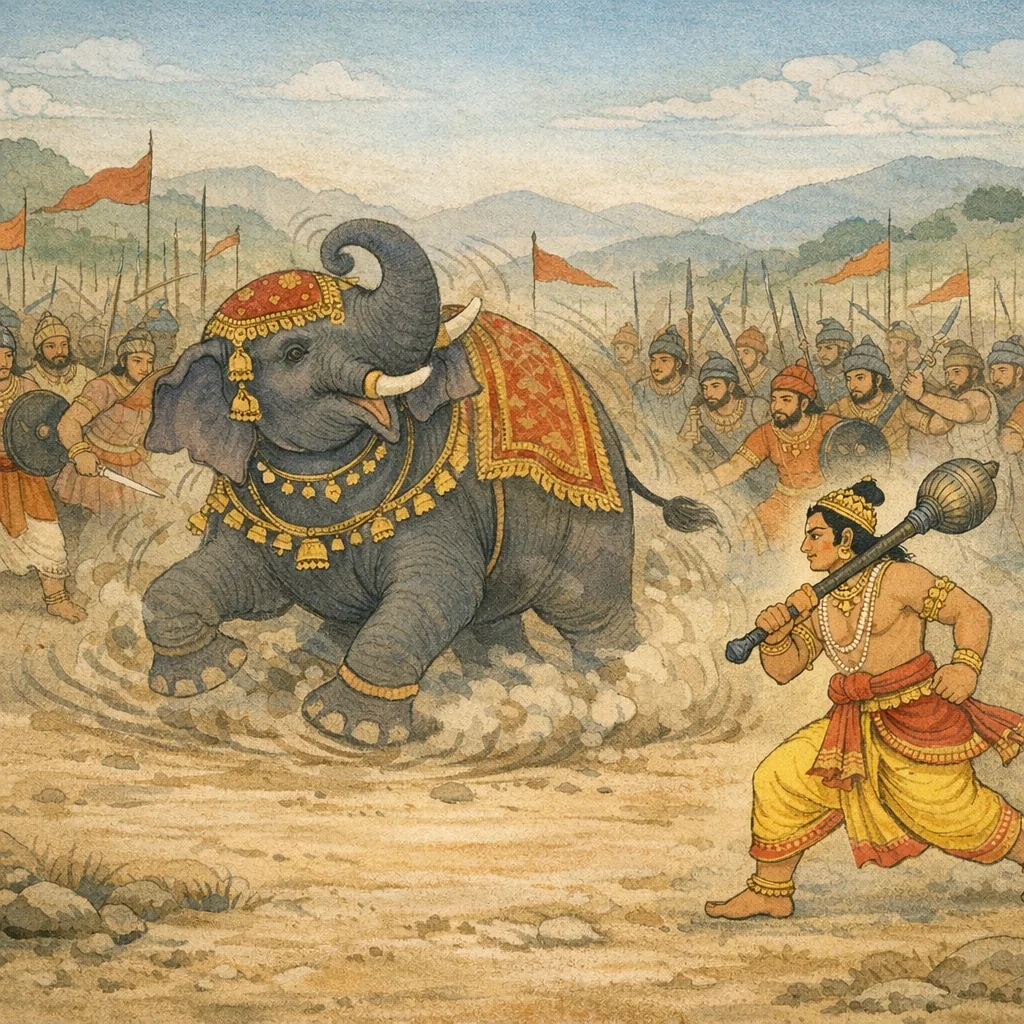
Chapter Arc: धृतराष्ट्र, रणभूमि के बिखरते मोर्चों के बीच, संजय से पूछते हैं—संशप्तकों के सामने अर्जुन ने क्या किया और वे पार्थ के विरुद्ध कैसे जूझे; उसी क्षण कथा का फलक भीम की ओर मुड़ता है, जहाँ गज-सेना के साथ उसका प्रचण्ड संग्राम उठ खड़ा होता है। → पाण्डव-सेना के अलग-अलग दलों में भिड़ते ही भीम स्वयं नागानीक (हाथियों की पंक्ति) पर टूट पड़ता है। सामने भगदत्त का महागज कालयान (दस हज़ार हाथियों के बल-सा) कुम्हार के चाक की तरह घूमता, सूँड़ से जल उछालकर घोड़ों को त्रस्त करता और पंक्तियाँ तोड़ता है; युधिष्ठिर भी भगदत्त को रोकने का प्रयत्न करते हैं, पर गज-वेग और राज-पराक्रम से दबाव बढ़ता जाता है। → भगदत्त के हाथी का उन्मत्त चक्रवात—जल-वर्षा से घोड़ों का बिदकना, रथों का बिखरना, और पाण्डव योद्धाओं का एक साथ उस गजराज को घेरकर रोकने का उग्र प्रयास—यहीं अध्याय का शिखर बनता है, जहाँ गज-युद्ध मनुष्य-युद्ध से भी अधिक भयावह रूप ले लेता है। → घेराबंदी और प्रत्याक्रमण के बीच पाण्डव पक्ष भगदत्त के गज-आक्रमण को तत्काल निस्तेज करने की दिशा में संगठित होता है; रणभूमि में शंख-नाद, सिंहनाद और धूल-धूम्र के बीच मोर्चे फिर से जमने लगते हैं, पर भगदत्त का भय अभी पूरी तरह टला नहीं दिखता। → भीम और पाण्डव-वीरों द्वारा घिरे हुए भी भगदत्त का गजराज अगले ही क्षण किस ओर टूटेगा—और किस रथ को रौंदेगा—यह अनिश्चितता अध्याय को आगे की तीव्रता पर छोड़ देती है।
Shlokas
Verse 1
(दाक्षिणात्य अधिक पाठके ५ श्लोक मिलाकर कुल ७० श्लोक हैं।) अपन बक। ] अति्ऑशाए:< षड्विशो<5ध्याय: भीमसेनका भगदत्तके हाथीके साथ युद्ध, हाथी और भगदत्तका भयानक पराक्रम धृतराष्ट्र रवाच तेष्वेवं संनिवत्तेषु प्रत्युद्यातेषु भागश: । कथं युयुधिरे पार्था मामकाश्न तरस्विन:,धृतराष्ट्रने पूछा--संजय! इस प्रकार जब सैनिक पृथक्-पृथक् युद्धके लिये लौटे और कौरव-योद्धा आगे बढ़कर सामना करनेके लिये उद्यत हुए, उस समय मेरे तथा कुन्तीके वेगशाली पुत्रोंने आपसमें किस प्रकार युद्ध किया? संशप्तकोंकी सेनापर चढ़ाई करके अर्जुनने क्या किया? अथवा संशप्तकोंने अर्जुनका क्या कर लिया?
Dhṛtarāṣṭra said: “Sañjaya, when the warriors had thus re-formed and advanced again in separate divisions for battle, and my Kaurava champions moved forward to meet them, how did the sons of Pāṇḍu and my own impetuous heroes fight one another? Tell me how the clash unfolded when both sides, driven by resolve and rivalry, returned to the field.”
Verse 2
किमर्जुनश्वाप्पकरोत् संशप्तकबलं प्रति | संशप्तका वा पार्थस्य किमकुर्वत संजय,धृतराष्ट्रने पूछा--संजय! इस प्रकार जब सैनिक पृथक्-पृथक् युद्धके लिये लौटे और कौरव-योद्धा आगे बढ़कर सामना करनेके लिये उद्यत हुए, उस समय मेरे तथा कुन्तीके वेगशाली पुत्रोंने आपसमें किस प्रकार युद्ध किया? संशप्तकोंकी सेनापर चढ़ाई करके अर्जुनने क्या किया? अथवा संशप्तकोंने अर्जुनका क्या कर लिया?
Dhṛtarāṣṭra asked: “What, indeed, did Arjuna do against the force of the Saṃśaptakas? Or what did the Saṃśaptakas do to Pārtha (Arjuna)?”
Verse 3
संजय उवाच तथा तेषु निवृत्तेषु प्रत्युद्यातेषु भागश: । स्वयमभ्यद्रवद् भीम॑ नागानीकेन ते सुत:,संजयने कहा--राजन्! इस प्रकार जब पाण्डव-सैनिक पृथक्-पृथक् युद्धके लिये लौटे और कौरव-योद्धा आगे बढ़कर सामना करनेके लिये उद्यत हुए, उस समय आपके पुत्र दुर्योधनने हाथियोंकी सेना साथ लेकर स्वयं ही भीमसेनपर आक्रमण किया
Sañjaya said: “O King, when the Pāṇḍava troops had turned back and returned to battle in separate divisions, and the Kaurava warriors had advanced to meet them, then your son Duryodhana himself charged at Bhīmasena, supported by a battalion of elephants.”
Verse 4
स नाग इव नागेन गोवृषेणेव गोवृष: । समाहूत: स्वयं राज्ञा नागानीकमुपाद्रवत्,जैसे हाथीसे हाथी और साँड़से साँड़ भिड़ जाता है, उसी प्रकार राजा दुर्योधनके ललकारनेपर भीमसेन स्वयं ही हाथियोंकी सेनापर टूट पड़े
Sañjaya said: Like an elephant charging an elephant, like a bull meeting a bull in combat, Bhīmasena—personally challenged by the king—rushed straight at the elephant-corps.
Verse 5
स युद्धकुशल: पार्थो बाहुवीर्येण चान्वित: । अभिनत् कुञ्जरानीकमचिरेणैव मारिष,आदरणीय नरेश! कुन्तीकुमार भीमसेन युद्धमें कुशल तथा बाहुबलसे सम्पन्न हैं। उन्होंने थोड़ी ही देरमें हाथियोंकी उस सेनाको विदीर्ण कर डाला
Sañjaya said: The son of Kuntī, skilled in war and endowed with the strength and valor of his arms, swiftly shattered the elephant-corps.
Verse 6
ते गजा गिरिसंकाशा: क्षरन्त: सर्वतो मदम् । भीमसेनस्य नाराचैविंमुखा विमदीकृता:,वे पर्वतके समान विशालकाय हाथी सब ओर मदकी धारा बहा रहे थे; परंतु भीमसेनके नाराचोंसे विद्ध होनेपर उनका सारा मद उतर गया। वे युद्धसे विमुख होकर भाग चले
Sañjaya said: Those elephants, huge as mountains, were streaming rut-fluid on every side. But when pierced by Bhīmasena’s sharp arrows, their intoxication drained away; losing their battle-fury, they turned from the fight and fled.
Verse 7
विधमेदभ्रजालानि यथा वायु: समुद्धत: । व्यधमत् तान्यनीकानि तथैव पवनात्मज:
Sañjaya said: “Just as a storm-driven wind scatters masses of clouds, so did the son of the Wind-god scatter those battle-formations.”
Verse 8
जैसे जोरसे उठी हुई वायु मेघोंकी घटाको छिलन्न-भिन्न कर डालती है, उसी प्रकार पवनपुत्र भीमसेनने उन समस्त गजसेनाओंको तहस-नहस कर डाला ।। स तेषु विसृजन् बाणान् भीमो नागेष्वशोभत । भुवनेष्विव सर्वेषु गभस्तीनुदितो रवि:
Sañjaya said: As a powerful wind rises and tears apart masses of clouds, so did Bhīmasena, the son of the Wind-god, shatter and lay waste to all those elephant-battalions. Releasing his arrows among the elephants, Bhīma shone there—like the newly risen sun spreading its rays across all the worlds.
Verse 9
जैसे उदित हुए सूर्य समस्त भुवनोंमें अपनी किरणोंका विस्तार करते हैं, उसी प्रकार भीमसेन उन हाथियोंपर बाणोंकी वर्षा करते हुए शोभा पा रहे थे ।। ते भीमबाणाभिहता: संस्यूता विबभुर्गजा: । गभस्तिभिरिवार्कस्य व्योम्नि नानाबलाहका:,वे भीमके बाणोंसे मारे जाकर परस्पर सटे हुए हाथी आकाशमें सूर्यकी किरणोंसे गुँथे हुए नाना प्रकारके मेघोंकी भाँति शोभा पा रहे थे
Sañjaya said: Struck by Bhīma’s arrows, the elephants—pressed close together—shone resplendent, like many kinds of clouds in the sky woven through with the sun’s rays.
Verse 10
तथा गजानां कदन॑ कुर्वाणमनिलात्मजम् । क्रुद्धों दुर्योधनो5भयेत्य प्रत्यविध्यच्छितै: शरै:,इस प्रकार गजसेनाका संहार करते हुए पवनपुत्र भीमसेनके पास आकर क्रोधमें भरे हुए दुर्योधनने उन्हें पैने बाणोंसे बींध डाला
Sañjaya said: Just then, as Bhīmasena—the son of the Wind—was wreaking slaughter among the elephants, Duryodhana, inflamed with anger, rushed up to confront him and pierced him with sharp arrows.
Verse 11
तत: क्षणेन क्षितिपं क्षतजप्रतिमेक्षण: । क्षयं निनीषुर्निशितैर्भीमो विव्याध पत्रिभि:,यह देख भीमसेनकी आँखें खूनके समान लाल हो गयीं। उन्होंने क्षणभरमें राजा दुर्योधनका नाश करनेकी इच्छासे पंखयुक्त पैने बाणोंद्वारा उसे बींध डाला
Sañjaya said: Then, in an instant, Bhīma—his eyes red like blood—resolved to bring the king to destruction. With sharp, feathered arrows, he pierced Duryodhana.
Verse 12
स शराचितसर्वाड्ि: क्रुद्धों विव्याध पाण्डवम् | नाराचैरर्करश्म्याभैर्भीमसेनं स्मयजन्निव,दुर्योधनके सारे अंग बाणोंसे व्याप्त हो गये थे। अतः उसने कुपित होकर सूर्यकी किरणोंके समान तेजस्वी नाराचोंद्वारा पाण्डुनन्दन भीमसेनको मुसकराते हुए-से घायल कर दिया
Sañjaya said: With all his limbs covered with arrows, Duryodhana—angered—struck the Pāṇḍava Bhīmasena with nārāca shafts blazing like the sun’s rays, wounding him as though with a faint, scornful smile.
Verse 13
तस्य नागं मणिमयं रत्नचित्रध्वजे स्थितम् । भल्ल्लाभ्यां कार्मुकं चैव क्षिप्रं चिच्छेद पाण्डव:,राजन्! उसके रत्ननिर्मित विचित्र ध्वजके ऊपर मणिमय नाग विराजमान था। उसे पाण्डुनन्दन भीमने शीघ्र ही दो भल्लोंसे काट गिराया और उसके धनुषके भी टुकड़े-टुकड़े कर दिये
Sañjaya said: O king, upon his jewel-adorned, wondrous banner stood a nāga fashioned of precious gems. Bhīma, Pāṇḍu’s son, swiftly cut it down with two bhalla arrows and shattered his bow as well.
Verse 14
दुर्योधनं पीड्यमानं दृष्टवा भीमेन मारिष । चुक्षो भयिषुरभ्यागादड़ो मातड़मास्थित:,आर्य! भीमसेनके द्वारा दुर्योधनको पीड़ित होते देख क्षोभमें डालनेकी इच्छासे मतवाले हाथीपर बैठे हुए राजा अंग उनका सामना करनेके लिये आ गये
Sañjaya said: O venerable one, seeing Duryodhana hard-pressed by Bhīma, the king of Aṅga—seeking to provoke and unsettle Bhīma—advanced to confront him, mounted on a rutting elephant. The scene shows how, amid war’s collapse of dharma, warriors rush in not only to shield allies but also to inflame an opponent’s anger and break his composure.
Verse 15
तमापतत्तं नागेन्द्रमम्बुदप्रतिमस्वनम् । कुम्भान्तरे भीमसेनो नाराचैरार्दयद् भूशम्,वह गजराज मेघके समान गर्जना करनेवाला था। उसे अपनी ओर आते देख भीमसेनने उसके कुम्भस्थलमें नाराचोंद्वारा बड़ी चोट पहुँचायी
Sañjaya said: Seeing the lordly elephant charging toward him, its roar like a thundercloud, Bhīmasena struck it fiercely with nārāca arrows, wounding it in the region between its temples. In the brutal necessity of battle, the warrior meets overwhelming force with decisive counterforce, to halt a deadly onrush and protect his side.
Verse 16
तस्य कायं विनिर्भिद्य न्यमज्जद् धरणीतले । ततः पपात द्विरदो वज्ाहत इवाचल:,भीमसेनका नाराच उस हाथीके शरीरको विदीर्ण करके धरतीमें समा गया, इससे वह गजराज वज्के मारे हुए पर्वतकी भाँति पृथ्वीपर गिर पड़ा
Sañjaya said: The arrow, having pierced through the elephant’s body, sank into the ground. Thereupon the great tusker collapsed upon the earth like a mountain struck by Indra’s thunderbolt—an image that underscores the terrible finality of violence on the battlefield.
Verse 17
तस्यावर्जितनागस्य म्लेच्छस्याध: पतिष्यत: । शिरश्रिच्छेद भल्लेन क्षिप्रकारी वृकोदर:,वह म्लेच्छजातीय अंग हाथीसे अलग नहीं हुआ था। उस हाथीके साथ-साथ वह नीचे गिरना ही चाहता था कि शीघ्रकारी भीमसेनने एक भल्लके द्वारा उसका सिर काट दिया
Sañjaya said: As that Mleccha warrior—still not separated from his elephant—was about to fall downwards, swift-acting Vṛkodara (Bhīma) severed his head with a bhalla arrow. The scene underscores the ruthless immediacy of battlefield justice, where decisive force is used to neutralize a threat without delay.
Verse 18
तस्मिन् निपतिते वीरे सम्प्राद्रवत सा चमू: । सम्भ्रान्ताश्वद्धिपरथा पदातीनवमृदू्नती,उस वीरके धराशायी होते ही उसकी वह सारी सेना भागने लगी। घोड़े, हाथी तथा रथ सभी घबराहटमें पड़कर इधर-उधर चक्कर काटने लगे। वह सेना अपने ही पैदल सिपाहियोंको रौंदती हुई भाग रही थी
When that hero fell to the ground, the entire host broke and fled. Horses, elephants, and chariots, seized by panic, wheeled about in confusion, and the routed army ran on, trampling its own foot-soldiers—an image of how fear, once unleashed in war, destroys order and compassion alike.
Verse 19
तेष्वनीकेषु भग्नेषु विद्रवत्सु समन््तत:ः । प्राग्ज्योतिषस्ततो भीमं कुज्जरेण समाद्रवत्,इस प्रकार उन सेनाओंके व्यूह भंग होने तथा चारों ओर भागनेपर प्राग्ज्योतिषपुरके राजा भगदत्तने अपने हाथीके द्वारा भीमसेनपर धावा किया
Sañjaya said: When those battle-formations were broken and the troops fled in all directions, the king of Prāgjyotiṣa, Bhagadatta, charged at Bhīmasena with his elephant.
Verse 20
येन नागेन मघवानजयद्ू दैत्यदानवान् । तदन्वयेन नागेन भीमसेनमुपाद्रवत्,इन्द्रने जिस ऐरावत हाथीके द्वारा दैत्यों और दानवोंपर विजय पायी थी, उसीके वंशमें उत्पन्न हुए गजराजपर आरूढ़ हो भगदत्तने भीमसेनपर चढ़ाई की थी
Sañjaya said: Mounted upon the lordly elephant born in the lineage of Airāvata—by whom Indra once conquered the Daityas and Dānavas—Bhagadatta charged straight at Bhīmasena.
Verse 21
स नागप्रवरो भीम॑ सहसा समुपाद्रवत् । चरणाभ्यामथो द्वाभ्यां संहतेन करेण च,वह गजराज अपने दो पैरों तथा सिकोड़ी हुई सूँड़के द्वारा सहसा भीमसेनपर टूट पड़ा
Sañjaya said: The foremost of elephants suddenly charged at Bhīmasena, striking at him with its two feet and with its trunk tightly gathered.
Verse 22
व्यावृत्तनयन: क्रुद्ध: प्रमथन्निव पाण्डवम् । वृकोदररथं साश्वमविशेषमचूर्णयत्,उसके नेत्र सब ओर घूम रहे थे। वह क्रोधमें भरकर पाण्डुनन्दन भीमसेनको मानो मथ डालेगा, इस भावसे भीमसेनके रथकी ओर दौड़ा और उसे घोड़ोंसहित सामान्यतः: चूर्ण कर दिया
Sañjaya said: With eyes darting in every direction and inflamed with anger, he rushed at the chariot of Vṛkodara (Bhīma), as though he would crush the Pāṇḍava outright, and he smashed that chariot together with its horses, reducing it to ruin without distinction.
Verse 23
पद्धयां भीमो5प्यथो धावंस्तस्य गात्रेष्वलीयत । जानन्नञज्जलिकावेध॑ नापाक्रामत पाण्डव:,भीमसेन पैदल दौड़कर उस हाथीके शरीरमें छिप गये। पाण्डुपुत्र भीम अंजलिकावेधर जानते थे। इसलिये वहाँसे भागे नहीं
Sañjaya said: Even Bhīma, running on foot, pressed close and hid himself among that elephant’s limbs. Knowing the deadly ‘añjalikā’ shot, the Pāṇḍava (Bhīma) did not retreat from that spot.
Verse 24
गात्रा भ्यन्तरगो भूत्वा करेणाताडयन्मुहु: । लालयामास तं नागं वधाकाड्क्षिणमव्ययम्,वे उसके शरीरके नीचे होकर हाथसे बारंबार थपथपाते हुए वधकी आकांक्षा रखनेवाले उस अविनाशी गजराजको लाड़-प्यार करने लगे
Sañjaya said: Slipping beneath the elephant’s body, he repeatedly patted it with his hand, soothing and fondling that lordly elephant—unyielding and seemingly indestructible—though it was intent on killing. The scene shows how, even amid violence, skill and presence of mind can turn raw aggression aside through calm control rather than immediate slaughter.
Verse 25
कुलालचक्रवन्नागस्तदा तूर्णमथा भ्रमत् । नागायुतबल: श्रीमान् कालयानो वृकोदरम्,उस समय वह हाथी तुरंत ही कुम्हारके चाकके समान सब ओर घूमने लगा। उसमें दस हजार हाथियोंका बल था। वह शोभायमान गजराज भीमसेनको मार डालनेका प्रयत्न कर रहा था
Sañjaya said: Then that elephant began to whirl about swiftly, like a potter’s wheel. Endowed with the strength of ten thousand elephants and splendid in appearance, the lordly beast Kālayāna strove to strike down Vṛkodara (Bhīma). The scene shows how, in war’s fury, sheer force and momentum become instruments of lethal intent even against the foremost heroes.
Verse 26
भीमो<पि निष्क्रम्य ततः सुप्रतीकाग्रतो5भवत् । भीम॑ करेणावनम्य जानुभ्यामभ्यताडयत्,इति श्रीमहा भारते द्रोणपर्वणि संशप्तकवधपर्वणि भगदत्तयुद्धे षड्विंशो5ध्याय: ।। २६ ।। इस प्रकार श्रीमह्मा भारत द्रोणपर्वके अन्तर्गत संशप्तकवधपर्वमें भयदत्तका युद्धाविषयक छब्बीसवाँ अध्याय पूरा हुआ
Sañjaya said: Bhīma too then moved out and came to the fore, facing Supratīka. With his mighty hand he struck it down and battered it with his knees—an image of raw force unleashed in the chaos of battle, where courage and ferocity contend for mastery.
Verse 27
भीमसेन भी उसके शरीरके नीचेसे निकलकर उस हाथीके सामने खड़े हो गये। उस समय हाथीने अपनी सूँड़से गिराकर उन्हें दोनों घुटनोंसे कुचल डालनेका प्रयत्न किया ।। ग्रीवायां वेष्टयित्वैनं स गजो हन्तुमैहत । करवेष्टं भीमसेनो भ्रमं दत्त्वा व्यमोचयत्,इतना ही नहीं, उस हाथीने उन्हें गलेमें लपेटकर मार डालनेकी चेष्टा की। तब भीमसेन उसे भ्रममें डालकर उसकी सूँड़के लपेटसे अपने-आपको छुड़ा लिया
Sañjaya said: Bhīmasena slipped out from beneath the elephant’s body and stood facing it. The elephant, dropping him with its trunk, tried to crush him under its knees. Then, coiling around Bhīma’s neck, the beast sought to kill him; but Bhīma, by a quick feint that confused it, freed himself from the trunk’s constricting grip. The episode highlights presence of mind and disciplined strength in battle—power guided by alertness rather than blind rage.
Verse 28
पुनर्गात्राणि नागस्य प्रविवेश वृकोदर: । यावत् प्रतिगजायातं स्वबले प्रत्यवैक्षत,तदनन्तर भीमसेन पुनः उस हाथीके शरीरमें ही छिप गये और अपनी सेनाकी ओरसे उस हाथीका सामना करनेके लिये किसी दूसरे हाथीके आगमनकी प्रतीक्षा करने लगे
Sañjaya said: Then Vṛkodara (Bhīma) again entered into the limbs of the elephant, remaining concealed within it, and from the side of his own forces he kept watch—waiting until another elephant should come forward to confront that elephant. In the harsh ethics of battlefield stratagem, he chooses concealment and timing over open display, seeking advantage for his side amid the confusion of war.
Verse 29
भीमो<पि नागगात्रेभ्यो विनि:सृत्यापयाज्जवात् । ततः सर्वस्य सैन्यस्य नाद: समभवन्महान्,थोड़ी देर बाद भीम हाथीके शरीरसे निकलकर बड़े वेगसे भाग गये। उस समय सारी सेनामें बड़े जोरसे कोलाहल होने लगा
Sañjaya said: Bhīma too, having forced his way out from among the bodies of the elephants, sped away with great swiftness. Thereupon a tremendous roar arose throughout the entire army—an outbreak of alarm and tumult born of the shock of close combat and the sudden turn of events.
Verse 30
अहो धिड़ निहतो भीम: कुञज्जरेणेति मारिष | तेन नागेन संत्रस्ता पाण्डवानामनीकिनी
Sañjaya said: “Alas, shame! ‘Bhīma has been slain—by an elephant!’ O revered one. Hearing that cry about the ‘elephant,’ the Pāṇḍavas’ army was thrown into panic.”
Verse 31
ततो युधिषिरो राजा हतं मत्वा वृकोदरम्
Then King Yudhiṣṭhira, believing Vṛkodara (Bhīma) to have been slain, was struck by the moral shock that follows when war seems to consume even one’s strongest protector—an anguish that tests a ruler’s steadiness in dharma amid battlefield confusion.
Verse 32
त॑ रथं रथिनां श्रेष्ठा: परिवार्य परंतपा:
Sañjaya said: The foremost of chariot-warriors—mighty foes who scorch their enemies—surrounded that chariot on all sides, closing in with disciplined intent amid the press of battle.
Verse 33
स विघातं पृषत्कानामड्कुशेन समाहरन्
Sañjaya said: He checked and gathered in the onrush of the arrows, controlling the situation with an aṅkuśa-like restraint—turning a chaotic shower of missiles into something contained and manageable amid the battle’s violence.
Verse 34
तदद्भुतमपश्याम भगदत्तस्य संयुगे
Sañjaya said: In that battle, we witnessed a truly wondrous feat performed by Bhagadatta—an extraordinary display of prowess amid the chaos of war, stirring awe even among seasoned warriors.
Verse 35
ततो राजा दशार्णानां प्राग्ज्योतिषमुपाद्रवत्
Sañjaya said: Thereupon the king of the Daśārṇas charged against Prāgjyotiṣa, pressing the attack forward in the thick of battle—an episode that underscores how, in war, rulers drive their forces by decisive aggression, even as such momentum deepens the cycle of violence.
Verse 36
तिर्यग्यातेन नागेन समदेनाशुगामिना । तत्पश्चात् दशार्णराजने मदस्रावी, शीघ्रगामी तथा तिरछी दिशा (पार्श्चभाग)-की ओरसे आक्रमण करनेवाले गजराजके द्वारा भगदत्तपर धावा किया ।। तयोरयुद्धं समभवन्नागयोर्भीमरूपयो:
Sañjaya said: Then the king of Daśārṇa charged at Bhagadatta with his lordly elephant—one that moved swiftly, surged with musth, and attacked from an oblique, sideward line. Thus began a fierce combat between the two elephants, both terrifying in form. In the moral atmosphere of the war, the verse highlights how mastery, momentum, and tactical approach can decide encounters as much as sheer strength—yet all such prowess remains bound to the tragic necessity of battle.
Verse 37
सपक्षयो: पर्वतयोर्यथा सद्रुमयो: पुरा । वे दोनों हाथी बड़े भयंकर रूपवाले थे। उन दोनोंका युद्ध वैसा ही प्रतीत हुआ, जैसा कि पूर्वकालमें पंखयुक्त एवं वृक्षावलीसे विभूषित दो पर्वतोंमें युद्ध हुआ करता था || ३६६ || प्राग्ज्योतिषपतेरनाग: संनिवृत्यापसृत्य च
Sañjaya said: “Just as, in ancient times, two winged mountains thick with trees were said to clash, so did the battle of those two elephants appear—terrible in form, surging forward and then drawing back again. And the elephant of the lord of Prāgjyotiṣa, now closing in and now retreating, continued the fight.”
Verse 38
तोमरै: सूर्यरश्म्याभैर्भगदत्तो5थ सप्तभि:
Sañjaya said: Then Bhagadatta, with seven javelins gleaming like the sun’s rays, advanced his assault—an image of dazzling martial force amid the relentless ethics-testing violence of the battlefield.
Verse 39
व्यवच्छिद्य तु राजानं भगदत्तं युधिष्ठिर:
Sañjaya said: Then Yudhiṣṭhira, having cut off and isolated King Bhagadatta from his supporting forces, moved to check him—an act of prudent kingship amid war, aiming to neutralize a formidable threat without needless disorder.
Verse 40
स कुणज्जरस्थो रथिभि: शुशुभे सर्वतो वृत:
Sañjaya said: Stationed upon an elephant and encircled on every side by skilled chariot-warriors, he shone forth—protected by his companions amid the press of battle, a vivid image of martial order and collective duty in war.
Verse 41
पर्वते वनमध्यस्थो ज्वलन्निव हुताशन: । जैसे वनके भीतर पर्वतके शिखरपर दावानल प्रज्वलित हो रहा हो, उसी प्रकार सब ओर रथियोंसे घिरकर हाथीकी पीठपर बैठे हुए राजा भगदत्त सुशोभित हो रहे थे || ४० ३ || मण्डंल सर्वतः श्लिष्टं रथिनामुग्रधन्विनाम्
Sañjaya said: Like a blazing fire standing on a mountain amid a forest, a tightly packed ring of chariot-warriors—fierce archers—closed in from every side. In that encirclement, King Bhagadatta, seated upon his elephant, shone conspicuously, evoking the image of a wildfire flaring on a forested peak—an ominous brilliance amid the press of battle.
Verse 42
ततः प्राग्ज्योतिषो राजा परिगृहर महागजम्
Sañjaya said: Then the king of Prāgjyotiṣa seized hold of the great elephant—an act of bold, close-quarters resolve amid the chaos of battle, showing the warrior’s readiness to confront danger directly rather than retreat.
Verse 43
शिने: पौत्रस्य तु रथं परिगृहा महाद्विप:
Sañjaya said: The mighty elephant, having seized the chariot of Śini’s grandson, closed in upon it—an image of overwhelming force bearing down on a single warrior amid the chaos of battle, where valor is tested against brute power.
Verse 44
अभिनिक्षेप वेगेन युयुधानस्त्वपाक्रमत् । युयुधान (सात्यकि) अपने रथको छोड़कर दूर हट गये और उस महान् गजराजने शिनिपौत्र सात्यकिके उस रथको सूँड़से पकड़कर बड़े वेगसे फेंक दिया ।। ४३ $ ।। बृहतः सैन्धवानश्वान् समुत्थाप्याथ सारथि:
Sañjaya said: With the force of a sudden, violent cast, Yuyudhāna (Sātyaki) withdrew from the spot. Then that mighty lord of elephants seized Sātyaki’s chariot—Sātyaki, the descendant of Śini—with his trunk and hurled it away at great speed. After that, the charioteer roused the Sindhu-bred horses into a powerful surge and pressed on, as the battle’s tide turned on swift choices of retreat and renewed advance, where life and dharma are tested amid relentless violence.
Verse 45
स तु लब्ध्वान्तरं नागस्त्वरितो रथमण्डलात्
Sañjaya said: But that mighty warrior, finding an opening, swiftly moved out from the circle of chariots—seizing the moment in the press of battle with alertness and tactical resolve.
Verse 46
ते त्वाशुगतिना तेन त्रास्यमाना नरर्षभा:
But those bull-like men, shaken and thrown into panic by his swift onrush, were driven into fear as the battle’s momentum turned against them.
Verse 47
ते गजस्थेन काल्यन्ते भगदत्तेन पाण्डवा:
Sañjaya said: The Pāṇḍavas were being sorely pressed and harried by Bhagadatta, who fought from atop his elephant—his towering mount turning the battlefield into a place of dread and testing their steadiness amid overwhelming force.
Verse 48
तेषां प्रद्रवतां भीम: पज्चालानामितस्तत:
Sañjaya said: As the Pāñcālas fled in confusion, Bhīma moved about here and there among them, pressing the rout and intensifying the panic of the retreat—an image of how, in war, fear can spread through a force once its order breaks.
Verse 49
भगदत्तेन समरे काल्यमानेषु पाण्डुषु
Sañjaya said: In the thick of battle, as the Pāṇḍavas were hard-pressed by Bhagadatta, the struggle took on a grim urgency, testing resolve and duty amid the violence of war.
Verse 50
तस्याभिद्रवतो वाहान् हस्तमुक्तेन वारिणा
Sañjaya said: As he charged forward, his steeds were struck and checked by water released from the hand—an act that momentarily restrains violence without direct slaughter, showing how even in war tactical restraint can redirect the course of harm.
Verse 51
ततस्तमभ्ययात् तूर्ण रुचिपर्वाउ55कृतीसुत:
Sañjaya said: Then Kṛtī’s son, Ruciparvan, swiftly advanced toward him, pressing the battle forward with urgent intent.
Verse 52
समघ्नज्छरवर्षेण रथस्थो5न्तकसंनिभ: । तब आकृतीपुत्र रुचिपर्वने तुरंत ही उस हाथीपर आक्रमण किया। वह रथपर बैठकर साक्षात् यमराजके समान जान पड़ता था। उसने बाणोंकी वर्षासे उस हाथीको गहरी चोट पहुँचायी ।। ५१ $ ।। ततः स रुचिपर्वाणं शरेणानतपर्वणा
Sañjaya said: Seated on his chariot and seeming like Antaka (Death) himself, he at once charged the elephant of Ruciparvan, striking it with a dense shower of arrows. In that moment he appeared like Yama in person, and by his arrow-rain he inflicted deep wounds upon the elephant. Then he struck Ruciparvan with an arrow whose joints were unbent—a straight, well-made shaft…
Verse 53
तस्मिन् निपतिते वीरे सौभद्रो द्रौपदीसुत:
Sañjaya said: When that heroic warrior had fallen, the son of Subhadrā—Draupadī’s son—then moved at once. The line marks a turning point in the battle narrative: the fall of a notable fighter provokes an immediate response from the next champion, underscoring the chain of duty, loyalty, and retaliation that drives the war’s moral tension.
Verse 54
चेकितानो धृष्टकेतुर्युयुत्सुश्चार्दयन् द्विपम् । त एन॑ शरधाराभिर्धाराभिरिव तोयदा:
Sañjaya said: Cekitāna, Dhṛṣṭaketu, and Yuyutsu pressed hard upon the elephant. They showered it with unbroken streams of arrows, like rain-bearing clouds pouring down ceaseless torrents—relentless force amid righteous fury and the duty of the battlefield.
Verse 55
सिषिचुर्भरवान् नादान् विनदन्तो जिघांसव: । उस वीरके मारे जानेपर अभिमन्यु, द्रौपदीकुमार, चेकितान, धृष्टकेतु तथा युयुत्सुने भी उस हाथीको पीड़ा देना आरम्भ किया। ये सब लोग उस हाथीको मार डालनेकी इच्छासे विकट गर्जना करते हुए अपने बाणोंकी धारासे सींचने लगे, मानो मेघ पर्वतको जलकी धारासे नहला रहे हों || ५३-५४ ई ।। ततः पाष्ण्यड्कुशाड्गुष्ठै: कृतिना चोदितो द्विप:,तदनन्तर विद्वान् राजा भगदत्तने अपने पैरोंकी एँड़ी, अंकुश एवं अंगुष्ठसे प्रेरित करके हाथीको आगे बढ़ाया। फिर तो अपने कानोंको खड़े करके एकटक आँखोंसे देखते हुए सूँड़ फैलाकर उस हाथीने शीघ्रतापूर्वक धावा किया और युयुत्सुके घोड़ोंको पैरोंसे दबाकर उनके सारथिको मार डाला
Sañjaya said: Eager to kill and roaring fiercely, they drenched him with a dense shower of arrows, as though rain-clouds were bathing a mountain with streaming water. In the battle’s moral air, the image shows how collective wrath and the will to destroy can turn warriors into an impersonal force—overwhelming, loud, and relentless—when compassion is eclipsed by the urgent demand for victory.
Verse 56
प्रसारितकर: प्रायात् स्तब्धकर्णेक्षणो द्रुतम् । सो<धिष्ठाय पदा वाहान् युयुत्सो: सूतमारुजत्,तदनन्तर विद्वान् राजा भगदत्तने अपने पैरोंकी एँड़ी, अंकुश एवं अंगुष्ठसे प्रेरित करके हाथीको आगे बढ़ाया। फिर तो अपने कानोंको खड़े करके एकटक आँखोंसे देखते हुए सूँड़ फैलाकर उस हाथीने शीघ्रतापूर्वक धावा किया और युयुत्सुके घोड़ोंको पैरोंसे दबाकर उनके सारथिको मार डाला
Sañjaya said: With his trunk outstretched, the elephant charged swiftly, its ears rigid and its gaze fixed. Trampling down Yuyutsu’s horses under its feet, it struck down and killed his charioteer, the sūta. In the brutal momentum of battle, strength and skill appear not as moral ideals but as instruments of war, where even a warrior’s support is made a direct target, sharpening the battlefield’s ethical harshness.
Verse 57
युयुत्सुस्तु रथाद् राजन्नपाक्रामत् त्वरान्वित: । ततः: पाण्डवयोधास्ते नागराजं शरैर्द्रूतम्
Sañjaya said: “O King, Yuyutsu quickly withdrew from his chariot in haste. Then those Pāṇḍava warriors, with their arrows, drove back the lord of elephants.”
Verse 58
पुत्रस्तु तव सम्भ्रान्त: सौभद्रस्याप्लुतो रथम्,उस समय घबराये हुए आपके पुत्र युयुत्सु अभिमन्युके रथपर जा बैठे। हाथीकी पीठपर बैठे हुए राजा भगदत्त शत्रुओंपर बाण-वर्षा करते हुए सम्पूर्ण लोकोंमें अपनी किरणोंका विस्तार करनेवाले सूर्यके समान शोभा पा रहे थे
Sañjaya said: Your son, thrown into confusion, leapt onto the chariot of Saubhadra (Abhimanyu). At that moment, Yuyutsu—alarmed—took his place upon Abhimanyu’s chariot. Meanwhile King Bhagadatta, seated on the back of his elephant, showered arrows upon the foes and shone like the sun that spreads its rays across all the worlds.
Verse 59
स कुञ्जरस्थो विसृजन्निषूनरिषु पार्थिव: । बभौ रश्मीनिवादित्यो भुवनेषु समुत्सूजन्,उस समय घबराये हुए आपके पुत्र युयुत्सु अभिमन्युके रथपर जा बैठे। हाथीकी पीठपर बैठे हुए राजा भगदत्त शत्रुओंपर बाण-वर्षा करते हुए सम्पूर्ण लोकोंमें अपनी किरणोंका विस्तार करनेवाले सूर्यके समान शोभा पा रहे थे
Sañjaya said: Seated upon his elephant, King Bhagadatta kept loosing volleys of arrows at the foes. As his shafts spread across the battlefield, he shone like the sun extending its rays over the worlds.
Verse 60
तमार्जुनि्द्धादिशभिरयुयुत्सुर्दशभि: शरै: | त्रिभिस्त्रिभिद्रौपदेया धृष्टकेतुश्च विव्यधु:,अर्जुनकुमार अभिमन्युने बारह, युयुत्सुने दस और द्रौपदीके पुत्रों तथा धृष्टकेतुने तीन- तीन बाणोंसे भगदत्तके उस हाथीको घायल कर दिया
Sañjaya said: Abhimanyu, the son of Arjuna, struck Bhagadatta’s elephant with twelve arrows; Yuyutsu pierced it with ten; and the sons of Draupadī together with Dhṛṣṭaketu wounded it with three arrows each.
Verse 61
सो<5तियत्नार्पितिर्बाणैराचितो द्विरदो बभौ | संस्यूत इव सूर्यस्य रश्मिभिर्जलदो महान्,अत्यन्त प्रयत्नपूर्वक चलाये हुए उन बाणोंसे हाथीका सारा शरीर व्याप्त हो रहा था। उस अवस्थामें वह सूर्यकी किरणोंमें पिरोये हुए महामेघके समान शोभा पा रहा था
Sañjaya said: The elephant was wholly covered with arrows launched with utmost effort, so that its body was filled with shafts. In that state it shone like a great rain-cloud, as though threaded through by the sun’s rays.
Verse 62
नियन्तुः शिल्पयत्नाभ्यां प्रेरितोडरिशरार्दित: । परिचिक्षेप तान् नाग: स रिपून् सव्यदक्षिणम्,महावतके कौशल और प्रयत्नसे प्रेरित होकर वह हाथी शत्रुओंके बाणोंसे पीड़ित होनेपर भी उन विपक्षियोंको दायें-बायें उठाकर फेंकने लगा
Sañjaya said: Though tormented by the enemy’s arrows, the great war-elephant—urged on by its driver’s practiced skill and determined effort—began to seize those foes and hurl them to the left and to the right.
Verse 63
गोपाल इव दण्डेन यथा पशुगणान् वने । आवेष्टयत तां सेनां भगदत्तस्तथा मुहुः,जैसे ग्वाला जंगलमें पशुओंको डंडेसे हाँकता है, उसी प्रकार भगदत्तने पाण्डव-सेनाको बार-बार घेर लिया
Sañjaya said: Just as a cowherd in the forest drives and gathers a herd with his staff, so did Bhagadatta again and again encircle the Pāṇḍava army.
Verse 64
क्षिप्रं श्येनाभिपन्नानां वायसानामिव स्वन: । बभूव पाण्डवेयानां भृशं विद्रवतां स्वन:,जैसे बाज पक्षीके चंगुलमें फँसे हुए अथवा उसके आक्रमणसे त्रस्त हुए कौओंमें शीघ्र ही काँव-काँवका कोलाहल होने लगता है, उसी प्रकार भागते हुए पाण्डव योद्धाओंका आर्तनाद जोर-जोरसे सुनायी दे रहा था
Sañjaya said: “Just as crows, swiftly seized or terror-struck by the onrush of a hawk, erupt at once into a loud clamour, so too the anguished cries of the Pāṇḍava warriors—fleeing in disorder—were heard resounding intensely.”
Verse 65
स नागराज: प्रवराड्कुशाहतः पुरा सपक्षो5द्रिवरो यथा नृप । भयं तदा रिपुषु समादधद्ू भृशं वणिग्जनानां क्षुभितो यथार्णव:,नरेश्वरर उस समय विशाल अंकुशकी मार खाकर वह गजराज पूर्वकालके पंखधारी श्रेष्ठ पर्वतकी भाँति शत्रुओंको उसी प्रकार अत्यन्त भयभीत करने लगा, जैसे विद्षुब्ध महासागर व्यापारियोंको भयमें डाल देता है
Sañjaya said: O king, struck hard by a mighty goad, that lordly elephant then became, as it were, like a great mountain of old endowed with wings—irresistible and towering. At that moment he spread intense fear among the enemies, just as a storm-tossed ocean throws merchant-travellers into dread.
Verse 66
ततो ध्वनिर्दिरदरथाश्वपार्थिवै- भ॑याद् द्रवद्धिर्जनितो5ति भैरव: । क्षितिं वियद् द्यां विदिशो दिशस्तथा समावृणोत् पार्थिव संयुगे तत:,महाराज! तदनन्तर भयसे भागते हुए हाथी, रथ, घोड़े तथा राजाओंने वहाँ अत्यन्त भयंकर आर्तनाद फैला दिया। उनके उस भयंकर शब्दने युद्धस्थलमें पृथ्वी, आकाश, स्वर्ग तथा दिशा-विदिशाओंको सब ओरसे आच्छादित कर दिया
Sañjaya said: Then, as elephants, chariots, horses, and kings fled in fear, an exceedingly dreadful roar arose. That terrifying sound, O King, seemed to envelop the battlefield on every side—covering the earth, the sky, the heavens, and all the directions and intermediate quarters.
Verse 67
स तेन नागप्रवरेण पार्थिवो भृशं जगाहे द्विषतामनीकिनीम् । पुरा सुगुप्तां विबुधैरिवाहवे विरोचनो देववरूथिनीमिव,उस गजराजके द्वारा राजा भगदत्तने शत्रुओंकी सेनामें अच्छी तरह प्रवेश किया। जैसे पूर्वकालमें देवासुर-संग्रामके समय देवताओंद्वारा सुरक्षित देव-सेनामें विरोचनने प्रवेश किया था
Sañjaya said: Mounted upon that foremost of elephants, the king (Bhagadatta) drove deep and forcefully into the enemy host. It was like Virocana of old, in the battle of gods and asuras, breaking into the well-guarded army-formation of the gods.
Verse 68
भृशं ववौ ज्वलनसखो वियद् रज: समावृणोन्मुहुरपि चैव सैनिकान् । तमेकनागं गणशो यथा गजान् समन्ततो द्रुतमथ मेनिरे जना:,उस समय वहाँ बड़े चोरसे वायु चलने लगी। आकाशगमें धूल छा गयी। उस धूलने समस्त सैनिकोंको ढक दिया। उस समय सब लोग चारों ओर दौड़ लगानेवाले उस एकमात्र हाथीको हाथियोंके झुंड-सा मानने लगे
Sañjaya said: A fierce wind, the companion of fire, began to blow. Dust rose into the sky and again and again enveloped the soldiers. In that blinding haze, people took that single elephant—rushing swiftly in every direction—to be like a whole herd of elephants.
Verse 306
सहसाभ्यद्रवद् राजन् यत्र तस्थौ वृकोदर: । आर्य! उस समय सबके मुँहसे यही बात निकल रही थी--'अहो! इस हाथीने भीमसेनको मार डाला, यह कितनी बुरी बात है।” राजन! उस हाथीसे भयभीत हो पाण्डवोंकी सारी सेना सहसा वहीं भाग गयी, जहाँ भीमसेन खड़े थे
Sañjaya said: “O King, the entire host suddenly rushed toward the place where Vṛkodara (Bhīma) was standing. At that moment, from everyone’s mouths came the same cry—‘Alas! This elephant has slain Bhīmasena; how dreadful!’ Terrified by that elephant, the whole Pāṇḍava army fled in haste to where Bhīma stood.”
Verse 316
भगदत्तं सपाज्चाल्य: सर्वतः समवारयत् । तब राजा युधिष्ठिरने भीमसेनको मारा गया जानकर पांचालदेशीय सैनिकोंको साथ ले भगदत्तको चारों ओरसे घेर लिया
Sañjaya said: With the Pāñcāla forces, they hemmed in Bhagadatta from every side. Then King Yudhiṣṭhira, believing Bhīmasena to have been slain, gathered the Pāñcāla troops and surrounded Bhagadatta on all quarters.
Verse 326
अवाकिरन् शरैस्तीक्ष्पः शतशो5थ सहस्रश: । शत्रुओंको संताप देनेवाले वे श्रेष्ठ रथी उन महारथी भगदत्तको सब ओरसे घेरकर उनके ऊपर सैकड़ों और हजारों पैने बाणोंकी वर्षा करने लगे
Sañjaya said: With hundreds and then thousands of razor-sharp arrows, those foremost chariot-warriors—tormentors of their foes—surrounded the great warrior Bhagadatta on all sides and unleashed upon him a relentless rain of piercing shafts.
Verse 333
गजेन पाण्डुपञ्चालान् व्यधमत् पर्वतेश्वर: । पर्वतराज भगदत्तने उन बाणोंके प्रहारका अंकुशद्वारा निवारण किया और हाथीको आगे बढ़ाकर पाण्डव तथा पांचाल योद्धाओंको कुचल डाला
Sañjaya said: Mounted on his elephant, Bhagadatta—lord of the mountain-kingdom—crushed the Pāṇḍavas’ and the Pañcālas’ warriors. Checking the blows of the incoming arrows with his goad, he drove the elephant forward and trampled the opposing ranks.
Verse 346
तथा वृद्धस्य चरितं कुञ्जरेण विशाम्पते । प्रजानाथ! उस युद्धस्थलमें हाथीके द्वारा बूढ़े राजा भगदत्तका हमलोगोंने अद्भुत पराक्रम देखा
Sañjaya said: “O lord of the people, O ruler of men! In this battlefield we have witnessed a wondrous display of valor—how the aged king Bhagadatta, mounted upon his elephant, performed deeds of extraordinary prowess.”
Verse 373
पाश्वें दशार्णाधिपतेर्भित्वा नागमपातयत् । प्राग्ज्योतिषनरेशके हाथीने लौटकर और पीछे हटकर दशार्णराजके हाथीके पार्श्वभागमें गहरा आघात किया और उसे विदीर्ण करके मार गिराया
Sañjaya said: Striking the elephant of the lord of Daśārṇa upon its flank, he split it and brought it down. The king of Prāgjyotiṣa, having wheeled his own elephant about and then withdrawing to the rear, delivered a heavy blow to the Daśārṇa king’s elephant on its side, tore it open, and killed it—showing the ruthless precision of war, where strategy and force eclipse compassion.
Verse 383
जघान द्विरदस्थं त॑ शत्रु प्रचलितासनम् । तत्पश्चात् राजा भगदत्तने सूर्यकी किरणोंके समान चमकीले सात तोमरोंद्वारा हाथीपर बैठे हुए शत्रु दशार्णगजको, जिसका आसन विचलित हो गया था, मार डाला
Sañjaya said: He struck down that enemy who was seated upon an elephant, whose seat had been shaken loose. Thereafter King Bhagadatta, using seven bright javelins that flashed like the rays of the sun, slew the foe mounted on the elephant—Daśārṇagaja—whose position had already been destabilized, revealing the harsh, uncompromising logic of battlefield duty.
Verse 393
रथानीकेन महता सर्वतः पर्यवारयत् | तब युधिष्ठिरने राजा भगदत्तको अपने बाणोंसे घायल करके विशाल रथसेनाके द्वारा सब ओरसे घेर लिया
Sañjaya said: With a vast division of chariots, he hemmed him in on every side. Then King Yudhiṣṭhira, having wounded Bhagadatta with his arrows, surrounded him from all directions by means of a great chariot-host—disciplined warfare meant to restrain a formidable foe, not mere cruelty.
Verse 413
किरतां शरवर्षाणि स नाग: पर्यवर्तत । बाणोंकी वर्षा करते हुए भयंकर धनुर्धर रथियोंका मण्डल उस हाथीपर सब ओरसे आक्रमण कर रहा था और वह हाथी चारों ओर चक्कर काट रहा था
Sañjaya said: As showers of arrows were hurled, that elephant kept wheeling about. A fearsome ring of bow-armed chariot-warriors attacked it from every side without pause—an image of war’s relentless encirclement and the crushing force of coordinated violence.
Verse 423
प्रेषयामास सहसा युयुधानरथं प्रति । उस समय प्राग्ज्योतिषपुरके राजाने उस महान् गजराजको सब ओरसे काबूमें करके सहसा सात्यकिके रथकी ओर बढ़ाया
Sañjaya said: The king of Prāgjyotiṣapura, having brought the mighty lord of elephants fully under control from every side, suddenly drove it forward toward Sātyaki’s chariot—swift, forceful aggression in the thick of battle, where mastery over one’s mount becomes a weapon and intent is shown by decisive movement.
Verse 443
तस्थौ सात्यकिमासाद्य सम्प्लुतस्तं रथं प्रति । तदनन्तर सारथिने अपने रथके विशाल सिंधी घोड़ोंकों उठाकर खड़ा किया और कूदकर रथपर जा चढ़ा। फिर रथसहित सात्यकिके पास जाकर खड़ा हो गया
Sañjaya said: Having reached Sātyaki, he stood facing that chariot, poised and ready. Immediately thereafter, he hauled himself up by the great Sindhī horses of his own chariot and sprang onto it; then, with the chariot, he drew up close to Sātyaki and halted.
Verse 453
निश्चक्राम ततः सर्वान् परिचिक्षेप पार्थिवान् इसी बीचमें अवसर पाकर वह गजराज बड़ी उतावलीके साथ रथोंके घेरेसे पार निकल गया और समस्त राजाओंको उठा-उठाकर फेंकने लगा
Sañjaya said: Then the great elephant, seizing the moment, broke out from the encircling line of chariots and began to lift up and hurl down the kings on every side.
Verse 463
तमेकं द्विरदं संख्ये मेनिरे शतशो द्विपान् | उस शीघ्रगामी गजराजसे डराये हुए नरश्रेष्ठ नरेश युद्धस्थलमें उस एकको ही सैकड़ों हाथियोंके समान मानने लगे
Sañjaya said: In the thick of battle, they regarded that single elephant as equal to hundreds of elephants—so overwhelming was its presence that the warriors, shaken with fear, perceived one mighty force as many.
Verse 476
ऐरावतस्थेन यथा देवराजेन दानवा: । जैसे देवराज इन्द्र ऐगावत हाथीपर बैठकर दानवोंका नाश करते हैं, उसी प्रकार अपने हाथीकी पीठपर बैठे हुए राजा भगदत्त पाण्डव-सैनिकोंका संहार कर रहे थे
Sañjaya said: Just as the lord of the gods, Indra, seated upon Airāvata, strikes down the Dānavas, so too did King Bhagadatta, mounted on his elephant, slaughter the Pāṇḍava forces.
Verse 486
गजवाजिकृत: शब्द: सुमहान् समजायत । उस समय इधर-उधर भागते हुए पांचाल-सैनिकोंके हाथी-घोड़ोंका महान् भयंकर चीत्कार शब्द प्रकट हुआ
Sañjaya said: A tremendous roar arose—the terrifying clamour made by elephants and horses—as the Pāñcāla soldiers fled in all directions.
Verse 496
प्राग्ज्योतिषमभिक्रुद्ध: पुनर्भीम: समभ्ययात् । भगदत्तके द्वारा समरभूमिमें पाण्डव-सैनिकोंके खदेड़े जानेपर भीमसेन कुपित हो पुनः प्राग्ज्योतिषके स्वामी भगदत्तपर चढ़ आये
Sañjaya said: Enraged, Bhīma once again advanced against Bhagadatta, the lord of Prāgjyotiṣa. Though Bhagadatta had already driven the Pāṇḍava troops back from the battlefield, Bhīmasena—his wrath kindled by his men’s rout—charged at him again, resolved to answer force with force and restore his side’s honor in the fight.
Verse 503
सिक्त्वा व्यत्रासयन्नागस्ते पार्थमहरंस्तत: । उस समय आक्रमण करनेवाले भीमसेनके घोड़ोंपर उस हाथीने सूँड़से जल छोड़कर उन्हें भयभीत कर दिया। फिर तो वे घोड़े भीमसेनको लेकर दूर भाग गये
Sañjaya said: Sprinkling water with its trunk, the elephant terrified the horses; and those horses, seized by panic, bolted away, carrying Bhīmasena far from the fight.
Verse 523
सुपर्वा पर्वतपतिर्निन्ये वैवस्वतक्षयम् । यह देख जिनके अंगोंकी जोड़ सुन्दर है उन पर्वतराज भगदत्तने झुकी हुई गाँठवाले बाणके द्वारा रुचिपर्वाको यमलोक पहुँचा दिया
Sañjaya said: Suparvā, lord of the mountains, sent (his foe) to Vaivasvata’s abode—Yama’s realm. Thus Bhagadatta, like a mountain-king in his well-knit frame, with a hooked-headed arrow dispatched Ruciparvā to the world of Yama.
Verse 573
सिषिचुर्भरवान् नादान् विनदन्तो जिघांसव: । राजन! युयुत्सु बड़ी उतावलीके साथ रथसे उतरकर दूर चले गये थे। तत्पश्चात् पाण्डव- योद्धा उस गजराजको शीघ्रतापूर्वक मार डालनेकी इच्छासे भैरव-गर्जना करते हुए अपने बाणोंकी वर्षद्वारा उसे सींचने लगे
Sañjaya said: “O King, Yuyutsu in great haste descended from his chariot and moved far away. Thereafter the Pāṇḍava fighters, eager to quickly bring down that lordly elephant, cried out with terrifying battle-roars and drenched him with a shower of arrows.”
Frequently Asked Questions
A conflict of obligations: Arjuna must decide between responding immediately to a strategic threat to the wider army (Bhagadatta’s disruption) and honoring the immediate tactical necessity of defeating the Saṃśaptakas who are binding him to engagement.
Disciplined agency under pressure: the chapter models how clarity of priority and steadiness of resolve can convert a divided mind into decisive action, while still orienting that action toward collective protection rather than personal display.
No explicit phalaśruti appears in this unit; its meta-function is narrative and analytical—showing how tactical choices and specialized weapons alter local outcomes while sustaining the epic’s broader inquiry into duty and consequence.