Adhyaya 82
भीष्म-युधिष्ठिर-संमर्दः (Bhīṣma’s Pressure on Yudhiṣṭhira; Śikhaṇḍī’s Approach; Evening Withdrawal)
Upa-parva: Bhīṣma-vadha-udyoga (Strategic Encirclement and the Emergence of the Bhīṣma-Killing Objective)
Saṃjaya reports that Vikarṇa rescues the dismounted Citraseṇa by placing him onto a chariot, while the battle remains dense and tumultuous. Bhīṣma rapidly advances against Yudhiṣṭhira, causing the Sṛñjayas to perceive Yudhiṣṭhira as pushed toward mortal peril. Yudhiṣṭhira, accompanied by the twins, counters with intensive arrow volleys; Bhīṣma receives and returns missile-nets, rendering the opponent’s field of action partially obscured. Yudhiṣṭhira launches a nārāca, which Bhīṣma intercepts with a kṣurapra, then disables Yudhiṣṭhira’s chariot by killing its horses; Yudhiṣṭhira transfers to Nakula’s chariot. The twins are also covered by Bhīṣma’s arrows, prompting heightened deliberation about Bhīṣma’s neutralization; Yudhiṣṭhira urges allied rulers toward that objective and they encircle Bhīṣma, who continues to strike down major fighters. Śikhaṇḍī rushes toward Bhīṣma, challenging him; Bhīṣma disregards Śikhaṇḍī and turns on the Sṛñjayas, citing Śikhaṇḍī’s status as a limiting factor. Concurrently, Dhṛṣṭadyumna and Sātyaki press the Kaurava forces; Vindānuvinda counter Dhṛṣṭadyumna, leading to chariot transfers and renewed engagements. As the sun reddens and sets, ominous battlefield imagery is described (blood-like currents, fearful cries, and nightfall portents). Arjuna, Yudhiṣṭhira, Bhīma, and Duryodhana each withdraw to their camps; both sides establish guards, remove missiles, bathe, perform auspicious rites, and briefly return to a courtly atmosphere without recounting war narratives as the exhausted army sleeps.
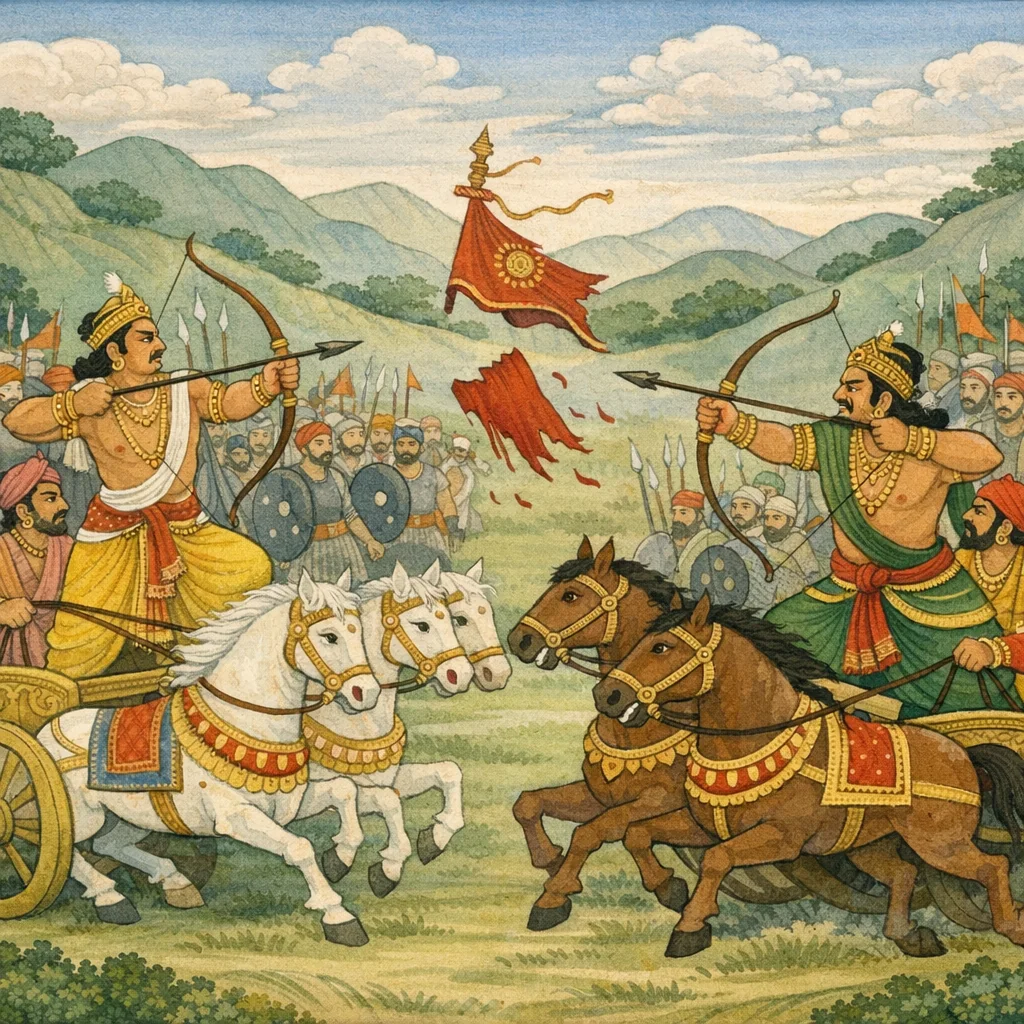
Chapter Arc: रणभूमि में दृढ़ वैरी दुर्योधन को आते देख भीमसेन का क्रोध भड़क उठता है; वर्षों से संचित प्रतिज्ञा का क्षण सामने खड़ा है—“आज या तो तू गिरेगा, या रण छोड़ देगा।” → भीम-दुर्योधन का घोर रथयुद्ध छिड़ता है; प्रहार-प्रतिप्रहार में ध्वज, धनुष और रथ-सज्जा तक कटने लगती है। समानांतर मोर्चों पर अभिमन्यु और द्रौपदीपुत्र धृतराष्ट्रपुत्रों से भिड़ते हैं; उन्मत्त महारथी एक-दूसरे पर टूट पड़ते हैं। → भीम के तीक्ष्ण प्रहार से दुर्योधन के रथ का नानारत्न-विभूषित ध्वज बिजली-सी टूटकर धरती पर गिर पड़ता है—कौरव-गौरव का प्रतीक क्षणभर में धूल में लुढ़क जाता है, और दुर्योधन पराजय-छाया में आ जाता है। → भीम की बढ़त से कौरव पक्ष विचलित होता है, पर भीष्म अपनी महाशक्ति से पाञ्चाल और पाण्डव-सैन्य पर शरवर्षा कर उन्हें यमलोक-मार्ग पर ढकेलते हैं; युद्ध का प्रवाह फिर भीष्म के अनुशासन में लौट आता है। → शतानीक के धनुष कटते ही वह सिंहनाद करता हुआ आगे बढ़ता है, पर दुष्कर्ण के आहत होने पर पाँच महारथी उसे चारों ओर से घेर लेते हैं—अगले क्षणों में शतानीक का भाग्य निर्णायक मोड़ पर लटक जाता है।
Shlokas
Verse 1
अपन करा बछ। रस एकोनाशीतितमो< ध्याय: भीमसेनके द्वारा दुर्योधनकी पराजय, अभिमन्यु और द्रौपदीपुत्रोंका धृतराष्ट्रपुत्रोंके साथ युद्ध तथा छठे दिनके युद्धकी समाप्ति संजय उवाच ततो दुर्योधनो राजा लोहितायति भास्करे । संग्रामरभसो भीम॑ हन्तुकामो5भ्यधावत,संजय कहते हैं--महाराज! तदनन्तर जब सूर्यदेवपर संध्याकी लाली छाने लगी, उस समय संग्रामके लिये उत्साह रखनेवाले राजा दुर्योधनने भीमसेनको मार डालनेकी इच्छासे उनपर धावा किया
Sañjaya said: Then, O King, as the Sun was turning red with the glow of twilight, King Duryodhana—fired with the frenzy of battle—rushed toward Bhima, intent on killing him.
Verse 2
तमायान्तमभिप्रेक्ष्य नृवीरं दृढवैरिणम् । भीमसेन: सुसंक़्रुद्ध इंदे वचनमब्रवीत्,अपने पक्के वैरी नरवीर दुर्योधनको आते देख भीमसेनका क्रोध बहुत बढ़ गया और वे उससे यह वचन बोले--
Seeing that steadfast enemy—Duryodhana, the heroic man—approaching, Bhīmasena’s anger surged. Burning with wrath, he addressed him with these words.
Verse 3
अयं स काल: सम्प्राप्तो वर्षपूगाभिवाज्छित: । अद्य त्वां निहनिष्यामि यदि नोत्सूजसे रणम्,“दुर्योधन! मैं बहुत वर्षोसे जिसकी अभिलाषा और प्रतीक्षा कर रहा था, वही यह अवसर आज प्राप्त हुआ है। यदि तू युद्ध छोड़कर भाग नहीं जायगा तो आज तुझे अवश्य मार डालूँगा
“That long-awaited moment—desired through many years—has now arrived. Today I shall strike you down, if you do not abandon the battle.”
Verse 4
अद्य कुन्त्या: परिक्लेशं वनवासं च कृत्स्नश: । द्रौपद्याश्न परिक्लेशं प्रणेष्यामि हते त्वयि,“माता कुन्तीको जो क्लेश उठाना पड़ा है, हमने वनवासका जो कष्ट भोगा है और सभामें द्रौषयदीको जो अपमानका दुःख सहन करना पड़ा है, उन सबका बदला आज मैं तेरे मारे जानेपर चुका लूँगा
“Today, when you are slain, I shall repay in full all suffering: my mother Kuntī’s anguish, the hardships of our forest exile, and the pain of the insult Draupadī endured in the royal assembly.”
Verse 5
यत् पुरा मत्सरी भूत्वा पाण्डवानवमन्यसे । तस्य पापस्य गान्धारे पश्य व्यसनमागतम्,'गान्धारीपुत्र! पूर्वकालमें डाह रखकर तू जो हम पाण्डवोंका तिरस्कार करता आया है, उसी पापके फलस्वरूप यह संकट तेरे ऊपर आया है। तू आँख खोलकर देख ले
Sañjaya said: “Since earlier, out of envy, you have despised the Pāṇḍavas. O Gāndhāra (Dhṛtarāṣṭra), behold the calamity that has now come upon you as the consequence of that sin.”
Verse 6
कर्णस्य मतमास्थाय सौबलस्य च यत् पुरा । अचिन्त्य पाण्डवान् कामाद् यथेष्टं कृतवानसि,“पहले कर्ण और शकुनिके बहकावेमें आकर पाण्डवोंको कुछ भी न गिनते हुए जो तूने इच्छानुसार मनमाना बर्ताव किया है, भगवान् श्रीकृष्ण संधिके लिये प्रार्थना करने आये थे, परंतु तूने मोहवश जो उनका भी तिरस्कार किया और बड़े हर्षमें भरकर उलूकके द्वारा जो तूने यह संदेश दिया था कि तुम मुझे और मेरे भाइयोंको मारकर अपनी प्रतिज्ञा पूरी करो, उसके अनुसार तुझे भाइयों तथा सगे-सम्बन्धियोंसहित अवश्य मार डालूँगा। पहले तूने जो- जो पाप किये हैं, उन सबका बदला चुकाकर बराबर कर दूँगा”
Sañjaya said: “Formerly, adopting the counsel of Karṇa and of Śakuni (the son of Subala), and driven by desire, you acted as you pleased—treating the Pāṇḍavas as though they were of no consequence.”
Verse 7
याचमानं च यन्मोहाद् दाशा्हमवमन्यसे । उलूकस्य समादेशं यद् ददासि च हृष्टवत्,“पहले कर्ण और शकुनिके बहकावेमें आकर पाण्डवोंको कुछ भी न गिनते हुए जो तूने इच्छानुसार मनमाना बर्ताव किया है, भगवान् श्रीकृष्ण संधिके लिये प्रार्थना करने आये थे, परंतु तूने मोहवश जो उनका भी तिरस्कार किया और बड़े हर्षमें भरकर उलूकके द्वारा जो तूने यह संदेश दिया था कि तुम मुझे और मेरे भाइयोंको मारकर अपनी प्रतिज्ञा पूरी करो, उसके अनुसार तुझे भाइयों तथा सगे-सम्बन्धियोंसहित अवश्य मार डालूँगा। पहले तूने जो- जो पाप किये हैं, उन सबका बदला चुकाकर बराबर कर दूँगा”
Sañjaya said: ‘And because of delusion you have slighted the Dāśārha (Śrī Kṛṣṇa) even when he came as a supplicant for peace. And, exulting, you sent through Ulūka the message that challenged them to fulfill their vow by killing you and your brothers. Such contempt for righteous counsel and such arrogant provocation bind the doer to the consequences of his own deeds.’
Verse 8
तेन त्वां निहनिष्यामि सानुबन्धं सबान्धवम् | समीकरिष्ये तत् पापं यत् पुरा कृतवानसि,“पहले कर्ण और शकुनिके बहकावेमें आकर पाण्डवोंको कुछ भी न गिनते हुए जो तूने इच्छानुसार मनमाना बर्ताव किया है, भगवान् श्रीकृष्ण संधिके लिये प्रार्थना करने आये थे, परंतु तूने मोहवश जो उनका भी तिरस्कार किया और बड़े हर्षमें भरकर उलूकके द्वारा जो तूने यह संदेश दिया था कि तुम मुझे और मेरे भाइयोंको मारकर अपनी प्रतिज्ञा पूरी करो, उसके अनुसार तुझे भाइयों तथा सगे-सम्बन्धियोंसहित अवश्य मार डालूँगा। पहले तूने जो- जो पाप किये हैं, उन सबका बदला चुकाकर बराबर कर दूँगा”
“Therefore I shall slay you—together with your accomplices and your kinsmen. I will make even (i.e., settle in full) that sin which you committed long ago.”
Verse 9
एवमुकक््त्वा धनुर्घोरं विकृष्योदभ्राम्य चासकृत् । समाधत्त शरान् घोरान् महाशनिसमप्रभान्,ऐसा कहकर भीमसेनने अपने भयंकर धनुषको बारंबार घुमाकर उसे बलपूर्वक खींचा और वज्रके समान तेजस्वी भयंकर बाणोंको उसके ऊपर रखा
Sañjaya said: Having spoken thus, Bhīmasena forcefully drew his dreadful bow, whirled it again and again, and then set upon it terrifying arrows whose brilliance was like that of a great thunderbolt—signaling his unwavering resolve to strike in the righteous fury of battle.
Verse 10
षड्विंशतिमथ क्रुद्धो मुमोचाशु सुयोधने । ज्वलिताग्निशिखाकारान् वज़्कल्पानजिद्दगान्,वे सीधे जानेवाले बाण वज्र तथा प्रजजलित आगकी लपटोंके समान जान पड़ते थे। उनकी संख्या छब्बीस थी। कुपित हुए भीमसेनने उन सबको शीघ्रतापूर्वक दुर्योधनपर छोड़ दिया
Sañjaya said: Then Bhīmasena, blazing with anger, swiftly loosed twenty-six arrows at Suyodhana (Duryodhana). Those shafts, irresistible in force, seemed like thunderbolts and like tongues of blazing fire—an image of war’s fierce momentum, where wrath drives the hand and the battlefield’s dharma hangs between restraint and vengeance.
Verse 11
ततोस्य कार्मुकं द्वाभ्यां सूत॑ द्वाभ्यां च विव्यथे । चतुर्भिरश्चानू जवनाननयद् यमसादनम्
Sañjaya said: Then with two arrows he struck down his bow, and with two more he pierced the charioteer. With four arrows he dispatched the swift horses, sending them to Yama’s abode. The scene reveals battle’s ruthless efficiency: disabling the enemy’s means of fighting—weapon, driver, and steeds—becomes decisive, even as it deepens the moral weight of violence on the field.
Verse 12
तत्पश्चात् भीमसेनने दो बाणोंसे दुर्योधनका धनुष काट दिया, दोसे उसके सारथिको पीड़ित किया और चार बाणोंसे उसके वेगशाली घोड़ोंको यमलोक भेज दिया ।। द्वाभ्यां च सुविकृष्टा भ्यां शराभ्यामरिमर्दन: । छत्र॑ चिच्छेद समरे राज्ञस्तस्य नरोत्तम,नरश्रेष्ठ) फिर शत्रुमर्दन भीमने धनुषको अच्छी तरह खींचकर छोड़े हुए दो बाणोंद्वारा समरभूमिमें राजा दुर्योधनके छत्रको काट दिया
Thereafter Bhīmasena cut down Duryodhana’s bow with two arrows, struck and distressed his charioteer with two more, and with four arrows sent his swift horses to the realm of Yama. Then the enemy-crushing Bhīma, drawing his bow to the full, severed in battle the royal parasol of that king—an emblem of sovereignty—publicly diminishing his martial prestige amid the clash of arms.
Verse 13
षड्भिश्न तस्य चिच्छेद ज्वलन्तं ध्वजमुत्तमम् । छित्त्वा तं च ननादोच्चैस्तव पुत्रस्य पश्यत:,इसके बाद अपनी प्रभासे प्रकाशित होनेवाले उसके उत्तम ध्वजको छ: बाणोंसे खण्डित कर दिया। आपके पुत्रके देखते-देखते उस ध्वजको काटकर भीमसेन उच्चस्वरसे सिंहनाद करने लगे
Then with six arrows he cut to pieces that splendid, blazing standard. Having severed it, Bhīmasena roared aloud like a lion, even as your son looked on.
Verse 14
रथाच्च स ध्वज: श्रीमान् नानारत्नविभूषितात् | पपात सहसा भूमौ विद्युज्जलधरादिव,दुर्योधनके नाना रत्नविभूषित रथसे वह शोभाशाली ध्वज सहसा कटकर पृथ्वीपर गिर पड़ा, मानो मेघोंकी घटासे भूमिपर बिजली गिरी हो
Sañjaya said: From that chariot—adorned with many kinds of jewels—the splendid standard suddenly fell to the earth, like a flash of lightning dropping from a rain-cloud. The fall of the banner signals an ominous turn in the battle’s moral and psychological landscape, where outward splendor cannot secure inner steadiness or rightful fortune.
Verse 15
ज्वलन्तं सूर्यसंकाशं नागं मणिमयं शुभम् | ध्वजं कुरुपतेश्छिन्नं ददृशु: सर्वपार्थिवा:,कुरुराज दुर्योधनके उस सूर्यके समान प्रज्वलित नागचिह्लित मणिमय सुन्दर ध्वजको कटकर गिरते समय समस्त राजाओंने देखा
Sañjaya said: All the kings beheld the Kuru lord’s banner—auspicious, gem-studded, bearing the serpent emblem—blazing like the sun as it was cut down and fell.
Verse 16
अथैनं दशभिरन्बाणिस्तोत्रैरिव महाद्विपम् । आजपघान रणे वीरं स्मयन्निव महारथ:,इसके बाद महारथी भीमने मुसकराते हुए-से रणभूमिमें वीरवर दुर्योधनको दस बाणोंसे उसी तरह घायल किया, जैसे महावत अंकुशोंसे महान् गजराजको पीड़ा देता है
Sañjaya said: Then the great chariot-warrior struck that hero in battle with ten follow-up arrows, as though goading a mighty elephant with a driver’s hook, almost as if with a faint smile.
Verse 17
ततः स राजा सिन्धूनां रथश्रेष्ठी महारथ: । दुर्योधनस्य जग्राह पार्ष्णि सत्पुरुषैर्व॒त:,तदनन्तर रथियोंमें श्रेष्ठ सिन्धुराज महारथी जयद्रथने कुछ सत्पुरुषोंक साथ आकर दुर्योधनके पृष्ठभागकी रक्षाका कार्य सँभाला
Then Jayadratha, the king of the Sindhus—foremost among charioteers and a great warrior—arrived with noble men and took up the duty of guarding Duryodhana’s rear.
Verse 18
कृपश्च रथिनां श्रेष्ठ; कौरव्यममितौजसम् | आरोपयद् रथं राजन् दुर्योधनममर्षणम्,राजन! इसी प्रकार रथियोंमें श्रेष्ठ कृपाचार्यने अमर्षमें भरे हुए अमिततेजस्वी कुरुवंशी दुर्योधनको अपने रथपर चढ़ा लिया
Sañjaya said: O King, Kripa—foremost among chariot-warriors—helped the Kuru prince Duryodhana, of immeasurable prowess and burning resentment, to mount his chariot.
Verse 19
स गाढविद्धो व्यथितो भीमसेनेन संयुगे । निषसाद रथोपस्थे राजन् दुर्योधनस्तदा,नरेश्वर! भीमसेनने उस युद्धमें दुर्योधनको बहुत घायल कर दिया था। अत: उस समय वह व्यथासे व्याकुल होकर रथके पिछले भागमें जा बैठा
Sañjaya said: Deeply wounded and shaken by Bhīmasena in the thick of battle, King Duryodhana then sank down and sat upon the rear part of his chariot, O King.
Verse 20
परिवार्य ततो भीम॑ जेतुकामो जयद्रथ: । रथैरनेकसाहसैर्भीमस्थावारयद् दिश:,तत्पश्चात् जयद्रथने भीमसेनको जीतनेकी इच्छा रखकर कई हजार रथोंके द्वारा उन्हें घेर लिया और उनकी सम्पूर्ण दिशाओंको अवरुद्ध कर दिया
Sañjaya said: Then Jayadratha, intent on overcoming Bhīma, surrounded him and, with many thousands of chariots, blocked the directions around Bhīma’s position—seeking victory by containment and overwhelming force rather than by a single fair encounter.
Verse 21
धृष्टकेतुस्ततो राजन्नभिमन्युश्न वीर्यवान् केकया द्रौपदेयाश्व॒ तव पुत्रानयोधयन्,महाराज! इसी समय धृष्टकेतु, पराक्रमी अभिमन्यु, पाँच केकयराजकुमार तथा द्रौपदीके पाँचों पुत्र आपके पुत्रोंके साथ युद्ध करने लगे
Sañjaya said: “Then, O King, Dhṛṣṭaketu, the valiant Abhimanyu, the Kekaya princes, and the sons of Draupadī engaged your sons in battle. Thus the struggle widened as renowned young warriors entered the fray, each fulfilling his chosen allegiance and duty amid the moral weight of kin-slaying war.”
Verse 22
चित्रसेन: सुचित्रश्न चित्राड्रश्नित्रदर्शन: । चारुचित्र: सुचारुश्न तथा नन्न्दोपनन्दकौ,उस युद्धमें चित्रसेन, सुचित्र, चित्रांग, चित्रदर्शन, चारुचित्र, सुचारु, नन्द और उपनन्द-- इन आठ यशस्वी सुकुमार एवं महाधनुर्थर वीरोंने अभिमन्युके रथको चारों ओरसे घेर लिया
In that battle, Citraseṇa, Sucitra, Citrāṅga, Citradarśana, Cārucitra, Sucāru, and Nanda and Upananda—eight illustrious youthful warriors, mighty archers—surrounded Abhimanyu’s chariot on all sides.
Verse 23
अष्टावेते महेष्वासा: सुकुमारा यशस्विन: । अभिमन्युरथं राजन् समन्तात् पर्यवारयन्,उस युद्धमें चित्रसेन, सुचित्र, चित्रांग, चित्रदर्शन, चारुचित्र, सुचारु, नन्द और उपनन्द-- इन आठ यशस्वी सुकुमार एवं महाधनुर्थर वीरोंने अभिमन्युके रथको चारों ओरसे घेर लिया
Sañjaya said: O King, in that battle eight youthful, illustrious warriors—mighty archers—surrounded Abhimanyu’s chariot on all sides, hemming him in from every direction.
Verse 24
आजघान तततस्तूर्णमभिमन्युर्महामना: । एकैकं पजञ्चभिर्बाणै: शितै: संनतपर्वभि:,उस समय महामना अभिमन्युने तुरंत ही झुकी हुई गाँठवाले पाँच-पाँच तीखे बाणोंद्वारा प्रत्येकको बींध डाला
Sañjaya said: Then the high-souled Abhimanyu swiftly struck—piercing each opponent in turn with five razor-sharp arrows, well-fashioned and bent at the joints.
Verse 25
वज़मृत्युप्रतीकाशैर्विचित्रायुधनि:सृतै: । अमृष्यमाणास्ते सर्वे सौभद्रंं रथसत्तमम्
Sañjaya said: Unable to endure him, all those warriors assailed Saubhadra—the foremost of charioteers—by releasing a shower of varied weapons, gleaming like thunderbolts and seeming like death itself.
Verse 26
स पीड्यमान: समरे कृतास्त्रो युद्धदुर्मद:,महाराज! अभिमन्यु अस्त्रविद्याका ज्ञाता और युद्धमें उन््मत्त होकर लड़नेवाला है। उसने समरभूमिमें बाणोंसे पीड़ित होनेपर भी आपके सैनिकोंमें कँपकँपी उत्पन्न कर दी। ठीक उसी तरह, जैसे देवासुर-संग्राममें वज्रधारी इन्द्रने बड़े-बड़े असुरोंको भयसे पीड़ित कर दिया था
Sañjaya said: “O King, Abhimanyu—skilled in the science of weapons and fighting with battle-fury—though hard-pressed in the melee and struck by arrows, still sent a tremor through your troops. It was like Indra, wielder of the thunderbolt, who in the war between gods and demons struck great asuras with fear.”
Verse 27
अभिमन्युर्महाराज तावकान् समकम्पयत् | यथा देवासुरे युद्धे वज्पाणि्महासुरान्,महाराज! अभिमन्यु अस्त्रविद्याका ज्ञाता और युद्धमें उन््मत्त होकर लड़नेवाला है। उसने समरभूमिमें बाणोंसे पीड़ित होनेपर भी आपके सैनिकोंमें कँपकँपी उत्पन्न कर दी। ठीक उसी तरह, जैसे देवासुर-संग्राममें वज्रधारी इन्द्रने बड़े-बड़े असुरोंको भयसे पीड़ित कर दिया था
Sañjaya said: “O King, Abhimanyu made your warriors tremble. Just as, in the war between the gods and the demons, Indra—wielder of the thunderbolt—shook the mighty asuras with fear, so did Abhimanyu strike terror on the battlefield through his prowess.”
Verse 28
विकर्णस्य ततो भल््लान् प्रेषयामास भारत । चतुर्दश रथश्रेष्ठो घोरानाशीविषोपमान्,भारत! तदनन्तर रथियोंमें श्रेष्ठ पराक्रमी अभिमन्युने विकर्णके ऊपर सर्पके समान आकारवाले चौदह भयंकर भल्ल चलाये और उनके द्वारा विकर्णके रथसे ध्वज, सारथि और घोड़ोंकोी मार गिराया। उस समय वह युद्धमें नृत्य-यसा कर रहा था
Sanjaya said: Then, O Bharata, the foremost of chariot-warriors sent forth fourteen dreadful bhalla-arrows against Vikarna, like venomous serpents. With those shafts he struck down the banner, the charioteer, and the horses of Vikarna’s chariot; and at that moment he moved in battle as though dancing—displaying fearless mastery amid the grim work of war.
Verse 29
स तैर्विकर्णस्य रथात् पातयामास वीर्यवान् | ध्वजं सूतं हयांश्वैव नृत्यमान इवाहवे,भारत! तदनन्तर रथियोंमें श्रेष्ठ पराक्रमी अभिमन्युने विकर्णके ऊपर सर्पके समान आकारवाले चौदह भयंकर भल्ल चलाये और उनके द्वारा विकर्णके रथसे ध्वज, सारथि और घोड़ोंकोी मार गिराया। उस समय वह युद्धमें नृत्य-यसा कर रहा था
Sañjaya said: Mighty Abhimanyu, by those shafts, struck down from Vikarṇa’s chariot its banner, charioteer, and horses, as though he were dancing amid the battle, O Bhārata.
Verse 30
पुनश्चान्यान् शरान् पीतानकुण्ठाग्रान्ू शिलाशितान् । प्रेषयामास संक़रुद्धो विकर्णाय महाबल:,तत्पश्चात् उस महाबली वीरने अत्यन्त कुपित हो शानपर चढ़ाकर तेज किये हुए अप्रतिहत धारवाले दूसरे पानीदार बाण विकर्णपर चलाये
Sañjaya said: Then again, that mighty warrior—burning with anger—shot other arrows at Vikarṇa: gleaming shafts with unblunted points, their edges honed on stone. The verse shows how wrath sharpens violence in battle, turning skill and strength into instruments of relentless harm.
Verse 31
ते विकर्ण समासाद्य कड्कबर्हिणवासस: । भित्त्वा देहं गता भूमिं ज्वलन्त इव पन्नगा:,उन बाणोंके पुच्छभागमें मोरके पंख लगे हुए थे। वे विकर्णके शरीरको विदीर्ण करके भीतर घुस गये और वहाँसे भी निकलकर प्रज्वलित सर्पोकी भाँति पृथ्वीपर गिर पड़े
Sañjaya said: Those arrows, their shafts adorned with water-bird feathers and peacock plumes, struck Vikarṇa; tearing through his body, they passed on and fell to the earth like blazing serpents. The image evokes the war’s impersonal relentlessness—where skill and wrath make weapons seem alive with terror, and a warrior’s body becomes a brief passage for fate and violence.
Verse 32
ते शरा हेमपुड्खाग्रा व्यदृश्यन्त महीतले । विकर्णरुधिरक्लिन्ना वमन्त इव शोणितम्,उन बाणोंके पुच्छ और अग्रभाग सुनहरे थे। वे विकर्णके रुधिरमें भीगे हुए बाण पृथ्वीपर रक्त वमन करते हुए-से दृष्टिगोचर हो रहे थे
Sañjaya said: Those arrows, with golden fletchings and golden points, were seen scattered upon the ground. Smeared and soaked in Vikarṇa’s blood, they looked as though they were vomiting forth gore—an image that starkly reveals the brutal cost of battle and the bodily consequence of martial duty pursued to its end.
Verse 33
विकर्ण वीक्ष्य निर्भिन्न तस्यैवान्ये सहोदरा: । अभ्यद्रवन्त समरे सौभद्रप्रमुखान् रथान्,विकर्णको क्षत-विक्षत हुआ देख उसके दूसरे भाइयोंने समरभूमिमें अभिमन्यु आदि रथियोंपर धावा किया
Sañjaya said: Seeing Vikarṇa struck down and torn by wounds, his other full brothers rushed into the battle, charging the chariots led by Saubhadra (Abhimanyu). The scene shows how kinship and the warrior’s dharma drive immediate retaliation, even as war’s violence multiplies grief and vengeance.
Verse 34
अभियात्वा तथैवान्यान् रथांस्तान् सूर्यवर्चस: । अविध्यन् समरे<न्योन्यं संरम्भाद् युद्धदुर्मदा:,वे सब-के-सब युद्धमें उन््मत्त होकर लड़नेवाले थे। उन्होंने दूसरे-दूसरे रथियोंपर भी, जो अभिमन्युकी ही भाँति सूर्यके समान तेजस्वी थे, आक्रमण किया। फिर वे सब लोग अत्यन्त क्रोधमें भरकर एक-दूसरेको अपने बाणोंद्वारा घायल करने लगे
Sañjaya said: Advancing likewise against the other chariot-warriors—radiant with a sun-like splendor—they struck one another in the battle. Maddened by the arrogance of war and driven by sudden fury, they wounded each other with their weapons, showing how wrath and martial pride can eclipse restraint and right judgment even among the mighty.
Verse 35
दुर्मुख: श्रुतकर्माणं विद्ध्वा सप्तभिराशुगै: । ध्वजमेकेन चिच्छेद सारथिं चास्य सप्तभि:,दुर्मुखने श्रुतकर्माको सात शीघ्रगामी बाणोंद्वारा बीधकर एकसे उसका ध्वज काट डाला और सात बाणोंसे उसके सारथिको घायल कर दिया
Sañjaya said: Durmukha struck Śrutakarmā with seven swift arrows; with a single shaft he severed his banner, and with seven more he wounded his charioteer.
Verse 36
अश्वान् जाम्बूनदैर्जालै: प्रच्छन्नान् वातरंहस: । जघान षड्भिरासाद्य सारथिं चाभ्यपातयत्,उसके घोड़े वायुके समान वेगशाली तथा सोनेकी जालीसे आच्छादित थे। दुर्मुखने उन घोड़ोंको छः बाणोंसे मार डाला और सारथिको भी रथसे नीचे गिरा दिया
Sañjaya said: The horses, swift as the wind and covered with nets of Jāmbūnada-gold, were struck down when Durmukha closed in and pierced them with six arrows; he also felled the charioteer from the chariot.
Verse 37
स हताश्वे रथे तिष्ठन् श्रुतकर्मा महारथ: । शक्ति चिक्षेप संक्रुद्धो महोल्कां ज्वलितामिव,महारथी श्रुतकर्मा घोड़ोंके मारे जानेपर भी उसी रथपर खड़ा रहा और अत्यन्त क्रोधमें भरकर उसने दुर्मुखपर प्रज्वलित उल्काके समान एक शक्ति चलायी
Sañjaya said: Though his horses had been slain, the great chariot-warrior Śrutakarmā remained standing upon his chariot. Inflamed with wrath, he hurled a śakti-weapon, blazing like a great meteor.
Verse 38
सा दुर्मुखस्य विमल वर्म भित्त्वा यशस्विन: । विदार्य प्राविशद् भूमिं दीप्यपमाना स्वतेजसा,वह शक्ति अपने तेजसे उद्दधीप्त हो रही थी। उसने यशस्वी दुर्मुखके चमकीले कवचको फाड़ डाला। फिर वह धरतीको चीरती हुई उसमें समा गयी
Sañjaya said: The blazing spear, radiant with its own energy, tore through the bright armor of the renowned Durmukha. Having split it apart, it then cleaved the earth and disappeared into the ground.
Verse 39
त॑ दृष्टवा विरथं तत्र सुतसोमो महारथः । पश्यतां सर्वसैन्यानां रथमारोपयत् स्वकम्,भीमसेनके बाणसे मूर्च्छित दुर्योधन महारथी सुतसोमने अपने भाई श्रुतकर्माको युद्धमें रथहीन हुआ देख समस्त सैनिकोंके देखते-देखते उसे अपने रथपर चढ़ा लिया
Sañjaya said: Seeing Sutasoma there left without a chariot, the great warrior—before the eyes of all the armies—lifted him onto his own chariot.
Verse 40
श्रुतकीर्तिस्तथा वीरो जयत्सेनं सुतं तव । अभ्ययात् समरे राजन् हन्तुकामो यशस्विनम्,राजन! इसी प्रकार वीरवर श्रुतकीर्तिने युद्धभूमिमें आपके यशस्वी पुत्र जयत्सेनको मार डालनेकी इच्छासे उसपर आक्रमण किया
Sañjaya said: “In the same way, the valiant Śrutakīrti advanced in battle, O King, against your son Jayatsena—intent on slaying that renowned warrior.”
Verse 41
तस्य विक्षिपतश्चापं श्रुतकीर्तेर्महास्वनम् । चिच्छेद समरे तूर्ण जयत्सेन: सुतस्तव
Sañjaya said: As Śrutakīrti was brandishing his great, thunderous bow, your son Jayatsena swiftly cut it down in the midst of battle.
Verse 42
क्षुरप्रेण सुतीक्ष्णेन प्रहसन्निव भारत । भारत! श्रुतकीर्ति जब बड़े जोर-जोरसे खींचकर अपने विशाल धनुषकी गम्भीर टंकार फैला रहा था, उसी समय रणभूमिमें आपके पुत्र जयत्सेनने हँसते हुए-से एक तीखे क्षुप्रद्वारा तुरंत उसका धनुष काट दिया ।। त॑ दृष्टवा छिन्नधन्वानं शतानीक: सहोदरम्
Sañjaya said: O Bhārata, as Śrutakīrti was forcefully drawing his great bow and spreading its deep, resonant twang across the battlefield, at that very moment your son Jayatsena—almost as if laughing—swiftly severed Śrutakīrti’s bow with a razor-edged, exceedingly sharp arrow. Seeing his brother Śrutakīrti standing there with his bow cut, Śatānīka reacted…
Verse 43
शतानीकस्तु समरे दृढं विस्फार्य कार्मुकम्,शतानीकने संग्रामभूमिमें अपने धनुषको जोरसे खींचकर शीघ्रतापूर्वक दस बाण मारकर जयत्सेनको घायल कर दिया। फिर उसने मदवर्षी गजराजके समान बड़े जोरसे गर्जना की
Sañjaya said: In the thick of battle, Śatānīka powerfully drew his bow to the full and, with swift precision, struck Jayatsena with ten arrows, wounding him. Then, like a great royal elephant in musth, he roared with tremendous force.
Verse 44
विव्याध दशभिस्तूर्ण जयत्सेनं शिलीमुखै: । ननाद सुमहानादं प्रभिन्न इव वारण:,शतानीकने संग्रामभूमिमें अपने धनुषको जोरसे खींचकर शीघ्रतापूर्वक दस बाण मारकर जयत्सेनको घायल कर दिया। फिर उसने मदवर्षी गजराजके समान बड़े जोरसे गर्जना की
Sañjaya said: Drawing his bow with force, Śatānīka swiftly pierced Jayatsena with ten sharp arrows. Then, like a rutting elephant that has broken loose, he let out a mighty roar.
Verse 45
अथान्येन सुतीक्ष्णेन सर्वावरणभेदिना । शतानीको जयत्सेनं विव्याध हृदये भूशम्,तत्पश्चात् समस्त आवरणोंका भेदन करनेमें समर्थ दूसरे तीक्ष्ण बाणद्वारा शतानीकने जयत्सेनके वक्ष:स्थलमें गहरी चोट पहुँचायी
Sañjaya said: Then, with another exceedingly sharp arrow—one capable of piercing through every kind of armor—Śatānīka struck Jayatsena violently in the region of the heart. The scene underscores the grim precision of battle, where martial skill and lethal intent override personal sentiment, and where the ethical weight of war is carried through disciplined action rather than hatred.
Verse 46
तथा तस्मिन् वर्तमाने दुष्कर्णो भ्रातुरन्तिके । चिच्छेद समरे चाप॑ नाकुले: क्रोधमूर्च्छित:
Sañjaya said: As that combat was unfolding, Duṣkarṇa—overcome by a surge of anger—cut down the bow of Nakula in the midst of battle, close by his own brother. The episode underscores how wrath, rather than restraint, drives warriors to decisive and often ruthless acts on the battlefield.
Verse 47
उसके इस प्रकार करनेपर अपने भाईके पास खड़ा हुआ दुष्कर्ण क्रोधसे व्याकुल हो उठा। उसने समरभूमिमें नकुलपुत्र शतानीकका धनुष काट दिया ।। अथान्यद् धनुरादाय भारसाहमनुत्तमम् | समादत्त शरान् घोरान् शतानीको महाबल:,तब महाबली शतानीकने भार सहन करनेमें समर्थ दूसरा अत्यन्त उत्तम धनुष लेकर उसपर भयंकर बाणोंका अनुसंधान किया
Sañjaya said: Then the mighty Śatānīka, able to bear the strain of heavy weapons, took up another excellent bow and set fierce arrows upon it—steadfastly resuming the fight after his bow had been cut, showing the warrior’s resolve to continue one’s duty in battle despite sudden loss.
Verse 48
तिष्ठ तिछ्ठेति चामन्त्रय दुष्कर्ण भ्रातुरग्रत: । मुमोचास्मै शितान् बाणान् ज्वलितान् पन्नगानिव,फिर भाईके सामने ही दुष्कर्णसे 'खड़ा रह, खड़ा रह” ऐसा कहकर उसके ऊपर प्रज्वलित सर्पोंके समान तीखे बाणोंका प्रहार किया
Sañjaya said: Calling out to Duṣkarṇa, “Stand! Stand!”, and doing so right before his brother, he loosed upon him sharp arrows—blazing like serpents—an act that heightens the ferocity and humiliation of the battlefield encounter.
Verse 49
ततोअस्य धनुरेकेन द्वाभ्यां सूतं॑ च मारिष । चिच्छेद समरे तूर्ण तं च विव्याध सप्तभि:,आर्य! तदनन्तर एक बाणसे उसके धनुषको काट दिया, दोसे उसके सारथिको क्षत- विक्षत कर दिया और सात बाणोंसे उस युद्धस्थलमें स्वयं दुष्कर्णको भी तुरंत घायल कर दिया
Sañjaya said: Then, in the midst of battle, he swiftly cut down his bow with a single arrow; with two more he struck and mangled his charioteer; and thereafter he at once pierced Duṣkarṇa himself with seven arrows. The episode underscores the ruthless precision of kṣatriya warfare, where disabling the opponent’s means of combat—weapon, driver, and finally the warrior—becomes a grim, methodical strategy within the accepted codes of battle.
Verse 50
अश्वान् मनोजवांस्तस्य कर्बुरान् वातरंहस: । जघान निशितैस्तूर्ण सर्वान् द्वादशभि: शरै:,दुष्कर्णके घोड़े मन और वायुके समान वेगशाली थे। उनका रंग चितकबरा था। शतानीकने बारह तीखे बाणोंसे उन सब घोड़ोंको भी तुरंत मार डाला
Sañjaya said: His horses—swift as thought and as fast as the wind, dappled in color—were all quickly struck down by sharp arrows, twelve in number. The scene reveals the ruthless efficiency of battlefield skill, where even the noble strength of fine steeds is cut short in the relentless calculus of war.
Verse 51
अथापरेण भल््लेन सुयुक्तेनाशुपातिना । दुष्कर्ण सुदृढं क्रुद्धों विव्याध हृदये भूशम्
Sañjaya said: Then, with another well-aimed bhalla-arrow, swift in its flight, the enraged warrior struck Duṣkarṇa—piercing him firmly in the region of the heart. In the moral atmosphere of the Kurukṣetra war, the verse underscores how wrath and martial skill combine to produce decisive, often fatal, consequences, reminding the listener that violence, once unleashed, moves by its own grim logic regardless of personal ties.
Verse 52
दुष्कर्ण व्यथितं दृष्टया पठच राजन् महारथा:
Sañjaya said: “O King, seeing Duṣkarṇa distressed, the great chariot-warriors among the Pāṇḍavas (and their allies) reacted accordingly.”
Verse 53
छाद्यमानं शरत्रातैः शतानीकं॑ यशस्विनम्
Sañjaya said: “The illustrious Śatānīka was being completely covered—overwhelmed on all sides—by volleys of arrows.”
Verse 54
अभ्यधावन्त संक्रुद्धा: केकया: पञज्च सोदरा: । उनके बाणसमूहोंसे यशस्वी शतानीकको आच्छादित होते देख क्रोधमें भरे हुए पाँच भाई केकयराजकुमारोंने उन पाँचों महारथियोंपर धावा किया || ५३ हू ।। तानभ्यापतत: प्रेक्ष्य तव पुत्रा महारथा:
Sañjaya said: Enraged, the five Kekaya brothers charged forward. Seeing them rushing on, your sons—mighty chariot-warriors—prepared to meet their assault. The scene underscores how wrath and the urge to answer violence with violence rapidly widen the circle of conflict on the battlefield.
Verse 55
प्रत्युद्ययुरमहाराज गजानिव महागजा: । महाराज! उन्हें आते देख आपके महारथी पुत्र उनका सामना करनेके लिये आगे बढ़े, जैसे हाथी दूसरे हाथियोंसे भिड़नेके लिये आगे बढ़ते हैं || ५४ हू ।। दुर्मुखो दुर्जयश्वैव तथा दुर्मर्षणो युवा,नरेश्वर! दुर्मुख, दुर्जय, युवा वीर दुर्मर्षण, शत्रुंजय तथा शत्रुसह--ये सब-के-सब यशस्वी वीर क्रोधमें भरकर पाँचों भाई केकयोंका सामना करनेके लिये एक साथ आगे बढ़े
Sañjaya said: O great king, seeing them advance, your foremost warriors moved out to meet them—like mighty elephants surging forward to clash with other elephants. O lord of men, Durmukha, Durjaya, the young hero Durmarṣaṇa, along with Śatruñjaya and Śatrusaha—these five renowned brothers, inflamed with anger, rushed together to confront the five Kekaya brothers.
Verse 56
शत्रुञ्जय: शत्रुसह: सर्वे क्रुद्धा यशस्विन: । प्रत्युद्याता महाराज केकयान् भ्रातर: समम्,नरेश्वर! दुर्मुख, दुर्जय, युवा वीर दुर्मर्षण, शत्रुंजय तथा शत्रुसह--ये सब-के-सब यशस्वी वीर क्रोधमें भरकर पाँचों भाई केकयोंका सामना करनेके लिये एक साथ आगे बढ़े
Sañjaya said: O great king, O lord of men—Durmukha, Durjaya, the young hero Durmarṣaṇa, Śatruñjaya, and Śatrusaha—all renowned warriors, inflamed with anger, advanced together to meet the five Kekaya brothers in battle.
Verse 57
रथैर्नगरसंकाशैहयैर्युक्तैर्मनोजवै: । नानावर्णविचित्राभि: पताकाभिरलंकृतै:,उनके रथ नगरोंके समान प्रतीत होते थे। उनमें मनके समान वेगशाली घोड़े जुते हुए थे। नाना प्रकारके रूप-रंगवाली और विचित्र पताकाएँ उन्हें अलंकृत कर रही थीं। ऐसे रथोंपर आरूढ़ सुन्दर धनुष धारण किये विचित्र कवच और ध्वजोंसे सुशोभित उन वीरोंने शत्रुकी सेनामें उसी प्रकार प्रवेश किया, जैसे सिंह एक वनसे दूसरे वनमें प्रवेश करते हैं
Sañjaya said: Their chariots looked like moving cities, yoked with horses swift as thought and adorned with many-hued, wondrous banners. Thus mounted—bearing fine bows, wearing varied armor, and shining with distinctive standards—those heroes plunged into the enemy host like lions passing from one forest into another.
Verse 58
वरचापधरा वीरा विचित्रकवचध्वजा: । विविशुस्ते पर॑ं सैन्यं सिंहा इव वनाद् वनम्,उनके रथ नगरोंके समान प्रतीत होते थे। उनमें मनके समान वेगशाली घोड़े जुते हुए थे। नाना प्रकारके रूप-रंगवाली और विचित्र पताकाएँ उन्हें अलंकृत कर रही थीं। ऐसे रथोंपर आरूढ़ सुन्दर धनुष धारण किये विचित्र कवच और ध्वजोंसे सुशोभित उन वीरोंने शत्रुकी सेनामें उसी प्रकार प्रवेश किया, जैसे सिंह एक वनसे दूसरे वनमें प्रवेश करते हैं
Sañjaya said: Those heroes, bearing excellent bows and adorned with wondrous armor and banners, plunged into the enemy host—like lions passing from one forest into another.
Verse 59
तेषां सुतुमुलं युद्ध व्यतिषक्तरथद्धिपम् । अवर्तत महारीौद्रे निघध्नतामितरेतरम्,फिर तो एक-दूसरेपर प्रहार करते हुए उन सभी महारथियोमें अत्यन्त भयंकर तुमुल युद्ध होने लगा। रथोंसे रथ और हाथियोंसे हाथी भिड़ गये
Sañjaya said: Among them there arose an exceedingly tumultuous battle—chariots and elephants intermingled in close clash. In that great and dreadful fury of war, they struck one another down without pause.
Verse 60
अन्योन्यागस्कृतां राजन् यमराष्ट्रविवर्धनम् मुहूर्तास्तमिते सूर्ये चक्रुर्युद्धे सुदारुणम्,राजन! एक-दूसरेपर प्रहार करनेवाले उन महारथियोंका वह युद्ध यमलोककी वृद्धि करनेवाला था। सूर्यास्तके दो घड़ी बादतक उन सब लोगोंने बड़ा भयंकर युद्ध किया
Sañjaya said: O King, striking one another in mutual offense, those warriors waged a most dreadful battle—one that only swelled the realm of Yama. Even after the sun had set, for two muhūrtas they continued that fierce fighting.
Verse 61
रथिन: सादिनश्चाथ व्यकीर्यन्त सहस्रश: । ततः शान्तनव: क्रुद्ध: शरै:ः संनतपर्वभि:
Sañjaya said: Then the chariot-warriors and the horsemen were scattered in their thousands. Thereupon Śāntanava (Bhīṣma), enraged, struck with arrows whose joints were well-bent—unleashing disciplined, lethal force amid the chaos of battle.
Verse 62
नाशयामास सेनां तां भीष्मस्तेषां महात्मनाम् | पज्चालानां च सैन्यानि शरैर्निन्ये यमक्षयम्
Sañjaya said: Bhīṣma shattered that army of those great-souled warriors; and with his arrows he drove the forces of the Pāñcālas to Yama’s abode.
Verse 63
उसमें सहस्रों रथी और घुड़सवार प्राणशून्य होकर बिखर गये। तब शान्तनुनन्दन भीष्मने कुपित होकर झुकी हुई गाँठवाले बाणोंद्वारा उन महामना वीरोंकी सेनाका विनाश कर डाला; पांचालोंकी सेनाकी कितनी ही टुकड़ियोंको अपने बाणोंद्वारा यमलोक पहुँचा दिया ।। एवं भित्त्वा महेष्वास: पाण्डवानामनीकिनीम् । कृत्वावहारं सैन्यानां ययौ स्वशिबिरं नूप,नरेश्वर! महाधनुर्धर भीष्म इस प्रकार पाण्डव-सेनाका संहार करके अपनी समस्त सेनाओंको युद्धसे लौटाकर अपने शिविरको चले गये
Sañjaya said: There, thousands of chariot-warriors and horsemen fell lifeless and lay scattered. Then Bhīṣma, Śāntanu’s son, enraged, destroyed the army of those high-minded heroes with arrows whose joints bent downward; and with his shafts he sent many divisions of the Pāñcālas to Yama’s world. Thus, having shattered the Pāṇḍavas’ host, the great archer Bhīṣma ordered the withdrawal of all his troops from the fighting and returned to his own camp, O king.
Verse 64
(नाशयामासतुर्वीरौ धृष्टद्युम्नवृकोदरौ । कौरवाणामनीकानि शरै: संनतपर्वभि: ।।) इसी प्रकार धृष्टद्यमम और भीमसेन--इन दोनों वीरोंने झुकी हुई गाँठवाले बाणोंद्वारा कौरवसेनाओंका विनाश कर डाला। धर्मराजो5पि सम्प्रेक्ष्य धृष्टद्युम्नवृकोदरौ । मूर्थ्नि चैतावुपाप्राय प्रहृष्टः शिबिरं ययौ,धर्मराज युधिष्ठिरने धृष्टद्युम्म और भीमसेन दोनोंसे मिलकर उनका मस्तक सूँघा और बड़े हर्षके साथ अपने शिविरको प्रस्थान किया
Sañjaya said: In the same way, the two heroes Dhṛṣṭadyumna and Vṛkodara (Bhīma) destroyed the Kauravas’ battle-formations with arrows whose joints were bent downward. And Dharmarāja Yudhiṣṭhira, seeing Dhṛṣṭadyumna and Vṛkodara, went up to them, smelled the crown of each one’s head as a sign of affection and praise, and then, greatly pleased, departed for his camp.
Verse 78
इस प्रकार श्रीमह्या भारत भीष्मपर्वके अन्तर्गत भीष्मवधपर्वमें संकुलयुद्धविषयक अठहत्तरवाँ अध्याय पूरा हुआ
Thus ends the seventy-eighth chapter on the theme of the confused and densely intermingled battle, within the Bhīṣma Parva of the sacred Mahābhārata, in the sub-section concerning the slaying of Bhīṣma. This closing colophon signals a transition in the narrative, marking the completion of a unit of war-description and its moral weight—where duty, strategy, and the tragic cost of conflict converge.
Verse 79
(अर्जुनो वासुदेवश्च कौरवाणामनीकिनीम् । हत्वा विद्राव्य च शरै: शिबिरायैव जग्मतुः ।।) अर्जुन और भगवान् श्रीकृष्ण भी कौरव-सेनाको बाणोंद्वारा मारकर तथा रणभूमिसे भगाकर शिविरको ही चल दिये। इति श्रीमहाभारते भीष्मपर्वणि भीष्मवधपर्वणि षष्ठदिवसावहारे एकोनाशीतितमो<ध्याय:
Sañjaya said: Arjuna and Vāsudeva (Kṛṣṇa), having struck down the Kaurava host and driven the rest into flight with volleys of arrows, then returned to their own camp. The verse underscores the battlefield ethic of decisive action—neutralizing immediate threat and restoring order—while keeping the larger dharmic aim (the protection of rightful order) in view rather than mere cruelty or vengeance.
Verse 256
ववृषुर्मार्गणैस्ती$णैर्गिरिं मेरुमिवाम्बुदा: । वे सभी बाण विचित्र धनुषद्वारा छोड़े गये थे और सब-के-सब वज्र एवं मृत्युके तुल्य भयंकर थे। उन बाणोंके आघातको आपके पुत्र सहन न कर सके। उन सबने मिलकर रथियोंमें श्रेष्ठ सुभद्राकुमार अभिमन्युपर तीखे बाणोंकी वर्षा आरम्भ की, मानो बादल मेरुगिरिपर जलकी वर्षा कर रहे हों
Sañjaya said: They showered sharp arrows, as rain-clouds pour down upon Mount Meru. Those missiles, released from wondrous bows, were all dreadful—like thunderbolts and like death itself. Your sons could not endure the force of their blows; and together they began a fierce rain of arrows upon Abhimanyu, the son of Subhadrā, foremost among chariot-warriors—just as clouds rain upon the Meru mountain.
Verse 426
अभ्यपद्यत तेजस्वी सिंहवन्निनदन् मुहुः । अपने भाईका धनुष कटा हुआ देख तेजस्वी शतानीक बारंबार सिंहके समान गर्जना करता हुआ वहाँ आ पहुँचा
Sañjaya said: The radiant Śatānīka rushed forward, repeatedly roaring like a lion. Seeing his brother’s bow cut down, he arrived there in fierce resolve—his cry signaling both grief and righteous anger amid the duties and brutal necessities of war.
Verse 516
स पपात ततो भूमौ वज्राहत इव द्रुम: । तत्पश्चात् लक्ष्यको शीघ्र मार गिरानेवाले एक दूसरे भल्ल नामक बाणका उत्तम रीतिसे प्रयोग करके क्रोधमें भरे हुए शतानीकने दुष्कर्णके हृदयमें अत्यन्त गहरा आघात किया। इससे दुष्कर्ण वज्राहत वृक्षकी भाँति पृथ्वीपर गिर पड़ा
Sañjaya said: Struck down, he fell to the earth like a tree shattered by a thunderbolt. Then, swiftly taking aim, Śatānīka—his anger fully kindled—skillfully loosed a keen bhalla-arrow and drove it deep into Duṣkarṇa’s heart. Wounded thus, Duṣkarṇa collapsed upon the ground like a thunderbolt-smitten tree.
Verse 526
जिघांसन्त: शतानीकं सर्वत: पर्यवारयन् । राजन! दुष्कर्णको आघातसे पीड़ित देख पाँच महारथियोंने शतानीकको मार डालनेकी इच्छासे उसे सब ओरसे घेर लिया
Sañjaya said: “Intent on killing Śatānīka, they surrounded him on every side. O King, seeing Duṣkarṇa struck down and suffering from the blow, five great chariot-warriors closed in around Śatānīka with the resolve to slay him.”
Frequently Asked Questions
Bhīṣma’s conduct is shaped by a vow-based restraint regarding Śikhaṇḍī: despite being challenged, he deprioritizes direct engagement, illustrating how personal ethical constraints can override immediate tactical convenience.
When confronted with a dominant adversary, survival and governance goals may require coordinated coalition action and clear operational priorities; individual valor is shown as insufficient without disciplined formation, communication, and adaptive repositioning.
No explicit phalaśruti is stated in this chapter; its meta-significance is conveyed implicitly through Saṃjaya’s reportage style, emphasizing how tactical events and ethical constraints jointly condition later outcomes in the war narrative.