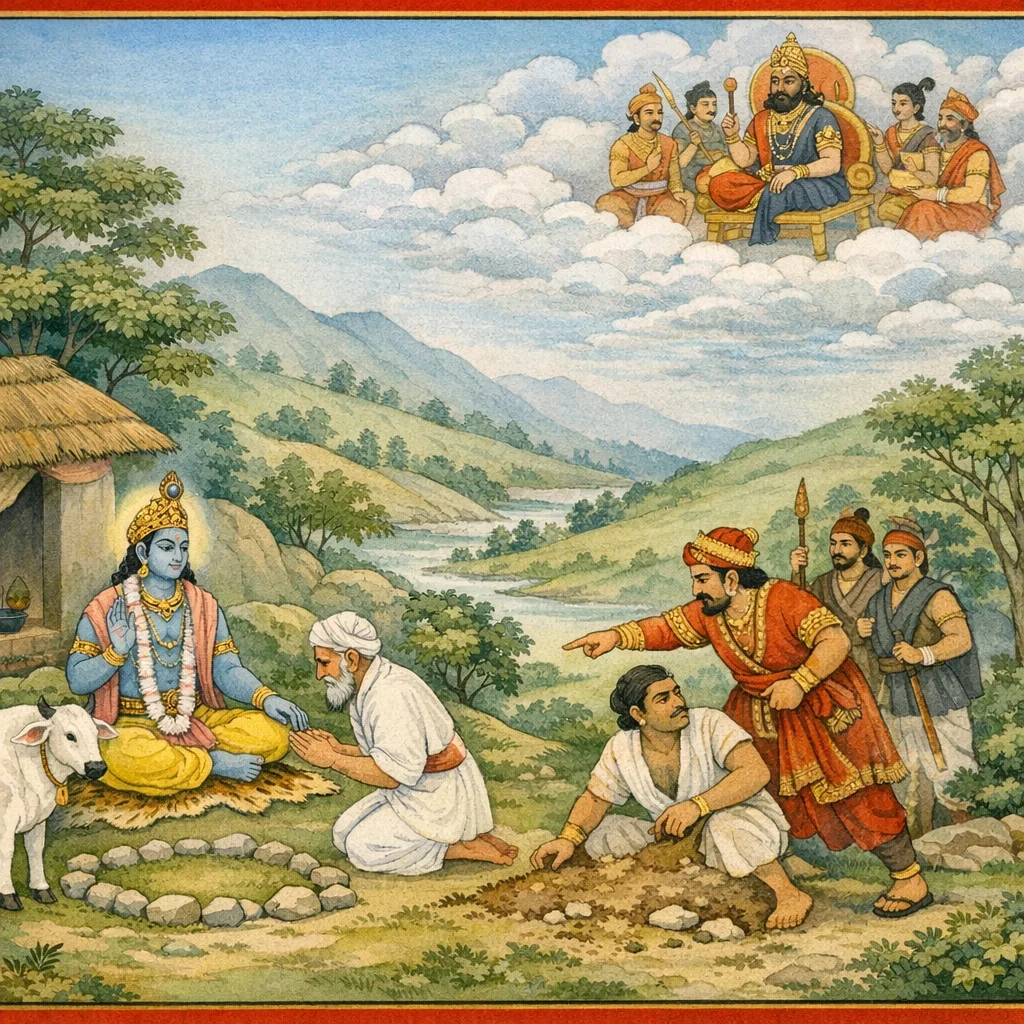
Adhyaya 42
Bhūmi-dāna, Satya-dharma, and the Non-cancellation of Sin by Charity
Continuing the Preta Kalpa’s karmic framework, the teaching moves from the certainty of karmic consequence to concrete dharmic choices that shape one’s post-death state. Viṣṇu first establishes that karma inevitably follows its agent. The chapter then praises bhūmi-dāna (gift of land) as the highest of gifts, supported by cosmological correspondences—gold from Agni, earth as Vaiṣṇavī, and cows as solar progeny—and pairs it with satya (truthfulness) as the supreme dharma. It tightens the moral logic by rejecting “compensatory charity”: theft and harm (including ruining livelihoods or initiating harmful customs) bring heavy demerit that later donations cannot cancel. Strong warnings follow against seizing land, obstructing one’s own gifts, and misappropriating property dedicated to brāhmaṇas or deities, with long-lasting consequences. The chapter culminates by ranking protection of impoverished brāhmaṇas above grand sacrifices, while cautioning that accepting gifts can endanger priests spiritually unless restrained by japa, homa, and strict conduct, preparing for further teachings on righteous action and post-mortem results.
Shlokas
Verse 1
वृषोत्सर्गनिरूपणं नामै कचत्वारिंशत्तमो ऽध्यायः श्रीविष्णुरुवाच / यथा धेनुसहस्रेषु वत्सो विन्दति मातरम् / तथा पूर्वकृतं कर्म कर्तारमनुगच्छति
Śrī Viṣṇu said: “Just as, among thousands of cows, a calf finds its own mother, so one’s previously performed karma inevitably follows its doer.”
Verse 2
आदित्यो वरुणो विष्णुर्ब्रह्मा सोमो हुताशनः / शूलपाणिश्च भगवानभिनन्दति भूमिदम्
Āditya (the Sun), Varuṇa, Viṣṇu, Brahmā, Soma (the Moon), Hutāśana (Agni), and the blessed Śūlapāṇi (Śiva) all approve of and rejoice in the one who gives land.
Verse 3
नास्ति भमिसमं दानं नास्ति भमिसमो निधिः / नास्ति सत्यसमो धर्मो नानृतात्पातकं परम्
No gift equals the gift of land; no treasure equals land itself. No dharma equals truthfulness; and no sin is greater than falsehood.
Verse 4
अग्नेरपत्यं प्रथमं सुवर्णं भूर्वैष्णवी सूर्यसुताश्च गावः / लोकत्रयं तेन भवेत्प्रदत्तं यः काञ्चनं गां च महीं च दद्यात्
Gold is first declared to be the offspring of Agni; the Earth is Vaiṣṇavī (belonging to Viṣṇu), and cows are said to be the daughters of the Sun. Therefore, one who donates gold, a cow, and land is regarded as having bestowed the three worlds.
Verse 5
त्रीण्याहुरतिदानानि गावः पृथ्वी सरस्वती / नरकादुद्धरन्त्येते जपपूजनहोमतः
They declare three gifts to be supremely great: cows, land, and Sarasvatī (sacred learning). These, through japa (recitation), pūjā (worship), and homa (fire-offerings), lift one up from hell.
Verse 6
कृत्वा बहूनि पापानि रौद्राणि विपुलानि च / अपि गोचर्ममात्रेण भूमिदानेन शुध्यति
Even after committing many sins—cruel and grave in nature—one becomes purified by the gift of land, even if it is only as much as the measure of a cowhide.
Verse 7
हरन्तमपि लोभेन निरुध्यैनं निवारयेत् / स याति नरके घोरे यस्तं न परिरक्षति
Even if one is driven by greed to take what is not theirs, one should restrain that person and stop them. He who does not protect others from such wrongdoing goes to a dreadful hell.
Verse 8
अकर्तव्यं न कर्तव्यं प्राणैः कण्ठगतैरपि / कर्तव्यमेव कर्तव्यमिति धर्मविदो विदुः
Even when the very breath of life rises to the throat, what must not be done should never be done; and what must be done must indeed be done—so know the wise who understand Dharma.
Verse 9
आकारप्रवर्तने पापं गोसहस्रवधैःसमम् / वृत्तिच्छेदे तथा वृत्तेः करणं लक्षधेनुकम्
To initiate or spread a harmful practice is a sin equal to slaughtering a thousand cows; and to cut off another’s livelihood—to cause the loss of one’s means of living—is a sin equal to killing a hundred thousand cows.
Verse 10
वरमेकाप्यपहृता न तु दत्तं गवां शतम् / एकां हृत्वा शतं दत्त्वा न तेन समता भवेत्
Better is it to have stolen not even a single cow than to have given away a hundred cows. If one steals one cow and then donates a hundred, there is no true equivalence by that (the sin is not cancelled).
Verse 11
स्वयमेव तु यो दत्त्वा स्वयमेव प्रबाधते / स पापी नरकं याति यावदाभूतसंप्लवम्
But one who, having given a gift with his own hand, later himself harasses the recipient or obstructs that gift—such a sinner goes to hell, remaining there until the dissolution of beings (the cosmic deluge).
Verse 12
न चाश्वमेधेन तथा विधिवद्दक्षिणावता / अवृत्तिकर्शिते दीने ब्राह्मणे गक्षिते यथा
Not even an Aśvamedha sacrifice properly performed, complete with the prescribed dakṣiṇā, yields merit equal to that gained by protecting a poor Brahmin emaciated by lack of livelihood.
Verse 13
न तद्भवति वेदेषु यज्ञे सुबहुदक्षिणे / यत्पुण्यं दुर्बले त्रस्ते ब्राह्मणे परिरक्षिते
That merit does not arise from the Vedas, nor from a sacrifice endowed with abundant dakṣiṇā; it is the merit gained by protecting a weak and terrified brāhmaṇa.
Verse 14
ब्रह्मस्वैश्चसुपुष्टानि वाहनानि बलानि च / युद्धकाले विशीर्यन्ते सैकताः सेतवो यथा
Even well-nourished mounts and strong forces, gained through brāhmaṇa-wealth unlawfully taken, fall apart in the time of battle—just as embankments made of sand crumble.
Verse 15
स्वदत्तां परदत्तां वा यो हरेच्च वसुन्धराम् / षष्टिवर्षसहस्राणि विष्ठायां जायते कृमिः
Whoever seizes land—whether it was given by oneself or granted by another—becomes a worm in filth for sixty thousand years.
Verse 16
ब्रह्मस्वं प्रणयाद्भुक्तं दहत्यासप्तमं कुलम् / तदेव चौर्यरूपेण दहत्याचन्द्रतारकम्
Property belonging to a brāhmaṇa, even when consumed out of affection or goodwill, burns a family up to the seventh generation; and that very same property, when taken as theft, burns the offender as long as the moon and stars endure.
Verse 17
लोहचूर्णाश्मचूर्णानि कदाचिज्जरयेत्पुमान् / ब्रह्मस्वन्त्रिषु लोकेषु कः पुमाञ्जरयिष्यति
A man may at some time wear down even iron filings and stone-powder; but within the three worlds, established by Brahmā’s order, what man could ever cause that law to wither?
Verse 18
देवद्रव्यविनाशेन ब्रह्मस्वहरणेन च / कुलान्यकुलतां यान्ति ब्राह्मणातिक्रमेण च
By destroying property dedicated to the Devas, by stealing what belongs to Brahmins, and by transgressing against Brahmins, even established families fall into disgrace and become as though without lineage.
Verse 19
ब्राह्मणाति क्रमो नास्ति विप्रे विद्याविवर्जिते / ज्वलन्तमग्निमुत्सृज्य न हि भस्मनि हूयते
A Brahmin who is devoid of true knowledge does not possess the excellence of Brahminhood. For, abandoning the blazing fire, no offering is ever made into mere ashes.
Verse 20
संक्रान्तौ यानि दानानि हव्यकव्यानि यानि च / सप्तकल्पक्षयं यावद्ददात्यर्कः पुनः पुनः
Whatever gifts are given at the time of a saṃkrānti, and whatever offerings meant for the gods and the ancestors are made then—those merits are repeatedly bestowed by the Sun, enduring until the exhaustion of seven kalpas.
Verse 21
प्रतिग्रहाध्यापनयाजनेषु प्रतिग्रहं स्वेष्टतमं वदन्ति / प्रतिग्रहाच्छ्रुध्यति जाप्यहोमं न याजनं कर्म पुनन्ति वेदाः
Among receiving gifts, teaching, and officiating sacrifices, they declare the receiving of gifts to be the most perilous. From accepting gifts, one’s recitation and oblations become impaired; the Vedas do not say that priestly officiation (alone) purifies that taint of action.
Verse 22
सदा जापी सदा होमी परपाकविवर्जितः / रत्नपूर्णामपि महीं प्रतिगृह्णन्न लिप्यते
One who is ever engaged in japa and ever devoted to the fire-offering, and who abstains from eating food cooked by others, is not tainted—even if he were to accept a whole earth filled with jewels.
Frequently Asked Questions
It states that one who seizes land—whether originally given by oneself or granted by another—incurs an extremely prolonged degrading result, described as becoming a worm in filth for sixty thousand years, underscoring land-theft as a severe dharmic rupture.
The chapter warns that accepting gifts can impair one’s recitation and oblations, implying subtle ethical and psychological entanglement; only stringent discipline—constant japa, regular homa, and avoidance of others’ cooked food—is presented as preventing taint even with large gifts.
It asserts that the merit of protecting an emaciated brāhmaṇa lacking livelihood surpasses even a properly performed Aśvamedha with prescribed dakṣiṇā, privileging lived dharma and social protection over spectacle-ritual.
It says gifts and offerings to devas and pitṛs performed at saṃkrānti yield enduring merit repeatedly ‘bestowed by the Sun,’ lasting until the exhaustion of seven kalpas, marking saṃkrānti as a highly amplified karmic window.