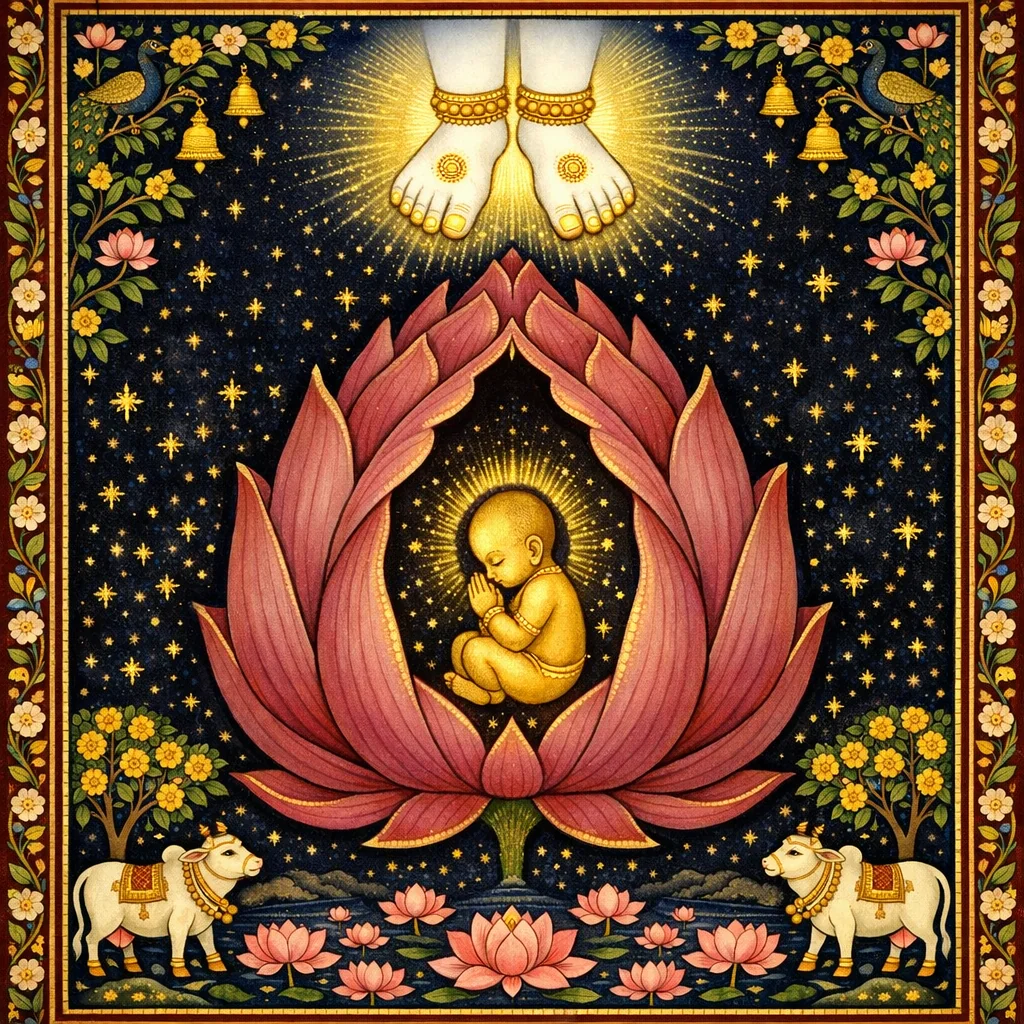
Adhyaya 31
The Lord’s Supervision of Embodiment: Fetal Development, Womb-Suffering, and the Jīva’s Prayer (Garbha-stuti) — and the Trap of Māyā
Continuing Lord Kapila’s sādhana-centered Sāṅkhya to Devahūti, this chapter traces the jīva’s entry into the womb under the Supreme Lord’s supervision and karmic allotment. It describes staged fetal development, the fetus’s severe suffering amid impurity and confinement, and the awakening of consciousness that recalls many prior births. Helpless, the embodied soul offers the womb-prayer (garbha-stuti), taking shelter of Viṣṇu’s lotus feet, acknowledging māyā’s binding power, and fearing the post-birth amnesia that renews false identification. Birth is then portrayed as a traumatic expulsion that erases memory; infancy and childhood proceed in distress, leading into ego, desire, anger, and fresh karmic entanglement. The chapter ends with sober warnings about sensual association—especially attachment that deepens bondage—and reframes birth and death as shifts of identification and perception rather than ultimate realities. It prepares Kapila’s next teaching: right vision, detachment, and bhakti to transcend repeated embodiment.
Shlokas
Verse 1
श्रीभगवानुवाच कर्मणा दैवनेत्रेण जन्तुर्देहोपपत्तये । स्त्रिया: प्रविष्ट उदरं पुंसो रेत:कणाश्रय: ॥ १ ॥
The Supreme Lord said: Under the Lord’s supervision and according to the results of one’s karma, the living soul enters a woman’s womb by taking shelter of a particle of the man’s semen, to assume a particular kind of body.
Verse 2
कललं त्वेकरात्रेण पञ्चरात्रेण बुद्बुदम् । दशाहेन तु कर्कन्धू: पेश्यण्डं वा तत: परम् ॥ २ ॥
On the first night, semen and ovum unite as kalala; by the fifth night it becomes like a bubble. By the tenth night it takes a plum-like form, and thereafter it gradually turns into a lump of flesh or an egg-like form, as is fitting.
Verse 3
मासेन तु शिरो द्वाभ्यां बाह्वङ्घ्र्याद्यङ्गविग्रह: । नखलोमास्थिचर्माणि लिङ्गच्छिद्रोद्भवस्त्रिभि: ॥ ३ ॥
Within a month the head is formed; by the end of two months the hands, feet, and other limbs take shape. By the end of three months appear the nails, fingers and toes, body hair, bones and skin, as well as the organ of generation and the bodily apertures—eyes, nostrils, ears, mouth, and anus.
Verse 4
चतुर्भिर्धातव: सप्त पञ्चभि: क्षुत्तृडुद्भव: । षड्भिर्जरायुणा वीत: कुक्षौ भ्राम्यति दक्षिणे ॥ ४ ॥
Within four months, the seven bodily constituents—chyle, blood, flesh, fat, bone, marrow, and semen—come into being. By five months, hunger and thirst are felt. By six months, the fetus, enclosed by the amnion, begins to move on the right side of the abdomen.
Verse 5
मातुर्जग्धान्नपानाद्यैरेधद्धातुरसम्मते । शेते विण्मूत्रयोर्गर्ते स जन्तुर्जन्तुसम्भवे ॥ ५ ॥
Drawing nourishment from the food and drink taken by the mother, the fetus grows, yet lies in that loathsome pit of stool and urine—the breeding ground of many kinds of worms.
Verse 6
कृमिभि: क्षतसर्वाङ्ग: सौकुमार्यात्प्रतिक्षणम् । मूर्च्छामाप्नोत्युरुक्लेशस्तत्रत्यै: क्षुधितैर्मुहु: ॥ ६ ॥
Bitten again and again over the whole body by the hungry worms within the womb, the child—so tender—endures dreadful agony, and in that terrible condition falls unconscious moment after moment.
Verse 7
कटुतीक्ष्णोष्णलवणरूक्षाम्लादिभिरुल्बणै: । मातृभुक्तैरुपस्पृष्ट: सर्वाङ्गोत्थितवेदन: ॥ ७ ॥
Because the mother eats foods that are bitter, pungent, overly hot, too salty, rough, or too sour, the child in the womb is continually afflicted with pains throughout the body, almost unbearable.
Verse 8
उल्बेन संवृतस्तस्मिन्नन्त्रैश्च बहिरावृत: । आस्ते कृत्वा शिर: कुक्षौ भुग्नपृष्ठशिरोधर: ॥ ८ ॥
Enclosed within the amnion and covered externally by the intestines, the child lies on one side within the womb, his head turned toward his belly, his back and neck arched like a bow.
Verse 9
अकल्प: स्वाङ्गचेष्टायां शकुन्त इव पञ्जरे । तत्र लब्धस्मृतिर्दैवात्कर्म जन्मशतोद्भवम् । स्मरन्दीर्घमनुच्छ्वासं शर्म किं नाम विन्दते ॥ ९ ॥
Unable to move his limbs, the child remains like a bird within a cage. If by providence he gains remembrance, he recalls the karmic sufferings of a hundred past births and laments with long, unbroken sighs; in such a state, what peace of mind could there be?
Verse 10
आरभ्य सप्तमान्मासाल्लब्धबोधोऽपि वेपित: । नैकत्रास्ते सूतिवातैर्विष्ठाभूरिव सोदर: ॥ १० ॥
Though consciousness develops from the seventh month, in the weeks before birth the child is driven downward by the airs that press upon the embryo. Like worms born in that same impure abdominal cavity, he cannot remain in one place.
Verse 11
नाथमान ऋषिर्भीत: सप्तवध्रि: कृताञ्जलि: । स्तुवीत तं विक्लवया वाचा येनोदरेऽर्पित: ॥ ११ ॥
Bound within seven coverings and gripped by fear, the living being seeks shelter; with folded hands he praises, in a trembling voice, the Lord who has placed him in that condition within the womb.
Verse 12
जन्तुरुवाच तस्योपसन्नमवितुं जगदिच्छयात्त- नानातनोर्भुवि चलच्चरणारविन्दम् । सोऽहं व्रजामि शरणं ह्यकुतोभयं मे येनेदृशी गतिरदर्श्यसतोऽनुरूपा ॥ १२ ॥
The soul says: I take shelter of the lotus feet of the Supreme Lord, who, by the will of the universe, appears in many eternal forms and walks upon the earth. He alone can free me from all fear, and from Him I have received this condition of life, befitting my impious deeds.
Verse 13
यस्त्वत्र बद्ध इव कर्मभिरावृतात्मा भूतेन्द्रियाशयमयीमवलम्ब्य मायाम् । आस्ते विशुद्धमविकारमखण्डबोधम् आतप्यमानहृदयेऽवसितं नमामि ॥ १३ ॥
Though I am a pure soul, I now appear bound by my deeds and, upheld by māyā made of elements, senses, and the mind’s abode, I lie within my mother’s womb. I bow to Him who is here with me yet untouched and changeless—unlimited, undivided consciousness—revealed within the repentant heart.
Verse 14
य: पञ्चभूतरचिते रहित: शरीरे च्छन्नोऽयथेन्द्रियगुणार्थचिदात्मकोऽहम् । तेनाविकुण्ठमहिमानमृषिं तमेनं वन्दे परं प्रकृतिपूरुषयो: पुमांसम् ॥ १४ ॥
Because I dwell in this body made of five elements, I seem cut off and veiled from my true self; though spiritual, my senses, qualities, and objects are misdirected. Therefore I offer obeisance to the Supreme Person—beyond material nature and all souls, free of any material body, ever glorious in His divine attributes.
Verse 15
यन्माययोरुगुणकर्मनिबन्धनेऽस्मिन् सांसारिके पथि चरंस्तदभिश्रमेण । नष्टस्मृति: पुनरयं प्रवृणीत लोकं युक्त्या कया महदनुग्रहमन्तरेण ॥ १५ ॥
Under the Lord’s māyā, the living being walks the worldly path of bondage to many qualities and karmas, struggling hard until he forgets his relationship with the Supreme Lord and again chooses this cycle of existence. Therefore, without the Lord’s great mercy, by what means can he return to the Lord’s transcendental loving service?
Verse 16
ज्ञानं यदेतददधात्कतम: स देवस् त्रैकालिकं स्थिरचरेष्वनुवर्तितांश: । तं जीवकर्मपदवीमनुवर्तमानास् तापत्रयोपशमनाय वयं भजेम ॥ १६ ॥
None but the Supreme Lord, as Paramātmā—present as His portion within all moving and unmoving beings—directs everything through past, present, and future. By His guidance the conditioned soul follows the path of karma. Therefore, to pacify the threefold miseries of this bound life, we must surrender to Him alone and worship Him alone.
Verse 17
देह्यन्यदेहविवरे जठराग्निनासृग्- विण्मूत्रकूपपतितो भृशतप्तदेह: । इच्छन्नितो विवसितुं गणयन्स्वमासान् निर्वास्यते कृपणधीर्भगवन्कदा नु ॥ १७ ॥
Fallen into a pit of blood, stool, and urine within the mother’s womb, his body scorched by the gastric fire, the embodied soul longs to come out, counts his months, and prays: “O Bhagavān, when shall I, poor and wretched, be released from this confinement?”
Verse 18
येनेदृशीं गतिमसौ दशमास्य ईश संग्राहित: पुरुदयेन भवादृशेन । स्वेनैव तुष्यतु कृतेन स दीननाथ: को नाम तत्प्रति विनाञ्जलिमस्य कुर्यात् ॥ १८ ॥
My Lord, by Your causeless mercy, though I am only ten months old, I have been awakened to consciousness. May You, the protector of the fallen, be pleased with this grace. I have no way to repay it except to pray with folded hands.
Verse 19
पश्यत्ययं धिषणया ननु सप्तवध्रि: शारीरके दमशरीर्यपर: स्वदेहे । यत्सृष्टयासं तमहं पुरुषं पुराणं पश्ये बहिर्हृदि च चैत्यमिव प्रतीतम् ॥ १९ ॥
In another kind of body, the living being sees only by instinct, knowing merely what is pleasing or displeasing to that body’s senses. But I have obtained a body in which I can restrain the senses and understand my true destination; therefore I offer reverent obeisances to the primeval Supreme Person, by whose blessing I received this body and by whose grace I can behold Him within the heart and also without.
Verse 20
सोऽहं वसन्नपि विभो बहुदु:खवासं गर्भान्न निर्जिगमिषे बहिरन्धकूपे । यत्रोपयातमुपसर्पति देवमाया मिथ्या मतिर्यदनु संसृतिचक्रमेतत् ॥ २० ॥
Therefore, O Lord, though I dwell in the womb amid terrible suffering, I do not wish to depart and fall again into the blind well of material life. For as soon as a child is born, Your external energy, deva-māyā, seizes him, and at once false identification arises—the beginning of the wheel of repeated birth and death.
Verse 21
तस्मादहं विगतविक्लव उद्धरिष्य आत्मानमाशु तमस: सुहृदात्मनैव । भूयो यथा व्यसनमेतदनेकरन्ध्रं मा मे भविष्यदुपसादितविष्णुपाद: ॥ २१ ॥
Therefore, no longer agitated, I shall quickly lift myself from the darkness of ignorance with the help of my friend—clear consciousness. By keeping the lotus feet of Lord Viṣṇu within my mind, I shall be saved from the misery of entering many wombs for repeated birth and death.
Verse 22
कपिल उवाच एवं कृतमतिर्गर्भे दशमास्य: स्तुवन्नृषि: । सद्य: क्षिपत्यवाचीनं प्रसूत्यै सूतिमारुत: ॥ २२ ॥
Lord Kapila said: Thus, even in the womb, the ten-month-old soul, resolved in mind, offers praise to the Lord; yet the wind that aids delivery at once thrusts him outward, face turned downward, so that he may be born.
Verse 23
तेनावसृष्ट: सहसा कृत्वावाक्शिर आतुर: । विनिष्क्रामति कृच्छ्रेण निरुच्छ्वासो हतस्मृति: ॥ २३ ॥
Suddenly driven downward by that wind, the child emerges with great difficulty, head first; nearly breathless, he is stripped of memory by intense agony.
Verse 24
पतितो भुव्यसृङ्मिश्र: विष्ठाभूरिव चेष्टते । रोरूयति गते ज्ञाने विपरीतां गतिं गत: ॥ २४ ॥
The child falls upon the ground, smeared with stool and blood, writhing like a worm born of filth. His higher knowledge vanishes, and under the sway of māyā he cries.
Verse 25
परच्छन्दं न विदुषा पुष्यमाणो जनेन स: । अनभिप्रेतमापन्न: प्रत्याख्यातुमनीश्वर: ॥ २५ ॥
After leaving the womb, the child is tended by people who cannot understand his wishes. Powerless to refuse what is given, he is drawn into circumstances he never sought.
Verse 26
शायितोऽशुचिपर्यङ्के जन्तु: स्वेदज-दूषिते । नेश: कण्डूयनेऽङ्गानामासनोत्थानचेष्टने ॥ २६ ॥
Laid upon a filthy bed, tainted by sweat and germs, the helpless child cannot even scratch his limbs to ease the itching—what to speak of sitting up, standing, or moving.
Verse 27
तुदन्त्यामत्वचं दंशा मशका मत्कुणादय: । रुदन्तं विगतज्ञानं कृमय: कृमिकं यथा ॥ २७ ॥
Helpless, the tender‑skinned infant is bitten by gnats, mosquitoes, bedbugs and other tiny creatures; bereft of discernment, he cries bitterly, as small worms bite a larger worm.
Verse 28
इत्येवं शैशवं भुक्त्वा दु:खं पौगण्डमेव च । अलब्धाभीप्सितोऽज्ञानादिद्धमन्यु: शुचार्पित: ॥ २८ ॥
Thus, having endured the miseries of infancy, he reaches boyhood; even then, failing to obtain what he longs for, he—out of ignorance—burns with anger and is pierced by sorrow.
Verse 29
सह देहेन मानेन वर्धमानेन मन्युना । करोति विग्रहं कामी कामिष्वन्ताय चात्मन: ॥ २९ ॥
As the body grows, so do false pride and swelling anger; driven by lust, the soul creates hostility toward others similarly lustful—bringing ruin upon itself.
Verse 30
भूतै: पञ्चभिरारब्धे देहे देह्यबुधोऽसकृत् । अहंममेत्यसद्ग्राह: करोति कुमतिर्मतिम् ॥ ३० ॥
In ignorance, the embodied soul takes the body—made of the five elements—to be the self, clinging to “I” and “mine”; thus it claims the impermanent as its own and sinks deeper into the darkness of delusion.
Verse 31
तदर्थं कुरुते कर्म यद्बद्धो याति संसृतिम् । योऽनुयाति ददत्क्लेशमविद्याकर्मबन्धन: ॥ ३१ ॥
For the sake of this body he performs actions, and bound by them he enters the course of saṁsāra; this body, fettered by ignorance and karma, follows him and continually brings distress.
Verse 32
यद्यसद्भि: पथि पुन: शिश्नोदरकृतोद्यमै: । आस्थितो रमते जन्तुस्तमो विशति पूर्ववत् ॥ ३२ ॥
If, therefore, the living entity again associates with the path of unrighteousness, influenced by sensually minded people engaged in the pursuit of sexual enjoyment and the gratification of the palate, he again goes to hell as before.
Verse 33
सत्यं शौचं दया मौनं बुद्धि: श्रीर्ह्रीर्यश: क्षमा । शमो दमो भगश्चेति यत्सङ्गाद्याति सङ्क्षयम् ॥ ३३ ॥
He becomes devoid of truthfulness, cleanliness, mercy, gravity, spiritual intelligence, shyness, austerity, fame, forgiveness, control of the mind, control of the senses, fortune and all such opportunities.
Verse 34
तेष्वशान्तेषु मूढेषु खण्डितात्मस्वसाधुषु । सङ्गं न कुर्याच्छोच्येषु योषित्क्रीडामृगेषु च ॥ ३४ ॥
One should not associate with a coarse fool who is bereft of the knowledge of self-realization and who is no more than a dancing dog in the hands of a woman.
Verse 35
न तथास्य भवेन्मोहो बन्धश्चान्यप्रसङ्गत: । योषित्सङ्गाद्यथा पुंसो यथा तत्सङ्गिसङ्गत: ॥ ३५ ॥
The infatuation and bondage which accrue to a man from attachment to any other object is not as complete as that resulting from attachment to a woman or to the fellowship of men who are fond of women.
Verse 36
प्रजापति: स्वां दुहितरं दृष्ट्वा तद्रूपधर्षित: । रोहिद्भूतां सोऽन्वधावदृक्षरूपी हतत्रप: ॥ ३६ ॥
At the sight of his own daughter, Brahmā was bewildered by her charms and shamelessly ran up to her in the form of a stag when she took the form of a hind.
Verse 37
तत्सृष्टसृष्टसृष्टेषु को न्वखण्डितधी: पुमान् । ऋषिं नारायणमृते योषिन्मय्येह मायया ॥ ३७ ॥
Among all beings born of Brahmā’s creation—men, demigods, and animals—none but the sage Nārāyaṇa remains of unbroken understanding; for here māyā, in the form of woman, enchants all.
Verse 38
बलं मे पश्य मायाया: स्त्रीमय्या जयिनो दिशाम् । या करोति पदाक्रान्तान्भ्रूविजृम्भेण केवलम् ॥ ३८ ॥
Behold the mighty power of My māyā in the form of woman: by the mere play of her eyebrows she can hold even the world’s greatest conquerors beneath her sway.
Verse 39
सङ्गं न कुर्यात्प्रमदासु जातु योगस्य पारं परमारुरुक्षु: । मत्सेवया प्रतिलब्धात्मलाभो वदन्ति या निरयद्वारमस्य ॥ ३९ ॥
One who longs to reach yoga’s highest end and, by serving Me, has gained true realization of the self should never associate with a seductive woman; scripture declares her the gateway to hell for the advancing devotee.
Verse 40
योपयाति शनैर्माया योषिद्देवविनिर्मिता । तामीक्षेतात्मनो मृत्युं तृणै: कूपमिवावृतम् ॥ ४० ॥
Woman, fashioned by the Lord, stands as the very emblem of māyā; one who associates with that māyā by accepting her services should know it to be the path of death—like a hidden well covered with grass.
Verse 41
यां मन्यते पतिं मोहान्मन्मायामृषभायतीम् । स्त्रीत्वं स्त्रीसङ्गत: प्राप्तो वित्तापत्यगृहप्रदम् ॥ ४१ ॥
A living being who, through attachment to a woman in a former life, has obtained a woman’s body, foolishly regards My māyā in the form of a man—her husband—as the supreme giver of wealth, children, home, and other worldly gains.
Verse 42
तामात्मनो विजानीयात्पत्यपत्यगृहात्मकम् । दैवोपसादितं मृत्युं मृगयोर्गायनं यथा ॥ ४२ ॥
Therefore a woman should know her husband, home, and children to be an arrangement of the Lord’s external energy leading her toward death—just as the hunter’s sweet song is death for the deer.
Verse 43
देहेन जीवभूतेन लोकाल्लोकमनुव्रजन् । भुञ्जान एव कर्माणि करोत्यविरतं पुमान् ॥ ४३ ॥
Because of his particular body, the materialistic living being wanders from world to world, following fruitive karma; thus, while tasting its results, he engages in action without cessation.
Verse 44
जीवो ह्यस्यानुगो देहो भूतेन्द्रियमनोमय: । तन्निरोधोऽस्य मरणमाविर्भावस्तु सम्भव: ॥ ४४ ॥
Thus the jīva attains a suitable body with a material mind and senses according to his karma. When the reaction of a particular action comes to an end, that is called death; when a new reaction begins, that is called birth.
Verse 45
द्रव्योपलब्धिस्थानस्य द्रव्येक्षायोग्यता यदा । तत्पञ्चत्वमहंमानादुत्पत्तिर्द्रव्यदर्शनम् ॥ ४५ ॥ यथाक्ष्णोर्द्रव्यावयवदर्शनायोग्यता यदा । तदैव चक्षुषो द्रष्टुर्द्रष्टृत्वायोग्यतानयो: ॥ ४६ ॥
When the body—the seat of perception—can no longer perceive objects, its dissolution into the five elements (pañcatva) is called death. And when, through false ego, one begins to see the body as ‘I myself,’ that arising of bodily identification is called birth.
Verse 46
द्रव्योपलब्धिस्थानस्य द्रव्येक्षायोग्यता यदा । तत्पञ्चत्वमहंमानादुत्पत्तिर्द्रव्यदर्शनम् ॥ ४५ ॥ यथाक्ष्णोर्द्रव्यावयवदर्शनायोग्यता यदा । तदैव चक्षुषो द्रष्टुर्द्रष्टृत्वायोग्यतानयो: ॥ ४६ ॥
Just as disease of the optic nerve can render the eyes unable to see color and form, dulling sight so that the jīva—the seer of both eye and vision—loses the power to see; similarly, when the body, the seat of perception, becomes incapable of perceiving, that is death, and when the notion arises, ‘this body is I,’ that is birth.
Verse 47
तस्मान्न कार्य: सन्त्रासो न कार्पण्यं न सम्भ्रम: । बुद्ध्वा जीवगतिं धीरो मुक्तसङ्गश्चरेदिह ॥ ४७ ॥
Therefore one should not fear death, nor mistake the body for the self, nor exaggerate bodily enjoyment. Knowing the true course of the jīva, the steadfast person should move through this world free from attachment.
Verse 48
सम्यग्दर्शनया बुद्ध्या योगवैराग्ययुक्तया । मायाविरचिते लोके चरेन्न्यस्य कलेवरम् ॥ ४८ ॥
With intelligence endowed with right vision, joined to yoga and detachment, one should, in this world fashioned by māyā, set the body aside by reason and live unconcerned and unattached.
Frequently Asked Questions
The garbha-stuti dramatizes that even in maximum constraint the jīva’s only secure refuge is Viṣṇu. The prayer shows (1) karma determines embodiment but under the Lord’s sanction, (2) knowledge can awaken even in suffering, and (3) the greatest danger is not pain but forgetfulness after birth, when deva-māyā triggers false ego and restarts saṁsāra. The chapter uses this to argue that surrender (śaraṇāgati) and remembrance (smaraṇa) are the essential protections.
It reframes death as the failure of the body’s perceptual apparatus and birth as the onset of misidentification—when one begins to view the physical body as the self. Thus, the core bondage is not merely biological change but ignorance (avidyā) and ahaṅkāra; liberation requires right vision supported by bhakti and detachment.
The chapter includes (a) the Lord’s authoritative statement on karmic entry into the womb, (b) Kapila’s didactic narration to Devahūti, and (c) the fetus’s first-person prayer. The shifts are pedagogical: Kapila frames doctrine, the Lord grounds it in sovereignty, and the jīva’s voice supplies experiential urgency—turning metaphysics into a call for surrender.
Within this teaching context, the warning targets the mechanism of bondage: uncontrolled saṅga inflames kāma, which drives karma, which compels further embodiment. The text presents “gateway to hell” language as a caution about māyā’s power to redirect the sādhaka from yoga’s culmination into identification, possessiveness, and repeated birth and death.