Adhyaya 24
Kapila’s Advent: Brahmā’s Confirmation, the Marriage of the Nine Daughters, and Kardama’s Renunciation
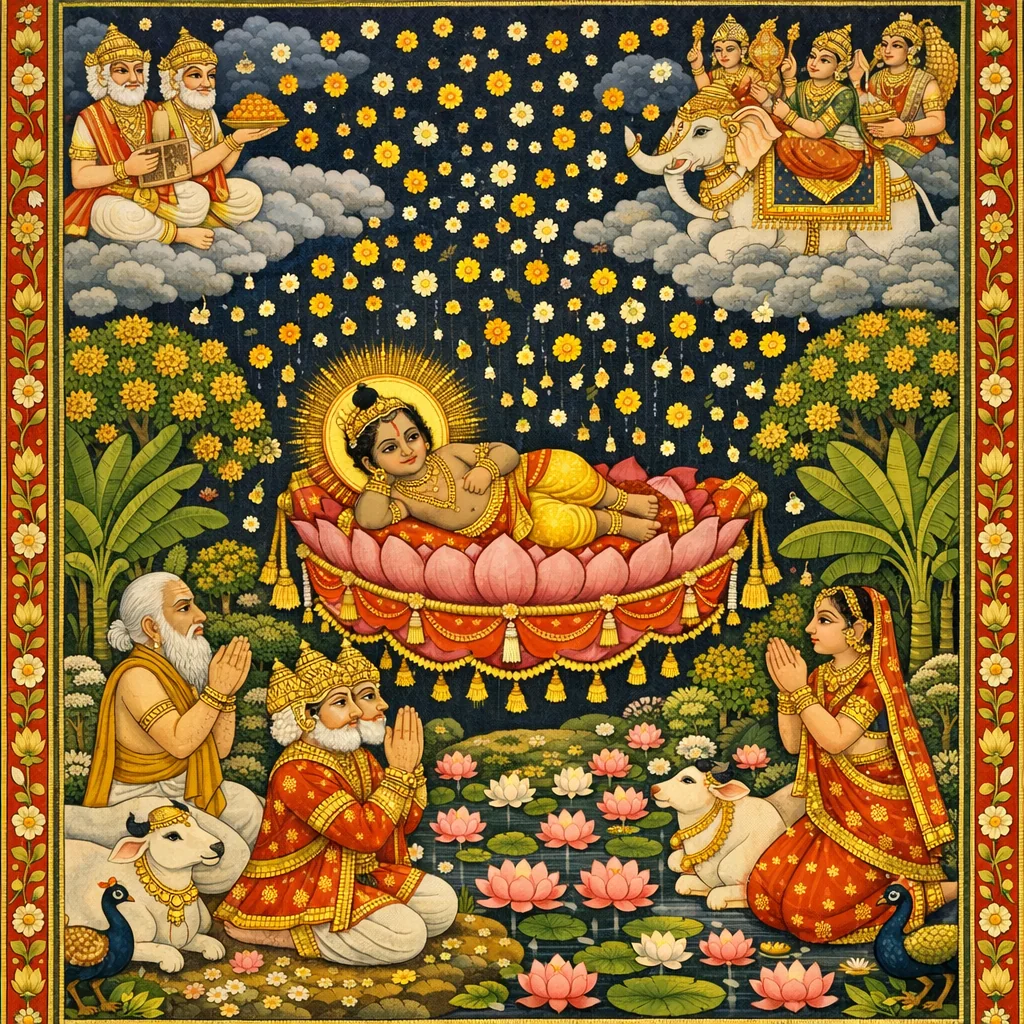
After Devahūti’s renunciant plea, Kardama consoles her with Viṣṇu’s promise that the Lord will enter her womb and cut the heart’s knot by teaching Brahma-jñāna. Devahūti worships steadily, and the Lord appears as Kapila amid celestial music, flowers, and auspicious signs. Brahmā arrives with sages, recognizes the avatāra’s purpose—reviving Sāṅkhya-yoga—and praises Kardama’s obedience to guru and paternal command. He instructs Kardama to marry his nine daughters to nine ṛṣis to expand prajā (lineages and population), linking household dharma with cosmic visarga. After Brahmā departs, Kardama completes the marriages and privately surrenders to the newborn Lord, glorifying His transcendental forms and supremacy over time and the guṇas. Kardama requests sannyāsa; Kapila grants it and declares His mission to teach the lost Sāṅkhya for liberation from material desire. Kardama leaves as a silent wandering mendicant, realizes the Paramātmā in all, and attains the path back to Godhead, preparing for Kapila’s forthcoming instruction to Devahūti.
Shlokas
Verse 1
मैत्रेय उवाच निर्वेदवादिनीमेवं मनोर्दुहितरं मुनि: । दयालु: शालिनीमाह शुक्लाभिव्याहृतं स्मरन् ॥ १ ॥
Maitreya said: Thus, remembering the words of Lord Viṣṇu, the compassionate sage Kardama replied as follows to Devahūti, Manu’s praiseworthy daughter, who was speaking in the mood of renunciation.
Verse 2
ऋषिरुवाच मा खिदो राजपुत्रीत्थमात्मानं प्रत्यनिन्दिते । भगवांस्तेऽक्षरो गर्भमदूरात्सम्प्रपत्स्यते ॥ २ ॥
The sage said: Do not be downcast, O princess; you are blameless and worthy of praise. The infallible Lord, Acyuta, will soon enter your womb as your son.
Verse 3
धृतव्रतासि भद्रं ते दमेन नियमेन च । तपोद्रविणदानैश्च श्रद्धया चेश्वरं भज ॥ ३ ॥
You have undertaken sacred vows; may auspiciousness be yours. Therefore worship the Lord with faith—through control of the senses, holy observances, austerity, and the charitable giving of your wealth.
Verse 4
स त्वयाराधित: शुक्लो वितन्वन्मामकंयश: । छेत्ता ते हृदयग्रन्थिमौदर्यो ब्रह्मभावन: ॥ ४ ॥
The supremely pure Lord, worshiped by you, will spread my fame; in His generosity He will come as your son, teach the knowledge of Brahman, and cut the knot within your heart.
Verse 5
मैत्रेय उवाच देवहूत्यपि संदेशं गौरवेण प्रजापते: । सम्यक् श्रद्धाय पुरुषं कूटस्थमभजद्गुरुम् ॥ ५ ॥
Śrī Maitreya said: Devahūti received the instruction of Prajāpati Kardama with reverence and firm faith, and thus began to worship the Supreme Puruṣa—the master of the universe—who abides within every heart.
Verse 6
तस्यां बहुतिथे काले भगवान्मधुसूदन: । कार्दमं वीर्यमापन्नो जज्ञेऽग्निरिव दारुणि ॥ ६ ॥
After many long years, the Supreme Lord, Madhusūdana, entered Kardama’s seminal potency and appeared within Devahūti, just as fire is brought forth from wood in sacrifice.
Verse 7
अवादयंस्तदा व्योम्नि वादित्राणि घनाघना: । गायन्ति तं स्म गन्धर्वा नृत्यन्त्यप्सरसो मुदा ॥ ७ ॥
At the time of His descent, the demigods—like rain-bearing clouds—sounded instruments in the sky; the Gandharvas sang the Lord’s glories, and the Apsarās danced in joyful rapture.
Verse 8
पेतु: सुमनसो दिव्या: खेचरैरपवर्जिता: । प्रसेदुश्च दिश: सर्वा अम्भांसि च मनांसि च ॥ ८ ॥
At the Lord’s appearance, the celestials who moved freely through the sky showered divine flowers. All directions, all waters, and the minds of all beings became serene and fully satisfied.
Verse 9
तत्कर्दमाश्रमपदं सरस्वत्या परिश्रितम् । स्वयम्भू: साकमृषिभिर्मरीच्यादिभिरभ्ययात् ॥ ९ ॥
Then Svayambhū Brahmā, accompanied by sages such as Marīci, went to Kardama’s hermitage, which was sheltered by the river Sarasvatī.
Verse 10
भगवन्तं परं ब्रह्म सत्त्वेनांशेन शत्रुहन् । तत्त्वसंख्यानविज्ञप्त्यै जातं विद्वानज: स्वराट् ॥ १० ॥
O slayer of the foe, the unborn Brahmā—nearly independent in attaining knowledge—understood that a portion of Bhagavān, the Supreme Brahman, had appeared in Devahūti’s womb in the mode of pure sattva, to expound the complete wisdom known as sāṅkhya-yoga.
Verse 11
सभाजयन् विशुद्धेन चेतसा तच्चिकीर्षितम् । प्रहृष्यमाणैरसुभि: कर्दमं चेदमभ्यधात् ॥ ११ ॥
Then Brahmā, with a purified heart and senses filled with joy, worshiped Bhagavān for the work He intended to perform as an avatāra, and spoke thus to Kardama (and Devahūti).
Verse 12
ब्रह्मोवाच त्वया मेऽपचितिस्तात कल्पिता निर्व्यलीकत: । यन्मे सञ्जगृहे वाक्यं भवान्मानद मानयन् ॥ १२ ॥
Lord Brahmā said: My dear son Kardama, you accepted my words without duplicity and with due reverence; thus you have properly honored me. Whatever instructions I gave, you carried out, and thereby you have shown me respect.
Verse 13
एतावत्येव शुश्रूषा कार्या पितरि पुत्रकै: । बाढमित्यनुमन्येत गौरवेण गुरोर्वच: ॥ १३ ॥
Sons should render service to their father only to this extent. One should obey the order of one’s father or spiritual master with reverence, saying, “Yes, sir.”
Verse 14
इमा दुहितर: सत्यस्तव वत्स सुमध्यमा: । सर्गमेतं प्रभावै: स्वैर्बृंहयिष्यन्त्यनेकधा ॥ १४ ॥
My dear son, your thin-waisted daughters are certainly chaste and virtuous. By their own descendants they will expand this creation in many ways.
Verse 15
अतस्त्वमृषिमुख्येभ्यो यथाशीलं यथारुचि । आत्मजा: परिदेह्यद्य विस्तृणीहि यशो भुवि ॥ १५ ॥
Therefore, today give your daughters to the foremost sages, according to each girl’s nature and preference, and thus spread your fame throughout the universe.
Verse 16
वेदाहमाद्यं पुरुषमवतीर्णं स्वमायया । भूतानां शेवधिं देहं बिभ्राणं कपिलं मुने ॥ १६ ॥
O Kardama, I know that the original Supreme Personality of Godhead has descended by His internal energy. He bestows what living beings desire, and He has now assumed the body of Kapila Muni.
Verse 17
ज्ञानविज्ञानयोगेन कर्मणामुद्धरन् जटा: । हिरण्यकेश: पद्माक्ष: पद्ममुद्रापदाम्बुज: ॥ १७ ॥
By mystic yoga and the practical application of scriptural knowledge, Kapila Muni—golden-haired, lotus-eyed, and bearing lotus marks upon His lotus feet—will uproot the deeply rooted desire for karmic work in this material world.
Verse 18
एष मानवि ते गर्भं प्रविष्ट: कैटभार्दन: । अविद्यासंशयग्रन्थिं छित्त्वा गां विचरिष्यति ॥ १८ ॥
O Devahūti, daughter of Manu, the Supreme Lord who slew the demon Kaiṭabha has now entered your womb. He will cut the knots of ignorance and doubt and then wander throughout the world.
Verse 19
अयं सिद्धगणाधीश: साङ्ख्याचार्यै: सुसम्मत: । लोके कपिल इत्याख्यां गन्ता ते कीर्तिवर्धन: ॥ १९ ॥
Your son will be the lord of the siddhas, the perfected souls. The ācāryas of Sāṅkhya will honor him, and in the world he will be famed as Kapila, increasing your glory.
Verse 20
मैत्रेय उवाच तावाश्वास्य जगत्स्रष्टा कुमारै: सहनारद: । हंसो हंसेन यानेन त्रिधामपरमं ययौ ॥ २० ॥
Śrī Maitreya said: Having thus reassured Kardama Muni and Devahūti, Brahmā, the creator of the universe—also known as Haṁsa—returned to the highest realm among the three planetary systems, riding his swan carrier with the four Kumāras and Nārada.
Verse 21
गते शतधृतौ क्षत्त: कर्दमस्तेन चोदित: । यथोदितं स्वदुहितृ: प्रादाद्विश्वसृजां तत: ॥ २१ ॥
O Vidura, after Śatadhṛti Brahmā departed, Kardama Muni, obeying his command, gave his nine daughters—exactly as instructed—to the nine great sages who would generate the world’s population.
Verse 22
मरीचये कलां प्रादादनसूयामथात्रये । श्रद्धामङ्गिरसेऽयच्छत्पुलस्त्याय हविर्भुवम् ॥ २२ ॥ पुलहाय गतिं युक्तां क्रतवे च क्रियां सतीम् । ख्यातिं च भृगवेऽयच्छद्वसिष्ठायाप्यरुन्धतीम् ॥ २३ ॥
Kardama Muni gave his daughter Kalā to Marīci, and Anasūyā to Atri. He gave Śraddhā to Aṅgirā, and Havirbhū to Pulastya. He gave Gati to Pulaha, the chaste Kriyā to Kratu, Khyāti to Bhṛgu, and Arundhatī to Vasiṣṭha.
Verse 23
मरीचये कलां प्रादादनसूयामथात्रये । श्रद्धामङ्गिरसेऽयच्छत्पुलस्त्याय हविर्भुवम् ॥ २२ ॥ पुलहाय गतिं युक्तां क्रतवे च क्रियां सतीम् । ख्यातिं च भृगवेऽयच्छद्वसिष्ठायाप्यरुन्धतीम् ॥ २३ ॥
Kardama Muni gave his daughter Kalā to Marīci, and Anasūyā to Atri. He entrusted Śraddhā to Aṅgirā and Havirbhū to Pulastya. He gave Gati to Pulaha, the chaste Kriyā to Kratu, Khyāti to Bhṛgu, and Arundhatī to Vasiṣṭha.
Verse 24
अथर्वणेऽददाच्छान्तिं यया यज्ञो वितन्यते । विप्रर्षभान् कृतोद्वाहान् सदारान् समलालयत् ॥ २४ ॥
He gave Śānti to Atharvā; by Śānti the sacrificial rites (yajña) are properly expanded and performed. Thus he arranged the marriages of the foremost brāhmaṇas and maintained them together with their wives.
Verse 25
ततस्त ऋषय: क्षत्त कृतदारा निमन्त्र्य तम् । प्रातिष्ठन्नन्दिमापन्ना: स्वं स्वमाश्रममण्डलम् ॥ २५ ॥
O Kṣattā (Vidura), thus married, the sages took leave of Kardama and departed in great joy, each returning to the circle of his own hermitage (āśrama).
Verse 26
स चावतीर्णं त्रियुगमाज्ञाय विबुधर्षभम् । विविक्त उपसङ्गम्य प्रणम्य समभाषत ॥ २६ ॥
When Kardama Muni understood that Triyuga—Viṣṇu, the foremost of all the demigods—had descended, he approached the Lord in a secluded place, offered obeisances, and spoke as follows.
Verse 27
अहो पापच्यमानानां निरये स्वैरमङ्गलै: । कालेन भूयसा नूनं प्रसीदन्तीह देवता: ॥ २७ ॥
Kardama Muni said: “Alas! After a long time, the demigods of this universe have surely become pleased with the suffering souls who, by their own misdeeds, are entangled in matter and burn in hellish misery.”
Verse 28
बहुजन्मविपक्वेन सम्यग्योगसमाधिना । द्रष्टुं यतन्ते यतय: शून्यागारेषु यत्पदम् ॥ २८ ॥
After many births of ripened practice, the disciplined yogīs, absorbed in perfect yoga-samādhi, strive in secluded places to behold the lotus feet of Bhagavān, the Supreme Personality of Godhead.
Verse 29
स एव भगवानद्य हेलनं नगणय्य न: । गृहेषु जातो ग्राम्याणां य: स्वानां पक्षपोषण: ॥ २९ ॥
Not counting the negligence of us ordinary householders, that very Bhagavān has appeared today in our home solely to nourish and protect His own devotees.
Verse 30
स्वीयं वाक्यमृतं कर्तुमवतीर्णोऽसि मे गृहे । चिकीर्षुर्भगवान् ज्ञानं भक्तानां मानवर्धन: ॥ ३० ॥
Kardama Muni said: O Lord, You who ever increase the honor of Your devotees have descended into my home to fulfill Your word and to spread the path of true knowledge.
Verse 31
तान्येव तेऽभिरूपाणि रूपाणि भगवंस्तव । यानि यानि च रोचन्ते स्वजनानामरूपिण: ॥ ३१ ॥
My Lord, though You have no material form, You possess innumerable forms of Your own; they are truly Your transcendental forms, pleasing to the hearts of Your devotees.
Verse 32
त्वां सूरिभिस्तत्त्वबुभुत्सयाद्धा सदाभिवादार्हणपादपीठम् । ऐश्वर्यवैराग्ययशोऽवबोध- वीर्यश्रिया पूर्तमहं प्रपद्ये ॥ ३२ ॥
My Lord, Your lotus feet ever deserve reverent homage and worship from the great sages who yearn to know the Absolute Truth. You are complete in opulence, renunciation, transcendental fame, knowledge, strength, and beauty; therefore I surrender unto Your lotus feet.
Verse 33
परं प्रधानं पुरुषं महान्तं कालं कविं त्रिवृतं लोकपालम् । आत्मानुभूत्यानुगतप्रपञ्चं स्वच्छन्दशक्तिं कपिलं प्रपद्ये ॥ ३३ ॥
I take shelter of Bhagavān Kapila, the Supreme Personality of Godhead—independently powerful and transcendental; the Supreme Puruṣa, Lord of pradhāna (the total material nature) and of time; the all-knowing maintainer of the worlds under the three guṇas, who after dissolution draws all manifestations back into Himself.
Verse 34
आ स्माभिपृच्छेऽद्य पतिं प्रजानां त्वयावतीर्णर्ण उताप्तकाम: । परिव्रजत्पदवीमास्थितोऽहं चरिष्ये त्वां हृदि युञ्जन् विशोक: ॥ ३४ ॥
O Lord of all beings, today I ask a boon of You. You have freed me from my debt to my father and fulfilled my desires; therefore I wish to take up the path of the wandering mendicant, renounce household life, and roam without lamentation, ever binding You within my heart.
Verse 35
श्री भगवानुवाच मया प्रोक्तं हि लोकस्य प्रमाणं सत्यलौकिके । अथाजनि मया तुभ्यं यदवोचमृतं मुने ॥ ३५ ॥
Bhagavān Kapila said: Whatever I speak—directly or through the scriptures—is in every way authoritative for the people of this world. O Muni, because I previously spoke the truth that I would become your son, I have now descended to fulfill that truth.
Verse 36
एतन्मे जन्म लोकेऽस्मिन्मुमुक्षूणां दुराशयात् । प्रसंख्यानाय तत्त्वानां सम्मतायात्मदर्शने ॥ ३६ ॥
My appearance in this world is especially to expound Sāṅkhya—the discerning analysis of the tattvas—honored for self-realization by those who seek freedom from the bondage of needless material desires.
Verse 37
एष आत्मपथोऽव्यक्तो नष्ट: कालेन भूयसा । तं प्रवर्तयितुं देहमिमं विद्धि मया भृतम् ॥ ३७ ॥
This path of self-realization—subtle and hard to grasp—has been lost in the long course of time. Know that I have assumed this body as Kapila to revive it and explain this philosophy again to human society.
Verse 38
गच्छ कामं मयापृष्टो मयि संन्यस्तकर्मणा । जित्वा सुदुर्जयं मृत्युममृतत्वाय मां भज ॥ ३८ ॥
Now, with My sanction, go as you desire, offering all your works unto Me. Conquer the death that is so hard to conquer, and worship Me with bhakti for immortality.
Verse 39
मामात्मानं स्वयंज्योति: सर्वभूतगुहाशयम् । आत्मन्येवात्मना वीक्ष्य विशोकोऽभयमृच्छसि ॥ ३९ ॥
Within your own heart, by your awakened intelligence, you will always behold Me—the self-effulgent Supreme Self dwelling in the heart-cave of all beings. Thus you will attain a state free from lamentation and fear.
Verse 40
मात्र आध्यात्मिकीं विद्यां शमनीं सर्वकर्मणाम् । वितरिष्ये यया चासौ भयं चातितरिष्यति ॥ ४० ॥
I shall also teach My mother this sublime spiritual knowledge, which pacifies all reactions of karma. By it she will attain perfection and self-realization, and thus cross beyond all material fear.
Verse 41
मैत्रेय उवाच एवं समुदितस्तेन कपिलेन प्रजापति: । दक्षिणीकृत्य तं प्रीतो वनमेव जगाम ह ॥ ४१ ॥
Śrī Maitreya said: Thus, having been fully instructed by his son Kapila, Prajāpati Kardama Muni, with a pleased and pacified mind, circumambulated Him in pradakṣiṇā and at once departed for the forest.
Verse 42
व्रतं स आस्थितो मौनमात्मैकशरणो मुनि: । नि:सङ्गो व्यचरत्क्षोणीमनग्निरनिकेतन: ॥ ४२ ॥
The sage Kardama accepted a vow of silence, taking exclusive shelter of the Supreme Lord and meditating upon Him alone. Free from all association, he wandered over the earth like a sannyāsī—without attachment to fire or to any dwelling.
Verse 43
मनो ब्रह्मणि युञ्जानो यत्तत्सदसत: परम् । गुणावभासे विगुण एकभक्त्यानुभाविते ॥ ४३ ॥
He fixed his mind upon Parabrahman, the Supreme Personality of Godhead—beyond cause and effect—who manifests the three modes of nature yet remains beyond them, and who is realized only by unwavering, exclusive devotion.
Verse 44
निरहंकृतिर्निर्ममश्च निर्द्वन्द्व: समदृक् स्वदृक् । प्रत्यक्प्रशान्तधीर्धीर: प्रशान्तोर्मिरिवोदधि: ॥ ४४ ॥
Thus he gradually became free from false ego and possessiveness. Undisturbed by duality, equal to all, he could truly see his own self. His intelligence turned inward and became perfectly calm, like an ocean without waves.
Verse 45
वासुदेवे भगवति सर्वज्ञे प्रत्यगात्मनि । परेण भक्तिभावेन लब्धात्मा मुक्तबन्धन: ॥ ४५ ॥
Thus, by the highest mood of devotion to Bhagavān Vāsudeva—the omniscient Supersoul within all—he became established in the self and was freed from all bondage.
Verse 46
आत्मानं सर्वभूतेषु भगवन्तमवस्थितम् । अपश्यत्सर्वभूतानि भगवत्यपि चात्मनि ॥ ४६ ॥
He began to see the Supreme Personality of Godhead seated within the heart of every being, and he saw that all beings exist upon Him and also within the self.
Verse 47
इच्छाद्वेषविहीनेन सर्वत्र समचेतसा । भगवद्भक्तियुक्तेन प्राप्ता भागवती गति: ॥ ४७ ॥
Freed from desire and hatred, equal-minded everywhere, and engaged in pure devotion to Bhagavān, Kardama Muni ultimately attained bhāgavatī gati—the path of returning to the Lord’s abode.
Frequently Asked Questions
This fulfills visarga (secondary creation): the Prajāpati household becomes a channel for expanding progeny and dharmic lineages through great ṛṣis. It also demonstrates that gṛhastha duties, when performed under higher instruction and without selfish motive, serve the Lord’s cosmic plan and do not obstruct liberation.
Kapila appears after entering Kardama’s semen and manifesting in Devahūti ‘like fire from sacrificial wood,’ while devas celebrate. The point is that the Lord’s descent is both intimate and sovereign: He enters material processes yet remains transcendental, appearing specifically to protect devotees and teach liberating knowledge.
Kardama understands his āśrama obligations are complete—he has followed Brahmā’s command, produced progeny, and ensured his daughters’ dharmic futures. Seeing the Lord personally, he seeks exclusive absorption (ananya-bhajana) and requests permission to renounce, showing that renunciation is proper when duties are fulfilled and the heart is fixed on Vāsudeva.
Kapila indicates that the authentic, self-realization-oriented Sāṅkhya (distinguishing ātmā from prakṛti and culminating in devotion to the indwelling Lord) becomes obscured when reduced to mere analysis or ritualistic aims. His avatāra restores the path as a practical ‘door to spiritual life’ leading to freedom from fear and karmic reactions.