Adhyaya 16
The Lord’s Apology to the Kumāras and the Fall of Jaya and Vijaya
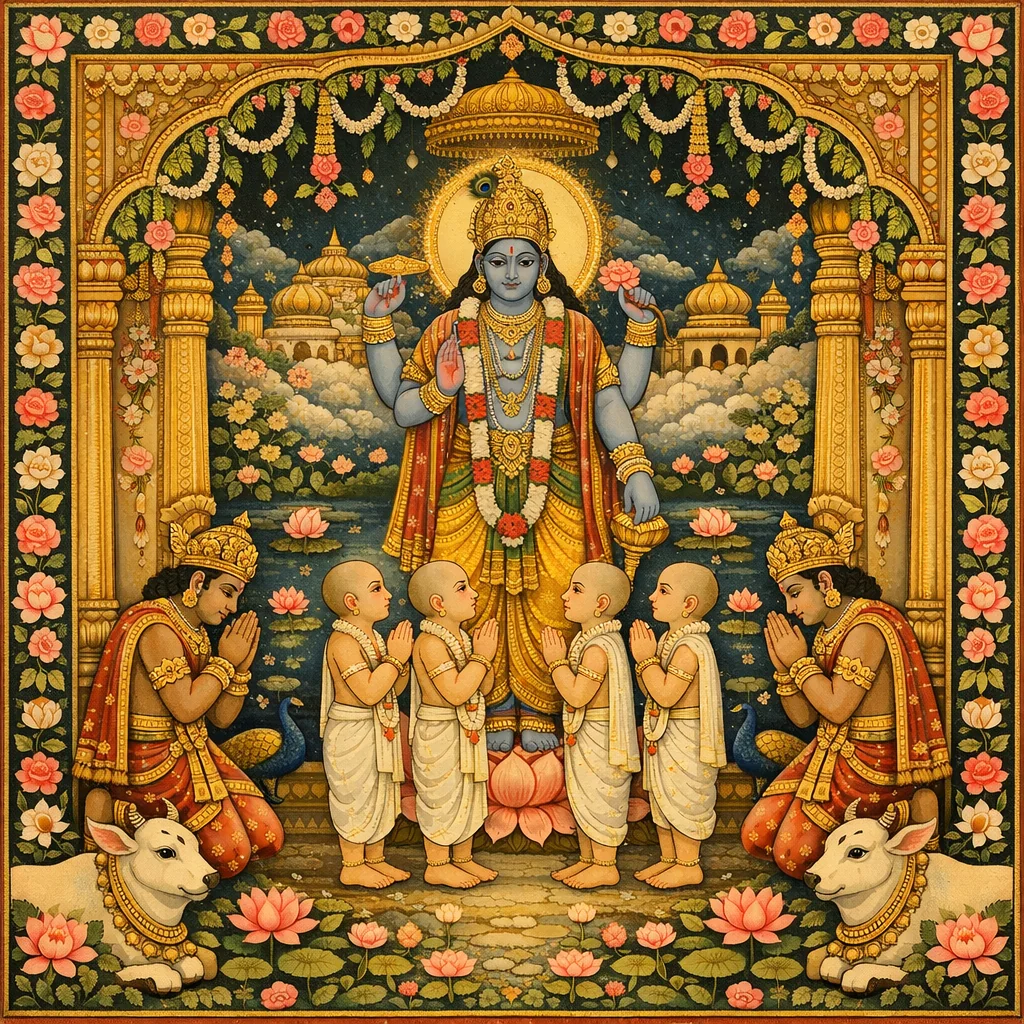
At Vaikuṇṭha’s gate, after the Four Kumāras curse the doorkeepers Jaya and Vijaya, Brahmā and the Supreme Lord appear to settle the crisis. The Lord accepts responsibility for His servants’ offense and seeks forgiveness, declaring brāhmaṇas, cows, and the defenseless to be integral to His own body. Revealing His bhakta-vātsalya, He values offerings to saintly brāhmaṇas above ritual oblations and honors the dust of Vaiṣṇava feet. The sages, first angered, are softened by His Vedic-like words yet cannot grasp His deeper purpose; they praise Him as the source and protector of dharma and submit to whatever outcome He ordains. The Lord explains the curse was sanctioned by Him: Jaya and Vijaya will take demoniac births but return swiftly through intense, anger-driven absorption in Him. As they leave Vaikuṇṭha, the demigods lament and Lakṣmī’s earlier foretelling is recalled. The narrative turns toward their incarnation in Diti’s womb as cosmic antagonists, setting the stage for coming divine interventions and the restoration of balance.
Shlokas
Verse 1
ब्रह्मोवाच इति तद् गृणतां तेषां मुनीनां योगधर्मिणाम् । प्रतिनन्द्य जगादेदं विकुण्ठनिलयो विभु: ॥ १ ॥
Brahma said: After commending the sages, steadfast in the dharma of yoga, for their words, the all-powerful Lord, who resides in Vaikuntha, spoke as follows.
Verse 2
श्रीभगवानुवाच एतौ तौ पार्षदौ मह्यं जयो विजय एव च । कदर्थीकृत्य मां यद्वो बह्वक्रातामतिक्रमम् ॥ २ ॥
The Supreme Lord said: These two are My attendants, Jaya and Vijaya; by disregarding Me, they have committed a great offense against you.
Verse 3
यस्त्वेतयोर्धृतो दण्डो भवद्भिर्मामनुव्रतै: । स एवानुमतोऽस्माभिर्मुनयो देवहेलनात् ॥ ३ ॥
O great sages devoted to Me, I approve the punishment you have meted out to them; because of their slight to the devas, it is sanctioned by Me as well.
Verse 4
तद्व: प्रसादयाम्यद्य ब्रह्म दैवं परं हि मे । तद्धीत्यात्मकृतं मन्ये यत्स्वपुम्भिरसत्कृता: ॥ ४ ॥
Today I seek your grace; to Me the brāhmaṇa is the highest and most beloved. The disrespect shown by My servants I regard as My own offense; therefore I beg your forgiveness for this incident.
Verse 5
यन्नामानि च गृह्णाति लोको भृत्ये कृतागसि । सोऽसाधुवादस्तत्कीर्तिं हन्ति त्वचमिवामय: ॥ ५ ॥
When a servant commits a wrong, people blame the master; such reproach destroys the master’s fame, as white leprosy taints the whole skin.
Verse 6
यस्यामृतामलयश:श्रवणावगाह: सद्य: पुनाति जगदाश्वपचाद्विकुण्ठ: । सोऽहं भवद्भय उपलब्धसुतीर्थकीर्ति- श्छिन्द्यां स्वबाहुमपि व: प्रतिकूलवृत्तिम् ॥ ६ ॥
Immersing the ear in hearing the nectar-pure glorification of My name and fame at once purifies the world, even a śvapaca caṇḍāla. Now you have realized Me without doubt; therefore, if even My own arm were to act against you, I would not hesitate to cut it off.
Verse 7
यत्सेवया चरणपद्मपवित्ररेणुं सद्य:क्षताखिलमलं प्रतिलब्धशीलम् । न श्रीर्विरक्तमपि मां विजहाति यस्या: प्रेक्षालवार्थ इतरे नियमान् वहन्ति ॥ ७ ॥
The Lord said: Because I am the servant of My devotees, the sacred dust of My lotus feet at once destroys all sinful impurity. By that service My nature has become such that Śrī Lakṣmī does not leave Me, even though I am unattached to her, whereas others praise her beauty and undertake vows and disciplines to gain from her even a slight favor.
Verse 8
नाहं तथाद्मि यजमानहविर्विताने श्च्योतद्घृतप्लुतमदन् हुतभुङ्मुखेन । यद्ब्राह्मणस्य मुखतश्चरतोऽनुघासं तुष्टस्य मय्यवहितैर्निजकर्मपाकै: ॥ ८ ॥
I do not relish the oblations that sacrificers pour, drenched in ghee, into the sacrificial fire—one of My own mouths—as much as I relish the delicious, ghee-rich morsels offered to the mouths of brāhmaṇas who have dedicated to Me the fruits of their work and who are ever content with My prasāda.
Verse 9
येषां बिभर्म्यहमखण्डविकुण्ठयोग- मायाविभूतिरमलाङ्घ्रि रज: किरीटै: । विप्रांस्तु को न विषहेत यदर्हणाम्भ: सद्य: पुनाति सहचन्द्रललामलोकान् ॥ ९ ॥
I am the master of My unobstructed internal potency, the yoga-māyā of Vaikuṇṭha, and the water of the Gaṅgā is the remnant after My feet are washed. That water instantly sanctifies the three worlds, and Śiva, crowned with the moon, bears it upon his head. If I Myself place the dust of a Vaiṣṇava’s feet upon My head like a diadem, who would refuse to do the same?
Verse 10
ये मे तनूर्द्विजवरान्दुहतीर्मदीया भूतान्यलब्धशरणानि च भेदबुद्ध्या । द्रक्ष्यन्त्यघक्षतदृशो ह्यहिमन्यवस्तान् गृध्रा रुषा मम कुषन्त्यधिदण्डनेतु: ॥ १० ॥
The brāhmaṇas, the cows, and all defenseless beings are My own body. Those whose vision is wounded by their sins see them as separate from Me through a mind of division. They are like enraged serpents, and Yamarāja’s vulturelike messengers—he who punishes the sinful—tear them apart in wrath with their beaks.
Verse 11
ये ब्राह्मणान्मयि धिया क्षिपतोऽर्चयन्त- स्तुष्यद्धृद: स्मितसुधोक्षितपद्मवक्त्रा: । वाण्यानुरागकलयात्मजवद् गृणन्त: सम्बोधयन्त्यहमिवाहमुपाहृतस्तै: ॥ ११ ॥
But those who captivate My heart are they who, seeing the brāhmaṇas as My very Self, honor them even when harsh words are spoken. Their hearts are gladdened, their lotus faces bright with nectarean smiles, and with loving speech they soothe the brāhmaṇas as a son would appease an angry father—so that it is as though they were pacifying Me Myself.
Verse 12
तन्मे स्वभर्तुरवसायमलक्षमाणौ युष्मद्वयतिक्रमगतिं प्रतिपद्य सद्य: । भूयो ममान्तिकमितां तदनुग्रहो मे यत्कल्पतामचिरतो भृतयोर्विवास: ॥ १२ ॥
These servants of Mine, not knowing their Master’s intent, have transgressed against you both. Therefore I shall count it as a grace shown to Me if you decree that, though they must taste the fruit of their offense, they may soon return to My presence and that their exile from My abode may end before long.
Verse 13
बह्मोवाच अथ तस्योशतीं देवीमृषिकुल्यां सरस्वतीम् । नास्वाद्य मन्युदष्टानां तेषामात्माप्यतृप्यत ॥ १३ ॥
Brahmā continued: Though the sages had been bitten by the serpent of anger, their souls were not satisfied, for they kept drinking in the Lord’s lovely, illuminating words, like an unbroken stream of Vedic hymns.
Verse 14
सतीं व्यादाय शृण्वन्तो लघ्वीं गुर्वर्थगह्वराम् । विगाह्यागाधगम्भीरां न विदुस्तच्चिकीर्षितम् ॥ १४ ॥
The Lord’s excellent speech seemed simple to hear, yet its import was weighty and unfathomably deep. The sages listened with ears wide open and pondered it, but even as they plunged into its profundity, they could not discern what He intended to do.
Verse 15
ते योगमाययारब्धपारमेष्ठ्यमहोदयम् । प्रोचु: प्राञ्जलयो विप्रा: प्रहृष्टा: क्षुभितत्वच: ॥ १५ ॥
The four brāhmaṇa sages were nonetheless overjoyed to behold Him, and a thrill ran through their bodies. Then, with palms joined, they spoke to the Lord, who by His inner potency, yoga-māyā, had revealed the manifold glories of the Supreme Person, as follows:
Verse 16
ऋषय ऊचु: न वयं भगवन् विद्मस्तव देव चिकीर्षितम् । कृतो मेऽनुग्रहश्चेति यदध्यक्ष: प्रभाषसे ॥ १६ ॥
The sages said: O Bhagavān, O Divine Lord, we cannot know what You intend. For though You are the supreme ruler of all, You speak in our favor, saying, “You have shown Me a kindness,” as if we had rendered some good to You.
Verse 17
ब्रह्मण्यस्य परं दैवं ब्राह्मणा: किल ते प्रभो । विप्राणां देवदेवानां भगवानात्मदैवतम् ॥ १७ ॥
O Lord, You are the supreme guardian of brahminical culture. By honoring the brāhmaṇas as foremost, You teach the world by Your own example. Truly, You alone are the highest worshipable Deity for the gods and for the brāhmaṇas as well.
Verse 18
त्वत्त: सनातनो धर्मो रक्ष्यते तनुभिस्तव । धर्मस्य परमो गुह्यो निर्विकारो भवान्मत: ॥ १८ ॥
From You arises the eternal dharma of all beings, and by Your many divine manifestations You have ever protected religion. You are the supreme, most confidential goal of all religious principles; in our view You are eternally inexhaustible and unchanging.
Verse 19
तरन्ति ह्यञ्जसा मृत्युं निवृत्ता यदनुग्रहात् । योगिन: स भवान् किंस्विदनुगृह्येत यत्परै: ॥ १९ ॥
By Your mercy, yogīs and transcendentalists, ceasing all material desires, easily cross beyond deathly nescience. Therefore it is impossible that the Supreme Lord could be favored by anyone else, for You are the very source of all grace.
Verse 20
यं वै विभूतिरुपयात्यनुवेलमन्यै- रर्थार्थिभि: स्वशिरसा धृतपादरेणु: । धन्यार्पिताङ्घ्रितुलसीनवदामधाम्नो लोकं मधुव्रतपतेरिव कामयाना ॥ २० ॥
Lakṣmī, the goddess of fortune—whose foot-dust other seekers of gain bear upon their heads—attends upon You at every appointed time. For she longs to gain a place in Your abode, where, like the king of bees, You hover over the fresh garland of tulasī offered at Your feet by a blessed devotee.
Verse 21
यस्तां विविक्तचरितैरनुवर्तमानां नात्याद्रियत्परमभागवतप्रसङ्ग: । स त्वं द्विजानुपथपुण्यरज: पुनीत: श्रीवत्सलक्ष्म किमगा भगभाजनस्त्वम् ॥ २१ ॥
O Lord, bearing the mark of Śrīvatsa and ever accompanied by Lakṣmī, You are deeply devoted to the association and deeds of Your pure bhāgavata devotees, yet You are never attached even to the goddesses of fortune who constantly serve You in transcendental love. How, then, could the sacred dust of the brāhmaṇas’ path purify You, and how could the Śrīvatsa emblem upon Your chest make You in any way more glorious or fortunate?
Verse 22
धर्मस्य ते भगवतस्त्रियुग त्रिभि: स्वै: पद्भिश्चराचरमिदं द्विजदेवतार्थम् । नूनं भृतं तदभिघाति रजस्तमश्च सत्त्वेन नो वरदया तनुवा निरस्य ॥ २२ ॥
O Bhagavān, You are dharma personified. In three yugas You manifest with Your three steps and protect this universe of moving and unmoving beings for the sake of the devas and the twice-born. By Your boon-giving grace, pure in sattva, please drive away rajas and tamas.
Verse 23
न त्वं द्विजोत्तमकुलं यदिहात्मगोपं गोप्ता वृष: स्वर्हणेन ससूनृतेन । तर्ह्येव नङ्क्ष्यति शिवस्तव देव पन्था लोकोऽग्रहीष्यदृषभस्य हितत्प्रमाणम् ॥ २३ ॥
O Lord, if You do not protect the highest line of the twice-born, who are under Your own guardianship, by accepting their worship and gentle words, then Your auspicious path of devotion will be cast aside. People in general, relying on Your authority, will abandon that way.
Verse 24
तत्तेऽनभीष्टमिव सत्त्वनिधेर्विधित्सो: क्षेमं जनाय निजशक्तिभिरुद्धृतारे: । नैतावता त्र्यधिपतेर्बत विश्वभर्तु- स्तेज: क्षतं त्ववनतस्य स ते विनोद: ॥ २४ ॥
Dear Lord, treasure-house of all goodness, desiring the welfare of all beings You remove the evil element by Your own mighty potency, though it may seem against Your wish. Yet You are the master of the three creations and the maintainer of the universe; Your splendor is not diminished by humility. Rather, by submission You reveal Your transcendental pastimes.
Verse 25
यं वानयोर्दममधीश भवान् विधत्ते वृत्तिं नु वा तदनुमन्महि निर्व्यलीकम् । अस्मासु वा य उचितो ध्रियतां स दण्डो येऽनागसौ वयमयुङ्क्ष्महि किल्बिषेण ॥ २५ ॥
O Lord, whatever punishment You wish to give to these two innocent persons—or even to us—we shall accept without duplicity. We understand that we have cursed those who were without fault.
Verse 26
श्रीभगवानुवाच एतौ सुरेतरगतिं प्रतिपद्य सद्य: संरम्भसम्भृतसमाध्यनुबद्धयोगौ । भूय: सकाशमुपयास्यत आशु यो व: शापो मयैव निमितस्तदवेत विप्रा: ॥ २६ ॥
The Lord replied: O brāhmaṇas, know that the punishment you placed upon them was ordained by Me from the beginning. Therefore they will at once fall into birth in an asura family; yet, through samādhi intensified by anger, their minds will remain firmly united with Me, and they will soon return to My presence.
Verse 27
ब्रह्मोवाच अथ ते मुनयो दृष्ट्वा नयनानन्दभाजनम् । वैकुण्ठं तदधिष्ठानं विकुण्ठं च स्वयंप्रभम् ॥ २७ ॥
Brahmā said: Having beheld the Lord of Vaikuṇṭha, the Supreme Personality of Godhead, in the self-effulgent realm of Vaikuṇṭha, the sages departed from that transcendental abode.
Verse 28
भगवन्तं परिक्रम्य प्रणिपत्यानुमान्य च । प्रतिजग्मु: प्रमुदिता: शंसन्तो वैष्णवीं श्रियम् ॥ २८ ॥
The sages circumambulated the Supreme Lord, offered respectful obeisances, and returned in great delight, praising the divine opulence of Vaiṣṇava glory.
Verse 29
भगवाननुगावाह यातं मा भैष्टमस्तु शम् । ब्रह्मतेज: समर्थोऽपि हन्तुं नेच्छे मतं तु मे ॥ २९ ॥
The Lord said to His attendants: Depart from here, but do not fear; may auspiciousness be yours. Though I can nullify the brāhmaṇas’ curse, I will not do so—rather, it has My approval.
Verse 30
एतत्पुरैव निर्दिष्टं रमया क्रुद्धया यदा । पुरापवारिता द्वारि विशन्ती मय्युपारते ॥ ३० ॥
This departure from Vaikuṇṭha was foretold by Ramā (Lakṣmī) in anger: when I was asleep, she left My abode and, upon returning, you stopped her at the gate.
Verse 31
मयि संरम्भयोगेन निस्तीर्य ब्रह्महेलनम् । प्रत्येष्यतं निकाशं मे कालेनाल्पीयसा पुन: ॥ ३१ ॥
By practicing yoga in anger, you will be cleansed of the offense of disregarding the brāhmaṇas, and within a very short time you will return again to Me.
Verse 32
द्वा:स्थावादिश्य भगवान् विमानश्रेणिभूषणम् । सर्वातिशयया लक्ष्म्या जुष्टं स्वं धिष्ण्यमाविशत् ॥ ३२ ॥
Thus, having spoken at the gate of Vaikuṇṭha, the Lord entered His own abode, adorned with rows of celestial vimānas and graced with Lakṣmī’s unsurpassed splendor and opulence.
Verse 33
तौ तु गीर्वाणऋषभौ दुस्तराद्धरिलोकत: । हतश्रियौ ब्रह्मशापादभूतां विगतस्मयौ ॥ ३३ ॥
But those two gatekeepers, the foremost among the celestials, lost their beauty and radiance by the brāhmaṇas’ curse; stripped of pride and filled with sorrow, they fell from Hari-loka, Vaikuṇṭha.
Verse 34
तदा विकुण्ठधिषणात्तयोर्निपतमानयो: । हाहाकारो महानासीद्विमानाग्र्येषु पुत्रका: ॥ ३४ ॥
Then, as Jaya and Vijaya fell from the Lord’s abode, a great cry of lamentation arose among all the demigods seated in their splendid vimānas.
Verse 35
तावेव ह्यधुना प्राप्तौ पार्षदप्रवरौ हरे: । दितेर्जठरनिर्विष्टं काश्यपं तेज उल्बणम् ॥ ३५ ॥
Brahmā continued: Those two foremost doorkeepers, the Lord Hari’s intimate attendants, have now entered Diti’s womb, being covered by the mighty, radiant seed of Kaśyapa Muni.
Verse 36
तयोरसुरयोरद्य तेजसा यमयोर्हि व: । आक्षिप्तं तेज एतर्हि भगवांस्तद्विधित्सति ॥ ३६ ॥
Today the prowess of those twin asuras has disturbed you, for it has diminished your power. Yet I have no remedy within my reach, because Bhagavān Himself desires to bring all this to pass.
Verse 37
विश्वस्य य: स्थितिलयोद्भवहेतुराद्यो योगेश्वरैरपि दुरत्यययोगमाय: । क्षेमं विधास्यति स नो भगवांस्त्र्यधीश- स्तत्रास्मदीयविमृशेन कियानिहार्थ: ॥ ३७ ॥
My sons, the Lord is the master of the three guṇas and the primal cause of the universe’s creation, maintenance, and dissolution. His wondrous yoga-māyā is difficult to fathom even for the greatest yogīs. That ancient Supreme Personality of Godhead alone will grant us safety—what service can we render by merely deliberating on this matter?
Frequently Asked Questions
Because the doorkeepers act as His representatives, their misconduct reflects upon the master, and the Lord models dharma by accepting moral accountability. In bhāgavata theology, humility before devotees and brāhmaṇas is not a limitation of God but a līlā that establishes the authority of saintly persons and protects the social-spiritual order (poṣaṇa). The Lord’s apology also reveals bhakta-vātsalya: He places the honor of His devotees above His own majesty.
The text presents the episode as divinely sanctioned (ordained by the Lord) and mediated by yoga-māyā, meaning it serves a purposeful līlā rather than indicating material contamination of Vaikuṇṭha. The sages’ anger functions as a catalyst within the Lord’s plan to manifest formidable opponents and thereby display protective incarnations and restore balance in the worlds. Thus, the “fall” is a controlled descent for cosmic narrative and theological instruction.
This chapter states they enter Diti’s womb through Kaśyapa’s seed, initiating their demoniac incarnations. The purpose is twofold: (1) to fulfill the curse approved by the Lord, preserving the inviolability of saintly words, and (2) to intensify their absorption in the Lord through hostility, enabling a swift return to His presence while also generating the cosmic antagonists necessary for the Lord’s protective līlās.
It prioritizes personalist devotion and saintly service over ritual formalism. Although the Lord is the ultimate enjoyer of sacrifice, He declares greater “relish” in offerings given to realized brāhmaṇas who dedicate results to Him, teaching that yajña reaches perfection when it culminates in bhakti, humility, and honoring the Lord’s devotees—an applied ethic that safeguards dharma in society.