Adhyaya 26
Naraka-varṇana: The Hellish Planets and the Karmic Logic of Punishment
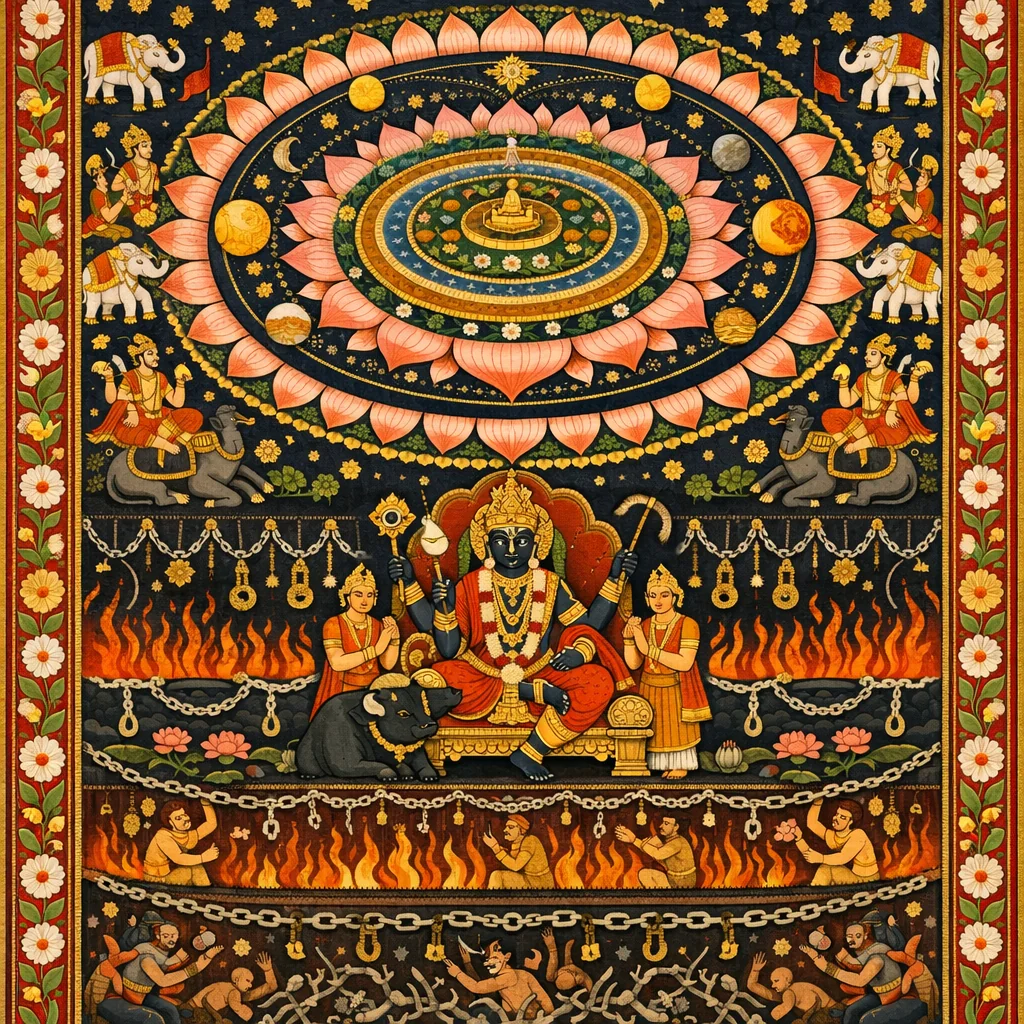
Continuing Canto 5’s cosmographic account (sthāna), Parīkṣit turns from planetary arrangement to moral causality, asking why jīvas enter diverse material conditions. Śukadeva answers by classifying action through the three guṇas—sattva, rajas, tamas—and teaches that one’s destination, heavenly or Naraka, follows the quality and intention of karma. Asked where Naraka lies, he places the hellish regions beneath Bhū-maṇḍala, above the Garbhodaka Ocean, near Pitṛloka, where Yamarāja administers justice through the Yamadūtas. The chapter names the principal hells (with totals varying by tradition) and, hell by hell, links sins—such as theft, adultery, violence, cruelty, false witness, abuse of power, disrespect, and perverse acts—to corresponding punishments, stressing proportional retribution and remembrance of wrongdoing. It concludes by turning from fear to remedy: hearing and teaching the virāṭ-rūpa description strengthens bhakti, supports samādhi, and leads from cosmic awareness toward realization of Kṛṣṇa’s spiritual form, closing the cosmology section and guiding the listener toward inner transformation.
Shlokas
Verse 1
राजोवाच महर्ष एतद्वैचित्र्यं लोकस्य कथमिति ॥ १ ॥
King Parīkṣit said: O great sage, how does this diversity of conditions among living beings arise? Kindly explain it to me.
Verse 2
ऋषिरुवाच त्रिगुणत्वात्कर्तु: श्रद्धया कर्मगतय: पृथग्विधा: सर्वा एव सर्वस्य तारतम्येन भवन्ति ॥ २ ॥
The sage said: O King, because the doer is conditioned by the three guṇas and acts according to his faith, the courses of karma are various; thus the results differ by degrees.
Verse 3
अथेदानीं प्रतिषिद्धलक्षणस्याधर्मस्य तथैव कर्तु: श्रद्धाया वैसादृश्यात्कर्मफलं विसदृशं भवति या ह्यनाद्यविद्यया कृतकामानां तत्परिणामलक्षणा: सृतय: सहस्रश: प्रवृत्तास्तासां प्राचुर्येणानुवर्णयिष्याम: ॥ ३ ॥
Now, even in forbidden irreligion (adharma), the fruit of karma becomes dissimilar according to the doer’s differing faith. Bound by desires through beginningless ignorance, beings have entered thousands of hellish paths; I shall describe them as far as I can.
Verse 4
राजोवाच नरका नाम भगवन्किं देशविशेषा अथवा बहिस्त्रिलोक्या आहोस्विदन्तराल इति ॥ ४ ॥
The King asked: O venerable lord, are the hells in some particular region, outside the three worlds, or in the intermediate space?
Verse 5
ऋषिरुवाच अन्तराल एव त्रिजगत्यास्तु दिशि दक्षिणस्यामधस्ताद्भूमेरुपरिष्टाच्च जलाद्यस्यामग्निष्वात्तादय: पितृगणा दिशि स्वानां गोत्राणां परमेण समाधिना सत्या एवाशिष आशासाना निवसन्ति ॥ ५ ॥
The sage replied: All hellish planets lie in the intermediate space between the three worlds and the Garbhodaka Ocean—on the universe’s southern side, beneath Bhū-maṇḍala and slightly above the Garbhodaka waters. Pitṛloka is also there; the Pitṛs, led by Agniṣvāttā, dwell in deep samādhi, meditating on the Supreme Personality of Godhead and ever desiring true blessings for their lineages.
Verse 6
यत्र ह वाव भगवान् पितृराजो वैवस्वत: स्वविषयं प्रापितेषु स्वपुरुषैर्जन्तुषु सम्परेतेषु यथाकर्मावद्यं दोषमेवानुल्लङ्घितभगवच्छासन: सगणो दमं धारयति ॥ ६ ॥
The King of the pitās is Yamarāja, the very powerful son of the sun-god. He resides in Pitṛloka with his personal assistants and, while abiding by the rules and regulations set down by the Supreme Lord, has his agents, the Yamadūtas, bring all the sinful men to him immediately upon their death. After bringing them within his jurisdiction, he properly judges them according to their specific sinful activities and sends them to one of the many hellish planets for suitable punishments.
Verse 7
तत्र हैके नरकानेकविंशतिं गणयन्ति अथ तांस्ते राजन्नामरूपलक्षणतोऽनुक्रमिष्यामस्तामिस्रोऽन्धतामिस्रो रौरवो महारौरव: कुम्भीपाक: कालसूत्रमसिपत्रवनं सूकरमुखमन्धकूप: कृमिभोजन: सन्दंशस्तप्तसूर्मिर्वज्रकण्टकशाल्मली वैतरणी पूयोद: प्राणरोधो विशसनं लालाभक्ष: सारमेयादनमवीचिरय:पानमिति । किञ्च क्षारकर्दमो रक्षोगणभोजन: शूलप्रोतो दन्दशूकोऽवटनिरोधन: पर्यावर्तन: सूचीमुखमित्यष्टाविंशतिर्नरका विविधयातनाभूमय: ॥ ७ ॥
Some authorities say that there is a total of twenty-one hellish planets, and some say twenty-eight. My dear King, I shall outline all of them according to their names, forms and symptoms. The names of the different hells are as follows: Tāmisra, Andhatāmisra, Raurava, Mahāraurava, Kumbhīpāka, Kālasūtra, Asipatravana, Sūkaramukha, Andhakūpa, Kṛmibhojana, Sandaṁśa, Taptasūrmi, Vajrakaṇṭaka-śālmalī, Vaitaraṇī, Pūyoda, Prāṇarodha, Viśasana, Lālābhakṣa, Sārameyādana, Avīci, Ayaḥpāna, Kṣārakardama, Rakṣogaṇa-bhojana, Śūlaprota, Dandaśūka, Avaṭa-nirodhana, Paryāvartana and Sūcīmukha. All these planets are meant for punishing the living entities.
Verse 8
तत्र यस्तु परवित्तापत्यकलत्राण्यपहरति स हि कालपाशबद्धो यमपुरुषैरतिभयानकैस्तामिस्रे नरके बलान्निपात्यते अनशनानुदपानदण्डताडनसन्तर्जनादिभिर्यातनाभिर्यात्यमानो जन्तुर्यत्र कश्मलमासादित एकदैव मूर्च्छामुपयाति तामिस्रप्राये ॥ ८ ॥
My dear King, a person who appropriates another’s legitimate wife, children or money is arrested at the time of death by the fierce Yamadūtas, who bind him with the rope of time and forcibly throw him into the hellish planet known as Tāmisra. On this very dark planet, the sinful man is chastised by the Yamadūtas, who beat and rebuke him. He is starved, and he is given no water to drink. Thus the wrathful assistants of Yamarāja cause him severe suffering, and sometimes he faints from their chastisement.
Verse 9
एवमेवान्धतामिस्रे यस्तु वञ्चयित्वा पुरुषं दारादीनुपयुङ्क्ते यत्र शरीरी निपात्यमानो यातनास्थो वेदनया नष्टमतिर्नष्टदृष्टिश्च भवति यथा वनस्पतिर्वृश्च्यमानमूलस्तस्मादन्धतामिस्रं तमुपदिशन्ति ॥ ९ ॥
The destination of a person who slyly cheats another man and enjoys his wife and children is the hell known as Andhatāmisra. There his condition is exactly like that of a tree being chopped at its roots. Even before reaching Andhatāmisra, the sinful living being is subjected to various extreme miseries. These afflictions are so severe that he loses his intelligence and sight. It is for this reason that learned sages call this hell Andhatāmisra.
Verse 10
यस्त्विह वा एतदहमिति ममेदमिति भूतद्रोहेण केवलं स्वकुटुम्बमेवानुदिनं प्रपुष्णाति स तदिह विहाय स्वयमेव तदशुभेन रौरवे निपतति ॥ १० ॥
A person who accepts his body as his self works very hard day and night for money to maintain his own body and the bodies of his wife and children. While working to maintain himself and his family, he may commit violence against other living entities. Such a person is forced to give up his body and his family at the time of death, when he suffers the reaction for his envy of other creatures by being thrown into the hell called Raurava.
Verse 11
ये त्विह यथैवामुना विहिंसिता जन्तव: परत्र यमयातनामुपगतं त एव रुरवो भूत्वा तथा तमेव विहिंसन्ति तस्माद्रौरवमित्याहू रुरुरिति सर्पादतिक्रूरसत्त्वस्यापदेश: ॥ ११ ॥
One who, in this world, out of envy commits violence against many living beings is, after death, taken by Yamarāja to hell. There, the very beings he injured appear as creatures called rurus and inflict upon him most terrible pain; therefore that hell is known as Raurava. The ruru, seldom seen in this world, is said to be more cruel and spiteful than a serpent.
Verse 12
एवमेव महारौरवो यत्र निपतितं पुरुषं क्रव्यादा नाम रुरवस्तं क्रव्येण घातयन्ति य: केवलं देहम्भर: ॥ १२ ॥
Likewise, the hell called Mahāraurava awaits one who maintains his own body by harming others. There, ruru beasts known as kravyāda torment him and devour his flesh.
Verse 13
यस्त्विह वा उग्र: पशून् पक्षिणो वा प्राणत उपरन्धयति तमपकरुणं पुरुषादैरपि विगर्हितममुत्र यमानुचरा: कुम्भीपाके तप्ततैले उपरन्धयन्ति ॥ १३ ॥
Cruel persons who, to maintain their bodies and gratify their tongues, cook poor animals and birds alive are condemned even by man-eaters. In the next life the Yamadūtas carry them to the hell called Kumbhīpāka, where they are cooked in boiling oil.
Verse 14
यस्त्विह ब्रह्मध्रुक स कालसूत्रसंज्ञके नरके अयुतयोजनपरिमण्डले ताम्रमये तप्तखले उपर्यधस्तादग्न्यर्काभ्यामतितप्यमानेऽभिनिवेशित: क्षुत्पिपासाभ्यां च दह्यमानान्तर्बहि:शरीर आस्ते शेते चेष्टतेऽवतिष्ठति परिधावति च यावन्ति पशुरोमाणि तावद्वर्षसहस्राणि ॥ १४ ॥
The killer of a brāhmaṇa is cast into the hell called Kālasūtra, a vast copper realm with a circumference of ayuta-yojanas. Heated from below by fire and from above by the scorching sun, its copper surface blazes. There he burns inwardly from hunger and thirst and outwardly from the heat of sun and fire; thus he sometimes lies down, sometimes sits, sometimes stands, and sometimes runs about. He must suffer in this way for thousands of years equal to the number of hairs on an animal’s body.
Verse 15
यस्त्विह वै निजवेदपथादनापद्यपगत: पाखण्डं चोपगतस्तमसिपत्रवनं प्रवेश्य कशया प्रहरन्ति तत्र हासावितस्ततो धावमान उभयतोधारैस्तालवनासिपत्रैश्छिद्यमानसर्वाङ्गो हा हतोऽस्मीति परमया वेदनया मूर्च्छित: पदे पदे निपतति स्वधर्महा पाखण्डानुगतं फलं भुङ्क्ते ॥ १५ ॥
If, without any emergency, a person abandons his own Vedic path and turns to heretical ways, the servants of Yamarāja thrust him into the hell called Asipatravana and lash him with whips. Fleeing in agony, he runs here and there, yet on every side palm trees with sword-sharp leaves cut his limbs. Wounded all over, crying, “Alas, I am slain!”, he faints from intense pain and falls at every step. Thus does the destroyer of his own dharma reap the fruit of hypocrisy.
Verse 16
यस्त्विह वै राजा राजपुरुषो वा अदण्ड्ये दण्डं प्रणयति ब्राह्मणे वा शरीरदण्डं स पापीयान्नरकेऽमुत्र सूकरमुखे निपतति तत्रातिबलैर्विनिष्पिष्यमाणावयवो यथैवेहेक्षुखण्ड आर्तस्वरेण स्वनयन् क्वचिन्मूर्च्छित: कश्मलमुपगतो यथैवेहादृष्टदोषा उपरुद्धा: ॥ १६ ॥
In his next life, a sinful king who punishes an innocent person is taken to the hell named Sūkaramukha, where he is crushed exactly as one crushes sugarcane.
Verse 17
यस्त्विह वै भूतानामीश्वरोपकल्पितवृत्तीनामविविक्तपरव्यथानां स्वयं पुरुषोपकल्पितवृत्तिर्विविक्तपरव्यथो व्यथामाचरति स परत्रान्धकूपे तदभिद्रोहेण निपतति तत्र हासौ तैर्जन्तुभि: पशुमृगपक्षिसरीसृपैर्मशकयूकामत्कुणमक्षिकादिभिर्ये के चाभिद्रुग्धास्तै: सर्वतोऽभिद्रुह्यमाणस्तमसि विहतनिद्रानिर्वृतिरलब्धावस्थान: परिक्रामति यथा कुशरीरे जीव: ॥ १७ ॥
The Supreme Lord punishes a man who torments insignificant creatures by putting him in Andhakūpa hell, where he is attacked by birds, beasts, and insects from all sides.
Verse 18
यस्त्विह वा असंविभज्याश्नाति यत्किञ्चनोपनतमनिर्मितपञ्चयज्ञो वायससंस्तुत: स परत्र कृमिभोजने नरकाधमे निपतति तत्र शतसहस्रयोजने कृमिकुण्डे कृमिभूत: स्वयं कृमिभिरेव भक्ष्यमाण: कृमिभोजनो यावत्तदप्रत्ताप्रहूतादोऽनिर्वेशमात्मानं यातयते ॥ १८ ॥
A person who eats without sharing with guests is no better than a crow. After death, he falls into Kṛmibhojana hell, becomes a worm, and feeds on other worms.
Verse 19
यस्त्विह वै स्तेयेन बलाद्वा हिरण्यरत्नादीनि ब्राह्मणस्य वापहरत्यन्यस्य वानापदि पुरुषस्तममुत्र राजन् यमपुरुषा अयस्मयैरग्निपिण्डै: सन्दंशैस्त्वचि निष्कुषन्ति ॥ १९ ॥
My dear King, a person who robs a brāhmaṇa or anyone else of gold is put into Sandaṁśa hell, where his skin is torn by red-hot iron tongs.
Verse 20
यस्त्विह वा अगम्यां स्त्रियमगम्यं वा पुरुषं योषिदभिगच्छति तावमुत्र कशया ताडयन्तस्तिग्मया सूर्म्या लोहमय्या पुरुषमालिङ्गयन्ति स्त्रियं च पुरुषरूपया सूर्म्या ॥ २० ॥
A man or woman who indulges in illicit sex is punished in Taptasūrmi hell. The man is forced to embrace a red-hot iron woman, and the woman a red-hot iron man.
Verse 21
यस्त्विह वै सर्वाभिगमस्तममुत्र निरये वर्तमानं वज्रकण्टकशाल्मलीमारोप्य निष्कर्षन्ति ॥ २१ ॥
A person who indulges in sex indiscriminately — even with animals — is taken after death to the hell known as Vajrakaṇṭaka-śālmalī. In this hell there is a silk-cotton tree full of thorns as strong as thunderbolts. The agents of Yamarāja hang the sinful man on that tree and pull him down forcibly so that the thorns very severely tear his body.
Verse 22
ये त्विह वै राजन्या राजपुरुषा वा अपाखण्डा धर्मसेतून् भिन्दन्ति ते सम्परेत्य वैतरण्यां निपतन्ति भिन्नमर्यादास्तस्यां निरयपरिखाभूतायां नद्यां यादोगणैरितस्ततो भक्ष्यमाणा आत्मना न वियुज्यमानाश्चासुभिरुह्यमाना: स्वाघेन कर्मपाकमनुस्मरन्तो विण्मूत्रपूयशोणितकेशनखास्थिमेदोमांसवसावाहिन्यामुपतप्यन्ते ॥ २२ ॥
A person who is born into a responsible family... but who neglects to execute his prescribed duties... falls down at the time of death into the river of hell known as Vaitaraṇī... full of stool, urine, pus, blood, hair, nails, bones, marrow, flesh and fat.
Verse 23
ये त्विह वै वृषलीपतयो नष्टशौचाचारनियमास्त्यक्तलज्जा: पशुचर्यां चरन्ति ते चापि प्रेत्य पूयविण्मूत्रश्लेष्ममलापूर्णार्णवे निपतन्ति तदेवातिबीभत्सितमश्नन्ति ॥ २३ ॥
The shameless husbands of lowborn śūdra women live exactly like animals... After death, such persons are thrown into the hell called Pūyoda, where they are put into an ocean filled with pus, stool, urine, mucus, saliva and similar things... and are forced to eat those disgusting things.
Verse 24
ये त्विह वै श्वगर्दभपतयो ब्राह्मणादयो मृगयाविहारा अतीर्थे च मृगान्निघ्नन्ति तानपि सम्परेताँल्लक्ष्यभूतान् यमपुरुषा इषुभिर्विध्यन्ति ॥ २४ ॥
If in this life a man of the higher classes... is very fond of taking his pet dogs, mules or asses into the forest to hunt and kill animals unnecessarily, he is placed after death into the hell known as Prāṇarodha. There the assistants of Yamarāja make him their targets and pierce him with arrows.
Verse 25
ये त्विह वै दाम्भिका दम्भयज्ञेषु पशून् विशसन्ति तानमुष्मिँल्लोके वैशसे नरके पतितान्निरयपतयो यातयित्वा विशसन्ति ॥ २५ ॥
A person who in this life is proud of his eminent position, and who heedlessly sacrifices animals simply for material prestige, is put into the hell called Viśasana after death. There the assistants of Yamarāja kill him after giving him unlimited pain.
Verse 26
यस्त्विह वै सवर्णां भार्यां द्विजो रेत: पाययति काममोहितस्तं पापकृतममुत्र रेत:कुल्यायां पातयित्वा रेत: सम्पाययन्ति ॥ २६ ॥
If a foolish member of the twice-born classes forces his wife to drink his semen out of a lusty desire to keep her under control, he is put after death into the hell known as Lālābhakṣa. There he is thrown into a flowing river of semen, which he is forced to drink.
Verse 27
ये त्विह वै दस्यवोऽग्निदा गरदा ग्रामान् सार्थान् वा विलुम्पन्ति राजानो राजभटा वा तांश्चापि हि परेत्य यमदूता वज्रदंष्ट्रा: श्वान: सप्तशतानि विंशतिश्च सरभसं खादन्ति ॥ २७ ॥
In this world, some persons are professional plunderers who set fire to others’ houses or administer poison to them. Also, members of the royalty or government officials sometimes plunder mercantile men. After death such demons are put into the hell known as Sārameyādana, where 720 dogs with teeth like thunderbolts devour them.
Verse 28
यस्त्विह वा अनृतं वदति साक्ष्ये द्रव्यविनिमये दाने वा कथञ्चित्स वै प्रेत्य नरकेऽवीचिमत्यध:शिरा निरवकाशे योजनशतोच्छ्रायाद् गिरिमूर्ध्न: सम्पात्यते यत्र जलमिव स्थलमश्मपृष्ठमवभासते तदवीचिमत्तिलशो विशीर्यमाणशरीरो न म्रियमाण: पुनरारोपितो निपतति ॥ २८ ॥
A person who bears false witness or lies while transacting business or giving charity is thrown headfirst into the hell known as Avīcimat from a mountain eight hundred miles high. Although his body is broken to tiny pieces on the stone floor, he does not die but continuously suffers.
Verse 29
यस्त्विह वै विप्रो राजन्यो वैश्यो वा सोमपीथस्तत्कलत्रं वा सुरां व्रतस्थोऽपि वा पिबति प्रमादतस्तेषां निरयं नीतानामुरसि पदाऽऽक्रम्यास्ये वह्निना द्रवमाणं कार्ष्णायसं निषिञ्चन्ति ॥ २९ ॥
Any brāhmaṇa who drinks liquor, or any kṣatriya or vaiśya who drinks soma-rasa, is taken to the hell known as Ayaḥpāna. There the agents of Yamarāja stand on their chests and pour hot melted iron into their mouths.
Verse 30
अथ च यस्त्विह वा आत्मसम्भावनेन स्वयमधमो जन्मतपोविद्याचारवर्णाश्रमवतो वरीयसो न बहु मन्येत स मृतक एव मृत्वा क्षारकर्दमे निरयेऽवाक्शिरा निपातितो दुरन्ता यातना ह्यश्नुते ॥ ३० ॥
A lowborn person who becomes falsely proud and fails to respect those more elevated by birth, austerity, or education is like a dead man even in this life. After death, he is thrown headfirst into the hell known as Kṣārakardama, where he suffers great tribulation.
Verse 31
ये त्विह वै पुरुषा: पुरुषमेधेन यजन्ते याश्च स्त्रियो नृपशून्खादन्ति तांश्च ते पशव इव निहता यमसदने यातयन्तो रक्षोगणा: सौनिका इव स्वधितिनावदायासृक्पिबन्ति नृत्यन्ति च गायन्ति च हृष्यमाणा यथेह पुरुषादा: ॥ ३१ ॥
There are men and women in this world who sacrifice human beings to Bhairava or Bhadra Kālī and then eat their victims’ flesh. Those who perform such sacrifices are taken after death to the abode of Yamarāja, where their victims, having taken the form of Rākṣasas, cut them to pieces with sharpened swords. Just as in this world the man-eaters drank their victims’ blood, dancing and singing in jubilation, their victims now enjoy drinking the blood of the sacrificers and celebrating in the same way.
Verse 32
ये त्विह वा अनागसोऽरण्ये ग्रामे वा वैश्रम्भकैरुपसृतानुपविश्रम्भय्य जिजीविषून् शूलसूत्रादिषूपप्रोतान्क्रीडनकतया यातयन्ति तेऽपि च प्रेत्य यमयातनासु शूलादिषु प्रोतात्मान: क्षुत्तृड्भ्यां चाभिहता: कङ्कवटादिभिश्चेतस्ततस्तिग्मतुण्डैराहन्यमाना आत्मशमलं स्मरन्ति ॥ ३२ ॥
In this life some people give shelter to animals and birds that come to them for protection in the village or forest, and after making them believe that they will be protected, such people pierce them with lances or threads and play with them like toys, giving them great pain. After death such people are brought by the assistants of Yamarāja to the hell known as Śūlaprota, where their bodies are pierced with sharp, needlelike lances. They suffer from hunger and thirst, and sharp-beaked birds such as vultures and herons come at them from all sides to tear at their bodies. Tortured and suffering, they can then remember the sinful activities they committed in the past.
Verse 33
ये त्विह वै भूतान्युद्वेजयन्ति नरा उल्बणस्वभावा यथा दन्दशूकास्तेऽपि प्रेत्य नरके दन्दशूकाख्ये निपतन्ति यत्र नृप दन्दशूका: पञ्चमुखा: सप्तमुखा उपसृत्य ग्रसन्ति यथा बिलेशयान् ॥ ३३ ॥
Those who in this life are like envious serpents, always angry and giving pain to other living entities, fall after death into the hell known as Dandaśūka. My dear King, in this hell there are serpents with five or seven hoods. These serpents eat such sinful persons just as snakes eat mice.
Verse 34
ये त्विह वा अन्धावटकुसूलगुहादिषु भूतानि निरुन्धन्ति तथामुत्र तेष्वेवोपवेश्य सगरेण वह्निना धूमेन निरुन्धन्ति ॥ ३४ ॥
Those who in this life confine other living entities in dark wells, granaries or mountain caves are put after death into the hell known as Avaṭa-nirodhana. There they themselves are pushed into dark wells, where poisonous fumes and smoke suffocate them and they suffer very severely.
Verse 35
यस्त्विह वा अतिथीनभ्यागतान् वा गृहपतिरसकृदुपगतमन्युर्दिधक्षुरिव पापेन चक्षुषा निरीक्षते तस्य चापि निरये पापदृष्टेरक्षिणी वज्रतुण्डा गृध्रा: कङ्ककाकवटादय: प्रसह्योरु- बलादुत्पाटयन्ति ॥ ३५ ॥
A householder who receives guests or visitors with cruel glances, as if to burn them to ashes, is put into the hell called Paryāvartana, where he is gazed at by hard-eyed vultures, herons, crows and similar birds, which suddenly swoop down and pluck out his eyes with great force.
Verse 36
यस्त्विह वा आढ्याभिमतिरहङ्कृतिस्तिर्यक्प्रेक्षण: सर्वतोऽभिविशङ्की अर्थव्ययनाशचिन्तया परिशुष्यमाणहृदयवदनो निर्वृतिमनवगतो ग्रह इवार्थमभिरक्षति स चापि प्रेत्य तदुत्पादनोत्कर्षणसंरक्षणशमलग्रह: सूचीमुखे नरके निपतति यत्र ह वित्तग्रहं पापपुरुषं धर्मराजपुरुषा वायका इव सर्वतोऽङ्गेषु सूत्रै: परिवयन्ति ॥ ३६ ॥
One who, in this world, is intoxicated with wealth and puffed up with pride—seeing with a crooked gaze, ever suspicious on all sides, fearing loss and even doubting his superiors—has his heart and face dried by anxiety over spending and ruin, and he clings to his riches like one seized by a demon. For the sins committed to gain, increase, and guard that wealth, after death he falls into the hell called Sūcīmukha, where Yamarāja’s servants punish him by passing thread through his whole body and stitching him, like weavers making cloth.
Verse 37
एवंविधा नरका यमालये सन्ति शतश: सहस्रशस्तेषु सर्वेषु च सर्व एवाधर्मवर्तिनो ये केचिदिहोदिता अनुदिताश्चावनिपते पर्यायेण विशन्ति तथैव धर्मानुवर्तिन इतरत्र इह तु पुनर्भवे त उभयशेषाभ्यां निविशन्ति ॥ ३७ ॥
In Yamarāja’s realm there are hundreds and thousands of such hells. All who live in irreligion—those I have mentioned and those I have not—enter them in turn according to the measure of their sin. Those who follow dharma go elsewhere, to the worlds of the devas; yet when the fruits of piety or impiety are exhausted, both return again to earth for another birth.
Verse 38
निवृत्तिलक्षणमार्ग आदावेव व्याख्यात: । एतावानेवाण्डकोशो यश्चतुर्दशधा पुराणेषु विकल्पित उपगीयते यत्तद्भगवतो नारायणस्य साक्षान्महापुरुषस्य स्थविष्ठं रूपमात्ममायागुणमयमनुवर्णितमादृत: पठति शृणोति श्रावयति स उपगेयं भगवत: परमात्मनोऽग्राह्यमपि श्रद्धाभक्तिविशुद्धबुद्धिर्वेद ॥ ३८ ॥
I have already explained, at the outset, the path of liberation marked by renunciation (nivṛtti). In the Purāṇas the vast universe—like an egg divided into fourteen regions—is sung of; it is regarded as the Lord Nārāyaṇa’s gross external form, the Mahāpuruṣa’s body, fashioned of His own energy (ātma-māyā) and the guṇas, and is known as the virāṭ-rūpa. One who, with deep faith, reads this description, hears it, or teaches it to others to spread bhāgavata-dharma, gradually increases in śraddhā and bhakti and in purified understanding; though difficult to grasp, by this process he becomes cleansed and slowly awakens to the Supreme Absolute Truth, the Paramātmā.
Verse 39
श्रुत्वा स्थूलं तथा सूक्ष्मं रूपं भगवतो यति: । स्थूले निर्जितमात्मानं शनै: सूक्ष्मं धिया नयेदिति ॥ ३९ ॥
Having heard of the Lord’s gross form and His subtle form, a yati who longs for liberation should first conquer the mind by meditation on the gross (virāṭ) form, and then, step by step, lead it by intelligence to the subtle, spiritual form. Thus the mind becomes established in samādhi, and by devotional service he realizes the Lord’s sac-cid-ānanda-vigraha, the goal of devotees.
Verse 40
भूद्वीपवर्षसरिदद्रिनभ:समुद्र- पातालदिङ्नरकभागणलोकसंस्था । गीता मया तव नृपाद्भुतमीश्वरस्य स्थूलं वपु: सकलजीवनिकायधाम ॥ ४० ॥ तस्मात् सङ्कीर्तनं विष्णोर्जगन्मङ्गलमंहसाम् । महतामपि कौरव्य विद्ध्यैकान्तिकनिष्कृतम् ॥ ३१ ॥
My dear King, I have described to you the earth and the other worlds—their regions, rivers and mountains—as well as the sky, the oceans, the lower realms, the directions, the hellish domains, and the stars. All of this is the wondrous expanse of the Lord’s gross virāṭ-vapu, the gigantic material form upon which the entire host of living beings rests.
Frequently Asked Questions
Śukadeva explains that embodied variety arises from karma shaped by the three guṇas. Actions performed in sattva tend toward dharma and relative happiness; rajas produces mixed results due to desire and attachment; tamas produces suffering because it drives ignorance, cruelty, and animal-like behavior. Moreover, the degree of awareness matters: accidental ignorance yields lighter reactions, deliberate wrongdoing with knowledge yields heavier reactions, and willful atheistic wrongdoing yields the most severe consequences.
Bhāgavatam 5.26 places Naraka regions in the intermediate space between the three worlds and the Garbhodaka Ocean, on the southern side of the universe, beneath Bhū-maṇḍala and slightly above the Garbhodaka waters. Pitṛloka is also in this region, and Yamarāja resides there to administer karmic justice through his agents.
The text acknowledges variant enumerations preserved by different authorities: some state 21 hells, others 28. Śukadeva proceeds to list 28 named hells in this chapter, indicating that the tradition preserves multiple counting schemes while agreeing on the core principle: graded punishments correspond to graded impiety.
The Yamadūtas are Yamarāja’s emissaries who seize sinful persons at death, bind them with the ‘rope of time,’ bring them to Yamarāja’s jurisdiction, and convey them to appropriate hellish regions for correctional punishment. Their function is administrative enforcement of the Supreme Lord’s karmic law, not random violence.
After describing Naraka, Śukadeva redirects the listener to purification: faithful hearing, teaching, and contemplation of the Lord’s virāṭ-rūpa increases devotion and steadies the mind. A seeker (yati) begins with the universal form to control the mind and then progresses to meditating on Kṛṣṇa’s spiritual form (sac-cid-ānanda-vigraha). Thus, the cosmic description becomes a ladder from external comprehension to internal bhakti and samādhi.