Adhyaya 2
The Lord’s Advent: Yoga-māyā’s Mission, Saṅkarṣaṇa’s Transfer, and the Demigods’ Prayers
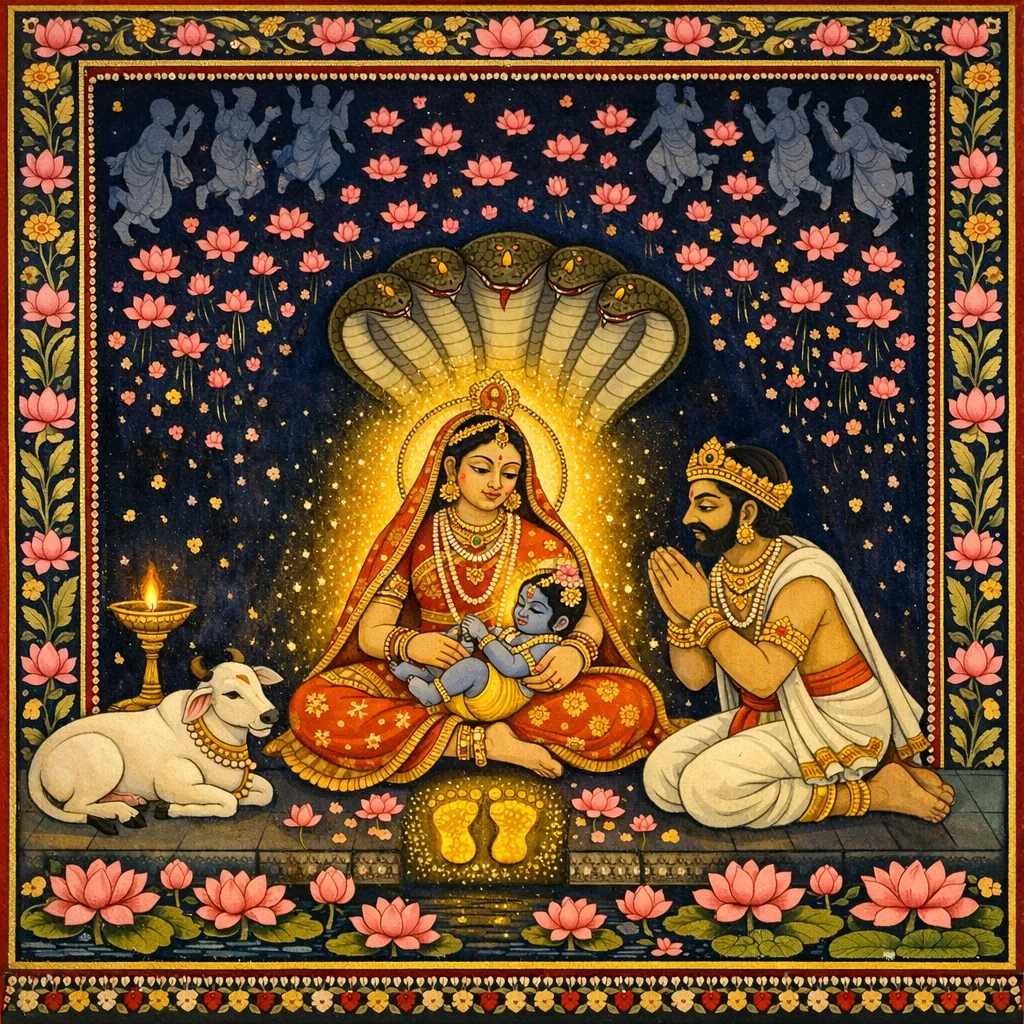
Sukadeva Gosvami narrates the terror in Mathura as Kamsa persecutes the Yadus. After Kamsa kills Devaki's first six sons, the seventh (Sankarshana) is mystically transferred by Yoga-maya to Rohini's womb in Vraja. The Supreme Lord then enters Vasudeva's heart and is transferred to Devaki, who becomes illuminated with divine radiance. Kamsa, alarmed yet restrained by his reputation, waits for the birth. Meanwhile, Brahma and the demigods offer profound prayers (Garbha-stuti) glorifying the Lord's absolute nature and the supreme power of bhakti.
Shlokas
Verse 1
श्रीशुक उवाच प्रलम्बबकचाणूरतृणावर्तमहाशनै: । मुष्टिकारिष्टद्विविदपूतनाकेशीधेनुकै: ॥ १ ॥ अन्यैश्चासुरभूपालैर्बाणभौमादिभिर्युत: । यदूनां कदनं चक्रे बली मागधसंश्रय: ॥ २ ॥
Śukadeva Gosvāmī said: Sheltered by Jarāsandha, the king of Magadha, the powerful Kaṁsa began to persecute the rulers of the Yadu dynasty, aided by demons such as Pralamba, Baka, Cāṇūra, Tṛṇāvarta, Aghāsura, Muṣṭika, Ariṣṭa, Dvivida, Pūtanā, Keśī, Dhenuka, Bāṇāsura, Narakāsura, and many other demoniac kings upon the earth.
Verse 2
श्रीशुक उवाच प्रलम्बबकचाणूरतृणावर्तमहाशनै: । मुष्टिकारिष्टद्विविदपूतनाकेशीधेनुकै: ॥ १ ॥ अन्यैश्चासुरभूपालैर्बाणभौमादिभिर्युत: । यदूनां कदनं चक्रे बली मागधसंश्रय: ॥ २ ॥
Śukadeva Gosvāmī said: Sheltered by Jarāsandha, the king of Magadha, the powerful Kaṁsa began to persecute the rulers of the Yadu dynasty, aided by demons such as Pralamba, Baka, Cāṇūra, Tṛṇāvarta, Aghāsura, Muṣṭika, Ariṣṭa, Dvivida, Pūtanā, Keśī, Dhenuka, Bāṇāsura, Narakāsura, and many other demoniac kings upon the earth.
Verse 3
ते पीडिता निविविशु: कुरुपञ्चालकेकयान् । शाल्वान् विदर्भान् निषधान् विदेहान् कोशलानपि ॥ ३ ॥
Persecuted by the demoniac kings, the Yādavas left their own realm and entered other lands, such as those of the Kurus, Pañcālas, Kekayas, Śālvas, Vidarbhas, Niṣadhas, Videhas, and Kośalas.
Verse 4
एके तमनुरुन्धाना ज्ञातय: पर्युपासते । हतेषु षट्सु बालेषु देवक्या औग्रसेनिना ॥ ४ ॥ सप्तमो वैष्णवं धाम यमनन्तं प्रचक्षते । गर्भो बभूव देवक्या हर्षशोकविवर्धन: ॥ ५ ॥
Some relatives followed Kaṁsa’s ways and entered his service. After Kaṁsa, son of Ugrasena, slew Devakī’s six sons, a plenary portion of Śrī Kṛṣṇa entered Devakī’s womb as the seventh child—praised by great sages as Ananta (Śeṣa), the Vaiṣṇava abode—thus increasing both her joy and her sorrow.
Verse 5
एके तमनुरुन्धाना ज्ञातय: पर्युपासते । हतेषु षट्सु बालेषु देवक्या औग्रसेनिना ॥ ४ ॥ सप्तमो वैष्णवं धाम यमनन्तं प्रचक्षते । गर्भो बभूव देवक्या हर्षशोकविवर्धन: ॥ ५ ॥
When Devakī’s six children were slain by Kaṁsa, the seventh pregnancy appeared in her womb, known as Ananta (Śeṣa), the Vaiṣṇava abode. That pregnancy increased in Devakī both joy and grief.
Verse 6
भगवानपि विश्वात्मा विदित्वा कंसजं भयम् । यदूनां निजनाथानां योगमायां समादिशत् ॥ ६ ॥
The Bhagavān, the Supreme Soul of all, knowing the fear arising from Kaṁsa, commanded Yoga-māyā to protect the Yadus, His own devotees.
Verse 7
गच्छ देवि व्रजं भद्रे गोपगोभिरलङ्कृतम् । रोहिणी वसुदेवस्य भार्यास्ते नन्दगोकुले । अन्याश्च कंससंविग्ना विवरेषु वसन्ति हि ॥ ७ ॥
The Lord instructed Yoga-māyā: “O auspicious Goddess, go to Vraja, adorned with gopas and gopīs. There, in Nanda’s Gokula, dwells Rohiṇī, the wife of Vasudeva; and other wives of Vasudeva also live there in hiding, fearful of Kaṁsa. Go there.”
Verse 8
देवक्या जठरे गभन शेषाख्यं धाम मामकम् । तत् सन्निकृष्य रोहिण्या उदरे सन्निवेशय ॥ ८ ॥
Within Devakī’s womb is My partial expansion known as Śeṣa. Bring Him from there and place Him into the womb of Rohiṇī without difficulty.
Verse 9
अथाहमंशभागेन देवक्या: पुत्रतां शुभे । प्राप्स्यामि त्वं यशोदायां नन्दपत्न्यां भविष्यसि ॥ ९ ॥
O all-auspicious Yoga-māyā, I shall appear as the son of Devakī with the fullness of My divine opulences, and you shall appear as the daughter of mother Yaśodā, queen of Mahārāja Nanda.
Verse 10
अर्चिष्यन्ति मनुष्यास्त्वां सर्वकामवरेश्वरीम् । धूपोपहारबलिभि: सर्वकामवरप्रदाम् ॥ १० ॥
Ordinary people will worship you splendidly with incense, offerings, and sacrifices—even animal rites—because you are revered as the supreme goddess who grants the fulfillment of all material desires.
Verse 11
नामधेयानि कुर्वन्ति स्थानानि च नरा भुवि । दुर्गेति भद्रकालीति विजया वैष्णवीति च ॥ ११ ॥ कुमुदा चण्डिका कृष्णा माधवी कन्यकेति च । माया नारायणीशानी शारदेत्यम्बिकेति च ॥ १२ ॥
In various places upon the earth, people will give you many names—Durgā, Bhadrakālī, Vijayā, Vaiṣṇavī; also Kumudā, Caṇḍikā, Kṛṣṇā, Mādhavī, Kanyakā, Māyā, Nārāyaṇī, Īśānī, Śāradā, and Ambikā.
Verse 12
नामधेयानि कुर्वन्ति स्थानानि च नरा भुवि । दुर्गेति भद्रकालीति विजया वैष्णवीति च ॥ ११ ॥ कुमुदा चण्डिका कृष्णा माधवी कन्यकेति च । माया नारायणीशानी शारदेत्यम्बिकेति च ॥ १२ ॥
In various places upon the earth, people will give you many names—Durgā, Bhadrakālī, Vijayā, Vaiṣṇavī; also Kumudā, Caṇḍikā, Kṛṣṇā, Mādhavī, Kanyakā, Māyā, Nārāyaṇī, Īśānī, Śāradā, and Ambikā.
Verse 13
गर्भसङ्कर्षणात् तं वै प्राहु: सङ्कर्षणं भुवि । रामेति लोकरमणाद् बलभद्रं बलोच्छ्रयात् ॥ १३ ॥
The son of Rohiṇī will be famed on earth as Saṅkarṣaṇa, for He was drawn from Devakī’s womb into Rohiṇī’s. He will be called Rāma because He delights the people of Gokula, and Balabhadra because of His vast bodily strength.
Verse 14
सन्दिष्टैवं भगवता तथेत्योमिति तद्वच: । प्रतिगृह्य परिक्रम्य गां गता तत् तथाकरोत् ॥ १४ ॥
Thus instructed by Bhagavān, Yoga-māyā at once assented, saying “So be it,” and confirmed it with the Vedic sound “om.” Accepting His command, she circumambulated the Lord and departed for Nanda-gokula on earth, where she carried out everything exactly as she had been told.
Verse 15
गर्भे प्रणीते देवक्या रोहिणीं योगनिद्रया । अहो विस्रंसितो गर्भ इति पौरा विचुक्रुशु: ॥ १५ ॥
When Yoga-nidrā (Yoga-māyā) drew Devakī’s child and transferred Him into the womb of Rohiṇī, Devakī appeared to have miscarried. Therefore the people of the palace cried out in lamentation, “Alas! Devakī has lost her child!”
Verse 16
भगवानपि विश्वात्मा भक्तानामभयङ्कर: । आविवेशांशभागेन मन आनकदुन्दुभे: ॥ १६ ॥
Then Bhagavān, the Supersoul of all beings and the remover of fear for His devotees, entered the mind of Ānakadundubhi (Vasudeva) with a portion of His full opulence.
Verse 17
स बिभ्रत् पौरुषं धाम भ्राजमानो यथा रवि: । दुरासदोऽतिदुर्धर्षो भूतानां सम्बभूव ह ॥ १७ ॥
Bearing within the core of his heart the form of Bhagavān, Vasudeva carried the Lord’s transcendently radiant effulgence and shone like the sun. Thus he became difficult to perceive or approach by the senses—unassailable even for Kaṁsa, indeed for all living beings.
Verse 18
ततो जगन्मङ्गलमच्युतांशंसमाहितं शूरसुतेन देवी । दधार सर्वात्मकमात्मभूतंकाष्ठा यथानन्दकरं मनस्त: ॥ १८ ॥
Thereafter, by Śūrasuta Vasudeva, the all-auspicious, fully opulent Bhagavān—Acyuta with His plenary expansions—was transferred from Vasudeva’s mind to Devakī’s mind. Thus initiated by Vasudeva, Devakī bore Śrī Kṛṣṇa within the core of her heart—He who is the original consciousness of all and the cause of all causes—and she became beautiful like the eastern horizon adorned by the rising moon.
Verse 19
सा देवकी सर्वजगन्निवास-निवासभूता नितरां न रेजे । भोजेन्द्रगेहेऽग्निशिखेव रुद्धासरस्वती ज्ञानखले यथा सती ॥ १९ ॥
Devakī bore within her womb the Supreme Personality of Godhead, the cause of all causes and the shelter of the entire cosmos; yet, confined in Kaṁsa’s house, she was like a flame hidden by the walls of a pot, or like Sarasvatī—possessing knowledge but unable to bestow it upon the world for its good.
Verse 20
तां वीक्ष्य कंस: प्रभयाजितान्तरांविरोचयन्तीं भवनं शुचिस्मिताम् । आहैष मे प्राणहरो हरिर्गुहांध्रुवं श्रितो यन्न पुरेयमीदृशी ॥ २० ॥
With the Supreme Lord within her womb, Devakī made her place of confinement shine with radiance. Seeing her joyful, pure, and gently smiling, Kaṁsa, struck within by fear, thought: “Surely Hari, Viṣṇu, has taken shelter in her womb; He will take my life, for Devakī has never before appeared so brilliant and jubilant.”
Verse 21
किमद्य तस्मिन् करणीयमाशु मेयदर्थतन्त्रो न विहन्ति विक्रमम् । स्त्रिया: स्वसुर्गुरुमत्या वधोऽयंयश: श्रियं हन्त्यनुकालमायु: ॥ २१ ॥
Kaṁsa thought: “What should I do now? The Supreme Lord, knowing His own purpose, will not abandon His prowess. Devakī is a woman—my sister—and she is now pregnant; if I kill her, my reputation, opulence, and span of life will surely be destroyed.”
Verse 22
स एष जीवन् खलु सम्परेतोवर्तेत योऽत्यन्तनृशंसितेन । देहे मृते तं मनुजा: शपन्तिगन्ता तमोऽन्धं तनुमानिनो ध्रुवम् ॥ २२ ॥
One who lives in extreme cruelty is considered dead even while alive; whether living or after death, people condemn him. And one who identifies the self with the body is surely carried after death to the hell called Andhatama.
Verse 23
इति घोरतमाद् भावात् सन्निवृत्त: स्वयं प्रभु: । आस्ते प्रतीक्षंस्तज्जन्म हरेर्वैरानुबन्धकृत् ॥ २३ ॥
Śukadeva Gosvāmī said: Thinking in this fearful way, Kaṁsa—though resolved to continue his enmity toward the Supreme Lord—refrained from the vicious killing of his sister. He decided to wait for Hari’s birth and then do what he deemed necessary.
Verse 24
आसीन: संविशंस्तिष्ठन् भुञ्जान: पर्यटन् महीम् । चिन्तयानो हृषीकेशमपश्यत् तन्मयं जगत् ॥ २४ ॥
Whether seated on his throne, lying on his bed, standing, or roaming the earth—while eating, sleeping, or walking—Kaṁsa saw only his enemy, the Supreme Lord Hṛṣīkeśa; to him the whole world appeared pervaded by Him.
Verse 25
ब्रह्मा भवश्च तत्रैत्य मुनिभिर्नारदादिभि: । देवै: सानुचरै: साकं गीर्भिर्वृषणमैडयन् ॥ २५ ॥
Brahmā and Śiva, accompanied by sages like Nārada and others, and by demigods such as Indra, Candra, and Varuṇa with their attendants, invisibly approached Devakī’s chamber and together offered obeisances and prayers to please the Supreme Personality of Godhead, the bestower of blessings upon all.
Verse 26
सत्यव्रतं सत्यपरं त्रिसत्यंसत्यस्य योनिं निहितं च सत्ये । सत्यस्य सत्यमृतसत्यनेत्रंसत्यात्मकं त्वां शरणं प्रपन्ना: ॥ २६ ॥
The demigods prayed: O Lord, You are steadfast in Your vow and devoted to truth; in the three phases—creation, maintenance, and dissolution—You are the Supreme Truth. You are the source of truth and established in truth. You are the truth of truth, with eyes of immortal truth, truth itself. We bow down and surrender to You—please grant us protection.
Verse 27
एकायनोऽसौ द्विफलस्त्रिमूल-श्चतूरस: पञ्चविध: षडात्मा । सप्तत्वगष्टविटपो नवाक्षोदशच्छदी द्विखगो ह्यादिवृक्ष: ॥ २७ ॥
This body may be likened to the “original tree”: one trunk, two fruits (enjoyment of happiness and suffering of distress), three roots (association with the three guṇas), four tastes (dharma, artha, kāma, mokṣa), five kinds (the knowledge-acquiring senses), six conditions (lamentation, illusion, old age, death, hunger, thirst), seven layers of bark (skin, blood, flesh, fat, bone, marrow, semen), eight branches (five elements plus mind, intelligence, false ego), nine hollows (eyes, ears, nostrils, mouth, anus, genitals), and ten leaves (the ten vital airs). In this tree dwell two birds: the individual soul and the Supersoul.
Verse 28
त्वमेक एवास्य सत: प्रसूति-स्त्वं सन्निधानं त्वमनुग्रहश्च । त्वन्मायया संवृतचेतसस्त्वांपश्यन्ति नाना न विपश्चितो ये ॥ २८ ॥
O Lord, You alone are the efficient cause of this material world, manifest in many varieties like the original tree; You are also its maintainer, and after annihilation everything is preserved within You. But those whose minds are covered by Your external māyā cannot see You behind this manifestation; that is not the vision of learned devotees.
Verse 29
बिभर्षि रूपाण्यवबोध आत्माक्षेमाय लोकस्य चराचरस्य । सत्त्वोपपन्नानि सुखावहानिसतामभद्राणि मुहु: खलानाम् ॥ २९ ॥
O Lord, ever perfect in knowledge, for the welfare of all beings—moving and unmoving—You assume many transcendental incarnations. These forms delight the saintly devotees, yet for the faithless they become again and again the power of destruction.
Verse 30
त्वय्यम्बुजाक्षाखिलसत्त्वधाम्निसमाधिनावेशितचेतसैके । त्वत्पादपोतेन महत्कृतेनकुर्वन्ति गोवत्सपदं भवाब्धिम् ॥ ३० ॥
O lotus-eyed Lord, refuge of all existence, one who in samādhi fixes the mind upon Your lotus feet and accepts those feet as the great boat shown by the mahājanas crosses the ocean of saṁsāra as easily as stepping over a calf’s hoofprint.
Verse 31
स्वयं समुत्तीर्य सुदुस्तरं द्युमन् भवार्णवं भीममदभ्रसौहृदा: । भवत्पदाम्भोरुहनावमत्र ते निधाय याता: सदनुग्रहो भवान् ॥ ३१ ॥
O Lord, radiant like the sun, the compassionate ācāryas have themselves crossed the fearsome, hard-to-cross ocean of saṁsāra and have left here the boat of Your lotus feet. Ever merciful, You accept that very method to aid Your other devotees.
Verse 32
येऽन्येऽरविन्दाक्ष विमुक्तमानिन- स्त्वय्यस्तभावादविशुद्धबुद्धय: । आरुह्य कृच्छ्रेण परं पदं तत: पतन्त्यधोऽनादृतयुष्मदङ्घ्रय: ॥ ३२ ॥
O lotus-eyed Lord, those who are not devoted may deem themselves liberated, yet their intelligence is impure for lack of bhāva toward You. Though by severe austerity they rise to the highest station, they fall down again because they disregard Your lotus feet.
Verse 33
तथा न ते माधव तावका: क्वचिद् भ्रश्यन्ति मार्गात्त्वयि बद्धसौहृदा: । त्वयाभिगुप्ता विचरन्ति निर्भया विनायकानीकपमूर्धसु प्रभो ॥ ३३ ॥
O Mādhava, even if devotees bound to You in love sometimes slip from the path of bhakti, they do not fall like nondevotees, for You still protect them. Sheltered by You, they move forward fearlessly, as if treading upon the heads of obstacles, and continue to advance in devotional service.
Verse 34
सत्त्वं विशुद्धं श्रयते भवान् स्थितौ शरीरिणां श्रेयउपायनं वपु: । वेदक्रियायोगतप:समाधिभि- स्तवार्हणं येन जन: समीहते ॥ ३४ ॥
O Lord, in the time of cosmic maintenance You take shelter of pure sattva and manifest a transcendental body, the very means of welfare for embodied beings. By Vedic rites, yoga, austerity, expiation, and finally samādhi, people strive to worship You according to Vedic principles.
Verse 35
सत्त्वं न चेद्धातरिदं निजं भवेद् विज्ञानमज्ञानभिदापमार्जनम् । गुणप्रकाशैरनुमीयते भवान् प्रकाशते यस्य च येन वा गुण: ॥ ३५ ॥
O Cause of all causes, if Your own being were not beyond the material guṇas, knowledge could not discern spirit from matter nor cleanse away ignorance. You are understood only by the radiance of Your qualities, for the guṇas shine by You and under Your sovereignty.
Verse 36
न नामरूपे गुणजन्मकर्मभि- र्निरूपितव्ये तव तस्य साक्षिण: । मनोवचोभ्यामनुमेयवर्त्मनो देव क्रियायां प्रतियन्त्यथापि हि ॥ ३६ ॥
O Lord, those who merely tread the path of mental and verbal speculation cannot ascertain Your name and form, nor Your qualities, births, and deeds, for You are the Witness of all. Yet You are truly known only through devotional service (bhakti).
Verse 37
शृण्वन् गृणन् संस्मरयंश्च चिन्तयन् नामानि रूपाणि च मङ्गलानि ते । क्रियासु यस्त्वच्चरणारविन्दयो- राविष्टचेता न भवाय कल्पते ॥ ३७ ॥
Even while engaged in many duties, devotees whose hearts are wholly absorbed in Your lotus feet—ever hearing, chanting, remembering, and contemplating Your auspicious names and forms—are not fit for bondage to worldly becoming.
Verse 38
दिष्टया हरेऽस्या भवत: पदो भुवो भारोऽपनीतस्तव जन्मनेशितु: । दिष्टयाङ्कितां त्वत्पदकै: सुशोभनै- र्द्रक्ष्याम गां द्यां च तवानुकम्पिताम् ॥ ३८ ॥
O Hari, we are blessed, for by Your birth the heavy burden of the asuras upon this earth is at once removed. Blessed indeed, for on earth and in the heavenly realms we shall behold the beautiful marks upon Your lotus feet—lotus, conchshell, club, and disc—adorning the worlds with Your mercy.
Verse 39
न तेऽभवस्येश भवस्य कारणं विना विनोदं बत तर्कयामहे । भवो निरोध: स्थितिरप्यविद्यया कृता यतस्त्वय्यभयाश्रयात्मनि ॥ ३९ ॥
O Supreme Lord, You do not take birth in this world like an ordinary being bound by the fruits of karma; Your appearance has no cause other than the delight of Your own līlā-śakti. Likewise, the living beings, who are Your parts, have no cause for miseries such as birth, death, and old age—except when they are led by Your external energy, māyā; You are the fearless shelter, the Paramātmā.
Verse 40
मत्स्याश्वकच्छपनृसिंहवराहहंस- राजन्यविप्रविबुधेषु कृतावतार: । त्वं पासि नस्त्रिभुवनं च यथाधुनेश भारं भुवो हर यदूत्तम वन्दनं ते ॥ ४० ॥
O supreme controller, You previously accepted incarnations as a fish, a horse, a tortoise, Narasiṁha, a boar, a swan, as a royal hero (Rāma), as a brāhmaṇa (Paraśurāma), and among the devas as Vāmana, and by Your mercy You protected the three worlds. Now also, O Lord, protect us by removing the earth’s burden and disturbances. O Kṛṣṇa, best of the Yadus, we offer You our reverent obeisances.
Verse 41
दिष्टयाम्ब ते कुक्षिगत: पर: पुमा- नंशेन साक्षाद् भगवान् भवाय न: । माभूद् भयं भोजपतेर्मुमूर्षो- र्गोप्ता यदूनां भविता तवात्मज: ॥ ४१ ॥
O mother Devakī, by your good fortune and ours, Bhagavān Himself—together with His plenary portions such as Baladeva—is now within your womb for our welfare. Therefore do not fear Kaṁsa, lord of the Bhojas, who is destined to be slain by the Lord. Your eternal son, Kṛṣṇa, will be the protector of the entire Yadu dynasty.
Verse 42
श्रीशुक उवाच इत्यभिष्टूय पुरुषं यद्रूपमनिदं यथा । ब्रह्मेशानौ पुरोधाय देवा: प्रतिययुर्दिवम् ॥ ४२ ॥
Śrī Śuka said: Having thus offered prayers to the Supreme Puruṣa, Lord Viṣṇu, in accordance with His true nature, all the devas—led by Brahmā and Śiva—returned to their own abodes in the heavenly realms.
Frequently Asked Questions
The transfer is a protective līlā arranged by Bhagavān through Yoga-māyā: it preserves the Lord’s associates from Kaṁsa’s violence, relocates Rohiṇī and the Yadu household into the safer Vraja setting, and establishes Baladeva’s identity as Saṅkarṣaṇa (“drawn/attracted and transferred”) while preparing the pastoral stage where Kṛṣṇa’s childhood līlā will unfold.
Kaṁsa’s constant absorption in the Lord is described as unfavorable remembrance (prātikūlya-smaraṇa): he sees Kṛṣṇa everywhere out of fear and hatred. The chapter uses this to show the Lord’s all-pervasiveness and the psychological force of meditation, while still distinguishing bhakti (favorable surrender) from hostile fixation.
Yoga-māyā is the Lord’s internal arrangement potency that facilitates līlā, concealment, and protection. Kṛṣṇa explains that people will worship her under many regional forms and names (e.g., Durgā, Bhadrakālī, Ambikā), often for material boons; the text distinguishes such desire-driven worship from devotion to Kṛṣṇa, while acknowledging her as worshipable as His śakti.
They affirm the Lord as the Supreme Truth across creation-maintenance-destruction, the antaryāmī behind material manifestation, and the only secure refuge. They emphasize that speculative or impersonal attempts at liberation without devotion are unstable, whereas bhakti—hearing, chanting, and remembrance of the Lord’s name, form, and feet—is the reliable boat across saṁsāra.