Adhyaya 8
रणभूमिवर्णनम् — Devāsuropama-yuddha and the ‘River’ Metaphor of the Battlefield
Upa-parva: Yuddha-varṇana (Caturaṅga-kṣaya-prakaraṇa) — Battlefield Description Unit
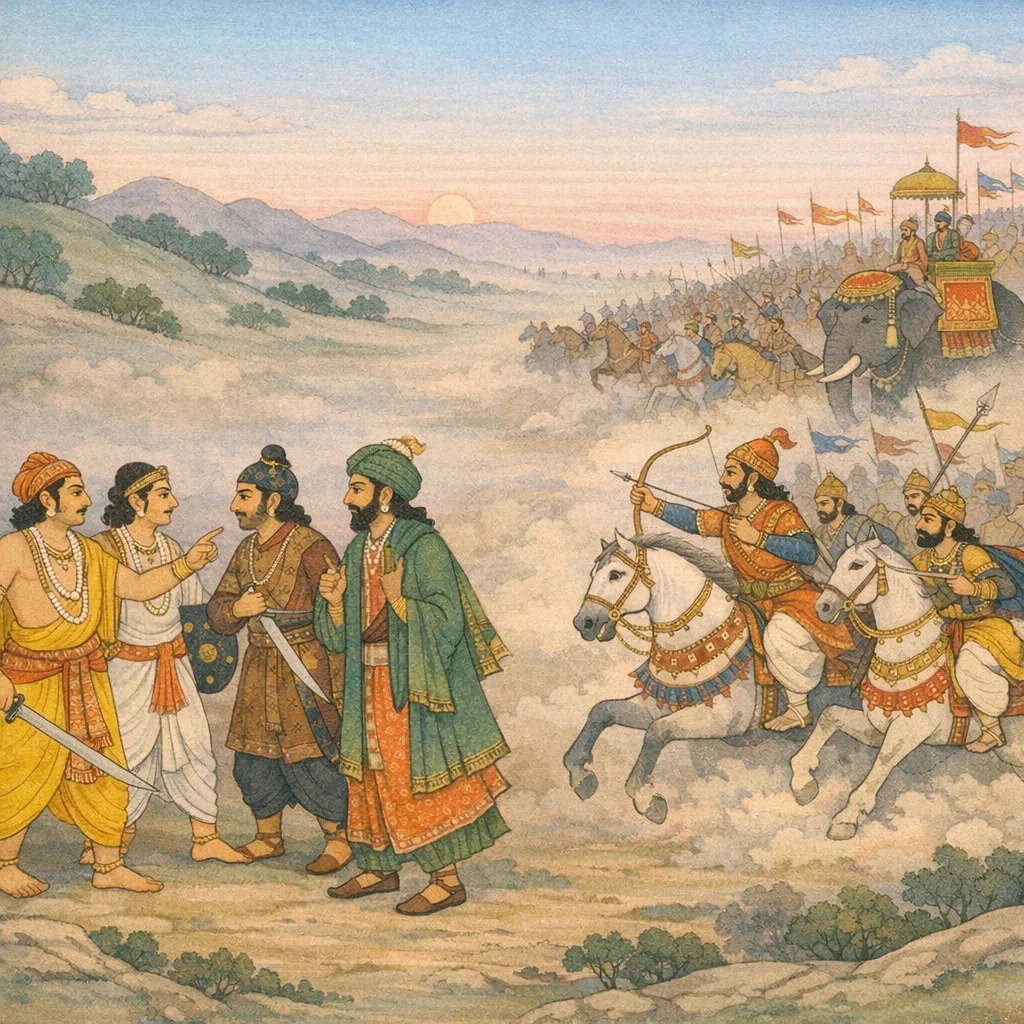
Saṃjaya describes the outbreak of a fear-amplifying engagement between Kurus and Sṛñjayas, characterized as devāsuropama. The chapter catalogs the convergence of infantry, chariots, elephants, and cavalry; depicts elephants trampling and scattering warriors; and notes skilled charioteers and horsemen dispatching opponents with volleys of arrows and close-quarters weapons (prāsa, śakti, ṛṣṭi). A prominent aesthetic strategy is sensory accumulation: hoofbeats, wheel-noise, conch and instrument blasts, and the indistinguishability of forms amid armor-glare. The narrative then intensifies into graphic battlefield imagery—severed limbs, falling heads, and the ground ‘ornamented’ by weapons and bodies—rendered through similes to fruit falling from palms and lotuses in season. The chapter culminates in an extended metaphor of a ‘river’ flowing on the battlefield, carrying combatants toward the world of ancestors, with banners as trees and bones as gravel. As the engagement becomes nirmaryāda (without bounds), Arjuna and Bhīmasena induce confusion in the opposing force, sound conches, and issue lion-roars; Dhṛṣṭadyumna and Śikhaṇḍin then surge forward with Dharmarāja, moving to confront Madrarāja Śalya, while the Kaurava host breaks and retreats in panic, abandoning kin in the rush for self-preservation.
Chapter Arc: रात्रि बीतते ही संजय धृतराष्ट्र को सुनाते हैं कि रणभूमि फिर जाग उठी—राजा (शल्य) के अभिप्राय को जानकर दोनों पक्षों की शेष सेनाएँ युद्ध के लिए सज-धज कर मैदान में उतरने लगीं। → रथों की सजावट, पैदल-दलों की पंक्तियाँ, और वाद्यों की गम्भीर ध्वनि से दिशाएँ भर जाती हैं। भीष्म, द्रोण और कर्ण के वध के बाद कौरव-पुत्रों में यह नई आशा उभरती है कि शल्य के नेतृत्व में अब विजय सम्भव है; उधर पाण्डव-पक्ष भी निर्णायक प्रहार के लिए अग्रसर होता है। → नकुल-सहदेव अपनी-अपनी सेनाओं सहित शत्रु-प्रधानों शकुनि और उलूक के सम्मुख आकर मोर्चा बाँधते हैं; साथ ही धृष्टद्युम्न, शिखण्डी और सात्यकि शल्य की वाहिनी को कुचलने के लिए वेग से धावा बोलते हैं—दोनों ओर ‘परस्पर वध की इच्छा’ से भोर की संध्या में सेनाएँ टकराने को तत्पर हो जाती हैं। → अध्याय का अंत व्यापक युद्ध-वर्णन की भूमिका के रूप में होता है—संजय धृतराष्ट्र से कहते हैं कि स्थिर होकर सुनें, क्योंकि जहाँ हाथी-घोड़े-मनुष्यों का महान संहार हुआ, उसी संग्राम का क्रम वे आगे बताएँगे; सेनाएँ आमने-सामने आ चुकी हैं और आक्रमण आरम्भ हो गया है। → शल्य की सेना पर धृष्टद्युम्न-शिखण्डी-सात्यकि का धावा पड़ चुका है—अब अगले क्षणों में कौन-सा महाद्वंद्व फूटेगा और किसकी पंक्ति टूटेगी?
Shlokas
Verse 1
ऑपन--माज बछ। ऊँ ्स:-आ अष्टमो> ध्याय: उभयपक्षकी सेनाओंका समरांगणमें उपस्थित होना एवं बची हुई दोनों सेनाओंकी संख्याका वर्णन संजय उवाच व्यतीतायां रजन्यां तु राजा दुर्योधनस्तदा । अब्रवीत् तावकान् सर्वान् संनहान्तां महारथा:,संजय कहते हैं--जब रात व्यतीत हो गयी, तब राजा दुर्योधनने आपके समस्त सैनिकोंसे कहा--“महारथीगण कवच बाँधकर युद्धके लिये तैयार हो जाय
Sañjaya said: When the night had passed, King Duryodhana then addressed all your warriors, saying, “Let the great chariot-fighters arm themselves and make ready for battle.” The verse frames the renewed resolve to continue a destructive conflict, highlighting how leadership commands and collective obedience propel war forward despite its moral cost.
Verse 2
राज्ञश्न मतमाज्ञाय समनहात सा चमू: । अयोजयमन् रथांस्तूर्ण पर्यधावंस्तथा परे,राजाका यह अभिप्राय जानकर सारी सेना युद्धके लिये सुसज्जित होने लगी। कुछ लोगोंने तुरंत ही रथ जोत दिये। दूसरे चारों ओर दौड़ने लगे। हाथी सुसज्जित किये जाने लगे। पैदल सैनिक कवच बाँधने लगे तथा अन्य सहस्रों सैनिकोंने रथोंपर आवरण डाल दिये
Sañjaya said: Having understood the king’s intention, that army at once began to make itself ready. Some swiftly yoked the chariots, while others ran about in every direction, hastening the preparations for battle—an image of collective obedience and the momentum of war once a ruler’s resolve is known.
Verse 3
अकल्प्यन्त च मातड्रा: समनहान्त पत्तय: । रथानास्तरणोपेतांश्षक्रुरन्ये सहस्रश:,राजाका यह अभिप्राय जानकर सारी सेना युद्धके लिये सुसज्जित होने लगी। कुछ लोगोंने तुरंत ही रथ जोत दिये। दूसरे चारों ओर दौड़ने लगे। हाथी सुसज्जित किये जाने लगे। पैदल सैनिक कवच बाँधने लगे तथा अन्य सहस्रों सैनिकोंने रथोंपर आवरण डाल दिये
Sañjaya said: The elephants were being readied, the foot-soldiers were fastening on their armor, and thousands of others swiftly prepared chariots furnished with coverings. Understanding the king’s intent, the entire army began to equip itself for battle—each unit hastening to its appointed task, as the machinery of war moved into motion.
Verse 4
वादित्राणां च निनद:ः प्रादुरासीद् विशाम्पते । आयोधनार्थ योधानां बलानां चाप्युदीर्यताम्,प्रजानाथ!| उस समय सब ओरसे भाँति-भाँतिके वाद्योंकी गम्भीर ध्वनि प्रकट होने लगी। युद्धके लिये उद्यत योद्धाओं और आगे बढ़ती हुई सेनाओंका महान् कोलाहल सुनायी देने लगा
Sañjaya said: “O lord of the people, the deep roar of many kinds of musical instruments suddenly arose on every side. Along with it was heard the great tumult of warriors ready for battle and of armies surging forward for the fight.”
Verse 5
ततो बलानि सर्वाणि हतशिष्टानि भारत । प्रस्थितानि व्यदृश्यन्त मृत्युं कृत्वा निवर्तनम्,भारत! तत्पश्चात् मरनेसे बची हुई सारी सेनाएँ मृत्युको ही युद्धसे लौटनेका निमित्त बनाकर प्रस्थान करती दिखायी दीं
Sañjaya said: Then, O Bhārata, all the remaining forces—those left after the slaughter—were seen setting out, making death itself the very cause and condition of their withdrawal. In that moment, retreat was not chosen for safety, but because the battlefield had become a place where returning meant only returning through death.
Verse 6
शल्यं सेनापतिं कृत्वा मद्रराजं महारथा: । प्रविभज्य बल॑ सर्वमनीकेषु व्यवस्थिता:,समस्त महारथी मद्रराज शल्यको सेनापति बनाकर और सारी सेनाको अनेक भागोंमें विभक्त करके भिन्न-भिन्न दलोंमें खड़े हुए
Sañjaya said: Having appointed Śalya, the king of Madra, as commander-in-chief, the great chariot-warriors then divided the entire army and took up their positions in separate battle-divisions. The verse underscores the deliberate organization of war—leadership, order, and coordinated deployment—showing how strategic discipline is treated as a decisive moral and practical responsibility amid the chaos of battle.
Verse 7
इस प्रकार श्रीमह्ा भारत शल्यपर्वमें शल्यका सेनापतिके पदपर अभिषेकाविषयक सातवाँ अध्याय पूरा हुआ,ततः सर्वे समागम्य पुत्रेण तव सैनिका: । कृपश्च कृतवर्मा च द्रौणि: शल्योडथ सौबल:
Sañjaya said: Then all those warriors of yours, gathered together with your son. Among them were Kṛpa, Kṛtavarmā, Droṇa’s son (Aśvatthāmā), Śalya, and Saubala (Śakuni). The verse marks a moment of consolidation after a leadership decision: the Kaurava side assembles its principal commanders around Duryodhana, underscoring the war’s grim continuity and the ethical weight of choosing to persist in conflict despite mounting ruin.
Verse 8
न न एकेन योद्धव्यं कथज्चिदपि पाण्डवै:,“हमलोगोंमेंसे कोई एक योद्धा अकेला रहकर किसी तरह भी पाण्डवोंके साथ युद्ध न करे। जो अकेला ही पाण्डवोंके साथ युद्ध करेगा अथवा जो पाण्डवोंके साथ जूझते हुए वीरको अकेला छोड़ देगा, वह पाँच पातकों और उपपातकोंसे युक्त होगा इति श्रीमहा भारते शल्यपर्वणि व्यूहनिर्माणे5ष्टमो5ध्याय:
Sañjaya said: “One must never, under any circumstance, fight the Pāṇḍavas alone. Whoever engages the Pāṇḍavas single-handedly, or whoever abandons a hero while he is locked in combat with the Pāṇḍavas, incurs the guilt of the five great sins along with subsidiary transgressions.”
Verse 9
यो होक: पाण्डवैर्युध्येद् यो वा युध्यन्तमुत्सूजेत् । स पज्चभिर्भवेद् युक्त: पातकैश्नोपपातकै:,“हमलोगोंमेंसे कोई एक योद्धा अकेला रहकर किसी तरह भी पाण्डवोंके साथ युद्ध न करे। जो अकेला ही पाण्डवोंके साथ युद्ध करेगा अथवा जो पाण्डवोंके साथ जूझते हुए वीरको अकेला छोड़ देगा, वह पाँच पातकों और उपपातकोंसे युक्त होगा
Sañjaya said: “Whoever among us fights the Pāṇḍavas alone, or whoever abandons a warrior who is already engaged in battle, becomes tainted—bound by the guilt of the five great sins and also by the lesser sins. Thus, in this war, one must not seek solitary combat nor desert a comrade in the midst of fighting.”
Verse 10
(अद्याचार्यसुतो द्रौणि्नैंको युध्येत शत्रुभि: ।) अन्योन्यं परिरक्षद्धिय्योद्धव्यं सहितैश्न ह । एवं ते समयं कृत्वा सर्वे तत्र महारथा:
Sañjaya said: “(Today, Droṇa’s son, Drauṇi, should not fight the enemies all alone.) Rather, standing together and guarding one another, they must fight in concert. Having thus made this agreement, all those great chariot-warriors there bound themselves to that plan.”
Verse 11
तथैव पाण्डवा राजन व्यूहा सैन्यं महारणे
Sañjaya said: “In the same manner, O King, the Pāṇḍavas also arranged their battle-formations and marshalled their army in that great combat.”
Verse 12
तद् बल॑ भरतश्रेष्ठ क्षुब्धार्णवसमस्वनम्
Sañjaya said: “O best of the Bharatas, that mighty force raised a roar like the sound of a storm-tossed ocean.”
Verse 13
समुद्धूतार्णवाकारमुद्धूतरथकुञ्जरम् । भरतश्रेष्ठ वह सेना विश्षुब्ध महासागरके समान कोलाहल कर रही थी। उसके रथ और हाथी बड़े वेगसे आगे बढ़ रहे थे, मानो किसी महासमुद्रमें ज्वार उठ रहा हो ।। १२३ || धृतराष्ट्र रवाच द्रोणस्य चैव भीष्मस्य राधेयस्य च मे श्रुतम्
Sañjaya said: “O best of the Bharatas, your army rose in tumult like a heaving ocean. Its chariots and elephants surged forward with great speed, as though a mighty tide had lifted in the vast sea.” Dhṛtarāṣṭra said: “I have heard of Droṇa, of Bhīṣma, and of Rādheya (Karna) …”
Verse 14
कथं रणे हत: शल्यो धर्मराजेन संजय
Sañjaya said: “How was Śalya slain in battle by Dharmarāja? Tell me, O Sañjaya.”
Verse 15
संजय उवाच क्षयं मनुष्यदेहानां तथा नागाश्चवसंक्षयम्
Sañjaya said: “I beheld the wasting away of human bodies, and likewise the destruction of the elephants as well.”
Verse 16
आशा बलवती राजन पुत्राणां ते5भवत्तदा,माननीय नरेश! द्रोणाचार्य, भीष्म तथा सूतपुत्र कर्णके मारे जानेपर आपके पुत्रोंके मनमें यह प्रबल आशा हो गयी कि शल्य रणभूमिमें सम्पूर्ण कुन्तीकुमारोंका वध कर डालेंगे
Sañjaya said: O King, at that time a powerful hope arose in your sons. Revered ruler, after Droṇa, Bhīṣma, and Karṇa—the son of a charioteer—had been slain, they became strongly convinced that Śalya would, on the battlefield, kill all the sons of Kuntī. The verse highlights how, amid the moral collapse of war, desperate expectation replaces clear judgment, and faith is placed in yet another champion to reverse an already fated course.
Verse 17
हते द्रोणे च भीष्मे च सूतपुत्रे च पातिते । शल्य: पार्थान् रणे सर्वान् निहनिष्यति मारिष,माननीय नरेश! द्रोणाचार्य, भीष्म तथा सूतपुत्र कर्णके मारे जानेपर आपके पुत्रोंके मनमें यह प्रबल आशा हो गयी कि शल्य रणभूमिमें सम्पूर्ण कुन्तीकुमारोंका वध कर डालेंगे
Sañjaya said: “When Droṇa and Bhīṣma had been slain, and when the charioteer’s son (Karna) too had been brought down, your sons conceived a powerful hope: ‘Śalya will surely strike down all the sons of Pṛthā in battle.’”
Verse 18
तामाशां हृदये कृत्वा समाश्चवस्य च भारत । मद्रराजं च समरे समाश्रित्य महारथम्
Sañjaya said: “O Bhārata, having fixed that hope firmly in his heart, and taking refuge in the mighty chariot-warrior—the king of Madra—amidst the battle, he set his course accordingly.”
Verse 19
नाथवन्तं तदा55त्मानममन्यन्त सुतास्तव । भारत! उसी आशाको हृदयमें रखकर आपके पुत्रोंको कुछ आश्वासन मिला और वे समरांगणमें महारथी मद्रराज शल्यका आश्रय ले अपने-आपको सनाथ मानने लगे ।। यदा कर्ण हते पार्था: सिंहनादं प्रचक्रिरे
Sañjaya said: Then your sons began to think of themselves as protected. O Bhārata, holding that hope in their hearts, they gained a measure of reassurance; and on the battlefield, taking refuge in Śalya, the king of Madra and a great chariot-warrior, they regarded themselves as having a guardian. But when Karṇa was slain, the sons of Pāṇḍu raised a lion-like roar—signaling the moral and strategic turning of the war as confidence shifted to the side aligned with righteous resolve.
Verse 20
तान् समाश्चास्य योधांस्तु मद्रराज: प्रतापवान्,महाराज! तब प्रतापी महारथी मद्रराज शल्यने उन योद्धाओंको आश्वासन दे समृद्धिशाली सर्वतोभद्रनामक व्यूह बनाकर भारनाशक, अत्यन्त वेगशाली और विचित्र धनुषको कँपाते हुए सिंधी घोड़ोंसे युक्त श्रेष्ठ रथपर आरूढ़ हो पाण्डवोंपर आक्रमण किया
Sañjaya said: O King, the valiant ruler of Madra first reassured those warriors. Then the mighty chariot-warrior Śalya, lord of Madra, formed the prosperous battle-array called “Sarvatobhadra.” Mounted on an excellent chariot yoked with Sindhī horses, shaking his wondrous bow and moving with crushing force and extreme speed, he charged to attack the Pāṇḍavas.
Verse 21
व्यूह्म व्यूहं महाराज सर्वतो भद्रमृद्धिमत् प्रत्युद्ययौ रणे पार्थान् मद्रराज: प्रतापवान्,महाराज! तब प्रतापी महारथी मद्रराज शल्यने उन योद्धाओंको आश्वासन दे समृद्धिशाली सर्वतोभद्रनामक व्यूह बनाकर भारनाशक, अत्यन्त वेगशाली और विचित्र धनुषको कँपाते हुए सिंधी घोड़ोंसे युक्त श्रेष्ठ रथपर आरूढ़ हो पाण्डवोंपर आक्रमण किया
Sanjaya said: O King, the valiant ruler of Madra, Śalya, having arrayed his forces into the prosperous formation called “Sarvatobhadra,” advanced in battle to meet the sons of Pāṇḍu. Then that mighty chariot-warrior, after heartening his fighters, mounted his excellent chariot yoked with Sindhī horses and, shaking his wondrous bow with great speed, launched an assault upon the Pāṇḍavas—pressing the war forward through disciplined formation and martial resolve.
Verse 22
विधुन्वन् कार्मुकं चित्र भारघ्नं वेगवत्तरम् । रथप्रवरमास्थाय सैन्धवाश्वंं महारथ:,महाराज! तब प्रतापी महारथी मद्रराज शल्यने उन योद्धाओंको आश्वासन दे समृद्धिशाली सर्वतोभद्रनामक व्यूह बनाकर भारनाशक, अत्यन्त वेगशाली और विचित्र धनुषको कँपाते हुए सिंधी घोड़ोंसे युक्त श्रेष्ठ रथपर आरूढ़ हो पाण्डवोंपर आक्रमण किया
Sañjaya said: Shaking his wondrous bow—weight-destroying and exceedingly swift—and mounting a foremost chariot drawn by Sindhu-bred horses, the great warrior advanced to strike at the Pāṇḍavas. The scene underscores the grim momentum of battle: reassurance and formation on one side, and the decisive surge of a commander on the other, as prowess is marshalled toward a violent end.
Verse 23
तस्य सूतो महाराज रथस्थो5शोभयद् रथम् । स तेन संवृतो वीरो रथेनामित्रकर्षण:
Sañjaya said: O great king, his charioteer, standing upon the chariot, made that chariot shine with skill and readiness. Screened and supported by that chariot, the heroic foe-subduer advanced—his martial power now expressed through the ordered discipline of chariot-war, where protection, control, and duty converge amid the violence of battle.
Verse 24
प्रयाणे मद्रराजो5भून्मुखं व्यूहस्य दंशित:
Sañjaya said: As the army set forth, the king of Madra became the very front of the battle-array—like a poised, biting fang—taking the lead in the advance and embodying the fierce resolve of the formation.
Verse 25
सव्ये5भूत् कृतवर्मा च त्रिगर्ती: परिवारित:,व्यूहके वामभागमें त्रिगर्तोंसे घिरा हुआ कृतवर्मा खड़ा था। दक्षिण पार्श्चमें शकों और यवनोंकी सेनाके साथ कृपाचार्य थे और पृष्ठभागमें काम्बोजोंसे घिरकर अश्व॒त्थामा खड़ा था
Sañjaya said: On the left flank stood Kṛtavarmā, surrounded by the Trigartas. On the right side was Kṛpācārya, accompanied by the forces of the Śakas and Yavanas. And at the rear stood Aśvatthāmā, encircled by the Kāmbojas. Thus the Kaurava battle-array was set with seasoned commanders guarding its sides and back, revealing the grim resolve to sustain the war through disciplined formation and allied strength.
Verse 26
गौतमो दक्षिणे पाश्वे शकैश्न यवनै: सह । अश्वत्थामा पृष्ठतो5भूत् काम्बोजै: परिवारित:,व्यूहके वामभागमें त्रिगर्तोंसे घिरा हुआ कृतवर्मा खड़ा था। दक्षिण पार्श्चमें शकों और यवनोंकी सेनाके साथ कृपाचार्य थे और पृष्ठभागमें काम्बोजोंसे घिरकर अश्व॒त्थामा खड़ा था
Sañjaya said: On the right flank stood Gautama (Kṛpācārya) together with the Śakas and Yavanas; and at the rear stood Aśvatthāmā, surrounded by the Kāmbojas. The verse maps the Kaurava battle-array, showing how seasoned commanders and allied contingents were positioned to protect the formation—an image of war’s calculated order, where loyalty to one’s side and strategic duty override personal ease, even as the larger ethical tragedy of fratricidal conflict continues.
Verse 27
दुर्योधनो5भवन्मध्ये रक्षित: कुरुपुज्गवै: । हयानीकेन महता सौबलश्चापि संवृत:
Sañjaya said: Duryodhana stood in the midst, protected by the foremost of the Kurus; and he was also enclosed by a great cavalry division, with Śakuni of Subala’s line as well. The verse underscores how the Kaurava command sought to preserve its king by layered protection—elite warriors and massed forces—revealing the strategic and moral weight placed on safeguarding leadership amid the chaos of war.
Verse 28
पाण्डवाश्च महेष्वासा व्यूह्य् सैन्यमरिंदमा:
Sañjaya said: The Pāṇḍavas—mighty archers and subduers of foes—drew up their forces in battle formation, preparing with disciplined resolve for the coming clash. The line underscores the ethical weight of war: even amid violence, order, strategy, and responsibility govern action.
Verse 29
धृष्टद्युम्न: शिखण्डी च सात्यकिश्व॒ महारथ:
Sañjaya said: “Dhṛṣṭadyumna, Śikhaṇḍī, and Sātyaki—each a great chariot-warrior—(advanced/stood forth).” The line highlights the Pandava side’s reliance on proven champions in the climactic violence of war, where personal prowess is repeatedly marshalled in service of a larger, contested claim to righteous order.
Verse 30
ततो युधिष्ठिरो राजा स्वेनानीकेन संवृत:
Then King Yudhiṣṭhira, surrounded and supported by his own division of the army, advanced in ordered strength—an image of rightful leadership upheld by loyal protectors amid the moral strain of war.
Verse 31
शल्यमेवाभिदुद्राव जिघांसुर्भरतर्षभ: । अपनी सेनासे घिरे हुए भरतश्रेष्ठ राजा युधिष्ठिरने शल्यको मार डालनेकी इच्छासे उनपर ही आक्रमण किया ।। हार्दिक्यं च महेष्वासमर्जुन: शत्रुसैन्यहा
Sañjaya said: Yudhiṣṭhira, the best of the Bharatas, though hemmed in by his own troops, charged straight at Śalya with the intent to slay him. At the same time Arjuna—destroyer of hostile armies—rushed upon Hārdikya, the great bowman. The scene underscores the grim ethics of war: even the most dharma-minded king is compelled to take direct lethal action against a principal enemy commander to protect his side and bring the conflict to an end.
Verse 32
गौतम॑ं भीमसेनो वै सोमकाश्ष महारथा:
Sañjaya said: Bhīmasena indeed, along with Gautama and the Somaka great chariot-warriors, (were present/advanced in that encounter). The line situates Bhīma among notable allies, emphasizing the collective martial resolve and the ethical weight of comradeship in the unfolding battle.
Verse 33
माद्रीपुत्रो तु शकुनिमुलूकं च महारथम्
Sañjaya said: Madri’s son (Nakula) then confronted Śakuni, and also Ulūka, that great chariot-warrior—pressing the battle against the chief instigators and champions of the Kaurava side.
Verse 34
ससैन्यौ सहसैन्यौ तावुपतस्थतुराहवे । सेनासहित माद्रीकुमार नकुल और सहदेव युद्धस्थलमें अपनी सेनाके साथ खड़े हुए महारथी शकुनि और उलूकका सामना करनेके लिये उपस्थित थे || ३३ $ ।। तथैवायुतशो योधास्तावका: पाण्डवान् रणे
Sañjaya said: Both of them, each accompanied by his own troops, took their stand on the battlefield, ready for combat. Likewise, countless warriors of yours confronted the Pāṇḍavas in the fight—an image of war’s vast momentum, where personal valor and duty are swallowed into the larger, morally fraught clash of kin against kin.
Verse 35
धृतराष्ट उवाच हते भीष्मे महेष्वासे द्रोणे कर्णे महारथे
Dhṛtarāṣṭra said: “After Bhīṣma—mighty wielder of the great bow—had been slain, and after Droṇa and Karṇa, the great chariot-warrior, had fallen…”
Verse 36
कुरुष्वल्पावशिष्टेषु पाण्डवेषु च संयुगे । सुसंरब्धेषु पार्थेषु पराक्रान्तेषु संजय
Dhṛtarāṣṭra said: “O Sañjaya, when only a few of the Pāṇḍavas remain on the battlefield—those sons of Pṛthā who are fiercely enraged and fighting with full valor—tell me what was done then.”
Verse 37
मामकानां परेषां च कि शिष्टमभवद् बलम् | धृतराष्ट्रने पूछा--संजय! महाधनुर्धर भीष्म, द्रोण तथा महारथी कर्णके मारे जानेपर जब युद्धस्थलमें कौरव और पाण्डवयोद्धा थोड़े-से ही बच गये थे और कुन्तीके पुत्र अत्यन्त कुपित होकर पराक्रम दिखाने लगे थे, उस समय मेरे और शत्रुओंके पक्षमें कितनी सेना शेष रह गयी थी? ।। संजय उवाच यथा वयं परे राजन् युद्धाय समुपस्थिता:
Sañjaya said: “O King, I shall relate how we and the opposing side stood arrayed and prepared for battle.”
Verse 38
एकादश सहस्राणि रथानां भरतर्षभ,पत्तिकोट्यस्तथा तिसख्रो बलमेतत्तवाभवत् | भरतश्रेष्ठ) आपके पक्षमें ग्यारह हजार रथ, दस हजार सात सौ हाथी, दो लाख घोड़े तथा तीन करोड़ पैदल--इतनी सेना शेष रह गयी थी
Sañjaya said: “O bull among the Bharatas, there remained on your side eleven thousand chariots and three koṭis of foot-soldiers. Such was the force that still belonged to you.”
Verse 39
दश दन्तिसहस्राणि सप्त चैव शतानि च । पूर्णे शतसहस्रे द्वे हयानां तत्र भारत
Sañjaya said: “There were ten thousand elephants, and seven hundred more; and there, O Bhārata, there were also two full hundreds of thousands of horses.” The verse underscores the immense scale of the war-host, hinting at the vast resources consumed and the grave human and animal cost that accompanies adharma-driven conflict.
Verse 40
रथानां षघट्सहस्राणि षघट्सहस्राश्ष॒ कुज्जरा:,भारत! उस युद्धमें पाण्डवोंके पास छः: हजार रथ, छ: हजार हाथी, दस हजार घोड़े और दो करोड़ पैदल--इतनी सेना शेष थी
Sañjaya said: “O Bhārata, in this battle the Pāṇḍavas still had a remaining force of six thousand chariots, six thousand elephants, ten thousand horses, and two crores of foot-soldiers.”
Verse 41
दश चाश्वसहस््राणि पत्तिकोटी च भारत । एतद् बल॑ पाण्डवानाम भवच्छेषमाहवे,भारत! उस युद्धमें पाण्डवोंके पास छः: हजार रथ, छ: हजार हाथी, दस हजार घोड़े और दो करोड़ पैदल--इतनी सेना शेष थी
Sañjaya said: “O Bhārata, ten thousand horses and a crore of foot-soldiers—this was the remaining strength of the Pāṇḍavas in that battle.” The statement underscores the grim arithmetic of war: even the ‘righteous’ side must reckon with vast loss, and victory is measured not only by triumph but by what remains after destruction.
Verse 42
एत एव समाजममुर्युद्धाय भरतर्षभ । एवं विभज्य राजेन्द्र मद्रराजवशे स्थिता:
Sañjaya said: “Thus, O bull among the Bharatas, they arranged that host for battle. Having apportioned the forces in this manner, O king, they stood under the command and control of the king of Madra.”
Verse 43
तथैव पाण्डवा: शूरा: समरे जितकाशिन:
Sañjaya said: “In the same manner, the heroic Pāṇḍavas too, in the thick of battle, proved themselves conquerors of those who sought to destroy them—standing firm in courage and resolve amid the moral trial of war.”
Verse 44
इमे ते च बलौघेन परस्परवधैषिण:
Sañjaya said: “These forces of yours, gathered in great masses of troops, are intent on mutual slaughter—each side seeking the other’s destruction.”
Verse 45
ततः प्रववृते युद्ध घोररूपं भयानकम् | तावकानां परेषां च निध्नतामितरेतरम्,फिर तो परस्पर प्रहार करते हुए आपके और शत्रुपक्षके सैनिकोंमें अत्यन्त भयानक घोर युद्ध छिड़ गया
Sanjaya said: Then there broke out a dreadful and terrifying battle, as your warriors and the opposing host struck each other down in mutual slaughter.
Verse 76
अन्ये च पार्थिवा: शेषा: समयं चक्कुरादृता: । तदनन्तर आपके सम्पूर्ण सैनिक कृपाचार्य, कृतवर्मा, अश्वत्थामा, शल्य, शकुनि तथा बचे हुए अन्य नरेशोंने राजा दुर्योधनसे मिलकर आदरपूर्वक यह नियम बनाया--
Sañjaya said: The remaining kings also, with due respect, agreed upon a compact. Thereafter, the surviving leaders of the Kaurava host—Kṛpa the preceptor, Kṛtavarmā, Aśvatthāmā, Śalya, Śakuni, and the other kings who were left—met with King Duryodhana and, honoring him, established a rule of conduct for what was to be done next.
Verse 103
मद्रराजं पुरस्कृत्य तूर्णमभ्यद्रवन् परान् । “आज आचार्यपुत्र अश्वत्थामा शत्रुओंके साथ अकेले युद्ध न करें। हम सब लोगोंको एक साथ होकर एक-दूसरेकी रक्षा करते हुए युद्ध करना चाहिये। ऐसा नियम बनाकर वे सब महारथी मद्रराज शल्यको आगे करके तुरंत ही शत्रुओंपर टूट पड़े
Verse 113
अभ्ययु: कौरवान् राजन् योत्स्यमाना: समन्ततः । राजन! इसी प्रकार उस महासमरमें पाण्डव भी अपनी सेनाका व्यूह बनाकर सब ओरसे युद्धके लिये उद्यत हो कौरवोंपर चढ़ आये
Sañjaya said: “O King, the Kauravas advanced from every side, eager to fight. In the same manner, amid that great battle the Pāṇḍavas too, having drawn up their army in battle-array, came rushing upon the Kauravas from all directions, fully prepared for combat.”
Verse 136
पातनं शंस मे भूय: शल्यस्याथ सुतस्य मे | धृतराष्ट्र बोले--संजय! मैंने द्रोणाचार्य, भीष्म तथा राधापुत्र कर्णके वधका सारा वृत्तान्त सुन लिया है। अब पुनः मुझे शल्य तथा मेरे पुत्र दुर्योधनके मारे जानेका सारा समाचार कह सुनाओ
Dhṛtarāṣṭra said: “Sañjaya, I have already heard in full the account of the slaying of Droṇa, Bhīṣma, and Rādhā’s son Karṇa. Now tell me again—describe completely the fall of Śalya and of my son Duryodhana.”
Verse 143
भीमेन च महाबाहूु: पुत्रो दुर्योधनो मम । संजय! रणभूमिमें राजा शल्य धर्मराजके द्वारा कैसे मारे गये तथा भीमसेनने मेरे महाबाहु पुत्र दुर्योधनका वध कैसे किया?
Sanjaya said: “Sanjaya, how was King Shalya slain on the battlefield by Dharmaraja (Yudhishthira)? And how did Bhimasena bring about the death of my mighty-armed son Duryodhana?”
Verse 153
शृणु राजन् स्थिरो भूत्वा संग्रामं शंसतो मम । संजयने कहा--राजन्! जहाँ हाथी, घोड़े और मनुष्योंके शरीरोंका महान् संहार हुआ था, उस संग्रामका मैं वर्णन करता हूँ; आप सुस्थिर होकर सुनिये
Sañjaya said: O King, remain steady and listen. I shall recount to you that battle, in which there was a vast slaughter of elephants, horses, and men—so hear my narration with composure.
Verse 193
तदा तु तावकान् राजन्नाविवेश महद् भयम् । राजन! कर्णके मारे जानेसे प्रसन्न हुए कुन्तीके पुत्र जब सिंहनाद करने लगे, उस समय आपके पुत्रोंके मनमें बड़ा भारी भय समा गया
Sañjaya said: “But then, O King, a great fear entered the hearts of your men. When Kuntī’s sons, gladdened at the slaying of Karṇa, began to roar like lions, your sons were seized by overwhelming dread.” Ethically, the verse highlights how the fall of a principal champion can collapse morale and expose the inner fragility of those who rely on power rather than steadiness of mind and dharma.
Verse 233
तस्थौ शूरो महाराज पुत्राणां ते भयप्रणुत् राजाधिराज! शल्यके रथपर बैठा हुआ उनका सारथि उस रथकी शोभा बढ़ा रहा था। उस रथसे घिरे हुए शत्रुसूदन शूरवीर राजा शल्य आपके पुत्रोंका भय दूर करते हुए युद्धके लिये खड़े हो गये
Sañjaya said: O great king, the heroic Śalya stood ready for battle, dispelling the fear of your sons. Seated upon Śalya’s chariot, his charioteer enhanced the splendor of that car. Surrounded by that chariot’s protection and display, the enemy-slaying, valiant King Śalya took his stand for war, driving away the dread that had seized your sons—an image of royal duty and martial resolve meant to steady wavering hearts.
Verse 246
मद्रकै: सहितो वीरै: कर्णपुत्रैश्न दुर्जयै: प्रस्थानकालमें कवचधारी मद्रराज शल्य उस सैन्यव्यूहके मुखस्थानमें थे। उनके साथ मद्रदेशीय वीर तथा कर्णके दुर्जय पुत्र भी थे
Sañjaya said: At the time of setting forth, the Madra king Śalya, clad in armor, stood at the very front of the army formation. With him were valiant warriors of the Madra land, along with the hard-to-conquer sons of Karṇa. The scene underscores the deliberate placing of renowned fighters at the vanguard, where courage and responsibility are tested first amid the moral weight of war.
Verse 273
प्रययौ सर्वसैन्येन कैतव्यश्ष महारथ: । मध्यभागमें कुरुकुलके प्रमुख वीरोंद्वारा सुरक्षित दुर्योधन और घुड़सवारोंकी विशाल सेनासे घिरा हुआ शकुनि भी था। उसके साथ महारथी उलूक भी सम्पूर्ण सेनासहित युद्धके लिये आगे बढ़ रहा था
Sañjaya said: The great chariot-warrior—Shakuni, famed for deceit—advanced with his entire army. In the center stood Duryodhana, protected by the foremost heroes of the Kuru line; and Shakuni too was there, surrounded by a vast force of horsemen. Along with him, the mahāratha Ulūka also moved forward with all his troops, pressing on to battle. The scene underscores how power is often shielded by elite warriors, while morally compromised counsel and stratagems still drive the war’s momentum.
Verse 283
त्रिधा भूता महाराज तव सैन्यमुपाद्रवन् । महाराज! शत्रुओंका दमन करनेवाले महाधनुर्थर पाण्डव भी सेनाका व्यूह बनाकर तीन भागोंमें विभक्त हो आपकी सेनापर चढ़ आये
Sañjaya said: O great king, your army was assailed by the Pāṇḍavas, who, having formed a battle-array, divided themselves into three divisions and advanced to crush the enemy—pressing the fight with disciplined force and resolute intent amid the demands of war.
Verse 313
संशप्तकगणांश्वैव वेगितो5भिविदुद्रुवे । शत्रुसेनाका संहार करनेवाले अर्जुनने महाधनुर्धर कृतवर्मा तथा संशप्तकगणोंपर बड़े वेगसे आक्रमण किया
Sañjaya said: Spurred on with fierce speed, Arjuna—renowned as a destroyer of hostile armies—rushed straight at the Saṃśaptaka bands and at the great bowman Kṛtavarman, assailing them with overwhelming momentum. The scene underscores the grim ethic of battlefield duty: decisive action taken to break an enemy’s force and protect one’s own side amid the relentless demands of war.
Verse 326
अभ्यद्रवन्त राजेन्द्र जिघांसन्त: पराम् युधि | राजेन्द्र! भीमसेन और महारथी सोमकगणोंने युद्धमें शत्रुओंका संहार करनेकी इच्छासे कृपाचार्यपर धावा बोल दिया
Sañjaya said: “O king, they charged forward in the battle, intent on slaying their foes. Thus Bhīmasena and the great chariot-warriors among the Somakas rushed upon Kṛpācārya, driven by the desire to destroy the enemy.”
Verse 346
अभ्यवर्तन्त संक्रुद्धा विविधायुधपाणय: । इसी प्रकार रणभूमिमें नाना प्रकारके अस्त्र-शस्त्र लिये क्रोधमें भरे हुए आपके पक्षके दस हजार योद्धा पाण्डवोंका सामना करने लगे
Sañjaya said: Enraged, with many kinds of weapons in their hands, they surged forward—your side’s warriors pressing into the battlefield to confront the Pāṇḍavas. The scene underscores how wrath and martial zeal drive men into violent engagement, eclipsing restraint and discernment amid the chaos of war.
Verse 373
यावच्चासीद् बल शिएष्टं संग्रामे तन्निबोध मे । संजयने कहा--राजन्! हम और हमारे शत्रु जिस प्रकार युद्धके लिये उपस्थित हुए और उस समय संग्राममें हमलोगोंके पास जितनी सेना शेष रह गयी थी, वह सब बताता हूँ, सुनिये
Sañjaya said: “Learn from me how long our best remaining strength endured in the battle. I will tell you, O King, how we and our foes stood arrayed for war, and what measure of forces still remained to us at that time.”
Verse 396
पत्तिकोट्यस्तथा तिसख्रो बलमेतत्तवाभवत् | भरतश्रेष्ठ) आपके पक्षमें ग्यारह हजार रथ, दस हजार सात सौ हाथी, दो लाख घोड़े तथा तीन करोड़ पैदल--इतनी सेना शेष रह गयी थी
Sanjaya said: “O best of the Bharatas, this was the strength that still remained on your side: eleven thousand chariots, ten thousand seven hundred elephants, two hundred thousand horses, and three crores of foot-soldiers.” In the grim arithmetic of war, he reports the surviving force—an ethical reminder that victory and loss are measured not only in outcomes but in the vast human cost that continues even after great slaughter.
Verse 426
पाण्डवान् प्रत्युदीयुस्ते जयगृद्धा: प्रमन््यव: । भरतश्रेष्ठ! ये ही सैनिक युद्धके लिये उपस्थित हुए थे। राजेन्द्र! इस प्रकार सेनाका विभाग करके विजयकी अभिलाषासे क्रोधमें भरे हुए आपके सैनिक मद्रराज शल्यके अधीन हो पाण्डवोंपर चढ़ आये
Sañjaya said: Those warriors, ravenous for victory and inflamed with wrath, advanced against the Pāṇḍavas. O best of the Bharatas, they were the very soldiers who had assembled for battle. O lord of kings, thus—after the army had been duly arrayed and divided—your troops, driven by the desire to win and seething with anger, charged the Pāṇḍavas under the command of Śalya, king of Madra.
Verse 433
उपयाता नरव्याप्रा: पञ्चालाश्न यशस्विन: । इसी प्रकार समरांगणमें विजयसे सुशोभित होनेवाले शूरवीर पुरुषसिंह पाण्डव और यशस्वी पांचाल वीर आपकी सेनाके समीप आ पहुँचे
Sañjaya said: The active and battle-engaged Pañcālas—men of renown—advanced and came near. In the same way, the Pāṇḍavas, lion-like heroes, splendid with the prospect of victory on the battlefield, along with the famed Pañcāla warriors, drew close to your army—signaling the tightening of the conflict and the moral weight of a war fought among kinsmen and allies.
Verse 446
उपयाता नरव्याघ्रा: पूर्वा संध्यां प्रति प्रभो । प्रभो! इस प्रकार परस्पर वधकी इच्छावाले ये और वे पुरुषसिंह योद्धा प्रातःःकाल एक- दूसरेके निकट आये
Sañjaya said: O lord, those tiger-like men advanced toward the early twilight (dawn). Driven by mutual intent to slay, the lion-like warriors came close to one another at daybreak, as the battle’s next phase was about to begin.
Verse 2936
शल्यस्य वाहिनीं हन्तुमभिदुद्रुवुराहवे । (उन तीनोंके अध्यक्ष थे--) धृष्टद्युम्न, शिखण्डी और महारथी सात्यकि। इन लोगोंने युद्धस्थलमें शल्यकी सेनाका वध करनेके लिये उसपर धावा बोल दिया
Sañjaya said: In the thick of battle, they surged forward to destroy Śalya’s army. Led by Dhṛṣṭadyumna, Śikhaṇḍī, and the great chariot-warrior Sātyaki, they launched a fierce assault upon Śalya’s forces—an act driven by the grim wartime duty to break the enemy’s strength, even as it underscores the Mahābhārata’s recurring tension between righteous purpose and the violence required to achieve it.
Frequently Asked Questions
The implicit dilemma is the clash between obligatory engagement (kṣātra-dharma) and the escalating human cost, where tactical success is narrated alongside the collapse of restraint (nirmaryādatā) and communal loss.
The imagery underscores impermanence and the impersonal momentum of outcomes: formations, status symbols, and bodies are rendered transient, suggesting how agency operates within larger causal currents (karma) during systemic breakdown.
No explicit phalaśruti appears in this passage; its meta-commentary is conveyed indirectly through Saṃjaya’s framing and the extended ‘battlefield river’ metaphor that interprets combat as a passage toward ancestral realms rather than a mere tactical event.