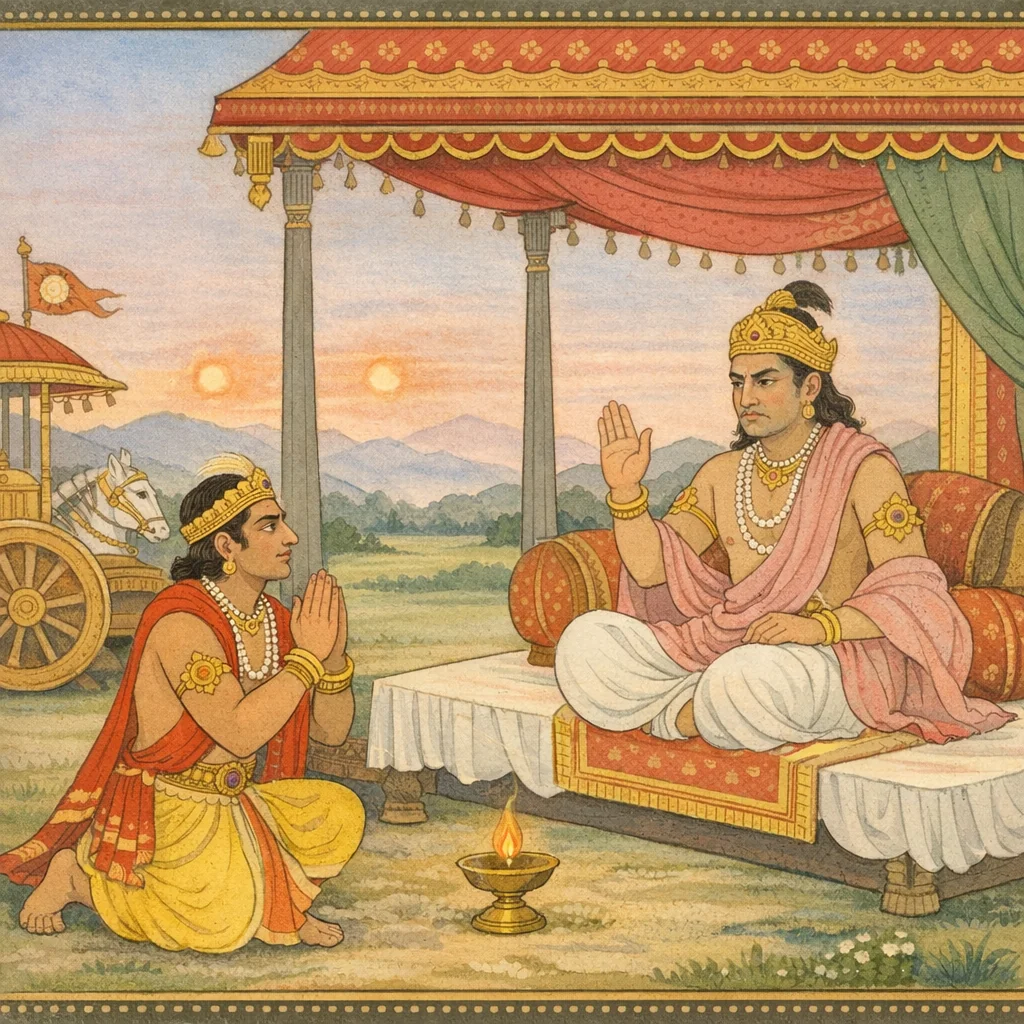
Adhyaya 31
कर्णेन व्यूहविधानम् — Karṇa’s Battle Formation and the Pāṇḍava Counter-Plan (Adhyāya 31)
Upa-parva: Vyūha-racanā and Counter-Deployment Episode (Karna’s Formation vs. Pāṇḍava Response)
Saṃjaya describes Karṇa observing the Pāṇḍava formation protected by Dhṛṣṭadyumna and advancing with chariot-roar and instruments, then counter-forming his own array and pressing the Pāṇḍava host, momentarily gaining advantage against Yudhiṣṭhira. Dhṛtarāṣṭra interrogates the specifics of the Kaurava deployment—wings, sub-wings, and proper division—prompting Saṃjaya’s technical account: commanders occupy the right wing (including Kṛpa and Kṛtavarmā), protective sub-divisions (Śakuni and Ulūka), and the left wing held by Saṃśaptakas, with additional allied contingents positioned for pressure against Arjuna. Karṇa stands at the center-front, supported by key figures; Duryodhana follows, protected by allies; Aśvatthāmā and other Kuru leaders trail the chariot divisions, with infantry and elephant-guards reinforcing. The formation is characterized as expertly designed (bārhaspatya), visually imposing, and dynamically projecting fear. Yudhiṣṭhira then addresses Arjuna to evaluate the threat and prevent being overrun; Arjuna affirms and commits to the decisive neutralization of the formation’s principal. Yudhiṣṭhira assigns matchups across leaders (including Bhīma, Nakula, Sahadeva, Dhṛṣṭadyumna, and others). As Arjuna’s chariot approaches, Śalya points out battlefield omens—dust, tremors, cries of scavengers, and unsettling sights—while also acknowledging Arjuna’s near-unconquerability; he redirects attention to the broader Pāṇḍava strength. The chapter closes with the armies clashing intensely, likened to converging rivers.
Chapter Arc: कर्ण के सेनापतित्व के साथ ही कुरु-शिविर में एक निर्णायक प्रश्न उठता है—उसके रथ की लगाम किसके हाथ होगी? दुर्योधन मद्रराज शल्य के पास जाकर अत्यन्त आदर और प्रशंसा के साथ उन्हें कर्ण का सारथि बनने का आग्रह करता है। → शल्य भीतर-भीतर अपमान की ज्वाला अनुभव करते हैं और घोर विरोध करते हैं—वे मद्राधिप, क्षत्रिय-श्रेष्ठ; उन्हें ‘प्रेष्य’ की भाँति किसी के अधीन करना धर्म-विरुद्ध है। दुर्योधन बार-बार स्तुति, नीति और उदाहरणों से उन्हें मनाने का प्रयत्न करता है—जैसे ब्रह्मा ने शिव की रक्षा हेतु सारथि-भाव स्वीकार किया और जैसे कृष्ण अर्जुन की रक्षा करते हैं, वैसे ही शल्य कर्ण की रक्षा करें। शल्य शर्त रखते हैं कि वे कर्ण के समीप अपनी श्रद्धानुसार वाणी बोलेंगे, अर्थात् अवसर आने पर कटु-सत्य भी कहेंगे। → शल्य का धर्म-तर्क चरम पर पहुँचता है—‘श्रेष्ठ होकर नीच कर्म में लगना’ और ‘श्रेष्ठ पुरुष को नीच के अधीन करना’ दोनों पाप हैं; प्रेमवश किसी श्रेष्ठ को अधीन कर देना अधर्म है। वे वर्ण-व्यवस्था और सामाजिक मर्यादा के श्रुति-स्मरण तक ले आते हैं, मानो दुर्योधन के आग्रह को धर्म-शास्त्र के कठोर प्रकाश में रखकर परख रहे हों। → दुर्योधन की चतुर विनय-नीति और ‘कर्ण-शल्य’ की संयुक्त प्रभा का युद्ध-प्रयोजन अंततः शल्य को स्वीकार की ओर मोड़ता है—वे सारथि बनना मान लेते हैं, पर अपनी शर्त के साथ: कर्ण के निकट वे अपनी वाणी को बाँधेंगे नहीं। इस प्रकार बाह्य रूप से गठबंधन बनता है, पर भीतर एक तीखी धार सुरक्षित रहती है। → कर्ण और शल्य को ‘उदय होते दो सूर्य’ की तरह देखकर शत्रु-सेना के नाश की कामना की जाती है—पर शल्य की शर्त संकेत देती है कि यही सारथ्य आगे चलकर कर्ण के लिए वरदान नहीं, वाणी-शस्त्र बन सकता है।
Shlokas
Verse 1
अप्--_क- द्वात्रिशोड्थध्याय: दुर्योधनकी शल्यसे कर्णका सारथि बननेके लिये प्रार्थना और शल्यका इस विषयमें घोर विरोध करना, पुनः श्रीकृष्णके समान अपनी प्रशंसा सुनकर उसे स्वीकार कर लेना संजय उवाच पुत्रस्तव महाराज मद्रराजं॑ महारथम् | विनयेनोपसंगम्य प्रणयाद् वाक्यमब्रवीत्,संजय कहते हैं--महाराज! आपका पुत्र दुर्योधन मद्रराज महारथी शल्यके पास विनीतभावसे जाकर प्रेमपूर्वक इस प्रकार बोला--
Sañjaya said: O King, your son Duryodhana approached Śalya, the mighty chariot-warrior and king of Madra, with humility; and, speaking with affectionate persuasion, he addressed him in these words. The scene frames a moral tension: in the midst of war, political need and personal bonds are used to secure strategic advantage, testing the boundaries between courtesy, loyalty, and righteous conduct.
Verse 2
सत्यव्रत महाभाग द्विषतां तापवर्धन | मद्रेश्वर रणे शूर परसैन्यभयंकर,“महाभाग! सत्यव्रत! शत्रुओंका संताप बढ़ानेवाले मद्रराज! रणवीर! शत्रुसैन्यभयंकर! वक्ताओंमें श्रेष्ठ! आपने कर्णकी बात सुनी है। उसीके अनुसार इन राजसिंहोंके बीचमें मैं स्वयं आपका वरण करता हूँ
Sañjaya said: “O noble one of true vows, increaser of the enemies’ anguish! O lord of Madra, hero in battle, terror to the opposing host, foremost among speakers— you have heard Karṇa’s words. In accordance with them, here amid these lion-like kings, I myself choose you.”
Verse 3
श्रुत॒वानसि कर्णस्य ब्रुवतो वदतां वर । यथा नृपतिसिंहानां मध्ये त्वां वरये स्वयम्,“महाभाग! सत्यव्रत! शत्रुओंका संताप बढ़ानेवाले मद्रराज! रणवीर! शत्रुसैन्यभयंकर! वक्ताओंमें श्रेष्ठ! आपने कर्णकी बात सुनी है। उसीके अनुसार इन राजसिंहोंके बीचमें मैं स्वयं आपका वरण करता हूँ
Sanjaya said: “O best of speakers, you have heard Karna as he spoke. In keeping with his words, here amid these lion-like kings I myself choose you. O greatly fortunate one, steadfast in truth, increaser of the enemies’ anguish—O king of Madra, hero of battle, terror to the hostile host, foremost among orators—having heard Karna’s counsel, I now openly declare my choice of you among these royal champions.”
Verse 4
तत्त्वामप्रतिवीर्याद्य शत्रुपक्षक्षयावह । मद्रेश्वर प्रयाचेडहं शिरसा विनयेन च,'शत्रुपक्षका विनाश करनेवाले, अनुपम शक्तिशाली, रथियोंमें श्रेष्ठ मद्रराज! मैं मस्तक झुकाकर विनयपूर्वक आपसे यह याचना करता हूँ कि आप अर्जुनके विनाश और मेरे हितके लिये प्रेमपूर्वक कर्णका सारथ्य कीजिये
Sanjaya said: “O lord of Madra, you who are truly of irresistible prowess and a bringer of destruction to the enemy host—bowing my head, I humbly entreat you: for the slaying of Arjuna and for my own advantage, please, with goodwill, take up the role of Karna’s charioteer.”
Verse 5
तस्मात् पार्थविनाशार्थ हितार्थ मम चैव हि | सारथ्य॑ रथिनां श्रेष्ठ प्रणयात् कर्तुमहसि,'शत्रुपक्षका विनाश करनेवाले, अनुपम शक्तिशाली, रथियोंमें श्रेष्ठ मद्रराज! मैं मस्तक झुकाकर विनयपूर्वक आपसे यह याचना करता हूँ कि आप अर्जुनके विनाश और मेरे हितके लिये प्रेमपूर्वक कर्णका सारथ्य कीजिये
Sañjaya said: “Therefore, for the destruction of Pārtha (Arjuna) and indeed for my own welfare, O best of chariot-warriors, you ought—out of affectionate regard—to undertake the office of charioteer.” In the moral atmosphere of the war, the request frames loyalty and personal advantage as motives, urging skilled service to secure the fall of a foremost opponent.
Verse 6
त्वयि यन्तरि राधेयो विद्विषो मे विजेष्यते । अभीषूणां हि कर्णस्य ग्रहीतान्यो न विद्यते
Sañjaya said: “With you as his charioteer, Rādheya (Karna) will surely overcome my foes. For no one else exists who can so take up and hold the reins of Karna’s horses.”
Verse 7
स पाहि सर्वथा कर्ण यथा ब्रह्मा महेश्वरम
Sañjaya said: “Protect him in every way, O Karṇa—just as Brahmā protects Maheśvara.” The line frames Karṇa’s duty as vigilant guardianship, invoking a cosmic analogy to intensify the moral weight of loyalty and protection amid the pressures of war.
Verse 8
यथा च सर्वथा55पत्सु वार्ष्णेय: पाति पाण्डवम् | तथा मद्रेश्वराद्य त्वं राधेयं प्रतिपालय
Sañjaya said: “Just as Vārṣṇeya (Kṛṣṇa) protects the Pāṇḍava in every way amid all crises, so you too, O lord of Madra, must now safeguard Rādheya (Karna).”
Verse 9
'जैसे ब्रह्माजीनी सारथि बनकर महादेवजीकी रक्षा की थी और जैसे सब प्रकारकी आपत्तियोंसे श्रीकृष्ण अर्जुनकी रक्षा करते हैं, उसी प्रकार आप कर्णकी सर्वथा रक्षा कीजिये। मद्रराज! आज आप राधापुत्रका प्रतिपालन कीजिये ।। भीष्मो द्रोण: कृप: कर्णोभवान् भोजश्न वीर्यवान् शकुनि: सौबलो द्रौणिरहमेव च नो बलम्,'भीष्म, द्रोण, कृपाचार्य कर्ण, आप, पराक्रमी कृतवर्मा, सुबलपुत्र शकुनि, द्रोणकुमार अश्वृत्थामा और मैं--ये ही हमारे बल हैं
Sanjaya said: “Just as Brahmā once became a charioteer and safeguarded Mahādeva, and just as Śrī Kṛṣṇa protects Arjuna from every kind of peril, so you too must protect Karṇa in every way. O king of Madra, today you must act as the guardian of Rādhā’s son. Bhīṣma, Droṇa, Kṛpa, Karṇa, you (Śalya), the valiant Bhoja (Kṛtavarmā), Śakuni the son of Subala, Droṇa’s son (Aśvatthāmā), and I—these alone are our strength.”
Verse 10
एवमेष कृतो भागो नवधा पृथिवीपते । न च भागोजत्र भीष्मस्य द्रोणस्य च महात्मन:
Sañjaya said: “Thus, O lord of the earth, this division has been made into nine parts. Yet in this allotment there is no share assigned here to Bhīṣma, nor to the great-souled Droṇa.”
Verse 11
वृद्धौ हि तो महेष्वासौ छलेन निहतौ युधि,वे दोनों महाधनुर्धर योद्धा बूढ़े हो गये थे, इसलिये युद्धमें शत्रुओंद्वारा छलपूर्वक मारे गये। अनघ! वे दुष्कर कर्म करके यहाँसे स्वर्गलोकमें चले गये। इसी प्रकार दूसरे पुरुषसिंह वीर भी युद्धमें शत्रुओंद्वारा मारे गये हैं
Sañjaya said: Those two great bowmen had grown old; therefore, in battle they were slain by the enemy through deceit. O sinless one, having accomplished arduous deeds, they departed from here to the world of heaven. In the same way, other lion-like heroes too have been struck down in war by their foes.
Verse 12
कृत्वा नसुकरं कर्म गतौ स्वर्गमितोडनघ । तथान्ये पुरुषव्याप्रा: परैर्विनिहता युधि,वे दोनों महाधनुर्धर योद्धा बूढ़े हो गये थे, इसलिये युद्धमें शत्रुओंद्वारा छलपूर्वक मारे गये। अनघ! वे दुष्कर कर्म करके यहाँसे स्वर्गलोकमें चले गये। इसी प्रकार दूसरे पुरुषसिंह वीर भी युद्धमें शत्रुओंद्वारा मारे गये हैं
Sañjaya said: Having accomplished deeds that are not easy to perform, those blameless heroes have departed from here to heaven. In the same way, other tiger-like men too have been struck down in battle by their foes—war consuming even the mighty, and death coming through the stratagems of opponents as the aged bowmen met their end.
Verse 13
अस्मदीयाश्र बहव: स्वर्गायोपगता रणे । त्यक्त्वा प्राणान् यथाशक्ति चेष्टां कृत्वा च पुष्कलाम्,'मेरे पक्षके बहुत-से योद्धा विजयके लिये यथाशक्ति पूरी चेष्टा करके रणभूमिमें प्राण त्यागकर स्वर्गलोकको चले गये
Sanjaya said: Many of our own warriors, having exerted themselves to the best of their power and having made great efforts for victory, abandoned their lives on the battlefield and went to heaven. The line underscores the Kṣatriya ideal that strenuous striving in a righteous battle, even when it ends in death, is regarded as a meritorious passage to the heavenly worlds.
Verse 14
तदिदं हतभूयिष्ठं बल॑ मम नराधिप । पूर्वमप्यल्पकै: पार्थर्हत॑ं किमुत साम्प्रतम्,“नरेश्वर! इस प्रकार मेरी इस सेनाका अधिकांश भाग नष्ट हो चुका है। पहले भी जब अपनी सारी सेना मौजूद थी, अल्पसंख्यक कुन्तीकुमारोंने कौरवसेनाका नाश कर दिया था। फिर इस समय तो कहना ही क्या है?
Verse 15
बलवन्तो महात्मान: कौन्तेया: सत्यविक्रमा: । बल॑ शेषं न हन्यूमें यथा तत् कुरु पार्थिव,'भूपाल! बलवान, महामनस्वी और सत्यपराक्रमी कुन्तीकुमार मेरी शेष सेनाको जिस तरह भी नष्ट न कर सकें, ऐसा उपाय कीजिये
Sañjaya said: “The sons of Kuntī are mighty, great-souled, and true in their valor. O king, devise such a measure that they may not be able to destroy what remains of my forces.”
Verse 16
हतवीरमिदं सैन्यं पाण्डवै: समरे विभो । कर्णो होको महाबाहुरस्मत्प्रियहिते रत:,'प्रभो! पाण्डवोंने समरांगणमें मेरी सेनाके प्रमुख वीरोंको मार डाला है। एक महाबाहु कर्ण ही ऐसा है, जो हमारे प्रिय एवं हितसाधनमें लगा हुआ है
Sañjaya said: “O mighty lord, this army has been stripped of its foremost heroes by the Pāṇḍavas in battle. Only Karṇa, the great-armed warrior, remains—steadfastly devoted to what is dear and beneficial to us.”
Verse 17
भवांश्व पुरुषव्यात्र सर्वतलोकमहारथ: । शल्य कर्ण;ोअर्जुनेनाद्य योद्धुमिच्छति संयुगे,'पुरुषसिंह शल्य! दूसरे आप भी सम्पूर्ण विश्वमें विख्यात महारथी होकर हमारे हितसाधनमें संलग्न हैं। आज कर्ण रणभूमिमें अर्जुनके साथ युद्ध करना चाहता है
Sañjaya said: “O tiger among men, you are indeed a great chariot-warrior renowned throughout the world and are engaged in securing our welfare. O Śalya, today Karṇa wishes to fight Arjuna on the battlefield.”
Verse 18
तस्मिञज्जयाशा विपुला मद्रराज नराधिप । तस्याभीषुग्रहवरो नान्यो5स्ति भुवि कश्नन
Sañjaya said: “O king of Madra, O ruler among men, in him there is vast hope of victory. For him there is no equal anywhere on earth in the excellence of seizing and mastering the reins (of the chariot)—none at all.”
Verse 19
“मद्रराज! नरेश्वर! उसके मनमें विजयकी बड़ी भारी आशा है, परंतु उसके घोड़ोंकी रास पकड़नेवाला (आपके समान) दूसरा कोई इस भूतलपर नहीं है ।। पार्थस्य समरे कृष्णो यथाभीघषुग्रहो वर: । तथा त्वमपि कर्णस्य रथे$भीषुग्रहो भव
Sañjaya said: “O king of Madra, O lord of men! He cherishes a mighty hope of victory; yet on this earth there is no second man like you to hold the reins of his horses. Just as Kṛṣṇa is the excellent charioteer who controls the reins for Pārtha in battle, so too become the reinsman on Karṇa’s chariot.”
Verse 20
जैसे संग्रामभूमिमें अर्जुनके रथकी बागडोर सँभालनेवाले श्रेष्ठ सारथि श्रीकृष्ण हैं, उसी प्रकार आप भी कर्णके रथपर बैठकर उसकी बागडोर अपने हाथमें लीजिये ।। तेन युक्तो रणे पार्थो रक्ष्यमाण श्ष पार्थिव । यानि कर्माणि कुरुते प्रत्यक्षाणि तथैव तत्,“राजन! श्रीकृष्णसे संयुक्त एवं सुरक्षित होकर पार्थ रणभूमिमें जो-जो कर्म करते हैं, वे सब आपकी आँखोंके सामने हैं
Sanjaya said: “Just as, on the battlefield, the supreme charioteer Śrī Kṛṣṇa holds and guides the reins of Arjuna’s chariot, so too should you mount Karṇa’s chariot and take the reins into your own hands. For when Pārtha (Arjuna) is joined with Kṛṣṇa and protected by him in battle, whatever deeds he performs are accomplished openly before your very eyes, O king.”
Verse 21
पूर्व न समरे होवमवधीदर्जुनो रिपून् इदानीं विक्रमो हास्य कृष्णेन सहितस्य च,'पहले युद्धमें अर्जुन इस प्रकार शत्रुओंका वध नहीं करते थे। इस समय श्रीकृष्णके साथ होनेसे ही इनका पराक्रम बढ़ गया है
Sañjaya said: Formerly, in battle, Arjuna did not slay his enemies in such a manner. Now, however, his prowess has increased—because he is accompanied by Kṛṣṇa. (Implicitly, Sañjaya points to the moral and strategic force that comes from righteous guidance and divine companionship in war.)
Verse 22
कृष्णेन सहित: पार्थों धार्तराष्ट्री महाचमूम् । अहन्यहनि मद्रेश द्रावयन् दृश्यते युधि,“मद्रराज! श्रीकृष्णके साथ अर्जुन प्रतिदिन हमारी विशाल सेनाको युद्धभूमिमें खदेड़ते देखे जाते हैं
Sañjaya said: “O king of Madra, Arjuna—accompanied by Kṛṣṇa—can be seen on the battlefield day after day, driving back the vast army of the Dhārtarāṣṭras. The sight proclaims the steady ascendancy of skill guided by divine counsel, and it underscores how resolve and right guidance can rout even a great host.”
Verse 23
भागो<वशिष्ट: कर्णस्य तव चैव महाद्ुते । तं भागं सह कर्णेन युगपन्नाशयाद्य हि
Sañjaya said: “O great and radiant one, a share of the outcome still remains for both Karṇa and you. Therefore, destroy that remaining share at once—together with Karṇa—so that it is ended simultaneously.”
Verse 24
“महातेजस्वी नरेश! अब कर्णका और आपका भाग शेष रह गया है। अतः: आप कर्णके साथ रहकर शत्रुसेनाके उस भागको एक साथ ही नष्ट कर दीजिये ।। अरुणेन यथा सार्ध तम: सूर्यो व्यपोहति । तथा कर्णेन सहितो जहि पार्थ महाहवे,'जैसे अरुणके साथ सूर्य अन्धकारका नाश करते हैं, उसी प्रकार आप महासमरमें कर्णके साथ रहकर कुन्तीकुमार अर्जुनका वध कीजिये
Sañjaya said: “O king of great splendor, now only the share of the battle that belongs to Karṇa and to you remains. Therefore, standing together with Karṇa, destroy that portion of the enemy’s army in one concerted blow. Just as the Sun, accompanied by Aruṇa, drives away darkness, so too—joined with Karṇa—strike down Pārtha (Arjuna) in the great battle.”
Verse 25
उद्यन्तौ च यथा सूर्यों बालसूर्यसमप्रभौ । कर्णशल्यौ रणे दृष्टवा विद्रवन्तु महारथा:,'प्रातःकालीन सूर्यके तुल्य तेजस्वी कर्ण और शल्यको उदित होते हुए दो सूर्योके समान रणभूमिमें देखकर शत्रुसेनाके महारथी भाग जायेँ
Sañjaya said: “Like two rising suns, radiant as the morning sun, Karṇa and Śalya—when seen together on the battlefield—cause even the foremost great chariot-warriors of the opposing host to break and flee.”
Verse 26
व | हे हि |: ; धप ७ ् * | सूर्यारुणौ यथा दृष्टवा तमो नश्यति मारिष । तथा नश्यन्तु कौन्तेया: सपठ्चाला: ससूंजया:
Sañjaya said: “O noble one, just as darkness vanishes when the Sun and the dawn are seen, so too may the sons of Kuntī—together with the Pāñcālas and with Sūñjaya—be brought to ruin.” In the moral atmosphere of the war, the verse frames the opposing host as ‘darkness’ to be dispelled, revealing how martial rhetoric can recast destruction as a kind of inevitable clearing away.
Verse 27
“मान्यवर! जैसे सूर्य और अरुणको देखते ही अन्धकार नष्ट हो जाता है, उसी प्रकार आप दोनोंको देखकर कुन्तीके पुत्र, पांचाल और सूंजय नष्ट हो जायाँ ।। रथिनां प्रवर: कर्णो यन्तृणां प्रवरो भवान् संयोगो युवयोलोके नाभून्न च भविष्यति,“कर्ण रथियोंमें श्रेष्ठ है और आप सारथियोंके शिरोमणि हैं। संसारमें आप दोनोंका संयोग जो आज बन गया है, न तो कभी हुआ था और न आगे कभी होगा
Sañjaya said: “Noble sir, just as darkness vanishes the moment the Sun and Aruṇa are seen, so too, on beholding you both, the sons of Kuntī, the Pāñcālas, and the Sṛñjayas would be undone. Karṇa is the foremost among chariot-warriors, and you are the foremost among charioteers. Such a union of you two, in this world, has never occurred before—and will never occur again.”
Verse 28
यथा सर्वास्ववस्थासु वार्ष्णेय: पाति पाण्डवम् | तथा भवान् परित्रातुं कर्ण वैकर्तनं रणे,'जैसे श्रीकृष्ण सभी अवस्थाओंमें पाण्डुपुत्र अर्जुनकी रक्षा करते हैं, उसी प्रकार आप रणभूमिमें वैकर्तन कर्णकी रक्षा करें
Sañjaya said: “Just as Vārṣṇeya (Śrī Kṛṣṇa) protects the Pāṇḍava (Arjuna) in every circumstance, so may you, on the battlefield, protect Karṇa, the son of the cutter (Vaikartana).” The line underscores the moral weight of protection in war: victory is not only a matter of prowess, but also of steadfast guardianship and the sustaining presence of a trusted ally.
Verse 29
(सारथ्यं क्रियतां तस्य युध्यमानस्य संयुगे ।) त्वया सारथिना होष अप्रधृष्यो भविष्यति । देवतानामपि रणे सशक्राणां महीपते । कि पुन: पाण्डवेयानां मा विशंकीर्वचो मम,'युद्धस्थलमें युद्ध करते समय कर्णके सारथिका कार्य सँभालिये। राजन! आपके सारथि होनेसे यह कर्ण रणभूमिमें इन्द्रसहित सम्पूर्ण देवताओंके लिये भी अजेय हो जायगा, फिर पाण्डवोंकी तो बात ही क्या है। आप मेरे इस कथनमें संदेह न कीजिये”
Sañjaya said: “Take up the charioteer’s charge for him while he fights in the press of battle. With you as his driver, O king, Karṇa will become unassailable—invincible even to the gods in combat, Indra included. How much more, then, against the sons of Pāṇḍu? Do not doubt my words.”
Verse 30
संजय उवाच दुर्योधनवच: श्रुत्वा शल्य: क्रोधसमन्वित: । विशिखां भ्रुकुटिं कृत्वा धुन्वन् हस्तौ पुन: पुन:,संजय कहते हैं--राजन्! दुर्योधनकी बात सुनकर शल्यको बड़ा क्रोध हुआ। वे अपनी भौंहोंको तीन जगहसे टेढ़ी करके बारंबार हाथ हिलाने लगे
Sañjaya said: O King, on hearing Duryodhana’s words, Śalya was seized with anger. Drawing his brows into a sharp, threefold frown, he repeatedly shook his hands—an outward sign of rising wrath and impending harsh reply amid the moral strain of war.
Verse 31
इस प्रकार श्रीमह्याभारत कर्णपर्वमें कर्ण और दुर्योधनका संवादविषयक इकतीसवाँ अध्याय पूरा हुआ,क्रोधरक्ते महानेत्रे परिवृत्य महाभुज: । कुलैश्वर्यश्रुतबलैर्दप्त: शल्यो<ब्रवीदिदम् महाबाहु शल्यको अपने कुल, ऐश्वर्य, शास्त्रज्ान और बलका बड़ा अभिमान था। वे क्रोधसे लाल हुए विशाल नेत्रोंको घुमाकर इस प्रकार बोले
Sañjaya said: Inflamed with anger, his great eyes reddened, and rolling them about, the mighty-armed Śalya—puffed up with pride in his lineage, sovereignty, learning, and strength—spoke these words. (Thus ends the thirty-first chapter of the Karṇa Parva, concerning the dialogue between Karṇa and Duryodhana.)
Verse 32
शल्य उवाच अवमन्यसि गान्धारे ध्रुवं च परिशड्कसे । यन्मां ब्रवीषि विश्रब्धं सारथ्यं क्रियतामिति,शल्यने कहा--गान्धारीपुत्र! तुम मेरा अपमान कर रहे हो, निश्चय ही तुम्हारे मनमें मेरे प्रति संदेह है, तभी तुम निर्भय होकर कह रहे हो कि आप “*सारथिका कार्य कीजिये' इति श्रीमहा भारते कर्णपर्वणि शल्यसारथ्ये द्वात्रिंशोडध्याय:
Śalya said: “O son of Gāndhārī, you are slighting me, and surely you harbor suspicion toward me. That is why you speak to me so boldly, saying, ‘Perform the office of charioteer for me.’”
Verse 33
अस्मत्तो5 भ्यधिकं कर्ण मन्यमान: प्रशंससि । नचाहं युधि राधेयं गणये तुल्यमात्मन:,तुम कर्णको मुझसे श्रेष्ठ मानकर उसकी भूरि-भूरि प्रशंसा करते हो; परंतु युद्धस्थलमें राधापुत्र कर्णको मैं अपने समान नहीं गिनता हूँ
Śalya said: “Karna, thinking him superior to me, you praise him again and again. But on the battlefield I do not count Rādheya (Karna) as equal to myself.”
Verse 34
आदिश्यतामभ्यधिको ममांश: पृथिवीपते । तमहं समरे जित्वा गमिष्यामि यथागतम्,राजन! तुम शत्रुसेनाके अधिक-से-अधिक भागको मेरे हिस्सेमें दे दो, मैं उसे जीतकर जैसे आया हूँ, वैसे लौट जाऊँगा
Śalya said: “O lord of the earth, assign to me a share greater than the rest. Having conquered that (portion of the enemy force) in battle, I shall return, O king, just as I came.”
Verse 35
अथवाप्येक एवाहं योत्स्यामि कुरुनन्दन । पश्य वीर्य ममाद्य त्वं संग्रामे दहतो रिपून्,अथवा कुरुनन्दन! आज मैं अकेला ही युद्ध करूँगा। तुम संग्राममें शत्रुओंको दग्ध करते हुए मेरे पराक्रमको देख लेना
Śalya declares to the Kuru prince that, if need be, he will fight single-handed today. He urges him to witness his prowess on the battlefield as he burns down the enemy ranks—an assertion meant to stiffen resolve and project confidence amid the moral strain and urgency of war.
Verse 36
न चापि कामान् कौरव्य निधाय हृदये पुमान् । अस्मद्विध: प्रवर्तेत मा मां त्वमभिशड्भशकिथा:,कौरव्य! मेरे-जैसा पुरुष अपने मनमें कुछ कामनाएँ रखकर युद्धमें प्रवृत्त नहीं होता। अतः तुम मुझपर संदेह न करो
Śalya said: “Nor does a man like me enter into action—least of all into battle—after planting personal desires in his heart. Therefore, O Kauravya, do not suspect me.”
Verse 37
युधि वाप्यवमानो मे न कर्तव्य: कथज्चन । पश्य पीनौ मम भुजी वज़्संहननौ दृढौ
Śalya said: “Whether in battle or otherwise, you must never show me contempt in any way. Look—my arms are thick and powerful, with a frame as hard as a thunderbolt and firm with strength.”
Verse 38
धनु: पश्य च मे चित्र शरांश्वाशीविषोपमान् | रथं पश्य च मे क्लृप्तं सदश्वैर्वातवेगितैः
Śalya said: “Look at my splendid bow, and look at my arrows—like venomous serpents. And look at my chariot, fully prepared, drawn by excellent horses swift as the wind.” In the ethical atmosphere of the war, this is a declaration of readiness and martial confidence, emphasizing the lethal capability of weapons and the preparedness to act decisively in battle.
Verse 39
गदां च पश्य गान्धारे हेमपट्टविभूषिताम् । तुम्हें युद्धमें किसी प्रकार मेरा अपमान नहीं करना चाहिये। तुम मेरी मोटी और वज्रके समान गँठीली इन सुदृढ़ भुजाओंको तो देखो। मेरे इस विचित्र धनुष और विषधर सर्पके समान इन विषैले बाणोंकी ओर तो दृष्टिपात करो। गन्धारीकुमार! वायुके समान वेगशाली उत्तम घोड़ोंसे जुते हुए मेरे इस सजे-सजाये रथ और सुवर्णपत्रसे मढ़ी हुई गदापर भी तो दृष्टि डालो || ३७-३८ $ ।। दारयेयं महीं कृत्स्नां विकिरेयं च पर्वतान्
Śalya said: “Look, O son of Gāndhārī, at my mace adorned with bands of gold. I could split the entire earth and scatter the mountains.” In the ethical atmosphere of the war, Śalya’s words are a warning against contempt and a boast of martial capacity—asserting status and demanding due respect even amid alliance, where pride and insult can fracture discipline and dharma on the battlefield.
Verse 40
तं॑ मामेवंविधं राजन् समर्थमरिनिग्रहे
O King, I—being such as I am, fully capable of subduing enemies—
Verse 41
कस्माद् युनड्धक्षि सारथ्ये नीचस्याधिरथे रणे । नरेश्वर! इस प्रकार शत्रुओंका दमन करनेमें पूर्णतया समर्थ होनेपर भी तुम मुझे इस नीच सूतपुत्र कर्णके सारथिके कामपर कैसे नियुक्त कर रहे हो? || ४० $ ।। न मामधुरि राजेन्द्र नियोक्तुं त्वमिहाहसि
Śalya said: “Why do you yoke me to the office of charioteer in battle for a low-born chariot-warrior? O king of men, though you are fully capable of crushing the enemy, how can you appoint me to serve as the charioteer of Karṇa, that base son of a sūta? O best of kings, you are not fit to command me in this matter.”
Verse 42
यो हाभ्युपगतं प्रीत्या गरीयांसं वशे स्थितम्
Śalya said: “Whoever, with genuine affection, accepts a superior person who has come to him and is living under his authority…”
Verse 43
ब्रह्मणा ब्राह्मणा: सृष्टा मुखात् क्षत्रं च बाहुत:
Śalya said: “By Brahmā, the brāhmaṇas were created from the mouth, and the kṣatra (the warrior order) from the arms.” In the ethical frame of the discourse, this recalls the traditional hierarchy of social functions: speech, learning, and counsel as the brāhmaṇa’s domain, and strength, protection, and governance as the kṣatriya’s—implying that each must act according to their ordained duty, especially amid the moral strain of war.
Verse 44
तेभ्यो वर्णविशेषाश्व॒ प्रतिलोमानुलोमजा:
From them arise further distinct social classifications, born through unions both contrary to and in accordance with the accepted order of varṇa. Śalya points to how lineage and conduct become ethically debated when marriages and relationships cross prescribed norms, producing mixed communities that society then labels and judges.
Verse 45
अथान्योन्यस्य संयोगाच्चातुर्वर्ण्यस्य भारत । भारत! इन्हींसे अनुलोम और विलोम क्रमसे विभिन्न वर्णोकी उत्पत्ति होती है। चारों वर्णोके पारस्परिक संयोगसे अन्य जातियाँ उत्पन्न हुई हैं ।। ४४ $ ।। गोप्तार: संगृहीतारो दातार: क्षत्रिया: स्मृता:,इनमें क्षत्रिय-जातिके लोग सबकी रक्षा करनेवाले, सबसे कर लेनेवाले और दान देनेवाले बताये गये हैं। ब्राह्मण यज्ञ कराने, वेद पढ़ाने और विशुद्ध दान ग्रहण करनेके द्वारा जीवन-निर्वाह करते हुए सम्पूर्ण जगतपर अनुग्रह करनेके लिये इस भूतलपर ब्रह्माजीके द्वारा स्थापित किये गये हैं
Shalya said: “O Bharata, from the mutual unions within the fourfold social order arise further groups—through both the ‘in-order’ (anuloma) and ‘reverse’ (viloma) sequences. From the intermixture of the four varṇas, other communities are born. The Kṣatriyas are remembered as those who protect all, collect revenues, and give gifts. The Brāhmaṇas—living by conducting sacrifices, teaching the Veda, and accepting only pure gifts—were established on earth by Brahmā for the welfare of the whole world.”
Verse 46
याजनाध्यापनैरविंप्रा विशुद्धैश्व प्रतिग्रहै: । लोकस्यानुग्रहार्थाय स्थापिता ब्राह्मणा भुवि,इनमें क्षत्रिय-जातिके लोग सबकी रक्षा करनेवाले, सबसे कर लेनेवाले और दान देनेवाले बताये गये हैं। ब्राह्मण यज्ञ कराने, वेद पढ़ाने और विशुद्ध दान ग्रहण करनेके द्वारा जीवन-निर्वाह करते हुए सम्पूर्ण जगतपर अनुग्रह करनेके लिये इस भूतलपर ब्रह्माजीके द्वारा स्थापित किये गये हैं
Śalya said: “Brahmins sustain themselves by officiating at sacrifices, by teaching the Veda, and by accepting only pure and blameless gifts. For the welfare of the whole world, they were established upon the earth so that they might extend grace and guidance to society.”
Verse 47
कृषिश्च पाशुपाल्यं च विशां दान॑ च धर्मत: । ब्रद्मक्षत्रविशां शूद्रा विहिता: परिचारका:,कृषि, पशुपालन और धर्मानुसार दान देना वैश्योंका कर्म है तथा शूद्रलोग ब्राह्मण, क्षत्रिय और वैश्योंकी सेवाके काममें नियुक्त किये गये हैं
Śalya said: “For the Vaiśyas, agriculture and the tending of cattle, along with giving in charity according to dharma, are the prescribed duties. The Śūdras are appointed to serve the Brāhmaṇas, Kṣatriyas, and Vaiśyas.”
Verse 48
ब्रद्मक्षत्रस्य विहिता: सूता वै परिचारका: । न क्षत्रियों वै सूतानां शूणुयाच्च कथठ्चन,सूतजातिके लोग ब्राह्मणों और क्षत्रियोंके सेवक नियुक्त किये गये हैं, क्षत्रिय सूतोंका सेवक हो, यह कोई किसी प्रकार कहीं नहीं सुन सकता
Śalya said: “For the Brahmins and the Kshatriyas, the Sūtas have been appointed as attendants and servants. That a Kshatriya should serve the Sūtas—this is something one never hears of in any way.”
Verse 49
अहं मूर्धाभिषिक्तो हि राजर्षिकुलजो नृप:ः । महारथ: समाख्यात: सेव्य: स्तुत्यश्न वन्दिनाम्,मैं राजर्षियोंके कुलमें उत्पन्न हुआ मूर्द्धाभिषिक्त नरेश हूँ, विश्वविख्यात महारथी हूँ, सूतोंद्वारा सेव्य और वन्दीजनोंद्वारा स्तुतिके योग्य हूँ
Śalya said: “I am a duly consecrated king, born in the lineage of royal seers. I am renowned as a great chariot-warrior, fit to be attended by bards and worthy of praise from panegyrists.” In context, Śalya asserts his royal legitimacy and martial stature, appealing to social and ethical norms of honor, rank, and deserved respect amid the tensions of war.
Verse 50
सो5हमेतादृशो भूत्वा नेहारिबलसूदन: । सूतपुत्रस्य संग्रामे सारथ्यं कर्तुमुत्सहे,ऐसा प्रतिष्ठित एवं शत्रुसेनाका संहार करनेमें समर्थ होकर मैं यहाँ युद्धस्थलमें एक सूतपुत्रके सारथिका कार्य कदापि नहीं कर सकता
Śalya said: “Though I am such a man—one capable of crushing the enemy’s forces—I cannot bring myself, here on this battlefield, to serve as the charioteer of a mere charioteer’s son in war.”
Verse 51
अवमानमहं प्राप्प न योत्स्यामि कथउठ्चन । आपूृच्छे त्वाद्य गान्धारे गमिष्यामि गृहाय वै,गान्धारीनन्दन! आज इस अपमानको पाकर अब मैं किसी प्रकार युद्ध नहीं करूँगा। अतः तुमसे आज्ञा चाहता हूँ। आज ही अपने घरको लौट जाऊँगा
Śalya said: “Having received this insult, I will not fight in any way. I take leave of you today, O son of Gāndhārī; indeed, I shall depart at once for my home.” The statement frames withdrawal from battle as a response to dishonor, highlighting how wounded pride and perceived disrespect can disrupt martial duty and alliances in the midst of war.
Verse 52
संजय उवाच एवमुक्त्वा महाराज शल्य: समितिशोभन: । उत्थाय प्रययौ तूर्ण राजमध्यादमर्षित:,संजय कहते हैं--महाराज! ऐसा कहकर युद्धमें शोभा पानेवाले शल्य अमर्षमें भर गये और राजाओंके बीचसे उठकर तुरंत चल दिये
Sanjaya said: “O King, having spoken thus, Shalya—whose presence lends splendor to the battlefield—rose up in a surge of indignation and quickly departed from the midst of the assembled kings.”
Verse 53
प्रणयाद् बहुमानाच्च त॑ निगृह[ सुतस्तव । अब्रवीन्मधुरं वाक््यं साम्ना सर्वार्थसाधकम्,तब आपके पुत्रने बड़े प्रेम और आदरसे उन्हें रोका तथा सान्त्वनापूर्ण मधुर स्वरमें उनसे यह सर्वार्थलाधक वचन कहा--
Sañjaya said: Out of affection and respectful regard, your son restrained him and, in a soothing and gentle tone, spoke words of conciliation—speech calculated to accomplish every purpose. The moment underscores how, even amid the harshness of war, persuasion and courteous restraint can be used to avert rash action and secure one’s aims without needless escalation.
Verse 54
यथा शल्य विजानीषे एवमेतदसंशयम् । अभिप्रायस्तु मे कश्चित् तं निबोध जनेश्वर,“महाराज शल्य! आप अपने विषयमें जैसा समझते हैं ऐसी ही बात है, इसमें तनिक भी संशय नहीं है। मेरा कोई और ही अभिप्राय है, उसे ध्यान देकर सुनिये
Sañjaya said: “O King Śalya, it is exactly as you understand it—of this there is no doubt at all. Yet I have another intention in mind; listen to it attentively, O lord of men.”
Verse 55
न कर्णो3 भ्यधिक सर्त्वत्तो न शड़्के त्वां च पार्थिव । न हि मद्रेश्वरो राजा कुर्याद् यदनृतं भवेत्,'भूपाल! न तो कर्ण आपसे श्रेष्ठ है और न आपके प्रति मैं संदेह ही करता हूँ। मद्रदेशके स्वामी राजा शल्य कोई ऐसा कार्य नहीं कर सकते, जो उनकी सत्य प्रतिज्ञाके विपरीत हो
Sañjaya said: “I do not think Karṇa surpasses him in true prowess; nor do I doubt you, O king. For King Śalya, lord of Madra, would never do anything that would amount to falsehood or violate his pledge of truth.”
Verse 56
ऋतमेव हि पूर्वास्ते वदन्ति पुरुषोत्तमा: | तस्मादार्तायनि: प्रोक्तो भवानिति मतिर्मम,“आपके पूर्वज श्रेष्ठ पुछष थे और सदा सत्य ही बोला करते थे, इसीलिये आप 'आर्तायनि” कहलाते हैं; मेरी ऐसी ही धारणा है
Sanjaya said: “Indeed, your forefathers—men of the highest worth—always spoke only what is true. Therefore, it is my understanding that you are called ‘Ārtāyani,’ because you stand in that lineage of truthfulness.”
Verse 57
शल्यभूतस्तु शत्रूणां यस्मात्त्वं युधि मानद | तस्माच्छल्यो हि ते नाम कथ्यते पृथिवीतले,“मानद! आप युद्धस्थलमें शत्रुओंके लिये शल्य (काँटे)-के समान हैं, इसीलिये इस भूतलपर आपका शल्य नाम विख्यात है
Sañjaya said: “O bestower of honor, because in battle you become like a sharp thorn to your enemies, therefore on this earth you are indeed spoken of by the name ‘Śalya’.”
Verse 58
यदेतद् व्याह्वतं पूर्व भवता भूरिदक्षिण । तदेव कुरु धर्मज्ञ मदर्थ यद् यदुच्यते,'गज्ञोंमें प्रचुर दक्षिणा देनेवाले धर्मज्ञ नरेश्वरर आपने पहले यह जो कुछ कहा है और इस समय जो कुछ कह रहे हैं, उसीको मेरे लिये पूर्ण करें
Sañjaya said: “O king renowned for giving abundant sacrificial gifts, O knower of dharma—whatever you formerly declared, and whatever you are now saying, fulfill that very resolve for my sake.”
Verse 59
न च त्वत्तो हि राधेयो न चाहमपि वीर्यवान् | वृणे<हं त्वां हयाग्रयाणां यन्तारमिह संयुगे,“आपकी अपेक्षा न तो राधापुत्र कर्ण बलवान् है और न मैं ही। आप उत्तम अश्वोंके सर्वश्रेष्ठ संचालक (अश्वविद्याके सर्वोत्तम ज्ञाता) हैं, इसलिये इस युद्धस्थलमें आपका वरण कर रहा हूँ
Verse 60
मन्ये चाभ्यधिकं शल्य गुणै: कर्ण धनंजयात् । भवन्तं वासुदेवाच्च लोको5यमिति मन्यते,“शल्य! मैं कर्णको अर्जुनसे अधिक गुणवान् मानता हूँ और यह सारा जगत् आपको वसुदेवनन्दन श्रीकृष्णसे श्रेष्ठ मानता है
Sañjaya said: “O Śalya, I consider Karṇa to surpass Dhanañjaya (Arjuna) in excellence and qualities; and this whole world, I believe, regards you as even superior to Vāsudeva (Kṛṣṇa).” In the charged moral atmosphere of the war, the statement functions as strategic praise—meant to elevate confidence and status—while also revealing how reputation and public opinion can be wielded as a weapon alongside arms.
Verse 61
कर्णो ह्भ्यधिकः पार्थादस्त्रैरेव नरर्षभ । भवानभ्यधिक: कृष्णादश्वज्ञाने बले तथा,“नरश्रेष्ठ) कर्ण तो अर्जुनसे केवल अस्त्र-ज्ञानमें ही बढ़ा-चढ़ा है, परंतु आप श्रीकृष्णसे अश्वविद्या और बल दोनोंमें बड़े हैं
Sanjaya said: “O bull among men, Karna surpasses Partha (Arjuna) only in the mastery of weapons. But you surpass Krishna in both knowledge of horses and in physical strength.” In context, the statement is a pointed comparison meant to assess relative capacities on the battlefield—distinguishing technical martial skill (astra-vidyā) from practical war-competence such as horsemanship and bodily power—thereby shaping confidence, strategy, and the moral psychology of combatants.
Verse 62
यथाश्वह्ददयं वेद वासुदेवो महामना: । द्विगुणं त्वं तथा वेत्सि मद्रराजेश्वरात्मज,“मद्रराजकुमार! महामनस्वी श्रीकृष्ण जिस प्रकार अश्वविद्याका रहस्य जानते हैं, वैसा ही, बल्कि उससे भी दूना आप जानते हैं!
Sanjaya said: “Just as the great-souled Vāsudeva (Kṛṣṇa) knows the secret lore called ‘Aśvahṛdaya’, so do you know it—indeed, you know it twice as well, O son of the lord of Madra.”
Verse 63
ऋते हि त्वां महाभाग वासुदेवसमं युधि । “आपके सारथि होनेपर राधापुत्र कर्ण मेरे शत्रुओंको जीत लेगा। कर्णके रथकी बागडोर पकड़नेवाला आपके सिवा दूसरा कोई नहीं है। महाभाग! आप युद्धमें वसुदेवनन्दन श्रीकृष्णके समान हैं,शल्य उवाच यन्मां ब्रवीषि गान्धारे मध्ये सैन्यस्थ कौरव । विशिष्ट देवकीपुत्रात् प्रीतिमानस्म्यहं त्वयि शल्यने कहा--कौरव! गान्धारीपुत्र! तुम सारी सेनाके बीचमें जो मुझे देवकीनन्दन श्रीकृष्णसे भी बढ़कर बता रहे हो, इससे मैं तुमपर बहुत प्रसन्न हूँ
Sanjaya said: “O greatly fortunate one, apart from you—who in battle are equal to Vāsudeva—there is no other who can truly hold the reins of Karṇa’s chariot.” Śalya replied: “O son of Gāndhārī, O Kaurava standing amid the assembled army—since you speak of me as superior even to Devakī’s son (Kṛṣṇa), I am pleased with you.” In context, the passage highlights how praise and comparison to Kṛṣṇa are used to secure Śalya’s cooperation as Karṇa’s charioteer, revealing the ethical tension between genuine merit and strategic flattery in wartime counsel.
Verse 64
एष सारशथ्यमातिष्ठे राधेयस्य यशस्विन: । युध्यत: पाण्डवाग्रयेण यथा त्वं वीर मन््यसे,वीर! जैसा तुम चाहते हो उसके अनुसार मैं पाण्डव-शिरोमणि अर्जुनके साथ युद्ध करते हुए यशस्वी कर्णका सारथिकर्म अब स्वीकार किये लेता हूँ
Shalya said: “I now accept the duty of charioteer for the illustrious Radheya (Karna), as he fights with the foremost of the Pandavas (Arjuna)—in the very manner you, O hero, deem fit.” In this moment, Shalya formally consents to serve as Karna’s driver, framing the act as a chosen obligation within the ethics of war, where one’s role must be performed according to agreed martial conduct even amid personal tensions.
Verse 65
समयश्न हि मे वीर कश्रिद् वैकर्तनं प्रति । उत्सूजेयं यथाश्रद्धमहं वाचो5स्य संनिधौ,परंतु वीरवर! कर्णके साथ मेरी एक शर्त रहेगी। “मैं इसके समीप, जैसी मेरी इच्छा हो, वैसी बातें कर सकता हूँ”
Shalya said: “O hero, I have one condition regarding Vaikartana (Karna). In his very presence, I must be free to speak to him as I see fit—according to my own conviction and intention. Only with this liberty will I accompany him.”
Verse 66
संजय उवाच तथेति राजन पुत्रस्ते सह कर्णेन भारत । अब्रवीन्मद्रराजस्यथ मतं भरतसत्तम,संजयने कहा--भारत! भरतभूषण नरेश! इसपर कर्णसहित आपके पुत्रने “बहुत अच्छा” कहकर शल्यकी शर्त स्वीकार कर ली
Sanjaya said: “So be it, O King.” Then your son, O Bharata, together with Karna, replied in assent and accepted the intention and terms proposed by the king of Madra, O best of the Bharatas. In the moral texture of the episode, this marks a deliberate choice to proceed with a war-strategy bargain—an agreement that binds conduct in battle and reveals how expediency and honor are negotiated amid the pressures of dharma and victory.
Verse 106
ताभ्यामतीत्य तौ भागौ निहता मम शत्रव: । 'पृथ्वीपते! इस प्रकार मेरी सेनाके ये नौ भाग किये गये थे। अब यहाँ भीष्म तथा महात्मा द्रोणाचार्यका भाग नहीं रह गया है। उन दोनोंने उनके लिये निर्धारित भागोंसे और आगे बढ़कर मेरे शत्रुओंका संहार किया है
Sañjaya said: Surpassing even those two allotted divisions, my enemies were struck down. The sense is that Bhīṣma and the great-souled Droṇa did not remain confined to the portions assigned to them in the battle-array; going beyond their designated sectors, they carried out a sweeping slaughter of the opposing warriors—an image of overwhelming martial prowess that also hints at how, in war, formal plans and boundaries are often overridden by the momentum of violence and the drive to secure victory.
Verse 396
शोषयेयं समुद्रांश्व तेजसा स्वेन पार्थिव । राजन! मैं सारी पृथ्वीको विदीर्ण कर सकता हूँ, पर्वतोंको तोड़-फोड़कर बिखेर सकता हूँ और अपने तेजसे समुद्रोंको भी सुखा सकता हूँ
Śalya said: “O king, by my own fiery energy I could even dry up the oceans.” The statement is a boast of overwhelming power, used in the charged moral atmosphere of war to assert dominance and intimidate—yet it also hints at the ethical danger of unchecked pride (mada) when strength is spoken of as limitless.
Verse 416
न हि पापीयस: श्रेयान् भूत्वा प्रेष्यत्वमुत्सहे । राजेन्द्र! तुम्हें मुझे नीच कर्ममें नहीं लगाना चाहिये। मैं श्रेष्ठ होकर अत्यन्त नीच पापी पुरुषकी दासता नहीं कर सकता
Śalya said: “I cannot bring myself to accept servitude after being one who is better and nobler. O king among kings, you should not employ me in base deeds. Though I stand as a superior man, I cannot submit to the slavery of an utterly vile and sinful person.”
Verse 423
वशे पापीयसो धत्ते तत् पापमधरोत्तरम् । जो पुरुष प्रेमवश अपने पास आकर अपनी आज्ञाके अधीन रहनेवाले किसी श्रेष्ठतम पुरुषको नीचतम मनुष्यके अधीन कर देता है, उसे उच्चको नीच और नीचको उच्च करनेका महान् पाप लगता है
Śalya declares that yielding to a baser influence brings a grave, inverted sin. If, out of attachment or partiality, a man takes a truly superior person—one who has come to him in trust and lives under his command—and places him under the control of an inferior, he incurs a great moral fault: the wrongdoing of turning the high into the low and the low into the high.
Verse 436
ऊरुभ्यामसृजद् वैश्याज्शूद्रान् पदभ्यामिति श्रुति: । ब्रह्माजीने ब्राह्मणोंको अपने मुखसे, क्षत्रियोंकों भुजाओंसे, वैश्योंको जाँघोंसे और शूद्रोंको पैरोंसे उत्पन्न किया है, ऐसा श्रुतिका मत है
Śalya said: “The śruti declares that the Vaiśyas were produced from the thighs and the Śūdras from the feet. Likewise, according to the Vedic view, Brahmā brought forth the Brāhmaṇas from his mouth, the Kṣatriyas from his arms, the Vaiśyas from his thighs, and the Śūdras from his feet.” In the midst of war-counsel and moral disputation, this statement invokes a traditional cosmological model to argue about social order and duty (dharma) as understood in Vedic authority.
Frequently Asked Questions
Leaders must balance personal rivalries and vows with collective responsibility: whether to prioritize decisive leader-targeting or broader protection of the host without escalating disorder and unnecessary loss.
Effective leadership under crisis requires clear structure—defined wings, reserves, and matchups—paired with sober assessment of risk signals (nimitta) and disciplined execution rather than reactive bravado.
No explicit phalaśruti is stated; the chapter’s meta-function is technical and diagnostic, using formation-description and omens to situate the listener within causality and impending escalation.