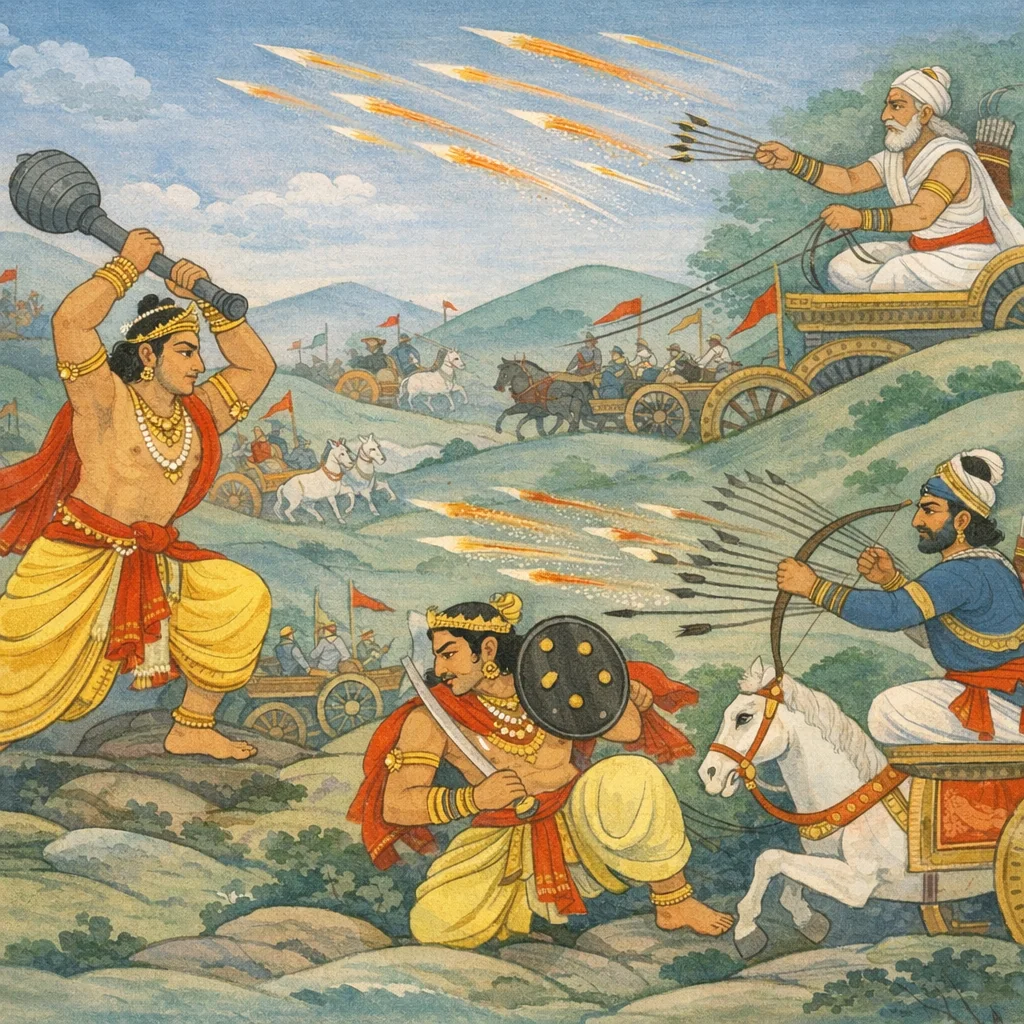
Adhyaya 159
अध्याय १५९ — रात्रौ श्रमविरामः (Night Exhaustion and Brief Pause in Battle)
Upa-parva: Rātri-śrama–virāma (Night Fatigue and Truce Episode) — Droṇa Parva Context Unit
Sañjaya reports that after Ghaṭotkaca is killed by Karṇa, Yudhiṣṭhira is seized by grief and anger and instructs Dhṛṣṭadyumna to check Droṇa, emphasizing Dhṛṣṭadyumna’s destined role in Droṇa’s fall. A coalition of Pāṇḍava allies—named leaders, charioteers, infantry, elephants, and horses—surges forward with the intention of reaching Droṇa. Droṇa receives them in battle; Duryodhana also advances to protect Droṇa’s life. The engagement, however, becomes impaired by severe night conditions: darkness and dust combine with fatigue so that many warriors are described as ‘sleep-blinded,’ acting without clear perception, sometimes harming allies and themselves. Arjuna (Bībhatsu) recognizes the degraded state of the armies and calls out loudly, advising a brief pause and rest on the battlefield until the moon rises, after which combat can resume. Both sides approve this counsel; troops rest in place with weapons and mounts, and the text offers extended battlefield imagery of sleeping soldiers, elephants, and horses. As moonlight spreads and darkness recedes, the armies awaken and the battle recommences with renewed force.
Chapter Arc: संजय धृतराष्ट्र से कहता है कि रणभूमि में पाण्डव-पक्ष के प्रमुख योद्धा—युधिष्ठिर, भीम, धृष्टद्युम्न और सात्यकि—मन को युद्ध में स्थिर कर द्रोण की प्रचण्ड व्यवस्था को तोड़ने हेतु आगे बढ़ते हैं। → सोमदत्त सात्यकि को देखकर पुनः क्रुद्ध होता है और तीव्र शरवर्षा से उसे ढक देता है; उधर द्रोणाचार्य पाञ्चालों को भयभीत कर पीछे ढकेलते हैं, और युधिष्ठिर पर एक के बाद एक दिव्यास्त्रों (वारुण, याम्य, आग्नेय, त्वाष्ट, सावित्र) का क्रमशः प्रयोग कर दबाव बढ़ाते हैं। → भीमसेन शक्तिप्रहार से काँपकर मूर्च्छित हो जाता है, फिर चेतना पाकर क्रोध में गदा/शस्त्र-प्रहार से प्रत्याघात करता है; साथ ही वह नाराचों से शत्रु-रथियों का संहार करता हुआ कर्णपुत्र वृषसेन पर भी बाण-वर्षा आरम्भ कर देता है—रण का केन्द्र भीम की उग्र प्रतिज्ञा-शक्ति बन जाता है। → द्रोण की मार से पाञ्चालों का पलायन और पाण्डवों का पुनर्संगठन साथ-साथ चलता है; भीम की वापसी (मूर्च्छा से उठकर) पाण्डव-पक्ष में नया उत्साह भरती है, जबकि कौरव-पक्ष में भीम के संहार से क्षति और भय फैलता है। → द्रोण के दिव्यास्त्र-क्रम और भीम द्वारा वृषसेन पर केन्द्रित आक्रमण के बीच यह अनिश्चित रह जाता है कि अगला निर्णायक पतन किसका होगा—युधिष्ठिर की रक्षा टूटेगी या कौरव-पक्ष का कोई प्रमुख स्तम्भ ढहेगा।
Shlokas
Verse 1
#-+3.2"22 हु हि की - भूमि नापनेका एक नाप जो चार सौ हाथका होता है। सप्तपञ्चाशर्दाधिकशततमोब् ध्याय: सोमदत्तकी ! मूच्छ , भीमके द्वारा बाह्लीकका वध, धृतराष्ट्रके दस पुत्रों और शकुनिके सात रथियों एवं पाँच भाइयोंका संहार तथा द्रोणाचार्य हक आस युद्धमें युधिष्ठिरकी जय संजय उवाच द्रुपदस्यात्मजान् दृष्टवा कुन्तिभोजसुतांस्तथा । द्रोणपुत्रेण निहतान् राक्षसांश्ष सहस्रश:,युधिष्ठिरों भीमसेनो धृष्टद्युम्नश्न पार्षत: । युयुधानश्न संयत्ता युद्धायैव मनो दधु: २ ।। संजय कहते हैं--राजन! द्रोणपुत्र अश्वत्थामाके द्वारा द्रपद और कुन्तिभोजके पुत्रों तथा सहसौ्रों राक्षसरोंको मारा गया देख युधिष्ठिर, भीमसेन, द्रुपदकुमार धुृष्टद्युम्न तथा युयुधानने भी सावधान होकर युद्धमें ही मन लगाया
Sañjaya said: O King, seeing the sons of Drupada and the son of Kuntibhoja, and also thousands of rākṣasas, slain by Droṇa’s son (Aśvatthāman), Yudhiṣṭhira, Bhīmasena, Dhṛṣṭadyumna the son of Pārṣata (Drupada), and Yuyudhāna (Sātyaki) became fully alert and fixed their minds solely on battle. The verse frames a moral turning-point: the shock of ruthless slaughter hardens resolve, showing how adharma on the battlefield provokes an answering escalation rather than peace.
Verse 2
युधिष्ठिरों भीमसेनो धृष्टद्युम्नश्न पार्षत: । युयुधानश्न संयत्ता युद्धायैव मनो दधु: २ ।। संजय कहते हैं--राजन! द्रोणपुत्र अश्वत्थामाके द्वारा द्रपद और कुन्तिभोजके पुत्रों तथा सहसौ्रों राक्षसरोंको मारा गया देख युधिष्ठिर, भीमसेन, द्रुपदकुमार धुृष्टद्युम्न तथा युयुधानने भी सावधान होकर युद्धमें ही मन लगाया
Sañjaya said: “O King, Yudhiṣṭhira, Bhīmasena, Dhṛṣṭadyumna the son of Pārṣata (Drupada), and Yuyudhāna, all fully alert and prepared, fixed their minds solely upon battle.”
Verse 3
सोमदत्त: पुनः क्रुद्धो दृष्टया सात्यकिमाहवे । महता शरवर्षेणच्छादयामास भारत,भारत! युद्धस्थलमें सात्यकिको देखकर सोमदत्त पुनः कुपित हो उठे और उन्होंने बड़ी भारी बाण-वर्षा करके सात्यकिको आच्छादित कर दिया
Sanjaya said: Seeing Sātyaki on the battlefield, Somadatta once again flared up in anger; and, O Bhārata, he covered him with a mighty shower of arrows—an act that shows how wrath in war drives warriors to relentless escalation rather than restraint.
Verse 4
ततः समभवद् युद्धमतीव भयवर्धनम् | त्वदीयानां परेषां च घोरं विजयकाड्क्षिणाम्,फिर तो विजयकी अभिलाषा रखनेवाले आपके और शत्रुपक्षके सैनिकोंमें अत्यन्त भंयकर घोर युद्ध छिड़ गया
Sanjaya said: Then there arose a battle—exceedingly fear-increasing—terrible on both sides, as your warriors and the opposing host, all longing for victory, clashed with grim resolve. The verse underscores how the thirst for triumph intensifies violence and dread, drawing both parties into a mutually destructive escalation.
Verse 5
त॑ दृष्टवा समुपायान्तं रुक्मपुड्खे: शिलाशितै: । दशभ्रि: सात्वतस्यार्थे भीमो विव्याध सायकै:,सोमदत्तको आते देख भीमसेनने सात्यकिकी सहायताके लिये शिलापर तेज किये हुए सुवर्णमय पंखवाले दस बाणोंद्वारा उन्हें घायल कर दिया
Sañjaya said: Seeing him advancing, Bhīma, for the sake of Sātvata (Sātyaki), struck him with ten arrows—golden-feathered and stone-whetted—thereby checking his assault. The act is framed as protective intervention in battle: Bhīma uses force not for cruelty, but to defend an ally and uphold his side’s immediate duty in war.
Verse 6
सोमदत्तो5पि तं वीरं शतेन प्रत्यविध्यत । सात्वतस्त्वभिसंक्रुद्ध: पुत्राधिभिरभिप्लुतम्,सोमदत्तने भी वीर भीमसेनको सौ बाणोंसे वेधकर बदला चुकाया। इधर सात्यकिने भी अत्यन्त कुपित हो पुत्रशोकमें डूबे हुए, नहुषनन्दन ययातिकी भाँति वृद्धताके गुणोंसे युक्त बूढ़े सोमदत्तको वज्रको भी मार गिरानेवाले दस तीखे बाणोंसे बींध डाला
Sañjaya said: Somadatta too repaid that hero by piercing him with a hundred arrows. Then Sātyaki, fiercely enraged and overwhelmed by grief for his sons, struck the aged Somadatta—endowed with the qualities of old age—like Nahusha’s descendant Yayāti, piercing him with ten sharp arrows capable of bringing down even one as hard as a thunderbolt. The scene underscores how, in war, retaliation and personal sorrow can intensify violence, even against elders, when duty and rage collide.
Verse 7
वृद्ध वृद्धगुणैर्युक्ते ययातिमिव नाहुषम् । विव्याध दशभिस्ती $णै: शरैर्वज़निपातनै:,सोमदत्तने भी वीर भीमसेनको सौ बाणोंसे वेधकर बदला चुकाया। इधर सात्यकिने भी अत्यन्त कुपित हो पुत्रशोकमें डूबे हुए, नहुषनन्दन ययातिकी भाँति वृद्धताके गुणोंसे युक्त बूढ़े सोमदत्तको वज्रको भी मार गिरानेवाले दस तीखे बाणोंसे बींध डाला
Sanjaya said: Then Sātyaki, burning with grief for his son and angered beyond measure, pierced Somadatta—an aged warrior endowed with the virtues of old age, like Yayāti of the line of Nahuṣa—with ten sharp arrows, mighty as thunderbolts. In the relentless ethic of the battlefield, this act stands as a grim repayment in the cycle of retaliation, where personal sorrow is transmuted into martial resolve.
Verse 8
शक्त्या चैन विनिर्भिवद्य पुनर्विव्याध सप्तभि: । ततस्तु सात्यकेरर्थे भीमसेनो नवं दृढम्
Sañjaya said: Piercing him through with a spear, he then struck him again with seven more shafts. Thereupon, for Sātyaki’s sake, Bhīmasena firmly took up a fresh resolve—his purpose hardening into decisive action amid the press of battle.
Verse 9
मुमोच परिघं घोरं सोमदत्तस्य मूर्थनि । फिर शक्तिसे इन्हें विदीर्ण करके सात बाणोंद्वारा पुन: गहरी चोट पहुँचायी। तत्पश्चात् सात्यकिके लिये भीमसेनने सोमदत्तके मस्तकपर नूतन, सुदृढ़ एवं भयंकर परिघका प्रहार किया ।। ८$ || सात्वतोप्यग्निसंकाशं मुमोच शरमुत्तमम्
Sanjaya said: Bhimasena hurled a dreadful iron club onto Somadatta’s head. Then, against Sātyaki as well, he released an excellent arrow, blazing like fire—pressing the battle forward with relentless force amid the harsh ethics of war, where valor and duty are asserted through decisive strikes.
Verse 10
युगपत् पेततुर्वीरे घोरौ परिघमार्गणीौ
Sañjaya said: At the same moment, the two dreadful weapons—the iron club and the missile—fell upon the hero, marking the grim immediacy of war where violent instruments strike together and fate turns in an instant.
Verse 11
व्यामोहिते तु तनये बाह्लीकस्तमुपाद्रवत्
Sañjaya said: But when his son was thrown into confusion and disorientation, Bāhlīka rushed at him—an impulsive act that underscores how, in the chaos of war, even elders may be driven by attachment and factional duty rather than calm discernment.
Verse 12
भीमो<थ सात्वतस्यार्थे बाह्लीक॑ नवभि: शरै:
Sañjaya said: Then Bhīma, acting for the sake of the Sātvata warrior, struck Bāhlīka with nine arrows—an intervention driven by loyalty to an ally amid the ruthless momentum of battle.
Verse 13
प्रातिपेयस्तु संक्रुद्ध: शक्ति भीमस्य वक्षसि
Sañjaya said: Enraged, Prātipeya hurled his spear at Bhīma’s chest—an act that shows how wrath on the battlefield drives warriors to decisive, life-taking strikes, where courage and restraint are tested amid the chaos of dharma’s tragic contest.
Verse 14
स तथाभिहतो भीमश्नचकम्पे च मुमोह च
Sañjaya said: Thus struck, Bhīma—though famed for steadfast courage—began to tremble slightly and, for a moment, fell into a faint. In the moral atmosphere of the war, the line underscores how even the mightiest can be shaken by the force of violence, revealing the human cost that adharma-driven fury and relentless combat impose on body and mind.
Verse 15
सा पाण्डवेन प्रहिता बाह्लीकस्य शिरो5हरत्
Sañjaya said: Discharged by the Pāṇḍava warrior, that missile struck true and severed Bāhlīka’s head—an image of the war’s ruthless finality, where prowess and fate converge and even venerable elders fall when adharma-driven conflict reaches its peak.
Verse 16
तस्मिन् विनिहते वीरे बाह्लीके पुरुषर्षभ
Sañjaya said: When that heroic warrior—Bāhlīka—had been slain, O bull among men, the course of the battle turned upon the moral weight of a fallen elder and the fierce resolve that such a death awakens in those who remain.
Verse 17
नागदत्तो दृढरथो महाबाहुरयोभुज:
Sañjaya said: “Nāgadatta and Dṛḍharatha—mighty-armed warriors with iron-like strength—(stood forth/advanced).” The line functions as a martial catalogue, highlighting the formidable human instruments of war and the ethical tension of valor being employed in a destructive conflict.
Verse 18
तान् दृष्टवा चुक्रुधे भीमो जगृहे भारसाधनान्
Sañjaya said: Seeing them, Bhīma flared up in wrath and seized his heavy weapons—readying himself to answer violence with force in the grim demands of the battlefield.
Verse 19
ते विद्धा व्यसव: पेतु: स्यन्दने भ्यो हतौजस:
Sañjaya said: Struck down, those warriors—bereft of life and with their strength destroyed—fell from their chariots. The scene underscores the grim moral weight of battle, where prowess and pride collapse in an instant under the law of war and fate.
Verse 20
चण्डवातप्रभग्नास्तु पर्वताग्रान्महीरुहा: । उन बाणोंसे घायल होकर आपके पुत्र अपने प्राणोंसे हाथ धो बैठे और पर्वतशिखरसे प्रचण्ड वायुद्वारा उखाड़े हुए वृक्षोंक समान तेजोहीन होकर रथोंसे नीचे गिर पड़े || १९३६ || नाराचैर्दशभिर्भीमस्तान् निहत्य तवात्मजान्
Sañjaya said: Like great trees torn from mountain-peaks by a violent gale, your sons—struck down and bereft of their splendor—fell from their chariots, their lives extinguished. Having slain those sons of yours with ten nārāca arrows, Bhīma left them lying on the field. The passage underscores the pitiless momentum of battle, where valor and lineage offer no refuge once adharma-driven conflict reaches its climax.
Verse 21
ततो वृकरथो नाम भ्राता कर्णस्य विश्रुत:
Then there appeared Vṛkaratha by name, the renowned brother of Karṇa—introduced by Sañjaya as a notable figure entering the unfolding battle narrative, where kinship and fame become markers of identity amid the moral strain of war.
Verse 22
ततः सप्त रथान् वीर: स्यालानां तव भारत
Sañjaya said: Then that valiant warrior, O Bhārata, (advanced against) seven chariots belonging to your brothers-in-law—marking a fierce turn in the battle where kinship ties are set aside under the harsh compulsions of war.
Verse 23
अमर्षयन्तो निहतं शतचन्द्रं महारथम्
Sañjaya said: Unable to bear it, they brooded over the fall of the great chariot-warrior Śatacandra, who had been slain—an image of how grief and wounded pride surge amid the moral chaos of battle.
Verse 24
शकुने भ्रातरो वीरा गवाक्ष: शरभो विभु: । सुभगो भानुदत्तश्न शूरा: पजच महारथा:
Sañjaya said: “Śakuni’s brothers—valiant heroes—Gavākṣa, Śarabha, Vibhu, Subhaga, and Bhānudatta: these five were mighty chariot-warriors.” In the moral atmosphere of the war narrative, the verse underscores how entire kin-groups are drawn into adharma-driven conflict, where loyalty to family and faction fuels the escalation of violence.
Verse 25
अभिद्र॒त्य शरैस्तीकणैरभीमसेनमताडयन् । महारथी शतचन्द्रके मारे जानेपर अमर्षमें भरे हुए शकुनिके वीर भाई गवाक्ष, शरभ, विभु, सुभग और भानुदत्त--ये पाँच शूर महारथी भीमसेनपर टूट पड़े और उन्हें पैने बाणोंद्वारा घायल करने लगे || २३-२४ $ ।। स ताड्यमानो नाराचैरवृष्टिवेगैरिवाचल:
Sañjaya said: Rushing forward, they struck Bhīmasena with sharp arrows. When Śatacandra had been slain, Śakuni’s valiant brothers—Gavākṣa, Śarabha, Vibhu, Subhaga, and Bhānudatta—five heroic mahārathas, surged upon Bhīma in wrath and began to wound him with keen shafts. Yet, though battered by heavy iron arrows, he stood unmoved—like a mountain lashed by the force of rain.
Verse 26
जघान पज्चभिर्बाणै: पञ्चैवातिरथान् बली । जैसे वर्षाके वेगसे पर्वत आहत होता है, उसी प्रकार उनके नाराचोंसे घायल होकर बलवान् भीमसेनने अपने पाँच बाणोंद्वारा उन पाँचों अतिरथी वीरोंको मार डाला ।। २५६ || तान् दृष्टवा निहतान् वीरान् विचेलुर्नृपसत्तमा:
Sañjaya said: The mighty Bhīmasena struck down five foremost chariot-warriors with five arrows. Seeing those heroes slain, the best of kings were shaken and wavered—an image of how, in the fury of battle, even the proud and powerful lose steadiness when confronted with sudden, decisive death.
Verse 27
ततो युधिष्ठिर: क्रुद्धस्तवतानीकमशातयत् । मिषत: कुम्भयोनेस्तु पुत्राणां तव चानघ
Then Yudhiṣṭhira, inflamed with anger, shattered your army—while the sons of Kumbhayoni (Vyāsa) and you, O blameless one, looked on. The line underscores how righteous restraint can give way to fierce resolve in war, and how even revered witnesses may be powerless before the momentum of battle and consequence.
Verse 28
उन पाँचों वीरोंको मारा गया देख सभी श्रेष्ठ नरेश विचलित हो उठे। निष्पाप नरेश्वर! तदनन्तर क्रोधमें भरे हुए राजा युधिष्ठिर द्रोणाचार्य तथा आपके पुत्रोंके देखते-देखते आपकी सेनाका संहार करने लगे ।। अम्बष्ठान् मालवाजछूरांस्त्रिगर्तानू स शिबीनपि । प्राहिणोन्मृत्युलोकाय क्रुद्धो युद्धे युधिछ्विर:,उस युद्धमें क्रुद्ध होकर युधिष्ठिरने अम्बष्ठों, मालवों, शूरवीर त्रिगर्तों तथा शिविदेशीय सैनिकोंको भी मृत्युके लोकमें भेज दिया
Sañjaya said: In that battle, Yudhiṣṭhira—overcome with wrath—dispatched the Ambaṣṭhas, the Mālavas, the valiant Trigartas, and the Śibi warriors as well to the realm of death. The verse underscores how even a king famed for righteousness can be driven, under the pressure of war and grief, into fierce and lethal action, revealing the moral strain that the battlefield imposes upon dharma.
Verse 29
अभीषाहाउुछूरसेनान् बाह्लीकान् सवसातिकान् | निकृत्य पृथिवीं राजा चक्रे शोणितकर्दमाम्,अभीषाह, सूरसेन, बाह्नीक और वसातिदेशीय योद्धाओंको नष्ट करके राजा युधिष्ठिरने इस भूतलपर रक्तकी कीच मचा दी
Sañjaya said: Having cut down the Abhīṣāhas, the Ucchūrasenas, the Bāhlīkas, and the warriors of the Vasāti region, King Yudhiṣṭhira turned the earth into a mire of blood. The verse underscores the grim ethical cost of war: even a dharma-minded king, compelled by the necessities of battle, becomes an agent of widespread slaughter, and the battlefield itself bears witness to the collapse of ordinary moral order under martial compulsion.
Verse 30
यौधेयान् मालवान् राजन् मद्रकाणां गणान् युधि । प्राहिणोन्मृत्युलोकाय शूरान् बाणैर्युधिष्ठिर:,राजन! युधिष्ठिरने अपने बाणोंसे यौधेय, मालव तथा शूरवीर मद्रकगणोंको मृत्युके लोकमें भेज दिया
Sañjaya said: O King, in the thick of battle Yudhiṣṭhira, with his arrows, dispatched the valiant Yaudheyas, the Mālavas, and the companies of the Madrakas to the realm of Death—an act of grim necessity within the righteous yet devastating course of war.
Verse 31
हताहरत गृह्नीत विध्यत व्यवकृन्तत । इत्यासीत् तुमुलः शब्दो युधिष्ठिररथं प्रति,युधिष्ठिरके रथके आसपास “मारो, ले आओ, पकड़ो, घायल करो, टुकड़े-टुकड़े कर डालो' इत्यादि भयंकर शब्द गूँजने लगा
Sañjaya said: “Against Yudhiṣṭhira’s chariot there arose a deafening uproar—‘Strike him down! Drag him away! Seize him! Pierce him! Hack him to pieces!’” The scene conveys how, in the frenzy of battle, speech itself becomes a weapon, revealing the collapse of restraint and the crowd’s thirst for decisive violence around the dharma-king’s position.
Verse 32
सैन्यानि द्रावयन्तं त॑ द्रोणो दृष्टवा युधिष्ठिरम् । चोदितस्तव पुत्रेण सायकैरभ्यवाकिरत्,द्रोणाचार्यने युधिष्ठिको अपनी सेनाओंको खदेड़ते देख आपके पुत्र दुर्योधनसे प्रेरित होकर उनपर बाणोंकी वर्षा आरम्भ कर दी
Sañjaya said: Seeing Yudhiṣṭhira driving the armies into flight, Droṇa—spurred on by your son (Duryodhana)—poured a shower of arrows upon him. The scene underscores how, in the heat of war, even revered teachers are drawn into intensified violence under the pressure of royal command and battlefield urgency.
Verse 33
द्रोणस्तु परमक्रुद्धों वायव्यास्त्रेण पार्थिवम् । विव्याध सो5पि तद् दिव्यमस्त्रमस्त्रेण जध्निवान्,अत्यन्त क्रोधमें भरे हुए द्रोणाचार्यने वायव्यास्त्रसे राजा युधिष्ठिरको बींध डाला। युधिष्ठिरने भी उनके दिव्यास्त्रोंको अपने दिव्यास्त्रसे ही नष्ट कर दिया
Sañjaya said: Drona, inflamed with extreme anger, struck the king Yudhiṣṭhira with the Wind-weapon (Vāyavya-astra). Yudhiṣṭhira, however, countered and destroyed that divine missile with his own divine weapon—showing that even in the fury of battle, mastery and restraint can answer aggression without surrendering to it.
Verse 34
तस्मिन् विनिहते चास्त्रे भारद्वाजो युधिष्ठिरे । वारुणं याम्यमाग्नेयं त्वाष्टूं सावित्रमेव च
Sañjaya said: When that weapon had been neutralized, Bhāradvāja (Droṇa) then, against Yudhiṣṭhira’s side, released in succession the Varuṇa-weapon, the Yama-weapon, the Agni-weapon, the Tvaṣṭṛ-weapon, and the Sāvitra-weapon as well—escalating the battle through ever more formidable divine missiles, and thereby deepening the moral tension between righteous restraint and the compulsions of war.
Verse 35
क्षिप्तानि क्षिप्यमाणानि तानि चास्त्राणि धर्मज:
Sañjaya said: “Those missiles—some already hurled and others still being hurled—were met by Dharmaja (Yudhiṣṭhira) amid the clash.”
Verse 36
जधघानास्त्रैर्महाबाहु: कुम्भयोनेरवित्रसन् । परंतु महाबाहु धर्मपुत्र युधिष्ठिरने द्रोणाचार्यसे तनिक भी भय न खाकर उनके द्वारा चलाये गये और चलाये जानेवाले सभी अस्त्रोंको अपने दिव्यास्त्रोंसे नष्ट कर दिया ।। ३५३६ || सत्यां चिकीर्षमाणस्तु प्रतिज्ञां कुम्भसम्भव:,भारत! द्रोणाचार्यने अपनी प्रतिज्ञाको सच्ची करनेकी इच्छासे आपके पुत्रके हितमें तत्पर हो धर्मपुत्र युधिष्ठिककों मार डालनेकी अभिलाषा लेकर उनके ऊपर ऐन्द्र और प्राजापत्य नामक अस्त्रोंका प्रयोग किया
Sanjaya said: The mighty-armed son of Kumbha (Droṇa) did not lose heart even when his missiles were struck down. Yet Yudhiṣṭhira, the righteous son of Dharma, without the least fear of Droṇa, countered and destroyed—by his own divine weapons—all the missiles that had been launched and were about to be launched. Then Droṇa, the Kumbha-born, intent on making his vow come true, and acting for the welfare of your son (Duryodhana), with the desire to slay Yudhiṣṭhira, employed against him the weapons called Aindra and Prājāpatya.
Verse 37
प्रादुश्चक्रेउस्त्रमैन्द्र वै प्राजापत्यं च भारत । जिधघांसुर्धर्मतनयं तव पुत्रहिते रत:,भारत! द्रोणाचार्यने अपनी प्रतिज्ञाको सच्ची करनेकी इच्छासे आपके पुत्रके हितमें तत्पर हो धर्मपुत्र युधिष्ठिककों मार डालनेकी अभिलाषा लेकर उनके ऊपर ऐन्द्र और प्राजापत्य नामक अस्त्रोंका प्रयोग किया
Sañjaya said: O Bhārata, intent on slaying Dharmarāja Yudhiṣṭhira and devoted to the welfare of your son, Droṇācārya brought forth and employed the Aindra weapon and the Prājāpatya weapon—seeking to make his vow come true. The moment underscores how, in the pressure of war and pledged duty, formidable divine missiles are invoked with a morally charged aim: the targeted killing of the righteous heir for the sake of partisan victory.
Verse 38
पति: कुरूणां गजसिंहगामी विशालवक्षा: पृथुलोहिताक्ष: । प्रादुश्षकारास्त्रमहीनतेजा माहेन्द्रमन्न्यत् स जघान तेन,तब गज और सिंहके समान गतिवाले, विशाल वक्ष:स्थलसे सुशोभित, बड़े-बड़े लाल नेत्रोंवाले, उत्कृष्ट तेजस्वी कुरुपति युधिष्ठिरने माहेन्द्र अस्त्र प्रकट किया और उसीसे अन्य सभी दिव्यास्त्रोंकी नष्ट कर दिया
Sañjaya said: The lord of the Kurus—moving with the force of an elephant and a lion, broad-chested, and large red-eyed—of undiminished, exalted brilliance, manifested the Māhendra weapon; and by means of it he struck down and nullified the other divine missiles. In the moral texture of the war, the verse underscores how mastery of power is shown not merely by unleashing force, but by restraining and countering destructive escalation through a superior, decisive means.
Verse 39
विहन्यमानेष्वस्त्रेषु द्रोण: क्रोधसमन्वित: । युधिष्ठिरवध॑ प्रेप्सुब्राह्मिमस्त्रमुदैरयत्,उन अस्त्रोंके नष्ट हो जानेपर क्रोधभरे द्रोणाचार्यने युधिष्ठिरका वध करनेकी इच्छासे ब्रह्मास्त्रका प्रयोग किया
Sañjaya said: When his weapons were being shattered, Droṇa—overcome with anger—resolved to kill Yudhiṣṭhira and therefore unleashed the Brahmā-weapon (Brahmāstra). The moment underscores how wrath in war can drive even a revered teacher toward catastrophic escalation, turning the battlefield into a test of restraint and dharma.
Verse 40
ततो नाज्ञासिषं किंचिद् घोरेण तमसा5<वृते । सर्वभूतानि च परं त्रासं जम्मुर्महीपते,महीपते! फिर तो मैं घोर अन्धकारसे आवृत उस युद्धसस््थलमें कुछ भी जान न सका और समस्त प्राणी अत्यन्त भयभीत हो उठे
Sañjaya said: Then, as that battlefield was enveloped in dreadful darkness, I could discern nothing at all. And all beings, O king, were seized by the utmost terror.
Verse 41
ब्रह्मास्त्रमुद्यतं दृष्टवा कुन्तीपुत्रो युधिष्ठिर: । ब्र्मास्त्रेणैव राजेन्द्र तदस्त्रं प्रत्यवारयत्,राजेन्द्र! ब्रह्मास्त्रको उद्यत देख कुन्तीकुमार युधिष्ठिरने ब्रह्मास्त्रसे ही उस अस्त्रका निवारण कर दिया
Sañjaya said: Seeing the Brahmāstra raised, Kuntī’s son Yudhiṣṭhira—O king—checked that weapon by deploying a Brahmāstra in return. In the midst of war’s fury, the narrative underscores a grim ethic of restraint-through-countermeasure: a catastrophic force is not met with panic or vengeance, but with a matching means intended to neutralize it and prevent wider ruin.
Verse 42
ततः सैनिकमुख्यास्ते प्रशशंसुर्नरर्षभौ । द्रोणपार्थों महेष्वासौ सर्वयुद्धविशारदौ,तदनन्तर प्रधान-प्रधान सैनिक सम्पूर्ण युद्धकलामें प्रवीण, महाधनुर्धर, नरश्रेष्ठ द्रोणाचार्य और युधिष्ठिरकी बड़ी प्रशंसा करने लगे
Sañjaya said: Then the foremost leaders among the troops began to extol those two bull-like heroes among men—Droṇa and Pārtha—both great bowmen, fully skilled in every mode of warfare. The scene underscores how, amid the moral strain of battle, martial excellence and disciplined mastery are publicly recognized and held up as standards for the army’s resolve.
Verse 43
ततः प्रमुच्य कौन्तेयं द्रोणो द्रुपदवाहिनीम् | व्यधमत् क्रोधताम्राक्षो वायव्यास्त्रेण भारत,भारत! उस समय द्रोणाचार्यने कुन्तीकुमारका सामना करना छोड़कर क्रोधसे लाल आँखें किये वायव्यास्त्रके द्वारा द्रपदकी सेनाका संहार आरम्भ किया
Sañjaya said: Then Droṇa, turning away from the son of Kuntī, began to crush Drupada’s army. His eyes reddened with wrath, he unleashed the Wind-weapon, and set about the destruction of Drupada’s forces—an image of how, in war, anger can drive even a master of arms to widen the circle of violence beyond a single opponent.
Verse 44
ते हन्यमाना दोणेन पज्चाला: प्राद्रवन् भयात् । पश्यतो भीमसेनस्य पार्थस्य च महात्मन:
Sañjaya said: Struck down by Droṇa, the Pāñcālas fled in fear—this happening before the very eyes of Bhīmasena and the noble Pārtha. The verse underscores the grim momentum of battle: even valiant allies can be driven to panic when confronted by overwhelming martial prowess, testing courage and resolve amid the demands of war.
Verse 45
द्रोणाचार्यकी मार खाकर पांचाल-सैनिक भीमसेन और महात्मा अर्जुनके देखते-देखते भयके मारे भागने लगे ।। ततः किरीटी भीमश्न सहसा संन्यवर्तताम् । महद्भयां रथवंशाभ्यां परिगृह बल॑ तदा,यह देख किरीटधारी अर्जुन और भीमसेन विशाल रथसेनाओंके द्वारा अपनी सेनाकी रोकथाम करते हुए सहसा उस ओर लौट पड़े
Sañjaya said: Then the diadem-crowned Arjuna and Bhīma at once turned back. Seeing their troops seized by great fear and beginning to break, they checked the wavering force with their chariot-formations, steadying the army in the face of panic. The moment underscores a warrior’s duty in battle: not merely to strike, but to restrain disorder, protect comrades, and restore courage when fear spreads.
Verse 46
बीभस्सुर्दक्षिणं पार्श्वमुत्तरं च वृकोदर: । भारद्वाजं शरौघाभ्यां महदभ्यामभ्यवर्षताम्
Sañjaya said: Arjuna covered the right flank, and Vṛkodara (Bhīma) the northern side; together they poured down a great, dense shower of arrows upon Bhāradvāja (Droṇa). In the moral atmosphere of the war, this depicts disciplined coordination and steadfast resolve in battle, even as it intensifies the tragic necessity of striking a revered teacher who has chosen the path of arms.
Verse 47
अर्जुनने द्रोणाचार्यके दाहिने पार्श्वमें और भीमसेनने बायें पारश्वमें महान् बाणसमूहोंकी वर्षा आरम्भ कर दी ।। केकया: सृञ्जयाश्वैव पञज्चालाश्व महौजस: । अन्वगच्छन् महाराज मत्स्याश्व सह सात्वतै,महाराज! उस समय केकय, सूंजय, महातेजस्वी पांचाल, मत्स्य तथा यादव-सैनिकोंने भी उन दोनोंका अनुसरण किया
Sañjaya said: Arjuna began a mighty shower of arrows on Droṇācārya’s right flank, and Bhīmasena on his left. O King, at that time the Kekayas, the Sṛñjayas, the high-souled Pañcālas, the Matsyas, and the Sātvata (Yādava) warriors also followed in support of those two. The scene underscores coordinated duty in battle: allies rally behind their champions to uphold their side’s cause through disciplined, collective action.
Verse 48
ततः सा भारती सेना वध्यमाना किरीटिना । तमसा निद्रया चैव पुनरेव व्यदीर्यत,उस समय किरीटधारी अर्जुनकी मार खाती हुई कौरवी-सेना अंधकार और निद्रासे पीड़ित हो पुनः: तितर-बितर हो गयी
Sañjaya said: Then that Kaurava host, being cut down by the diademed Arjuna, and overwhelmed by darkness and drowsiness, once again broke apart and scattered. The verse underscores how, in war, moral resolve and disciplined wakefulness are as decisive as weapons—when confusion and lethargy prevail, an army’s cohesion collapses.
Verse 49
द्रोणेन वार्यमाणास्ते स्वयं तव सुतेन च | नाशक्यन्त महाराज योधा वारयितुं तदा,महाराज! द्रोणाचार्य और स्वयं आपके पुत्र दुर्योधनके मना करनेपर भी उस समय आपके योद्धा रोके न जा सके
Sañjaya said: O King, at that time your warriors could not be restrained—though Droṇa tried to hold them back, and even your own son attempted to forbid them. The momentum of battle and factional zeal overran counsel, showing how, once passions are inflamed in war, even revered authority and filial command may fail to check violence.
Verse 96
सोमदत्तोरसि क्रुद्धः सुपत्र॑ निशितं युधि । इसी समय सात्यकिने भी युद्धस्थलमें कुपित हो सोमदत्तकी छातीपर सुन्दर पंखवाले, अग्निके समान तेजस्वी, उत्तम और तीखे बाणका प्रहार किया
Sañjaya said: Enraged in the thick of battle, Sātyaki struck Somadatta on the chest with a keen, well-feathered arrow—an act driven by wrath amid the relentless ethics of war, where valor and retaliation surge even as restraint is tested.
Verse 106
शरीरे सोमदत्तस्थ स पपात महारथ: । वे भयंकर परिघ और बाण वीर सोमदत्तके शरीरपर एक ही साथ गिरे। इससे महारथी सोमदत्त मूर्च्छित होकर गिर पड़े
Sañjaya said: Struck upon his body, the great chariot-warrior Somadatta collapsed and fell. In the fierce press of battle, heavy blows—like a crushing iron club and piercing arrows—came together upon him, showing how swiftly martial prowess can be undone when violence reaches its peak.
Verse 113
विसृजन् शरवर्षाणि कालवर्षीव तोयद: । अपने पुत्रके मूर्च्छित होनेपर बाह्लीकने वर्षाऋतुमें वर्षा करनेवाले मेघके समान बाणोंकी वृष्टि करते हुए वहाँ सात्यकिपर धावा किया
Sañjaya said: Pouring forth showers of arrows like a rain-cloud that rains in season, Bāhlīka—on seeing his son fall unconscious—rushed there against Sātyaki, striking him with a storm of shafts. The verse underscores how grief in war can harden into retaliatory fury, intensifying the cycle of violence on the battlefield.
Verse 126
प्रपीडयन् महात्मानं विव्याध रणमूर्थनि । भीमसेनने सात्यकिके लिये महात्मा बाह्नीकको पीड़ित करते हुए युद्धके मुहानेपर उन्हें नौ बाणोंसे घायल कर दिया
Sañjaya said: Pressing hard upon that great warrior, he struck him at the very forefront of the battle. In the clash involving Bhīmasena and Sātyaki, the noble Bāhnīka, though himself under strain, wounded his opponent with nine arrows at the mouth of the fight—an image of relentless martial duty where valor is measured by endurance amid suffering.
Verse 136
निचखान महाबाहु: पुरंदर इवाशनिम् | तब महाबाहु प्रतीपपुत्र बाह्नीकने अत्यन्त कुपित हो भीमसेनकी छातीमें अपनी शक्ति धँसा दी, मानो देवराज इन्द्रने किसी पर्वतपर वज्र मारा हो
Sañjaya said: The mighty-armed warrior drove it in like Purandara (Indra) hurling his thunderbolt. Then Bāhlīka, the mighty-armed son of Pratīpa, inflamed with extreme wrath, thrust his spear into Bhīmasena’s chest—as though Indra, king of the gods, had struck a mountain with the vajra. The passage underscores how rage in war magnifies violence, while the epic frames such acts within the larger moral reckoning of kṣatriya duty and the consequences of uncontrolled anger.
Verse 143
प्राप्प चेतश्न॒ बलवान् गदामस्मै ससर्ज ह | इस प्रकार शक्तिसे आहत होकर भीमसेन काँप उठे और मूर्च्छित हो गये। फिर सचेत होनेपर बलवान् भीमने उनपर गदाका प्रहार किया
Sañjaya said: Regaining consciousness, the mighty Bhīmasena hurled his mace at him. Though struck down by the force of the blow and momentarily shaken into a faint, Bhīma, once recovered, returned to the fight with renewed resolve—showing the relentless, duty-bound ferocity that governs warriors on the battlefield.
Verse 156
इस प्रकार श्रीमह्ाभारत द्रोणपर्वके अन्तर्गत घटोत्कचवधपर्वमें रात्रियुद्धविषयक एक सौ छप्पनवाँ अध्याय पूरा हुआ,स पपात हतः पृथ्व्यां वज्जाहत इवाद्रिराट् । पाए्डुपुत्र भीमसेनद्वारा चलायी हुई उस गदाने बाह्नलीकका सिर उड़ा दिया। वे वज्रके मारे हुए पर्वतराजकी भाँति मरकर पृथ्वीपर गिर पड़े
Sañjaya said: Struck down, he fell upon the earth like a mountain-king shattered by Indra’s thunderbolt. The mace hurled by Bhīmasena, son of Pāṇḍu, severed Bāhlīka’s head; and, like a great peak felled by a lightning stroke, he died and collapsed to the ground. Thus ends the one-hundred-and-fifty-sixth chapter on the night-battle, within the Ghaṭotkaca-slaying section of the Droṇa Parva of the Śrī Mahābhārata.
Verse 157
इति श्रीमहाभारते द्रोणपर्वणि घटोत्कचवधपर्वणि रात्रियुद्धे द्रोणयुधिष्ठिरयुद्धे सप्तपञ्चाशदधिकशततमो<ध्याय:
Sañjaya said: Thus, in the Śrī Mahābhārata, within the Droṇa Parva—specifically in the section on the slaying of Ghaṭotkaca—during the night-battle, in the episode of the combat between Droṇa and Yudhiṣṭhira, ends the one-hundred-and-fifty-seventh chapter (i.e., the 157th adhyāya).
Verse 163
पुत्रास्ते5 भ्यर्दयन् भीम॑ दश दाशरथे: समा: । नरश्रेष्ठ) वीर बाह्लीकके मारे जानेपर श्रीरामचन्द्रजीके समान पराक्रमी आपके दस पुत्र भीमसेनको पीड़ा देने लगे
Sanjaya said: Your ten sons—warriors equal in prowess to Daśaratha’s son (Rama)—began to press and torment Bhima. In the wake of Bāhlīka’s death, they closed in upon Bhimasena, seeking to overwhelm him through collective assault, a grim reminder of how, in war, valor is often tested not only by single combat but by coordinated aggression driven by grief and vengeance.
Verse 176
दृढ: सुहस्तो विरजा: प्रमाथ्युग्रोडनुयाय्यपि । उनके नाम इस प्रकार हैं--नागदत्त, दृढ़रथ (दृढ़रथाश्रय), महाबाहु, अयोभुज (अयोबाहु), दृढ़ (दृढ़क्षत्र), सुहस्त, विरजा, प्रमाथी, उग्र (उम्रश्रवा) और अनुयायी (अग्रयायी)
Sañjaya said: Among them were the warriors named Dṛḍha, Suhasta, Virajā, Pramāthī, Ugra, and Anuyāyī as well. Thus, the narrator enumerates the combatants—an ethical reminder of how war reduces living persons to lists of names, while still preserving their identity and lineage in memory.
Verse 186
एकमेकं समुद्दिश्य पातयामास मर्मसु । उनको सामने देखकर भीमसेन कुपित हो उठे। उन्होंने प्रत्येकके लिये एक-एक करके भारसाधनमें समर्थ दस बाण हाथमें लिये और उन्हें उनके मर्मस्थानोंपर चलाया
Sanjaya said: Fixing his aim on each opponent one by one, he struck them down by shooting at their vital points. Seeing them before him, Bhīmasena flared up in wrath; taking ten powerful arrows—each capable of bearing heavy force—he discharged them, one for each, into their vulnerable spots. The scene underscores the grim ethics of war: anger sharpens resolve, yet the choice to target vital points reveals how quickly combat turns from contest to annihilation.
Verse 216
जघान भीम॑ नाराचैस्तमप्यभ्यद्रवद् बली । तदनन्तर कर्णके सुविख्यात बलवान् भ्राता वकरथने आकर भीमसेनपर भी आक्रमण किया और उन्हें नाराचोंद्वारा घायल कर दिया
Sañjaya said: Bhīma struck him with nārāca arrows; yet that mighty warrior rushed back at Bhīma. Thereafter, the renowned and powerful brother, riding a chariot of curved course, charged Bhīmasena again and wounded him with nārāca shafts. In the relentless ethics of battlefield duty, each side answers injury with counter-assault, driven by loyalty to one’s cause and the harsh demands of kṣatriya warfare.
Verse 226
निहत्य भीमो नाराचै: शतचन्द्रमपोथयत् | भारत! तत्पश्चात् वीर भीमसेनने आपके सालोंमेंसे सात रथियोंको नाराचोंद्वारा मारकर शतचन्द्रको भी कालके गालमें भेज दिया
Sanjaya said: Having slain them, Bhima struck down Śatacandra with sharp nārāca arrows. O descendant of Bharata, thereafter the heroic Bhimasena, with nārācas, killed seven chariot-warriors from among your men and sent Śatacandra too into the jaws of Death. The passage underscores the relentless momentum of battle, where prowess and duty to one’s side drive swift, decisive violence, even as the moral weight of killing remains implicit in the epic’s tragic war setting.
Verse 346
चिक्षेप परमक्रुद्धों जिघांसु: पाण्डुनन्दनम् । उस अस्त्रके नष्ट हो जानेपर द्रोणाचार्यने युधिष्ठिरपर क्रमश: वारुण, याम्य, आग्नेय, त्वाष्ट और सावित्र नामक दिव्यास्त्र चलाया; क्योंकि वे अत्यन्त कुपित होकर पाण्डुनन्दन युधिष्ठिरको मार डालना चाहते थे
Sañjaya said: Burning with extreme wrath and intent on killing the son of Pāṇḍu, Droṇācārya hurled his weapon. When that missile was destroyed, Drona—driven by anger and the grim resolve to slay Yudhiṣṭhira—then, one after another, unleashed the divine missiles named Vāruṇa, Yāmya, Āgneya, Tvāṣṭra, and Sāvitra against him. The scene underscores how, in the heat of war, even a revered teacher can be swept into a perilous breach of restraint, turning sacred knowledge into instruments of personal fury.
Verse 2036
कर्णस्य दयितं पुत्रं वृषसेनमवाकिरत् । आपके उन पुत्रोंको दस नाराचोंद्वारा मारकर भीमसेनने कर्णके प्यारे पुत्र वृषसेनपर बाणोंकी वर्षा आरम्भ कर दी
Sanjaya said: Bhimasena, having already slain those sons of yours with ten razor-sharp arrows, then began to shower volleys of shafts upon Vrishasena, Karna’s beloved son—pressing the battle without pause, where personal affection is crushed beneath the ruthless demands of war and duty.
Frequently Asked Questions
Whether continuing combat under conditions that erase discernment (darkness, dust, exhaustion) fulfills kṣatra-dharma or instead produces avoidable, indiscriminate harm—prompting the question of when restraint becomes the more responsible duty.
Disciplined action includes knowing when not to act: situational awareness, humane restraint, and restoration of clarity are portrayed as compatible with duty, especially when cognitive impairment increases unintended consequences.
No explicit phalaśruti is stated; the meta-commentary is implicit in the narrative framing—Arjuna’s counsel is socially validated by both armies and even praised by higher observers, indicating normative approval of restraint under degraded conditions.