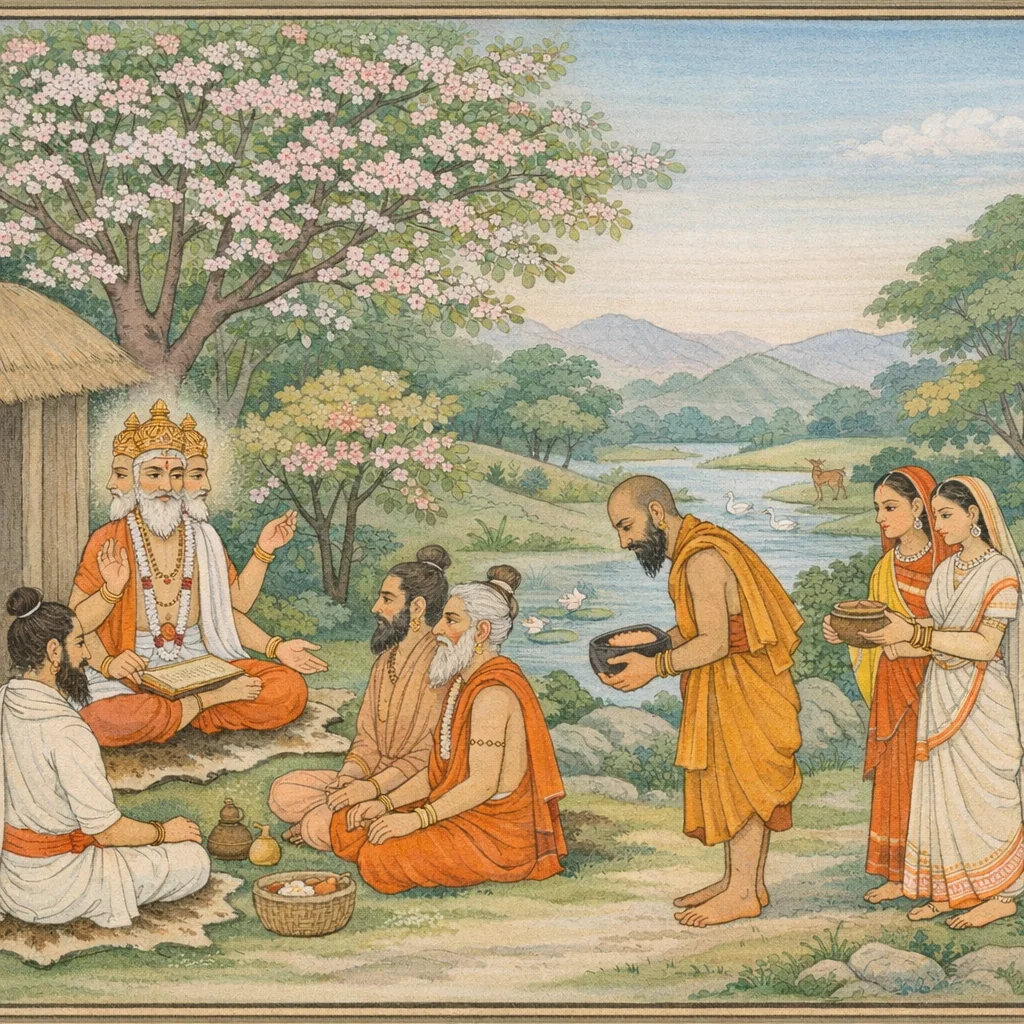
Adhyaya 46
Brahmā’s Instruction on Brahmacarya, Vānaprastha, and the Aliṅga Path (Ethics of Non-attachment)
Upa-parva: Mokṣa–Dharma Upadeśa (Renunciant Discipline Discourse)
This chapter is a prescriptive discourse attributed to Brahmā, presenting a graduated discipline across life-stages and culminating in a liberation-oriented ideal. It first defines the exemplary brahmacārin: study according to capacity, strict continence, sensory restraint, truthfulness, purity, service to the guru, regulated food with permission, daily fire offerings, simple staff and ochre-toned garments, and constant svādhyāya. It then outlines vānaprastha conduct: withdrawal to the forest, bark/skin clothing, morning ablutions, avoidance of village life, hospitality to guests, subsistence on roots, fruits, leaves, and grains, and controlled speech and appetite. The final movement describes the mokṣa-seeker’s mendicant discipline: offering fearlessness to beings, acting without possessiveness, accepting unsolicited and minimal sustenance, avoiding accumulation, maintaining equanimity in gain/loss, and practicing non-harm, truth, straightforwardness, non-anger, and non-slander. The chapter emphasizes inward withdrawal (tortoise-like retraction of senses), freedom from dualities and egoism, and the ‘aliṅga’ (non-marked, non-display) mode of practice—moving in the world without ostentation. It concludes with an analytic enumeration of constituents (senses, elements, mind, intellect, self, unmanifest) to be discerned and relinquished, resulting in release from bonds and attainment of the highest state.
Chapter Arc: ब्रह्मा महर्षियों से कहते हैं—पूर्वोक्त मार्ग के अनुसार ब्रह्मचारी, वानप्रस्थी और संन्यासी का धर्म सुनो; मोक्ष की ओर जाने वाला पथ आचरण की सूक्ष्मताओं में छिपा है। → व्रत-जीवन की कठोरता क्रमशः तीव्र होती जाती है: गुरु-आज्ञा से भोजन, अन्न की निन्दा न करना, भिक्षा-आधारित निर्वाह, बिना याचना/संकल्प के जो मिले उसी में संतोष, स्वाद-लोलुपता का त्याग, और लोक-अपमान सहकर भी सत्धर्म की निन्दा न करना। → मोक्षविद् संन्यासी का शिखर-लक्षण उद्घोषित होता है—वह न किसी को उद्वेग देता है, न किसी से स्वयं उद्विग्न होता है; सर्वभूतों का विश्वासी बनकर, रस-आस्वाद से परे, केवल प्राणधारण हेतु यथामात्र भोजन करता है। → आचार-सम्पन्न मुनि की परिभाषा स्थिर होती है: लोक-तिरस्कार सहकर भी शान्ति, शुचिता, इन्द्रियनिग्रह, और विवेक-चिन्तन (इन्द्रिय-विषय, पंचमहाभूत, मन-बुद्धि-अहंकार, प्रकृति-पुरुष) द्वारा बन्धनों से विमुक्ति; फलस्वरूप स्वर्ग/उर्ध्वगति का आश्वासन।
Shlokas
Verse 1
ऑपन--माज बछ। ःडिज षट्चत्वारिशो5 ध्याय: ब्रह्मचारी, वानप्रस्थी और संन्यासीके धर्मका वर्णन ब्रह्मोवाच एवमेतेन मार्गेण पूर्वोक्तेन यथाविधि । अधीतवान् यथाशक्ति तथैव ब्रह्म॒चर्यवान्,ब्रह्माजीनी कहा--महर्षिगण! इस प्रकार इस पूर्वोक्त मार्गके अनुसार गृहस्थको यथावत् आचरण करना चाहिये एवं यथाशक्ति अध्ययन करते हुए ब्रह्मचर्य-व्रतका पालन करनेवाले पुरुषको चाहिये कि वह अपने धर्ममें तत्पर रहे, विद्वान् बने, सम्पूर्ण इन्द्रियोंको अपने अधीन रखे, मुनि-व्रतका पालन करे, गुरुका प्रिय और हित करनेमें लगा रहे, सत्य बोले तथा धर्मपरायण एवं पवित्र रहे
Brahmā said: “In this very way—following the previously stated path and the proper rule—one should live as prescribed. Having studied according to one’s capacity, and maintaining the vow of brahmacarya, a man should remain steadfast in his own duty: become learned, bring all the senses under control, observe the discipline of a sage, strive for what is pleasing and beneficial to the teacher, speak truth, and remain devoted to dharma and purity.”
Verse 2
स्वधर्मनिरतो विद्वान् सर्वेन्द्रिययतो मुनि: । गुरो: प्रियहिते युक्त: सत्यधर्मपर: शुचि:,ब्रह्माजीनी कहा--महर्षिगण! इस प्रकार इस पूर्वोक्त मार्गके अनुसार गृहस्थको यथावत् आचरण करना चाहिये एवं यथाशक्ति अध्ययन करते हुए ब्रह्मचर्य-व्रतका पालन करनेवाले पुरुषको चाहिये कि वह अपने धर्ममें तत्पर रहे, विद्वान् बने, सम्पूर्ण इन्द्रियोंको अपने अधीन रखे, मुनि-व्रतका पालन करे, गुरुका प्रिय और हित करनेमें लगा रहे, सत्य बोले तथा धर्मपरायण एवं पवित्र रहे
Vāyu said: “Let a man be devoted to his own prescribed duty and become truly learned. Let him, as a disciplined sage, restrain all his senses. Let him be engaged in what is pleasing and beneficial to his teacher, speak truth, remain devoted to righteousness, and keep himself pure.”
Verse 3
गुरुणा समनुज्ञातो भुज्जीतान्नमकुत्सयन् । हविष्यभैक्ष्यभुक् चापि स्थानासनविहारवान्,गुरुकी आज्ञा लेकर भोजन करे। भोजनके समय अन्नकी निन्दा न करे। भिक्षाके अन्नको हविष्य मानकर ग्रहण करे। एक स्थानपर रहे। एक आसनसे बैठे और नियत समयमें भ्रमण करे
Vāyu said: “Having received his teacher’s permission, he should eat his food without disparaging it. Even when living on alms, he should accept that begged food as if it were a sacrificial offering (havis). He should remain in a fixed place, keep to a single seat, and go out for walking only at regulated times.”
Verse 4
द्विकालमन्निं जुद्दान: शुचिर्भूत्वा समाहित: । धारयीत सदा दण्डं बैल्वं पालाशमेव वा,पवित्र और एकाग्रचित्त होकर दोनों समय अग्निमें हवन करे। सदा बेल या पलाशका दण्ड लिये रहे
Vāyu-deva said: “Having become pure and self-controlled, and with the mind collected, one should offer oblations into the sacred fire at both daily times. One should always carry a staff made of bilva wood, or else of palāśa. Thus the discipline of purity, steadiness, and regulated worship is maintained as a foundation for dharma.”
Verse 5
क्षौीमं कार्पासिकं चापि मृगाजिनमथापि वा । सर्व काषायरक्तं वा वासो वापि द्विजस्य ह,रेशमी अथवा सूती वस्त्र या मृगचर्म धारण करे। अथवा ब्राह्मणके लिये सारा वस्त्र गेरुए रंगका होना चाहिये
Vāyu-deva said: “For a twice-born (especially a brāhmaṇa), the garment may be of linen, or of cotton, or even a deer-skin; or else his clothing may be entirely dyed in ochre-red. Thus, the text lays down acceptable forms of dress for the ascetic or disciplined life—favoring simplicity, restraint, and visible commitment to purity and dharma rather than luxury.”
Verse 6
मेखला च भवेन्मौज्जी जटी नित्योदकस्तथा । यज्ञोपवीती स्वाध्यायी अलुब्धो नियतव्रत:,ब्रह्मचारी मूँजकी मेखला पहने, जटा धारण करे, प्रतिदिन स्नान करे, यज्ञोपवीत पहने, वेदके स्वाध्यायमें लगा रहे तथा लोभहीन होकर नियमपूर्वक व्रतका पालन करे
Vāyu-deva declares the marks of a disciplined brahmacārin: he should wear a girdle made of muñja-grass, keep matted locks, bathe daily, wear the sacred thread, remain devoted to Vedic self-study, and—free from greed—observe his vows with steady restraint. The verse frames ascetic discipline as an ethical training: purity of conduct, regular practice, and inner non-attachment are presented as the foundations of dharma.
Verse 7
पूताभिश्न तथैवाद्धिः सदा दैवततर्पणम् । भावेन नियत: कुर्वन् ब्रह्मचारी प्रशस्यते,जो ब्रह्मचारी सदा नियमपरायण होकर श्रद्धाके साथ शुद्ध जलसे नित्य देवताओंका तर्पण करता है, उसकी सर्वत्र प्रशंसा होती है
Vāyu said: “He is praised everywhere who, steadfast in his vows as a brahmacārin, regularly offers libations to the gods with pure water, doing so with sincere faith and right intention. Such disciplined devotion is held up as exemplary conduct.”
Verse 8
एवं युक्तो जयेल्लोकान् वानप्रस्थो जितेन्द्रिय: । न संसरति जातीषु परमं स्थानमाश्रित:,इसी प्रकार आगे बतलाये जानेवाले उत्तम गुणोंसे युक्त जितेन्द्रिय वानप्रस्थी पुरुष भी उत्तम लोकोंपर विजय पाता है। वह उत्तम स्थानको पाकर फिर इस संसारमें जन्म धारण नहीं करता
Verse 9
संस्कृत: सर्वसंस्कारैस्तथैव ब्रह्मचर्यवान् । ग्रामान्निष्क्रम्य चारण्ये मुनि: प्रत्रजितो वसेत्,वानप्रस्थ मुनिको सब प्रकारके संस्कारोंके द्वारा शुद्ध होकर ब्रह्मचर्यव्रतका पालन करते हुए घरकी ममता त्यागकर गाँवसे बाहर निकलकर वनमें निवास करना चाहिये
Verse 10
चर्मवल्कलसंवासी सायं प्रातरुपस्पृशेत् । अरण्यगोचरो नित्य न ग्रामं प्रविशेत् पुन:,वह मृगचर्म अथवा वल्कल-वस्त्र पहने। प्रातः: और सायंकालके समय स्नान करे। सदा वनमें ही रहे। गाँवमें फिर कभी प्रवेश न करे
Vāyu-deva said: “Let him live clad in hide or bark-garments. Let him perform ritual purification by bathing at dawn and at dusk. Let him dwell constantly in the forest, and never again enter a village.” The instruction frames an ascetic discipline of withdrawal from social life, emphasizing purity, restraint, and steadfast renunciation as a dharmic mode of living.
Verse 11
अर्चयन्नतिथीन् काले दद्याच्चापि प्रतिश्रयम् । फलपत्रावरैर्मूले: श्यामाकेन च वर्तयन्,अतिथिको आश्रय दे और समयपर उनका सत्कार करे। जंगली फल, मूल, पत्ता अथवा सावाँ खाकर जीवन-निर्वाह करे
Vāyu said: “At the proper time one should honor visiting guests and also provide them shelter. Sustaining oneself on wild fruits, leaves, and roots—or even on śyāmāka grain—one should live in a way that never neglects hospitality.”
Verse 12
प्रवृत्तमुदकं वायुं सर्व वानेयमाश्रयेत् । प्राश्नीयादानुपूर्व्येण यथादीक्षमतन्द्रित:,बहते हुए जल, वायु आदि सब वनकी वस्तुओंका ही सेवन करे। अपने व्रतके अनुसार सदा सावधान रहकर क्रमश: उपर्युक्त वस्तुओंका आहार करे
Vāyu-deva said: “Let him subsist only on what the forest provides—flowing water, air, and other wild produce. Remaining ever vigilant and true to his vowed discipline, he should take these in due order, as prescribed by his consecration.”
Verse 13
समूलफल;भि क्षाभिरचेंदतिथिमागतम् | यद् भक्ष्यं स्थात् ततो दद्याद भिक्षां नित्यमतन्द्रित:,यदि कोई अतिथि आ जाय तो फल-मूलकी भिक्षा देकर उसका सत्कार करे। कभी आलस्य न करे। जो कुछ भोजन अपने पास उपस्थित हो, उसीमेंसे अतिथिको भिक्षा दे
Vāyu said: “When an unannounced guest arrives, one should honor him by offering alms of roots and fruits. One must never be negligent. Whatever food is available at the moment—out of that very store one should always give the guest his share.”
Verse 14
देवतातिथि पूर्व च सदा प्राश्नीत वाग्यत: । अस्पर्धितमनाश्चैव लघ्वाशी देवताश्रय:,नित्य प्रति पहले देवता और अतिथियोंको भोजन दे, उसके बाद मौन होकर स्वयं अन्न ग्रहण करे। मनमें किसीके साथ स्पर्धा न रखे, हलका भोजन करे, देवताओंका सहारा ले
Vāyu said: “One should always first offer food to the gods and to guests; thereafter, keeping silence and self-restraint, one should partake of one’s own meal. Let the mind be free from rivalry with anyone; let one eat lightly, and live taking refuge in the gods.”
Verse 15
दान्तो मैत्र: क्षमायुक्त: केशान् श्मश्रुच धारयन् । जुद्दन् स्वाध्यायशीलश्च सत्यधर्मपरायण:,इन्द्रियोंका संयम करे, सबके साथ मित्रताका बर्ताव करे, क्षमाशील बने और दाढ़ी-मूँछ तथा सिरके बालोंको धारण किये रहे। समयपर अग्निहोत्र और वेदोंका स्वाध्याय करे तथा सत्य-धर्मका पालन करे
Vāyu said: “Let him be self-controlled and friendly, endowed with forbearance, and keep his hair and beard. Let him duly maintain the sacred fires (performing the agnihotra), be devoted to Vedic study, and remain steadfast in truth and dharma.”
Verse 16
शुचिदेह: सदा दक्षो वननित्य: समाहित: । एवं युक्तो जयेत् स्वर्ग वानप्रस्थो जितेन्द्रिय:,शरीरको सदा पवित्र रखे। धर्म-पालनमें कुशलता प्राप्त करे। सदा वनमें रहकर चित्तको एकाग्र किये रहे। इस प्रकार उत्तम धर्मोको पालन करनेवाला जितेन्द्रिय वानप्रस्थी स्वर्गपर विजय पाता है
Vāyu said: “Let the forest-dweller keep his body pure, remain ever capable and diligent in the duties of dharma, live continually in the forest, and stay collected in mind. Thus disciplined and self-controlled, the vānaprastha—having conquered his senses—wins the heavenly world.”
Verse 17
गृहस्थो ब्रह्मचारी च वानप्रस्थो5थ वा पुन: । य इच्छेन्मोक्षमास्थातुमुत्तमां वृत्तिमाश्रयेत्,ब्रह्मचारी, गृहस्थ अथवा वानप्रस्थ कोई भी क्यों न हो, जो मोक्ष पाना चाहता हो, उसे उत्तम वृत्तिका आश्रय लेना चाहिये
Vāyu said: “Whether one lives as a householder, a celibate student, or a forest-dweller—whoever truly wishes to set out upon liberation should adopt the highest mode of conduct.”
Verse 18
अभयं सर्वभूतेभ्यो दत्त्वा नैष्कर्म्यमाचरेत् । सर्वभूतसुखो मैत्र: सर्वेन्द्रिययतो मुनि:,(वानप्रस्थकी अवधि पूरी करके) सम्पूर्ण भूतोंको अभय-दान देकर कर्म-त्यागरूप संन्यास-धर्मका पालन करे। सब प्राणियोंके सुखमें सुख माने। सबके साथ मित्रता रखे। समस्त इन्द्रियोंका संयम और मुनि-वृत्तिका पालन करे
Vāyu said: “Having granted fearlessness to all beings, one should live the discipline of renunciation—acting without selfish motive. Let him find his own joy in the welfare of all creatures, remain friendly toward everyone, restrain all the senses, and uphold the conduct of a sage.”
Verse 19
अयाचितमसंक्लृप्तमुपपन्नं यदृच्छया । कृत्वा प्राह्ने चरेद् भैक्ष्यं विधूमे भुक्तवज्जने
Vāyu said: “Let him accept only what is unasked for, uncontrived, and comes of itself by chance. Having done his duties, at midday he should go forth for alms, and he should eat among people who have already eaten—taking food that is without smoke (not specially cooked for him).”
Verse 20
वृत्ते शरावसम्पाते भैक्ष्यं लिप्सेत मोक्षवित् । बिना याचना किये, बिना संकल्पके दैवात् जो अन्न प्राप्त हो जाय, उस भिक्षासे ही जीवन-निर्वाह करे। प्रातःकालका नित्यकर्म करनेके बाद जब गृहस्थोंके यहाँ रसोई-घरसे धुआँ निकलना बंद हो जाय, घरके सब लोग खा-पी चुकें और बर्तन धो-माजकर रख दिये गये हों, उस समय मोक्षधर्मके ज्ञाता संन्यासीको भिक्षा लेनेकी इच्छा करनी चाहिये ।। १९६ || लाभेन च न हृष्येत नालाभे विमना भवेत् | न चातिकभिक्षां भिक्षेत केवलं प्राणयात्रिक:,भिक्षा मिल जानेपर हर्ष और न मिलनेपर विषाद न करे। (लोभवश) बहुत अधिक भिक्षाका संग्रह न करे। जितनेसे प्राण-यात्राका निर्वाह हो उतनी ही भिक्षा लेनी चाहिये
Vāyu said: “A knower of liberation should seek alms only when the proper time has come—without begging, without scheming, and content with whatever food fate provides. After completing the morning duties, he should go for alms only when the household kitchens have finished cooking, the family has eaten, and the utensils have been washed and put away. If alms are obtained, he should not exult; if they are not obtained, he should not sink into dejection. He should not collect excessive alms out of greed, but take only so much as sustains the journey of life.”
Verse 21
यात्रार्थी कालमाकाडूक्षेश्षरेद् भैक्ष्यं समाहित: । लाभं॑ साधारण नेच्छेन्न भुज्जीताभिपूजित:,संन्यासी जीवन-निर्वाहके ही लिये भिक्षा माँगे। उचित समयतक उसके मिलनेकी बाट देखे। चित्तको एकाग्र किये रहे। साधारण वस्तुओंकी प्राप्तिकी भी इच्छा न करे। जहाँ अधिक सम्मान होता हो, वहाँ भोजन न करे
Vāyu-deva said: “A renunciant who begs only to sustain his journey and livelihood should wait for the proper time to receive alms, remaining collected and attentive. He should not even desire ordinary gains, and he should not eat where he is excessively honored.”
Verse 22
अभिपूजितलाभाद्धि विजुगुप्सेत भिक्षुक: | भुक्तान्यन्नानि तिक्तानि कषायकटुकानि च,मान-प्रतिष्ठाके लाभसे संन्यासीको घृणा करनी चाहिये। वह खाये हुए तिक्त, कसैले तथा कड़वे अन्नका स्वाद न ले
Vāyu said: A mendicant should feel revulsion toward gains that come through being specially honored and celebrated. He should accept as his fare only what has already been eaten—food that is bitter, astringent, or pungent—so that he does not become attached to taste, comfort, or the pursuit of status. The ethical point is that a renunciant must guard against pride and social prestige, which subtly bind the mind as surely as wealth.
Verse 23
नास्वादयीत भुगज्जानो रसांश्व मधुरांस्तथा । यात्रामात्रं च भुज्जीत केवलं प्राणधारणम्,भोजन करते समय मधुर रसका भी आस्वादन न करे। केवल जीवन-निर्वाहके उद्देश्यसे प्राण-धारणमात्रके लिये उपयोगी अन्नका आहार करे
Vāyu-deva said: “Even while eating, one should not indulge in tasting sweet flavors. One should take food only in the measure required for one’s journey through life—eating solely for the bare maintenance of breath and life.”
Verse 24
असंरोधेन भूतानां वृत्तिं लिप्सेत मोक्षवित् न चान्यमन्नं लिप्सेत भिक्षमाण: कथंचन,मोक्षके तत्त्वको जाननेवाला संन्यासी दूसरे प्राणियोंकी जीविकामें बाधा पहुँचाये बिना ही यदि भिक्षा मिल जाती हो तभी उसे स्वीकार करे। भिक्षा माँगते समय दाताके द्वारा दिये जानेवाले अन्नके सिवा दूसरा अन्न लेनेकी कदापि इच्छा न करे
Vāyu said: “One who knows the path to liberation should seek his livelihood without obstructing the lives of other beings. And while begging, he should never, under any circumstance, desire food other than what the giver freely offers.”
Verse 25
न संनिकाशयेद् धर्म विविक्ते चारजाश्षरेत् | शून्यागारमरण्यं वा वृक्षमूलं नदीं तथा,उसे अपने धर्मका प्रदर्शन नहीं करना चाहिये। रजोगुणसे रहित होकर निर्जन स्थानमें विचरते रहना चाहिये। रातको सोनेके लिये सूने घर, जंगल, वृक्षकी जड़, नदीके किनारे अथवा पर्वतकी गुफाका आश्रय लेना चाहिये। ग्रीष्मकालमें गाँवमें एक रातसे अधिक नहीं रहना चाहिये, किंतु वर्षाकालमें किसी एक ही स्थानपर रहना उचित है
Vāyu said: “One should not make a display of one’s dharma. Free from the agitation of rajas, one should move about in secluded places. For resting at night, one may take shelter in an empty house, a forest, the root of a tree, or the bank of a river.”
Verse 26
प्रतिश्रयार्थ सेवेत पार्वतीं वा पुनर्गुहाम् ग्रामैकरात्रिको ग्रीष्मे वर्षास्वेकत्र वा वसेत्,उसे अपने धर्मका प्रदर्शन नहीं करना चाहिये। रजोगुणसे रहित होकर निर्जन स्थानमें विचरते रहना चाहिये। रातको सोनेके लिये सूने घर, जंगल, वृक्षकी जड़, नदीके किनारे अथवा पर्वतकी गुफाका आश्रय लेना चाहिये। ग्रीष्मकालमें गाँवमें एक रातसे अधिक नहीं रहना चाहिये, किंतु वर्षाकालमें किसी एक ही स्थानपर रहना उचित है
Vāyu said: “For the sake of shelter, one may resort to a deserted house or again to a mountain cave. In the summer, one should stay in a village for only a single night; but in the rainy season it is proper to remain in one place.” The instruction frames an ascetic discipline: avoid display and comfort-seeking, take only minimal refuge for rest, and regulate one’s movements according to season so that practice remains steady and unobtrusive.
Verse 27
अध्वा सूर्येण निर्दिष्ट: कीटवच्च चरेन्महीम् । दयार्थ चैव भूतानां समीक्ष्य पृथिवीं चरेत्
“Let him follow the path indicated by the Sun, moving over the earth like a tiny insect—humbly and without pride. And, for the sake of compassion toward all beings, let him travel about, observing the world.”
Verse 28
पूताभिरद्धिर्नित्यं वै कार्य कुर्वीत मोक्षवित्
Vāyu said: “One who understands liberation should constantly perform the duties to be done, using purified means—acting with inner and outer cleanliness and with disciplined conduct—so that action itself becomes a support for freedom rather than bondage.”
Verse 29
अहिंसा ब्रह्मचर्य च सत्यमार्जवमेव च,अहिंसा, ब्रह्मचर्य, सत्य, सरलता, क्रोधका अभाव, दोष-दृष्टिका त्याग, इन्द्रियसंयम और चुगली न खाना--इन आठ व्रतोंका सदा सावधानीके साथ पालन करे। इन्द्रियोंको वशमें रखे
Vāyu said: “Non-violence, celibate self-restraint, truthfulness, and straightforwardness—along with freedom from anger, abandoning the habit of fault-finding, control of the senses, and refraining from tale-bearing—these are the eight vows. One should always guard them with vigilant effort and keep the senses under mastery.”
Verse 30
अक्रोधश्वानसूया च दमो नित्यमपैशुनम् । अष्टस्वेतेषु युक्त: स्याद् व्रतेषु नियतेन्द्रिय:,अहिंसा, ब्रह्मचर्य, सत्य, सरलता, क्रोधका अभाव, दोष-दृष्टिका त्याग, इन्द्रियसंयम और चुगली न खाना--इन आठ व्रतोंका सदा सावधानीके साथ पालन करे। इन्द्रियोंको वशमें रखे
Verse 31
अपापमशतं वृत्तमजिद्दां नित्यमाचरेत् । जोषयेत सदा भोज्यं ग्रासमागतमस्पृह:,उसे सदा पाप, शठता और कुटिलतासे रहित होकर बर्ताव करना चाहिये। नित्यप्रति जो अन्न अपने-आप प्राप्त हो जाय, उसको ग्रहण करना चाहिये, किंतु उसके लिये भी मनमें इच्छा नहीं रखनी चाहिये
Vāyu-deva said: “One should always conduct oneself in a manner free from sin—without deceit and without crookedness. Whatever morsel of food comes of itself, one should accept and partake of it, yet remain without craving even for that.”
Verse 32
यात्रामात्रं च भुज्जीत केवल प्राणयात्रिकम् | धर्मलब्धमथाश्रीयान्न काममनुवर्तयेत्,प्राणयात्राका निर्वाह करनेके लिये जितना अन्न आवश्यक है, उतना ही ग्रहण करे। धर्मतः प्राप्त हुए अन्नका ही आहार करे। मनमाना भोजन न करे
Vāyu-deva said: “One should eat only as much as is necessary to sustain life—only what supports one’s vital continuance. One should partake only of food obtained through dharma, and should not follow the impulses of craving or self-indulgence in eating.”
Verse 33
ग्रासादाच्छादनादन्यन्न गृह्लीयात् कथंचन । यावदाहारयेत् तावत् प्रतिगृह्लीत नाधिकम्,खानेके लिये अन्न और शरीर ढकनेके लिये वस्त्रके सिवा और किसी वस्तुका संग्रह न करे। भिक्षा भी, जितनी भोजनके लिये आवश्यक हो, उतनी ही ग्रहण करे, उससे अधिक नहीं
Vāyu-deva said: “One should never accept or store anything beyond what is needed for food and for covering the body. Even when receiving alms, one should take only as much as is required for one’s meal—never more.”
Verse 34
परेभ्यो न प्रतिग्राह्मूं न च देयं कदाचन । दैन्यभावाच्च भूतानां संविभज्य सदा बुध:,बुद्धिमान् संन्यासीको चाहिये कि दूसरोंके लिये भिक्षा न माँगे तथा सब प्राणियोंके लिये दयाभावसे संविभागपूर्वक कभी कुछ देनेकी इच्छा भी न करे
Vāyu said: “A wise renunciant should neither accept gifts from others nor ever give (with a view to charity). Rather, moved by compassion for living beings in distress, he should always distribute what comes to him by sharing it appropriately—without personal desire, display, or attachment.”
Verse 35
नाददीत परस्वानि न गृह्नीयादयाचित: । न किंचिद् विषयं भुक्त्वा स्पृहयेत् तस्य वै पुन:,दूसरोंके अधिकारका अपहरण न करे। बिना प्रार्थनाके किसीकी कोई वस्तु स्वीकार न करे। किसी अच्छी वस्तुका उपभोग करके फिर उसके लिये लालायित न रहे
Vāyu said: “One should not seize what belongs to another. One should not accept another’s property unless it is freely offered and requested for. And having enjoyed any object of sense, one should not again hanker after it.”
Verse 36
मृदमापस्तथाजन्नानि पत्रपुष्पफलानि च | असंवृतानि गृह्नीयात् प्रवृत्तानि च कार्यवान्,मिट्टी, जल, अन्न, पत्र, पुष्प और फल--ये वस्तुएँ यदि किसीके अधिकारमें न हों तो आवश्यकता पड़नेपर क्रियाशील संन्यासी इन्हें काममें ला सकता है
Vāyu said: “Earth (clay), water, food, and also leaves, flowers, and fruits—when these are not under anyone’s protected possession, a renunciant who is actively engaged in a necessary duty may take and use them. This is permitted when need arises, without violating dharma.”
Verse 37
न शिल्पजीविकां जीवेद्धिरण्यं नोत कामयेत् । न द्वेष्ठा नोपदेष्टा च भवेच्च निरुपस्कृत:,वह शिल्पकारी करके जीविका न चलावे, सुवर्णकी इच्छा न करे। किसीसे द्वेष न करे और उपदेशक न बने तथा संग्रहरहित रहे
Vāyu said: “One should not make a living by craft or trade, nor should one desire gold. Let him bear no hatred toward anyone, and let him not set himself up as a preacher or instructor. He should live without possessions or hoarding—unadorned, unencumbered—so that his conduct remains free from greed, rivalry, and dependence.”
Verse 38
श्रद्धापूतानि भुज्जीत निमित्तानि च वर्जयेत् । सुधावृत्तिरसक्तश्न सर्वभूतैरसंविदम्,श्रद्धासे प्राप्त हुए पवित्र अन्नका आहार करे। मनमें कोई निमित्त न रखे। सबके साथ अमृतके समान मधुर बर्ताव करे, कहीं भी आसक्त न हो और किसी भी प्राणीके साथ परिचय न बढ़ावे
Verse 39
आशीर्युक्तानि सर्वाणि हिंसायुक्तानि यानि च । लोकसंग्रहधर्म च नैव कुर्यान्न कारयेत्,जितने भी कामना और हिंसासे युक्त कर्म हैं, उन सबका एवं लौकिक कर्मोंका न स्वयं अनुष्ठान करे और न दूसरोंसे करावे
Vāyu said: One should neither perform oneself nor cause others to perform actions that are driven by desire for rewards, or that are tainted by violence; likewise, one should not engage in merely worldly duties pursued for social approval or maintenance when they compromise true righteousness. The teaching urges restraint from self-interested and harmful acts, and cautions against outsourcing such wrongdoing to others.
Verse 40
सर्वभावानतिक्रम्य लघुमात्र: परिव्रजेत् सम: सर्वेषु भूतेषु स्थावरेषु चरेषु च,सब प्रकारके पदार्थोकी आसक्तिका उल्लंघन करके थोड़ेमें संतुष्ट हो सब ओर विचरता रहे। स्थावर और जंगम सभी प्राणियोंके प्रति समान भाव रखे
Vāyu said: “Transcending attachment to every state and object of experience, one should wander as a renunciant, content with very little. Let him maintain an equal regard toward all beings—both the immobile and the moving.”
Verse 41
परं नोद्वेजयेत् काचिन्न च कस्यचिद॒द्विजेत् । विश्वास्य: सर्वभूतानामग्रयो मोक्षविदुच्यते,किसी दूसरे प्राणीको उद्वेगमें न डाले और स्वयं भी किसीसे उद्विग्न न हो। जो सब प्राणियोंका विश्वासपात्र बन जाता है, वह सबसे श्रेष्ठ और मोक्ष-धर्मका ज्ञाता कहलाता है
Verse 42
अनागतं च न ध्यायेन्नातीतमनुचिन्तयेत् । वर्तमानमुपेक्षेत कालाकाड्क्षी समाहित:,संन्यासीको उचित है कि भविष्यके लिये विचार न करे, बीती हुई घटनाका चिन्तन न करे और वर्तमानकी भी उपेक्षा कर दे। केवल कालकी प्रतीक्षा करता हुआ चित्तवृत्तियोंका समाधान करता रहे
Verse 43
न चक्षुषा न मनसा न वाचा दूषयेत् क्वचित् | न प्रत्यक्ष परोक्षं वा किंचिद् दुष्ट समाचरेत्,नेत्रसे, मनसे और वाणीसे कहीं भी दोषदृष्टि न करे। सबके सामने या दूसरोंकी आँख बचाकर कोई बुराई न करे
Vāyu said: “At no time should one taint others through the eye, the mind, or speech—by fault-finding or corrupt intent. Whether openly in front of others or secretly out of their sight, one should not commit any wicked act.”
Verse 44
इन्द्रियाण्युपसंहृत्य कूर्मोडड्रानीव सर्वश: । क्षीणेन्द्रियमनोबुद्धिर्निरीह: सर्वतत्त्ववित्,जैसे कछुआ अपने अंगोंको सब ओरसे समेट लेता है, उसी प्रकर इन्द्रियोंको विषयोंकी ओरसे हटा ले। इन्द्रिय, मन और बुद्धिको दुर्बल करके निश्वेष्ट हो जाय। सम्पूर्ण तत्त्वोंका ज्ञान प्राप्त करे
Vāyu said: “Withdraw the senses completely, as a tortoise draws in its limbs on every side. With the senses, mind, and intellect made quiet and weakened toward outward objects, remain free from restless striving, and become a knower of all principles (tattvas).”
Verse 45
निर्द्धदद्ों निर्ममस्कारो निःस्वाहाकार एव च | निर्ममो निरहंकारो निर्योगक्षेम आत्मवान्,द्वन्दोंसे प्रभावित न हो, किसीके सामने माथा न टेके। स्वाहाकार (अग्निहोत्र आदि)- का परित्याग करे। ममता और अहंकारसे रहित हो जाय, योगक्षेमकी चिन्ता न करे। मनपर विजय प्राप्त करे
Vāyu said: “Let him become free from the pairs of opposites; let him offer no servile bowing before anyone; let him abandon the ‘svāhā’ rites (such as offerings into fire). Let him be without possessiveness and without ego, unconcerned with gain and security, and self-controlled—so that he is not shaken by dualities and has mastery over the mind.”
Verse 46
निराशीर्निर्गुण: शान्तो निरासक्तो निराश्रय: । आत्मसज्जी च तत्त्वज्ञो मुच्यते नात्र संशय:,जो निष्काम, निर्गुण, शान्त, अनासक्त, निराश्रय, आत्मपरायण और तत्त्वका ज्ञाता होता है, वह मुक्त हो जाता है, इसमें संशय नहीं है इति श्रीमहाभारते आश्वमेधिके पर्वणि अनुगीतापर्वणि गुरुशिष्यसंवादे षट्चत्वारिंशो5ध्याय:
Vāyu-deva said: “One who is free from craving, beyond the play of the guṇas, inwardly tranquil, unattached, without dependence on external supports, firmly devoted to the Self, and a knower of reality—such a person is liberated; of this there is no doubt.”
Verse 47
अपादपाणिपृष्ठं तदशिरस्कमनूदरम् । प्रहीणगुणकर्माणं केवलं विमलं स्थिरम्,जो मनुष्य आत्माको हाथ, पैर, पीठ, मस्तक और उदर आदि अंगोंसे रहित, गुण- कर्मोंसे हीन, केवल, निर्मल, स्थिर, रूप-रस-गन्ध-स्पर्श और शब्दसे रहित, ज्ञेय, अनासक्त, हाड़-मांसके शरीरसे रहित, निश्चिन्त, अविनाशी, दिव्य और सम्पूर्ण प्राणियोंमें स्थित सदा एकरस रहनेवाला जानते हैं, उनकी कभी मृत्यु नहीं होती
Vāyu said: That Self is understood as having no feet, hands, back, head, or belly—devoid of the operations of the guṇas and of karma; solitary, stainless, and unshaken. One who knows the Self in this way—as unattached, beyond sensory qualities, and not confined to the perishable body—does not truly die; for such knowledge rests in the imperishable, divine reality that abides equally in all beings.
Verse 48
अगन्धमरसस्पर्शमरूपाशब्दमेव च । अनुगम्यमनासक्तममांसमपि चैव यत्,जो मनुष्य आत्माको हाथ, पैर, पीठ, मस्तक और उदर आदि अंगोंसे रहित, गुण- कर्मोंसे हीन, केवल, निर्मल, स्थिर, रूप-रस-गन्ध-स्पर्श और शब्दसे रहित, ज्ञेय, अनासक्त, हाड़-मांसके शरीरसे रहित, निश्चिन्त, अविनाशी, दिव्य और सम्पूर्ण प्राणियोंमें स्थित सदा एकरस रहनेवाला जानते हैं, उनकी कभी मृत्यु नहीं होती
Vāyu said: That Self which is without smell, without taste and without touch; which is without form and indeed without sound; which is to be realized (by inner pursuit), unattached, and even without flesh—those who know the human Self to be devoid of limbs such as hands, feet, back, head, and belly; free from qualities and actions; pure, steady, beyond form, taste, smell, touch, and sound; knowable, unattached, free from the bony-fleshy body, untroubled, imperishable, divine, and abiding in all beings as ever the same—such knowers do not meet with death.
Verse 49
निश्चिन्तमव्ययं दिव्यं कूटस्थमपि सर्वदा | सर्वभूतस्थमात्मानं ये पश्यन्ति न ते मृता:,जो मनुष्य आत्माको हाथ, पैर, पीठ, मस्तक और उदर आदि अंगोंसे रहित, गुण- कर्मोंसे हीन, केवल, निर्मल, स्थिर, रूप-रस-गन्ध-स्पर्श और शब्दसे रहित, ज्ञेय, अनासक्त, हाड़-मांसके शरीरसे रहित, निश्चिन्त, अविनाशी, दिव्य और सम्पूर्ण प्राणियोंमें स्थित सदा एकरस रहनेवाला जानते हैं, उनकी कभी मृत्यु नहीं होती
Vāyu said: Those who truly perceive the Self as free from anxiety, imperishable, divine, ever unchanging, and present within all beings—such people are not overcome by death. The teaching points to liberation through right knowledge: when one recognizes the inner Self as untouched by bodily change and universally indwelling, fear and mortality lose their hold.
Verse 50
न तत्र क्रमते बुद्धिर्नेन्द्रियाणि न देवता: । वेदा यज्ञाक्ष लोकाक्ष न तपो न व्रतानि च,उस आत्मतत्त्वतक बुद्धि, इन्द्रिय और देवताओंकी भी पहुँच नहीं होती। जहाँ केवल ज्ञानवान् महात्माओंकी ही गति है, वहाँ वेद, यज्ञ, लोक, तप और व्रतका भी प्रवेश नहीं होता; क्योंकि वह बाह्य चिह्लसे रहित मानी गयी है। इसलिये बाह्य चिह्नोंसे रहित धर्मको जानकर उसका यथार्थरूपसे पालन करना चाहिये
Vāyu said: “In that supreme reality, neither the intellect can advance, nor the senses, nor even the gods. There, neither the Vedas nor sacrifices, nor the worlds of ordinary experience have entry—nor austerity, nor vows. For it is held to be beyond external marks. Therefore, having understood the dharma that is free from outward signs, one should practice it in its true form.”
Verse 51
यत्र ज्ञानवतां प्राप्तिरलिड्रग्रहणा स्मृता । तस्मादलिड्जधर्मज्ञो धर्मतत्त्वमुपाचरेत्,उस आत्मतत्त्वतक बुद्धि, इन्द्रिय और देवताओंकी भी पहुँच नहीं होती। जहाँ केवल ज्ञानवान् महात्माओंकी ही गति है, वहाँ वेद, यज्ञ, लोक, तप और व्रतका भी प्रवेश नहीं होता; क्योंकि वह बाह्य चिह्लसे रहित मानी गयी है। इसलिये बाह्य चिह्नोंसे रहित धर्मको जानकर उसका यथार्थरूपसे पालन करना चाहिये
Vāyudeva said: “That state which is reached by the wise is remembered as ‘without outward marks.’ Therefore, one who understands the dharma that is free from external signs should practice the true essence of dharma.” The teaching points beyond ritual and visible badges of religiosity, urging an inward, reality-based pursuit of dharma accessible only through knowledge and realization.
Verse 52
गूढधर्माश्रितो विद्वान् विज्ञानचरितं चरेत् । अमूढो मूढरूपेण चरेद् धर्ममदूषयन्,गुहा धर्ममें स्थित विद्वान् पुरुषको उचित है कि वह विज्ञानके अनुरूप आचरण करे। मूढ़ न होकर भी मूढ़के समान बर्ताव करे, किंतु अपने किसी व्यवहारसे धर्मको कलंकित न करे
Vāyu said: “A wise man, taking refuge in the hidden (subtle) ways of dharma, should conduct himself in accordance with true discernment. Though not deluded, he may move about in the guise of one who is simple or even foolish—yet he must never, by any act of his, stain or compromise dharma.”
Verse 53
तथैनमवमन्येरन् परे सततमेव हि । यथावृत्तश्नरेच्छान्त: सतां धर्मानकुत्सयन्
“In that case, others would continually hold him in contempt. But one who is content with whatever comes in the natural course of events, and who does not disparage the righteous ways upheld by the good, remains steady and beyond such reproach.”
Verse 54
इन्द्रियाणीन्द्रियार्थाश्ष महाभूतानि पडच च,ततः स्वर्गमवाप्रोति विमुक्त: सर्वबन्धनै: | जो मनुष्य इन्द्रिय, उनके विषय, पठचमहाभूत, मन, बुद्धि, अहंकार, प्रकृति और पुरुष --इन सबका विचार करके इनके तत्त्वका यथावत् निश्चय कर लेता है, वह सम्पूर्ण बन्धनोंसे मुक्त होकर स्वर्गको प्राप्त कर लेता है
Vāyu said: One who rightly discerns the true nature of the senses and their objects, along with the five great elements, becomes freed from every bond and thereby attains heaven. The ethical thrust is inward: liberation is gained not by outward conquest but by clear knowledge and detachment from the constituents that bind embodied life.
Verse 55
मनो बुद्धिरहंकारमव्यक्तं पुरुषं तथा । एतत् सर्व प्रसंख्याय यथावत् तत्त्वनिश्चयात्
Vāyu said: “Mind, intellect, ego-sense, the unmanifest principle, and also the Person (Puruṣa)—having duly enumerated all these in their proper order, one arrives at a firm ascertainment of reality.”
Verse 56
एतावदन्तवेलायां परिसंख्याय तत्त्ववित्,जो तत्त्ववेत्ता अन्त समयमें इन तत्त्वोंका ज्ञान प्राप्त करके एकान्तमें बैठकर परमात्माका ध्यान करता है, वह आकाशमें विचरनेवाले वायुकी भाँति सब प्रकारकी आसक्तियोंसे छूटकर पञ्चकोशोंसे रहित, निर्भय तथा निराश्रय होकर मुक्त एवं परमात्माको प्राप्त हो जाता है
Vāyu-deva said: ‘Thus, at the final hour, the knower of reality—having carefully reckoned and understood these principles—sits in solitude and meditates on the Supreme Self. Like the wind that moves freely through the sky, he becomes released from every kind of attachment; transcending the five sheaths, fearless and without dependence, he is liberated and attains the Supreme Self.’
Verse 57
ध्यायेदेकान्तमास्थाय मुच्यते5थ निराश्रय: । निर्मुक्त: सर्वसड्रेभ्यो वायुराकाशगो यथा,जो तत्त्ववेत्ता अन्त समयमें इन तत्त्वोंका ज्ञान प्राप्त करके एकान्तमें बैठकर परमात्माका ध्यान करता है, वह आकाशमें विचरनेवाले वायुकी भाँति सब प्रकारकी आसक्तियोंसे छूटकर पञ्चकोशोंसे रहित, निर्भय तथा निराश्रय होकर मुक्त एवं परमात्माको प्राप्त हो जाता है
Vāyu-deva said: “Taking refuge in solitude, one should meditate; then, becoming without dependence, one is released. Freed from every attachment—like the wind that moves through the open sky—such a knower of reality, at life’s end, attains liberation and reaches the Supreme Self.”
Verse 58
क्षीणकोशो निरातड्कस्तथेदं प्राप्तुयात् परम्,जो तत्त्ववेत्ता अन्त समयमें इन तत्त्वोंका ज्ञान प्राप्त करके एकान्तमें बैठकर परमात्माका ध्यान करता है, वह आकाशमें विचरनेवाले वायुकी भाँति सब प्रकारकी आसक्तियोंसे छूटकर पञ्चकोशोंसे रहित, निर्भय तथा निराश्रय होकर मुक्त एवं परमात्माको प्राप्त हो जाता है
Vāyu-deva said: “He becomes one whose sheaths are exhausted and who is free from fear; thus he reaches the Supreme. The knower of reality, at the final hour, having gained true knowledge of these principles and sitting in solitude, meditates on the Supreme Self. Like the wind that moves through the sky, he slips free of every attachment; becoming devoid of the five sheaths, fearless and without dependence, he is liberated and attains the Supreme Self.”
Verse 273
संचयांश्व न कुर्वीत स्नेहवासं च वर्जयेत् । जबतक सूर्यका प्रकाश रहे तभीतक संन्यासीके लिये रास्ता चलना उचित है। वह कीड़ेकी तरह धीरे-धीरे समूची पृथ्वीपर विचरता रहे और यात्राके समय जीवोंपर दया करके पृथ्वीको अच्छी तरह देख-भालकर आगे पाँव रखे। किसी प्रकारका संग्रह न करे और कहीं भी आसक्तिपूर्वक निवास न करे
Vāyu said: “A renunciant should not accumulate possessions, and should avoid settling anywhere out of attachment. Only while the sun’s light remains is it proper for a wandering ascetic to travel the road. Moving slowly like a tiny creature, he should roam over the whole earth; and while journeying, out of compassion for living beings, he should carefully look at the ground and place each step with attention. He should make no hoard of any kind and should not dwell anywhere with clinging.”
Verse 286
उपस्पृशेदुद्धृताभिरद्धिश्व॒ पुरुष: सदा । मोक्ष-धर्मके ज्ञाता संन्यासीको उचित है कि सदा पवित्र जलसे काम ले। प्रतिदिन तुरंत निकाले हुए जलसे स्नान करे (बहुत पहलेके भरे हुए जलसे नहीं)
Vāyu-deva said: “A person should always perform purification rites using freshly drawn water. Especially for one who knows the dharma of liberation and lives as a renunciant, it is proper to rely on pure water and to bathe each day with water drawn immediately, not with water stored long before.”
Verse 533
य एवं वृत्तसम्पन्न: स मुनि: श्रेष्ठ उच्यते । जिस कामके करनेसे समाजके दूसरे लोग अनादर करें, वैसा ही काम शान्त रहकर सदा करता रहे, किंतु सत्पुरुषोंके धर्मकी निन्दा न करे। जो इस प्रकारके बर्तावसे सम्पन्न है, वह श्रेष्ठ मुनि कहलाता है
Vāyu said: “He who is endowed with such disciplined conduct is called the best of sages. Even if others in society show disrespect for the work he undertakes, he should calmly continue to do what is right; yet he must never revile the dharma of the virtuous. One who is perfected in such behavior is truly the श्रेष्ठ (foremost) muni.”
Verse 556
ततः स्वर्गमवाप्रोति विमुक्त: सर्वबन्धनै: | जो मनुष्य इन्द्रिय, उनके विषय, पठचमहाभूत, मन, बुद्धि, अहंकार, प्रकृति और पुरुष --इन सबका विचार करके इनके तत्त्वका यथावत् निश्चय कर लेता है, वह सम्पूर्ण बन्धनोंसे मुक्त होकर स्वर्गको प्राप्त कर लेता है
Then he attains heaven, freed from every bond. The person who reflects upon the senses and their objects, the five great elements, the mind, intellect, ego, and the principles of Prakṛti and Puruṣa, and who arrives at a correct determination of their true nature—such a one becomes released from all attachments and reaches the heavenly state. In Vāyu’s teaching, liberation begins with clear discernment: knowing what is merely a constituent of nature and what is the witnessing Self loosens the knots of bondage.
Frequently Asked Questions
The chapter addresses how to pursue liberation without social disruption: it resolves the tension by prescribing minimal dependence, non-harm, truthful restraint, and a non-ostentatious (aliṅga) practice that avoids seeking status through visible piety.
Liberation is framed as a practical discipline of restraint and relinquishment: equanimity, non-attachment, and discernment of the constituents of experience culminate in freedom from bonds rather than in external accomplishment.
Yes. The chapter asserts that one who maintains these disciplines—especially non-attachment, sense-withdrawal, and relinquishment of constituents—does not cycle through births and attains the highest state, described as liberation from all bonds.