Adhyaya 11
इन्द्रक्रोधः, संवर्तक-वर्षणम्, गोवर्धनधारण-लीला
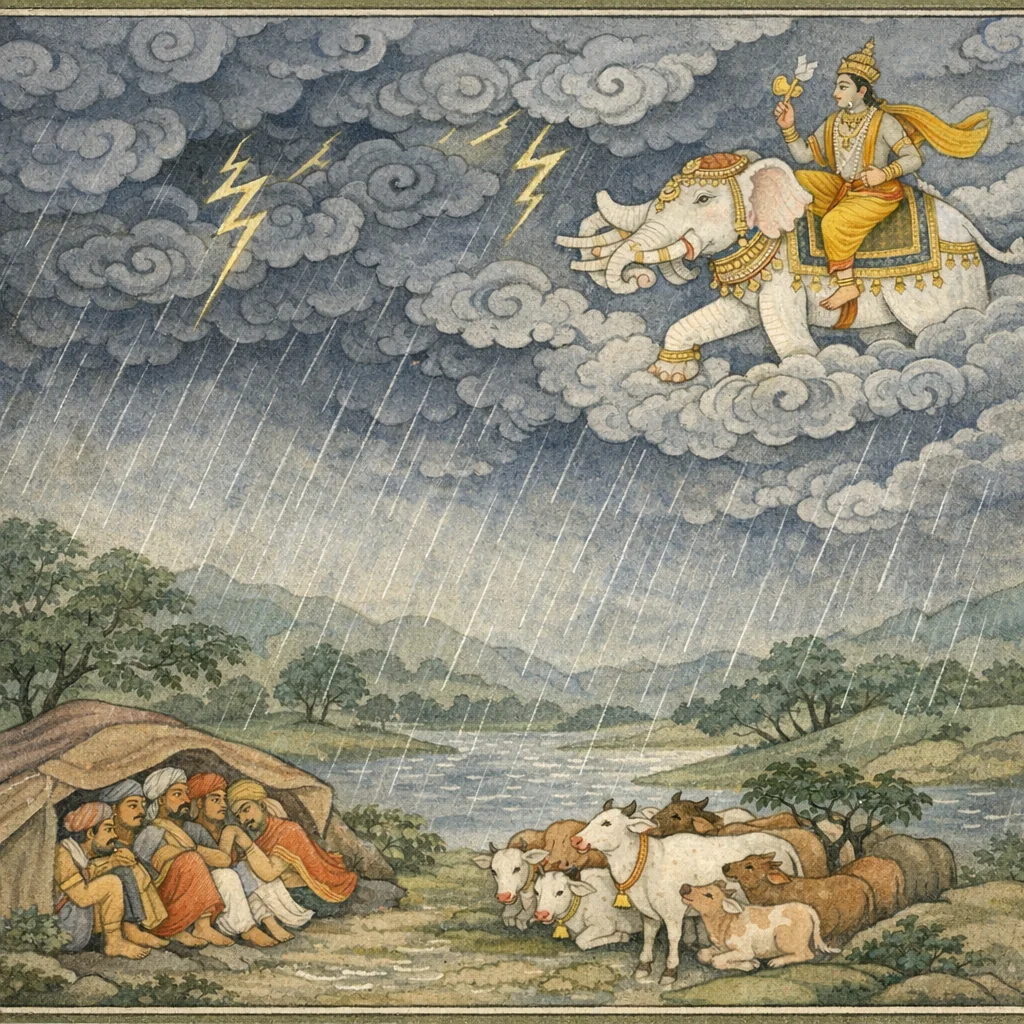
Parāśara tells Maitreya that Indra, angered at being “checked,” commands the Saṃvartaka host of clouds to act at once. Striking at Vraja’s very life—its cattle—he unleashes a dreadful storm of wind and rain; darkness spreads, earth and sky seem merged in one flood, and lightning and thunder deepen the ruin as cows and calves suffer. Seeing Gokula overwhelmed, Hari resolves to protect the whole settlement from Mahendra’s pride-born assault. Śrī Kṛṣṇa uproots Govardhana and holds it aloft with one hand like a vast umbrella, directing the cowherds and cowherd women to take shelter beneath with carts and herds. For seven nights the clouds pour down, yet Kṛṣṇa stands unwavering, praised by the Vrajavāsins. At last Indra’s vow fails; he withdraws the clouds, the sky clears, Kṛṣṇa sets the mountain back in place, and all return safely.
Shlokas
Verse 1
महे प्रतिहते शक्रो मैत्रेयातिरुषान्वितः संवर्तकं नाम गणं तोयदानाम् अथाब्रवीत्
When the great one (Indra) had been checked and thwarted, O Maitreya, Śakra—his heart inflamed with anger—addressed the rain-bearing host named Saṃvartaka.
Verse 2
भो भो मेघा निशम्यैतद् वचनं वदतो मम आज्ञानन्तरम् एवाशु क्रियताम् अविचारितम्
“O clouds, O clouds—hear my words: carry out my command at once, without hesitation and without deliberation.”
Verse 3
नन्दगोपः सुदुर्बुद्धिर् गोपैर् अन्यैः सहायवान् कृष्णाश्रयबलाध्मातो महभङ्गम् अचीकरत्
Nanda the cowherd, misguided in judgment, aided by other gopas and swollen with confidence from taking refuge in Śrī Kṛṣṇa’s protection, set about causing a great disruption.
Verse 4
आजीवो यः परस् तेषां गोपत्वस्य च कारणम् ता गावो वृष्टिपातेन पीड्यन्तां वचनान् मम
He who is their highest livelihood and the very cause of their life as cowherds—by my command, let those cattle be afflicted by the pounding fall of torrential rain.
Verse 5
अहम् अप्य् अद्रिशृङ्गाभं तुङ्गम् आरुह्य वारणम् साहाय्यं वः करिष्यामि वाय्वम्बूत्सर्गयोजितम्
I too shall mount a lofty elephant, towering like a mountain peak, and I will aid you—joined to the work of unleashing wind and water—so this undertaking may be fulfilled.
Verse 6
इत्य् आज्ञप्ताः सुरेन्द्रेण मुमुचुस् ते बलाहकाः वातवर्षं महाभीमम् अभावाय गवां द्विज
Thus commanded by the lord of the gods, O twice-born one, those rain-bearing clouds unleashed a dreadful storm of wind and rain, meant to bring ruin upon the cattle.
Verse 7
ततः क्षणेन धरणी ककुभो ऽम्बरम् एव च एकं धारामहासारपूरणेनाभवन् मुने
Then, O sage, in a single instant the earth, the quarters, and even the sky became as one, wholly filled and made continuous by the mighty, pouring torrents of that overwhelming flood.
Verse 8
विद्युल्लताकषाघातत्रस्तैर् इव घनैर् घनम् नादापूरितदिक्चक्रैर् धारासारम् अपात्यत
As if terrified by the whip-like strokes of lightning, the massed clouds, filling the circle of directions with thunder, poured down an unceasing torrent of rain.
Verse 9
अन्धकारीकृते लोके वर्षद्भिर् अनिशं घनैः अधश् चोर्ध्वं च तिर्यक् च जगद् आप्यम् इवाभवत्
As the world was veiled in darkness and dense clouds poured without cease, the universe—below, above, and in every direction—seemed to become one continuous expanse of water.
Verse 10
गावस् तु तेन पतता वर्षवातेन वेगिना धूताः प्राणाञ् जहुः सन्नत्रिकसक्थिशिरोधराः
The cows, battered by that rushing storm of rain and wind, were shaken so violently that they gave up their lives—necks, thighs, and heads wrenched and broken.
Verse 11
क्रोडेन वत्सान् आक्रम्य तस्थुर् अन्या महामुने गावो विवत्साश् च कृता वारिपूरेण चापराः
Some cows, O great sage, stood with their calves crushed beneath their flanks; others were left bereft of calves; and still others were overwhelmed as the floodwaters surged and filled the land.
Verse 12
वत्साश् च दीनवदना पवनाकम्पिकन्धराः त्राहि त्राहीत्य् अल्पशब्दाः कृष्णम् ऊचुर् इवार्तकाः
Even the calves—faces fallen in distress, their throats trembling as the wind shook them—cried in faint voices, “Save us, save us!”, as though stricken and seeking refuge in Śrī Kṛṣṇa.
Verse 13
ततस् तद् गोकुलं सर्वं गोगोपीगोपसंकुलम् अतीवार्तं हरिर् दृष्ट्वा मैत्रेयाचिन्तयत् तदा
Then, seeing all of Gokula—thronged with cows, gopīs, and gopas—overwhelmed by grievous distress, Hari reflected at that moment, O Maitreya.
Verse 14
एतत् कृतं महेन्द्रेण महभङ्गविरोधिना तद् एतद् अखिलं गोष्ठं त्रातव्यम् अधुना मया
“This has been done by Mahendra, who cannot bear the least affront to his pride. Therefore, this entire cowherds’ settlement must now be protected by me.”
Verse 15
इमम् अद्रिम् अहं धैर्याद् उत्पाट्योरुशिलाघनम् धारयिष्यामि गोष्ठस्य पृथुच्छत्रम् इवोपरि
“With steadfast resolve, I shall uproot this mountain—massive with great rocks—and hold it aloft above the cowherds’ settlement, like a broad umbrella spread overhead.”
Verse 16
इति कृत्वा मतिं कृष्णो गोवर्धनमहीधरम् उत्पाट्यैककरेणैव धारयाम् आस लीलया
Having thus resolved, Krishna uprooted Mount Govardhana and, with a single hand alone, held it aloft—effortlessly, as a divine līlā.
Verse 17
गोपांश् चाह जगन्नाथः समुत्पाटितभूधरः विशध्वम् अत्र सहिताः कृतं वर्षनिवारणम्
Then the Lord of the universe, having raised the mountain, addressed the gopas: “Enter here together, all of you; the rain has been held back.”
Verse 18
सुनिवातेषु देशेषु यथाजोषम् इहास्यताम् प्रविश्यतां न भेतव्यं गिरिपातस्य निर्भयैः
In lands sheltered from harsh winds, let the camp be set here as is most fitting. Let us enter within without fear; the fearless need not dread even a fall of the mountain-side.
Verse 19
इत्य् उक्तास् तेन ते गोपा विविशुर् गोधनैः सह शकटारोपितैर् भाण्डैर् गोप्यश् चासारपीडिताः
Thus instructed by him, the cowherds entered the refuge together with their herds of cattle, bringing also their goods loaded upon the carts; and the gopīs too—distressed by the lashing downpour—went in.
Verse 20
कृष्णो ऽपि तं दधारैव शैलम् अत्यन्तनिश्चलम् व्रजौकोवासिभिर् हर्षविस्मिताक्षैर् निरीक्षितः
Krishna, too, held aloft that mountain—utterly unwavering—while the residents of Vraja looked on with eyes widened in joy and astonishment.
Verse 21
गोपगोपीजनैर् हृष्टैः प्रीतिविस्तारितेक्षणैः संस्तूयमानचरितः कृष्णः शैलम् अधारयत्
As the delighted cowherds and cowherd-women gazed on him with eyes widened by love, praising the glory of his deeds, Krishna held aloft the mountain.
Verse 22
सप्तरात्रं महामेघा ववर्षुर् नन्दगोकुले इन्द्रेण चोदिता विप्र गोपानां नाशकारिणः
For seven nights, O brāhmaṇa, great thunderclouds—urged on by Indra—poured down upon Nanda’s cowherd-settlement, intent on the ruin of the gopas.
Verse 23
ततो धृते महाशैले परित्राते च गोकुले मिथ्याप्रतिज्ञो बलभिद् वारयाम् आस तान् घनान्
Then, when the mighty mountain had been held aloft and Gokula had been protected, Indra—the breaker of Bala—found his vow made false and caused those storm-clouds to withdraw.
Verse 24
व्यभ्रे नभसि देवेन्द्रे वितथात्मवचस्य् अथ निष्क्रम्य गोकुलं हृष्टं स्वस्थानं पुनर् आगमत्
When the sky cleared and Indra, lord of the gods, found his proud resolve made futile, the Supreme Protector led the joyful people of Gokula out, and they returned again to their own dwelling-place.
Verse 25
मुमोच कृष्णो ऽपि तदा गोवर्धनमहाचलम् स्वस्थाने विस्मितमुखैर् दृष्टस् तैस् तु व्रजौकसैः
Then Krishna, too, released the mighty mountain Govardhana and set it back in its proper place, while the people of Vraja, their faces filled with astonishment, looked on.
Frequently Asked Questions
It demonstrates that deva-power is contingent and can be checked by the Supreme Lord; cosmic administration does not outrank Bhagavān’s protective grace toward devotees.
The text stresses līlā (effortless divine play) to mark Kṛṣṇa’s supremacy and to show that protection flows from His inherent sovereignty, not from strained exertion.
Parāśara guides Maitreya to read the episode not as mere marvel but as instruction: pride leads to disorder, while refuge in Viṣṇu yields preservation and restored clarity (the clearing sky).