Adhyaya 11
आदित्यकर्म, त्रयीमयी वैष्णवी शक्तिः, सवितुरन्तर्यामी (The Sun’s Function and Vishnu’s Vedic Śakti within Savitṛ)
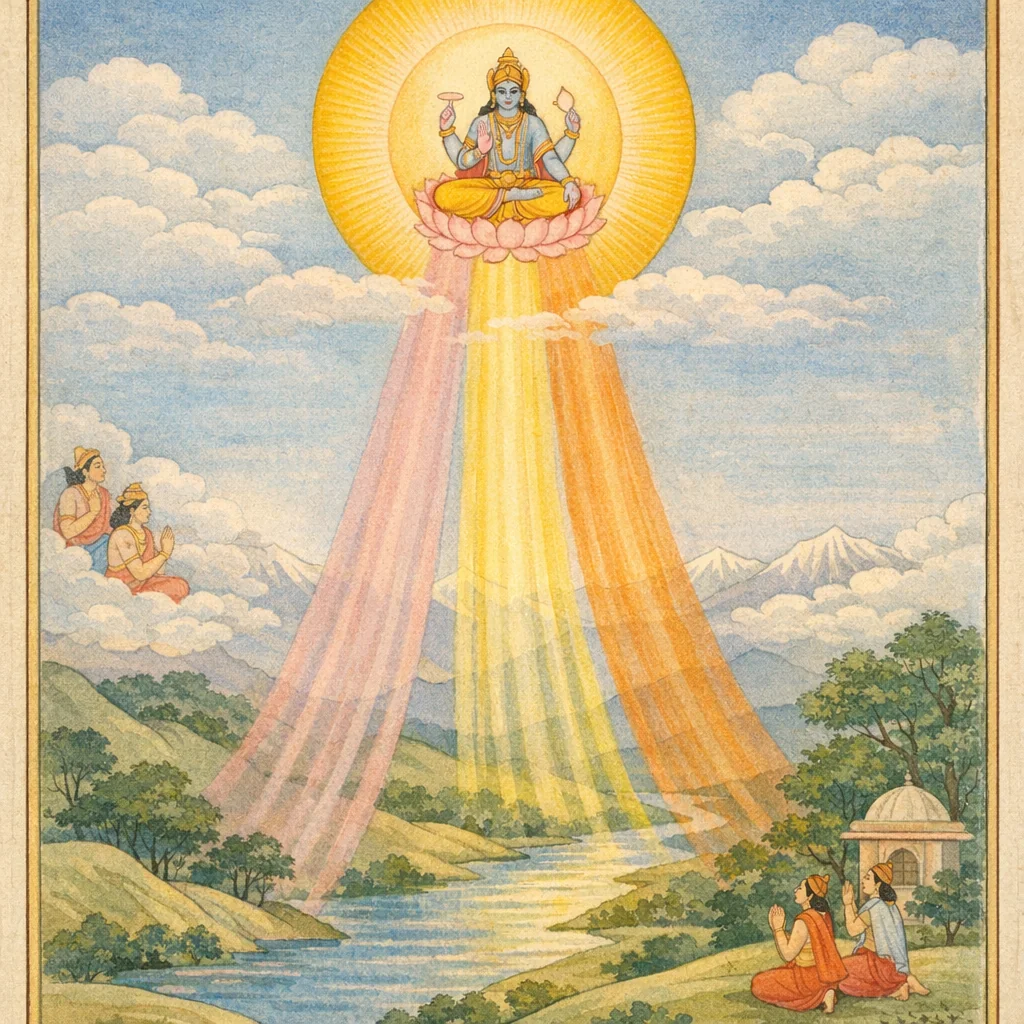
Maitreya raises a sharp doubt: if the saptagaṇa bring about cold, heat, and rain, what is the Sun’s own function, and why is rainfall credited to the Sun? Parāśara replies by affirming hierarchy—among the sevenfold host, Ravi is foremost in governance. He grounds this in theology: Viṣṇu’s supreme śakti, identical with the trayī (Ṛg–Yajus–Sāman), abides within Savitṛ as the indwelling ruler (antaryāmin). The day’s phases mirror the Vedic triad—Ṛk in the forenoon, Yajus at midday, and Sāman as the day declines. He also links Brahmā–Viṣṇu–Rudra with Ṛg–Yajus–Sāman and recalls the attendant roles of Gandharvas, Apsarases, Nāgas, Yakṣas, and Vālakhilyas. The chapter ends with cosmic sustenance: the Sun nourishes Devas, Pitṛs, and humans; the Suṣumnā ray feeds Soma; and the Sun draws up and releases the earth’s essence for crops—Viṣṇu’s preserving power operating through Sūrya.
Shlokas
Verse 1
यद् एतद् भगवान् आह गणः सप्तविधो रवेः मण्डले हिमतापादेः कारणं तन् मया श्रुतम्
That which the Blessed Lord has declared—how, within the orb of the Sun, the hosts are sevenfold and become the cause of cold and heat and the like—this indeed I have heard, and now relate.
Verse 2
व्यापाराश् चापि कथिता गन्धर्वोरगरक्षसाम् ऋषीणां वालखिल्यानां तथैवाप्सरसां गुरो
O revered teacher, the proper functions and appointed spheres of action have also been described—those of the Gandharvas, the Uragas, and the Rākṣasas; as well as those of the Ṛṣis, the Vālakhilyas, and likewise the Apsarases.
Verse 3
यक्षाणां च रथे भानोर् विष्णुशक्तिधृतात्मनाम् किं त्वादित्यस्य यत् कर्म तन् नात्रोक्तं त्वया मुने
O Sage, you have spoken of the Yakṣas upon Bhānu’s chariot, whose very being is upheld by the power of Viṣṇu; yet you have not declared here the ordained work of Āditya, the Sun’s true function in the cosmic order.
Verse 4
यदि सप्तगणो वारि हिमम् उष्णं च वर्षति तत् किम् अत्र रवेर् येन वृष्टिः सूर्याद् इतीर्यते
If it is the host of the Seven that pours down water—snow and heat as well—then what role is there here for the Sun? Why, then, is rainfall spoken of as arising from the Sun?
Verse 5
विवस्वान् उदितो मध्ये यात्य् अस्तम् इति किं जनः ब्रवीत्य् एतत् समं कर्म यदि सप्तगणस्य तत्
Why do people say, “Vivasvān rises, reaches the mid-sky, and then sets,” if, in truth, the sevenfold host performs one and the same uniform operation?
Verse 6
मैत्रेय श्रूयताम् एतद् यद् भवान् परिपृच्छति यथा सप्तगणे ऽप्य् एकः प्राधान्येनाधिको रविः
Maitreya, listen to what you ask: even among the sevenfold host, the Sun alone stands foremost, surpassing the rest by his governing pre-eminence.
Verse 7
या तु शक्तिः परा विष्णोर् ऋग्यजुःसामसंज्ञिता सैषा त्रयी तपत्य् अंहो जगतश् च हिनस्ति यत्
That supreme Power of Viṣṇu, known as the Ṛg, the Yajus, and the Sāman—this very threefold Veda burns away sin; by her radiance the world is purified, and all that is harmful is struck down.
Verse 8
सैष विष्णुः स्थितः स्थित्यां जगतः पालनोद्यतः ऋग्यजुःसामभूतो ऽन्तः सवितुर् द्विज तिष्ठति
This very Vishnu, established as the power of preservation, is intent on guarding the world. Becoming the essence of the Ṛg, Yajus, and Sāma Vedas, O twice-born, He abides within Savitṛ (the Sun) as the indwelling ruler.
Verse 9
मासि मासि रविर् यो यस् तत्र तत्र हि सा परा त्रयीमयी विष्णुशक्तिर् अवस्थानं करोति वै
In each and every month, wherever the Sun abides in his course, there indeed the supreme Power of Vishnu—formed of the triple Veda—establishes her presence.
Verse 10
ऋचस् तपन्ति पूर्वाह्णे मध्याह्ने च यजूंष्य् अथ बृहद्रथन्तरादीनि सामान्य् अह्नः क्षये रवौ
In the forenoon the Ṛk-hymns blaze forth; at midday the Yajus-formulas shine. And when the day declines, as the Sun nears his setting, the Sāman-chants—such as the Bṛhat and the Rathantara—resound.
Verse 11
अंश एषा त्रयी विष्णोर् ऋग्यजुःसामसंज्ञिता विष्णुशक्तिर् अवस्थानं सदादित्ये करोति सा
This triple Veda—known as Ṛg, Yajus, and Sāman—is itself a portion of Vishnu. As Vishnu’s śakti, it continually establishes His abiding presence in Āditya (the Sun).
Verse 12
न केवलं रवेः शक्तिर् वैष्णवी सा त्रयीमयी ब्रह्माथ पुरुषो रुद्रस् त्रयम् एतत् त्रयीमयम्
That Vaiṣṇavī Power is not merely the energy of the Sun; she is of the very essence of the Vedic Triad. And Brahmā, the Puruṣa, and Rudra—this entire triple principle, too, is woven of that same trayī reality.
Verse 13
सर्गादौ ऋङ्मयो ब्रह्मा स्थितौ विष्णुर् यजुर्मयः रुद्रः साममयो ऽन्ताय तस्मात् तस्याशुचिर् ध्वनिः
At creation’s dawn, Brahmā is of the nature of the Ṛg, the primal hymn; in the state of preservation, Viṣṇu is of the nature of the Yajus, the law of sacrifice and sovereign guardianship. For dissolution, Rudra is of the nature of the Sāman, the chant that draws all to their end; therefore from that final phase arises an impure, inauspicious reverberation.
Verse 14
एवं सा सात्त्विकी शक्तिर् वैष्णवी या त्रयीमयी आत्मसप्तगणस्थं तं भास्वन्तम् अधितिष्ठति
Thus that sāttvika Power—Vaiṣṇava in essence and formed of the Vedic triad—presides over the Radiant One, established within the Self among the sevenfold hosts, sustaining him from within as his governing presence.
Verse 15
तया चाधिष्ठितः सो ऽपि जाज्वलीति स्वरश्मिभिः तमः समस्तजगतां नाशं नयति चाखिलम्
Upheld and empowered by Her, he too blazes with his own rays, and he utterly drives away the darkness that shrouds all worlds, bringing it to complete destruction.
Verse 16
स्तुवन्ति तं वै मुनयो गन्धर्वैर् गीयते पुरः नृत्यन्त्य् अप्सरसो यान्ति तस्य चानु निशाचराः
The sages hymn Him in praise; before Him the Gandharvas sing. The Apsarases dance, and even the night-roaming spirits move in His train—each, in its own way, drawn into the order of His sovereign presence.
Verse 17
वहन्ति पन्नगा यक्षैः क्रियते ऽभीषुसंग्रहः वालखिल्यास् तथैवैनं परिवार्य समासते
The Nāgas bear him; the Yakṣas gather and order his rays. Likewise the Vālakhilya sages, encircling him on every side, remain ever stationed there—so that the Sun’s ordained course may be upheld without fail.
Verse 18
नोदेता नास्तमेता च कदाचिच् छक्तिरूपधृक् विष्णुर् विष्णोः पृथक् तस्य गणः सप्तविधो ऽप्य् अयम्
Vishnu, abiding as the very form of Śakti, never rises and never sets at any time. Yet, in manifestation, this host of His powers—distinct from Vishnu—is declared to be sevenfold.
Verse 19
स्तम्भस्थदर्पणस्यैति यो ऽयम् आसन्नतां नरः छायादर्शनसंयोगं स संप्राप्नोत्य् अथात्मनः
As a man who approaches a mirror fixed upon a pillar comes into contact with the sight of his own reflection, so too, by drawing near to the proper means of knowing, one attains the conjunction of perceiving the Self (Ātman).
Verse 20
एवं सा वैष्णवी शक्तिर् नैवापैति ततो द्विज मासानुमासं भास्वन्तम् अध्यास्ते तत्र संस्थितम्
Thus, O twice-born, that Vaiṣṇava potency never departs. Month after month it abides there, enthroned upon the radiant one (the Sun), steadfastly established in that very station.
Verse 21
पितृदेवमनुष्यादीन् स सदाप्याययन् प्रभुः परिवर्तत्य् अहोरात्रकारणं सविता द्विज
Nourishing without cease the Pitṛs, the gods, human beings, and the rest, that sovereign Lord—Savitṛ, the Sun—turns the wheel of time itself, becoming the very cause of day and night, O twice-born one.
Verse 22
सूर्यरश्मिः सुषुम्णो यस् तर्पितस् तेन चन्द्रमाः कृष्णपक्षे ऽमरैः शश्वत् पीयते वै सुधामयः
That solar ray called Suṣumnā, when it is satisfied and filled, thereby nourishes the Moon; and in the dark fortnight the Moon—made of nectar—is continually drunk by the immortals, the gods.
Verse 23
पीतं तं द्विकलं सोमं कृष्णपक्षक्षये द्विज पिबन्ति पितरस् तेषां भास्करात् तर्पणं तथा
O twice-born one, when the dark fortnight ends, the Pitṛs drink that Soma, now diminished to but two measures; and for them, satisfaction (tarpaṇa) is likewise gained through the Sun.
Verse 24
आदत्ते रश्मिभिर् यं तु क्षितिसंस्थं रसं रविः तम् उत्सृजति भूतानां पुष्ट्यर्थं सस्यवृद्धये
The essence that abides within the earth the Sun draws up with his rays; then he releases it again, for the nourishment of all beings and for the increase of crops.
Verse 25
तेन प्रीणात्य् अशेषाणि भूतानि भगवान् रविः पितृदेवमनुष्यादीन् एवम् आप्याययत्य् असौ
By that life-giving power, the blessed Sun delights all beings without remainder; thus he nourishes and sustains the Pitṛs, the Devas, humankind, and all others besides.
Verse 26
पक्षतृप्तिं तु देवानां पितॄणां चैव मासिकीम् शश्वत् तृप्तिं च मर्त्यानां मैत्रेयार्कः प्रयच्छति
O Maitreya, the Sun grants the gods their satisfaction in the fortnightly cycle; he bestows the Pitṛs their monthly nourishment; and to mortals he gives unceasing sustenance.
Frequently Asked Questions
It asserts that the Sun is foremost among the sevenfold host because Viṣṇu’s supreme śakti—of the nature of the Vedic trayī—abides within Savitṛ as antaryāmin, making solar activity theologically grounded rather than merely mechanical.
It presents the Sun’s daily cycle as a liturgical cosmology: the Veda is not only recited but embodied in cosmic time, indicating that kāla and prakāśa (illumination) operate as expressions of Viṣṇu-śakti.