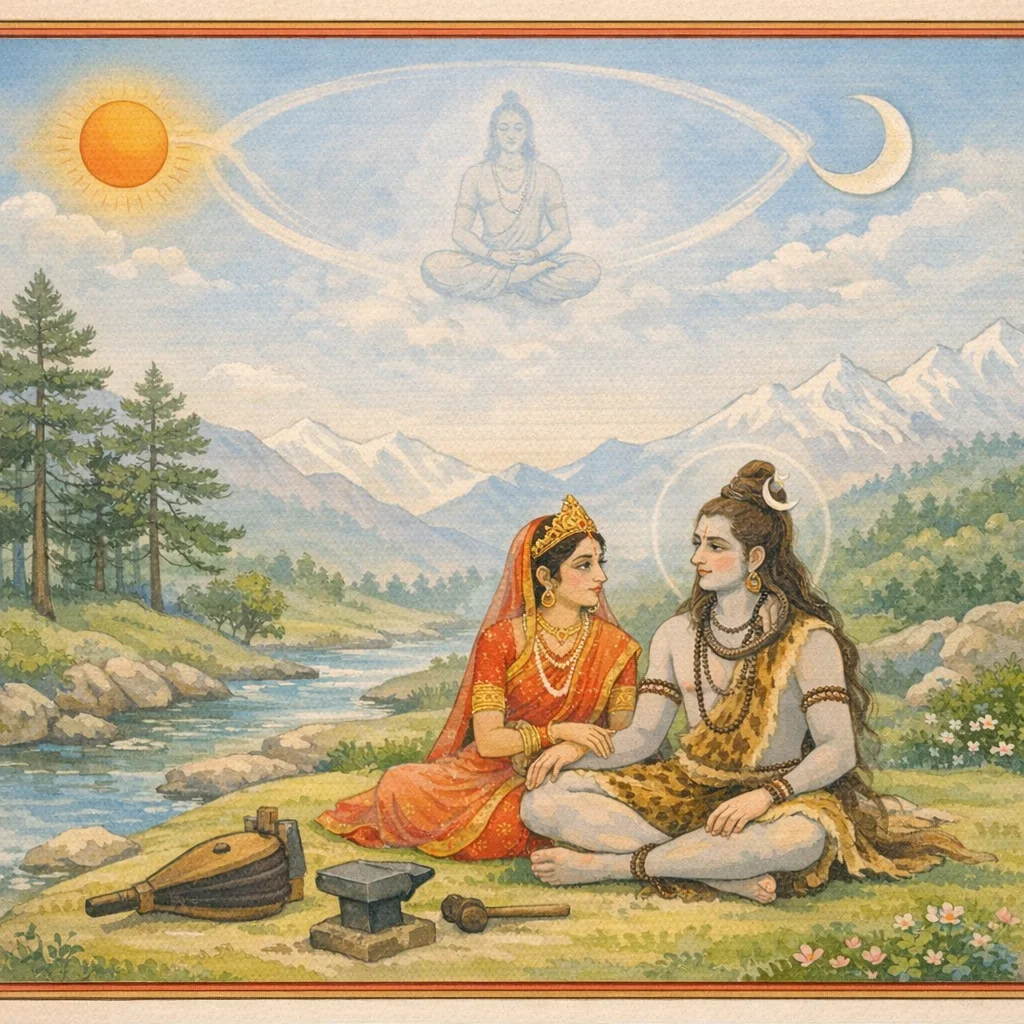
Vāyu-jaya (Prāṇa-vijaya) and Yogic Mastery over Time — वायुजय (प्राणविजय) तथा कालजय
Adhyāya 27 unfolds as a direct dialogue in which Devī asks Śaṃkara about the yogic attainment called “vāyostu padam,” the state or realm of Vāyu arising from yogākāśa. Śaṃkara replies that this is a prior instruction given for the welfare of yogins, and he connects mastery of prāṇa with the conquest of kāla (time and death). The chapter’s technical core is prāṇāyāma and dhāraṇā: prāṇa is said to abide in the heart, to be fire-associated yet all-pervasive, and to function as the operative basis of knowledge, vigor, and bodily activity. The yogin is enjoined to remain firmly established in dhāraṇā with the explicit aim of overcoming jarā and mṛtyu, using disciplined breath-control likened to a smith’s bellows. Mantric integration appears through a definition of prāṇāyāma employing the Gāyatrī with the vyāhṛtis and extended breath cycles. The closing emphasis contrasts cosmic cycles (sun, moon, planets) that “return” with yogins absorbed in meditation who do not “turn back,” underscoring liberation as irreversible through yogic steadiness.
Shlokas
Verse 1
देव्युवाच । वायोस्तु पदमाप्नोति योगाकाशसमुद्भवम् । तन्मे सर्वं समाचक्ष्व प्रसन्नस्त्वं यदि प्रभो
The Goddess said: “O Lord, the state attained through Vāyu—arising from the yogic ether (yogākāśa)—is spoken of. If You are gracious, please explain all of that to me in full.”
Verse 2
शंकर उवाच । पुरा मे सर्वमाख्यातं योगिनां हितकाम्यया । कालं जिगाय यस्सम्यग्वायोर्लिंगं यथा भवेत्
Śaṅkara said: Formerly, for the welfare of the yogins, I have already explained everything—how one truly established in Yoga conquers Time (Kāla), and how the Liṅga of Vāyu is to be known and worshipped.
Verse 3
तेन ज्ञात्वा दिनं योगी प्राणायामपरः स्थितः । स जयत्यागतं कालं मासार्द्धेनैव सुंदरि
Knowing the proper measure of the day by that method, the yogin remains firmly devoted to prāṇāyāma. O Beautiful One, by that discipline he conquers the time that comes upon him—indeed, within merely a month and a half.
Verse 4
हृत्स्थो वायुस्सदा वह्नेर्दीपकस्सोऽनुपावकः । स बाह्याभ्यंतरो व्यापी वायुस्सर्वगतो महान्
The vital Wind (Vāyu), stationed in the heart, ever kindles the inner fire as its lamp and attendant flame. That Vāyu pervades both the outer and the inner realms; it is the great, all-reaching principle that moves everywhere.
Verse 5
ज्ञानविज्ञानमुत्साहः सर्वं वायोः प्रवर्तते । येनेह निर्जितो वायुस्तेन सर्वमिदं जगत्
Knowledge and realized discernment, together with all vigor and endeavor, arise through the power of prāṇa, the vital wind. Whoever conquers this inner wind here truly gains mastery over the whole embodied world.
Verse 6
धारणायां सदा तिष्ठेज्जरामृत्युजिघांसया । योगी योगरतः सम्यग्धारणाध्यानतत्परः
With the intent to overcome old age and death, the yogin should remain ever established in dhāraṇā, steady inner concentration. Truly devoted to Yoga, he should properly dedicate himself to dhāraṇā and dhyāna, meditative absorption; through such disciplined inwardness the soul’s bonds are loosened and the Lord, Pati, is realized.
Verse 7
लोहकारो यथा भस्त्रामापूर्य्य मुखतो मुने । साधयेद्वायुना कर्म तद्वद्योगी समभ्यसेत्
O sage, just as a blacksmith fills the bellows by the mouth and accomplishes his work through the force of air, so too should the yogin repeatedly practice and master the discipline of the vital wind (prāṇa).
Verse 8
देवस्सहस्रके नेत्रपादहस्तसहस्रकः । ग्रंथीन्हि सर्वमावृत्य सोऽग्रे तिष्ठेद्दशांगुलम्
The indwelling Deva—endowed with a thousand eyes and a thousand hands and feet—enveloping all the subtle knots (granthis), stands in front, ten finger-breadths from the heart-region, as the guiding inner Presence.
Verse 9
गायत्रीं शिरसा सार्द्धं जपेद्व्याहृतिपूर्विकाम् । त्रिवारमायतप्राणाः प्राणायामस्स उच्यते
One should recite the Gāyatrī, together with the Śiras (the head-portion), preceded by the vyāhṛtis. When the breath is steadily extended in this manner three times, that is called prāṇāyāma.
Verse 10
गतागता निवर्तंते चन्द्रसूर्यादयो ग्रहाः । अद्यापि न निवर्तंते योगध्यानपरायणाः
The Moon, the Sun, and the other planets return again and again in their cycles of coming and going. Yet even now, those wholly devoted to yoga and meditation do not turn back from their inner absorption.
Verse 11
शतमब्दं तपस्तप्त्वा कुशाग्रापः पिबेद्द्विजः । तदाप्नोति फलं देवि विप्राणां धारणैकया
O Goddess, a twice-born man who performs austerities for a hundred years and drinks only water taken from the tips of kuśa grass attains that very fruit which the brāhmaṇas obtain merely by a single act of dhāraṇā (steadfast inner holding).
Verse 12
यो द्विजः कल्यमुत्थाय प्राणायामैकमाचरेत् । सर्वं पापं निहंत्याशु ब्रह्मलोकं स गच्छति
That twice-born person who rises at the auspicious time of dawn and performs even a single practice of prāṇāyāma quickly destroys all sin and attains Brahmaloka.
Verse 13
योऽतंद्रितस्सदैकांते प्रणायामपरो भवेत् । जरां मृत्युं विनिर्जित्य वायुगः खेचरीति सः
One who is untiring and, ever in solitude, is devoted to the discipline of prāṇāyāma—having conquered old age and death—becomes master of the vital wind; such a one is called a ‘khecarī’, a mover in the sky.
Verse 14
सिद्धस्य भजते रूपं कांतिं मेधां पराक्रमम् । शौर्यं वायुसमो गत्या सौख्यं श्लाघ्यं परं सुखम्
He attains the perfected state of a siddha: endowed with a pleasing form, radiant splendor, keen intelligence, and mighty prowess. His valor becomes steadfast, his movement swift as the wind, and he gains praiseworthy well-being—indeed, the highest happiness.
Verse 15
एतत्कथितमशेषं वायोस्सिद्धिं यदाप्नुते योगी । यत्तेजसोऽपि लभते तत्ते वक्ष्यामि देवेशि
Thus I have fully described the yogin’s siddhi of mastery over the element of wind. Now, O Goddess, I shall also tell you of the siddhi of tejas—the luminous power—that he comes to attain.
Verse 16
स्थित्वा सुखासने स्वे शेते जनवचनहीने तु । शशिरवियुतया तेजः प्रकाशयन्मध्यमे देशे
Seated upon his own sukhāsana, he rested in a place free from the speech of people; and with a radiance not born of the moon, he illumined the middle region.
Verse 17
वह्निगतं भ्रूमध्ये प्रकाशते यस्त्वतंद्रितो योगी । दीपहीनध्वांत पश्येन्न्यूनमसंशयं लोके
For the vigilant yogin, free from heedlessness, the fire abiding in the space between the eyebrows shines forth. Without doubt, in this world he beholds even lamp-less darkness as though it were diminished.
Verse 18
नेत्रे करशाखाभिः किंचित्संपीड्य यत्नतो योगी । तारं पश्यन्ध्यायेन्मुहूर्तमर्द्धं तमेकभावोऽपि
Gently pressing the eyes a little with the joints of the fingers, the yogin—careful and intent—should gaze upon the inner ‘tāra’ and meditate for half a muhūrta; even so, he becomes of one single state, one-pointed in that Reality.
Verse 19
ततस्तु तमसि ध्यायन्पश्यते ज्योतिरैश्वरम् । श्वेतं रक्तं तथा पीतं कृष्णमिन्द्रधनुष्प्रभम्
Then, meditating within the darkness of inner absorption, one beholds the Lord’s sovereign Light—appearing as white, red, yellow, and black, radiant like a rainbow.
Verse 20
भुवोर्मध्ये ललाटस्थं बालार्कसमतेजसम् । तं विदित्वा तु कामांगी क्रीडते कामरूपधृक्
Located on the forehead, between the eyebrows, it shines with the brilliance of the rising sun. Knowing that sacred seat, the beautiful-limbed one—assuming forms at will—sports in divine play.
Verse 21
कारणप्रशमावेशं परकायप्रवेशनम् । अणिमादिगुणावाप्तिर्मनसा चावलोकनम्
Entering the state where the causal impulses are pacified, entering another body, acquiring powers such as aṇimā and the rest, and perceiving distant or subtle things by the mind—these are among the yogic attainments spoken of here.
Verse 22
दूरश्रवण विज्ञानमदृश्यं बहुरूपधृक् । सतताभ्यासयोगेन खेचरत्वं प्रजायते
Through the yoga of constant practice, one gains the powers of hearing from afar, subtle knowledge, becoming unseen, assuming many forms, and the siddhi of moving through the sky (khecaratva).
Verse 23
श्रुताध्ययनसंपन्ना नानाशास्त्रविशारदाः । ज्ञानिनोऽपि विमुह्यंते पूर्वकर्मवशानुगाः
Even those accomplished in hearing and study, well-versed in many śāstras and counted among the wise, can still fall into delusion—because they continue under the compulsion of former actions (past karma).
Verse 24
पश्यंतोऽपि न पश्यंति शृण्वाना बधिरा यथा । यथांधा मानुषा लोके मूढाः पापविमोहिताः
Though they have eyes, they do not truly see; though they hear, they are like the deaf. Like blind men in the world, such people are deluded fools, their understanding eclipsed by sin—unable to recognize the Lord (Pati) and the path that cuts the bonds (pāśa).
Verse 25
वेदाहमेतं पुरुषं महांतमादित्यवर्णं तमसः परस्तात् । तमेव विदित्वातिमृत्युमेति नान्यः पंथा विद्यते प्रायणायः
I know that Supreme Person—great, radiant like the sun, and beyond the darkness of ignorance. By knowing Him alone one crosses beyond death; for liberation there is no other path.
Verse 26
एष ते कथितः सम्यक्तेजसो विधिरुत्तमः । कालं जित्वा यथा योगी चामरत्वं प्रपद्यते
Thus, I have correctly declared to you this supreme discipline concerning spiritual radiance (tejas). By conquering Time (Kāla), the yogin attains the state of the deathless—just as taught in this tradition of Śiva.
Verse 27
इति श्रीशिवमहापुराणे पञ्चम्यामुमासंहितायां कालवंचनशिवप्राप्तिवर्णनं नाम सप्तविंशोऽध्यायः
Thus, in the Śrī Śiva Mahāpurāṇa, in the fifth book—the Umāsaṃhitā—ends the twenty-seventh chapter, entitled “The account of attaining Śiva by outwitting Time (Kāla).”
Verse 28
तुरीया देवि भूतानां योगिनां ध्यानिनां तथा । सुखासने यथास्थानं योगी नियतमानसः
O Goddess, the fourth state (turīya) belongs to beings who are yogins and meditators. With a disciplined mind, the yogī sits in a comfortable āsana, properly established in his place of practice.
Verse 29
समुन्नतशरीरोऽपि स बद्ध्वा करसंपुटम् । चञ्च्वाकारेण वक्त्रेण पिबन्वायुं शनैश्शनैः
Keeping his body held upright, he joined his hands into a cupped hollow; then, shaping his mouth like a beak, he slowly and steadily drank in vāyu, the life-breath.
Verse 31
पिबन्ननुदिनं योगी न मृत्युवशगो भवेत् । दिव्यकायो महातेजाः पिपासा क्षुद्विवर्जितः
By drinking it every day, the yogin does not fall under the dominion of death. He attains a divine body, becomes greatly radiant, and is freed from thirst and hunger.
Verse 32
बलेन नागस्तुरगो जवेन दृष्ट्या सुपर्णस्सुश्रुतिस्तु दूरात् । आकुंचिताकुंडलिकृष्णकेशो गंधर्वविद्याधरतुल्यवर्णः
In strength he was like a nāga; in speed, like a horse; in vision, like Suparṇa (Garuḍa); and in hearing, he could perceive even from afar. His black hair was curled in ringlets, and his complexion resembled that of the Gandharvas and Vidyādharas.
Verse 33
जीवेन्नरो वर्षशतं सुराणां सुमेधसा वाक्पतिना समत्वम् । एवं चरन् खेचरतां प्रयाति यथेष्टचारी सुखितस्सदैव
Such a man lives for a hundred divine years and, through excellent intellect, attains equality with Vākpati, the lord of speech. Living thus, he gains the power to move through the sky at will, roaming as he desires and remaining ever joyful.
Verse 34
पुनरन्यत्प्रवक्ष्णमि विधानं यत्सुरैरपि । गोपितं तु प्रयत्नेन तच्छृणुष्व वरानने
Again I shall proclaim another sacred procedure—one that even the gods guard with great care. O fair-faced one, listen to it with attentive mind.
Verse 35
समाकुंच्याभ्यसेद्योगी रसनां तालुकं प्रति । किंचित्कालांतरेणैव क्रमात्प्राप्नोति लंबिकाम्
By repeatedly contracting and training the tongue toward the palate, the yogin—after some time—gradually attains mastery over the lambikā (uvula).
Verse 36
ततः प्रस्रवते सा तु संस्पृष्टा शीतलां सुधाम् । पिबन्नेव सदा योगी सोऽमरत्वं हि गच्छति
Then, when it is touched, the cool nectar (sudhā) begins to flow forth. Ever drinking it, the yogin indeed attains immortality—freedom from death’s bondage through the grace of Śiva, Lord of yogins.
Verse 37
रेफाग्रं लंबकाग्रं करतलघटनं शुभ्रपद्मस्य बिन्दोस्तेनाकृष्टा सुधेयं पतति परपदे देवतानंदकारी । सारं संसारतारं कृतकलुषतरं कालतारं सतारं येनेदं प्लावितांगं स भवति न मृतः क्षुत्पिपासाविहीनः
At the tip of the “repha” and at the tip of the hanging drop, by placing the palm at the point of the white lotus, nectar is drawn forth; that ambrosial essence flows in the supreme state, bringing delight to the gods. It is the very essence that ferries one across saṃsāra, that washes away accumulated impurity, that overcomes Time and carries one beyond it. When this body is flooded by that nectar, a person is as though not subject to death—free from hunger and thirst.
Verse 38
एभिर्युक्ता चतुर्भिः क्षितिधरतनये योगिभिर्वै धरैषा धैर्य्यान्नित्यं कुतोऽन्तं सकलमपि जगद्यत्सुखप्रापणाय । स्वप्ने देही विधत्ते सकलमपि सदा मानयन्यच्च दुःखं स्वर्गे ह्येवं धरित्र्याः प्रभवति च ततो वा स किञ्चिच्चतुर्णाम्
O daughter of the mountain, when this Earth is upheld by yogins endowed with these four supports, through steadfastness she continually bears the whole world so that beings may attain happiness. Even in dream the embodied soul projects and experiences all things, ever taking even sorrow to be real; so too in heaven the same pattern arises by the power of worldly nature. Therefore, apart from these four (supports), nothing else is truly sufficient.
Verse 39
तस्मान्मंत्रैस्तपोभिर्व्रतनियमयुतैरौषधैर्योगयुक्ता धात्री रक्ता मनुष्यैर्नयविनययुतैर्धर्मविद्भिः क्रमेण । भूतानामादि देवो न हि भवति चलः संयुतो वै चतुर्णां तस्मादेवं प्रवक्ष्ये विधिमनुगदितं छायिकं यच्छिवाख्यम्
Therefore the sustaining power (Dhātrī) becomes rightly aligned—through mantras, austerities, vows and disciplined observances, medicinal supports, and the practice of yoga—when human beings, guided by good conduct and humility and knowing dharma, undertake them step by step. For the Primordial Deva of all beings, Śiva, is not fickle; He is to be approached as the One conjoined with the fourfold means. Hence I shall now declare, according to the transmitted instruction, that prescribed method called Chāyika, which is known as ‘Śiva’.
Frequently Asked Questions
The chapter argues that prāṇa (vāyu) is not merely a physiological function but a cosmic and soteriological principle: since all vitality, cognition, and effort operate through vāyu, conquering vāyu through prāṇāyāma and dhāraṇā entails conquering kāla (time/death) as experienced in embodied existence.
The description encodes an inner cosmology: the heart-center is treated as the operational locus of prāṇa; its association with ‘fire’ indicates transformative tapas and metabolic/psychic heat; and its pervasion signals that prāṇa links microcosm and macrocosm. Thus, breath-discipline becomes a method for reorganizing the entire psychophysical field, not a localized exercise.
Rather than a new iconographic form, the adhyāya highlights functional roles: Devī as the authoritative inquirer who elicits yogic doctrine, and Śaṃkara as the guru-principle transmitting prāṇa-vidyā. The emphasis is on Śiva as yogeśvara (lord of yoga) and Umā as the revelatory interlocutor shaping practice-oriented theology.