शिवस्य पञ्चब्रह्मावतारवर्णनम् (Description of Shiva’s Pañcabrahma Avatāras)
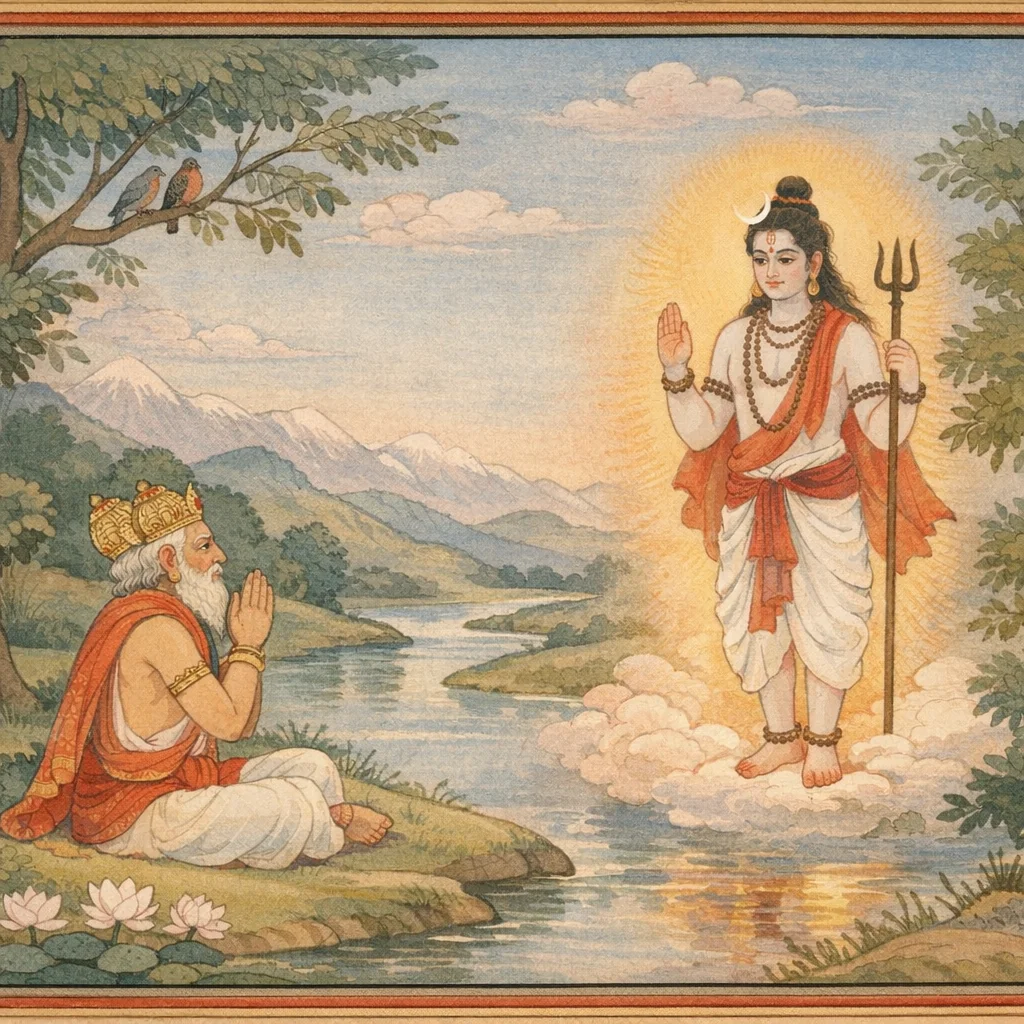
Adhyāya 1 begins with an auspicious salutation to Mahādeva and sets the teaching within a classic Purāṇic dialogue: Śaunaka asks Sūta (Vyāsa’s disciple) about the avatāra-portions of Śambhu by which Śiva benefits the righteous. Sūta replies by citing an earlier transmission—Nandī, ever remembering Śiva, answered Sanatkumāra on the same theme. Nandī declares that Śiva’s avatāras are countless across kalpas, yet he will describe them in proper order. The narrative is then anchored in the nineteenth kalpa, called Śveta-Lohita, and the first manifestation connected with Sadyojāta is introduced. In the cited verses, Brahmā’s contemplation brings forth the youthful, top-knotted Śveta-Lohita form; Brahmā recognizes Him as Śiva, offers reverence, and repeatedly contemplates the Supreme. Thus the chapter establishes that avatāra narration is not mere story, but a means to articulate Śiva’s fivefold (pañcabrahma) doctrinal structure and its cosmological placement.
Shlokas
Verse 1
इति श्रीशिवमहापुराणे तृतीयायां शतरुद्रसंहितायां शिवस्य पञ्चब्रह्मावतारवर्णनं नाम प्रथमोऽध्यायः
Thus, in the holy Śiva Mahāpurāṇa, in the Third Book, the Śatarudra Saṃhitā, ends the First Chapter entitled “The Description of Śiva’s Manifestation as the Fivefold Brahman (Pañcabrahma).”
Verse 2
सूत उवाच । मुने शौनक सद्भक्त्या दत्तचित्तो जितेन्द्रियः । अवताराञ्छिवस्याहं वच्मि ते मुनये शृणु
Sūta said: “O sage Śaunaka—endowed with true devotion, with your mind offered in reverence and your senses mastered—now listen. I shall speak to you, O muni, of the divine manifestations (avatāras) of Lord Śiva.”
Verse 3
एतत्पृष्टः पुरा नन्दी शिवमूर्तिस्सतां गतिः । सनत्कुमारेण मुने तमुवाच शिवं स्मरन्
Formerly, when the sage Sanatkumāra asked him this, Nandī—who embodies Śiva and is the refuge and goal of the righteous—replied while remembering Lord Śiva.
Verse 4
नन्दीश्वर उवाच । असंख्याता हि कल्पेषु विभोः सर्व्वेश्वरस्य वै । अवतारास्तथापीह वच्म्यहं तान्यथामति
Nandīśvara said: “Indeed, across the kalpas, the descents (avatāras) of the all-pervading Lord—Śiva, the Lord of all—are countless. Even so, here I shall describe those incarnations according to my understanding.”
Verse 5
एकोनविंशकः कल्पो विज्ञेयः श्वेत लोहितः । सद्योजातावतारस्तु प्रथमः परिकीर्तितः
Know that the nineteenth Kalpa is called Śveta-Lohita. In that cycle, the first manifestation (avatāra) proclaimed is Sadyojāta—Śiva’s immediate, auspicious emergence to order the worlds and bestow grace.
Verse 6
तस्मिंस्तत्परमं ब्रह्म ध्यायतो ब्रह्मणस्तथा । उत्पन्नस्तु शिखायुक्तः कुमारः श्वेतलोहितः
As Brahmā meditated upon the Supreme Brahman, there arose a youthful divine being—Śvetalohita—adorned with a topknot, radiant in form, born from contemplation of the highest Reality.
Verse 7
तं दृष्ट्वा पुरुषं ब्रह्मा ब्रह्मरूपिणमीश्वरम् । ज्ञात्वा ध्यात्वा स हृदये ववन्दे प्रयताञ्जलिः
Seeing that Supreme Person—Īśvara appearing in the very form of Brahmā—Brahmā recognized Him, meditated upon Him within his heart, and then bowed in reverence with joined palms.
Verse 8
सद्योजातं शिवं बुद्ध्वा जहर्ष भुवनेश्वरः । मुहुर्मुहुश्च सद्बुद्ध्या परं तं समचिन्तयत्
Recognizing Śiva as Sadyojāta (the ever-immediate, newly manifested form), the Lord of the worlds was filled with joy. Again and again, with purified understanding, he contemplated that Supreme Reality.
Verse 9
ततोऽस्य ध्यायतः श्वेताः प्रादुर्भूता यशस्विनः । कुमाराः परविज्ञानपरब्रह्मस्वरूपिणः
Then, as he meditated, illustrious, radiant-white Kumāras manifested. They were of the very nature of supreme knowledge and the Supreme Brahman, ever established in the highest spiritual wisdom.
Verse 10
सुनन्दो नन्दनश्चैव विश्वनन्दोपनन्दनौ । शिष्यास्तस्य महात्मानो यैस्तद्ब्रह्म समावृतम्
Sunanda, Nandana, Viśvananda, and Upanandana—these great-souled ones were his disciples; through them that Brahman, the supreme Reality, was encompassed and made manifest within the living tradition.
Verse 11
सद्योजातश्च वै शम्भुर्ददौ ज्ञानं च वेधसे । सर्गशक्तिमपि प्रीत्या प्रसन्नः परमेश्वरः
Then Śambhu, in His Sadyojāta aspect, graciously bestowed true knowledge upon Vedhas (Brahmā); and, the Supreme Lord being pleased, He also lovingly granted him the power to carry out creation.
Verse 12
ततो विंशतिमः कल्पो रक्तो नाम प्रकीर्तितः । ब्रह्मा यत्र महातेजा रक्तवर्णमधारयत्
Thereafter, the twentieth aeon is proclaimed as the ‘Rakta’ Kalpa. In that (cycle), the greatly resplendent Brahmā assumed a red hue.
Verse 13
ध्यायतः पुत्रकामस्य प्रादुर्भू तो विधेस्सुतः । रक्तमाल्याम्बरधरो रक्ताक्षो रक्तभूषणः
As he meditated with the longing for a son, the son of the Ordainer (Brahmā) manifested before him—wearing a red garland and red garments, with reddish eyes and adorned with red ornaments.
Verse 14
स तं दृष्ट्वा महात्मानं कुमारं ध्यानमाश्रितः । वामदेवं शिवं ज्ञात्वा प्रणनाम कृतांजलिः
Seeing that great-souled youthful form absorbed in meditation, he recognized Him as Vāmadeva—Lord Śiva Himself—and bowed down with folded hands.
Verse 15
ततस्तस्य सुता ह्यासंश्चत्वारो रक्तवाससः । विरजाश्च विवाहश्च विशोको विश्वभावनः
Thereafter, she had four sons, clad in red garments—Virajā, Vivāha, Viśoka, and Viśvabhāvana, the sustainer and inspirer of the universe.
Verse 16
वामदेवः स वै शम्भुर्ददौ ज्ञानं च वेधसे । सर्गशक्तिमपि प्रीत्या प्रसन्नः परमेश्वरः
That Vāmadeva—Śambhu Himself—graciously bestowed sacred knowledge upon Vedhas (Brahmā). Pleased and supremely compassionate, the Parameśvara also lovingly granted him the power of creation.
Verse 17
एकविंशतिमः कल्पः पीतवासा इति स्मृतः । ब्रह्मा यत्र महाभागः पीतवासा बभूव ह
The twenty-first aeon (kalpa) is remembered as “Pītavāsā.” In that (kalpa), the greatly fortunate Brahmā indeed became one who was clad in yellow garments.
Verse 18
ध्यायतः पुत्रकामस्य विधेर्जातः कुमारकः । पीतवस्त्रादिक प्रौढो महातेजा महाभुजः
As Vidhātr̥ (Brahmā), longing for a son, remained absorbed in meditation, from him was born a youthful boy—of mature bearing, adorned with yellow garments and ornaments, endowed with great radiance and mighty arms.
Verse 19
तं दृष्ट्वा ध्यानसंयुक्तं ज्ञात्वा तत्पुरुषं शिवम् । प्रणनाम ततो बुद्ध्या गायत्रीं शांकरीं विधिः
Seeing Him absorbed in meditation and recognizing Him as Śiva in the Tatpuruṣa form, Vidhi (Brahmā) bowed with reverent understanding and invoked the Śāṃkarī Gāyatrī.
Verse 20
जपित्वा तु महादेवीं सर्वलोकनमस्कृताम् । प्रसन्नस्तु महादेवो ध्यानयुक्तेन चेतसा
Having performed japa to Mahādevī—revered and bowed to by all the worlds—Mahādeva became gracious, his mind absorbed in meditation.
Verse 21
ततोऽस्य पार्श्वतो दिव्याः प्रादुर्भूताः कुमारकाः । पीतवस्त्रा हि सकला योगमार्गप्रवर्तकाः
Then, from his sides, divine youthful sages manifested—each clad in yellow garments—who became the promulgators of the path of Yoga.
Verse 22
ततस्तस्मिन्गते कल्पे पीतवर्णे स्वयंभुवः । पुनरन्यः प्रवृत्तस्तु कल्पो नाम्ना शिवस्तु स
Thereafter, when that Svāyambhuva Kalpa—characterized by a golden hue—had passed, another Kalpa commenced again, and it was known by the name “Śiva.”
Verse 23
एकार्णवे संव्यतीते दिव्यवर्षसहस्रके । स्रष्टुकामः प्रजा ब्रह्मा चिन्तयामास दुःखितः
When a thousand divine years had passed while all was but one cosmic ocean, Brahmā—yearning to bring forth beings—began to ponder, distressed within himself.
Verse 24
ततोऽपश्यन्महातेजा प्रादुर्भूतं कुमारकम् । कृष्णवर्णं महावीर्यं दीप्यमानं स्वतेजसा
Then that great, radiant one beheld a boy suddenly manifested—dark-hued, of immense prowess, blazing with his own innate splendor.
Verse 25
धृतकृष्णाम्बरोष्णीषं कृष्णयज्ञोपवीतिनम् । कृष्णेन मौलिनायुक्तं कृष्णस्नानानुलेपनम्
He wore black garments and a black turban; His sacred thread (yajñopavīta) was black. His head was adorned with a black crest, and He bore the marks of black bathing and black unguents—thus revealing Rudra’s manifest, attribute-bearing (saguṇa) form, fit for contemplation and worship.
Verse 26
स तं दृष्ट्वा महात्मानमघोरं घोरविक्रमम् । ववन्दे देवदेवेशमद्भुतं कृष्णपिंगलम्
Seeing that great-souled Lord—Aghora, yet of formidable might—he bowed down to the wondrous God of gods, the supreme Lord, dark-hued and tawny-eyed.
Verse 27
अघोरं तु ततो ब्रह्मा ब्रह्मरूपं व्यचिंतयत् । तुष्टाव वाग्भिरिष्टाभिर्भक्तवत्सलमव्ययम्
Then Brahmā contemplated the Lord as Aghora—the auspicious, non-terrifying Reality—conceiving Him as the very form of Brahman. Thereupon he praised that imperishable, unchanging One, tenderly devoted to His devotees, with chosen and cherished hymns.
Verse 28
अथास्य पार्श्वतः कृष्णाः कृष्णस्नानानुलेपनाः । चत्वारस्तु महात्मानः संबभूवुः कुमारकाः
Then, at his sides, there appeared four great-souled youthful beings—dark-hued, with dark bathing and anointing—manifesting as attendant forms in the presence of Rudra.
Verse 29
कृष्ण कृष्णशिखश्चैव कृष्णा स्यः कृष्णकण्ठधृक् । इति तेऽव्यक्तनामानः शिवरूपाः सुतेजसः
“(Some are) dark in hue; dark-crested as well; dark in form, bearing a dark throat. Thus are those Śiva-forms—whose names are unmanifest—radiant with their own innate splendor.”
Verse 30
एवंभूता महात्मानो ब्रह्मणः सृष्टिहेतवे । योगं प्रवर्त्तया मासुर्घोराख्यं महदद्भुतम्
Thus endowed, those great-souled beings—so that Brahmā might become the cause of creation—set in motion a formidable yoga called “Ghora,” vast and wondrous.
Verse 31
अथान्यो ब्रह्मणः कल्पः प्रावर्त्तत मुनीश्वराः । विश्वरूप इति ख्यातो नामतः परमाद्भुतः
Then, O foremost of sages, another cycle of Brahmā’s creation began—marvelously renowned by the name “Viśvarūpa,” the ‘All-Form,’ wondrous in its very designation.
Verse 32
ब्रह्मणः पुत्रकामस्य ध्यायतो मनसा शिवम् । प्रादुर्भूता महानादा विश्वरूपा सरस्वती
When Brahmā, desiring a son, mentally meditated upon Śiva, Sarasvatī—cosmic in form and resonant with the great primordial sound—manifested before him.
Verse 33
तथाविधः स भगवानीशानः परमेश्वरः । शुद्धस्फटिकसंकाशः सर्वाभरणभूषितः
Such indeed is that Blessed Lord Īśāna, the Supreme God: radiant like pure crystal and adorned with every kind of divine ornament.
Verse 34
तं दृष्ट्वा प्रणनामासौ ब्रह्मेशानमजं विभुम् । सर्वगं सर्वदं सर्वं सुरूपं रूपवर्जितम्
Seeing Him, he bowed down in reverence to Brahmā’s Lord—Īśāna, the Unborn, the all-pervading Supreme. He is present everywhere, the giver of all, the All itself—of perfect auspicious beauty, yet beyond all limiting form.
Verse 35
ईशानोऽपि तथादिश्य सन्मार्गं ब्रह्मणे विभुः । सशक्तिः कल्पयांचक्रे स बालांश्चतुरः शुभान्
Thus Īśāna too—the all-pervading Lord—having instructed Brahmā in the true path, then, together with His Śakti, brought into manifestation four auspicious divine youths.
Verse 36
जटीमुण्डी शिखण्डी च अर्द्धमुण्डश्च जज्ञिरे । योगेनादिश्य सद्धर्मं कृत्वा योगगतिं गताः
Then were born the forms called Jaṭīmuṇḍī, Śikhaṇḍī, and Arddhamuṇḍa. Through the discipline of yoga they taught the true dharma; and, having established the yogic path, they attained the consummation of yoga—liberation through union with Śiva.
Verse 37
एवं संक्षेपतः प्रोक्तः सद्यादीनां समुद्भवः । सनत्कुमार सर्वज्ञ लोकानां हितकाम्यया
Thus, in brief, the origin of Sadyā and the other forms was explained by Sanatkumāra, the all-knowing, out of a desire for the welfare of the worlds.
Verse 38
अथ तेषां महाप्राज्ञ व्यवहारं यथायथम् । त्रिलोकहितकारं हि सर्वं ब्रह्माण्डसंस्थितम्
Then, O greatly wise one, their conduct—each in its proper manner—was established within the cosmic egg; for everything is indeed ordered for the welfare of the three worlds.
Verse 39
ईशानः पुरुषो घोरो वामसंज्ञस्तथैव च । ब्रह्मसंज्ञो महेशस्य मूर्तयः पंच विश्रुताः
Īśāna, Puruṣa, Ghora, Vāma, and the form known as Brahmā—these are the five well-renowned manifestations (mūrtis) of Maheśa (Śiva).
Verse 40
ईशानः शिवरूपश्च गरीयान्प्रथमः स्मृतः । भोक्तारं प्रकृतेः साक्षात्क्षेत्रज्ञमधितिष्ठति
Īśāna—of the very form of Śiva—is remembered as the foremost and most exalted. He directly presides over the knower of the field (kṣetrajña), the individual self who experiences Prakṛti, and governs him from within.
Verse 41
शैवस्तत्पुरुषाख्यश्च स्वरूपो हि द्वितीयकः । गुणाश्रयात्मकं भोग्यं सर्वज्ञमधितिष्ठति
The second manifest form is the Śaiva one, known as Tatpuruṣa. Abiding as the all-knowing Lord, He presides over the enjoyables—the world of experience—that rest upon the guṇas.
Verse 42
धर्माय स्वांगसंयुक्तं बुद्धितत्त्वं पिनाकिनः । अघोराख्यस्वरूपो यस्तिष्ठत्यंतस्तृतीयकः
For the establishment of dharma, the Lord Pinākin (Śiva, bearer of the bow Pināka) abides within as the principle of Buddhi—the illuminative intellect—united with His own power. That inner, third principle is the very form known as Aghora.
Verse 43
वामदेवाह्वयो रूपश्चतुर्थः शङ्करस्य हि । अहंकृतेरधिष्ठानो बहुकार्यकरः सदा
Indeed, the fourth form of Śaṅkara is called Vāmadeva. He presides over the principle of egoity (ahaṃkṛti) and is ever engaged in accomplishing many functions.
Verse 44
ईशानाह्वस्वरूपो हि शंकरस्येश्वरः सदा । श्रोत्रस्य वचसश्चापि विभोर्व्योम्नस्तथैव च
Indeed, the Lord of Śaṅkara is ever of the form called Īśāna; and He is also the presiding divinity of hearing and of speech, as well as of the all-pervading sky (ether).
Verse 45
त्वक्पाणिस्पर्शवायूनामीश्वरं रूपमैश्वरम् । पुरुषाख्यं विचारज्ञा मतिमन्तः प्रचक्षते
The discerning and wise declare that the sovereign, lordly Form presiding over skin, the hands, touch, and the vital airs is the Supreme Person (Puruṣa) Himself.
Verse 46
वपुषश्च रसस्यापि रूपस्याग्नेस्तथैव च । अघोराख्यमधिष्ठानं रूपमाहुर्मनीषिणः
The wise declare that the adhiṣṭhāna—the presiding foundation—of the body, of taste, of form, and likewise of fire is the form known as Aghora: Śiva’s auspicious, non-terrifying aspect that sustains and governs these manifest principles.
Verse 47
रशनायाश्च पायोश्च रसस्यापां तथैव च । ईश्वरं वामदेवाख्यं स्वरूपं शांकरं स्मृतम्
The Śāṃkara form known as Vāmadeva is remembered as the Lord (Īśvara) presiding over the tongue, the anus, taste, and also the waters.
Verse 48
प्राणस्य चैवोपस्थस्य गंधस्य च भुवस्तथा । सद्योजाताह्वयं रूपमीश्वरं शांकरं विदुः
The wise know that the Śāṅkara Lord, Īśvara named Sadyojāta, presides over the vital breath, the generative organ, fragrance, and the earthly realm (Bhū).
Verse 49
इमे स्वरूपाः शंभोर्हि वन्दनीयाः प्रयत्नतः । श्रेयोर्थिभिर्नरैर्नित्यं श्रेयसामेकहेतवः
Indeed, these manifestations of Śambhu should be reverently worshiped with earnest effort; for those who seek the Highest Good, they are ever the single cause leading to all true auspiciousness.
Frequently Asked Questions
The chapter argues for the innumerability of Śiva’s manifestations across kalpas while offering an ordered account, beginning with the Śveta-Lohita kalpa and the emergence/recognition of a Śveta-Lohita youthful form linked to Sadyojāta, acknowledged and worshiped by Brahmā.
The kalpa-labeling (Śveta-Lohita) and the ‘youthful, top-knotted’ manifestation function as semiotic markers: they encode purity/brightness (śveta), dynamic power/energy (lohita), and tapas/discipline (śikhā) as outward signs of an inward metaphysical principle—Śiva’s self-revelation to contemplative awareness.
The adhyāya foregrounds the first Pañcabrahma-linked manifestation associated with Sadyojāta and the Śveta-Lohita designation; Gaurī is present primarily in the opening maṅgala verse as Śiva’s प्रिय (beloved), establishing the relational-theological frame but not yet driving the narrative.