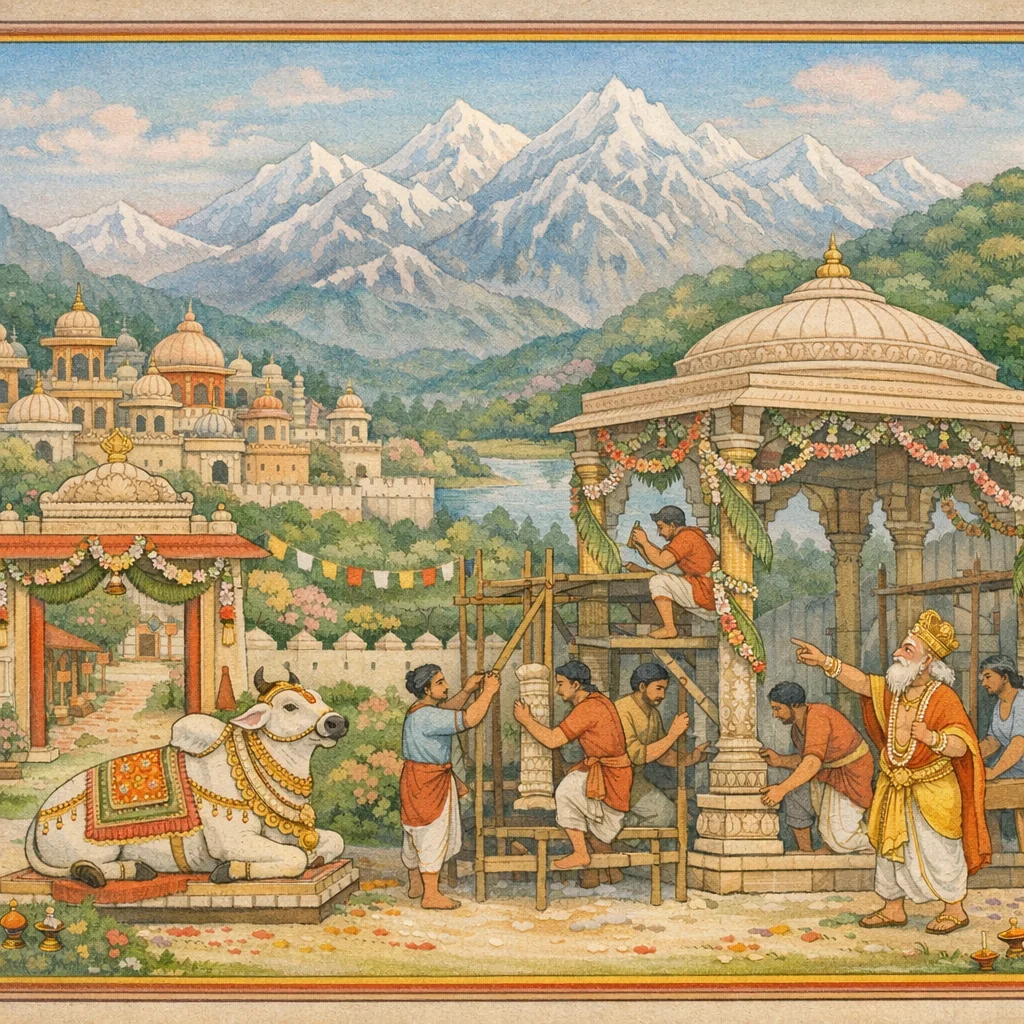
हिमवतः सुमङ्गलोत्सव-नगररचना (Himavān’s Auspicious Festival Preparations and City Adornment)
Adhyāya 38 portrays Himavān—hailed as the lord of the mountains (śaileśvara) and a foremost muni—joyfully preparing an extraordinary, highly auspicious festival in his own city for his daughter. The chapter emphasizes sacred architecture and ritual beauty: the main gate is guarded by Nandī, and a matching crafted gate is set up, both crystal-bright to mark symmetry and sanctity at the threshold. The roads are sprinkled and purified, and every gate is adorned with auspicious substances and decorations. The courtyard is arranged with plant-and-cloth ornamentation—banana/plantain pillars (rambhāstambha), bound threads, and fresh foliage—then mālatī garlands and shining toranas, with maṅgala items placed in the four directions. Himavān summons Viśvakarmā to build a vast maṇḍapa with beautiful vedikā altars, described in grand dimensions and filled with marvels where the “immobile” crafted forms rival the “mobile” living elements, creating wonder (camatkāra) and sacred completeness. Overall, it serves as a textual blueprint for ceremonial space: purified pathways, guarded thresholds, directional auspicious placements, and a central pavilion fit for formal proceedings under Garga’s guidance.
Shlokas
Verse 1
ब्रह्मोवाच । अथ शैलेश्वरः प्रीतो हिमवान्मुनि सत्तम । स्वपुरं रचयामास विचित्रं परमोत्सवम्
Brahmā said: Then the lord of the mountain, Himavān, delighted at heart—O best of sages—made ready his own city, arranging a wondrous and supremely auspicious festival.
Verse 2
सिक्तमार्गं संस्कृतं च शोभितं परमर्द्धिभिः । द्वारि द्वारि च रम्भादि मङ्गलं द्रव्यसंयुतम्
The pathways were sprinkled with water, carefully prepared and adorned with the finest splendor of prosperity. At every doorway there were auspicious arrangements—Rambhā and other celestial maidens present—together with the articles of welcome and festivity.
Verse 3
प्रांगणं रचयामास रम्भास्तंभसमन्वितम् । पट्टसूत्रैस्संनिबद्धरसालपल्लवान्वितम्
She then arranged a courtyard adorned with plantain-stalk pillars, and decorated it with mango shoots fastened together by cloth-threads.
Verse 4
मालतीमाल्यसंयुक्तं लसत्तोरणसुप्रभम् । शोभितम्मंगलद्रव्यैश्चतुर्दिक्षु स्थितैश्शुभैः
It was adorned with garlands of mālatī blossoms; its shining festoons and torana-arches glowed with beauty. Auspicious sacred articles were arranged in the four directions, and by those holy placements it appeared splendid—fit for worship of the auspicious Lord Śiva.
Verse 5
तथैव सर्वं परया मुदान्वितश्चक्रे गिरीन्द्रस्स्वसुतार्थमेव । गर्गम्पुरस्कृत्य महाप्रभावं प्रस्तावयोग्यं च सुमंगलं हि
In the same way, Girīndra (Himālaya), filled with supreme joy, arranged everything solely for the sake of his own daughter. Placing the great and illustrious sage Garga at the forefront, he set in motion an auspicious proposal—truly fit to be presented.
Verse 6
आहूय विश्वकर्माणं कारयामास सादरम् । मण्डपं च सुविस्तीर्णं वेदिकादिमनोहरम्
Having summoned Viśvakarmā with reverence, he had him carefully construct a spacious maṇḍapa—delightful with its vedikā (altar) and other auspicious arrangements.
Verse 7
अयुतेन सुरर्षे तद्योजनानां च विस्तृतम् । अनेकलक्षणोपेतं नानाश्चर्य्यसमन्वितम्
O sage among the gods, it was spread over ten thousand yojanas—endowed with many distinctive features and filled with manifold wonders.
Verse 8
स्थावरं जंगमं सर्वं सदृशन्तैर्मनोहरम् । सर्वतोऽद्भुतसर्वत्वं नानावस्तुचमत्कृतम्
All that was immobile and all that moved—everything—appeared delightful and enchanting, with forms and likenesses perfectly fitting. Everywhere it revealed a wondrous, all-pervading fullness, astonishing the mind through the marvel of countless diverse things.
Verse 9
जंगमं विजितन्तत्र स्थावरेण विशेषतः । जंगमेन च तत्रासीज्जितं स्थावरमेव हि
There, the moving beings were conquered—especially by the unmoving; and in that very encounter, the unmoving too were indeed conquered by the moving.
Verse 10
पयसा च जिता तत्र स्थलभूमिर्न चान्यथा । जलं किं हि स्थलं किं हि न विदुः केऽपि कोविदाः
There, the firm land—dry ground itself—was conquered by water, and in no other way. Some, though deemed learned, could not even discern what was water and what was dry land.
Verse 11
क्वचित्सिंहाः कृत्रिमाश्च क्वचित्सारसपंक्तयः । क्वचिच्छिखण्डिनस्तत्र कृत्रिमाश्च मनोहराः
In some places there were artificial lions; in other places, rows of sārasas (cranes). Elsewhere, delightful artificial peacocks with crests appeared, enchanting to behold.
Verse 12
क्वचित्स्त्रियः कृत्रिमाश्च नृत्यन्त्यः पुरुषैस्सह । मोहयन्त्यो जनान्सर्वान्पश्यन्त्यः कृत्रिमास्तथा
In some places, artificial women danced together with men. Deluding all the people, those very deceivers also looked about in a feigned manner.
Verse 13
तथा तेनैव विधिना द्वारपाला मनोहराः । हस्तैर्धनूंषि चोद्धृत्य स्थावरा जंगमोपमाः
In that very same prescribed manner, delightful gatekeepers were stationed; lifting bows in their hands, they appeared like unmoving sentinels—yet comparable to living, moving beings.
Verse 14
द्वारि स्थिता महालक्ष्मीः कृत्रिमा रचिताद्भुता । सर्वलक्षणसंयुक्ता गताः साक्षत्पयोर्णवात
At the doorway stood Mahālakṣmī—an astonishing form, artfully fashioned—endowed with every auspicious mark, as though she had come forth directly from the Ocean of Milk.
Verse 15
गजाश्चालङ्कृता ह्यासन्कृत्रिमा अकृतोपमाः । तथाश्वाः न सादिभिश्चैव गजाश्च गजसादिभिः
And there were elephants, richly ornamented—artfully fashioned and beyond compare. Likewise there were horses with their trappings; and elephants too, attended by mahouts and those skilled in handling elephants.
Verse 16
रथा रथिभिराकृष्टा महाश्चर्यसमन्विताः । वाहनानि तथान्यानि पत्तयः कृत्रिमास्तथा
Chariots—drawn along by charioteers and filled with great marvels—were seen there; and likewise other conveyances too, along with foot-soldiers, many of them ingeniously fashioned as artificial contrivances.
Verse 17
एवं विमोहनार्थन्तु कृतं वै विश्वकर्मणा । देवानां च मुनीनां च तेन प्रीतात्मना मुने
Thus, O sage, for the very purpose of bewildering them, Viśvakarmā indeed fashioned it—his heart well pleased—so that the gods and the seers might be deluded by that marvel.
Verse 19
तस्योपरि महादिव्यम्पुष्पकं रत्नभूषितम् । राजितं पल्लवैश्शुभ्रश्चामरैश्च सुशोभितम्
Above it stood a supremely divine floral canopy, adorned with jewels—resplendent with fresh tender shoots and beautifully graced by bright white chāmara fans (yak-tail whisks).
Verse 20
वामपार्श्वे गजौ द्वौ च शुद्धकाश्मीरसन्निभौ । चतुर्दन्तो षष्टिवर्षौ भेदमानौ महाप्रभौ
On the left side were two elephants, resembling pure Kashmir in saffron hue. Each had four tusks and was sixty years of age; mighty and radiant, they were in rut, exuding great splendor.
Verse 21
तथैवार्कनिभौ तेन कृतौ चाश्वौ महाप्रभौ । चामरालंकृतौ दिव्यौ दिव्यालङ्कारभूषितौ
Likewise, by him were fashioned two horses, radiant like the sun and of great splendor—divine steeds adorned with chāmara fans and ornamented with celestial decorations.
Verse 22
दंशिता वररत्नाढ्या लोकपालास्तथैव च । सर्वे देवा यथार्थं वै कृता वै विश्वकर्मणा
Adorned and richly embellished with excellent jewels, and likewise the Lokapālas (Guardians of the Worlds)—indeed, all the gods—were fashioned by Viśvakarmā in fitting and perfect form.
Verse 23
तथा हि ऋषयस्सर्वे भृग्वाद्याश्च तपोधनाः । अन्ये ह्युपसुरास्तद्वत्सिद्धाश्चान्येऽपि वै कृताः
So too were all the sages—Bhrigu and the rest, wealthy in the treasure of austerity; likewise other attendant semi-divinities (Upasuras) were made so, and other perfected beings (Siddhas) as well were brought to that same state.
Verse 24
विष्णुश्च पार्षदैस्सर्वैर्गरुडाख्यैस्समन्वितः । कृत्रिमो निर्मितस्तद्वत्परमाश्चर्यरूपवान्
Likewise, an artificial form of Viṣṇu was fashioned, attended by all his attendants known as the Garuḍas, appearing in a supremely wondrous guise.
Verse 25
तथैवाहं सुतैवेदैस्सिद्धैश्च परिवारितः । कृत्रिमो निर्मितस्तद्वत्पठन्सूक्तानि नारद
In the same way, O Suta, I too was surrounded by the Vedas and by the Siddhas. I was fashioned as an artificial, constructed form, and likewise I recited sacred hymns, O Nārada.
Verse 26
ऐरावतगजारूढश्शक्रस्स्वदलसंयुतः । कृत्रिमो निर्मितस्तद्वत्परिपूर्णेन्दुसंनिभः
Mounted upon the elephant Airāvata, Indra (Śakra), with his retinue, was fashioned there as an artificial figure—complete in every detail and shining like the full moon.
Verse 27
किं बहूक्तेन देवर्षे सर्वो वै विश्वकर्मणा । हिमागप्रेरितेनाशु क्लृप्तस्सुरसमाजकः
O divine seer, what need is there to say much? At Himālaya’s urging, Viśvakarman swiftly arranged everything, preparing the entire assembly of the gods.
Verse 28
एवंभूतः कृतस्तेन मण्डपो दिव्यरूपवान् । अनेकाश्चर्यसम्भूतो महान्देवविमोहनः
Thus, by him that pavilion was constructed, of a truly divine appearance—arisen with many wondrous features, vast in splendour, and so enchanting that it could captivate even the gods.
Verse 29
अथाज्ञप्तो गिरीशेन विश्वकर्मा महामतिः । निवासार्थं सुरादीनां तत्तल्लोकाम् हि यत्नतः
Then Viśvakarmā, the great-minded celestial architect, being commanded by Girīśa (Lord Śiva), diligently set about preparing the fitting abodes and realms for the devas and the other divine beings.
Verse 30
तत्रैव च महामञ्चाः सुप्रभाः परमाद्भुताः । रचितास्सुखदा दिव्या स्तेषां वै विश्वकर्मणा
Right there, magnificent couches—radiant and supremely wondrous—were fashioned: divine, comfort-bestowing seats, indeed made for them by Viśvakarmā.
Verse 31
तथाप्तसप्तलोकं वै विरेचे क्षणतोऽद्भुतम् । दीप्त्या परमया युक्तं निवासार्थं स्वयम्भुवः
Thus Svayambhū (Brahmā), in a wondrous instant, fashioned at once the entire sevenfold world, endowed with supreme radiance, that it might serve as a dwelling-place for embodied beings.
Verse 32
तथैव विष्णोस्त्वपरं वैकुण्ठाख्यं महोज्ज्वलम् । विरेचे क्षणतो दिव्यं नानाश्चर्यसमन्वितम्
Likewise, for Viṣṇu there appeared another supremely radiant realm called Vaikuṇṭha; in an instant it shone forth—divine and filled with many wondrous marvels.
Verse 33
अमरेशगृहन्दिव्यं तथैवाद्भुतमुत्तमम् । विरेचे विश्वकर्मासौ सर्वैश्वर्यसमन्वितम्
Viśvakarmā fashioned the celestial mansion of Amareśa—marvellous and unsurpassed—endowed with every form of prosperity and lordly splendor.
Verse 34
गृहाणि लोकपालानां विरेचे सुन्दराणि च । तद्वत्स प्रीतितो दिव्यान्यद्भुतानि महान्ति च
Out of affection, O dear one, he fashioned the beautiful dwellings of the guardians of the worlds (Lokapālas); likewise, in his delight, he created many great, wondrous, and divine marvels as well.
Verse 35
अन्येषाममराणां च सर्वेषां क्रमशस्तथा । सदनानि विचित्राणि रचितानि च तेन वै
Likewise, for all the other immortals (devas) as well, in proper order, their wondrous and varied abodes were indeed fashioned by him.
Verse 36
विश्वकर्मा महाबुद्धिः प्राप्तशम्भुमहावरः । विरेचे क्षणतः सर्वं शिवतुष्ट्यर्थमेव च
Viśvakarmā, the greatly intelligent one—having obtained the supreme boon from Śambhu—fashioned everything in an instant, solely to please Lord Śiva.
Verse 37
तथैव चित्रं परमं महोज्ज्वलं महाप्रभन्देववरैस्सुपूजितम् । गिरीशचिह्नं शिवलोकसंस्थितं सुशोभितं शम्भुगृहं चकार
In the same way, he fashioned an extraordinary abode—supremely wondrous and greatly radiant, of vast splendor, duly worshipped by the best of the gods—bearing the emblem of Girīśa (Lord Śiva), established in Śivaloka and beautifully adorned: the very mansion of Śambhu.
Verse 38
एवम्भूता कृता तेन रचना विश्वकर्मणा । विचित्रा शिवतुष्ट्यर्थं पराश्चर्या महोज्ज्वला
Thus, such a wondrous structure was fashioned by him—by Viśvakarmā—marvelously variegated, created solely to please Lord Śiva, supremely astonishing and brilliantly radiant.
Verse 39
एवं कृत्वाखिलं चेदं व्यवहारं च लौकिकम् । पर्य्यैक्षिष्ट मुदा शम्भ्वागमनं स हिमाचलः
Thus, having completed all those worldly arrangements and customary dealings, Himācala joyfully awaited the coming of Śambhu—Lord Śiva.
Verse 40
इति प्रोक्तमशेषेण वृत्तान्तम्प्रमुदावहम् । हिमालयस्य देवर्षे किम्भूयः श्रोतुमिच्छसि
Thus, O divine sage, I have fully related the joyful account concerning Himālaya. What more do you wish to hear?
Frequently Asked Questions
It describes Himavān’s elaborate, auspicious preparation of his city and ceremonial venue—gate, roads, courtyard, toranas, and a vast maṇḍapa—undertaken for his daughter’s purpose, framed as a grand festival arrangement.
The chapter encodes a ritual grammar: purified approaches, protected thresholds, directional maṅgala placements, and a consecration-ready pavilion together create a ‘fit’ space for divine-human rite, mirroring temple/marriage liturgical design principles.
Key motifs include Nandī as threshold guardian, symmetry through a crafted counterpart, the four-direction deployment of auspicious substances, and Viśvakarmā’s wondrous architecture where the ‘immobile’ and ‘mobile’ appear to outdo each other, intensifying sacred marvel.